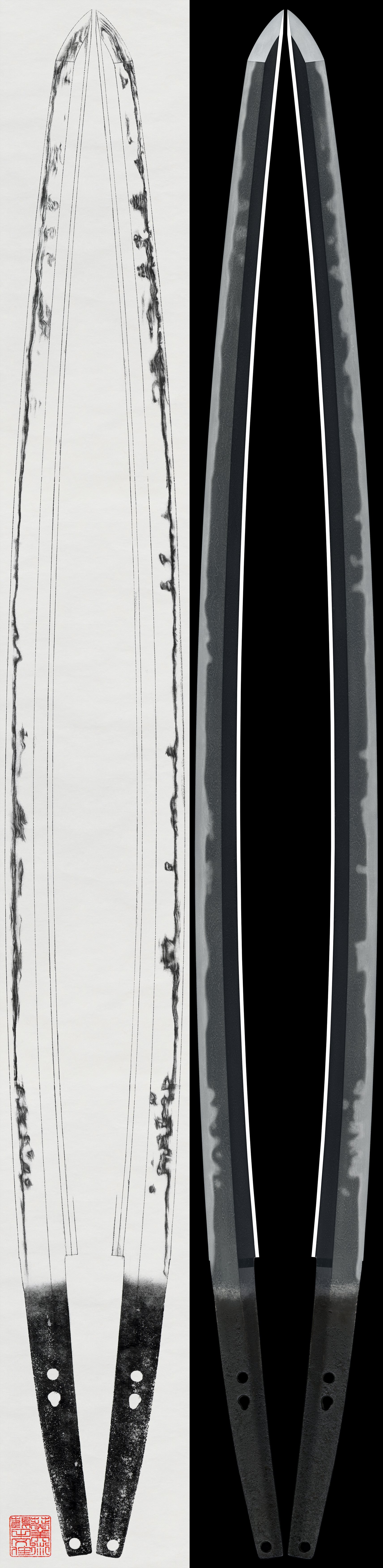
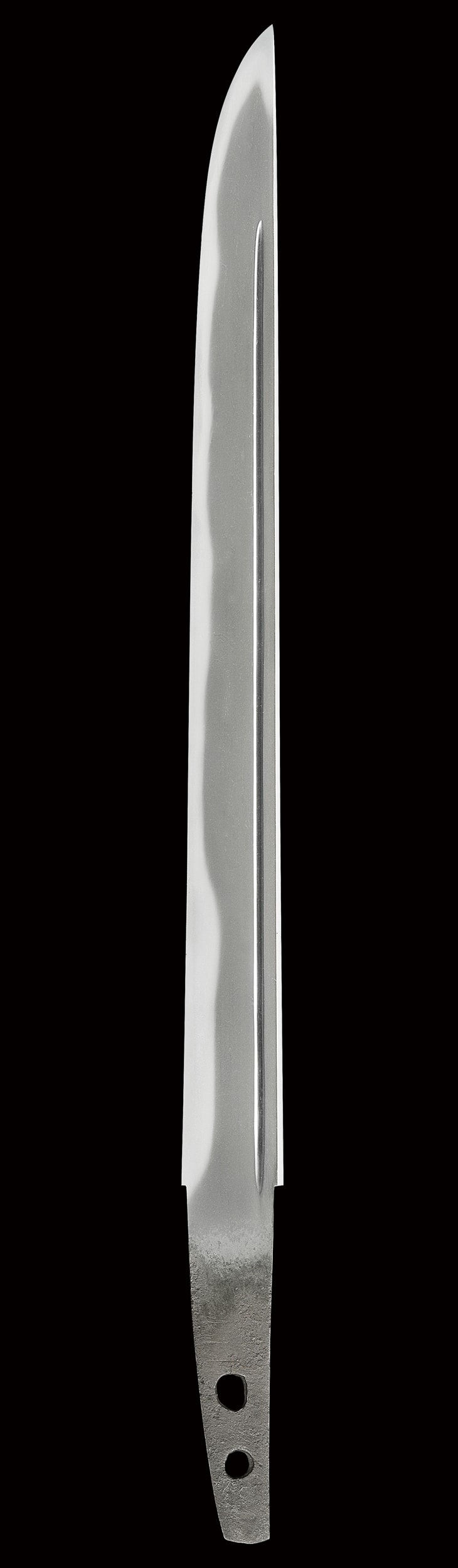
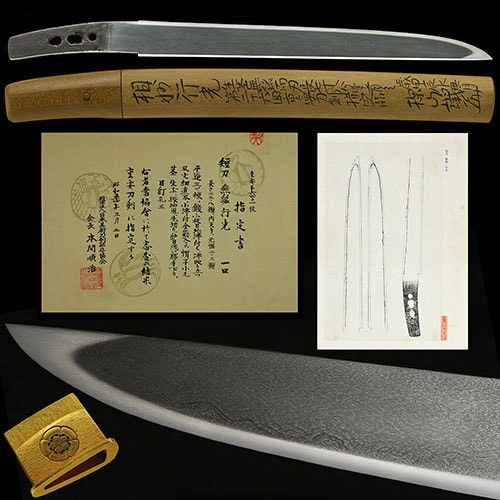
Kanro Toshinaga signed himself Gōshū Kanro Toshinaga of Takagi, and one raised to in 1976 carries that full inscription cut below the peg-hole. He worked at Kanro in Takagi, in Ōmi Province, across the close of the period and into the . From old times he has been transmitted as a man of the line of Takagi Sadamune of the province, and the published sources repeat the tradition while declining to take it at face value. Examining his extant signed work, they conclude that 'rather than regarding him as a pupil, it is more appropriate to view him as a swordsmith of the period'. His signed pieces are few, a handful of with one long-signed example, a dated and the rare , so he is a name known through a thin but unusually consistent body of work.
The hand that body shows is read first in the forging and the point. Over an that flows and takes in masame, with ji-nie gathered thickly and chikei entering, he tempers a shallow notare worked low and quiet rather than in clove-flower clusters. Into the habuchi run hotsure, kuichigai-ba and nijuba, the edge breaking up in nie, with sunagashi and kinsuji drawn through it and yubashiri gathering toward the upper half. The bōshi turns in a small round but breaks into hakikake at the very point. It is this pairing, the masame in the steel and the swept hakikake of the turn-back, that the published sources name as his constant marks, and on which they rest the reading that 'he is regarded as a swordsmith of Yamato-related character'2.
The jigane is the steady thing across his work. Itame mixed at times with mokume and ō-itame, the grain standing a little and flowing, ji-nie thick, chikei frequent, the surface bright and clear where the temper widens. On the wider mumei blades the steel opens into a flowing itame with passages of large grain, and the nioiguchi is described as bright and clear. Over so active a jigane the temper itself stays comparatively restrained, a low notare base into which gunome and a pointed tendency are mixed, the interest carried in the nie working of the edge rather than in height of pattern. One signed tantō, the published commentary notes, shows yubashiri, kuichigai-ba and nijuba in the upper half and a hakikakeboshi that 'clearly demonstrate Toshinaga's distinctive characteristics'3.
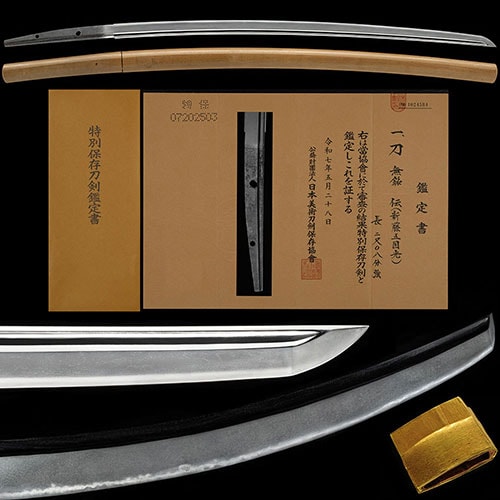
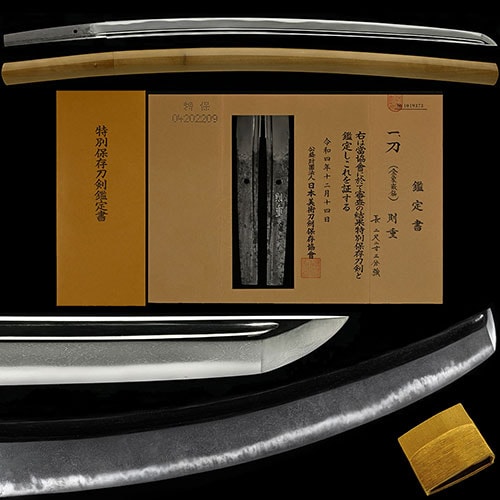
His record divides cleanly in two. The first face is the signed tantō, several of them ubu and so preserving his own work untouched, in katakiriba-zukuri or hira-zukuri with mitsu-mune, on which he occasionally carves bonji with a suken and goma-bashi. Within this group stand his two Important Cultural Properties, a hira-zukuritantō and a double-edged ken dated Enbun five, the year 1360. The second face is the ō-suriage, unsigned katana attributed to him from period and school, wide in body and flowing in the jigane, the same low notare and swept bōshi carried at full length. The published sources accept one such katana with the plain judgment that the traditional attribution can be upheld, while granting on another that no single feature compels the name, so the masame and the hakikake are made to carry the kiwame where personality alone will not.
What sets him apart is exactly what the judges name in him rather than in his neighbours. His is not the clean clove-flower of Bizen but a nie-laden, Yamato-flavoured manner, the flowing masame and the hakikakeboshi marking his steel and his point against the tighter Osafune hand; and the samenie working that ties him to the Sadamune circle of his day keeps him distinct from the plainer provincial smiths around him. The connection to Sadamune is read as one of period and shared taste rather than of master and pupil. One wide Nanbokuchōwakizashi, intensely nie-laden with kinsuji, sunagashi and yubashiri spilling into the ji, the published sources call 'a work truly brimming with martial spirit'4, and an unsigned tantō they receive as 'a fine example that connects closely to the smith's signed works'5.
For the collector he is a rare early name with a small and largely held record. Fujishiro grades him Jō saku. He has no National Treasures; his standing rests instead on two Important Cultural Properties, the hira-zukuritantō and the dated Enbun-five ken, both heritage preserved outside the market, together with a single Tokubetsu Jūyōtantō and six Jūyō blades among tantō, katana and a wakizashi. Of the holders on record one tantō is preserved at the Kōsetsu Museum of Art and another blade at the Tokyo National Museum, and one piece carries Date family provenance, the remaining whereabouts unrecorded. Only the Tokubetsu Jūyō and Jūyō tier could ever change hands, and even those come to light rarely, his extant signed works being, as the published commentary repeats, exceedingly few. A signed Kanro Toshinaga, with its flowing masame and swept hakikake, is an uncommon thing for a private collector to encounter, and a documented one a notable addition.
Kantei
two faces of one Yamato-flavoured Ōmi hand: the rare ubu signed tantō, with its flowing-masame itame, deep-nie notare worked in hotsure, kuichigai-ba and nijuba, and a hakikake boshi, set against the o-suriage mumei katana attributed to him from era and school, the same notare and hakikake carried at full tachi scale
Kanro Toshinaga is an Ōmi-Province smith of the late Kamakura to Nanbokuchō period, signing himself Gōshū Kanro Toshinaga of Takagi, and from old times transmitted as belonging to the line of Takagi Sadamune of the same province. The published sources caution that he is better read as a contemporary of Sadamune than as his pupil, and that his extant signed works are exceedingly rare. His recognized hand is the signed tantō: an itame ground that flows and takes in masame, ji-nie adhering thickly with chikei, over which he tempers a shallow notare worked with hotsure, kuichigai-ba and nijuba, nie thick, sunagashi and kinsuji running through, the boshi turning in a small round but breaking into hakikake at the point. From these tells the sources read him as a swordsmith of Yamato character, the masame in the forging and the hakikakeboshi being the consistent marks. The other face of his record is the o-suriagemumeikatana attributed to him from era and school, wide in body and flowing in the ji, the samenotare and hakikake carried at tachi scale. He holds two Important Cultural Properties, a hira-zukuritantō and a dated Enbun-five ken, alongside a single Tokubetsu Juyo and a small run of Juyo.
Diagnostic discriminators
柾ごころmasame-gokoro2
unique vs mainstream Bizen Osafune ground (no masame)
掃きかけhakikake6
unique vs Bizen ko-maru boshi without hakikake
喰違刃kuichigai-ba2
unique vs a clean Bizen choji habuchi
Observation by phase
The signed tantō (his recognized hand)
His securest record is the signed tantō, several made and surviving ubu, in katakiriba-zukuri or hira-zukuri with mitsu-mune, ordinary in uchizori or slightly elongated. The ground is itame, at times closely packed and mixed with mokume, that flows and takes in masame, with ji-nie thick and chikei entering. Over it he tempers a shallow notare, ko-notare mixed with gunome and a pointed tendency, into which run hotsure along the habuchi, kuichigai-ba and nijuba, the nioiguchi deep with coarse nie, sunagashi and kinsuji vigorous, yubashiri gathering at the upper half. The boshi turns in a small round but breaks into hakikake at the point. At the base of one ubutantō he carves bonji with a suken on the omote and goma-bashi on the ura. The published sources read these tells as Yamato character, the masame in the forging and the hakikakeboshi being the consistent marks, and call his finest signed pieces sound and excellent in ji and ha, valuable material for the study of his oeuvre. His two Important Cultural Properties stand within this signed register, a hira-zukuritantō and a dated Enbun-five (1360) ken.
The o-suriage mumei katana (attributed from era and school)
The other face of his record is the o-suriagemumeikatana attributed to him, the signed tantō supplying the standard against which they are read. These are wide in body over a flowing itame, at times mixed with ō-itame and standing grain, with ji-nie thick and chikei entering. The temper is a shallow notare, in the lower half deepening and mixed with gunome and a pointed tendency, intensely hotsure with uchi-noke, sunagashi and kinsuji frequent, ko-nie well adhered, the nioiguchi bright and clear. The boshi runs into a small round with hakikake, on one piece pointed. The grooves run from bō-hi to a naginata-hi-like variant and futasuji-hi. The published sources affirm these from era and school as the work of Toshinaga, finding features in ji and ha that can be accepted as consistent with him, while granting on one mumeikatana that there is no decisive proof the maker must be Toshinaga, so the attribution rests on era and the Yamato-flavoured manner rather than on a single personal tell.
The published sources record that Toshinaga has from old times been transmitted as a disciple of Takagi Sadamune, but caution that, judging from his extant signed tachi and tantō, this is difficult to credit, and that he is better regarded as a swordsmith of the same period as Sadamune.1
On the o-suriage mumei katana the published sources affirm the work from era and school, finding features in ji and ha consistent with Toshinaga, while granting that there is no decisive proof the maker must be him and the attribution can nonetheless be accepted.2
Historical importance
Where Toshinaga stands among comparable artisans: across all of nihontō, and within tradition, era, and period. The tiers (Foremost · Leading · Major · Notable) weigh official designations from the NBTHK and Japan's Agency for Cultural Affairs, together with historical honors of lasting repute such as the Sansaku and Meibutsu-chō.
随一
Foremost
屈指
Leading
有数
Major
All nihontōSōshūKotōNanbokuchō
著名
Notable
Select a lens to see how it's measured.
Designations
Kokuhō—
Jūyō Bunkazai2
Jūyō Bijutsuhin—
Gyobutsu—
Tokubetsu Jūyō1
Jūyō Tōken6
Elite Standing
0.14 across 9 designated works
Top 14% among smiths
Provenance
1 documented provenance across certified works by Toshinaga
Imperial—
Shogunal—
▸Premier Daimyō1
Major Daimyō—
Other Daimyō—
Zaibatsu—
Institutions—
Named Collectors—
Provenance Standing
1 works held in elite collections across 1 documented provenances