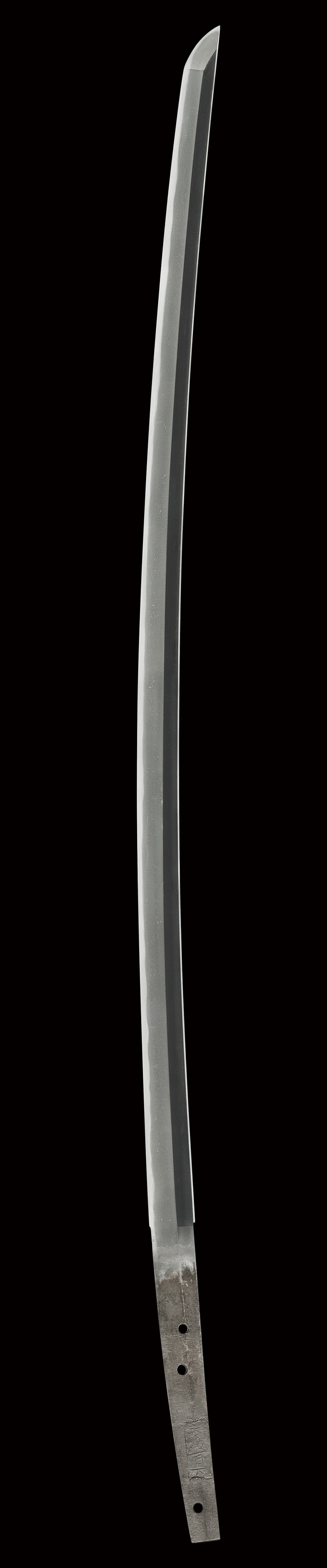
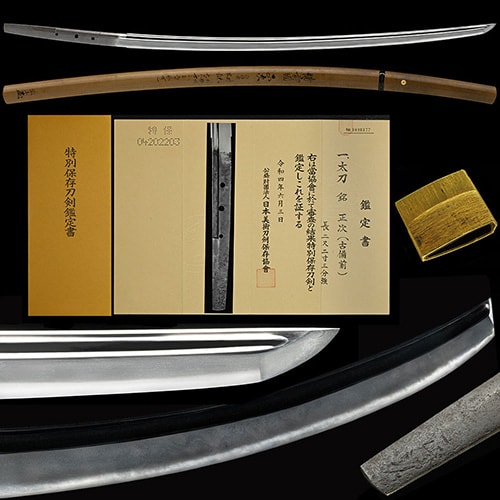
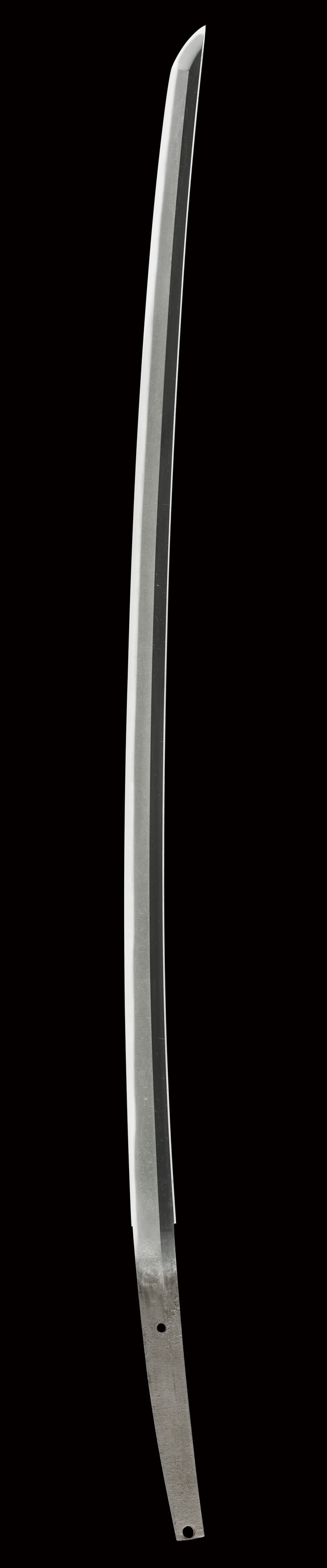
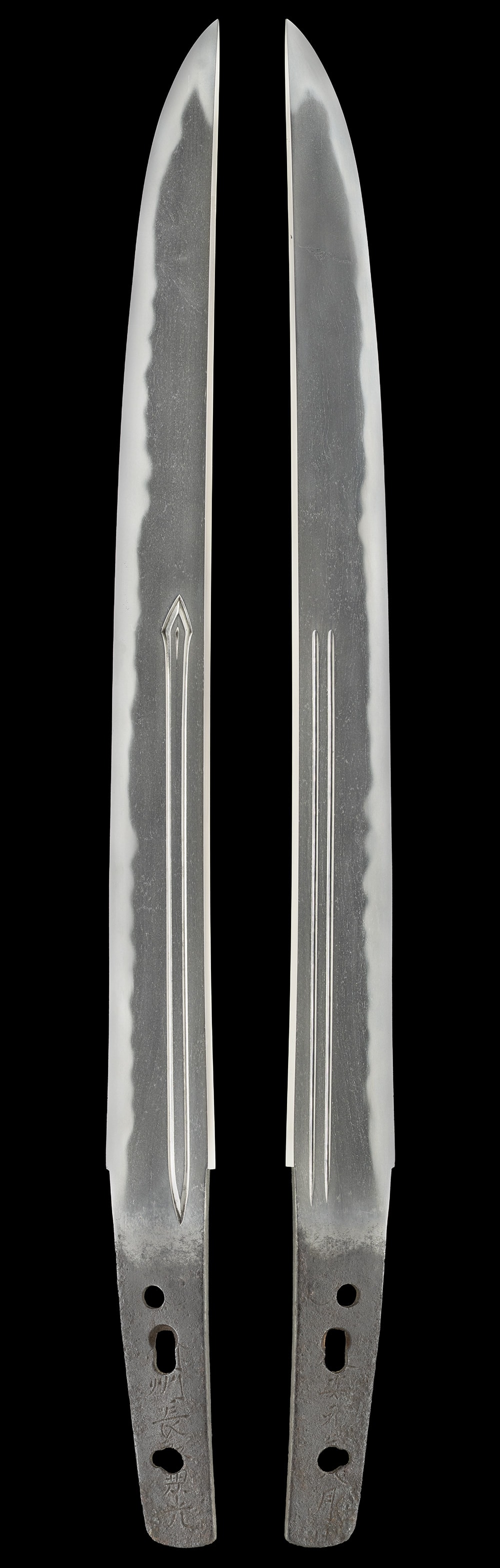
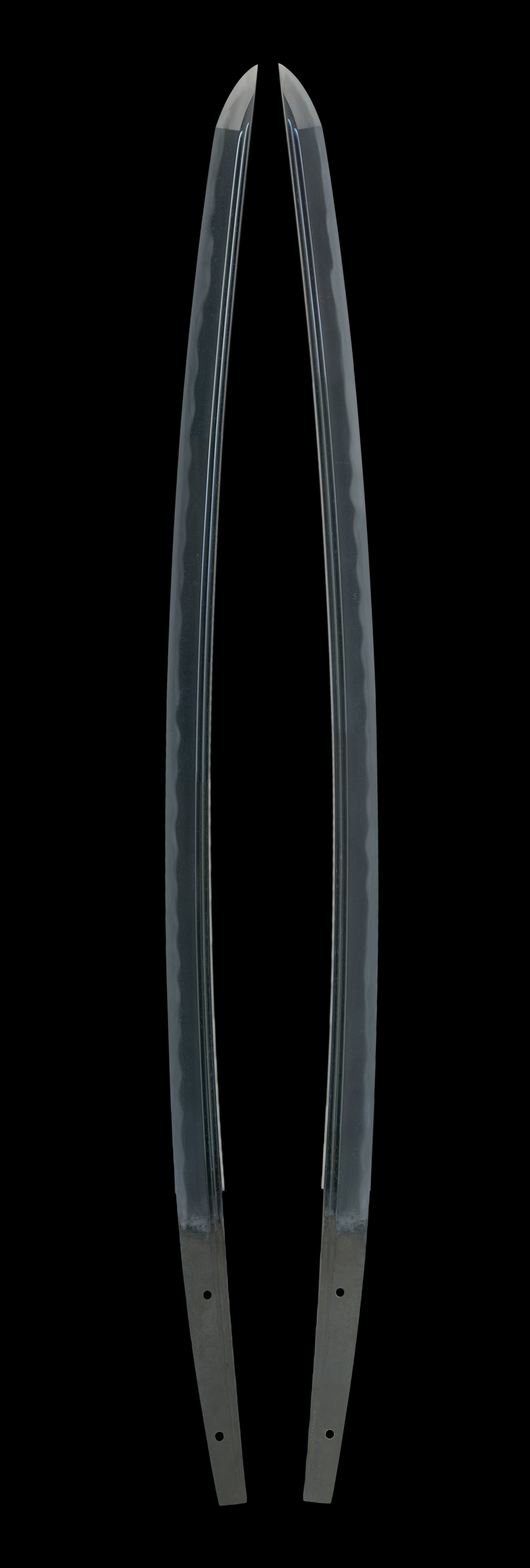
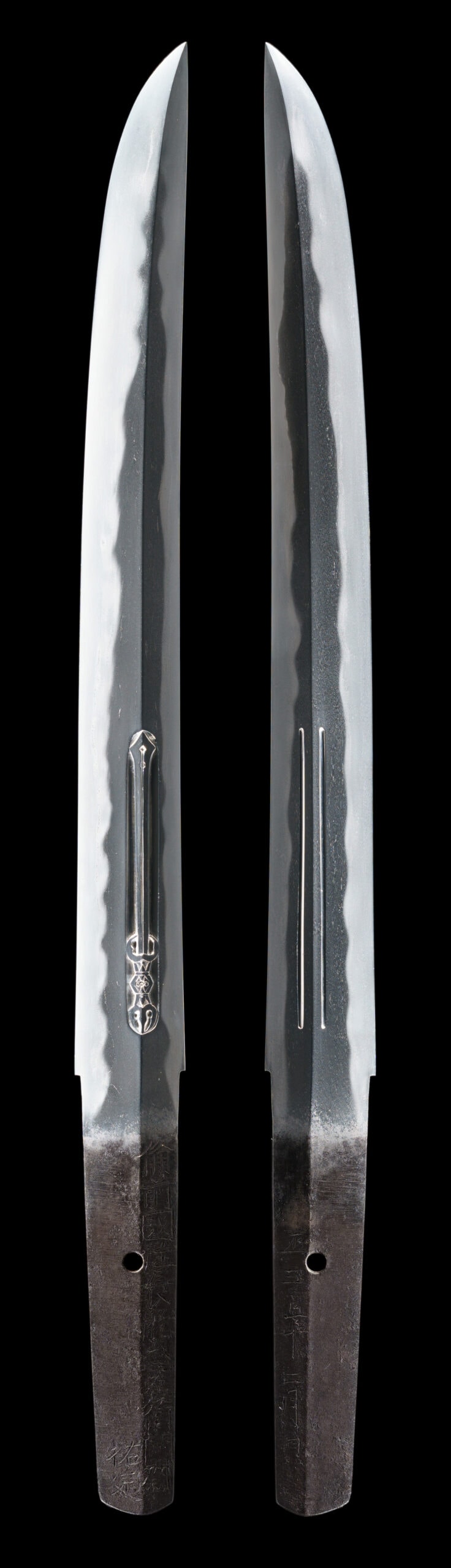
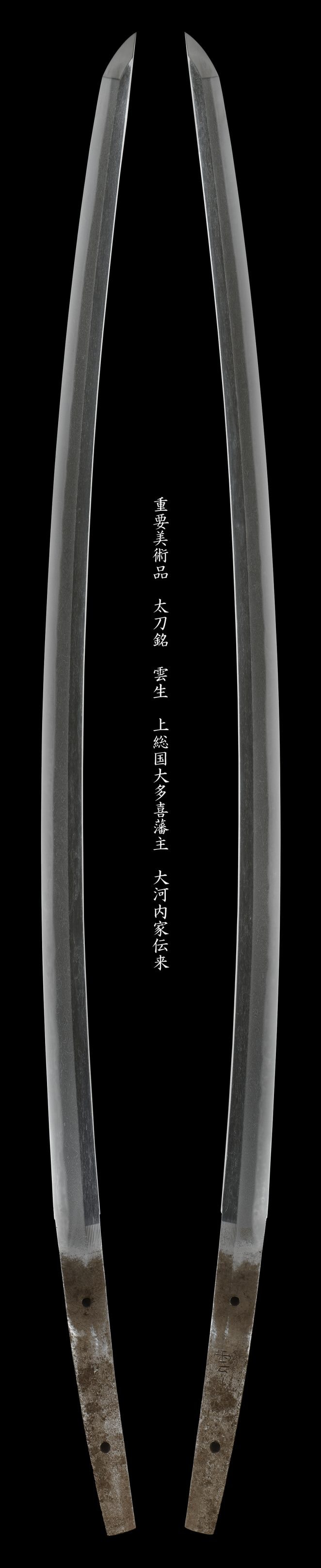
Sukekane is a swordsmith of the late to early period, his name one of the school's enduring puzzles. Two Jūyō-Bijutsuhin designated in 1935, one signed in six characters " no Sukekane " and held by the Matsudaira house, the other a small-signature blade from the Sakai house, fix him in the historical record; the published sources note that the name Sukekane is found among both the group and the Fukuoka line, and that there were likely three or four smiths who shared it. The man profiled here is the one, the archaic hand. The published commentary draws the distinction plainly: of the two Sukekane, "the former is an archaic, classical small- of -based workmanship, whereas the latter forges flamboyant chōji-based in which a sense of technical artifice is felt". His is the quiet side of the divide.
His characteristic temper is a -toned small midare. Over it run ko-chōji, ko-gunome and ko-notare, with ashi and yō entering well, the work nie-based, with sunagashi and fine kinsuji coursing through and, on a recurring group, nijūba and even sanjūba running intermittently along the upper edge. This is not the regular clove-flower of the Ichimonji smiths but the calm, antique line the published sources call the manner of old Bizen, where "flamboyant midare is uncommon"2 and "a suguha-toned base with shallow notare predominates"3. The bōshi answers the edge below it, running straight to a ko-maru or finishing in a yakizume-like sweep with hakikake, sometimes with yubashiri drifting at the turn.
The jigane is the constant. He forges a well-packed itame mixed with mokume, the grain standing a little, with ji-nie and chikei entering frequently, and a clear midare-utsuri rising in the ji. On the finest of them the reflection thickens into the patchy jifu-utsuri of old Bizen steel. Over that jigane the nioiguchi is bright and clear, and the ha carries thick ko-nie. The published sources prize exactly this antique flavor, calling one Tokubetsu-Jūyōtachi a work of "old-scented workmanship characteristic of Ko-Bizen"4, the ji and ha carrying a savory depth of taste.
Within his own record the work divides into two registers of one hand. The typical Sukekane is a slender tachi, ubu where it survives so or shortened yet keeping a high koshizori with funbari, the point a compact ko-kissaki, the temper a calm suguha-toned ko-midare. On his outstanding signed tachi the line opens out: a broad suguha into which chōji, gunome and angular elements are set, flowering into a brilliant midare that the judges single out, one such piece called "a particularly outstanding achievement" that strikingly manifests the features of Ko-Bizen. The signature is its own scholarly question. The published commentary records small, intermediate and large hands, and notes that while the convention treats small signatures as Ko-Bizen and large ones as Ichimonji, some Ichimonji works carry small signatures too, so that "a distinction based on the signature alone is not necessarily easy"5.
What sets the Ko-Bizen Sukekane apart from his Ichimonji namesake is exactly this nie-based restraint. His bright midare-utsuri, his suguha-toned small midare with its nijūba and deep nie, and the archaic, slightly drooping tachi shape with its ko-kissaki are read as Ko-Bizen, while the flamboyant chōji and the air of technical display belong to the other hand. On the ō-suriagemumeikatana and wakizashi attributed to him, the published sources affirm the appraisal from the period and the Ko-Bizen workmanship rather than from any single personal tell, accepting the traditional attribution where the jigane and hamon are markedly archaic in tone. His blades stand at the root of the Bizen line, before the school's great flowering at Fukuoka.
For the collector he is a rare early name. Fujishiro grades him Jō-jō saku, and the Tōkō Taikan values his work near the top of its scale. He has no National Treasure of his own Ko-Bizen hand; his record runs instead through the Important Cultural Property rank and the prewar Jūyō-Bijutsuhin, with two blades in the Tokubetsu-Jūyō and twenty-two in the Jūyō. Because his extant works are so few, the published sources call his best signed tachi documentary material of very high value for understanding him at all. His blades carry distinguished provenance, transmitted in the domain era through the Satake house of Akita, the Tokugawa and Matsudaira families, the Sakai house of Tadakatsu, the Ikeda of Inshū, and bearing in one case the gold-inlaid ownership name of Takeda Genshinren. Most are long held, not traded; only the Jūyō and Tokubetsu-Jūyō tier ever moves, and even then a signed Ko-Bizen Sukekane comes to light only seldom. A privately held example, of recorded whereabouts, is a notable thing for a collector to encounter, a document of how Bizen began.
Kantei
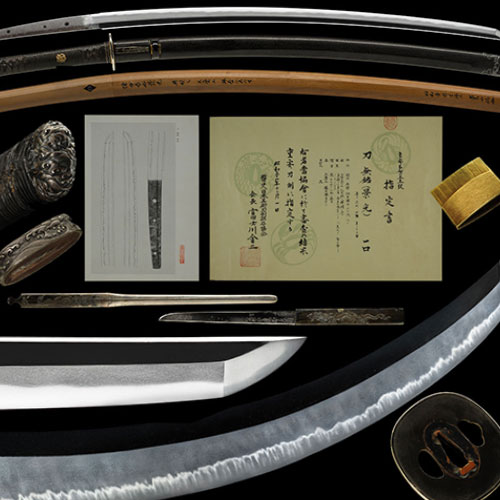
two registers of one Ko-Bizen Sukekane hand: the typical archaic, nie-based suguha-toned ko-midare over a well-packed itame and bright midare-utsuri, beside the broader suguha with choji and gunome of his finest signed tachi; the signature variation that divides Ko-Bizen from Ichimonji Sukekane is the school's central kantei problem
Sukekane is a Ko-Bizen smith of the late Heian to early Kamakura period whose name is one of the school's enduring kantei problems: the Meikan records Sukekane under both Ko-Bizen and Fukuoka Ichimonji, the published sources hold that several smiths likely shared the name, and the conventional small-mei equals Ko-Bizen versus large-mei equals Ichimonji division does not hold without scrutiny, since even an Ichimonji Sukekane can carry a small signature. His Ko-Bizen hand is the archaic, classical one. Over a well-packed itame mixed with mokume, with ji-nie, frequent chikei and a clear midare-utsuri, he tempers a suguha-toned ko-midare into which he sets ko-choji, ko-gunome and ko-notare, ashi and yo entering well, the work nie-based with sunagashi and kinsuji and a tendency to nijuba, the boshi running straight to a ko-maru or finishing in a yakizume-like sweep. The published sources call this the calm, nie-based small-midare of old Bizen, set against the flamboyant choji of the Ichimonji line. His finest signed tachi widen into a broad suguha with choji and gunome that the judges single out as an outstanding achievement, while his o-suriagemumei blades are attributed to him from era and Ko-Bizen workmanship.
Diagnostic discriminators
直刃調suguha-cho5
unique vs Fukuoka Ichimonji line (flamboyant choji)
乱れ映りmidare-utsuri4
二重刃nijuba3
unique vs his plainer ko-midare blades (no nijuba)
Observation by phase
The archaic suguha-toned ko-midare (his typical Ko-Bizen hand)
His representative work is the slender tachi, ubu where it survives so or shortened yet keeping a high koshizori with funbari, the point a compact ko-kissaki. Over an itame mixed with mokume, somewhat standing in the grain, with ji-nie, chikei entering and a clear midare-utsuri, he tempers a suguha-toned small midare. Into it run ko-choji, ko-gunome and ko-notare, ashi and yo well in, the nioi deep and ko-nie thickly adhering, with sunagashi and kinsuji and, in the upper half, a tendency to nijuba and even sanjuba. The boshi runs straight, turning back in a ko-maru or finishing yakizume-like with hakikake. The published sources call the Ko-Bizen Sukekane a nie-based, archaic and classical small midare, set apart from the flamboyant choji of the Ichimonji line. On a few blades the work shows yubashiri and an urumi, moist tendency in the nioiguchi, the antique flavor the judges prize.
The broad suguha with choji and gunome (his outstanding signed tachi)
On his finest signed tachi the temper opens out: a wide suguha-toned base into which choji, gunome and angular elements are set, flowering into a flamboyant midare, ashi and yo well in, thick ko-nie adhering, fine kinsuji and sunagashi, the nioiguchi bright and clear. Over a well-packed itame the midare-utsuri stands out distinctly and, on one of them, the patchy jifu-utsuri of old Bizen. The published sources call these works that strikingly manifest the characteristic features of Ko-Bizen and, beyond that, an especially distinguished achievement. This is the sameKo-Bizen hand as his quiet small midare, widened and brought to the showier edge of the school, never the regular clove-flower of the Ichimonji line but a Ko-Bizen reading of it.
Jigane 地鉄
乱れ映りmidare-utsuri1地斑映りjifu-utsuri1
Hamon 刃文
広直刃hiro-suguha2華やかhanayaka2小丁子ko-choji2金筋kinsuji1
Bōshi 帽子
掃きかけhakikake1
Scholarship
The published sources record that the Sukekane name appears in the Meikan under both Ko-Bizen and Fukuoka Ichimonji, that several smiths, likely three or four, shared it, and that the signature comes in small, intermediate and large hands. The conventional division of small-mei as Ko-Bizen and large-mei as Ichimonji is not reliable, since some Ichimonji works carry small signatures, so distinguishing the two on signature alone is not easy.3
On the broad signed tachi the published sources note that, although the archaic flavor predominates, conspicuous ko-choji midare appears in places, leading them to date such a piece to the early Kamakura; on the o-suriage mumei blades the attribution rests on Ko-Bizen workmanship and the period, not on a feature that must be Sukekane.2
Historical importance
Where Sukekane stands among comparable artisans: across all of nihontō, and within tradition, era, and period. The tiers (Foremost · Leading · Major · Notable) weigh official designations from the NBTHK and Japan's Agency for Cultural Affairs, together with historical honors of lasting repute such as the Sansaku and Meibutsu-chō.
随一
Foremost
屈指
Leading
All nihontō
有数
Major
BizenKotōEarly Kamakura
著名
Notable
Select a lens to see how it's measured.
Designations
Kokuhō1
Jūyō Bunkazai1
Jūyō Bijutsuhin2
Gyobutsu—
Tokubetsu Jūyō2
Jūyō Tōken22
Elite Standing
0.32 across 28 designated works
Top 8% among smiths
Provenance
6 documented provenances across certified works by Sukekane
Imperial—
▸Shogunal1
Premier Daimyō—
▸Major Daimyō2
▸Other Daimyō3
Zaibatsu—
Institutions—
Named Collectors—
Provenance Standing
3 works held in elite collections across 6 documented provenances