NihontoWatch MonNihontoWatchBETA
MarketEncyclopedia
NihontoWatch Mon

NihontoWatchBETA

Market
Encyclopedia
Overview·Kantei·Designations·Blade Forms·Signatures·Lineage·School
OverviewKanteiDesignationsBlade FormsSignaturesLineageSchool
  1. Schools
  2. Muramasa
  3. Muramasa

Muramasa

村正

Jūyō
Vol. 5, No. 22 · Katana

Muramasa

村正

41 ranked works

ProvinceIseEraTaiei (1521–1528)PeriodMuromachiSchoolMuramasaTraditionSoshu-denGeneration2ndTeacherMuramasaFujishiroJo-jo sakuToko Taikan700(top 17%)TypeSwordsmithCodeMUR5
41Jūyō Tōken

Overview

The oldest extant dated work of the name is of Bunki 1 (1501), signed Uemon-no-jo Muramasa (右衛門尉村正); from that anchor the published sources set the scheme of the name. Muramasa, the writes, was the representative swordsmith of Province in the late period, resident at Kuwana, and the accepted reading recurs across the designation records: "the common view takes Bunki as the first generation, Tenbun as the second and Tensho as the third, and among them the one held to be the second is the most skilled, his works survive in the greatest number, and his signature characters are moreover fluent and skillful" (最も技術が優れ). Treated here is that second master, the Tenbun-era Muramasa, forty-one designated works on record; of one the judges write that "the Muramasa most widely known to the world as the finest of the line is this second generation" (最も上手で世に知られている村正はこれである). The old tale that he studied under Masamune the sources reject as an unfounded tradition (不当); one text adds that no firm division of the generations is settled, and the older commentary counts Eisho together with Tenbun in the second master's span.

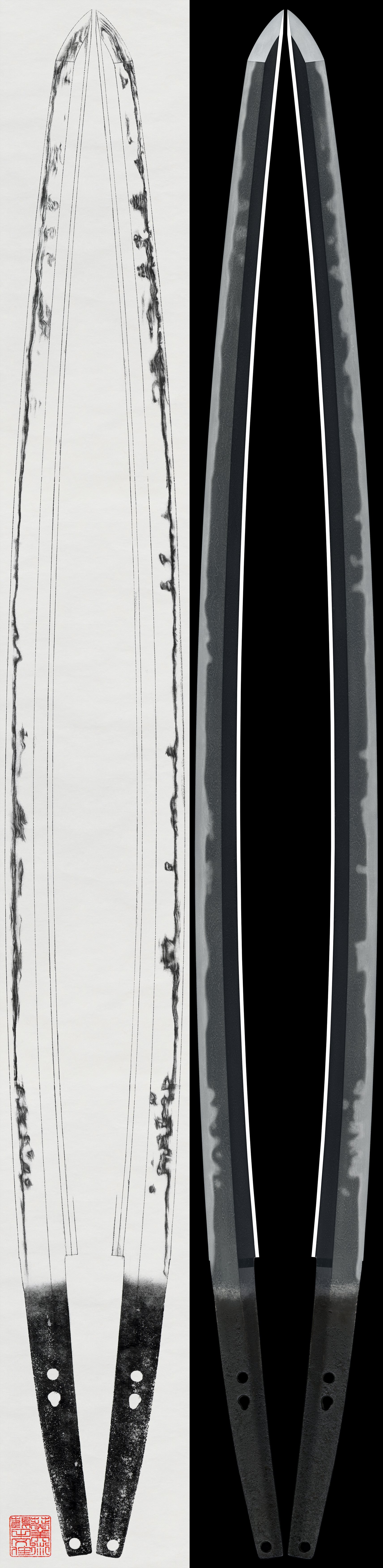
First among his marks the sources place the matched temper. "The point at which the of the and the align conspicuously is the characteristic of Muramasa" (表裏の刃文が目立って揃うところが村正の特色であり), one note states, "and the box-shaped , and the point that the valleys of the come close to the cutting edge, are likewise things to see in this smith" (箱がかった刃文や、乱れの谷が刃先に近くなる点も同工の見どころである). His standard is a of and mixed with box-shaped elements, compound () , pointed and figures; the heads of the split, and the valleys press down toward the edge. The tightens, the patchy, in mura, at times with a subdued cast; runs frequently. The is or with , often swept with and pointed in feeling, the return deep.

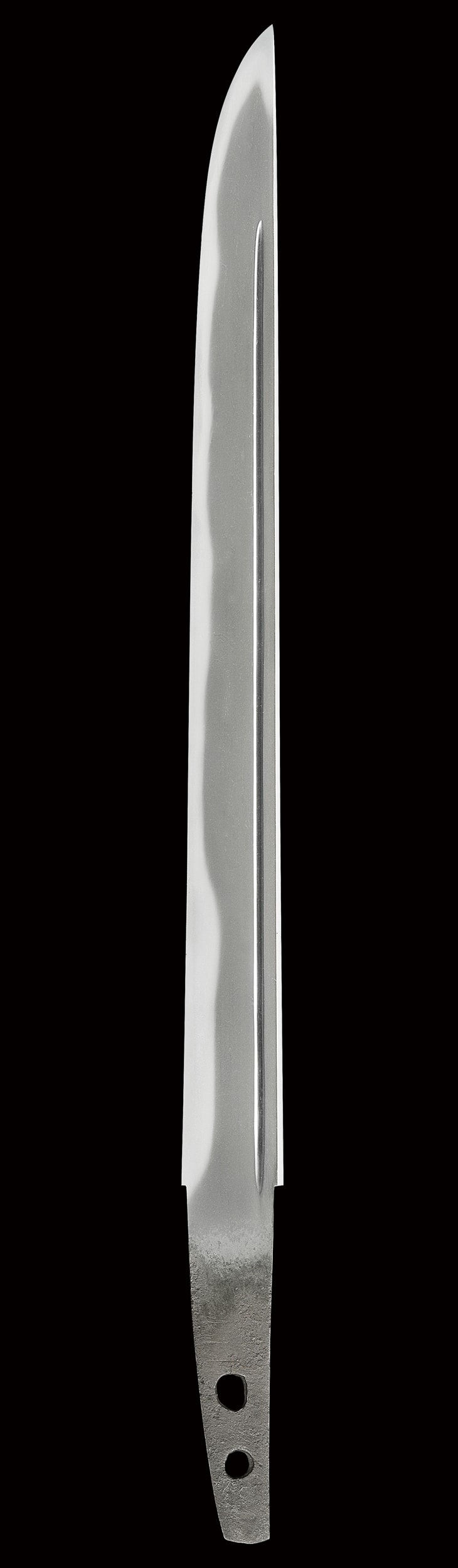
The forms that carry it are above all the and with , wide in and extended in length, the shallow; a smaller compact group has uchi-zori, and his are short, strongly -zori . The is mixed with flowing and -inclined grain, standing somewhat, with , and often shows the whitish cast the descriptions repeatedly note, at times a faint . Beneath it sits the : , narrowing through its lower half into the fish-belly form the texts call , which "becomes especially pronounced from the second generation" (たなご腹も二代から殊に著しくなる), and bearing the large two-character cut with a thick chisel (太鏨), whose fluent, forceful strokes are themselves a mark of the second master; rare pieces carry the long signature Seishu Kuwana ju Muramasa (勢州桑名住村正作). Forty of the forty-one designated works are signed. The single blade is the styled Ageha (揚羽), read as a signature rubbed away long ago, with a tradition that it came to Kotoku as his sashiryo; one keeps its faint two characters as a soko-mei, the gold inlay a title inscription of Okubo Tadahiro, not an attribution; and one bears a later-added gold reading Mukoku (夢告).

Beside this flamboyant rule the corpus records a quiet register, in medium or narrow , of which the judges write that "this is the kind that aimed at works of the school and the like, and it succeeds; now and then this occurs in his work" (来派の作などをねらったもので成功しており、間々同作にはこれがある); on it appears as large and box-shaped figures at the base under a -toned upper half, the two deliberately differing. A smaller register leans toward , and temper along the back thickening until the blade reads as in manner, called rare in his work by one text, a manner seen from time to time by another. There is also a corpus of spears, su-, omi-no- and the rare katakama-jumonji form, seven of the forty-one; the sources conclude that "he excelled also in the making of spears" (槍の製作にも長じていた); of one large-bodied example they write that it "should assuredly be called a celebrated spear" (蓋し名槍と称すべきである). A made jointly with Toshitsugu and Toshihiro also survives, Toshitsugu held an Odawara smith of about Kyoroku, prized by the judges for its documentary value.

The record is unusually explicit about the company in which he is judged. "At first sight it can be confused with works of the Kanesada sort" (一見すると末関の兼定等に紛れる), the notes say, elsewhere naming Kaneshiba; they find a likeness to the Shimada smiths, and of Heianjo Nagayoshi in Kyoto the judgment sharpens to "extremely close" (平安城長吉と酷似する), some relationship between the two being presumed. What parts him from all of these, in the judges' own listing, is the matched and , the box-shaped figures, the valleys pressing to the edge, the tight with its patchy , and the under the thick-chisel . Within the school, Masashige and Masazane work in the manner, and the decides once more: the is cut angular on Muramasa where Masashige rounds it with full flesh. remains an occasional flourish over the one matched , never the rule of his work.

Muramasa is rated Jo-jo in Fujishiro's grading; the second generation's designated record is forty-one works, all ; the register holds no National Treasures and no Important Cultural Properties, so nothing of his is permanently sealed away. History thinned the signatures on its own. From the period onward, the sources record, "legends circulated that the blades brought calamity upon the Tokugawa house, or that they would curse their owners, and for this reason many were rendered unsigned" (徳川家に祟るとか、持主に祟るなど云う伝説があって、その為に無銘となったものが多い), so that signed in particular are comparatively rare today. On the fate of the name the texts divide, some stating that after Tensho "the name lapsed, having met, it may be, the disfavor of the Tokugawa shogunal house" (徳川将軍家の忌避にふれてか名跡が絶えている), others that "the signature continued in succession into the era" (同銘が相継ぎ新刀に及んでいる). No museum or shrine holding is recorded against his blades and no roll attaches to them; on the record they have moved among private hands. A second-generation Muramasa, and signed with the thick-chisel two characters over the , comes to market only rarely, and the legend that effaced so many signatures has only added to the call for those that remain.

Kantei

one perfected manner: the mirror-image hako-gunome midare on hira-zukuri tanto and sunnobi ko-wakizashi; beside it a quiet Rai-style suguha variant, an occasional hitatsura-leaning register, and a substantial yari corpus

Muramasa the second, the Tenmon-era master of Kuwana in , is the strongest hand of the Sengo line: the published commentary calls the second generation the most skilled of the name, the most numerous in surviving work, and the most fluent of signature. His standard work is the and : an with flowing grain that stands somewhat and often whitens, a of and with box-shaped elements whose valleys drop close to the cutting edge, the and cut to one matching pattern, the tight with patchy mura-, and beneath it the pinched under a thick-chisel two-character .

Diagnostic discriminators

unique vs the profiled Sue-Soshu masters Hiromitsu and Akihiro

box-shaped midare elements, often as a hako-gakatta notare or a boxed gunome valley; with the matched hamon it parts him from the Sue-Seki smiths he can otherwise pass for

12% of his works

10% of his works

Observation by phase

The mirror-image midare (the standard manner)

hira-zukuri tanto and sunnobi ko-wakizashi, mitsu-mune, wide and shallow in sori (25 of 41 texts)

, , wide in and often with shallow -zori, the classic late- stance; a smaller group is compact and uchi-zori. The mixes flowing grain and , stands somewhat, carries and often whitens. The temper is and with box-shaped elements, compound , pointed teeth and peaked forms, the valleys of the dropping close to the cutting edge; and match to one pattern, the tightens, and the sit patchy, in mura. The runs or to , swept, often pointed, the return deep.

Sugata 姿
Jigane 地鉄
Hamon 刃文
Bōshi 帽子
The yari corpus (a parallel specialty)— su-yari, omi-no-yari and the rare katakama-jumonji yari (7 of 41 texts); the published sources say he excelled in the making of spears
The thick-chisel two-character mei (the standard register)— an ubu, tanago-bara nakago bearing the thick-chisel two-character mei Muramasa (37 of 41 texts); the fluent, skilled strokes are themselves a mark of the second generation, and the occasional long mei reads Seishu Kuwana ju Muramasa saku

The quiet suguha variant (the Rai copy)

tanto in chu- or hoso-suguha and katana finishing suguha-cho in the upper half (5 of 41 texts)

Beside the flamboyant standard stands a quiet register: a medium or narrow , small in and bright, which the judges call a changed manner; of one they write that it aims at the school and succeeds, a thing seen now and then in his work. On the quiet hand appears as an upper half in over a or base, the lower and upper temper deliberately differing.

Hamon 刃文

The hitatsura-leaning works

tanto and katana in which tobiyaki and heavy mune temper build to hitatsura-fu (4 of 41 texts)

and temper along the thicken in part of the corpus until the blade reads as -; the judges' own wording wavers, one text calling rare in his work, another a manner seen from time to time. Where the Sue- masters Hiromitsu and Akihiro fly as the banner manner, with Muramasa it remains an occasional flourish over the mirror-aligned .

Hamon 刃文
Scholarship

The accepted scheme reads Bunki as the first generation, Tenmon the second, Tensho the third; the oldest extant date of the school is Bunki 1, and one text adds that a firm division of the generations is not settled.

The older commentary counts Eisho with Tenmon in the second generation's span; the placing of Eisho between the first and second masters remains contested in the literature.

Signed survivors are comparatively rare: the Edo legend that Muramasa brought a curse upon the Tokugawa led to signatures being ground away, and many blades passed down mumei for that reason.

Whether the name survived the proscription divides the texts: some state the line died out, others that the same name continued in succession into the Shinto era.

Designations

Kokuhō—
Jūyō Bunkazai—
Jūyō Bijutsuhin—
Gyobutsu—
Tokubetsu Jūyō—
Jūyō Tōken41

Elite Standing

0.16 across 41 designated works

Top 13% among smiths

Blade Forms

Distribution across 41 ranked works

Signatures

Signature types across 41 ranked works

Currently Available

Lineage

TeacherMuramasa
Muramasa
Students (5)
  1. 1.Muramasa村正1 for sale41designated
  2. 2.Muramasa村正1designated
  3. 3.Muramasa村正
  4. 4.Toshimasa俊正
  5. 5.Muramasa村正

Muramasa School

Other artisans of the Muramasa school

  1. 1.Muramasa村正17designated
  2. 2.Masashige正重12designated
  3. 3.Masazane正眞1 for sale4designated
  4. 4.Muramasa村正1designated