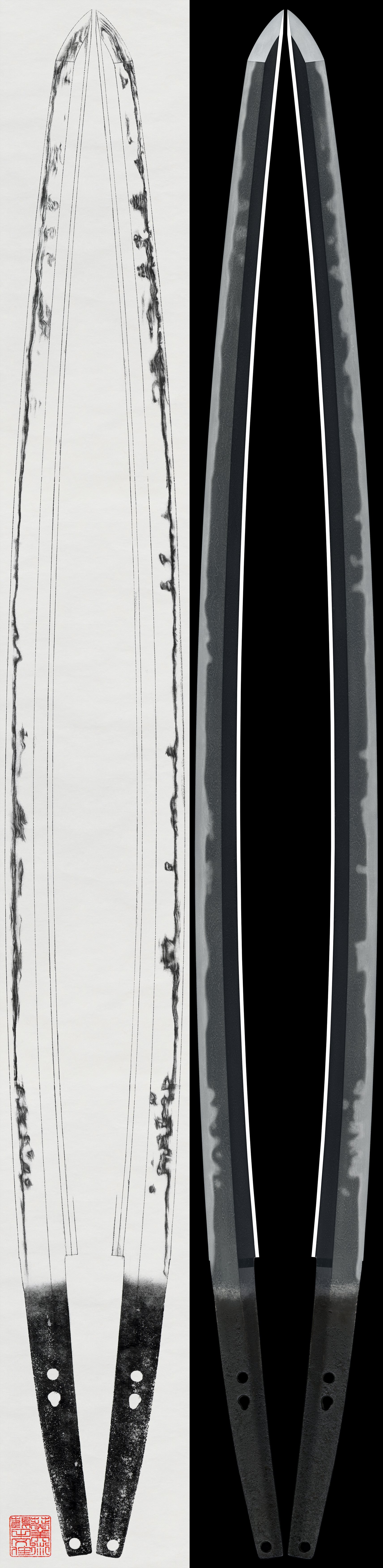
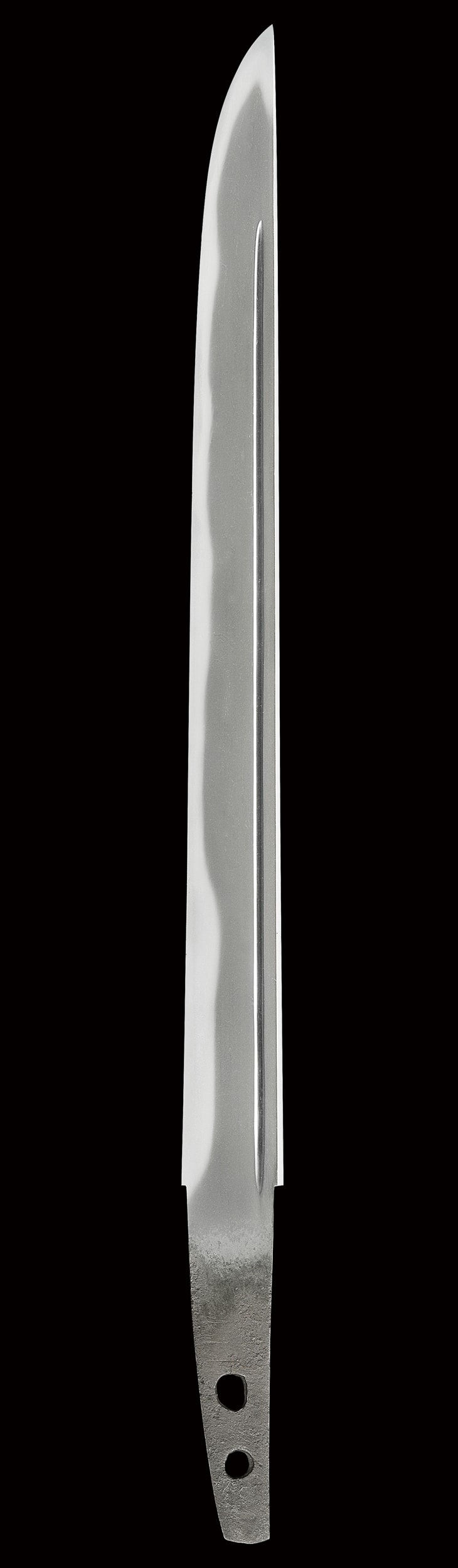
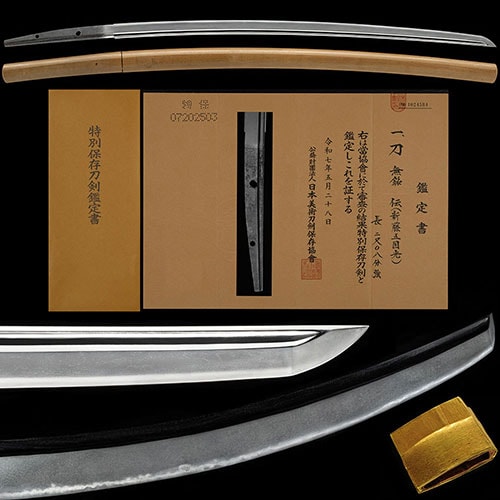
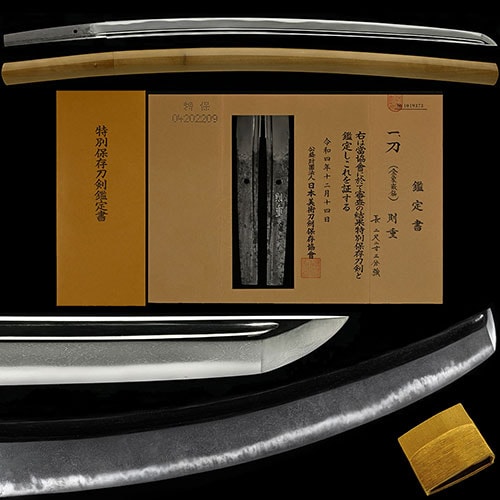
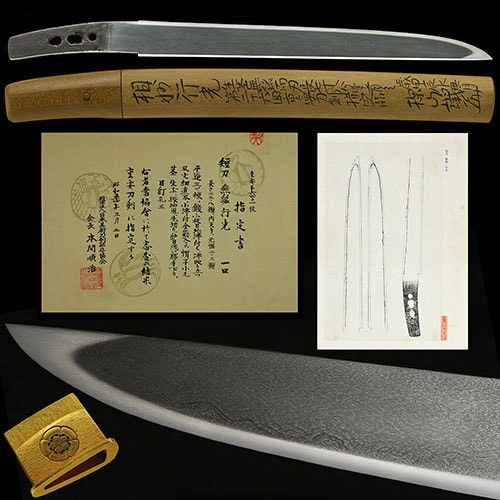
Muramasa was a swordsmith who resided at Kuwana in Ise Province, representative of that province in the late Muromachi period. Among extant works, the earliest dated example bears the year Bunki 1 (1501), regarded as the first generation; works dated to the Eishō and Tenbun eras are attributed to the second generation, and those of the Tenshō era to the third. Of these, the second generation is consistently identified in NBTHK assessments as "the most skillful among the successive generations," with the greatest number of surviving works and the highest proportion of fine pieces. The popular tradition linking Muramasa to Masamune as a pupil is, as the setsumei plainly state, "an unfounded tradition." Certain stylistic affinities with Heianjō Nagayoshi and Izumi no Kami Kanesada suggest some form of relationship, though its precise nature remains unclear. The lineage is said to have died out after the Tenshō generation, "perhaps because the name became an object of avoidance by the Tokugawa shogunal house."
The defining hallmark of Muramasa's workmanship is the conspicuous correspondence of the hamon on both omote and ura -- a matching temper that the NBTHK regards as the principal diagnostic feature. The tempering is characteristically "box-like" (hako-gakari), with the valleys of the midare pressing close to the cutting edge and a nioiguchi that tends toward a tightly drawn appearance (shimarigokoro). Within this framework, the range of expression is remarkably broad: the standard mode is gunome-midare mixed with notare, incorporating compound (fukushiki) gunome, togariba, and hakoba-like elements, all in ko-nie-deki with sunagashi running through the temper. Yet examples in hitatsura-like manner -- with tobiyaki, muneyaki, and vigorous hakikake -- are "not infrequently seen," and one piece even "aims at the manner of the Rai school and does so successfully." The jigane is typically itame-hada tending toward nagare with ji-nie and a somewhat whitish (shirake-gokoro) cast, though the finest works achieve a dense ko-itame with notably clear steel. Spears are also "accomplished and not especially few in number," with one monumental ōmi-yari of exceptional size praised as having been "forged so adroitly, without conspicuous coarse irregularity" that it would likely be "the outstanding example among works of this type."
Across more than fifty years of Juyo deliberations, the evaluative language returns to the same constellation of virtues: both ji and ha are kenzen -- sound and well-preserved -- and the finest examples are those in which the ji and ha are "notably clear" (saeru), the nioiguchi is "bright," and the workmanship is "excellent." The second generation in particular is praised for producing "a greater number of pieces of superior workmanship" than the first, and individual blades are singled out as being "especially superior" even within that elevated standard. The breadth of Muramasa's working range, from severe suguha to flamboyant hitatsura, combined with the unerring bilateral symmetry of the temper and the consistently tight nioiguchi, secures his position as the preeminent smith of Ise Province and among the most distinctive voices of the late Muromachi period.