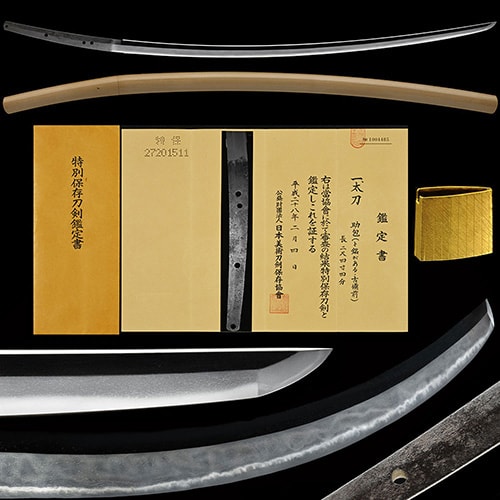
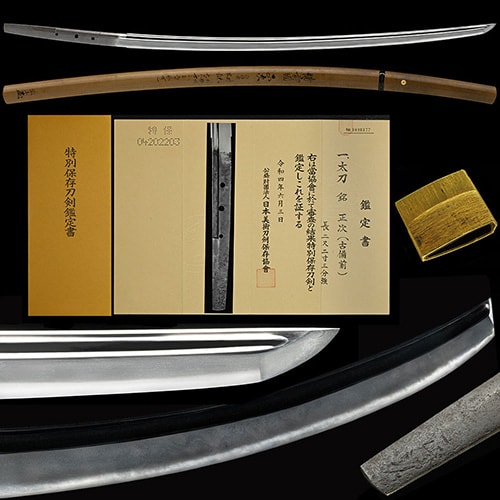
Tomomura (友村) was a swordsmith of the tradition, active in the early period. Sword reference works place his working period around the Kenryaku era (1211–1213). Extant signed works are exceedingly rare; the most celebrated is a designated as a Jūyō Bijutsuhin (Important Art Object) held by Yusuhara Hachimangū Shrine in Ōita Prefecture. Beyond this, only a small number of signed examples survive, lending each authenticated work considerable documentary significance for the study of the school.
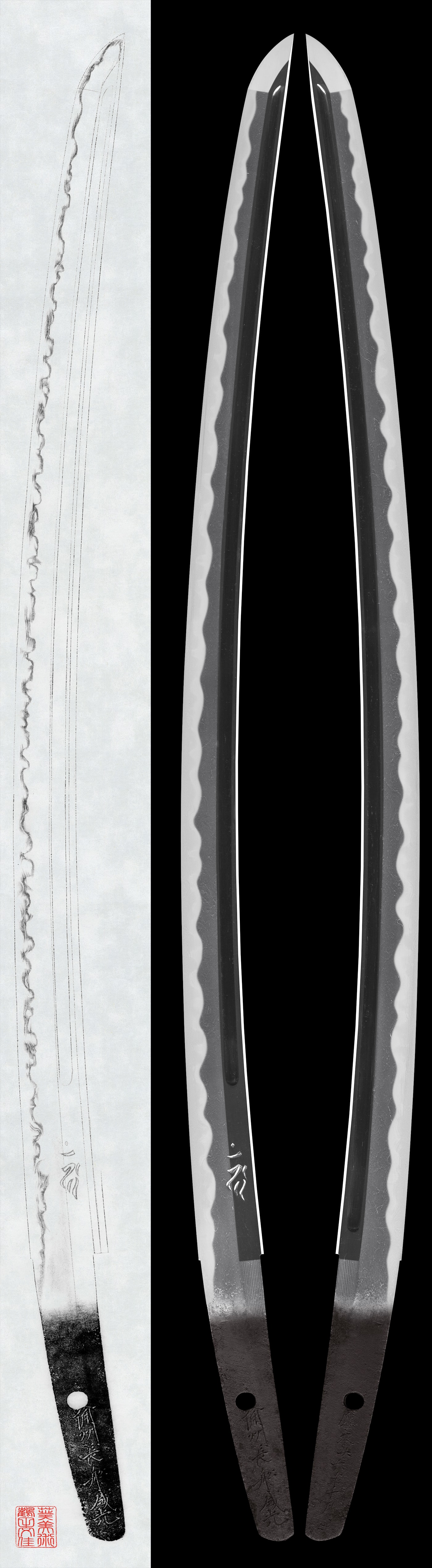
Tomomura's blades characteristically present a slender, classical with high that becomes slightly shallower toward the tip, often with a suggestion of and a . His forging shows with standing grain, mixed with and ; adheres with , and a distinctive patchy stands out prominently. The is fundamentally , mixed with , , and a -like tendency; and enter well, with deep and dense . A particularly notable feature is the appearance in the upper half of crescent-shaped that continue intermittently along the edge, producing a -like effect and, in places, an impression reminiscent of sanjūba. Near the base, fine and appear.
The consistently characterizes Tomomura's work as strongly evoking an "archaic, old-fashioned flavor" and an "unmistakably archaic charm." His workmanship is noted to be in accord with that of fellow smiths such as Yukihide, Naritaka, and Sukemura, whose works similarly display a effect "comparable to that seen in the celebrated Mikazuki Munechika." Authenticated blades are praised as — sound and well-preserved — in both and , displaying "excellent workmanship" and assessed as "valuable reference material" of great documentary importance for the tradition.