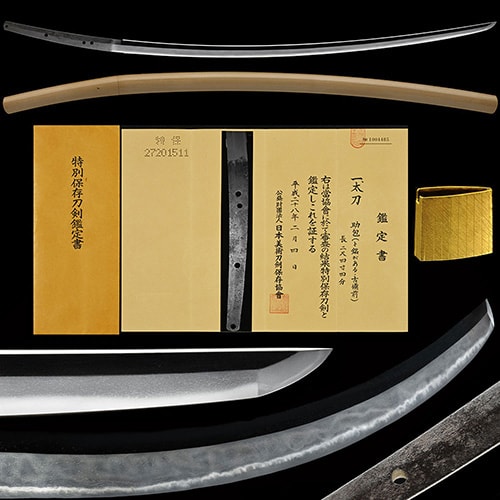
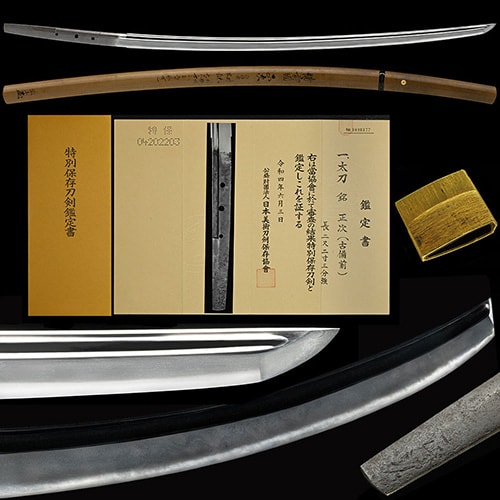
Tochika is a smith of the Masatsune line, working in around the middle of the period. The old sword books transmit him as the son of Tsuneto, himself a smith of the Masatsune house, and one tradition makes him a forebear of the line. His readable record is small, a handful of signed , and every surviving piece carries the bold two-character near the tang-tip. The enters the name as of the Jōki era with a note that one later smith shared it, but the published sources judge that none of the extant signed dates as early as that, placing his work instead in the mid-. He is one of those old hands who stands just before the great flowering, a documented name whose lineage the scholarship still treats as open.
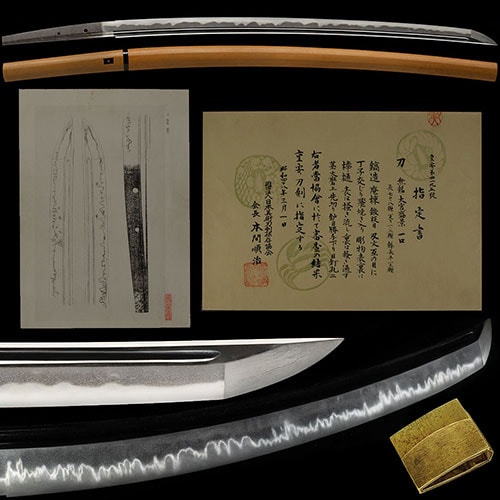
His hand is read in two manners, and the published record is careful to say that none of his work reads, at a glance, as plainly . The showy face is a brilliant . Over an mixed with that tends a little to standing grain, with fine and a clear , he sets a flamboyant clove temper that mixes -, and , the and entering vigorously, the deep and well adhered, with and running and intermixed. On the the is bright and clear, and the enters with a little before turning back in a small round with a slight pointed tendency. The published sources call this his outstanding decorative example and find in it, in one vein, a work that "calls to mind Moriie and Saburō Kunimune".
The is the constant under both manners. It is an , in places flowing and standing a little, carrying and the of old steel, which clears brightly on his best pieces and stands only faintly on the quieter ones, where the forging tightens toward . The other face of his record is exactly that quiet manner: a with a slight admixture of , the temper narrow and the tight, the running straight into a small round. One signed in this mode, and pleasing in shape, is read by the published sources as "workmanship corresponding to the example preserved at Nikkō Futarasan Shrine". It is this tight, controlled that the judges elsewhere set close to the manner of the Bitchū Aoe group, the second pole of his recorded work.
That the smith should temper both a flamboyant and a restrained -like is the central scholarly question around him. The judges note that two modes coexist within his small surviving body, that the signature differs somewhat from blade to blade, and that the 's early dating and -name later smith cannot be reconciled with what the blades actually show. From this the lineage is left unsettled, and the relation to the house is offered as inference from style rather than as fact. Even on a shortened blade, the published sources hold, a relationship with Moriie "is by no means to be regarded as unconnected".
What sets the Tochika apart is named in his own grounded traits rather than in any borrowed comparison. His brightest turn on the - gathered into a clove temper of deep and clear , while his quiet turn on a tight over a faint , and both stand on the slightly standing and of the old . He looks back toward Masatsune in the calm of the quiet pieces and forward toward the decorative of the mid- in the showy ones, a hand caught between the two and, for that reason, valued as a record of the transition.
For the collector he is a rare early name held almost entirely as patrimony. Fujishiro grades him Jō-jō . He has no National Treasures; his record runs through two Important Cultural Properties, one of them preserved at Nikkō Futarasan Shrine, together with a and several . The blade is transmitted as the wearing sword of Matsudaira Terusada, lord of Takasaki Domain, and is accompanied by a Kōtsune of Enpō 4 appraising it at five gold coins. Only four of his blades fall in the and tiers, and most designated blades, in private hands or institutional, are held rather than traded, so a signed Tochika comes to light only seldom. The published sources call an signed example "precious as documentary material for understanding the range of this smith's work", and a privately held one is a notable thing for a collector to encounter, a document of how old passed into the great age that followed.