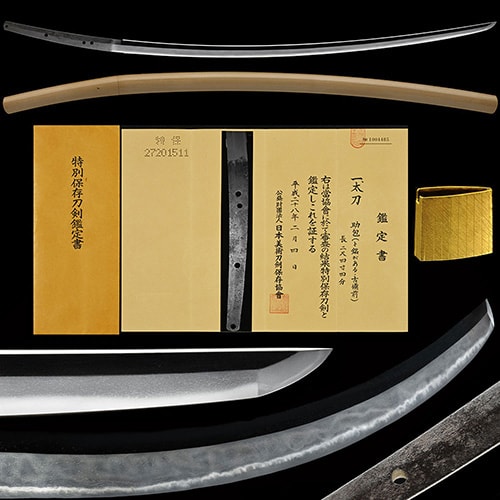
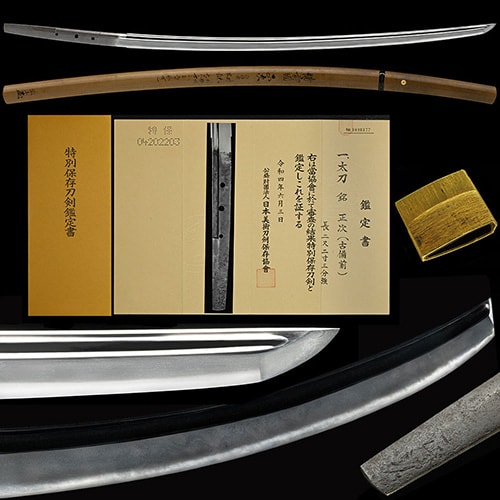
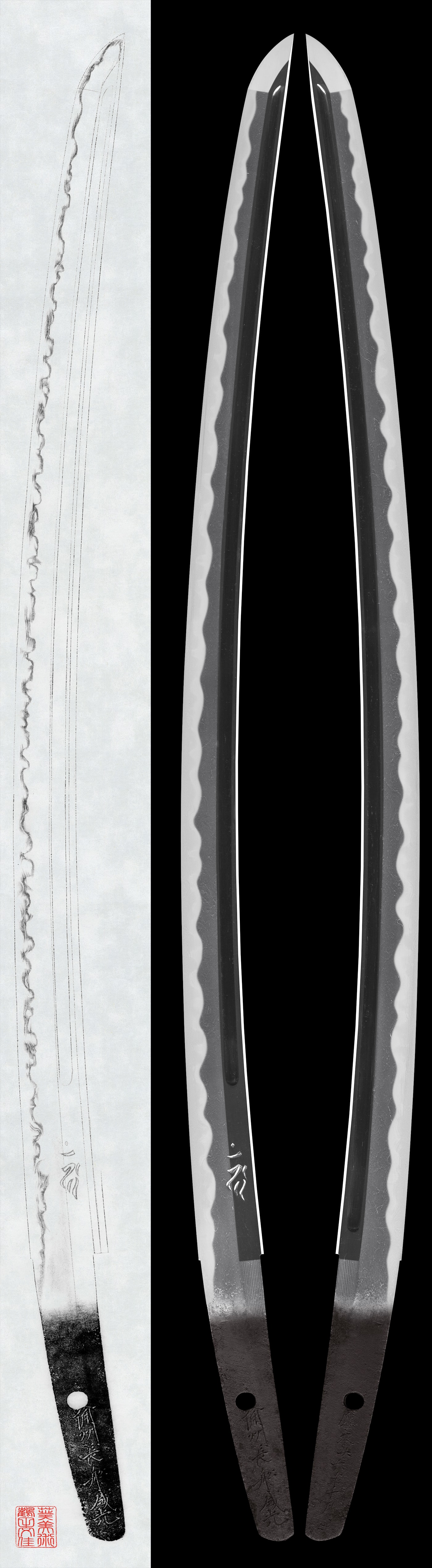
One of the surviving signed of Takakane records his place of residence in its inscription, " no Yoshioka Takakane," and the published sources note that the Yoshioka locality is transmitted not only as the home territory of the Yoshioka but, tracing the chronology further back, as an ancient seat of the smiths as well. That single blade, designated at the fiftieth session, captures the difficulty and the appeal of the name in one line of signature. Takakane is an early- smith of the late into the early period, placed by the reference works among the group and tied by tradition to the Sanpei line of Takahira. He does not, however, refer to a single man. The published sources put the matter plainly, that Takakane is not one person but is found in both and the line, and they add that extant works are few. Each surviving blade is therefore appraised individually to one group or the other, and the bulk of them are judged to be .
His characteristic hand is the quiet old- one. Over an the temper is a -toned into which a feeling enters, the and working well within the , the often deep, adhering, and and running through the tempered area. It is a small, restrained pattern rather than the showy clove-flower of the later masters, and the published sources read it as the archaic edge: a mixed with that, in their words, clearly displays the features of this school. The answers the in kind, sweeping with into a small , and on the early it can turn back so briefly as to approach . The signed work is concentrated in two-character cut near the , and only a single full long signature, the Yoshioka , survives among the recorded blades.
The is where the character is read most surely. The forging is , well worked and at times mixed with , the gathering thickly and on the finest blade settling as a dust-fine ; over it a stands distinctly. On the -signed pieces the grain flows and stands a little, with entering, so that the is a touch more active; on the it is calmer and the the steadier tell. The is consistent across the corpus and is itself a dating instrument: a slender with , high with , the curvature drooping slightly toward the tip, closed by a . Most surviving blades are , yet they keep the proportions of the period, and the examples, the Yoshioka among them, stand dignified and graceful in the form of the end of the Fujiwara age into the beginning of the .
The corpus divides into two registers along the line of the signature. The blades, signed simply Takakane, carry the quiet described above. A smaller group adds the character above the name and is appraised as Ko-; on these the published sources observe that the manner of the Fukuoka line, arising under Norimune in the early , still preserves a strong remnant of the older taste, the temper a mixed with and , the entering in toward a near- turnback. A third and more ornate mode appears on a few blades whose edge leans to a led by , the bright, with small and in places, the closest his work comes to the temper. The published sources also weigh his dating against the reference books: where the would place him as early as the Genryaku era, they reject that on the evidence of the workmanship and judge him roughly contemporary with the Kencho-era dated works of Yoshikane.
What distinguishes Takakane from the company he keeps is best drawn from his own grounded traits rather than from his neighbors. On the appraised blades the judges are explicit, writing that Takakane is found among both and Ko- but that the work in hand belongs to the former; his standing over a well-forged , and his -toned carrying deep in , are the features they return to as the period's fine character. Within the circle his is among the slenderest and most reserved hands, the temper closer to than to the bolder of some of his fellows, and the a steady presence rather than the faint reflection of the oldest Tomonari. The -signed register places him, uniquely among names, directly at the hinge between the archaic phase and the flowering that Fukuoka would bring to its height a generation later.
Takakane stands at 1,800 in the Toko Taikan, and the weight of designation against his name is modest but real: two of his blades reach the tier and four the , six designated works on record in all, with the great majority of his output signed rather than attributed. None of his blades carries a higher designation, so what survives sits in the and tiers rather than in shrine and museum patrimony, and the published record carries no documented provenance for him. His value to the collector and the scholar lies elsewhere: in the rarity and the documentary force of the signed pieces. The published sources call the Yoshioka 's inscription of exceptionally high documentary value, noting that a -period compilation, the Osekisho, preserves reference material for a Takakane with a closely similar signature, and they praise the antique elegance of the inscribed characters. One of his blades is judged to express conspicuously the characteristic workmanship of . Signed Takakane are few, and a privately held example reaches the open field only rarely; when one does, it comes with the rare combination of an early- hand and a legible early signature, and it is the signature, as much as the steel, that makes it a landmark.