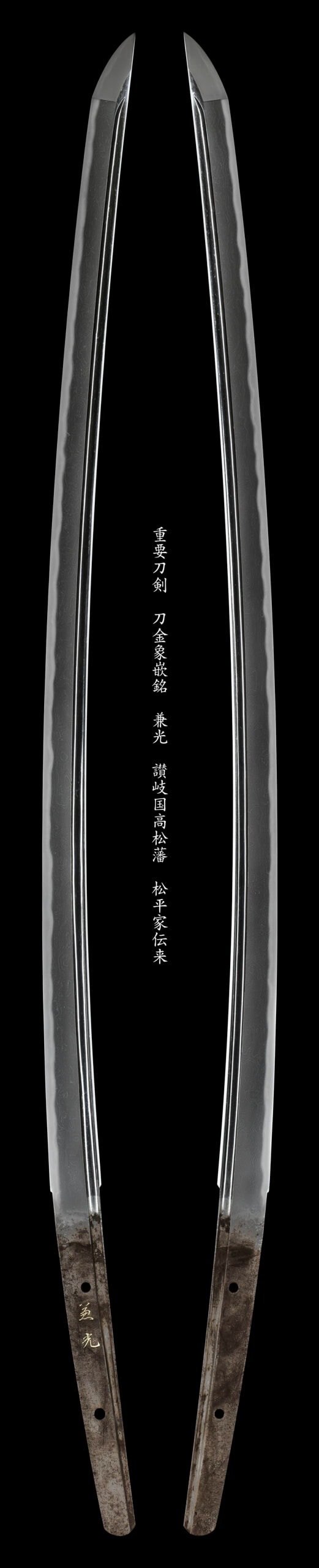
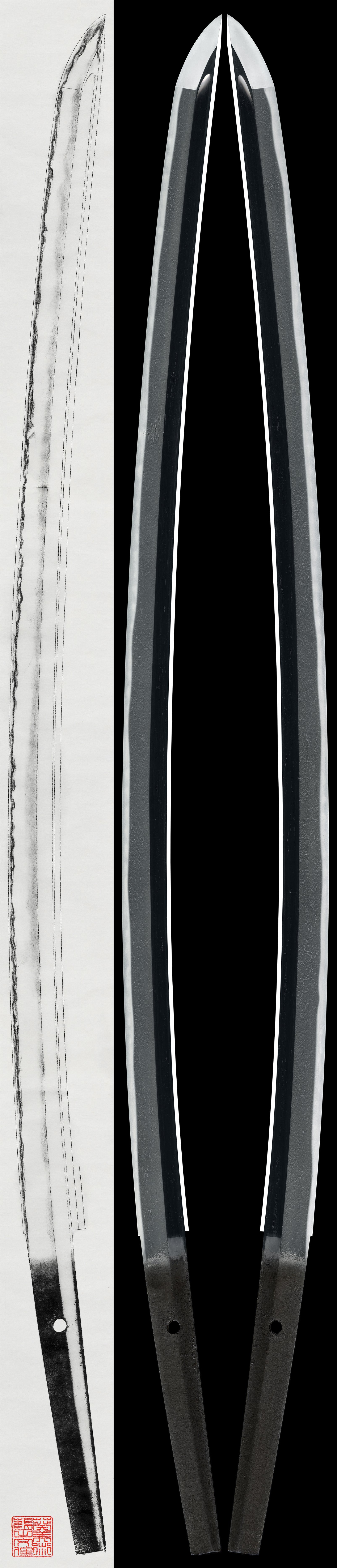
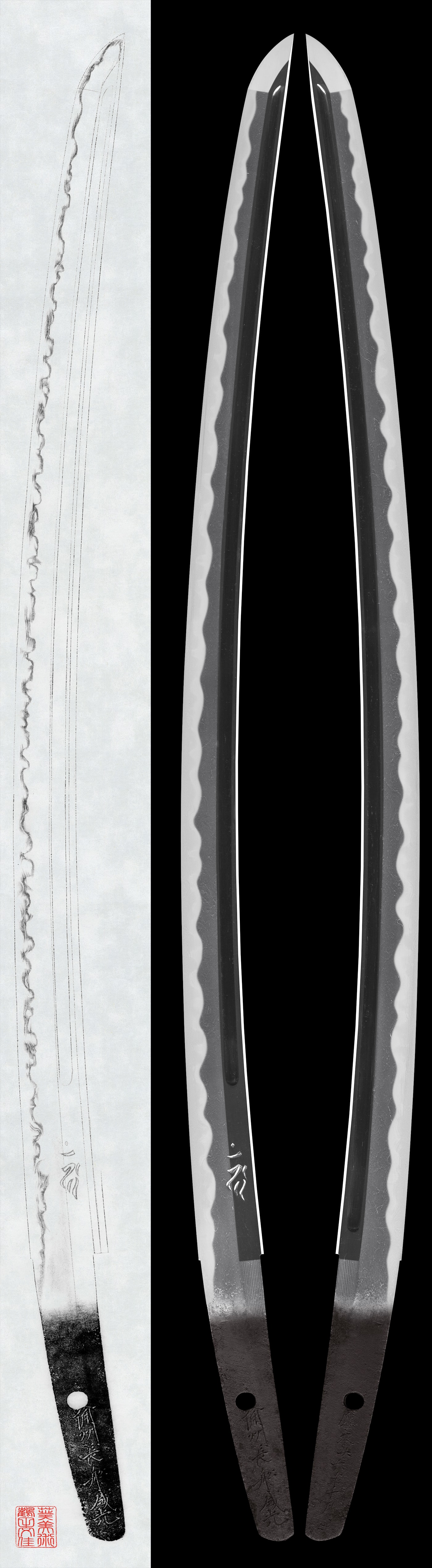
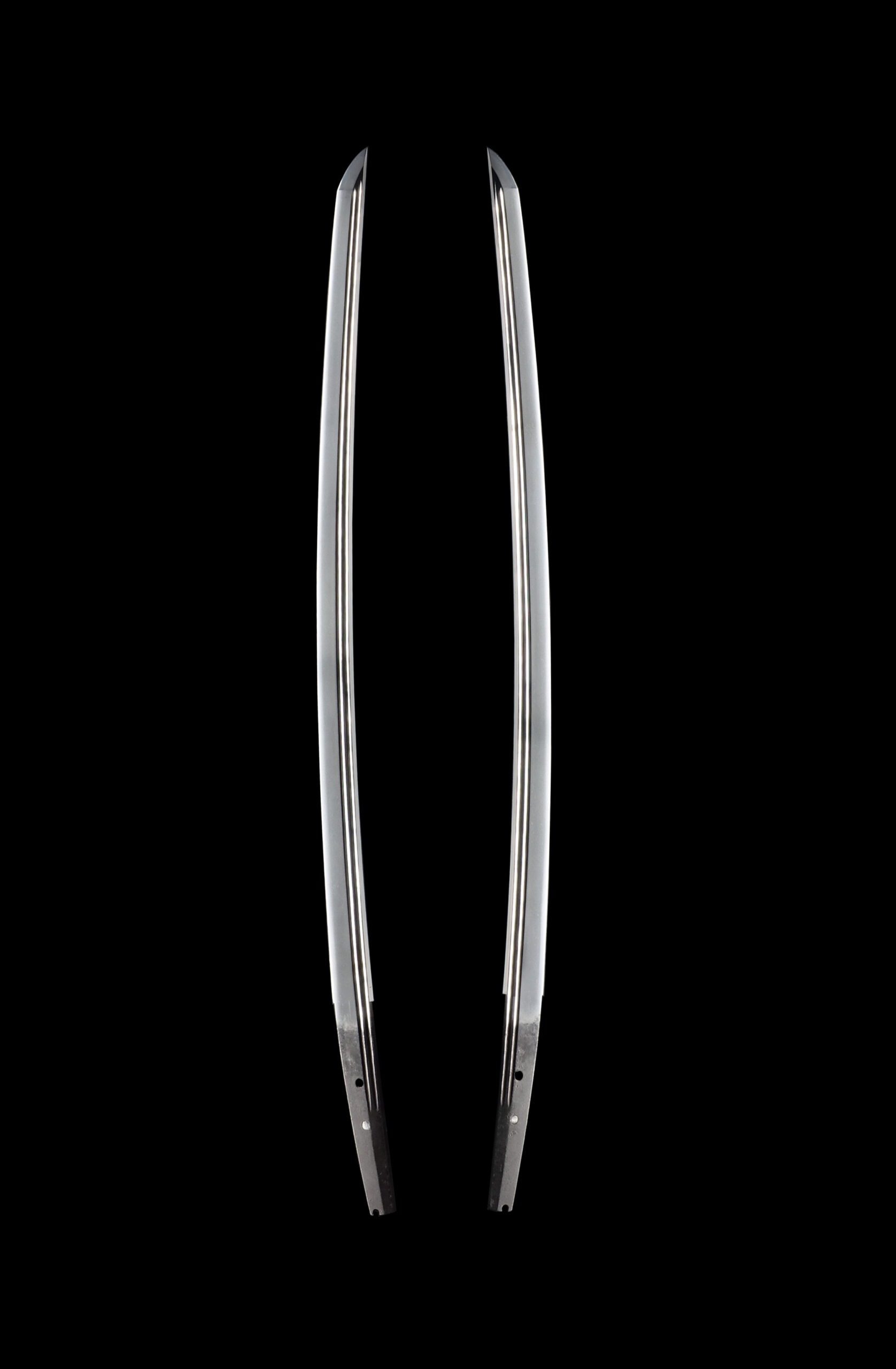
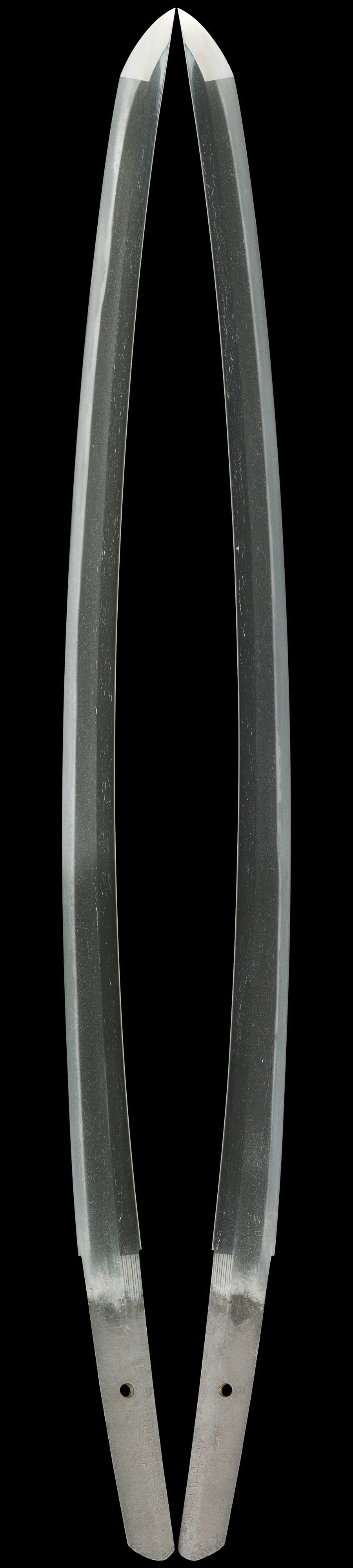
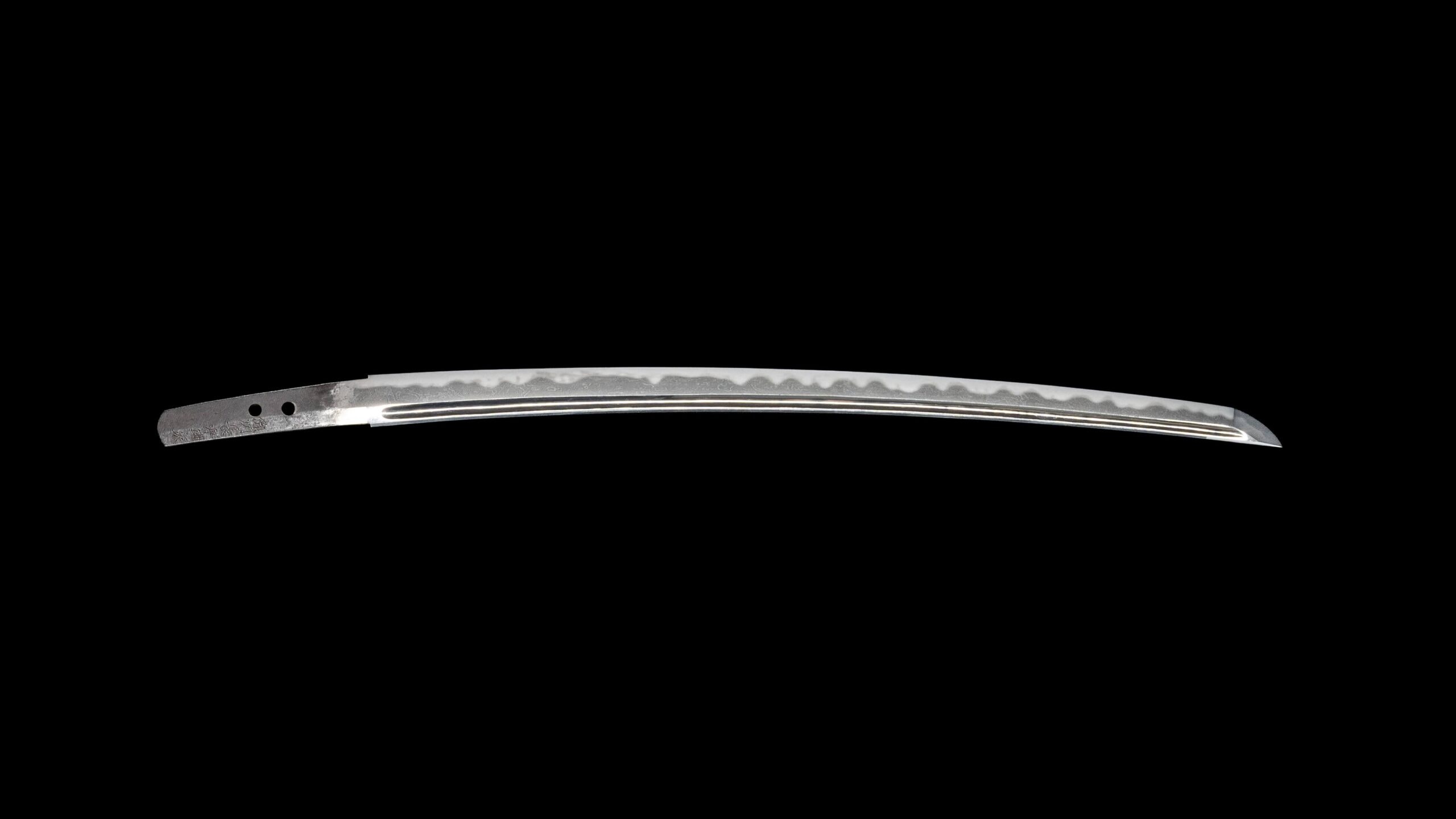
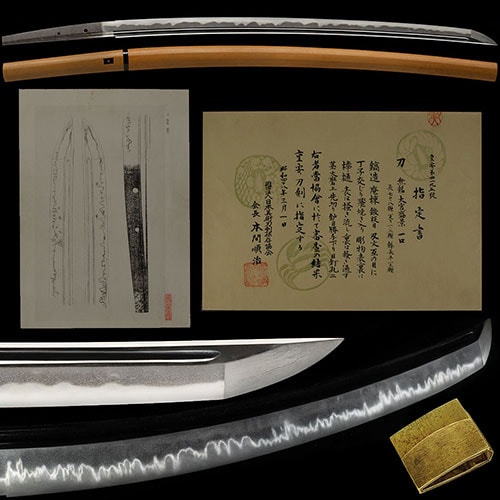
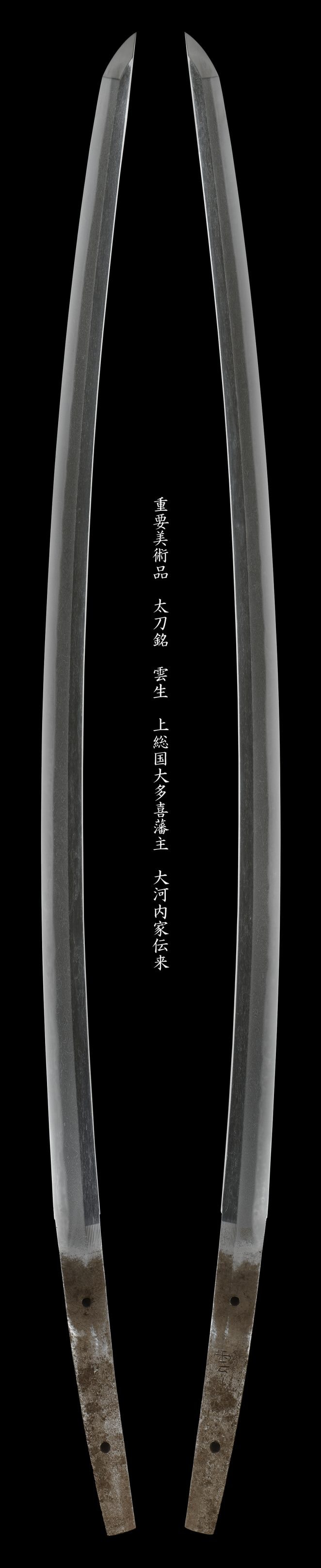
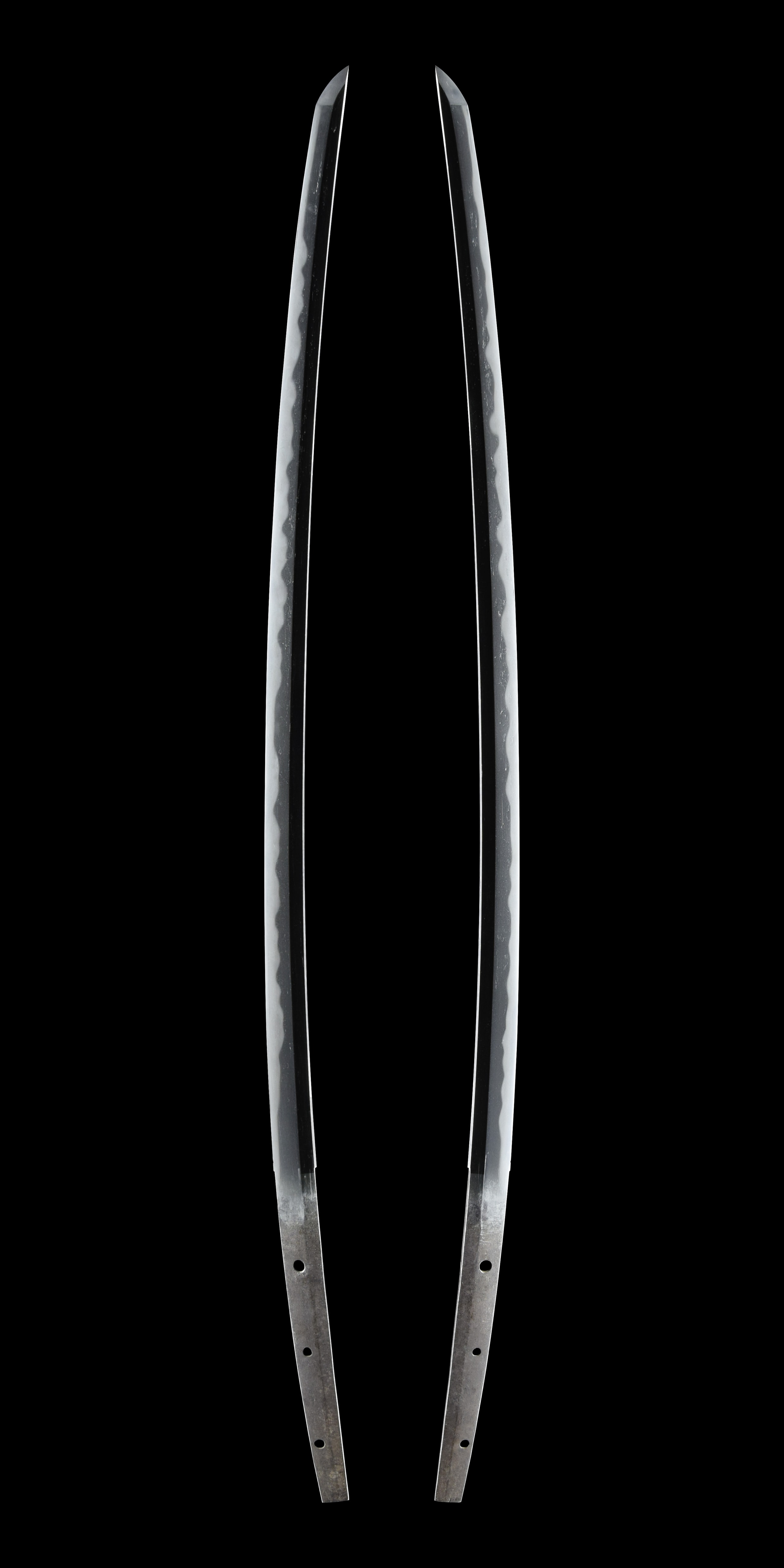
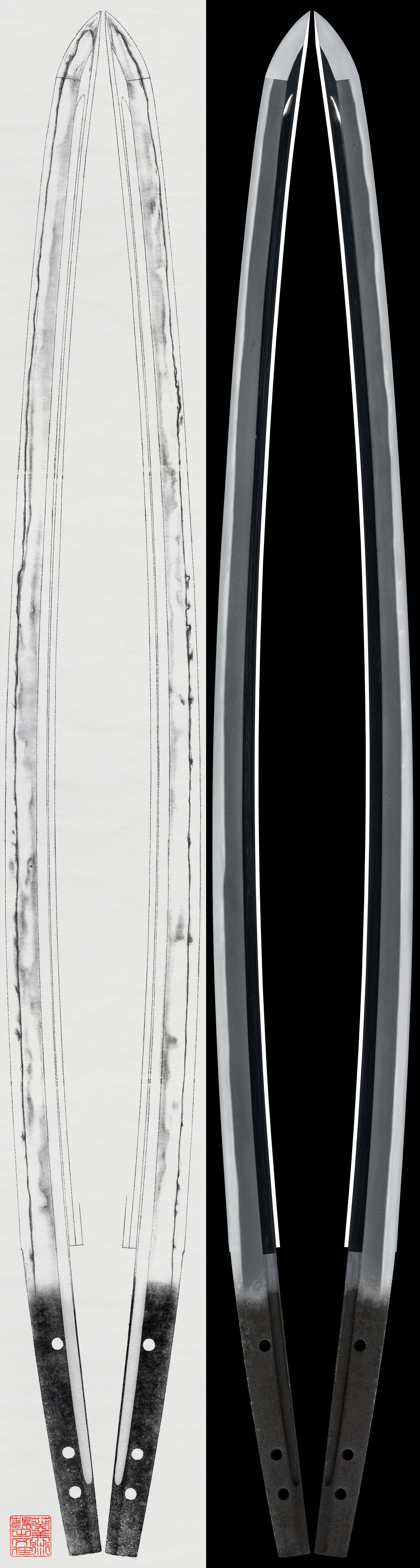
A dated Kōei 2 (1343), eighth month, signed in full no Yoshimitsu, is among the firmest documents of this smith. Yoshimitsu was a swordsmith of the school of the late into the period, by the prevailing tradition a son of Kagemitsu and the younger brother of Kanemitsu, with one account placing the first generation in the Nagamitsu line. His dated works run from Genkō at the close of through Jōji, roughly forty years that almost exactly parallel Kanemitsu, and the sword reference books distinguish a first generation, following his father, from a second that more nearly resembles his brother. Like Kanemitsu he commonly used Northern Court era names, although a dated 6, a Southern Court name, also survives. He belongs to the central workshop at the moment it turned from the classicism of Kagemitsu toward the broad manner of Kanemitsu, and his record is read on the seam between the two.
His recognition turns on a single axis the judges restate on nearly every blade: his is the manner of the Kanemitsu group, but the irregularity is composed in a smaller pattern. Over an that stands a little, often mixed with and , he tempers an angular and -style , with , and pointed elements intermixed, the whole resolving into a small-scale , in places running reversed, with and entering, the -dominant with , and fine and through the line. The and the angular carry over from his father Kagemitsu, while the crowding of many different edge-forms inside the irregularity is named as his own hand. On one signed the published sources put it plainly, that 'compared with his elder brother Kanemitsu the irregularity is of smaller motifs, and the inclusion of pointed elements within the tempered edge is readily perceived as a hallmark of Yoshimitsu'.
The is the constant beneath that edge. The carries , fine enter, and a vivid stands clearly, the bright reflection he shares with the school but renders well-defined; on the tightest-forged pieces the steel packs into and the only sharpens, and one signed mixes a -toned texture into the . His earliest dated stand apart from this prime manner. They are slender, high in with , forged in tight with a or a straight , and tempered not in at all but in a calm with slight , -dominant with , a register the judges read as following Kagemitsu rather than Kanemitsu.
The profile thus divides in three. The early dated , in the Kagemitsu , anchor the chronology, and of the Kōei 2 piece the published sources note that it is 'extremely similar to a Kanemitsu dated Kōei 3, sixth month', an Important Art Object, the two hands documented working side by side. The prime, the and angular in their smaller , is the body of the record. A third, smaller register pushes toward strong in the soden feeling the period prized: a the judges call a deliberate stressing of Sōshū-den, with abundant , , and , and a wide that turns blackish in the steel and adds , of which the published sources write that, weighing the excellence of its and the activity along the edge, it 'shows workmanship of upper-rank soden worthy of Yoshimitsu and his circle'. The first-and-second-generation question is left open across the Genkō-to-Jōji span, and is the central scholarly matter around him.
What sets him apart from his neighbours is exactly what the judges name, and it is drawn from his own work rather than from theirs. Against Kanemitsu his is the smaller and calmer, the cutting edge quieter; against his father Kagemitsu his prime carries more and the -touched activity of his late hand. On one the published commentary records that, the and at first suggesting the circle around Kanemitsu, it is precisely because 'the irregularity, set against Kanemitsu's broad openness, presents somewhat smaller-scale features that the blade is to be judged Yoshimitsu', and on a that 'the way many different edge-forms intermix within the irregularity displays the character of Yoshimitsu'. He stands as the quieter, more closely worked hand of the great mid- workshop, the brother who held to the small-patterned while Kanemitsu opened the line outward.
For the collector he is a documented but uncommon name. Fujishiro grades him Jō-jō . He has no National Treasures; his record runs instead through an Important Cultural Property, two and some thirty-two blades, and signed work is genuinely scarce, only about a dozen of the surviving pieces bearing a signature against a far larger body of . The Important Cultural Property, a signed and dated , is preserved at Kameoka Hachiman-gū in Miyagi. The named provenance of his blades is : the Kōei 2 passed from Tokugawa Yorinobu of Kishū to the Saijō Matsudaira house in 1667 and stayed there; a Kenmu-era signed was held near Torigoe Shrine in Asakusa and is said to have been a wearing sword of the shogun Ienari. With only a couple of blades in the tier and the rest at , a signed and dated Yoshimitsu reaches the market only seldom, and a privately held example, especially an dated , is a notable thing for a collector to encounter, a document of how the Kanemitsu line was carried in a quieter key.