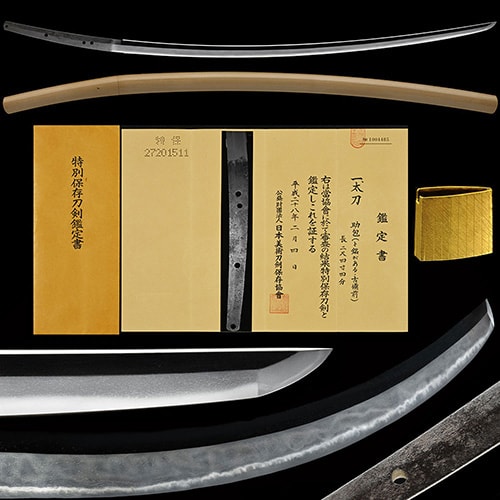
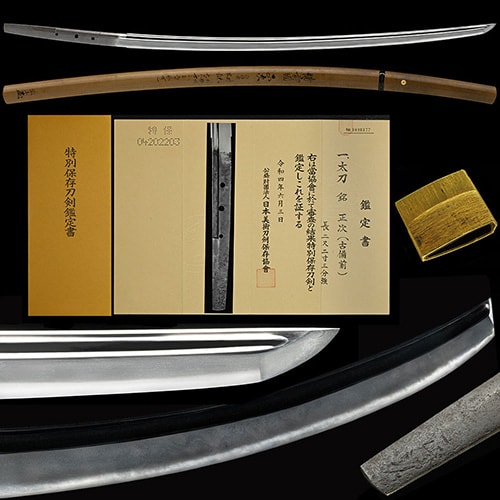
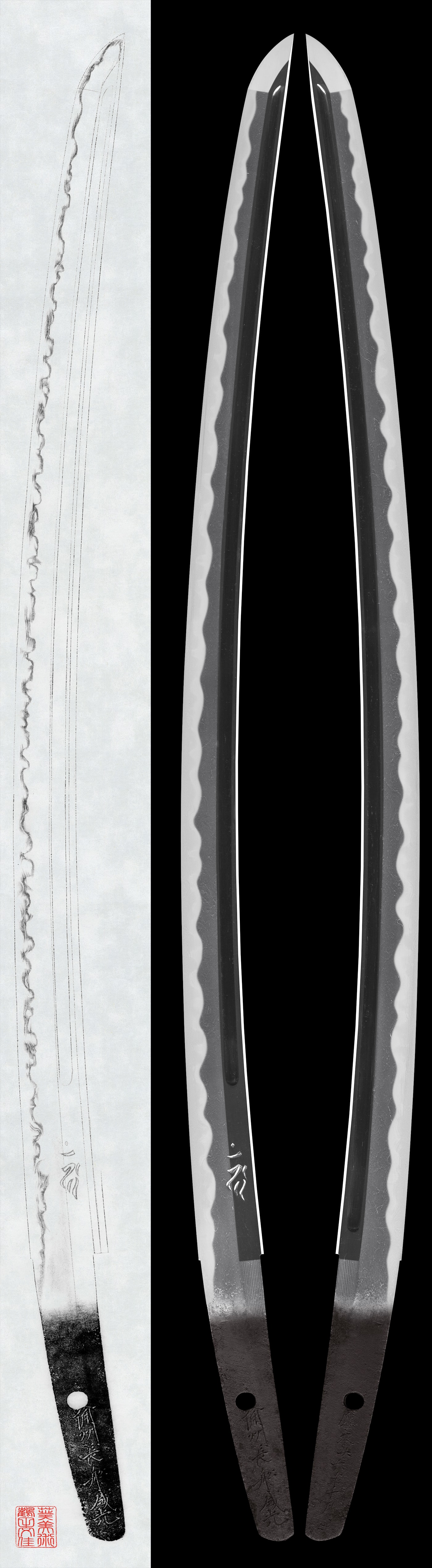
Shigetsune is a smith whom the places about the Kenchō era of the early period, working in at the threshold of the great flowering. He is among the most thinly recorded of the old- hands. The published sources identify him with the smith the swordbooks list under that era, and they state plainly that the details of his descent are not known, that "his lineage is not clear". Only a handful of signed survive: two were designated Bijutsuhin before the war, one entered the ranks in the school's early sessions, and a further was raised to . His name is read off these few blades and the close kinship of their signatures rather than off any documented teacher or line.
His characteristic hand is a -based small , the calm idiom of old . Over a slender he tempers a shallow base into which he sets , and , with and entering thickly and well adhered. The temper is never the towering clove-flower of the later Fukuoka school; it stays small and even, its interest carried in the activity rather than in the height of the heads. Fine and run through it, and on his best work the temper rises at the into a conspicuous , the one feature the judges single out on the Bijutsuhin . The runs with a shallow into a small , or finishes in a -like sweep.
The is the constant beneath that quiet temper. He forges an mixed with , in places standing a little and showing a somewhat coarse grain toward the base, carrying fine and a faint . On the finest pieces the forging tightens into a flowing and the faint reflection clears into a distinct , the speckled old- that the published sources count among the principal points of his work. The shape is the bearing of the period: slender, with a slight taper from base to tip, a high and strong , the curvature settling toward a small , and on two of the a cut on both faces.
His surviving work reads as one manner held through a spread of quality rather than as two separate registers. The plainer signed keep the -based even and restrained; the best, like the Bijutsuhin piece with its prominent and the largely blade with its bold three-character signature, raise the temper and brighten the without ever leaving the old- idiom. The published sources observe that his signatures are uniformly small in scale, cut as either Shigetsune or Shigetsune , and that two of the surviving share a manner of signing so close that the one anchors the reading of the other, which is how a smith with almost no documentary trail is held together at all.
What sets Shigetsune apart is exactly the old colour the judges name. His temper is held apart from the flamboyant of the mid- that would soon flower at Fukuoka, and the published sources call his workmanship "old in style and of high refinement", a piece in which "the characteristic flavor of is clearly evident". He stands before that flowering, among the quiet old- roots from which the most brilliant of the traditions grew, distinguished from the plainer hands of his own time by the brightness of his and the gathering of on his edge, and from his successors by the calm of his line.
For the collector he is a rare early name rather than a famous one. He has no National Treasures and no Important Cultural Properties; his record runs instead through the prewar Bijutsuhin, the and the ranks, with two blades in the and tiers in all. The Bijutsuhin passed through Ichiki Kitokurō and through Iwasaki Koyata to the Seikadō, and the blade carries a Kōtsune of Genroku 8 valuing it at ten gold coins. The judges call that blade "healthy in both and " and "an outstanding example among Shigetsune's work", and they hold the , signed "especially valuable for retaining its original tang and signature" and a precious document for the study of so little-known a smith. With so few blades surviving and most of them long held, a signed Shigetsune comes to market only seldom; a privately held example is a notable thing for a collector to encounter, and a small window onto how forged before its golden age.