NihontoWatch MonNihontoWatchBETA
MarketEncyclopedia
NihontoWatch Mon

NihontoWatchBETA

Market
Encyclopedia
Overview·Kantei·Designations·Provenance·Blade Forms·Signatures·Lineage·School
OverviewKanteiDesignationsProvenanceBlade FormsSignaturesLineageSchool
  1. Schools
  2. Ichimonji
  3. Fukuoka Ichimonji
  4. Munetada

Ichimonji Munetada

宗忠

Tokujū
Vol. 22, No. 7 · Tachi

Ichimonji Munetada

宗忠

5 ranked works

ProvinceBizenEraKenryaku (1211–1213)PeriodKamakuraSchoolIchimonjiTraditionBizen-denFujishiroJo-jo sakuToko Taikan1,000(top 8%)TypeSwordsmithCodeMUN430
1Jūyō Bunkazai
2Jūyō Bijutsuhin
1Tokubetsu Jūyō1Jūyō Tōken

Overview

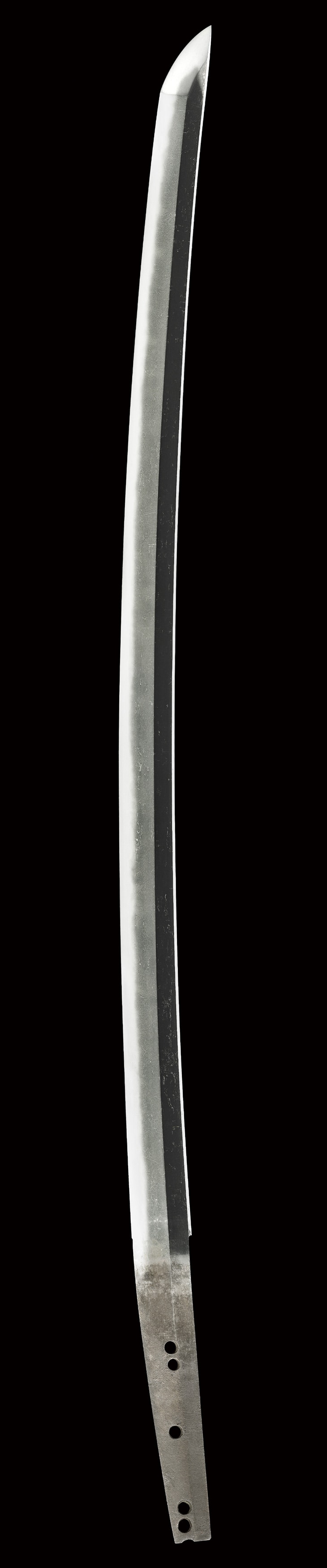
Munetada is one of the Ko- smiths, the earliest generation of the Fukuoka school that arose in early- . The swordbooks place him under the Fukuoka around the Kenryaku era, and one of his Jūyō Bijutsuhin entries identifies him with the Munetada recorded in the as working in those years, about 1211 to 1213. He belongs with Sukemune, Naomune, Muneyoshi, Narimune, Shigehisa and Sadazane among the early hands the swordbooks call Ko-, working before the school's great flowering under Norimune, Sukezane and Yoshifusa, when the full clove-flower temper of the mid- prime had not yet arrived. The published sources fix his recognized shape to a single type and state it plainly: his forms 'are limited to those of slender build with a compact , possessing an old-fashioned charm' (太刀姿は細身で、小鋒のつまった古香あるものに限られている).

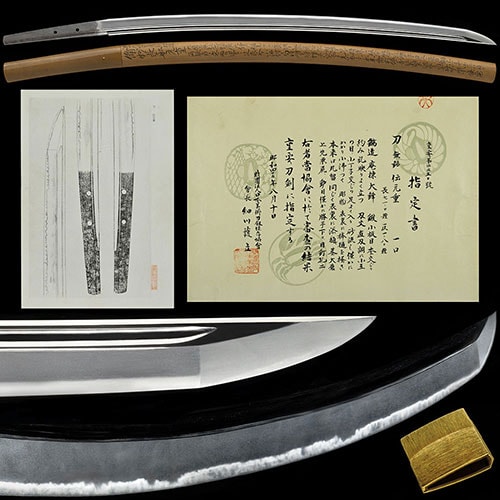
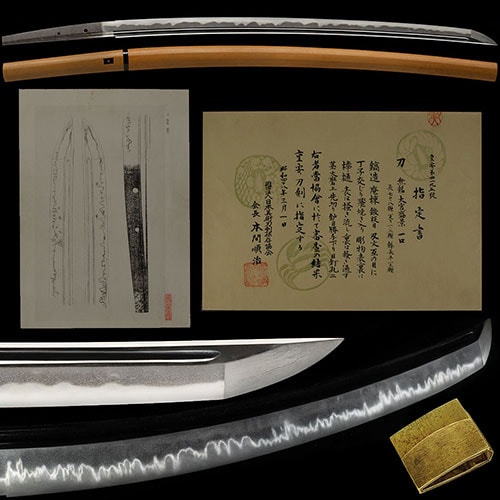
His hand is read first in that shape and in the beneath it. Over an mixed with that stands open overall, the carries with entering, and across it rises the reflection of old steel. On his most fully described that reflection comes as a , the speckled patchy form, and the published sources make a particular point of it: the dark banded areas 'reliably rise high, clearly crossing over the ' (地斑映りの暗帯部が確実に鎬を越えて高く現われている). This is not decoration but a dating tell, the very feature by which the judges secure his early- origin. Where the forging tightens into the only grows clearer, and on the shortened recorded before the war the reads as an of moist quality with a distinct standing in the .

The temper stays within the quieter compass of the early school. His is a mixed with and a slight tendency, the small-scale clove pattern of the Ko- rather than the towering heads of the prime. Above the it tightens to a tone, and through it run and , the deep, adhering well, with and appearing here and there. The is a shallow settling into a , on the narrower signed simply straight to a small round. Even at its busiest the line is held in and small , the activity carried in feet and leaves rather than in great clusters, the calm idiom the published sources separate from the later brilliance of his school.

Within so small a surviving body the judges still read two registers carried by one hand. The first is flamboyant, conspicuous for 'somewhat larger clove-heads being conspicuous' (やや房の大きめな丁子の目立つ), which they describe as 'a flamboyant interpretation' (華やかな出来口); they note that such a manner is occasionally seen among Ko- and cite the by Shigehisa as a parallel. The second is the quieter -toned of his narrower signed pieces, deep in and . The two are bound together by the , the -crossing that fixes the period whichever face the temper turns. One Jūyō Bijutsuhin is recorded as 'by the hand as the Munetada blade listed immediately above' (前掲(重美番号四五七番)の宗忠と同作である), one of the few places where two of his blades can be set side by side.

What separates him from his neighbours is exactly what the judges name. He is set apart from the full-size flamboyant of the school's mid- prime by the small scale of his clove pattern and by his slender, shape, never the broad -leaning forms of the height of Fukuoka. From the plainer smiths he is held apart by the gathering of on his edge and by the brightness and high reach of his . He stands at the threshold of the most brilliant of the traditions, the quiet root from which Fukuoka, Yoshioka and Katayama would grow, his work keeping the old colour of its period while already gathering the clove that the school would carry to its height.

For the collector he is a rare early name. Fujishiro grades him Jō-jō , and the Tōkō Taikan values his work in the upper range. He has no National Treasures; the published sources hold that 'reliably authentic signed work of Munetada survives in only two or three examples' (宗忠有銘確実なものは現存二三口にとどまり), and call the manner of his signature exceptionally fine. His record runs instead through one Important Cultural Property, one and one , with three signed designated Jūyō Bijutsuhin before the war. The judges call one shortened signed 'an excellent work of Munetada showing superior workmanship' (優れた出来を示した宗忠の秀作). His blades carry their own provenance: one descended in the Shimazu family, and another was among the cherished swords of Suga Saneshū, a Shōnai-domain retainer on close terms with Saigō Takamori. With only a pair of his blades in the and tiers, a signed Ko- Munetada comes to light only seldom, and a privately held example is a notable thing for a collector to encounter, a document of how the began.
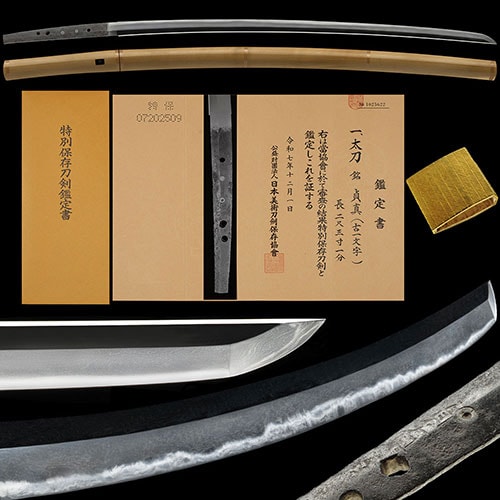
Kantei

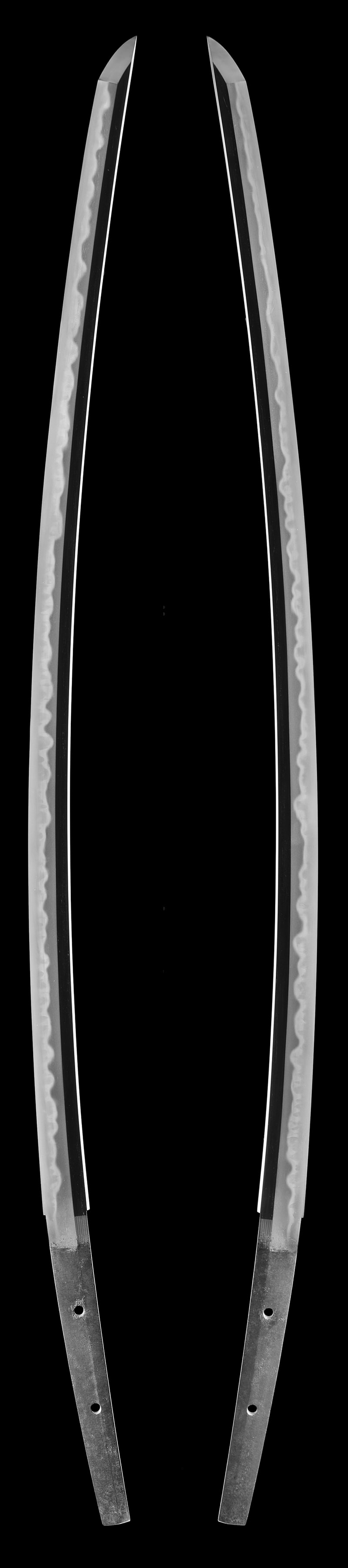
two registers of one Ko-Ichimonji hand on a slender, ko-kissaki tachi: the flamboyant manner with somewhat larger choji heads over a standing itame and jifu-utsuri crossing the shinogi, set beside the quieter suguha-toned ko-midare with deep nioi and ko-nie, both fixed to early-Kamakura Ko-Ichimonji by the same Ko-Bizen ground

Munetada is one of the Ko- smiths, the earliest generation of the Fukuoka school that arose in early- ; the swordbooks record him under the Fukuoka around the Kenryaku era (1211-1213), and the published sources hold that reliably authentic signed work of his survives in only two or three examples. The published sources limit his recognized shape to a single type: slender with a compact , retaining an archaic charm. Over an mixed with that stands open with and , his ground carries the reflection, a toned on his finest pieces to a whose dark bands rise clearly across the , the feature by which the sources fix his early- date. His temper is a mixed with and a tendency, tightening to a tone above the , with and , deep and , and , the a shallow to a . The published sources read two registers within this one hand: a flamboyant one in which somewhat larger heads stand out, set beside a quieter -toned manner, both anchored to the Ko- by the ground.

Diagnostic discriminators

unique vs mid-Kamakura Fukuoka Ichimonji prime (clean midare-utsuri, no shinogi-crossing jifu)

40% of his works · 4.0× vs mid-Kamakura Fukuoka Ichimonji prime (full-size flamboyant choji)

unique vs mid-Kamakura Ichimonji prime (broad ikubi shape)

Observation by phase

The flamboyant register (larger choji heads, jifu-utsuri crossing the shinogi)

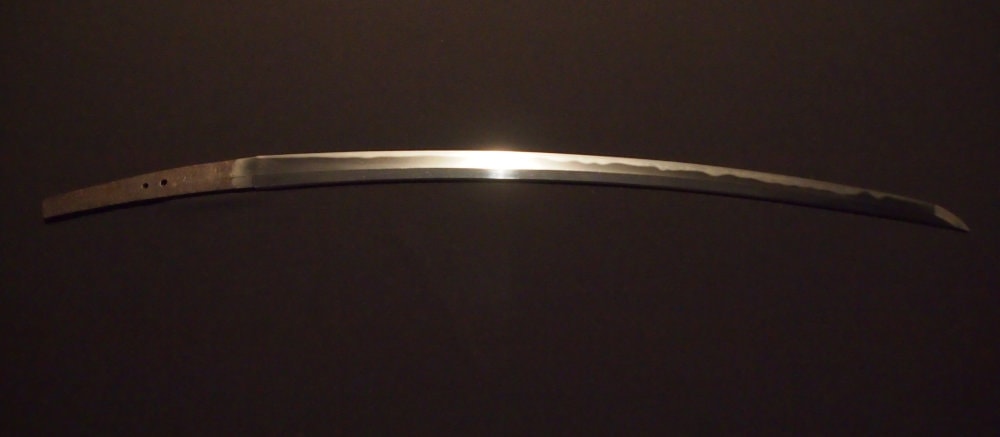
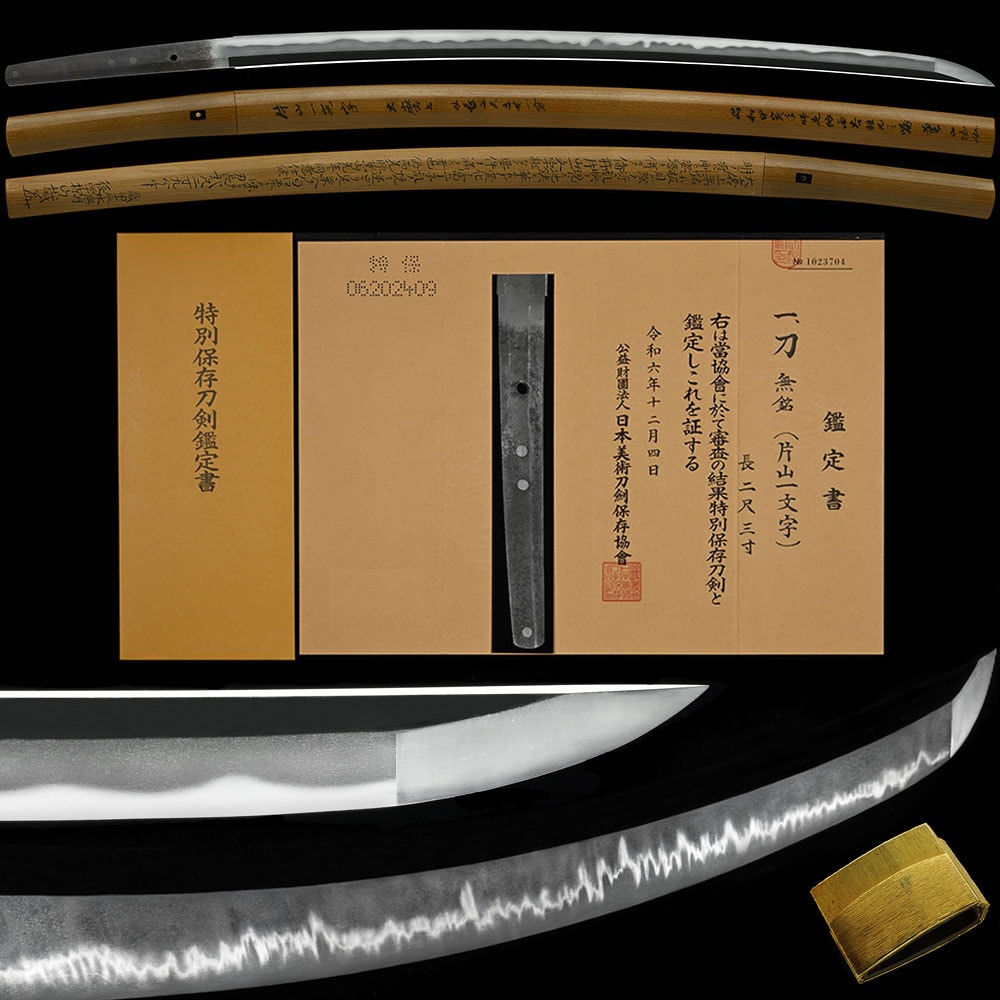
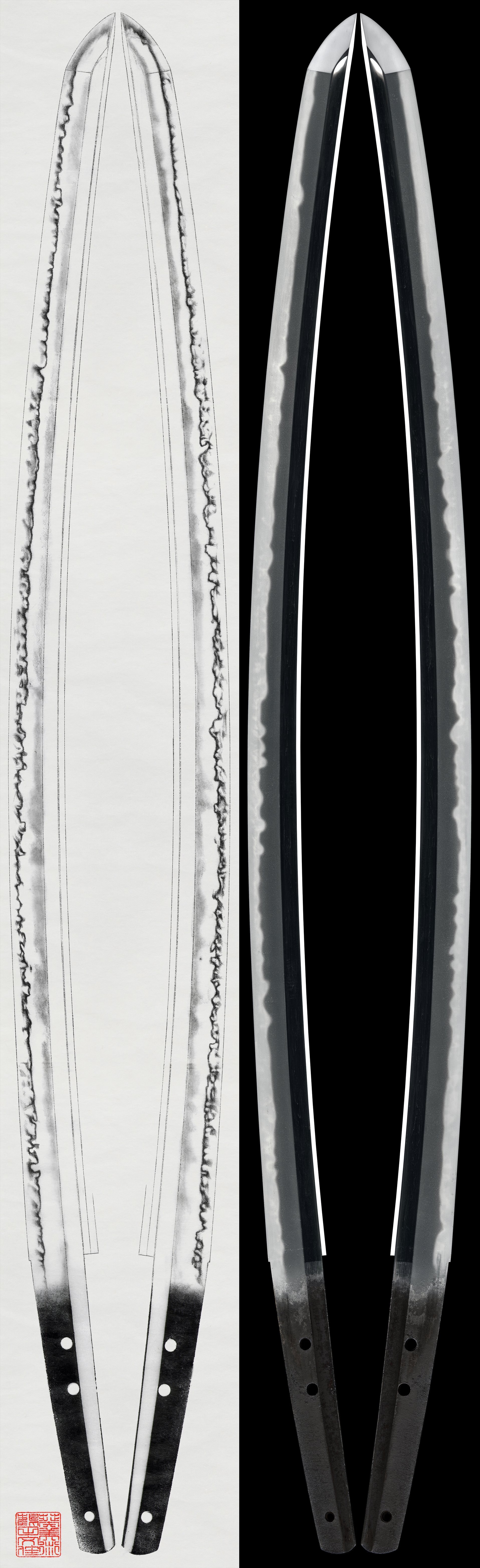
His most fully described work is a signed , standard in with a marked difference between base and tip widths, retaining a high with a slight forward-drooping tendency toward the tip, and a . The ground is mixed with , standing open overall, with and , over which a stands out clearly. The temper is a into which and a slight tendency are mixed; above the it tightens to a tone, with and , adhering, and and appearing. The is a shallow with a tendency. The published sources call this a flamboyant interpretation, conspicuous for its somewhat larger heads, and note that such a manner is occasionally seen among Ko-, citing the by Shigehisa as a parallel. The point that secures the early- date is that the dark banded areas of the reliably rise high, clearly crossing the ; the sources call the blade exceptionally well preserved and an excellent work of Munetada.

Sugata 姿
Jigane 地鉄
Hamon 刃文
Bōshi 帽子

The quiet suguha-toned register (the typical Ko-Ichimonji manner)

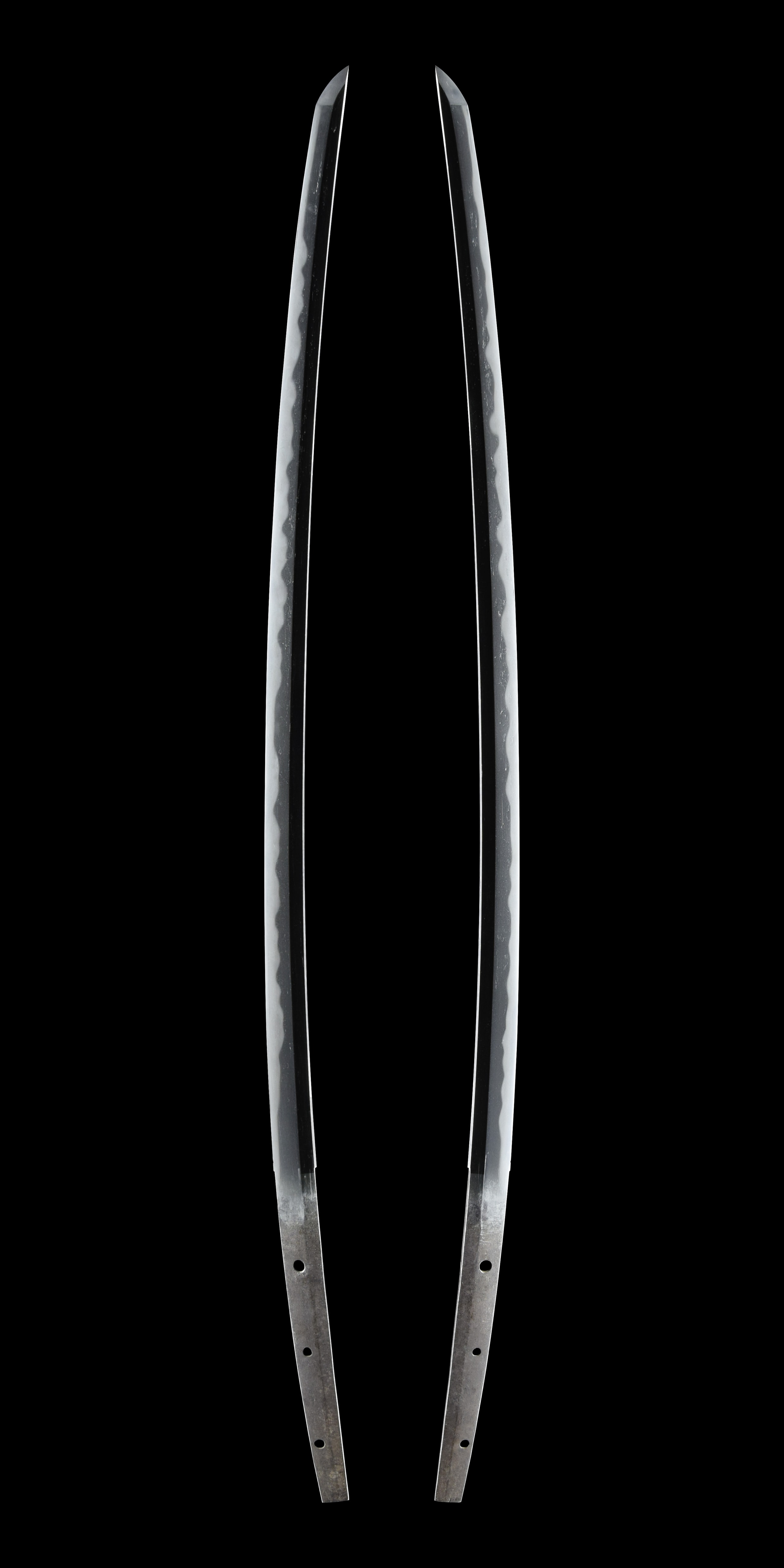
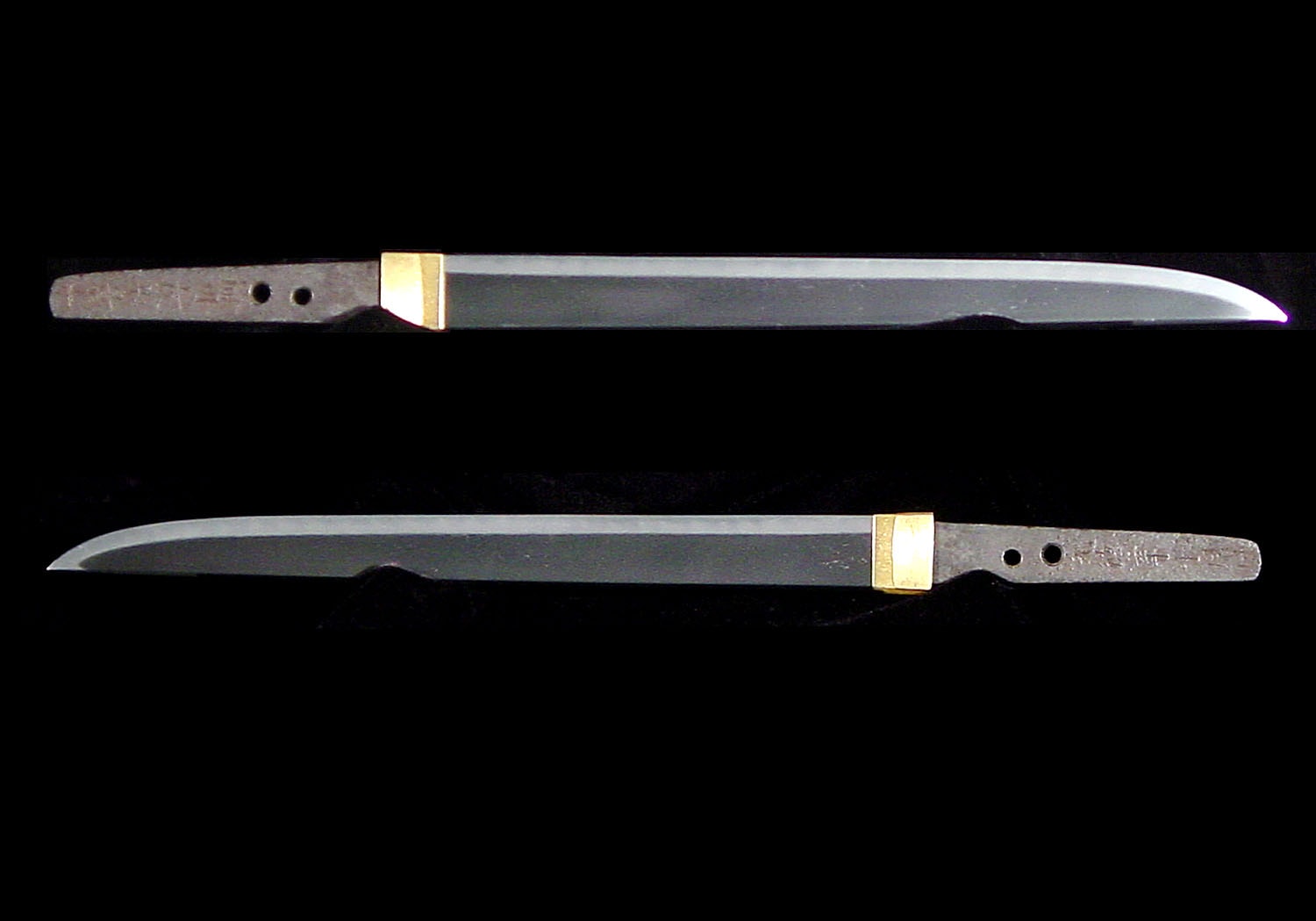
Beside the flamboyant stand his quieter signed pieces, the manner the published sources treat as typical Ko-. One greatly shortened , narrow in with a somewhat high and a small , is forged in mixed with , leaning a little toward standing grain, with and entering; over it the temper is a with mixed with , the deep and adhering well, with here and there, the slightly slender, running straight to a . Among the prewar designations, one shows an with a moist quality and a distinct , its temper a -toned in with and ; a companion by the hand is a feeling with mixed in, adhering, the broad, both and sound throughout. The published sources call the manner of his signature exceptionally fine, and judge these slender, quietly worked to retain their aesthetic appeal even where slight fatigue has set in.

Sugata 姿
Jigane 地鉄
Hamon 刃文
Bōshi 帽子
Scholarship

The published sources record Munetada as a Bizen Ko-Ichimonji smith, identifiable with the Munetada listed in the meikan under the Fukuoka Ichimonji around the Kenryaku era (1211-1213), and limit his recognized tachi to slender, ko-kissaki, compact forms possessing an archaic charm, judging reliably authentic signed work to survive in only two or three examples.

On his more flamboyant tachi the published sources observe that somewhat larger choji heads stand out, a manner occasionally seen among Ko-Ichimonji for which they cite the Tokubetsu Juyo tachi by Shigehisa as a parallel, and hold that the early-Kamakura date is secured by the dark banded areas of jifu-utsuri reliably rising high and crossing the shinogi.

Designations

Kokuhō—
Jūyō Bunkazai1
Jūyō Bijutsuhin2
Gyobutsu—
Tokubetsu Jūyō1
Jūyō Tōken1

Elite Standing

0.24 across 5 designated works

Top 10% among smiths

Provenance

4 documented provenances across certified works by Munetada

Provenance Standing

1 works held in elite collections across 4 documented provenances

Top 84% among smiths

Raw score: 1.83 / 10

Blade Forms

Distribution across 5 ranked works

Signatures

Signature types across 5 ranked works

Currently Available

Lineage

Munetada
Student
  1. 1.Sadazane貞眞1 for sale13designated

Ichimonji School

Other artisans of the Ichimonji school

  1. 1.Muneyoshi宗吉12designated
  2. 2.Sadazane貞眞1 for sale13designated
  3. 3.Narimune成宗10designated
  4. 4.Shigehisa重久5designated
  5. 5.Tsunetsugu恒次11designated
  6. 6.Sukenori助則4designated
  7. 7.Sukemune助宗4designated
  8. 8.Chikatsugu親次2designated
  9. 9.Naomune尚宗2designated
  10. 10.Yukikuni行國1 for sale2designated
  11. 11.Muneyori宗依3designated
  12. 12.Sukemasa資正1designated