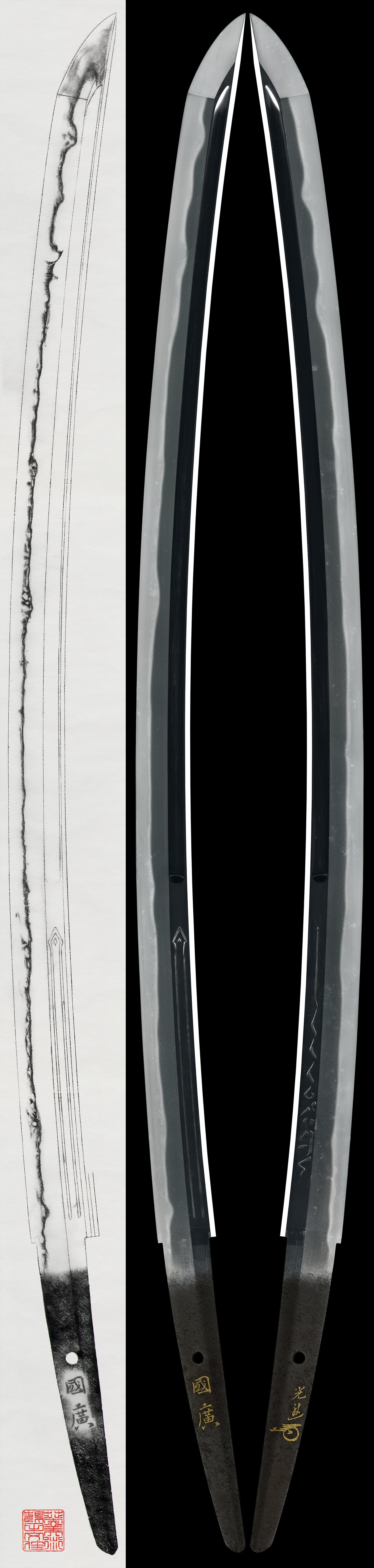
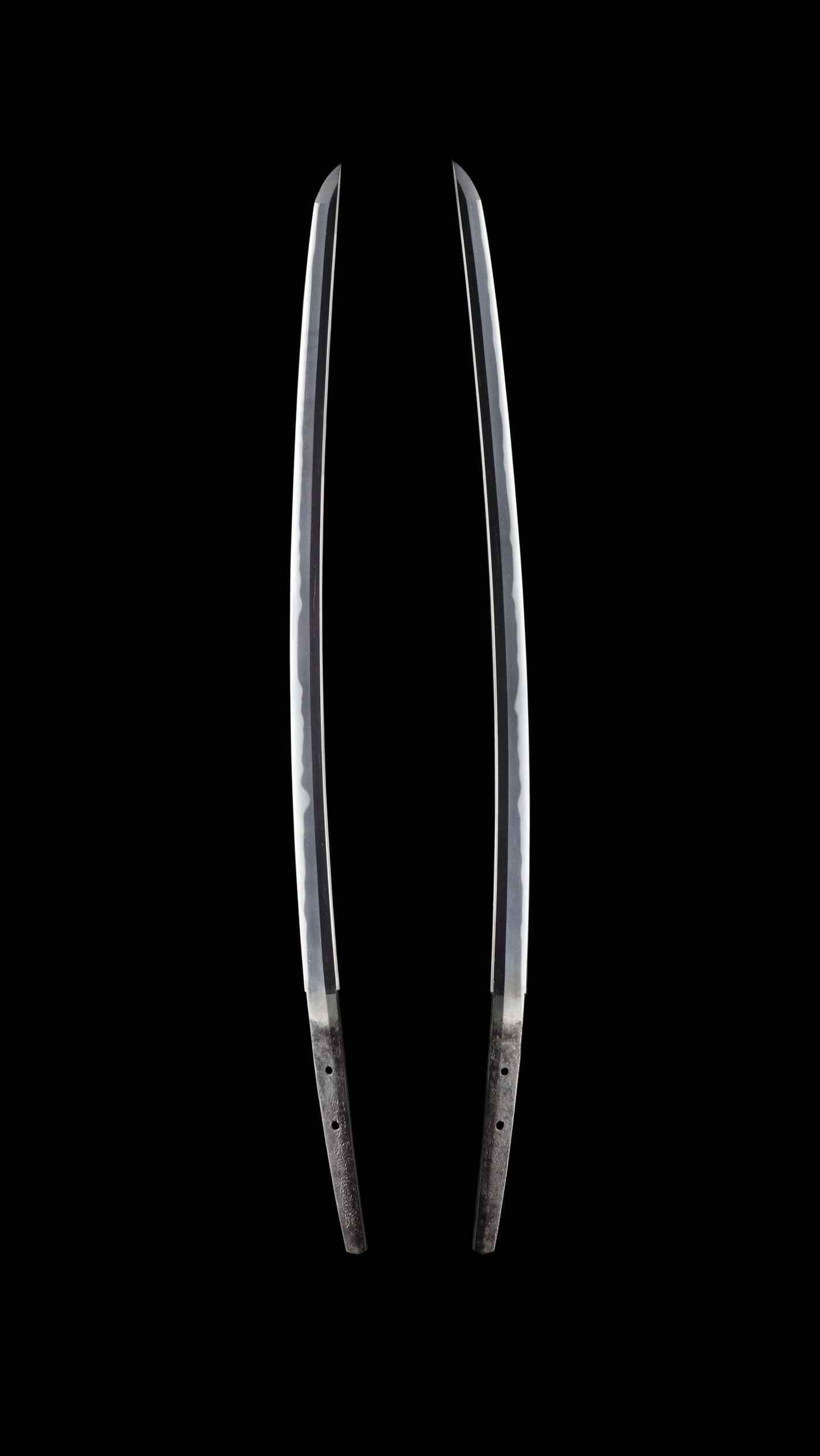
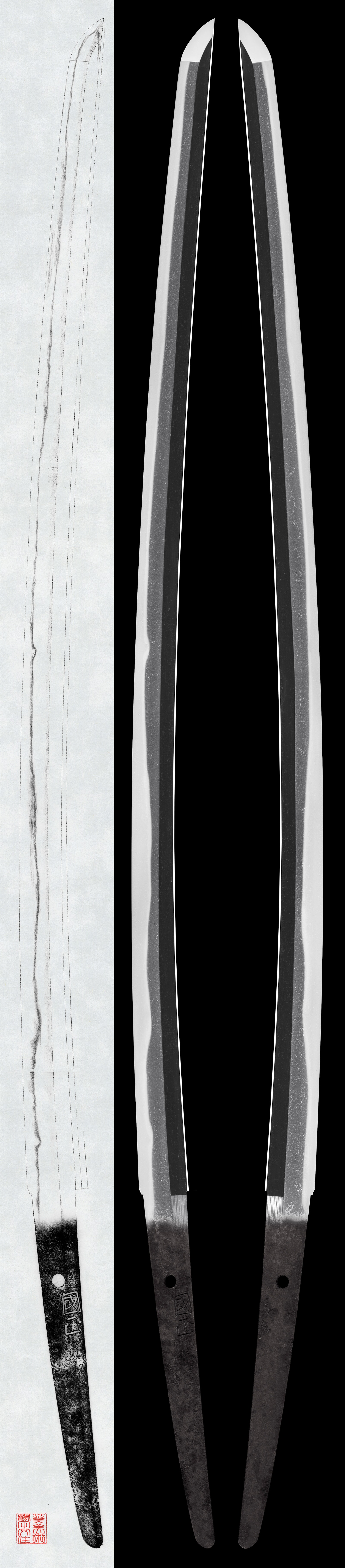
Kuniyuki signed himself Settsu Amagasaki-jū Fujiwara Kuniyuki, and that long signature, cut in bold thick chisel strokes on the of an below the , is where his small surviving record begins. He was a later pupil in the circle of Kunihiro, the Kyoto founder whose school carried the -revival manner into the early period. After Kunihiro's death in Keichō 19 (1614) he is thought to have left Kyoto for Settsu and settled at Amagasaki, and a handful of his blades narrow the address further to Hashiramoto, a place within the modern city. The published sources are careful about that name: the old sword-signature books had invariably miswritten it, and the forty-fourth-session commentary states plainly that 「柱本が正しく、現在の尼ヶ崎市内の地名である」, that Hashiramoto is the correct reading. His work is best understood not as a dated chronology but as the hand at its most legible, read by where he signed and by which form he chose, because his blades carry no dates beyond one 'ei 2 (1625) piece the sources cite.
The feature that identifies him most reliably is the . He forges an mixed with that stands open in the school's manner, the grain running flowing toward the edge and roughening into the loose, granular surface the published sources call the so-called -, with attaching and, on one , fine entering. The twenty-second-session names that outright, its rough forging carrying the qualities of work, and the surface recurs across the corpus, named or implied on most of his blades. It is not a personal invention but the inheritance from Kunihiro, so it places him within the line as surely as it marks his own hand; for a smith of whom the sources repeatedly note that 「現存する作刀は極めて少く」, his extant works are exceedingly few, the standing is the steadiest thing to hold to.
Over that his temper a as the main motif, mixed with and angular , attaching well and fine running through the . enter, and the most often settles into a subdued , sinking rather than standing bright, though on the twenty-second-session blade it is read as clear and bright instead. The runs , on one with an -inclined turnback on the , on others slightly pointed with and a deep . The shapes are sober: with , the normal to rather wide and the thick, the curvature shallow to moderate with a that on one long-bodied piece tightens toward the tip. Taken together the and give the quiet, astringent make the sources read as characteristic -mono rather than anything showy.
Within so small a body of work the clearest division is by form. His hold the notare-based described above, while his form a distinct register of the hand: built , wide in the and , the somewhat thick, with and at times . On the earlier of these the temper is a mixed with large , entering with , deep and ; on the latest, designated in the forty-fourth session, the settles instead into a base bearing only a slight hint of , the somewhat uneven, the sinking, and the temper carried down into the . That last is the one the commentary lingers over, finding that the rough forging and the subdued together display the character well; it calls the piece an altogether restrained make that yet yields a subdued, astringent flavor, 「総じて地味な作柄に仕上げているが、渋い味わいを醸し出している」.
Kuniyuki stands at no head of a school. His teacher is Kunihiro, and the line runs to him rather than from him: no pupil is recorded, and his place is that of a late, minor hand of the Kyoto school carried into Settsu. The Ichiran, quoted in the forty-fourth-session commentary, fixes the connection outright, noting that he signed 「摂州住藤原国幸ト切ル」, that he at times resided in Kyoto, worked in the Genna and 'ei eras, and was a disciple of Kunihiro; from the surviving work the sources judge his membership in the Kunihiro group certain. His worth to the line is documentary rather than generative, the forty-fourth-session blade singled out as valuable material for understanding the breadth of his own production and, through it, the reach of the Kunihiro school down into Amagasaki. What sets him apart on a blade is not a flamboyant signature trait but the consistency of the quiet make: the standing , the , and the sinking held together in a sober, well-finished whole.
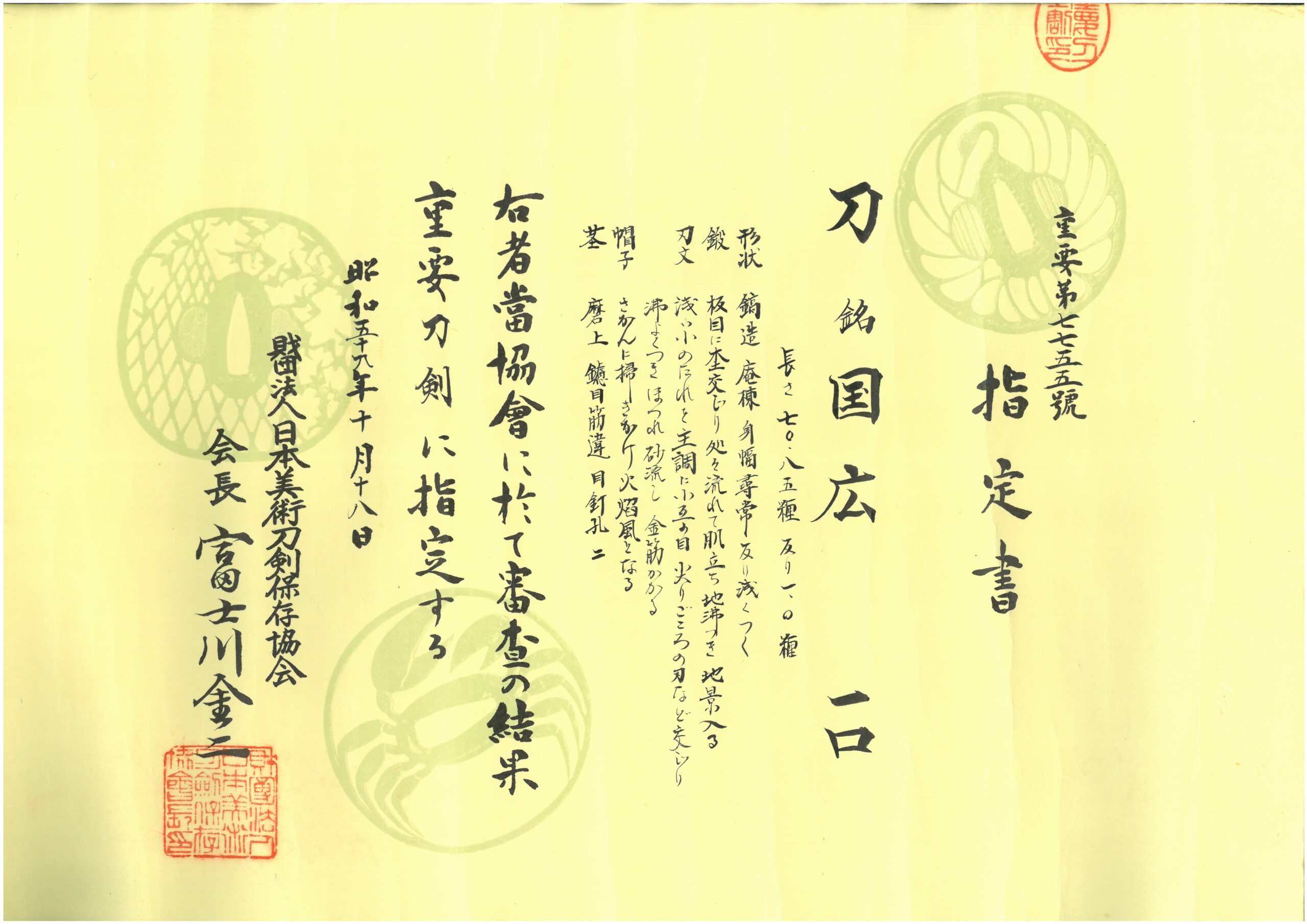
Six of his blades have reached -, an unusual concentration for a smith whose signed work the sources call exceedingly few, and these six pieces are the whole of his designated record, none of them raised to a higher tier. Fujishiro rates him Jō-, a solid second rank, and one of his carries its connoisseurship in the inscription itself, the patron Nakamura Kyūbei of Jōshū named on the , a record the commentary notes has not yet been traced. Recorded provenance is thin, one of the pieces carrying a documented descent through a long-held family collection. None of these blades is patrimony locked forever in a museum or shrine, yet none reaches the market with any frequency; for a smith this scarce, a signed Kuniyuki is something a collector encounters only rarely, from time to time and with patience, a piece of the school rather than a famous name. The published sources weigh him honestly, neither inflating a minor pupil nor overlooking him, and judge the best of his work, in their own phrase, 「同工の作域を知る上で、資料的にも貴重である」, valuable for the light it throws on the breadth of his hand.