NihontoWatch MonNihontoWatch
Market
Encyclopedia
Kantei
Overview·Historical importance·Designations·Kantei·Dated Works·Provenance·Blade Forms·Signatures·Lineage·School
OverviewHistorical importanceDesignationsKanteiDated WorksProvenanceBlade FormsSignaturesLineageSchool
  1. Schools
  2. Hizen
  3. Munetsugu

Hizen Munetsugu

宗次

Tokujū
Vol. 16, No. 51 · Katana

Hizen Munetsugu

宗次

16 ranked works

Major smith
ProvinceHizenEraKeicho (1596–1615)PeriodEdoSchoolHizenTraditionShintoGeneration1stFujishiroJo sakuToko Taikan500(top 26%)TypeSwordsmithCodeMUN545
2Gyobutsu
2Tokubetsu Jūyō12Jūyō Tōken

Overview

The first-generation Iyo no Jo Minamoto Munetsugu was called Sakai San'emon, and his family is said to have served for generations as priests of the Tenmangu shrine at Nagase village, the birthplace of . He forged at Nagase- in the castle town of Saga and later moved to Isahaya in . The published sources make him a pupil of the first-generation and set him beside that founder as "the very pioneer of early-modern smithing". A genealogy of the Iyo no Jo line kept by his descendants places his Iyo no Jo title in Keicho 11, and a surviving work dated Keicho 12 that already bears the title bears it out.

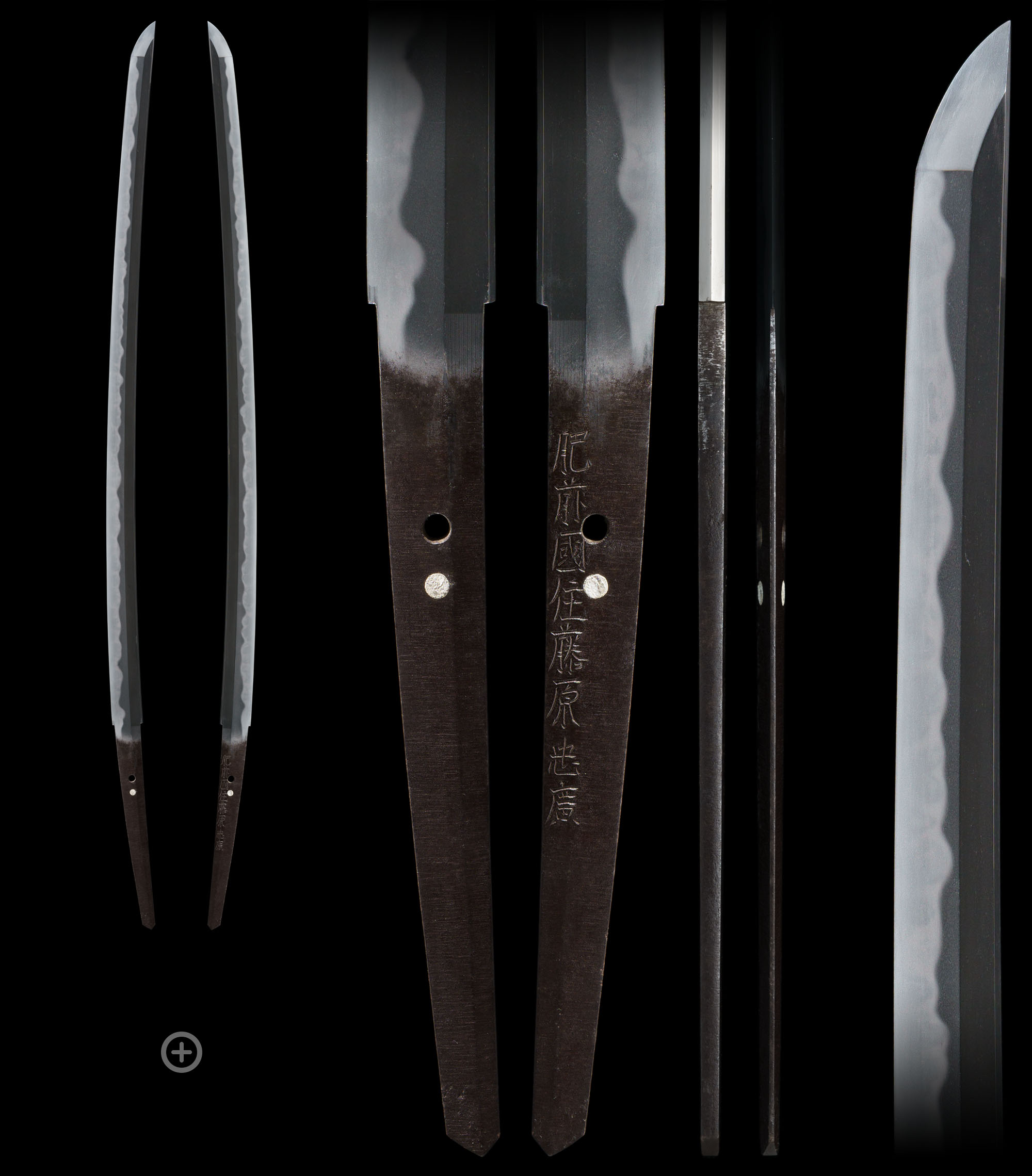
Within the group he is the exception, and the published sources say so plainly. swords in general temper the straight and turn it in a small round ; nearly all of his enter and sweep back in , at times flame-like, so that his work is "not to be confused with other swords". His is a mixed with , angular elements and pointed . and enter freely, the is deep and the thick, with rough gathering in places. runs through nearly every blade and long enter many of them. Above the temper appear and , and on some pieces .

The is an that tends to stand, mixed with and flowing grain. The is extremely fine and thick, the enter finely and abundantly, and on several blades the steel takes on a slightly dark tone. The forms are broad and robust, often with little taper and a long or an , and one commentary finds an archaic flavour in the forging itself. Even the tang belongs to the portrait. Perhaps with the tradition in mind, the texts suggest, he thinned the flesh on the edge side to give a form, and against the usual practice of signing the he cut a bold long signature in a distinctive hand on the .

The published sources name his model as - and above all , "the manner he most excelled in". Within that manner his work runs across a range. On some blades the temper is kept to a smaller, calmer pattern, yet the remain thickly covered in , and the small and -like effects above the temper carry an old flavour. At the other end stands a broad of the 70th session, its large , flame-like and strong described as bold and powerful, burning with a fierce intensity. A with a -like temper departs further still, and the texts ask whether he took Tsunahiro as its model. Dated works are very rare. The earlier commentaries regretted that none were known, and a dated 'ei 7 is valued for exactly that reason.

His place in the school follows from this. Among the smiths he is the one who "devoted his passion to re-creating the -", where the main line settled into a refined . The name ran for several generations. The published sources read the generation off the tang, assigning blades with reverse file marks to the second generation, who worked first under the name Muneyasu before taking the Iyo no Jo Munetsugu title.

Fujishiro rates him Jo , and fourteen of his blades stand in the and tiers, two in the former and twelve in the latter. The summit of that record is a dated 'ei 11 whose inscription tells its own commission. Nawa Sotan, of the lineage of Nawa Doen, a senior retainer of Tokugawa Yorinobu of , applied part of the silver that the third shogun Iemitsu bestowed on the capital during his visit that year to have Munetsugu forge it. The published sources call it the finest work of his lifetime, its order inscription and date both rare and of great documentary value. Beyond that sword, provenance is not recorded for his blades. For a private collector a signed Munetsugu in the tier is a realistic, if occasional, encounter, an individual early hand that surfaces from time to time and rewards patience, while his works appear only rarely.


Historical importance

Where Munetsugu stands among comparable artisans: across all of nihontō, and within tradition, era, and period. The tiers (Foremost · Leading · Major · Notable) weigh official designations from the NBTHK and Japan's Agency for Cultural Affairs, together with historical honors of lasting repute such as the Sansaku and Meibutsu-chō.

随一
Foremost
屈指
Leading
有数
Major
著名
Notable

Select a lens to see how it's measured.

Designations

Kokuhō—
Jūyō Bunkazai—
Jūyō Bijutsuhin—
Gyobutsu2
Tokubetsu Jūyō2
Jūyō Tōken12

Elite Standing

Kantei

Dated Works

Provenance

Blade Forms

Distribution across 16 ranked works

Signatures

Signature types across 16 ranked works

Currently Available

Lineage

Munetsugu
Student
  1. 1.Munetsugu宗次4designated

Hizen School

Other artisans of the Hizen school

  1. 1.Tadayoshi忠吉11 for sale155designated
  2. 2.Tadayoshi忠吉3 for sale62designated
  3. 3.Tadahiro忠廣27 for sale134designated
  4. 4.Masahiro正廣4 for sale30designated
  5. 5.Tadakuni忠國11 for sale32designated
  6. 6.Masahiro正廣5 for sale26designated
  7. 7.Yukihiro行廣8 for sale15designated
  8. 8.Yukihiro行廣2 for sale4designated
  9. 9.Yoshiie吉家4designated
  10. 10.Yoshinobu吉信4designated
  11. 11.Munetsugu宗次4designated
  12. 12.Yoshifusa吉房3designated

More from the Hizen school

View all →
Giheiya
Hozon
Katana - Hozon - by Hizen Tadayoshi - Hizen Kuni (attributed to 1st Gen. Tadayoshi) - Hozon Token, Saijosaku, Saijo OwazamonoKatana - Hozon - by Hizen Tadayoshi - Hizen Kuni (attributed to 1st Gen. Tadayoshi) - Hozon Token, Saijosaku, Saijo Owazamono
Koshirae

Katana

ByHizen Tadayoshi
¥1,500,000
World Seiyudo
Tokuho
Katana - Tokuho - by Hizen Yukihiro - 1st Gen. Dewa no Kami YukihiroKatana - Tokuho - by Hizen Yukihiro - 1st Gen. Dewa no Kami Yukihiro

Katana

ByHizen Yukihiro
¥3,200,000
Choshuya
Jūyō
Katana - Jūyō - by Hizen Masahiro - Signed. Hizen no kuni Kawachi daijo Fujiwara no MASAHIRO (Wazamono)Katana - Jūyō - by Hizen Masahiro - Signed. Hizen no kuni Kawachi daijo Fujiwara no MASAHIRO (Wazamono)

Katana

ByHizen Masahiro
¥7,500,000
Toyuukai
Tokuho
Katana - Tokuho - by Hizen Tadayoshi - Hizenkoku Junin Tadayoshi Saku - NBTHK Tokubetsu Hozon CertificateKatana - Tokuho - by Hizen Tadayoshi - Hizenkoku Junin Tadayoshi Saku - NBTHK Tokubetsu Hozon Certificate

Katana

ByHizen Tadayoshi
¥4,800,000
Toukentakarado
Tokuho
Katana - Tokuho - by Hizen Tadayoshi - Hizen no Kuni Omi no Kami Tadayoshi (5th Gen)Katana - Tokuho - by Hizen Tadayoshi - Hizen no Kuni Omi no Kami Tadayoshi (5th Gen)
Koshirae

Katana

ByHizen Tadayoshi
¥950,000
Asahi Token
Jūyō
Katana - Jūyō - by Hizen Tadahiro - Fujiwara Tadahiro, Hizen ProvinceKatana - Jūyō - by Hizen Tadahiro - Fujiwara Tadahiro, Hizen Province

Katana

ByHizen Tadahiro
¥12,000,000
Katanahanbai
Jūyō
Katana - Jūyō - by Hizen Tadayoshi - Hizen Kuni TadayoshiKatana - Jūyō - by Hizen Tadayoshi - Hizen Kuni Tadayoshi

Katana

ByHizen Tadayoshi
Ask
Tokka Biz
Tokuho
Katana - Tokuho - by Hizen Yoshihiro - Hizenkoku Ise Daijo Fujiwara Yoshihiro (Gassaku)Katana - Tokuho - by Hizen Yoshihiro - Hizenkoku Ise Daijo Fujiwara Yoshihiro (Gassaku)

Katana

ByHizen Yoshihiro
¥3,200,000

Munetsugu

Munetsugu(宗次) was a Japanese swordsmith of the Hizen school in Hizen province, active during the Keicho (1596-1615) period.

The work follows the Shinto tradition.

Designated works by Munetsugu include 2 Tokubetsu Jūyō, 12 Jūyō.