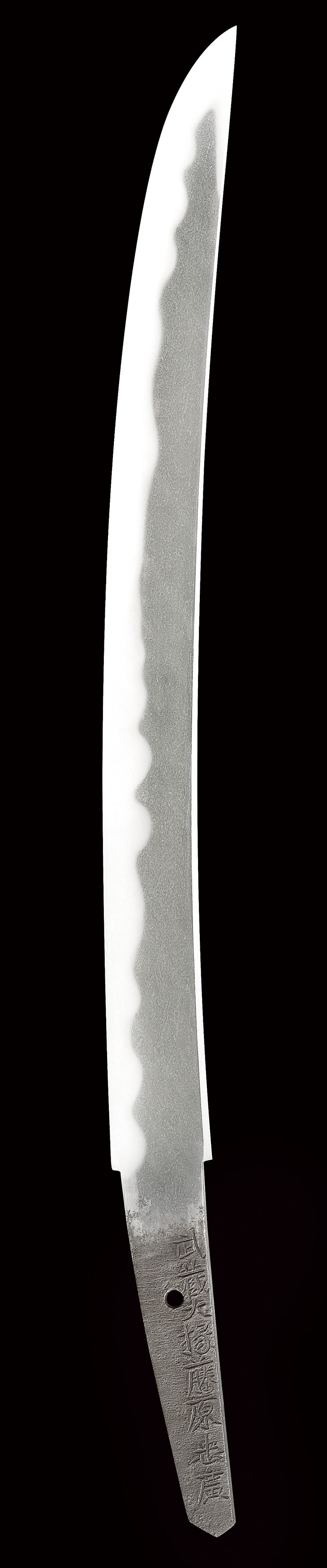
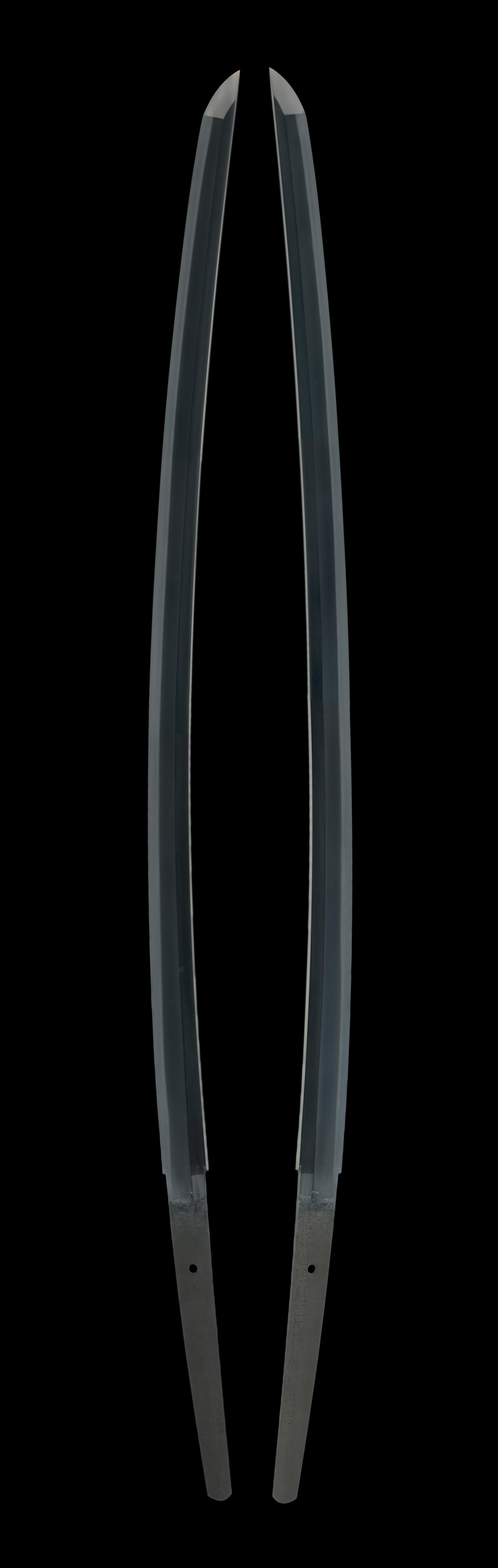
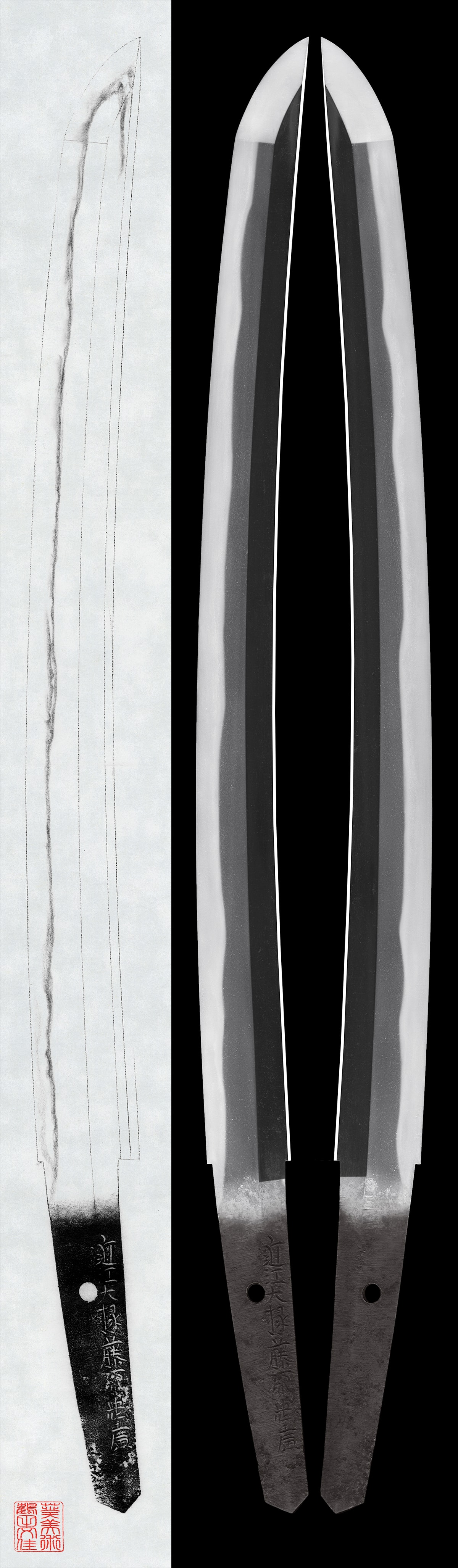
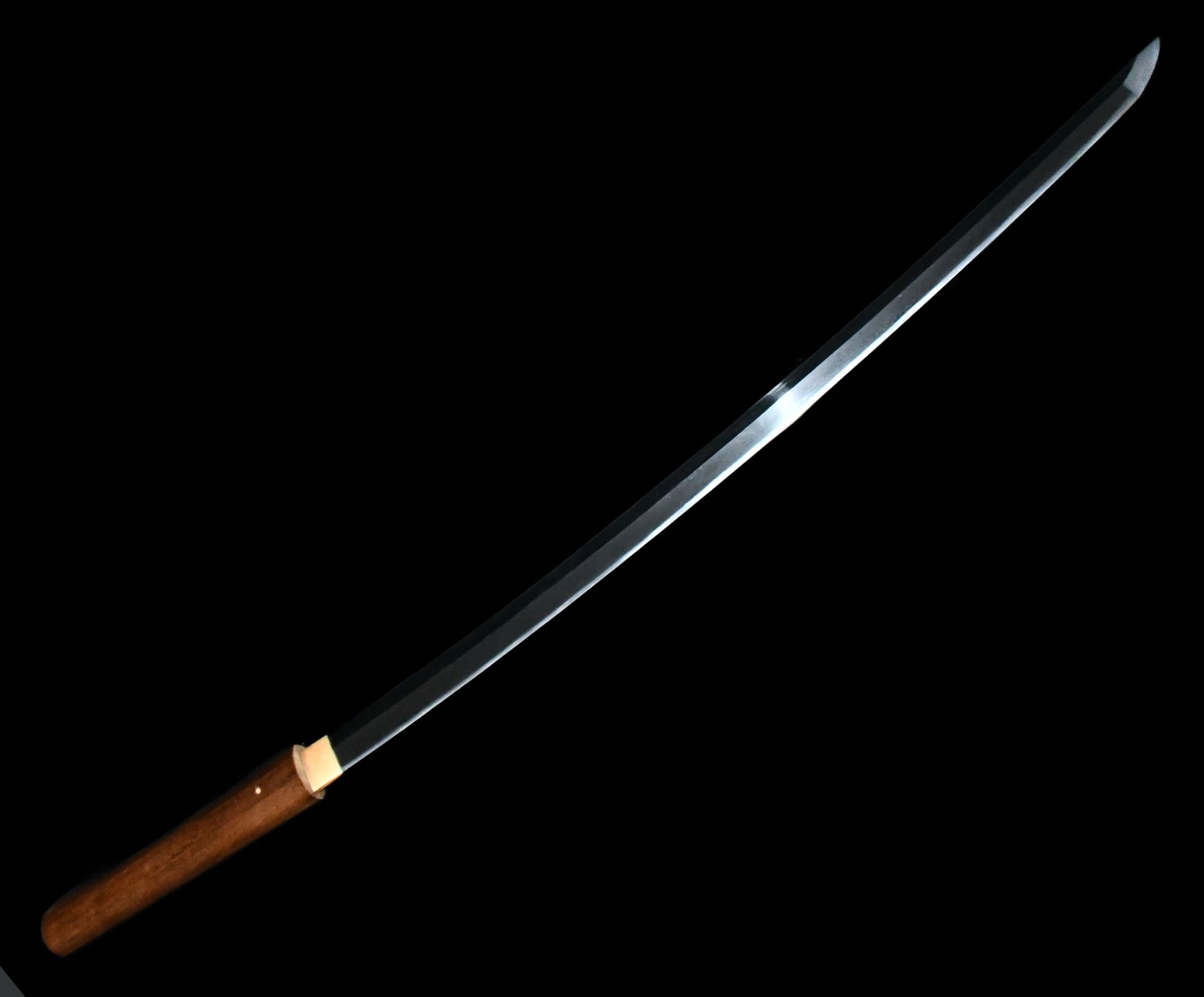
Yoshiie of signed his blades on the toward the with a long inscription that gives his residence as no and, on several, his common name as Sōemon-no-jō, and on the four works that survive in the record he dated them all to 'ei 7, the second month or the eighth, of the year 1630. The published sources set out his place plainly: he was originally of the Hashimoto family (吉家), a direct disciple of the first-generation , and the father of Tadakuni. He signed Hirosada (広貞) before he took the name Yoshiie. Within the school, the mainline tradition of the province centered on Saga, he belongs to the inner circle of the founder, and his hand is the school's own, the closely forged and the bright temper by which -to is known.
That hand is read first in the . He forges a , on the wider blades an , closely and well knit with gathering across it, the tightly grained surface that carries the konuka- look of the school, on one noted as slightly rough in texture. Over it the temper runs in the two manners the published sources name as his equally: a of mixed with , and a quieter . and enter the temper, attaches along it, runs frequently through it, and the is bright and clear. On the earliest of the four, the of 1967, the published record reads the edge from its fuller side, the deep and the well risen, 「匂深く沸よくつく」, with a pronounced rise and fall to the . The answers the body of the blade: a on the straighter pieces, and on the irregular ones a whose point turns sharp and sweeps out in before the return.
The one among the four parts from the in its shape. It is , wide in the body and in proportion, where the are with , shallow to somewhat high in curvature and carrying a drawn slightly long. Across these differences the and the temper hold: the closely forged with fine , the -and- with long and frequent , the bright , so that the reads as the -form face of one manner rather than a separate one. The is throughout, finished in a shallow with or , and the published sources draw attention to the chiseling of the signature, singling out the distinctive form of the character (国) and prizing the inclusion of the common name as a point of documentary value.
The scholarship around Yoshiie turns less on debated attribution than on a single biographical fact, which the records state in nearly the words across the four blades. His extant works under either the Hirosada or the Yoshiie signature are exceedingly few, and the reason given is that he served as one of the , the substitute makers, first under the first-generation and, after the founder's death, under the second generation, Ōmi Daijō (近江大掾) Tadahiro. The of 1971 puts it that he 「常に陰の人として生きた」, living continually in the shadows, and reads his scarcity directly out of that role. On his ability the texts are without reservation: of the 1969 the record observes 「乱れ出来、直刃もあって、技術は優れている」, that his work runs to both irregular and straight temper and that his technique is outstanding, and elsewhere it states 「直刃、乱刃ともに上手で、一般には乱刃が多い」, that he was skilled in both manners with the the more often met.
What sets Yoshiie apart within the school is not a departure from it but the completeness with which he carries its make. The published sources read his blades as representative of the lineage rather than of an individual departure: of the first they write 「同工同派の特色をよく示して出来がよく」, that it clearly shows the features of the smith and the lineage and that its workmanship is good. His place is therefore upstream toward the founder and downstream toward his son. He stands in the founder's circle as a hand trusted to make for the master under his name, and the line passes from him to Tadakuni rather than into a large body of work signed Yoshiie. The closely forged , the bright and the readiness in both and are the - inheritance held intact in a maker who spent his career making for others.
He is rated Jō in the Fujishiro ranking, and the published record on every one of his blades calls the survivals representative works and the 'ei 7 dates valuable as documentary reference. The whole designated record of his hand stands at four works, all of them Important Swords from the fifteenth, eighteenth, twentieth and twenty-third sessions, three and one , with no National Treasure or Important Cultural Property among them and no recorded provenance attached to any. For so scarce a smith, whose own scarcity the records trace to a lifetime spent in the shadows, a signed and dated Yoshiie is among the rarer things a collector of -to could encounter, coming to light only seldom; when one does, it carries the konuka- and the bright temper of the mainline in a hand the founder himself relied upon.