Dewanokami Yukihiro was the second son of Hashimoto Yoshinobu and the younger brother of Kawachi no Daijo Masahiro, which made him a grandson of the first-generation and placed him, from birth in Genna 3 (1617), within the great house. He worked not in the main line but on its collateral, the waki- or Soba- branch, of which he became the foremost master. He received the court title Dewa Daijo in Shoho 5 (1648), was promoted to Dewanokami in 3 (1663), and died in Tenna 2 (1682) at the age of sixty-six. A second-generation Yukihiro, his natural son, first signed Yukinaga and styled himself Tobanojo, took the Dewanokami title in Jokyo 1 (1684), and followed his father's manner so closely that on undated blades the published sources turn to the form of the characters and hiro, and to the Tobanojo prefix, to tell the generations apart, often leaving the question open pending further documentation.
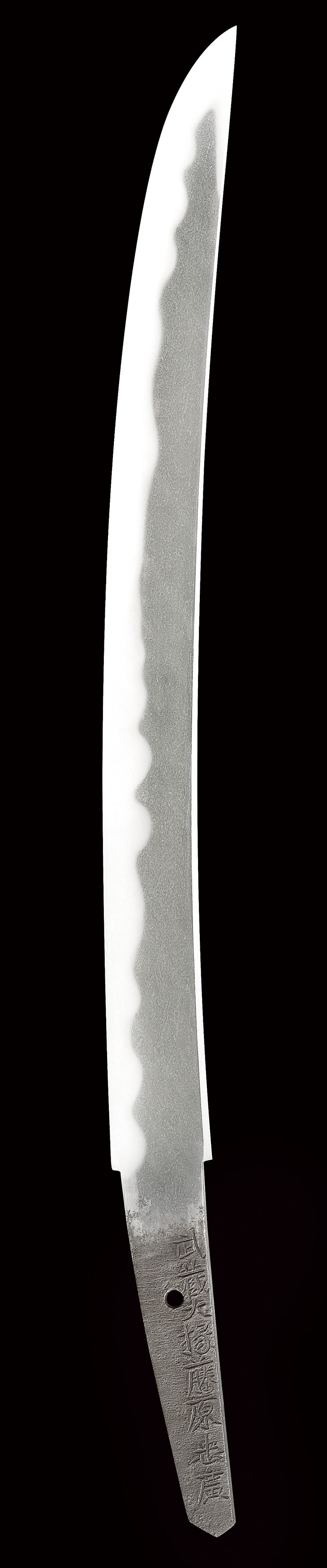
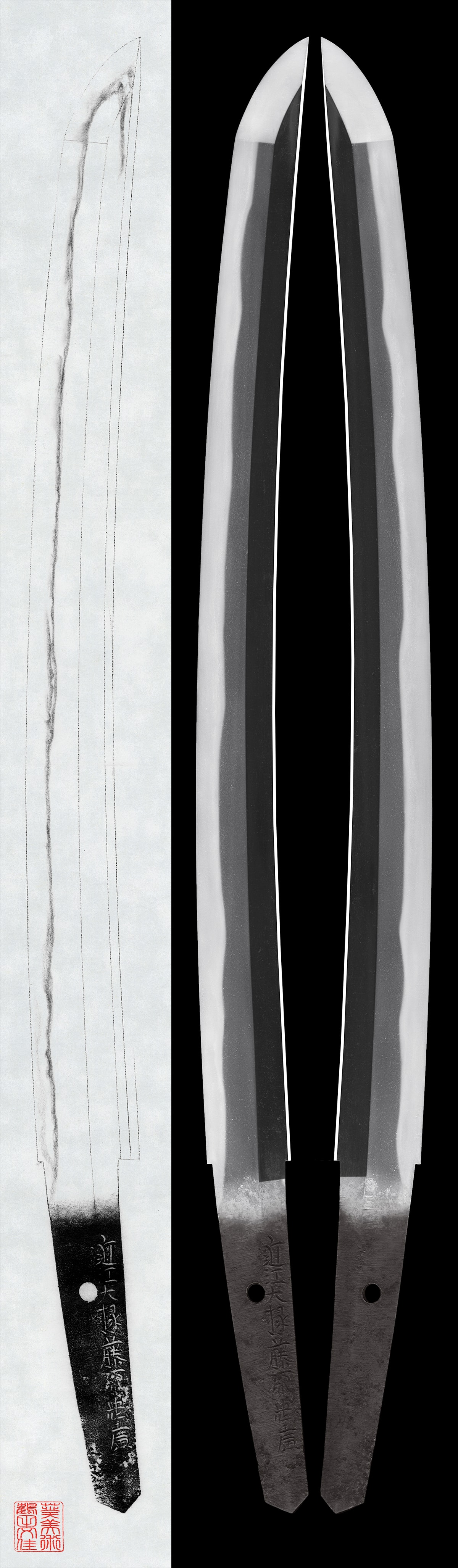
The manner for which Yukihiro is most known is a flamboyant . Over the school's tightly forged he tempers a clove pattern mixed with , angular forms, round-headed and -like elements, the broad, the temper large and showy. Long enter vigorously, the runs deep, adheres thickly with coarser mixed in here and there, and long with conspicuous run through the edge. The published sources fix the tell precisely: of one of his finest they write that "the vertically elongated long- is something often seen in the first-generation Yukihiro, clearly manifesting this smith's distinctive traits." It is this register that the commentary calls the in which "he fully displayed his true capability," the workmanship that on his boldest pieces, the judges allow, even calls to mind his elder brother Masahiro.
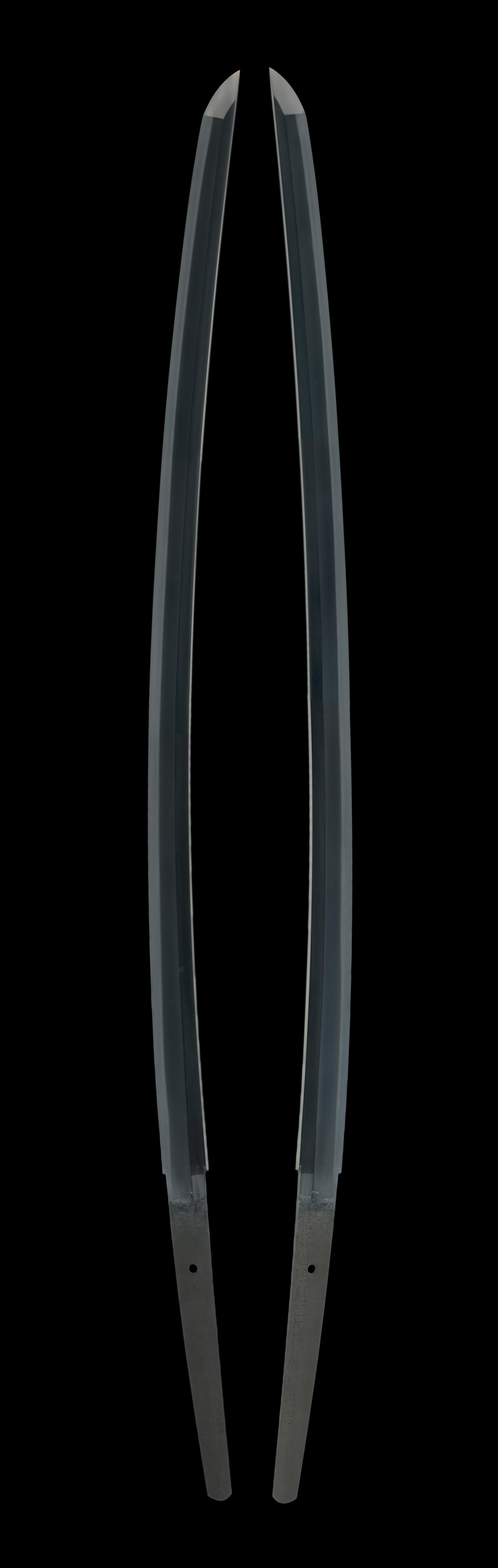
The is the constant beneath both his manners. It is a forged so tightly that it becomes the , the fine rice-bran surface in which lies thickly in minute particles and fine enters, the steel bright and at times tending slightly toward a blackish tone. Over that the runs straight into a or , frequently with at the point and a long turnback; on his wider pieces a touch of and -like gathers near the . The stays bright and clear across his record, the bright temper over the refined komenuka steel being the hallmark he carries whether the edge is wild or calm.
Alongside the showy clove pattern Yukihiro commanded the school's traditional straight temper, and a clear register of his record is a chu- or . Over the komenuka he sets a -toned line, mixing small or, near the base, an angular suggestive of , with and entering, deep , thickly adhering , and fine and . Of one wide- the published sources say its appearance could be mistaken for the straight temper of the main line, "a finish that could be confused with the main house's ," calling it a comparatively uncommon example that shows his high technical level. A dedicatory offered to Jingu carries the clean , the bright and notably clear. Orthogonal to all this runs a strand peculiar to the founder, the Aranda- or Dutch forging he is said to have learned at Nagasaki in Keian 3 (1650) under the Dutch smith Hisatsugu and one Yakushiji Tanenaga, in essence a method of working nanban-tetsu, imported steel; many of his blades carry the supplementary inscription i-Aranda- kore, and the dated examples among them the commentary prizes as valuable source material. He customarily cut the single character on the tang, and rarely the full , an idiom of his own that is not to be confused with the medieval school.
What sets Yukihiro apart within his own tradition is exactly what the judges name. His showy long- divides him from the calm of the main house, while his refined komenuka and bright keep him within it; of his with mixed chooji the sources write that it realizes "the -ba in which the swordsmiths of the so-called Soba- group were particularly adept," and the at the base of such pieces they note as one of that branch's principal points of interest. One reverses the usual arrangement, tempering above and a -toned shallow below, which the commentary calls an unusual manner within the tradition, while observing that the upper-half is still "the -ba at which he particularly excelled." He is, in the end, the brightest of the branch hands that grew up beside the main line, read against it rather than apart from it.
For the collector, Yukihiro is an attainable but uncommon name from the early world. Fujishiro grades him Jo . He has no National Treasures and no Important Cultural Properties; his record on file runs entirely through the rank, sixteen blades, almost all of them signed, several called by the published commentary outstanding among his work and rich in spirited force. The provenance that survives is modest and well-documented: one long offering dedicated to Jingu (the Daijingu) stands among the recorded pieces, the rest passing through private hands of partial record. Because nothing of his is locked away in the museum and shrine tiers that hold the very top of , a signed Dewanokami Yukihiro is not beyond the reach of a serious collector; but his blades come to light only from time to time, and a dated Aranda- example or one of his most flamboyant long- is a notable thing to encounter, a document of how the waki- branch carried the steel into its own brighter manner.