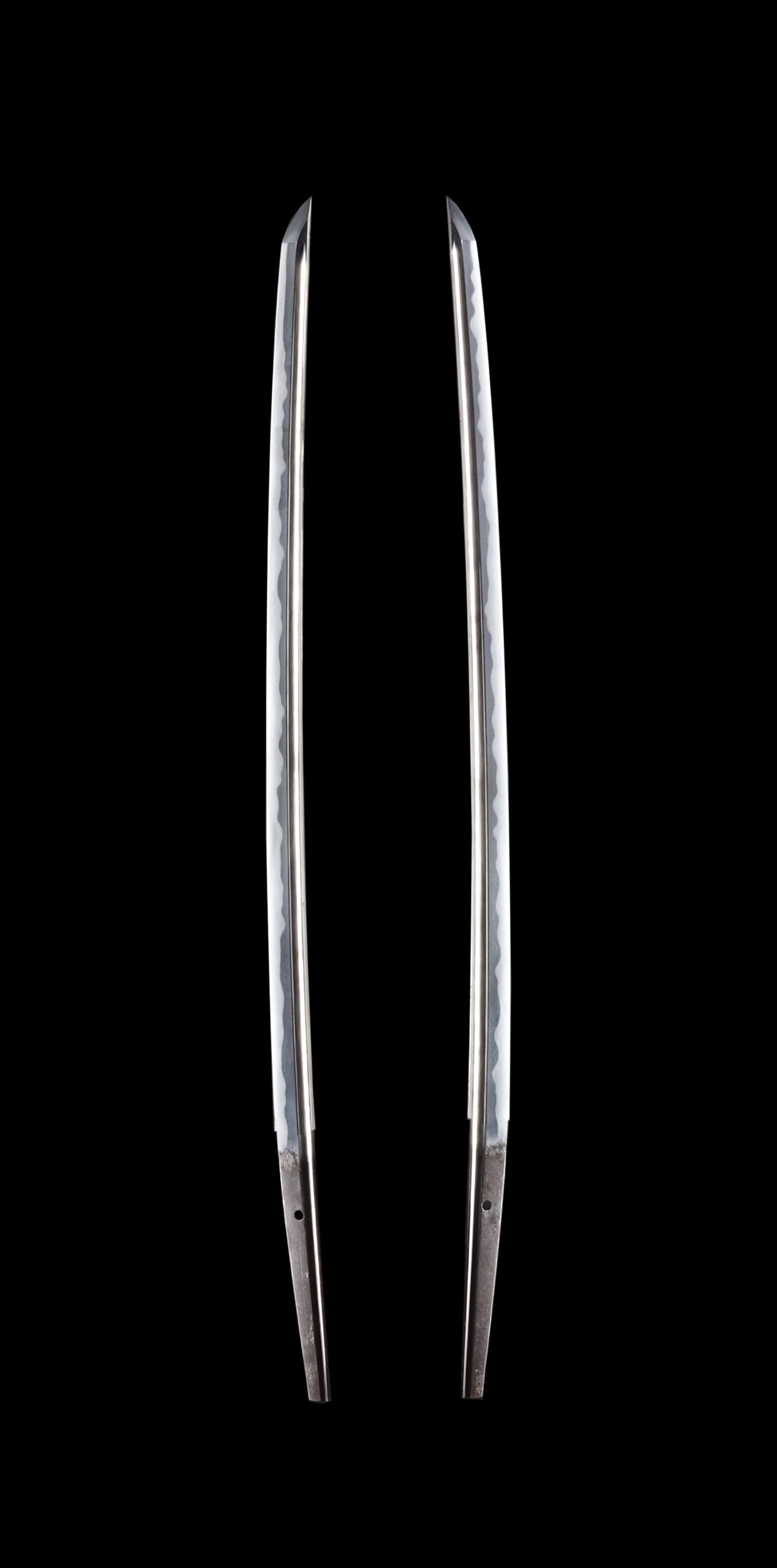
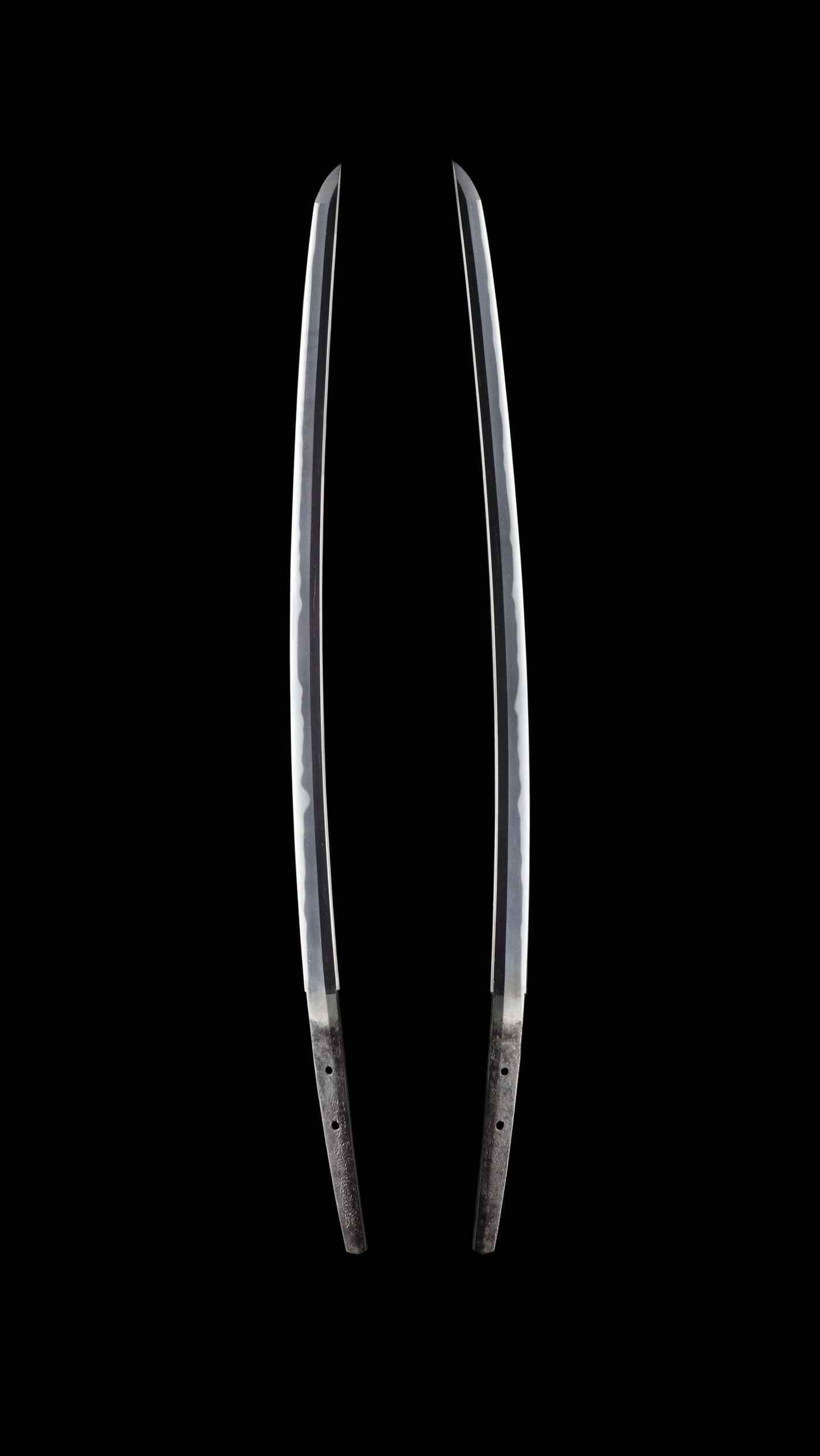
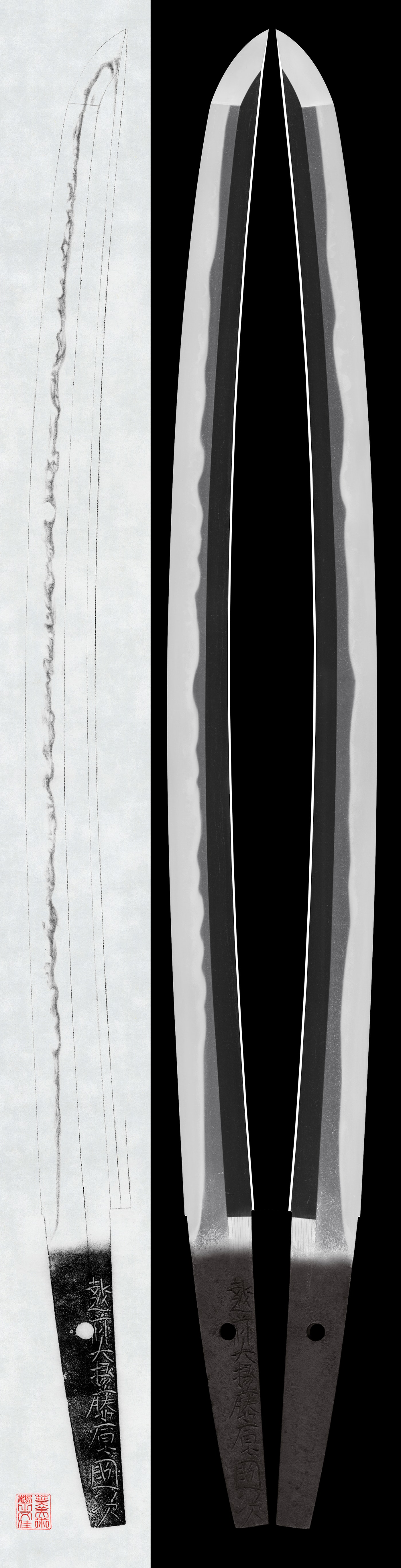
Kunimasa worked in Kyoto in the opening years of the period as a disciple of Kunihiro, and the central problem his blades pose is how few of them there are. The published sources note that extant signed works by him are exceedingly small in number, and that no example with a long signature or a date is known, so that even his personal history remains largely unrecorded. The one piece of firm documentary footing is an - blade by his senior Kuniyasu on which Kunimasa added the inscription Kuniyasu shōsaku, Kunimasa, a collaboration that fixes him as a junior member within the circle. From the close correspondence of his workmanship, his tang construction, and even his manner of cutting a signature to Kunihiro's own signed work, the published commentary reads him as a likely substitute maker for his master during the master's lifetime. Ichiran records of him only 「二字に切。堀川国広門人」, that he signed in two characters and was a pupil of Kunihiro, and adds nothing more.
His hand is the manner in concentrated form. Over an mixed with that stands up and at times runs into , with an element entering on the larger blades, he forges the loose, rough texture for which the school is known, the grain open and visible rather than tightly compacted. The temper is built on a carried as the principal motif, into which are mixed and, in places, an arrow-notch -like element; the is deep, adhere well, run through the edge and appear within it. A recurring tell of his work, and one the published sources treat as a feature of the school rather than a fault, is that the takes on a sunken, subdued character rather than standing bright across its whole length. The runs straight and turns back in a with a swept , though on the wider blades it can run to a pointed tip with a long .
The is where the school speaks most clearly through him. gathers over the standing grain, sometimes coarse and clustered, sometimes a fine even sprinkling, and enters along the open ; on one a diagonal rises from just above the , the published description noting the grain 「区下より斜めに水影」, a water-shadow climbing from below the notch. The reading of this is the heart of recognizing him, for it is neither the bright clear steel of a fine nor a quiet uniform but the standing, , slightly restless surface that the smiths inherited from Kunihiro's -leaning revival. The inflection governs the activity in the , the and and the deep over , so that his blades read as a Kyoto hand looking back through Kunihiro toward the older tradition.
Within so small a corpus two strains can be told apart. The principal one is the Kyoto manner described above, the substitute-maker's hand so close to Kunihiro that the tang and signature alone supported the attribution of substitution. A later strain shows a distinct silhouette, a clear difference between base and tip widths, a suggestion of , deeper curvature and a compact , a shape the published sources place in the 'ei and Shōhō years and read as the mark of a junior member of the group who continued to work after the master's death. Some of his blades carry an added inscription reading Bushū jū, resident of in Bushū, from which a second generation is presumed to have relocated eastward; once in his work came to be confused with that of the Hōjōji Kunimasa line, a conflation the commentary is at pains to correct. Whether the move belongs to the smith himself or to a successor the published record leaves open, to await further study.
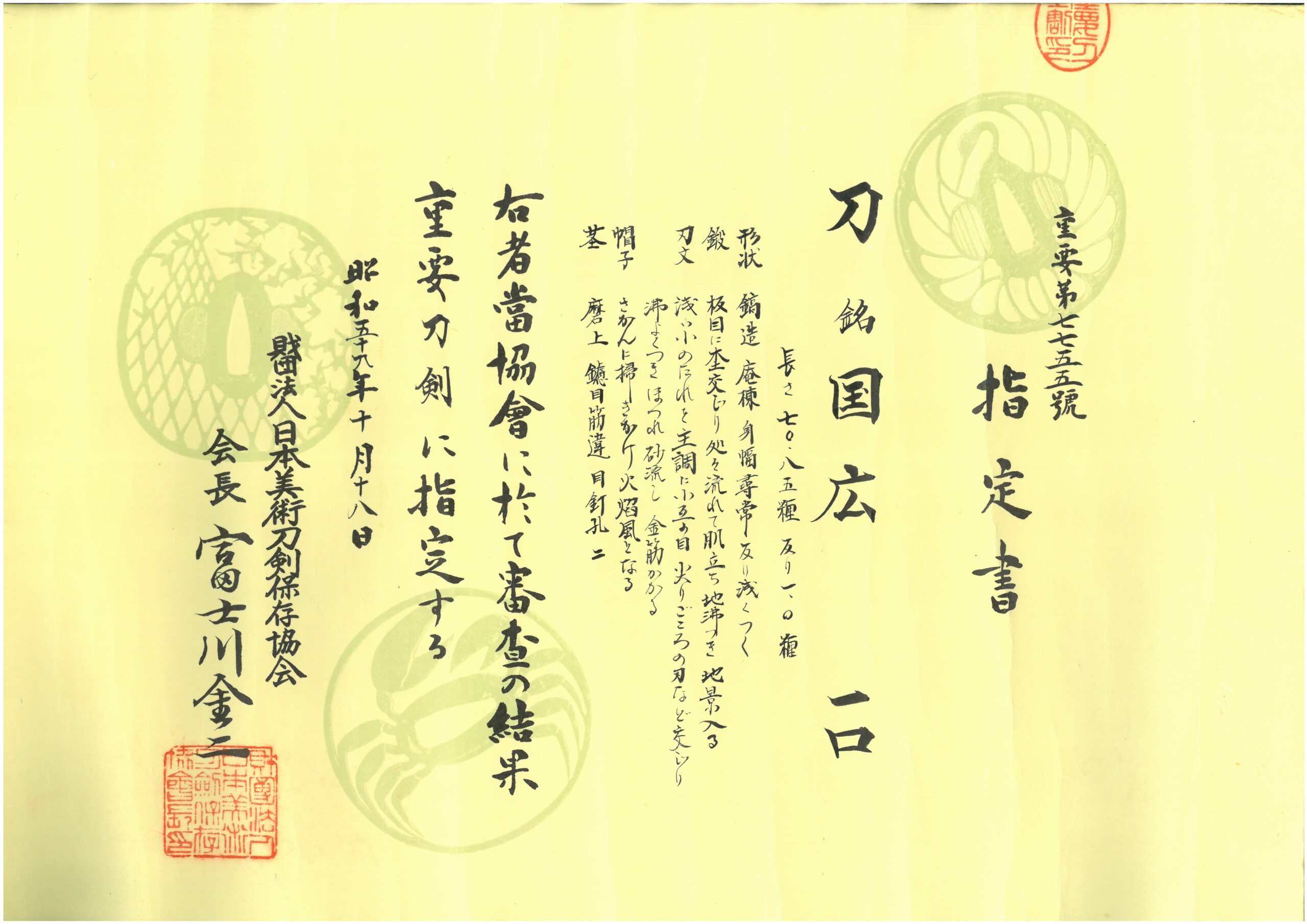
The documentary value of his surviving blades lies in how precisely they let the school be read off Kunihiro himself. The published commentary on his 33rd-session , naming the standing forging, the and , the mixed with , the and and the sunken , concludes that the blade 「堀川物の特色をよく示して出来がよい」, well demonstrates the characteristic traits of work and is good in its making. His distinction is therefore drawn not by departure from his teacher but by fidelity to him, the resemblance of the work and the tang and the signature taken together as the very evidence that he served at Kunihiro's side. Against the wider field his blades stand apart through this concentrated character rather than through any individual flamboyance, and the -centered temper, the published sources allow, may itself be read as a personal hallmark within the school.
Kunimasa has six blades on record at the level and none higher, with no National Treasure and no Important Cultural Property among them, which suits a smith of so small an output. The corpus carries no recorded provenance to houses or museums, and the holders named in the designation papers are private collectors of the Shōwa era rather than long-celebrated institutions, so that an honest account names no roll-call of famous owners. What the record does carry is the unusual closeness of expert judgment on the few blades that survive: his finest is called 「門下中の一流工というべきであろう」, that he should be regarded as a first-rate craftsman among Kunihiro's students, while his best is named 「国正有銘作中の白眉」, the finest among his signed works. For the collector this is a smith encountered rarely and only as a signed work, since unsigned blades are not given to him; when one of his six recorded or his single appears it is a -level piece valued as much for what it teaches about Kunihiro and his workshop as for itself, a quiet but instructive corner of the Kyoto revival.