NihontoWatch MonNihontoWatch
Market
Encyclopedia
Kantei
NihontoWatch MonNihontoWatch
Market
Encyclopedia
Kantei

Description

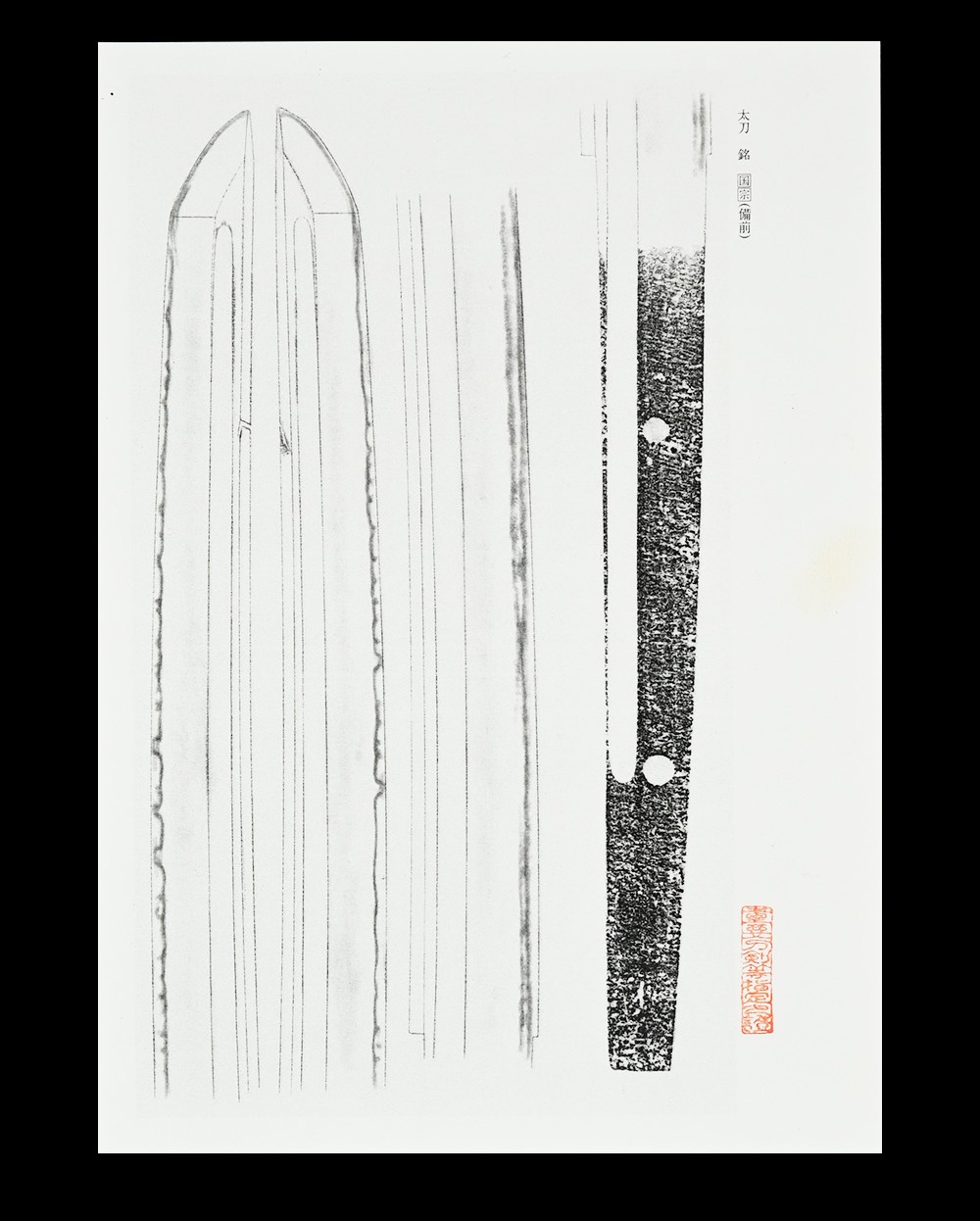
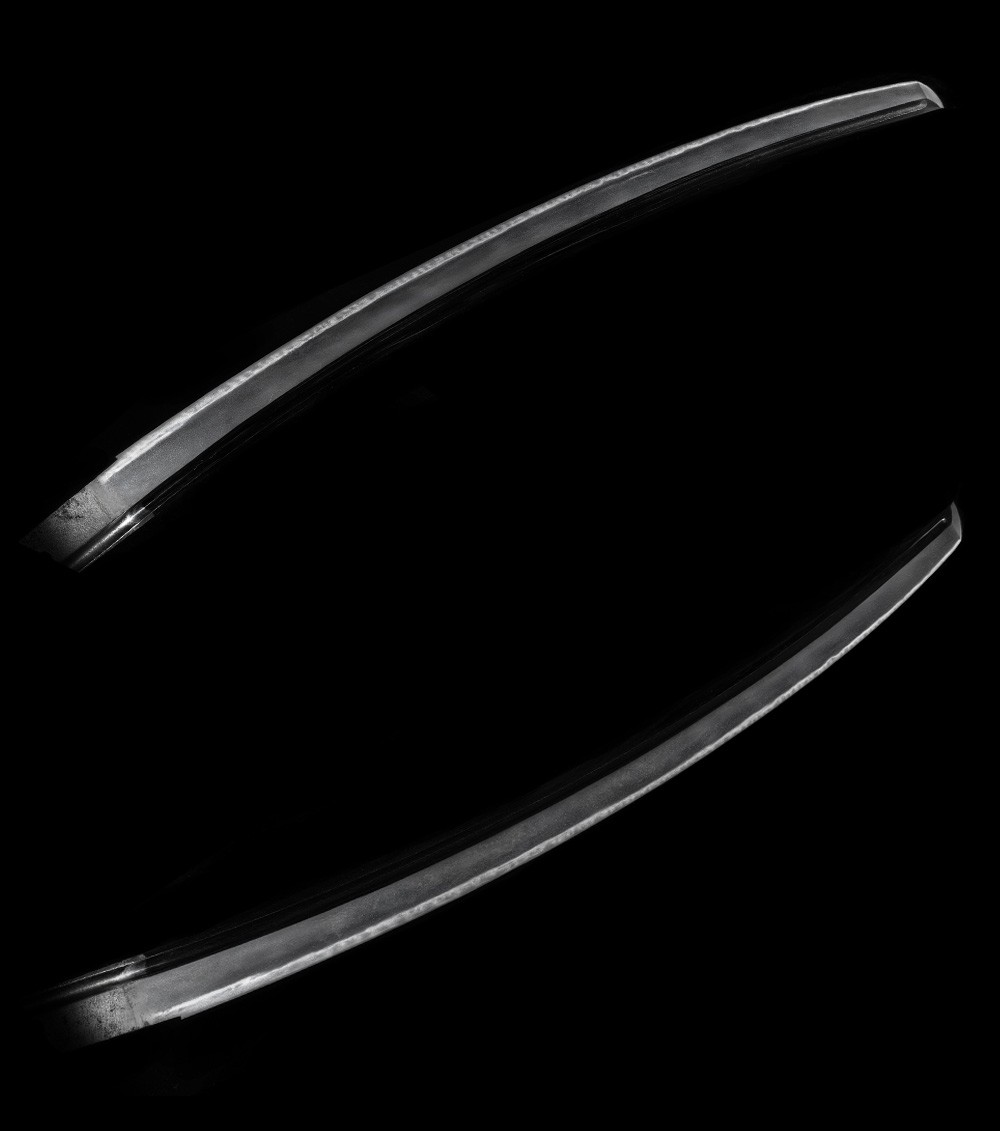
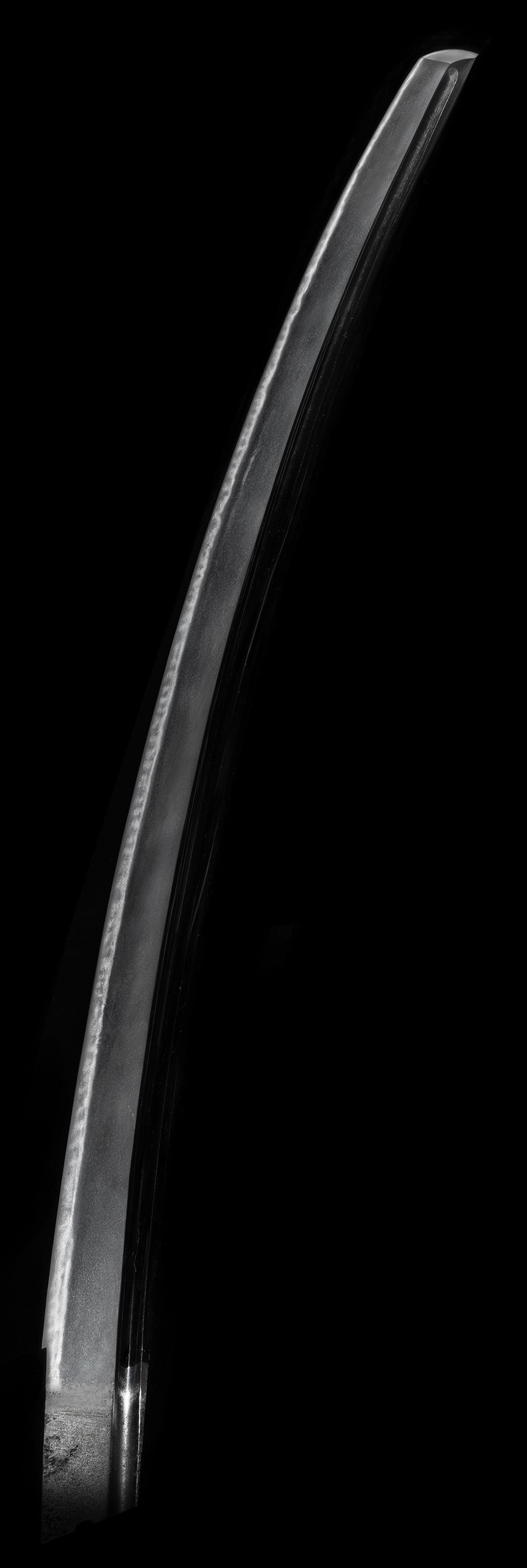
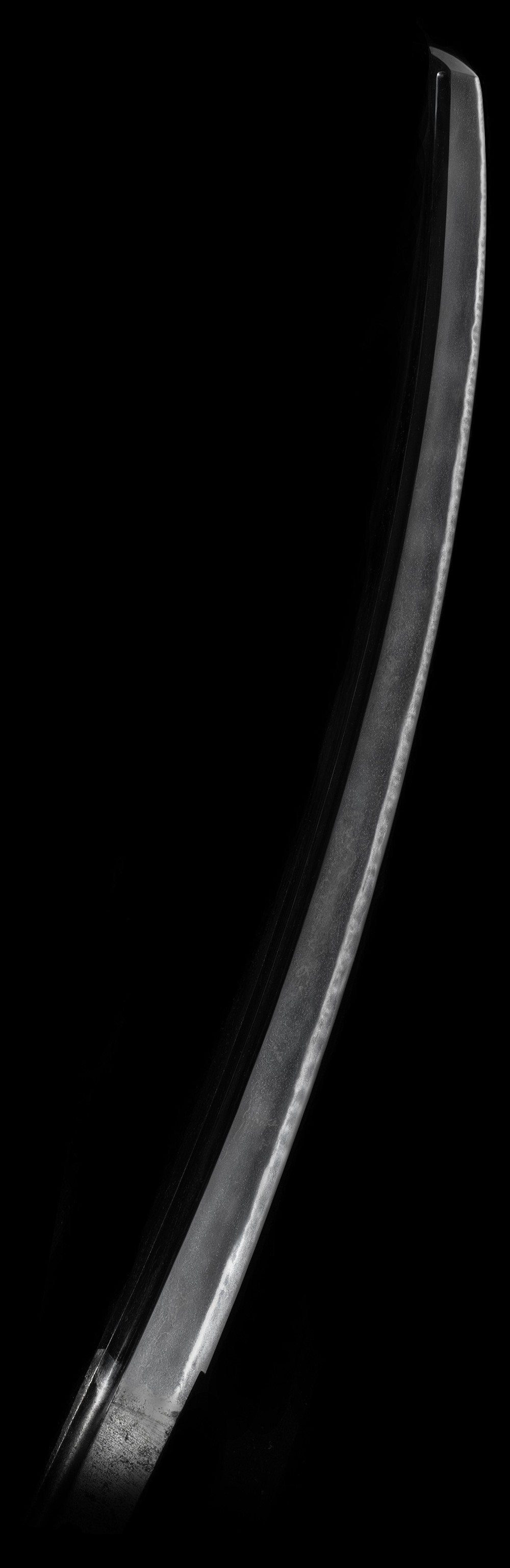
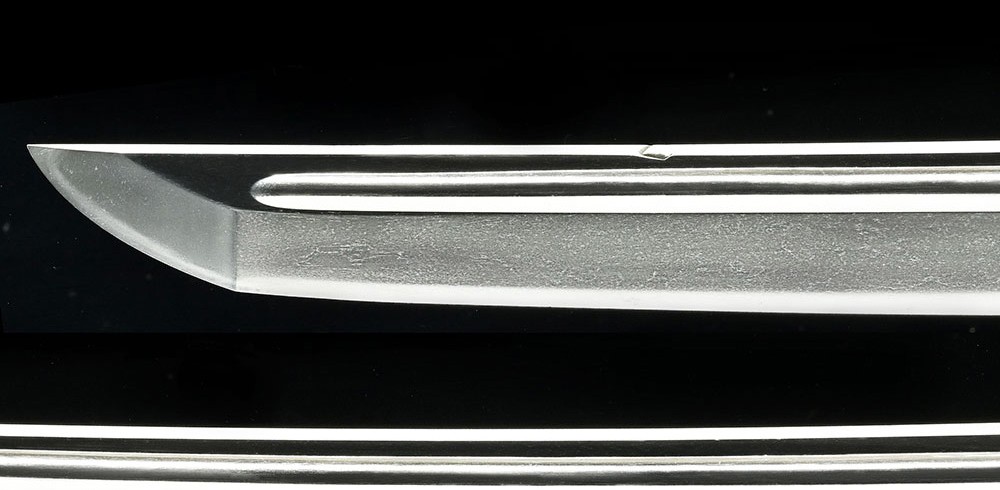
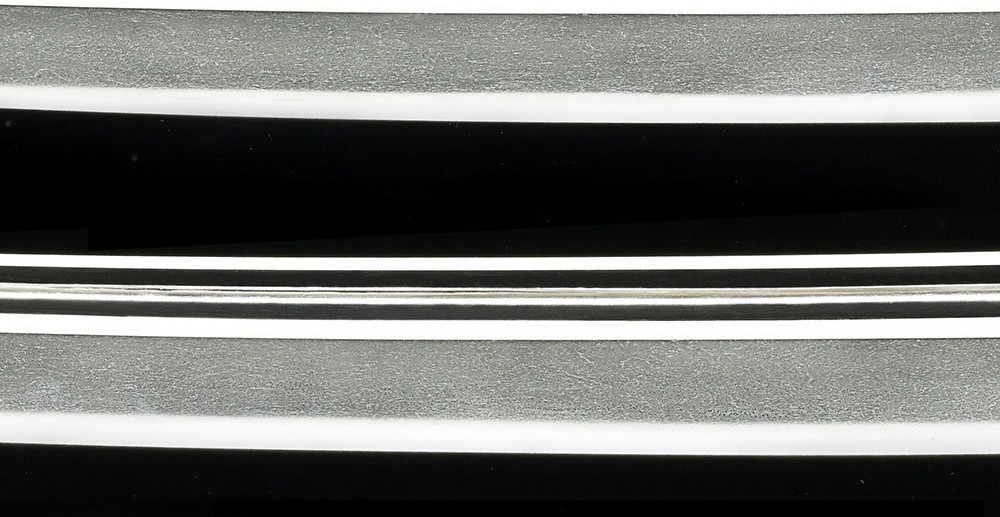
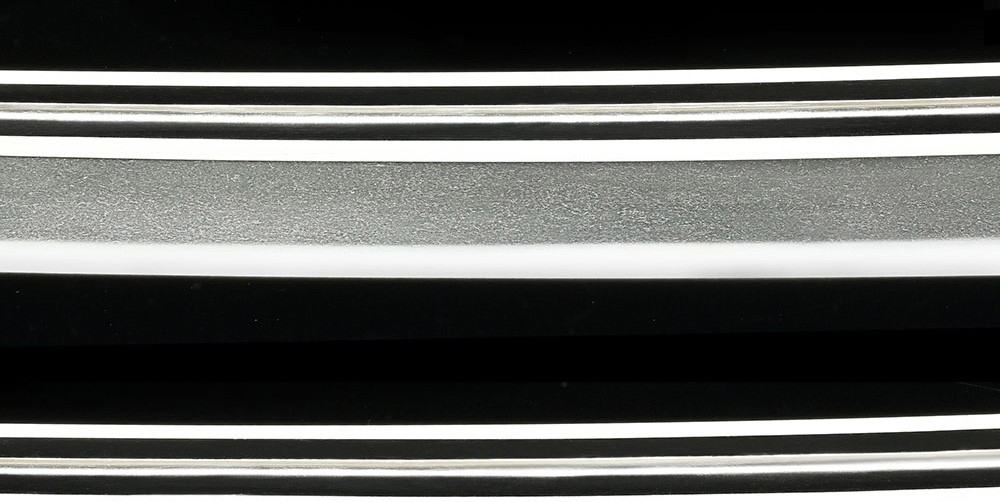
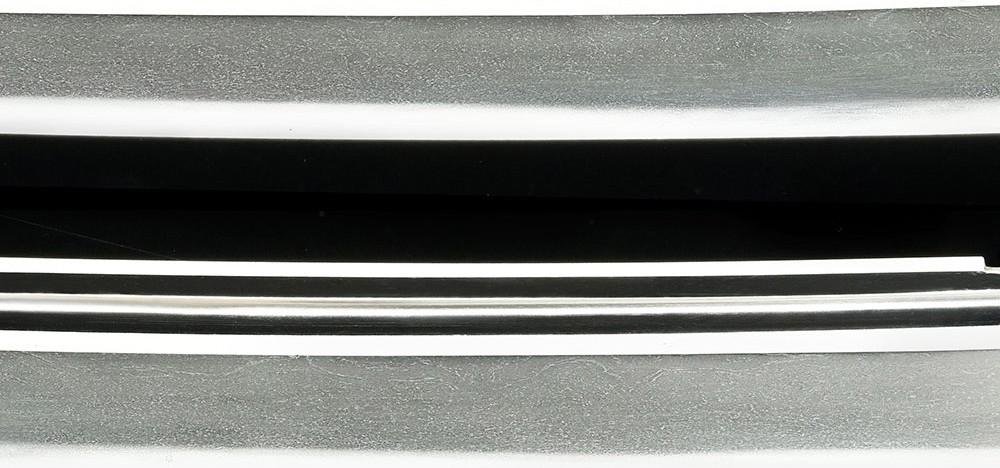
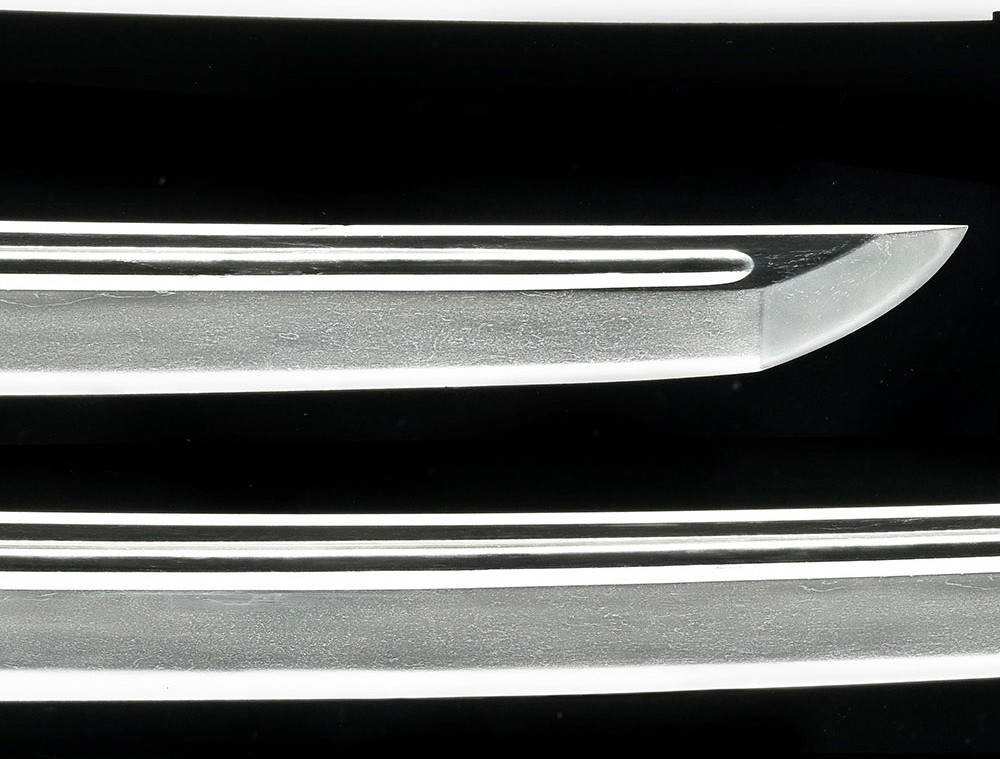
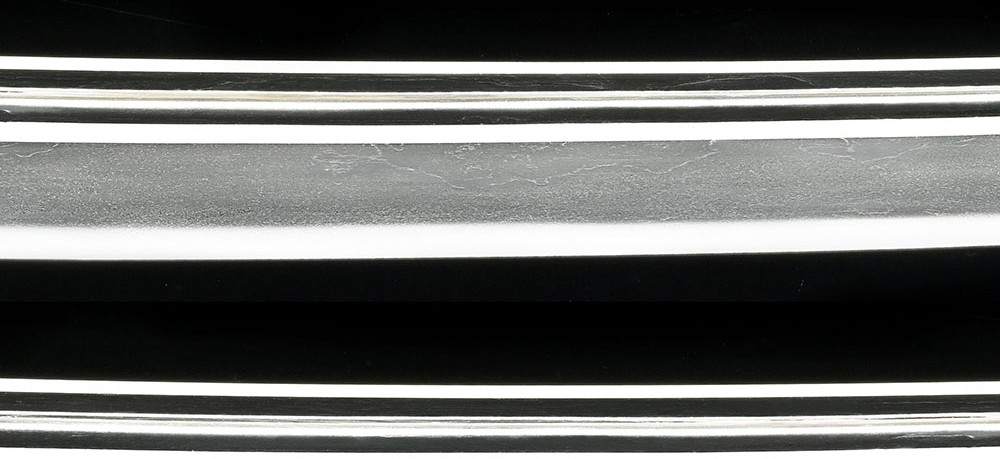
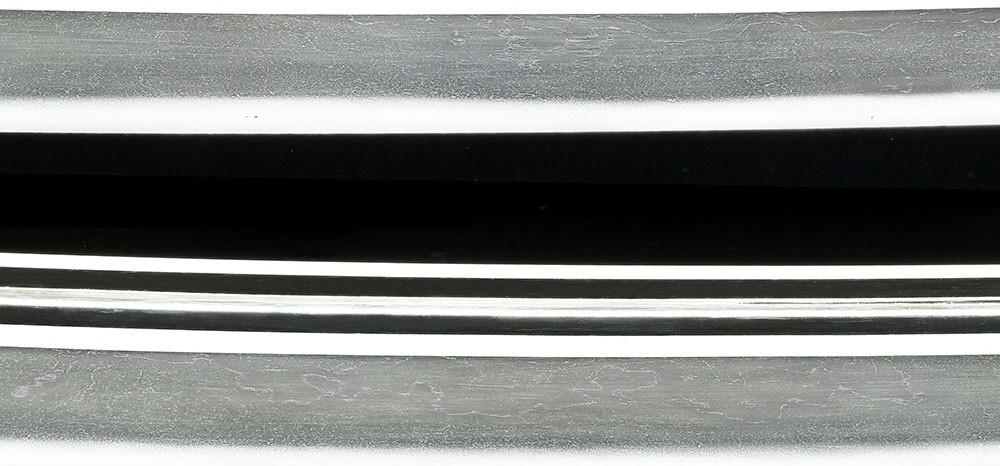
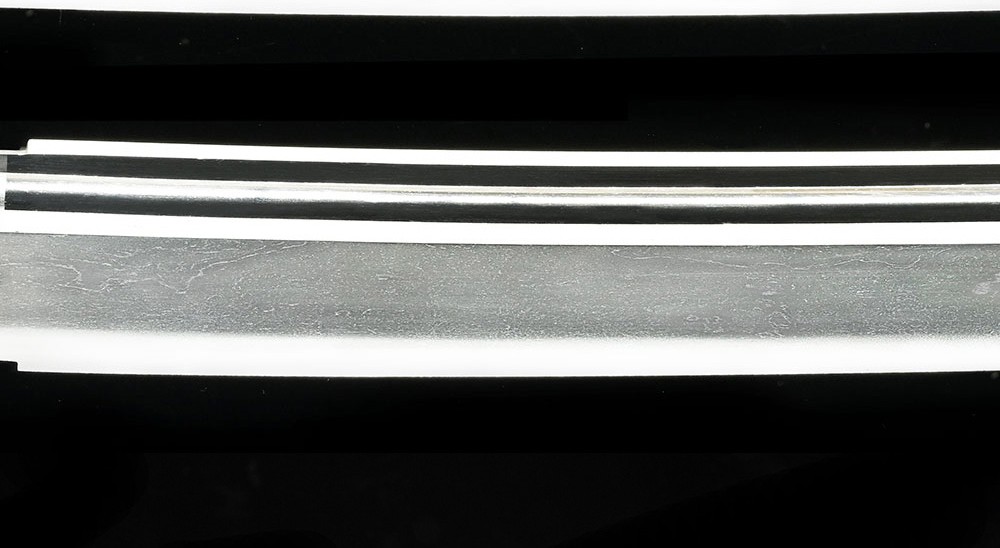
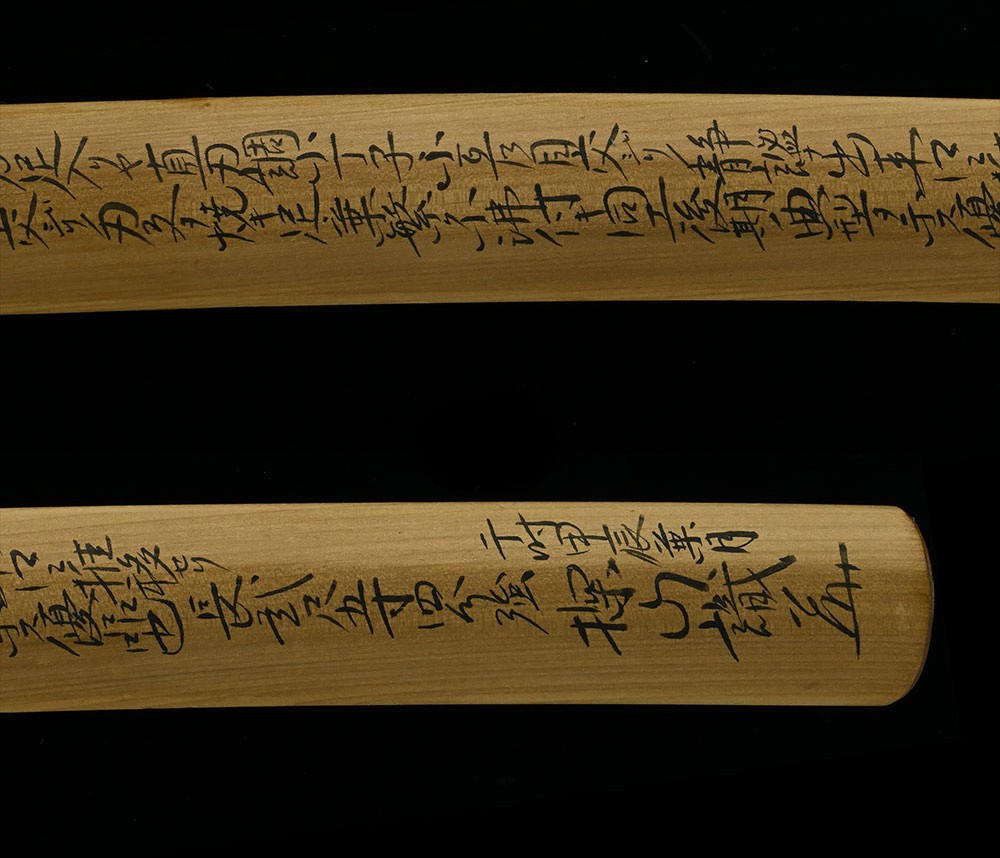
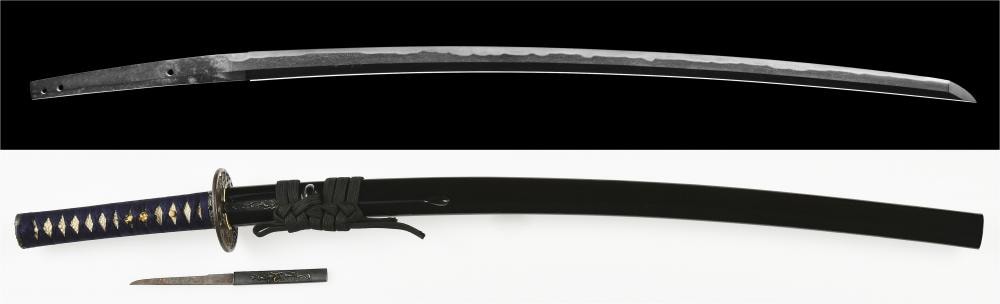
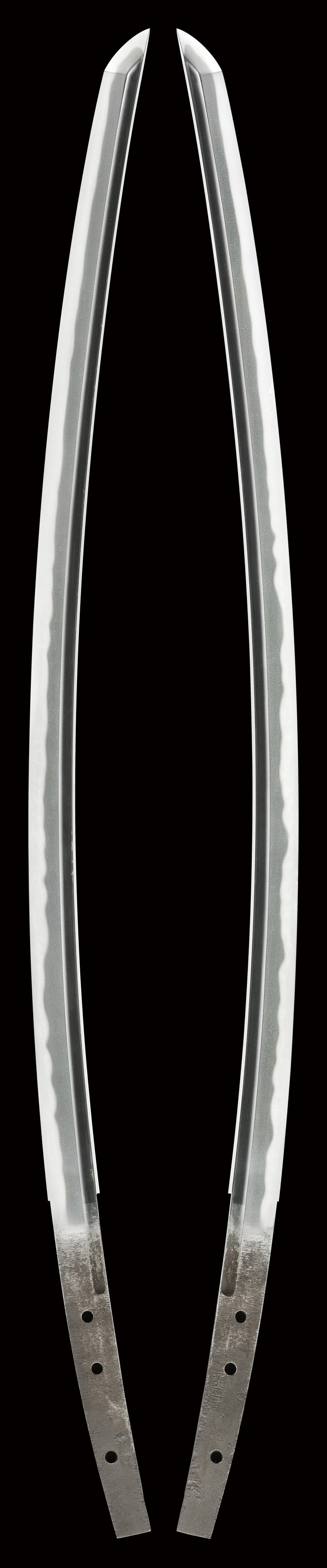
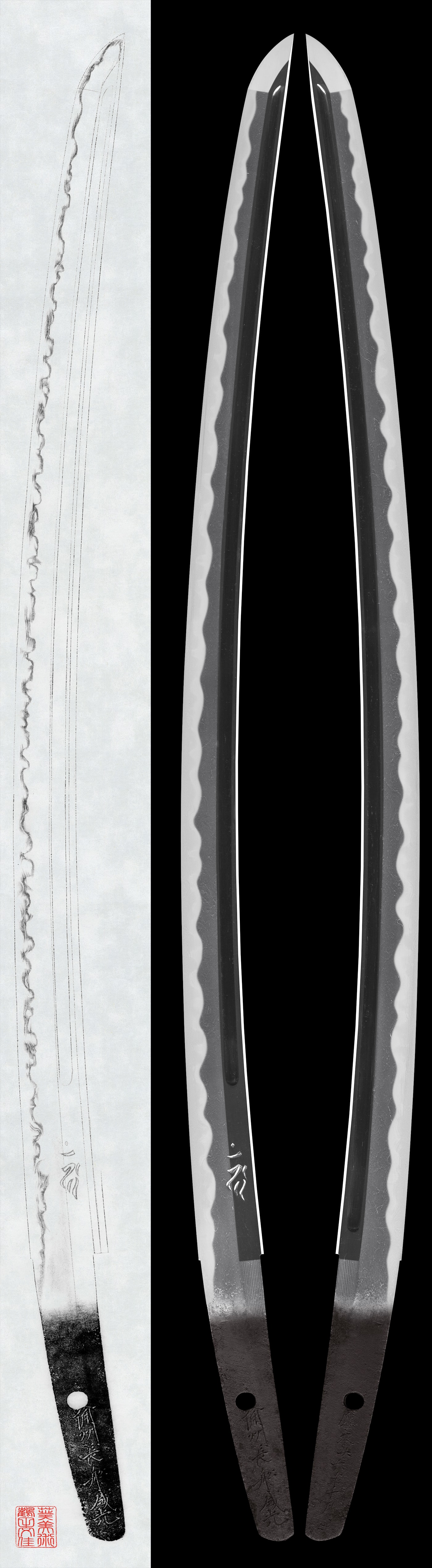
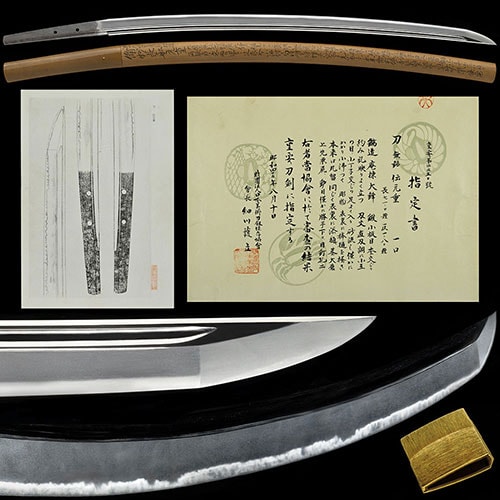
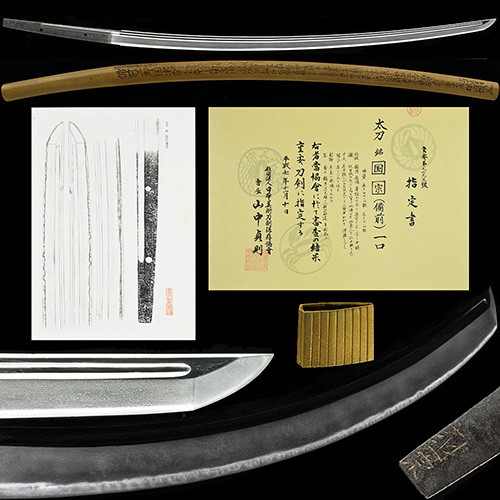
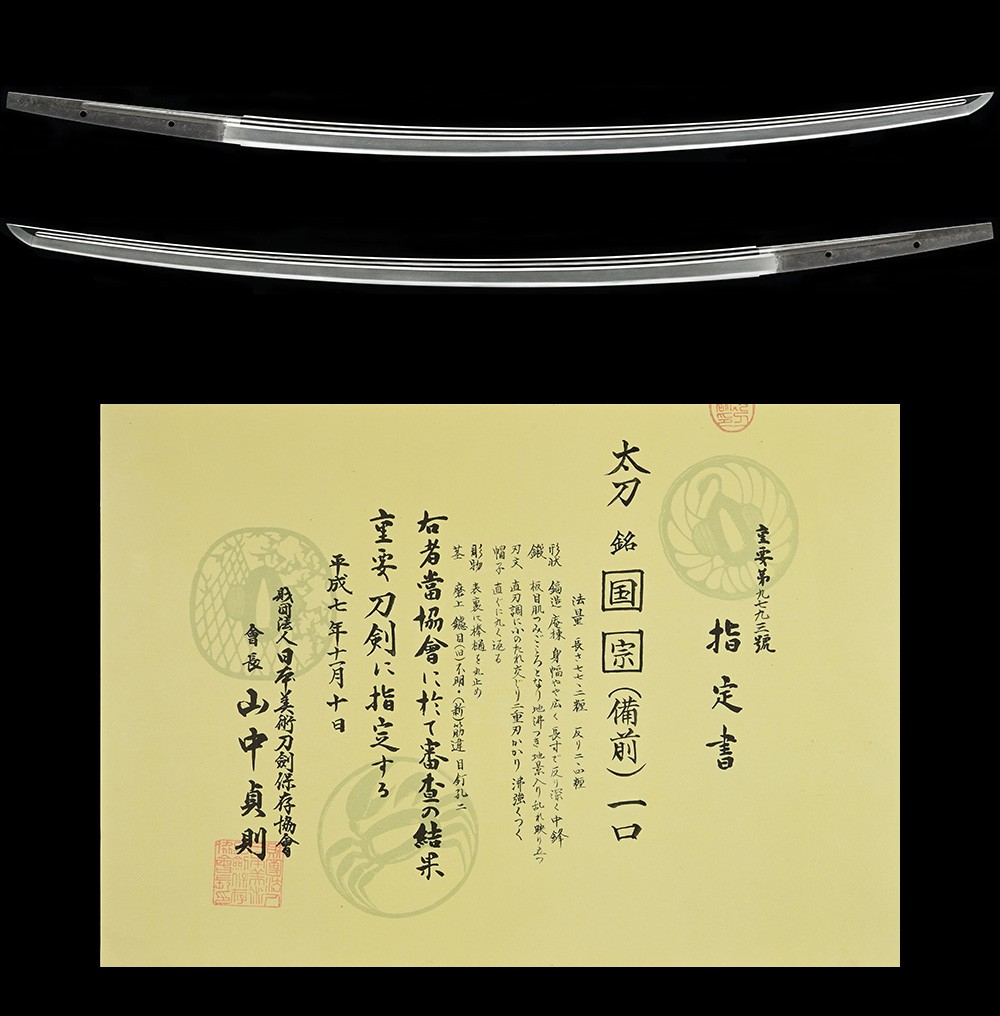
This is a masterpiece Tachi by Kunimune, a swordsmith from the mid-Kamakura period. It features a wide mihaba, deep sori, and a dignified koshizori shape, with a vibrant midare-utsuri. The hamon is suguha-style with small midare and choji, yubashiri, nijuba, and abundant ashi and yo, all contributing to a bright and clear nioikuchi.

NBTHK Setsumei

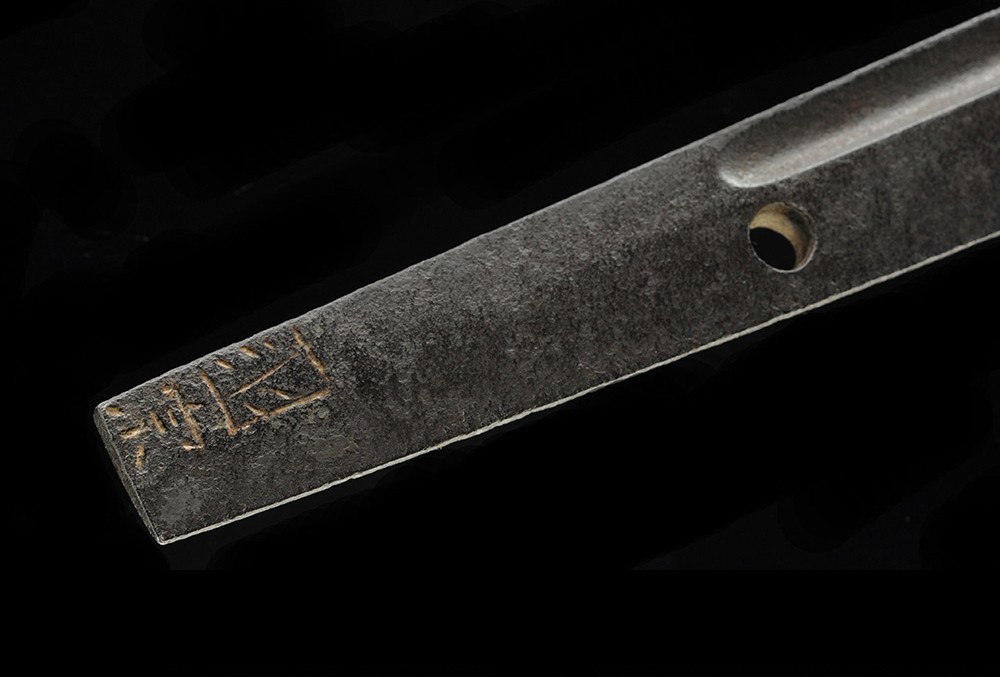
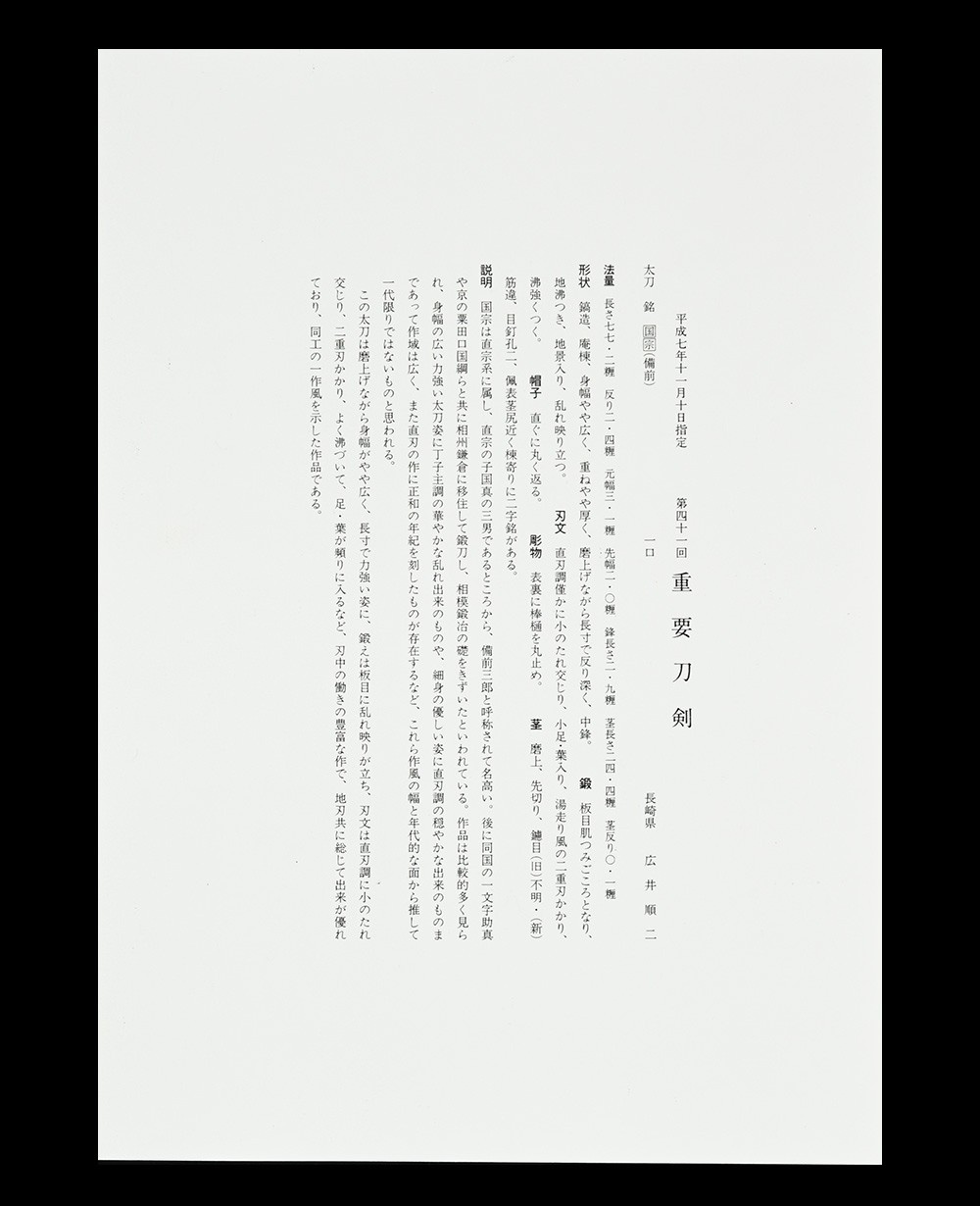
Juyo-Token, 41st Session — Designated October 10, 1995 Tachi, mei: Kunimune (国宗) Measurements Nagasa 77.2 cm, sori 2.4 cm, motohaba 3.1 cm, sakihaba 2.0 cm, kissaki-nagasa 2.9 cm, nakago-nagasa 24.4 cm, nakago-sori 0.1 cm Description Keijo: shinogi-zukuri, iori-mune; the mihaba is somewhat wide, the kasane somewhat thick; although suriage, it remains long in length with deep sori and a chu-kissaki. Kitae: itame-hada in a dense (tsumi-gokoro) structure; ji-nie attaches, chikei enter, and midare-utsuri appears clearly. Hamon: a suguha-based temper, mixed slightly with ko-notare; ko-ashi and yo enter; a yubashiri-like nijuba is present; nie forms strongly. Boshi: sugu and turns back in a rounded manner (maru-kaeri). Horimono: bo-hi on both sides, with rounded terminations (maru-dome). Nakago: saki-kiri; yasurime: (old) unclear, (new) katte-sagari; two mekugi-ana; on the omote, near the nakago-jiri and toward the mune, there is a two-character signature. Artisan Kunimune Era Kamakura period (inferred) Explanation Kunimune belonged to the Naomune lineage. As the third son of Kunima, Naomune’s son, he was famed under the appellation “Bizen Saburō.” It is said that he later relocated to Kamakura in Sagami Province together with Sukezane of the Ichimonji line of the same province and Awataguchi Kunitsuna of Kyōto, forging there and laying the foundations of the Sagami smiths. A comparatively large number of his works are encountered. Within them, his range is broad: there are powerfully built tachi with wide mihaba featuring splendid, chōji-dominant flamboyant midareba; and, at the other extreme, slender and gentle forms with calm workmanship in a suguha-based mode. Moreover, there exist examples in suguha that bear inscriptions of the Shōwa era (1312–1317). From both this breadth of style and the chronological evidence, he is thought not to have been limited to a single generation. This tachi, though suriage, retains a somewhat wide mihaba and presents a long, forceful sugata. The forging is itame with standing midare-utsuri; the temper is suguha-based with slight ko-notare, and shows a nijuba tendency. It is well covered with nie, and ashi and yo enter frequently, yielding abundant internal activities within the temper. The blade is kenzen (sound and well-preserved) in both ji and ha, and its workmanship is excellent. It is a fine work that demonstrates one facet of this smith’s style. Setsumei by Hiroi Dōken (広井道顕)

NihontoWatch MonNihontoWatch
MarketEncyclopediaKantei
Swords›Bizen-den›Naomune›Kunimune›Kunimune Signed Tachi Juyo Token
tachiJūyō
Saburo Kunimune

Kunimune Signed Tachi Juyo Token

mei · Kamakura · nagasa 77.1cm · sori 2.3cm

Price on request
Visit seller website →
Saburo Kunimune (國宗) · Kamakura1 work for sale →
TachiJūyō
Could you name the smith from the blade alone? Today’s kantei →
Saburo Kunimune — 1 of 21
Saburo Kunimune — 2 of 21
Saburo Kunimune — 3 of 21
Saburo Kunimune — 4 of 21
Saburo Kunimune — 5 of 21
Saburo Kunimune — 6 of 21
Saburo Kunimune — 7 of 21
Saburo Kunimune — 8 of 21
Saburo Kunimune — 9 of 21
Saburo Kunimune — 10 of 21
Saburo Kunimune — 11 of 21
Saburo Kunimune — 12 of 21
Saburo Kunimune — 13 of 21
Saburo Kunimune — 14 of 21
Saburo Kunimune — 15 of 21
Saburo Kunimune — 16 of 21
Saburo Kunimune — 17 of 21
Saburo Kunimune — 18 of 21
Saburo Kunimune — 19 of 21
Saburo Kunimune — 20 of 21
Saburo Kunimune — 21 of 21
1 / 21
1 / 21
Saburo Kunimune — 1 of 21Saburo Kunimune — 2 of 21Saburo Kunimune — 3 of 21Saburo Kunimune — 4 of 21Saburo Kunimune — 5 of 21Saburo Kunimune — 6 of 21Saburo Kunimune — 7 of 21Saburo Kunimune — 8 of 21Saburo Kunimune — 9 of 21Saburo Kunimune — 10 of 21Saburo Kunimune — 11 of 21Saburo Kunimune — 12 of 21Saburo Kunimune — 13 of 21Saburo Kunimune — 14 of 21Saburo Kunimune — 15 of 21Saburo Kunimune — 16 of 21Saburo Kunimune — 17 of 21Saburo Kunimune — 18 of 21Saburo Kunimune — 19 of 21Saburo Kunimune — 20 of 21Saburo Kunimune — 21 of 21
Saburo Kunimune (國宗) · Kamakura1 work for sale →
TachiJūyō
Could you name the smith from the blade alone? Today’s kantei →
Measurements & details
Smith
Saburo Kunimune
Type
Tachi
School
Naomune
Period
Around 1278–1310(Joei)
Province
Bizen
Signature
Signed(77% of this smith's designated works are signed)
Measurements
Nagasa 77.1cmSori 2.3cmMotohaba 3.2cmSakihaba 2cmKasane 0.66cmWeight 840g
Description

This is a masterpiece Tachi by Kunimune, a swordsmith from the mid-Kamakura period. It features a wide mihaba, deep sori, and a dignified koshizori shape, with a vibrant midare-utsuri. The hamon is suguha-style with small midare and choji, yubashiri, nijuba, and abundant ashi and yo, all contributing to a bright and clear nioikuchi.

NBTHK Zufu Commentary

Juyo #41

AI translation — may contain errors

-, 41st Session — Designated October 10, 1995

, : Kunimune (国宗)

Measurements 77.2 cm, 2.4 cm, 3.1 cm, 2.0 cm, 2.9 cm, 24.4 cm, 0.1 cm

Description Keijo: , ; the is somewhat wide, the somewhat thick; although , it remains long in length with deep and a . : in a dense () structure; attaches, enter, and appears clearly. : a -based temper, mixed slightly with ; and enter; a -like is present; forms strongly. : and turns back in a rounded manner (). : on both sides, with rounded terminations (). : ; : (old) unclear, (new) ; two ; on the , near the and toward the , there is a two-character signature.

Artisan Kunimune

Era period (inferred)

Explanation Kunimune belonged to the Naomune lineage. As the third son of Kunima, Naomune’s son, he was famed under the appellation “ Saburō.” It is said that he later relocated to in Province together with Sukezane of the line of the province and Kunitsuna of Kyōto, forging there and laying the foundations of the smiths.

A comparatively large number of his works are encountered. Within them, his range is broad: there are powerfully built with wide featuring splendid, -dominant flamboyant ; and, at the other extreme, slender and gentle forms with calm workmanship in a -based mode. Moreover, there exist examples in that bear inscriptions of the Shōwa era (1312–1317). From both this breadth of style and the chronological evidence, he is thought not to have been limited to a single generation.

This , though , retains a somewhat wide and presents a long, forceful . The forging is with standing ; the temper is -based with slight , and shows a tendency. It is well covered with , and and enter frequently, yielding abundant internal activities within the temper. The blade is (sound and well-preserved) in both and , and its workmanship is excellent. It is a fine work that demonstrates one facet of this smith’s style.

by Hiroi Dōken (広井道顕)

About the maker

Kunimune

國宗

Bizen Saburo (Naomune line) · Bizen · around 1278-1310

Fujishiro Sai-jo saku · Tōken Taikan top 3%

1 piece on the market now

›

Kunimune of Bizen, called Bizen Saburo, worked in the middle Kamakura period, the published sources placing him around the Shogen years (about 1259). He belonged to the Naomune line (直宗系), the third son of Naomune's son Kunizane, and from that birth order he was known as Saburo, the third. He lived at Osafune, yet the published sources keep his line clear of the Osafune mainstream and read his metal as Bizen to the last. The texts also carry an old account of his career: that the regent Hojo Tokiyori summoned him east, where with Sukezane of the Fukuoka-Ichimonji school and Kunitsuna of the Awataguchi school in Kyoto he became one of the pioneers of Sagami swordmaking (相州鍛冶). One Tokubetsu Juyo tachi sets the story down plainly, saying he 'was later summoned by the Kamakura shogunate under Hojo Tokiyori and moved to Kamakura, where together with Sukezane of the same province's Fukuoka-Ichimonji school and Kunitsuna of Kyoto's Awataguchi school he became one of the pioneers of Sagami swordmaking'[[c:1]].

The published sources divide his work into two hands, and that division is the whole of the smith. The first is a wide, powerful tachi, often with high koshizori and funbari and on the finest pieces an ubu pheasant-thigh kijimomo nakago, tempered in a flamboyant choji-led midare. Over an itame mixed with mokume that tends to stand he forges a vivid midare-utsuri, the temper crowding with gunome, angular and pointed teeth, ashi and yo entering richly, nioi-laden with ko-nie, kinsuji and sunagashi working through. The signature feature appears in this hand: the texts say that in the flamboyant midare works there is, as it has been called since old times, the 'Bizen Saburo no shirajimi,' a whitish stain that shows within the ha (古来「備前三郎の白染み」と称して, 刃中に染みがあらわれるところが特色とされている). The same texts add that the stain belongs mainly to this flamboyant hand and is little seen in the quiet one, so that its presence reads as a mark of the maker rather than a flaw.

The jigane is where the published sources set his point of difference. His flamboyant choji recalls Mitsutada and Moriie at first glance, yet beside them his forging stands somewhat more, the ha-hada at times rises, and nie mixes into the ha; ji-nie gathers on the standing itame, fine chikei runs in it, and the midare-utsuri rises bright. In places the nioiguchi sinks and clouds, an urumi the texts read together with the shirajimi as one quality of his steel. Over this hand the boshi runs midare-komi with a pointed tendency, or rises sugu and returns in a small round with brushed hakikake at the tip.

Beside the flamboyant hand stands a quiet one, and the two together are the spine. The second manner is a slender or ordinary-width, gentle sugata, the forging tighter, at times a fine ko-itame with minute ji-nie. Its temper is a suguha-cho mixing ko-choji and ko-gunome, with ashi and slanting saka-ashi, the nioiguchi tight with ko-nie, bright and clear at its best. The texts tie the two manners to the signatures themselves: the flamboyant hand is signed large, with a thick chisel and rounded calligraphy, the quiet hand small, with a thinner chisel and squared calligraphy. This quiet hand carries the dated remains, the late-Kamakura Showa years (正和年紀), and from the breadth of the two manners and those late dates the texts judge that 'taking the change of styles and the chronological evidence together, it appears the name was probably not the work of a single generation, though this point should await further study'[[c:2]].

For recognition the boshi is the working tell in the quiet hand. A calm Kunimune in suguha may look at first like Osafune Sanenaga or Kagemitsu, but the texts mark the difference at the turnback: of one signed tachi they say it 'at first sight recalls the workmanship of Sanenaga or Kagemitsu of Osafune, yet shows a difference in that the boshi rises straight and returns in a large round o-maru'[[c:3]], the slightly nie-laden ji and ha and the prominent chikei completing the judgment. At the flamboyant top end the confusion runs instead toward Ichimonji, and there a koshi-biraki opening in the midare and nie clotting even inside the ha settle the attribution; that koshi-open manner marks the small sub-group of the Tenkyuwari look, an anchor for mumei blades of the same air. The shirajimi too is a keyed feature rather than a constant: the texts note that 'this phenomenon is frequent in the works with a flamboyant midare temper and is little seen in those of a suguha-toned make'[[c:4]]. The lineage is kept clean at the root: the Naomune line stands apart from the Osafune mainline, and Nakahara Kunimune, whose dated tachi run from Kagen to Engyo in a quiet suguha base, is regarded as a pupil of the first generation.

For the connoisseur, Kunimune is Sai-jo saku in Fujishiro's grading, with three National Treasures, ten Important Cultural Properties and eight Tokubetsu Juyo among ninety-seven designated works on record. The National Treasure tachi of Terukuni Jinja in Kagoshima stands at the head of his signed work; the Nikko Toshogu tachi is the National Treasure of his rarer nie-based hand. The named blade Tenkyuwari carries one of the great sword histories: it was the sword Uesugi Kenshin wore when he broke the camp of Takeda Shingen's brother Tenkyu Nobushige at Kawanakajima, was given by Kenshin to Satake Yoshishige, and was held thereafter in the Satake house, lords of Kubota in Dewa, with an itomaki tachi koshirae of Kansei date. The Uesugi, Satake and Shimazu, the Kishu and Owari Tokugawa, the Ii and Abe houses and the Imperial Household appear among his recorded owners, and one tachi reached the Boston Museum of Fine Arts. About sixty-three of his blades fall in the Tokubetsu Juyo and Juyo tiers, which makes a designated Kunimune among the more attainable of the great Kamakura names; the National Treasures and Important Cultural Properties are heritage held in shrines and museums and do not trade, while a Tokubetsu Juyo or Juyo example, most of them held rather than offered, comes to a private collector only with patience, and is a major acquisition when it does, the one realistic way to own the Bizen master whose journey east stands behind the rise of Soshu.

Historical importance

Where Kunimune stands among comparable artisans: across all of nihontō, and within tradition, era, and period. The tiers (Foremost · Leading · Major · Notable) weigh official designations from the NBTHK and Japan's Agency for Cultural Affairs, together with historical honors of lasting repute such as the Sansaku and Meibutsu-chō.

随一
Foremost
屈指
Leading
有数
Major
著名
Notable

Select a lens to see how it's measured.

Designation record
93 designated works
Kokuhō (National Treasure)
2
Jūyō Bunkazai
10
Jūyō Bijutsuhin
14
Gyobutsu (Imperial)
4
Tokubetsu Jūyō
8
Jūyō
55
1 work by Kunimune on the market→
Kunimune — full profileBizen Saburo (Naomune line) school

Dated Works

Years he was demonstrably active, proven by signed-and-dated blades

Active period
1310Editorial estimate: 1278–1310
1 of 59 designated works carry a date

Study this maker →

About the school

Naomune

直宗

Bizen-den · Bizen

1 piece on the market now

›

The Bizen Saburo Kunimune school gathers a small group of Bizen-den smiths of the Naomune line (直宗系), worked in the province of Bizen and reaching its head in the middle Kamakura period. The line descends from the Ko-Bizen and Ko-Ichimonji smith Naomune through Kunizane to the Kunimune group, whose principal figure, called Bizen Saburo, the published sources place around the Shogen years (about 1259). Though the house resided at Osafune, the texts keep it clear of the Osafune mainstream that descended from Mitsutada, reading its line and its metal as Bizen to the last. The members carry an old account of Kunimune's career: that the regent Hojo Tokiyori summoned him east to Kamakura, where, with Sukezane of the Fukuoka-Ichimonji school and Kunitsuna of the Awataguchi school of Kyoto, he became one of the pioneers of Sagami swordmaking (相州鍛冶), so that the Naomune line stands at the join of Kamakura Bizen and the rise of Soshu-den. Beside Kunimune the members name Kuniyasu, recorded as the fourth son (the Shiro of the house), and Nakahara Kunimune, transmitted as a pupil of the first generation, whose dated remains run through the late Kamakura years. The shared vocabulary the members describe is a Bizen manner built over a standing grain. The forging is an itame mixed with mokume that tends to rise, with ji-nie gathered on the surface and fine chikei working through, over which a bright midare-utsuri appears. Within this base the school divides into two hands, and that division is its spine. The flamboyant hand is a wide, powerful tachi, often with high koshizori and funbari, tempered in a choji-led midare crowding with gunome, angular pointed teeth, ashi and yo entering richly, the nioiguchi laden with ko-nie and kinsuji and sunagashi running through; its keyed feature is the whitish stain known since old times as the Bizen Saburo no shirajimi (備前三郎の白染み)[[c:1]], which shows within the ha. The quiet hand is a slender or ordinary-width, gentle sugata, the forging tighter to a fine ko-itame with minute ji-nie, the temper a suguha-cho mixing ko-choji and ko-gunome with ashi and slanting saka-ashi, the nioiguchi tight with ko-nie.

Across the school a softer divergence recurs: the nioiguchi sinks and clouds to urumi in places, a quality the texts read together with the shirajimi; the members single out this clouding in Kuniyasu's suguha tachi with its ko-midare as the mark of his hand. Nakahara Kunimune's late hand inclines further toward an Aoe temperament (Aoe-kishitsu), his suguha base carrying a stepped dan-utsuri where suji-utsuri and midare-utsuri overlap. For kantei the boshi is the working tell in the quiet hand. A calm Kunimune in suguha may at first recall Sanenaga or Kagemitsu of Osafune, yet the members mark the difference at the turnback, where the boshi rises straight and returns in a large round o-maru, the nie-laden ji and ha and prominent chikei completing the judgment. At the flamboyant top end the confusion runs instead toward Ichimonji, and there a koshi-biraki opening in the midare with nie clotting even inside the ha settles the attribution; that koshi-open manner marks the small sub-group of the Tenkyuwari look, an anchor for mumei blades of the same air. The shirajimi is a keyed feature rather than a constant, frequent in the flamboyant midare works and little seen in the suguha-toned make. The breadth of the two manners and the late dates lead the texts to judge that the name was probably not the work of a single generation, a point left for further study. Kunimune stands at the head of the group, ranked Sai-jo saku in Fujishiro's grading; his signed work is headed by the Terukuni Jinja tachi of Kagoshima, and the named blade Tenkyuwari carries one of the great sword histories, worn by Uesugi Kenshin at Kawanakajima, given to Satake Yoshishige and held thereafter in the Satake house of Kubota in Dewa with an itomaki-tachi koshirae of Kansei date. The Uesugi, Satake and Shimazu, the Kishu and Owari Tokugawa, the Ii and Abe houses and the Imperial Household appear among the recorded owners, and one Nakahara Kunimune tachi likewise passed in the Satake family, the Bizen master whose journey east stands behind the rise of Soshu. Learn more →

3 recorded smiths100 designated works
Leading smiths
SmithEraDesignated
Kunimune國宗1278-131093
Kunisada國貞1259-12604
Kunimune國宗1303-13083
Kuniyasu國安1264-12750
Explore the Naomune school →

Historical context

Bizen in the Kamakura period

›

Kamakura was Bizen’s summit. Tradition places Ichimonji smiths among Go-Toba’s goban kaji, Mitsutada founded the Osafune line at mid-century, and orders flowed from the court and the warrior government alike. No province holds more National Treasure blades.

Bizen in the Kamakura period →

NBTHK Certificate
Jūyō Tōken重要刀剣
Important Sword
›

A blade of top-grade workmanship and condition, formally judged to rank with a nationally recognized Important Art Object (Jūyō Bijutsuhin). Awarded only at the NBTHK’s competitive annual examination.

Of Japan’s roughly 2.5 million registered swords, only 12,307 (about 1 in 203) have ever attained Jūyō.

About the NBTHK›

The NBTHK (Nihon Bijutsu Tōken Hozon Kyōkai, the Society for the Preservation of Japanese Art Swords) is a public-interest incorporated foundation founded in 1948 and supervised by Japan’s Agency for Cultural Affairs (Bunkachō); it is based at the Japanese Sword Museum in Tokyo. Its expert panels physically examine each submitted work (shinsa) and issue a certificate (kanteishō) ranking it by artistic and historical merit. NBTHK papers are the most widely recognized standard of authentication for Japanese swords and fittings.

NBTHK official site→
Seller
E
Eirakudo
🇯🇵Ships from Japan
›
✓Verified dealereirakudo.shop
✓Ships worldwide✓English supportWire transferCredit card
Return policy

Returns/exchanges/cancellations not accepted after shipment except for significant defects; if defective, return/exchange possible within 3 days of arrival (return shipping paid by customer).

View all of Eirakudo’s listings→View this item on the dealer’s site→

Previously sold by Saburo Kunimune

View all →
World Seiyudo
Jūyō
Katana - Jūyō - by Saburo Kunimune - Kinpun-mei Bizen-saburo Kunimune - NBTHK Juyo TokenKatana - Jūyō - by Saburo Kunimune - Kinpun-mei Bizen-saburo Kunimune - NBTHK Juyo Token
Sold

Katana

BySaburo Kunimune
SOLD
Shoubudou
Jūyō
Katana - Jūyō - by Saburo Kunimune - Mumei (Bizen Saburo Kunimune)Katana - Jūyō - by Saburo Kunimune - Mumei (Bizen Saburo Kunimune)
Sold

Katana

BySaburo Kunimune
SOLD
Samurai Nippon
Tokujū
Tachi - Tokuju - by Saburo Kunimune - Kunimune (Bizen Saburo)Tachi - Tokuju - by Saburo Kunimune - Kunimune (Bizen Saburo)
Sold

Tachi

BySaburo Kunimune
SOLD

More from the Bizen tradition

View all →
Nihonto.com
Jūyō
Tanto - Jūyō - by Osafune Kagemitsu - Juyo Tanto by Bizen KagemitsuTanto - Jūyō - by Osafune Kagemitsu - Juyo Tanto by Bizen Kagemitsu

Tantō

ByOsafune Kagemitsu
¥89,500
Aoi Art
Jūyō Bijutsuhin
Daisho - Jubi - by Osafune Nagamitsu - Dai Sho: Katana (Important Art Object): Mumei (Attributed to Nagamitsu) / Wakizashi: Mumei (Attributed to Sekishu Naotsuna)Daisho - Jubi - by Osafune Nagamitsu - Dai Sho: Katana (Important Art Object): Mumei (Attributed to Nagamitsu) / Wakizashi: Mumei (Attributed to Sekishu Naotsuna)

Daishō

ByOsafune Nagamitsu
Ask
Tsuruginoya
Jūyō
Katana - Jūyō - by Fukuoka Ichimonji School - Mumei Fukuoka IchimonjiKatana - Jūyō - by Fukuoka Ichimonji School - Mumei Fukuoka Ichimonji

Katana

ByFukuoka Ichimonji School
Ask
Hyozaemon
Tokuho
Tokuho - by Fukuoka Ichimonji Yoshifusa - Naginata Naoshi Wakizashi by Fukuoka Ichimonji Yoshifusa, a Master of IchimonjiTokuho - by Fukuoka Ichimonji Yoshifusa - Naginata Naoshi Wakizashi by Fukuoka Ichimonji Yoshifusa, a Master of Ichimonji

Naginata Naoshi Wakizashi by Fukuoka Ichimonji Yoshifusa, a Master of Ichimonji

ByFukuoka Ichimonji Yoshifusa
Ask
Aoi Art
Tokuho
Wakizashi - Tokuho - by Oei-Bizen Morimitsu - Bishū Osafune Morimitsu, dated Ōei 26 (1419) - NBTHK Tokubetsu Hozon TokenWakizashi - Tokuho - by Oei-Bizen Morimitsu - Bishū Osafune Morimitsu, dated Ōei 26 (1419) - NBTHK Tokubetsu Hozon Token

Wakizashi

ByOei-Bizen Morimitsu
Starting Bid¥1,500,000
Eirakudo
Tokuho
Katana - Tokuho - by Katayama Ichimonji School - Katayama Ichimonji - Tokubetsu Hozon TokenKatana - Tokuho - by Katayama Ichimonji School - Katayama Ichimonji - Tokubetsu Hozon Token

Katana

ByKatayama Ichimonji School
¥4,500,000
Eirakudo
Jūyō
Katana - Jūyō - by Motoshige - Motoshige - Juyo TokenKatana - Jūyō - by Motoshige - Motoshige - Juyo Token

Katana

ByMotoshige
¥6,000,000
Giheiya
Hozon
Katana - Hozon - by Takada School - Mumei (Hira Takada) - 72.1cm, with Koshirae and ShirasayaKatana - Hozon - by Takada School - Mumei (Hira Takada) - 72.1cm, with Koshirae and Shirasaya

Katana

ByTakada School
¥350,000

Swords

  • Katana
  • Wakizashi
  • Tantō
  • Tachi
  • Naginata
  • Yari
  • Japanese Swords
  • Samurai Swords

Fittings

  • Tsuba
  • Fuchi-Kashira
  • Kozuka
  • Menuki
  • Sword Guards (Tsuba)

Armor

  • Kabuto
  • Samurai Armor
  • All Samurai Armor

By Certification

  • Tokujū
  • Jūyō
  • Tokuho
  • Hozon

Resources

  • Dealer Directory
  • Artist Directory
  • The Daily Kantei
  • Glossary
  • Browse All
Nihontowatch© 2026
TermsPrivacyCookiesAbout

Price on request

View on Eirakudo

Description

This is a masterpiece Tachi by Kunimune, a swordsmith from the mid-Kamakura period. It features a wide mihaba, deep sori, and a dignified koshizori shape, with a vibrant midare-utsuri. The hamon is suguha-style with small midare and choji, yubashiri, nijuba, and abundant ashi and yo, all contributing to a bright and clear nioikuchi.

NBTHK Setsumei

Juyo-Token, 41st Session — Designated October 10, 1995 Tachi, mei: Kunimune (国宗) Measurements Nagasa 77.2 cm, sori 2.4 cm, motohaba 3.1 cm, sakihaba 2.0 cm, kissaki-nagasa 2.9 cm, nakago-nagasa 24.4 cm, nakago-sori 0.1 cm Description Keijo: shinogi-zukuri, iori-mune; the mihaba is somewhat wide, the kasane somewhat thick; although suriage, it remains long in length with deep sori and a chu-kissaki. Kitae: itame-hada in a dense (tsumi-gokoro) structure; ji-nie attaches, chikei enter, and midare-utsuri appears clearly. Hamon: a suguha-based temper, mixed slightly with ko-notare; ko-ashi and yo enter; a yubashiri-like nijuba is present; nie forms strongly. Boshi: sugu and turns back in a rounded manner (maru-kaeri). Horimono: bo-hi on both sides, with rounded terminations (maru-dome). Nakago: saki-kiri; yasurime: (old) unclear, (new) katte-sagari; two mekugi-ana; on the omote, near the nakago-jiri and toward the mune, there is a two-character signature. Artisan Kunimune Era Kamakura period (inferred) Explanation Kunimune belonged to the Naomune lineage. As the third son of Kunima, Naomune’s son, he was famed under the appellation “Bizen Saburō.” It is said that he later relocated to Kamakura in Sagami Province together with Sukezane of the Ichimonji line of the same province and Awataguchi Kunitsuna of Kyōto, forging there and laying the foundations of the Sagami smiths. A comparatively large number of his works are encountered. Within them, his range is broad: there are powerfully built tachi with wide mihaba featuring splendid, chōji-dominant flamboyant midareba; and, at the other extreme, slender and gentle forms with calm workmanship in a suguha-based mode. Moreover, there exist examples in suguha that bear inscriptions of the Shōwa era (1312–1317). From both this breadth of style and the chronological evidence, he is thought not to have been limited to a single generation. This tachi, though suriage, retains a somewhat wide mihaba and presents a long, forceful sugata. The forging is itame with standing midare-utsuri; the temper is suguha-based with slight ko-notare, and shows a nijuba tendency. It is well covered with nie, and ashi and yo enter frequently, yielding abundant internal activities within the temper. The blade is kenzen (sound and well-preserved) in both ji and ha, and its workmanship is excellent. It is a fine work that demonstrates one facet of this smith’s style. Setsumei by Hiroi Dōken (広井道顕)

NihontoWatch MonNihontoWatch
MarketEncyclopediaKantei
Swords›Bizen-den›Naomune›Kunimune›Kunimune Signed Tachi Juyo Token
tachiJūyō
Saburo Kunimune

Kunimune Signed Tachi Juyo Token

mei · Kamakura · nagasa 77.1cm · sori 2.3cm

Price on request
Visit seller website →
Saburo Kunimune (國宗) · Kamakura1 work for sale →
TachiJūyō
Could you name the smith from the blade alone? Today’s kantei →
Saburo Kunimune — 1 of 21
Saburo Kunimune — 2 of 21
Saburo Kunimune — 3 of 21
Saburo Kunimune — 4 of 21
Saburo Kunimune — 5 of 21
Saburo Kunimune — 6 of 21
Saburo Kunimune — 7 of 21
Saburo Kunimune — 8 of 21
Saburo Kunimune — 9 of 21
Saburo Kunimune — 10 of 21
Saburo Kunimune — 11 of 21
Saburo Kunimune — 12 of 21
Saburo Kunimune — 13 of 21
Saburo Kunimune — 14 of 21
Saburo Kunimune — 15 of 21
Saburo Kunimune — 16 of 21
Saburo Kunimune — 17 of 21
Saburo Kunimune — 18 of 21
Saburo Kunimune — 19 of 21
Saburo Kunimune — 20 of 21
Saburo Kunimune — 21 of 21
1 / 21
1 / 21
Saburo Kunimune — 1 of 21Saburo Kunimune — 2 of 21Saburo Kunimune — 3 of 21Saburo Kunimune — 4 of 21Saburo Kunimune — 5 of 21Saburo Kunimune — 6 of 21Saburo Kunimune — 7 of 21Saburo Kunimune — 8 of 21Saburo Kunimune — 9 of 21Saburo Kunimune — 10 of 21Saburo Kunimune — 11 of 21Saburo Kunimune — 12 of 21Saburo Kunimune — 13 of 21Saburo Kunimune — 14 of 21Saburo Kunimune — 15 of 21Saburo Kunimune — 16 of 21Saburo Kunimune — 17 of 21Saburo Kunimune — 18 of 21Saburo Kunimune — 19 of 21Saburo Kunimune — 20 of 21Saburo Kunimune — 21 of 21
Saburo Kunimune (國宗) · Kamakura1 work for sale →
TachiJūyō
Could you name the smith from the blade alone? Today’s kantei →
Measurements & details
Smith
Saburo Kunimune
Type
Tachi
School
Naomune
Period
Around 1278–1310(Joei)
Province
Bizen
Signature
Signed(77% of this smith's designated works are signed)
Measurements
Nagasa 77.1cmSori 2.3cmMotohaba 3.2cmSakihaba 2cmKasane 0.66cmWeight 840g
Description

This is a masterpiece Tachi by Kunimune, a swordsmith from the mid-Kamakura period. It features a wide mihaba, deep sori, and a dignified koshizori shape, with a vibrant midare-utsuri. The hamon is suguha-style with small midare and choji, yubashiri, nijuba, and abundant ashi and yo, all contributing to a bright and clear nioikuchi.

NBTHK Zufu Commentary

Juyo #41

AI translation — may contain errors

-, 41st Session — Designated October 10, 1995

, : Kunimune (国宗)

Measurements 77.2 cm, 2.4 cm, 3.1 cm, 2.0 cm, 2.9 cm, 24.4 cm, 0.1 cm

Description Keijo: , ; the is somewhat wide, the somewhat thick; although , it remains long in length with deep and a . : in a dense () structure; attaches, enter, and appears clearly. : a -based temper, mixed slightly with ; and enter; a -like is present; forms strongly. : and turns back in a rounded manner (). : on both sides, with rounded terminations (). : ; : (old) unclear, (new) ; two ; on the , near the and toward the , there is a two-character signature.

Artisan Kunimune

Era period (inferred)

Explanation Kunimune belonged to the Naomune lineage. As the third son of Kunima, Naomune’s son, he was famed under the appellation “ Saburō.” It is said that he later relocated to in Province together with Sukezane of the line of the province and Kunitsuna of Kyōto, forging there and laying the foundations of the smiths.

A comparatively large number of his works are encountered. Within them, his range is broad: there are powerfully built with wide featuring splendid, -dominant flamboyant ; and, at the other extreme, slender and gentle forms with calm workmanship in a -based mode. Moreover, there exist examples in that bear inscriptions of the Shōwa era (1312–1317). From both this breadth of style and the chronological evidence, he is thought not to have been limited to a single generation.

This , though , retains a somewhat wide and presents a long, forceful . The forging is with standing ; the temper is -based with slight , and shows a tendency. It is well covered with , and and enter frequently, yielding abundant internal activities within the temper. The blade is (sound and well-preserved) in both and , and its workmanship is excellent. It is a fine work that demonstrates one facet of this smith’s style.

by Hiroi Dōken (広井道顕)

About the maker

Kunimune

國宗

Bizen Saburo (Naomune line) · Bizen · around 1278-1310

Fujishiro Sai-jo saku · Tōken Taikan top 3%

1 piece on the market now

›

Kunimune of Bizen, called Bizen Saburo, worked in the middle Kamakura period, the published sources placing him around the Shogen years (about 1259). He belonged to the Naomune line (直宗系), the third son of Naomune's son Kunizane, and from that birth order he was known as Saburo, the third. He lived at Osafune, yet the published sources keep his line clear of the Osafune mainstream and read his metal as Bizen to the last. The texts also carry an old account of his career: that the regent Hojo Tokiyori summoned him east, where with Sukezane of the Fukuoka-Ichimonji school and Kunitsuna of the Awataguchi school in Kyoto he became one of the pioneers of Sagami swordmaking (相州鍛冶). One Tokubetsu Juyo tachi sets the story down plainly, saying he 'was later summoned by the Kamakura shogunate under Hojo Tokiyori and moved to Kamakura, where together with Sukezane of the same province's Fukuoka-Ichimonji school and Kunitsuna of Kyoto's Awataguchi school he became one of the pioneers of Sagami swordmaking'[[c:1]].

The published sources divide his work into two hands, and that division is the whole of the smith. The first is a wide, powerful tachi, often with high koshizori and funbari and on the finest pieces an ubu pheasant-thigh kijimomo nakago, tempered in a flamboyant choji-led midare. Over an itame mixed with mokume that tends to stand he forges a vivid midare-utsuri, the temper crowding with gunome, angular and pointed teeth, ashi and yo entering richly, nioi-laden with ko-nie, kinsuji and sunagashi working through. The signature feature appears in this hand: the texts say that in the flamboyant midare works there is, as it has been called since old times, the 'Bizen Saburo no shirajimi,' a whitish stain that shows within the ha (古来「備前三郎の白染み」と称して, 刃中に染みがあらわれるところが特色とされている). The same texts add that the stain belongs mainly to this flamboyant hand and is little seen in the quiet one, so that its presence reads as a mark of the maker rather than a flaw.

The jigane is where the published sources set his point of difference. His flamboyant choji recalls Mitsutada and Moriie at first glance, yet beside them his forging stands somewhat more, the ha-hada at times rises, and nie mixes into the ha; ji-nie gathers on the standing itame, fine chikei runs in it, and the midare-utsuri rises bright. In places the nioiguchi sinks and clouds, an urumi the texts read together with the shirajimi as one quality of his steel. Over this hand the boshi runs midare-komi with a pointed tendency, or rises sugu and returns in a small round with brushed hakikake at the tip.

Beside the flamboyant hand stands a quiet one, and the two together are the spine. The second manner is a slender or ordinary-width, gentle sugata, the forging tighter, at times a fine ko-itame with minute ji-nie. Its temper is a suguha-cho mixing ko-choji and ko-gunome, with ashi and slanting saka-ashi, the nioiguchi tight with ko-nie, bright and clear at its best. The texts tie the two manners to the signatures themselves: the flamboyant hand is signed large, with a thick chisel and rounded calligraphy, the quiet hand small, with a thinner chisel and squared calligraphy. This quiet hand carries the dated remains, the late-Kamakura Showa years (正和年紀), and from the breadth of the two manners and those late dates the texts judge that 'taking the change of styles and the chronological evidence together, it appears the name was probably not the work of a single generation, though this point should await further study'[[c:2]].

For recognition the boshi is the working tell in the quiet hand. A calm Kunimune in suguha may look at first like Osafune Sanenaga or Kagemitsu, but the texts mark the difference at the turnback: of one signed tachi they say it 'at first sight recalls the workmanship of Sanenaga or Kagemitsu of Osafune, yet shows a difference in that the boshi rises straight and returns in a large round o-maru'[[c:3]], the slightly nie-laden ji and ha and the prominent chikei completing the judgment. At the flamboyant top end the confusion runs instead toward Ichimonji, and there a koshi-biraki opening in the midare and nie clotting even inside the ha settle the attribution; that koshi-open manner marks the small sub-group of the Tenkyuwari look, an anchor for mumei blades of the same air. The shirajimi too is a keyed feature rather than a constant: the texts note that 'this phenomenon is frequent in the works with a flamboyant midare temper and is little seen in those of a suguha-toned make'[[c:4]]. The lineage is kept clean at the root: the Naomune line stands apart from the Osafune mainline, and Nakahara Kunimune, whose dated tachi run from Kagen to Engyo in a quiet suguha base, is regarded as a pupil of the first generation.

For the connoisseur, Kunimune is Sai-jo saku in Fujishiro's grading, with three National Treasures, ten Important Cultural Properties and eight Tokubetsu Juyo among ninety-seven designated works on record. The National Treasure tachi of Terukuni Jinja in Kagoshima stands at the head of his signed work; the Nikko Toshogu tachi is the National Treasure of his rarer nie-based hand. The named blade Tenkyuwari carries one of the great sword histories: it was the sword Uesugi Kenshin wore when he broke the camp of Takeda Shingen's brother Tenkyu Nobushige at Kawanakajima, was given by Kenshin to Satake Yoshishige, and was held thereafter in the Satake house, lords of Kubota in Dewa, with an itomaki tachi koshirae of Kansei date. The Uesugi, Satake and Shimazu, the Kishu and Owari Tokugawa, the Ii and Abe houses and the Imperial Household appear among his recorded owners, and one tachi reached the Boston Museum of Fine Arts. About sixty-three of his blades fall in the Tokubetsu Juyo and Juyo tiers, which makes a designated Kunimune among the more attainable of the great Kamakura names; the National Treasures and Important Cultural Properties are heritage held in shrines and museums and do not trade, while a Tokubetsu Juyo or Juyo example, most of them held rather than offered, comes to a private collector only with patience, and is a major acquisition when it does, the one realistic way to own the Bizen master whose journey east stands behind the rise of Soshu.
Historical importance

Where Kunimune stands among comparable artisans: across all of nihontō, and within tradition, era, and period. The tiers (Foremost · Leading · Major · Notable) weigh official designations from the NBTHK and Japan's Agency for Cultural Affairs, together with historical honors of lasting repute such as the Sansaku and Meibutsu-chō.

随一
Foremost
屈指
Leading
有数
Major
著名
Notable

Select a lens to see how it's measured.

Designation record
93 designated works
Kokuhō (National Treasure)
2
Jūyō Bunkazai
10
Jūyō Bijutsuhin
14
Gyobutsu (Imperial)
4
Tokubetsu Jūyō
8
Jūyō
55
1 work by Kunimune on the market→
Kunimune — full profileBizen Saburo (Naomune line) school

Dated Works

Years he was demonstrably active, proven by signed-and-dated blades

Active period
1310Editorial estimate: 1278–1310
1 of 59 designated works carry a date

Study this maker →

About the school

Naomune

直宗

Bizen-den · Bizen

1 piece on the market now

›

The Bizen Saburo Kunimune school gathers a small group of Bizen-den smiths of the Naomune line (直宗系), worked in the province of Bizen and reaching its head in the middle Kamakura period. The line descends from the Ko-Bizen and Ko-Ichimonji smith Naomune through Kunizane to the Kunimune group, whose principal figure, called Bizen Saburo, the published sources place around the Shogen years (about 1259). Though the house resided at Osafune, the texts keep it clear of the Osafune mainstream that descended from Mitsutada, reading its line and its metal as Bizen to the last. The members carry an old account of Kunimune's career: that the regent Hojo Tokiyori summoned him east to Kamakura, where, with Sukezane of the Fukuoka-Ichimonji school and Kunitsuna of the Awataguchi school of Kyoto, he became one of the pioneers of Sagami swordmaking (相州鍛冶), so that the Naomune line stands at the join of Kamakura Bizen and the rise of Soshu-den. Beside Kunimune the members name Kuniyasu, recorded as the fourth son (the Shiro of the house), and Nakahara Kunimune, transmitted as a pupil of the first generation, whose dated remains run through the late Kamakura years. The shared vocabulary the members describe is a Bizen manner built over a standing grain. The forging is an itame mixed with mokume that tends to rise, with ji-nie gathered on the surface and fine chikei working through, over which a bright midare-utsuri appears. Within this base the school divides into two hands, and that division is its spine. The flamboyant hand is a wide, powerful tachi, often with high koshizori and funbari, tempered in a choji-led midare crowding with gunome, angular pointed teeth, ashi and yo entering richly, the nioiguchi laden with ko-nie and kinsuji and sunagashi running through; its keyed feature is the whitish stain known since old times as the Bizen Saburo no shirajimi (備前三郎の白染み)[[c:1]], which shows within the ha. The quiet hand is a slender or ordinary-width, gentle sugata, the forging tighter to a fine ko-itame with minute ji-nie, the temper a suguha-cho mixing ko-choji and ko-gunome with ashi and slanting saka-ashi, the nioiguchi tight with ko-nie.

Across the school a softer divergence recurs: the nioiguchi sinks and clouds to urumi in places, a quality the texts read together with the shirajimi; the members single out this clouding in Kuniyasu's suguha tachi with its ko-midare as the mark of his hand. Nakahara Kunimune's late hand inclines further toward an Aoe temperament (Aoe-kishitsu), his suguha base carrying a stepped dan-utsuri where suji-utsuri and midare-utsuri overlap. For kantei the boshi is the working tell in the quiet hand. A calm Kunimune in suguha may at first recall Sanenaga or Kagemitsu of Osafune, yet the members mark the difference at the turnback, where the boshi rises straight and returns in a large round o-maru, the nie-laden ji and ha and prominent chikei completing the judgment. At the flamboyant top end the confusion runs instead toward Ichimonji, and there a koshi-biraki opening in the midare with nie clotting even inside the ha settles the attribution; that koshi-open manner marks the small sub-group of the Tenkyuwari look, an anchor for mumei blades of the same air. The shirajimi is a keyed feature rather than a constant, frequent in the flamboyant midare works and little seen in the suguha-toned make. The breadth of the two manners and the late dates lead the texts to judge that the name was probably not the work of a single generation, a point left for further study. Kunimune stands at the head of the group, ranked Sai-jo saku in Fujishiro's grading; his signed work is headed by the Terukuni Jinja tachi of Kagoshima, and the named blade Tenkyuwari carries one of the great sword histories, worn by Uesugi Kenshin at Kawanakajima, given to Satake Yoshishige and held thereafter in the Satake house of Kubota in Dewa with an itomaki-tachi koshirae of Kansei date. The Uesugi, Satake and Shimazu, the Kishu and Owari Tokugawa, the Ii and Abe houses and the Imperial Household appear among the recorded owners, and one Nakahara Kunimune tachi likewise passed in the Satake family, the Bizen master whose journey east stands behind the rise of Soshu. Learn more →
3 recorded smiths100 designated works
Leading smiths
SmithEraDesignated
Kunimune國宗1278-131093
Kunisada國貞1259-12604
Kunimune國宗1303-13083
Kuniyasu國安1264-12750
Explore the Naomune school →

Historical context

Bizen in the Kamakura period

›

Kamakura was Bizen’s summit. Tradition places Ichimonji smiths among Go-Toba’s goban kaji, Mitsutada founded the Osafune line at mid-century, and orders flowed from the court and the warrior government alike. No province holds more National Treasure blades.

Bizen in the Kamakura period →

NBTHK Certificate
Jūyō Tōken重要刀剣
Important Sword
›

A blade of top-grade workmanship and condition, formally judged to rank with a nationally recognized Important Art Object (Jūyō Bijutsuhin). Awarded only at the NBTHK’s competitive annual examination.

Of Japan’s roughly 2.5 million registered swords, only 12,307 (about 1 in 203) have ever attained Jūyō.

About the NBTHK›

The NBTHK (Nihon Bijutsu Tōken Hozon Kyōkai, the Society for the Preservation of Japanese Art Swords) is a public-interest incorporated foundation founded in 1948 and supervised by Japan’s Agency for Cultural Affairs (Bunkachō); it is based at the Japanese Sword Museum in Tokyo. Its expert panels physically examine each submitted work (shinsa) and issue a certificate (kanteishō) ranking it by artistic and historical merit. NBTHK papers are the most widely recognized standard of authentication for Japanese swords and fittings.

NBTHK official site→
Seller
E
Eirakudo
🇯🇵Ships from Japan
›
✓Verified dealereirakudo.shop
✓Ships worldwide✓English supportWire transferCredit card
Return policy

Returns/exchanges/cancellations not accepted after shipment except for significant defects; if defective, return/exchange possible within 3 days of arrival (return shipping paid by customer).

View all of Eirakudo’s listings→View this item on the dealer’s site→

Previously sold by Saburo Kunimune

View all →
World Seiyudo
Jūyō
Katana - Jūyō - by Saburo Kunimune - Kinpun-mei Bizen-saburo Kunimune - NBTHK Juyo TokenKatana - Jūyō - by Saburo Kunimune - Kinpun-mei Bizen-saburo Kunimune - NBTHK Juyo Token
Sold

Katana

BySaburo Kunimune
SOLD
Shoubudou
Jūyō
Katana - Jūyō - by Saburo Kunimune - Mumei (Bizen Saburo Kunimune)Katana - Jūyō - by Saburo Kunimune - Mumei (Bizen Saburo Kunimune)
Sold

Katana

BySaburo Kunimune
SOLD
Samurai Nippon
Tokujū
Tachi - Tokuju - by Saburo Kunimune - Kunimune (Bizen Saburo)Tachi - Tokuju - by Saburo Kunimune - Kunimune (Bizen Saburo)
Sold

Tachi

BySaburo Kunimune
SOLD

More from the Bizen tradition

View all →
Nihonto.com
Jūyō
Tanto - Jūyō - by Osafune Kagemitsu - Juyo Tanto by Bizen KagemitsuTanto - Jūyō - by Osafune Kagemitsu - Juyo Tanto by Bizen Kagemitsu

Tantō

ByOsafune Kagemitsu
¥89,500
Aoi Art
Jūyō Bijutsuhin
Daisho - Jubi - by Osafune Nagamitsu - Dai Sho: Katana (Important Art Object): Mumei (Attributed to Nagamitsu) / Wakizashi: Mumei (Attributed to Sekishu Naotsuna)Daisho - Jubi - by Osafune Nagamitsu - Dai Sho: Katana (Important Art Object): Mumei (Attributed to Nagamitsu) / Wakizashi: Mumei (Attributed to Sekishu Naotsuna)

Daishō

ByOsafune Nagamitsu
Ask
Tsuruginoya
Jūyō
Katana - Jūyō - by Fukuoka Ichimonji School - Mumei Fukuoka IchimonjiKatana - Jūyō - by Fukuoka Ichimonji School - Mumei Fukuoka Ichimonji

Katana

ByFukuoka Ichimonji School
Ask
Hyozaemon
Tokuho
Tokuho - by Fukuoka Ichimonji Yoshifusa - Naginata Naoshi Wakizashi by Fukuoka Ichimonji Yoshifusa, a Master of IchimonjiTokuho - by Fukuoka Ichimonji Yoshifusa - Naginata Naoshi Wakizashi by Fukuoka Ichimonji Yoshifusa, a Master of Ichimonji

Naginata Naoshi Wakizashi by Fukuoka Ichimonji Yoshifusa, a Master of Ichimonji

ByFukuoka Ichimonji Yoshifusa
Ask
Aoi Art
Tokuho
Wakizashi - Tokuho - by Oei-Bizen Morimitsu - Bishū Osafune Morimitsu, dated Ōei 26 (1419) - NBTHK Tokubetsu Hozon TokenWakizashi - Tokuho - by Oei-Bizen Morimitsu - Bishū Osafune Morimitsu, dated Ōei 26 (1419) - NBTHK Tokubetsu Hozon Token

Wakizashi

ByOei-Bizen Morimitsu
Starting Bid¥1,500,000
Eirakudo
Tokuho
Katana - Tokuho - by Katayama Ichimonji School - Katayama Ichimonji - Tokubetsu Hozon TokenKatana - Tokuho - by Katayama Ichimonji School - Katayama Ichimonji - Tokubetsu Hozon Token

Katana

ByKatayama Ichimonji School
¥4,500,000
Eirakudo
Jūyō
Katana - Jūyō - by Motoshige - Motoshige - Juyo TokenKatana - Jūyō - by Motoshige - Motoshige - Juyo Token

Katana

ByMotoshige
¥6,000,000
Giheiya
Hozon
Katana - Hozon - by Takada School - Mumei (Hira Takada) - 72.1cm, with Koshirae and ShirasayaKatana - Hozon - by Takada School - Mumei (Hira Takada) - 72.1cm, with Koshirae and Shirasaya

Katana

ByTakada School
¥350,000

Swords

  • Katana
  • Wakizashi
  • Tantō
  • Tachi
  • Naginata
  • Yari
  • Japanese Swords
  • Samurai Swords

Fittings

  • Tsuba
  • Fuchi-Kashira
  • Kozuka
  • Menuki
  • Sword Guards (Tsuba)

Armor

  • Kabuto
  • Samurai Armor
  • All Samurai Armor

By Certification

  • Tokujū
  • Jūyō
  • Tokuho
  • Hozon

Resources

  • Dealer Directory
  • Artist Directory
  • The Daily Kantei
  • Glossary
  • Browse All
Nihontowatch© 2026
TermsPrivacyCookiesAbout

Price on request

View on Eirakudo
NihontoWatch MonNihontoWatch
Market
Encyclopedia
Kantei
NihontoWatch MonNihontoWatch
Market
Encyclopedia
Kantei