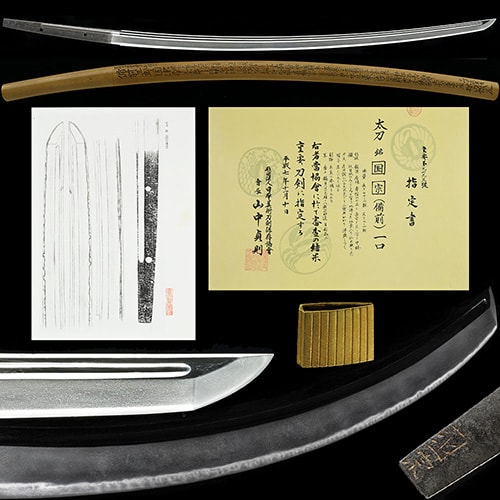
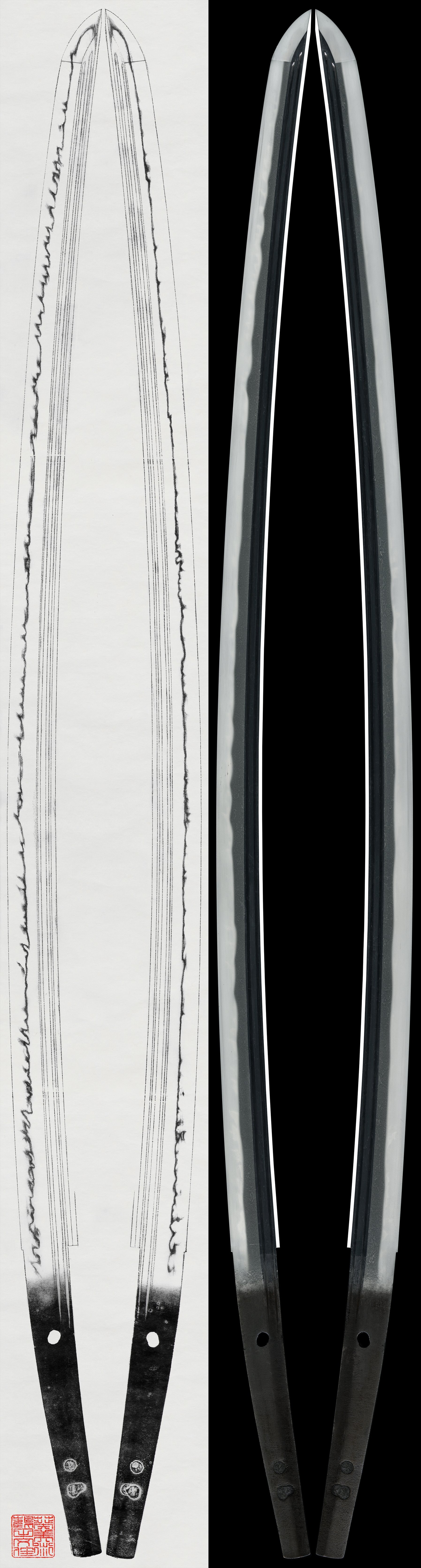
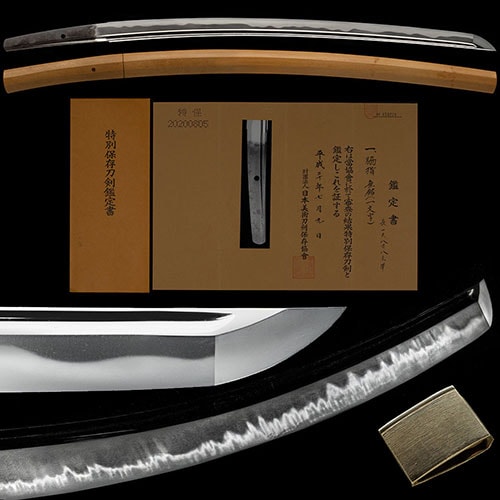
Kuniyasu is a swordsmith of the Naomune line, the lineage that descends from the smith Naomune through Kunizane to the Kunimune group of the middle period, the group whose head is known by the personal sobriquet Saburo. By the genealogy the published sources record, he is the fourth son, the Shiro of the house, standing beside Saburo Kunimune and Kunisada. The single blade that reads cleanly as his own hand is an , shortened yet keeping a two-character signature at the tang tip and a carried through both faces, designated Bijutsuhin before the war and recorded in the Kōzan and the Shinkō Meitō Zufu.
The forging of that is an that tends a little to a standing grain, with gathered on the surface. Over it the temper is a set with , and running through the line. The seeing-point is in the : it clouds softly to in places, and the published record names exactly that feature as the mark of his hand, observing that 'the has places where it clouds, showing the seeing-point of this smith's work'. It is a quiet manner, the straight-toned of the Naomune line rather than the showy of Fukuoka .
His place in the school is at a notable hinge in the history of the craft. Naomune, the founder, is counted by scholarship a and Ko- smith; from him the line runs through Kunizane to Kunimune, who, with Fukuoka Sukezane and Kunitsuna, was summoned to by the regent Hōjō Tokiyori and is held to have helped found the tradition. The Naomune line therefore stands at the join of and the rise of Sōshū-den, and Kuniyasu's straight, temper keeps to the side of that descent.
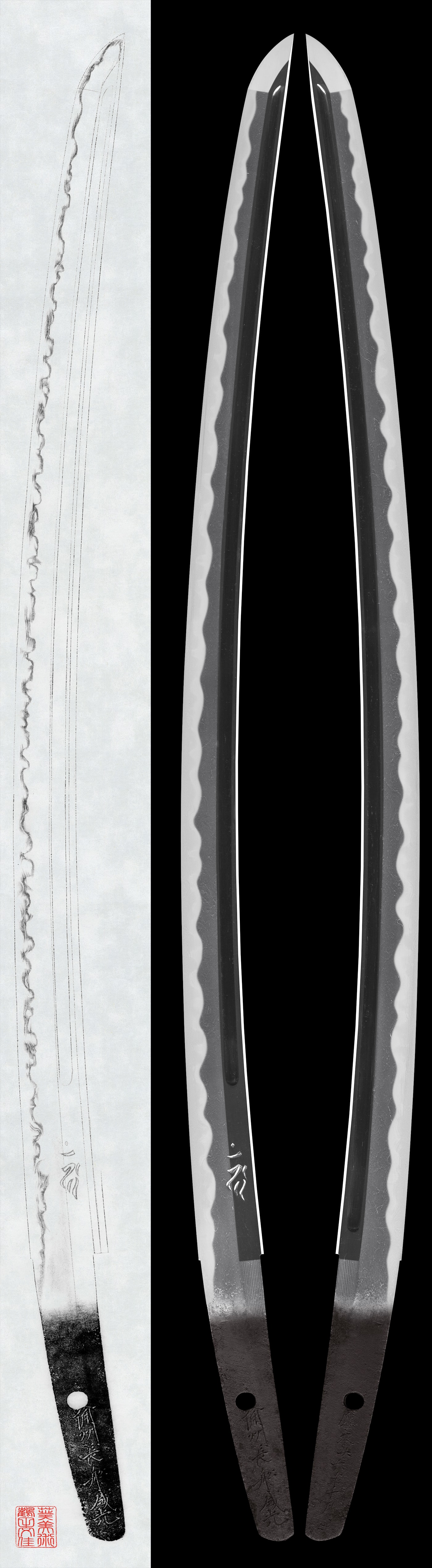
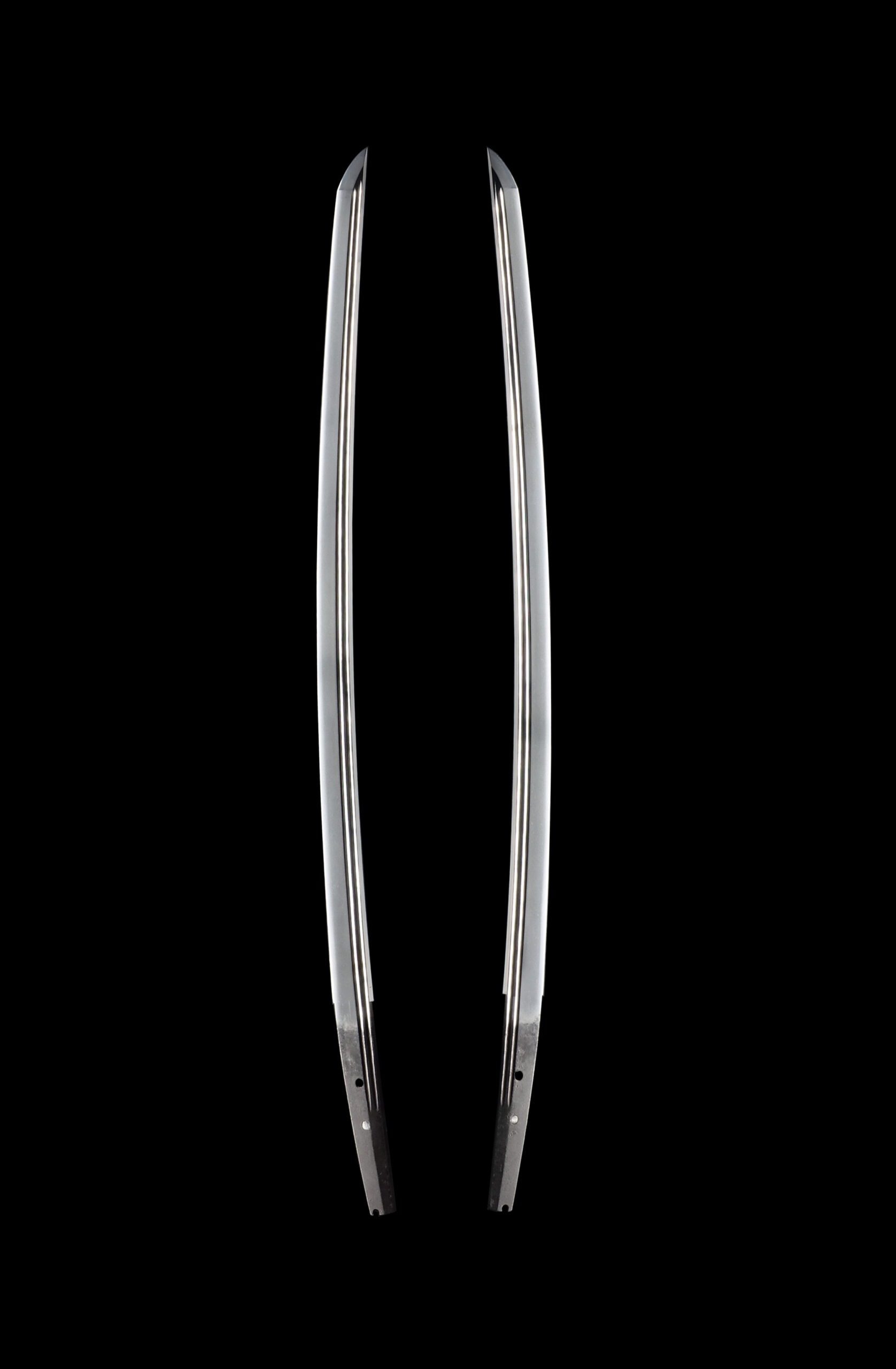
His record carries a caution worth stating plainly. Three further blades signed Kuniyasu, all prewar Bijutsuhin , are wide in body with large or extended points, the published sources calling them 'broad in width, with a large ' (身幅広く大切先の姿である). Their is coarse, with large grain showing across and , the temper a large ō-wan- or in deep with and pointed elements, and their carving runs to , a and a hatahoko. Those are features of a later, -toned hand, not of a mid- smith, and they are best read as the work of a different, later Kuniyasu sharing the name. Set against them, the with its clouded is the one piece that speaks for the Saburo Kuniyasu.
For the collector he is among the rarest of names to encounter authentically. His designation factor is modest, he has no National Treasures and no Important Cultural Properties, and his whole surviving record runs through the prewar Bijutsuhin tier. The blades of recorded whereabouts passed through private hands rather than great institutions, the signed held by Kimura Teizō of Osaka at its designation, the related by Yoshida Yoshimichi of Kyoto and Hamada Shigesanji of Kumamoto. A securely authenticated Saburo Kuniyasu, distinguished from his later namesakes by the soft clouding of the the published sources single out, is a thing a collector of meets only seldom and only with patience.