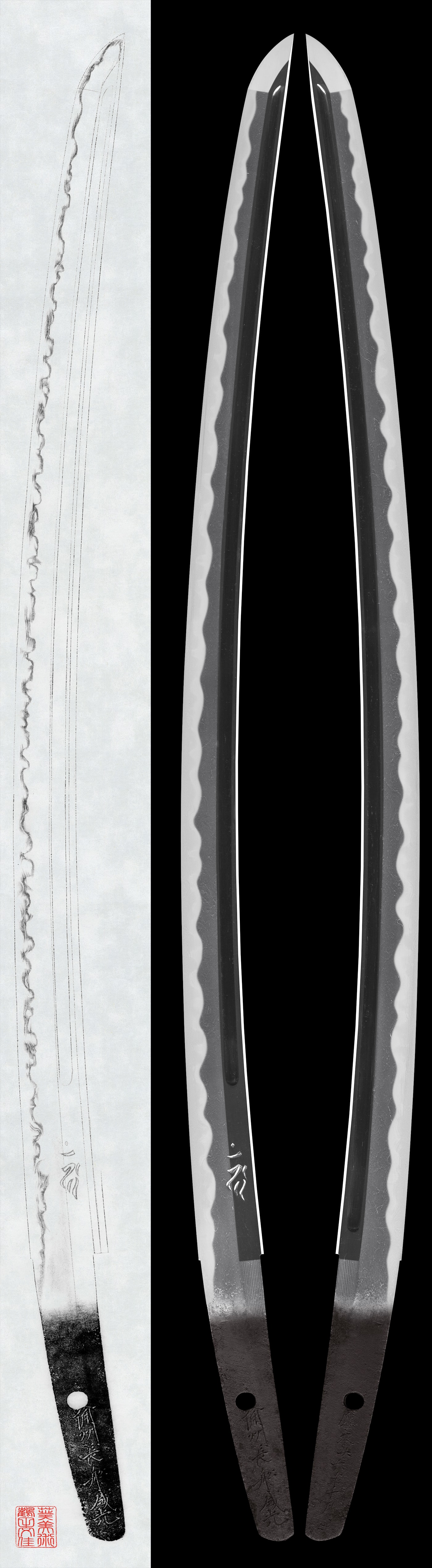
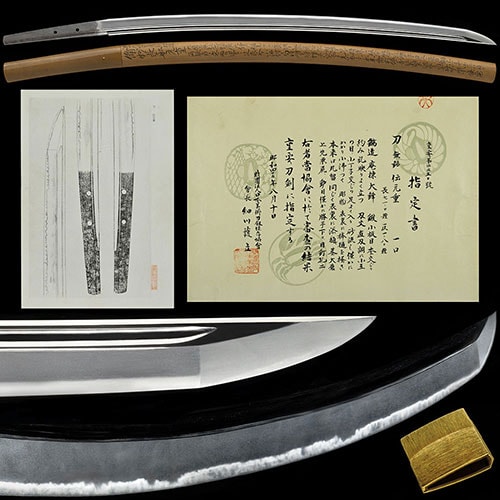
Kunimune of , called Saburo, worked in the middle period, the published sources placing him around the Shogen years (about 1259). He belonged to the Naomune line (直宗系), the third son of Naomune's son Kunizane, and from that birth order he was known as Saburo, the third. He lived at , yet the published sources keep his line clear of the mainstream and read his metal as to the last. The texts also carry an old account of his career: that the regent Hojo Tokiyori summoned him east, where with Sukezane of the Fukuoka- school and Kunitsuna of the school in Kyoto he became one of the pioneers of swordmaking (相州鍛冶). One sets the story down plainly, saying he 'was later summoned by the shogunate under Hojo Tokiyori and moved to , where together with Sukezane of the province's Fukuoka- school and Kunitsuna of Kyoto's school he became one of the pioneers of swordmaking'.
The published sources divide his work into two hands, and that division is the whole of the smith. The first is a wide, powerful , often with high and and on the finest pieces an pheasant-thigh , tempered in a flamboyant -led . Over an mixed with that tends to stand he forges a vivid , the temper crowding with , angular and pointed teeth, and entering richly, -laden with , and working through. The signature feature appears in this hand: the texts say that in the flamboyant works there is, as it has been called since old times, the ' Saburo no shirajimi,' a whitish stain that shows within the (古来「備前三郎の白染み」と称して、刃中に染みがあらわれるところが特色とされている). The texts add that the stain belongs mainly to this flamboyant hand and is little seen in the quiet one, so that its presence reads as a mark of the maker rather than a flaw.
The is where the published sources set his point of difference. His flamboyant recalls Mitsutada and Moriie at first glance, yet beside them his forging stands somewhat more, the - at times rises, and mixes into the ; gathers on the standing , fine runs in it, and the rises bright. In places the sinks and clouds, an the texts read together with the shirajimi as one quality of his steel. Over this hand the runs with a pointed tendency, or rises and returns in a small round with brushed at the tip.
Beside the flamboyant hand stands a quiet one, and the two together are the spine. The second manner is a slender or ordinary-width, gentle , the forging tighter, at times a fine with minute . Its temper is a mixing and , with and slanting , the tight with , bright and clear at its best. The texts tie the two manners to the signatures themselves: the flamboyant hand is signed large, with a thick chisel and rounded calligraphy, the quiet hand small, with a thinner chisel and squared calligraphy. This quiet hand carries the dated remains, the late- Showa years (正和年紀), and from the breadth of the two manners and those late dates the texts judge that 'taking the change of styles and the chronological evidence together, it appears the name was probably not the work of a single generation, though this point should await further study'.
For recognition the is the working tell in the quiet hand. A calm Kunimune in may look at first like Sanenaga or Kagemitsu, but the texts mark the difference at the turnback: of one signed they say it 'at first sight recalls the workmanship of Sanenaga or Kagemitsu of , yet shows a difference in that the rises straight and returns in a large round ', the slightly -laden and and the prominent completing the judgment. At the flamboyant top end the confusion runs instead toward , and there a opening in the and clotting even inside the settle the attribution; that -open manner marks the small sub-group of the Tenkyuwari look, an anchor for blades of the air. The shirajimi too is a keyed feature rather than a constant: the texts note that 'this phenomenon is frequent in the works with a flamboyant temper and is little seen in those of a -toned make'. The lineage is kept clean at the root: the Naomune line stands apart from the mainline, and Nakahara Kunimune, whose dated run from Kagen to Engyo in a quiet base, is regarded as a pupil of the first generation.
For the connoisseur, Kunimune is Sai-jo in Fujishiro's grading, with three National Treasures, ten Important Cultural Properties and eight among ninety-seven designated works on record. The National Treasure of Terukuni Jinja in Kagoshima stands at the head of his signed work; the Nikko Toshogu is the National Treasure of his rarer -based hand. The named blade Tenkyuwari carries one of the great sword histories: it was the sword Uesugi Kenshin wore when he broke the camp of Takeda Shingen's brother Tenkyu Nobushige at Kawanakajima, was given by Kenshin to Satake Yoshishige, and was held thereafter in the Satake house, lords of Kubota in Dewa, with an of Kansei date. The Uesugi, Satake and Shimazu, the Kishu and Owari Tokugawa, the Ii and Abe houses and the Imperial Household appear among his recorded owners, and one reached the Boston Museum of Fine Arts. About sixty-three of his blades fall in the and tiers, which makes a designated Kunimune among the more attainable of the great names; the National Treasures and Important Cultural Properties are heritage held in shrines and museums and do not trade, while a or example, most of them held rather than offered, comes to a private collector only with patience, and is a major acquisition when it does, the one realistic way to own the master whose journey east stands behind the rise of .