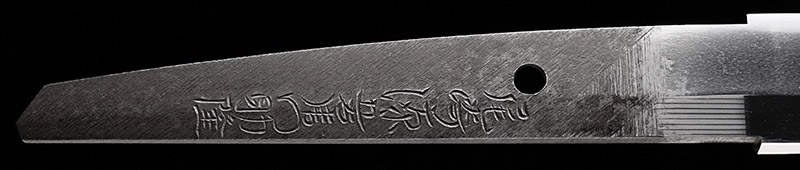
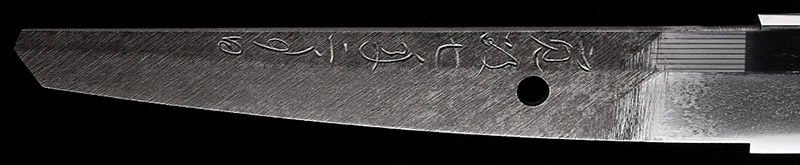
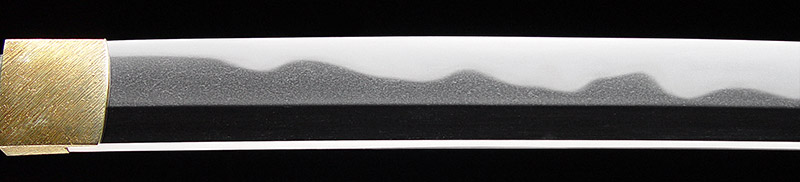
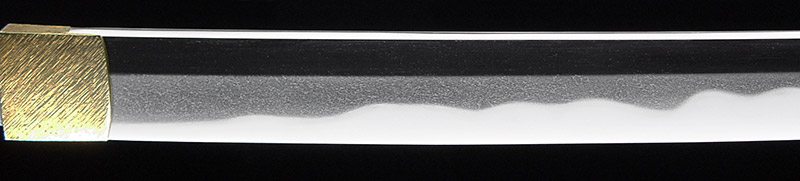
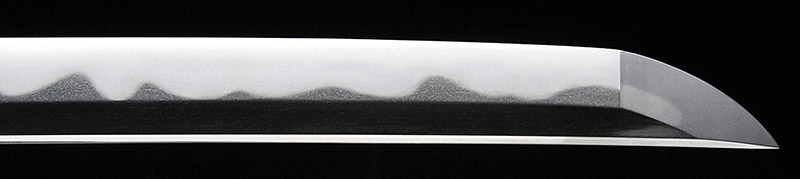
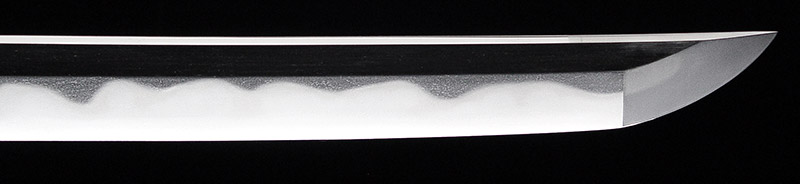
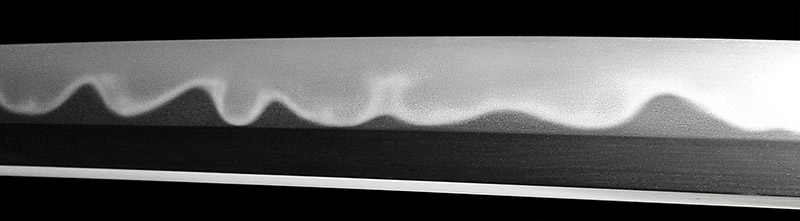
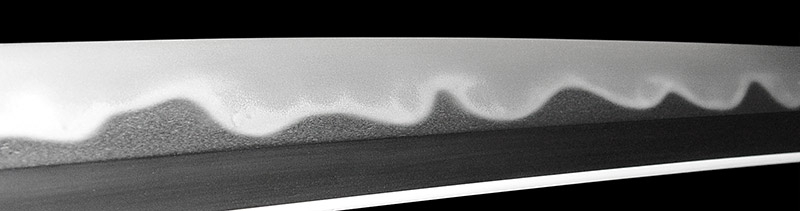
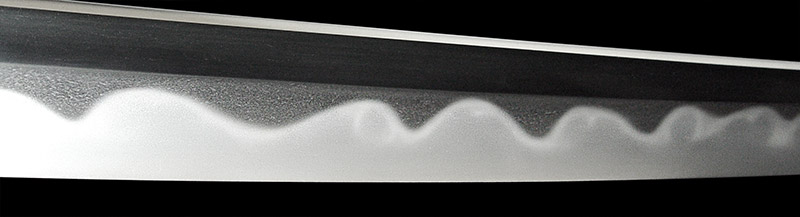
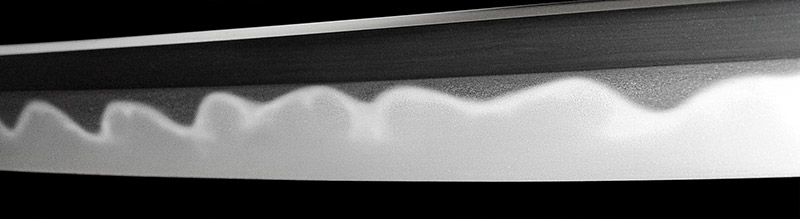
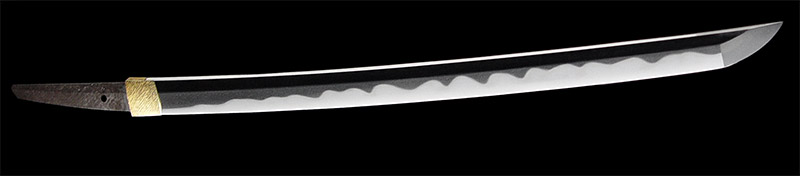
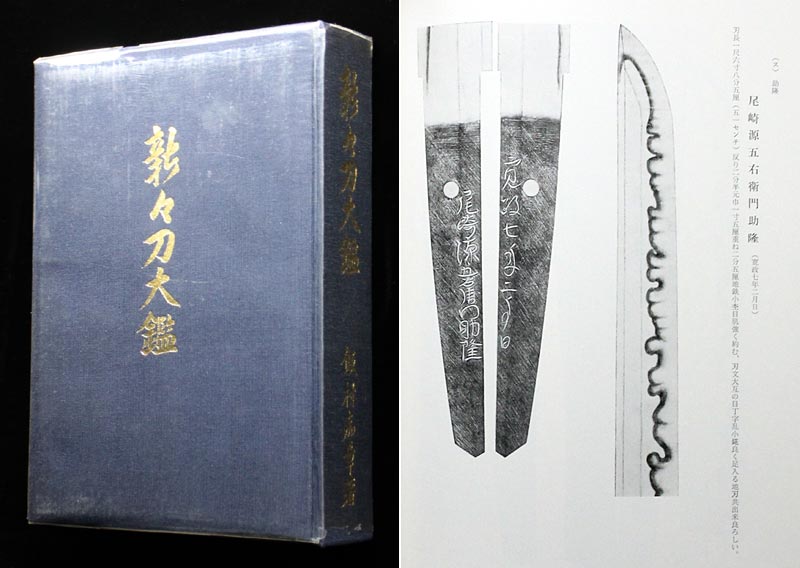
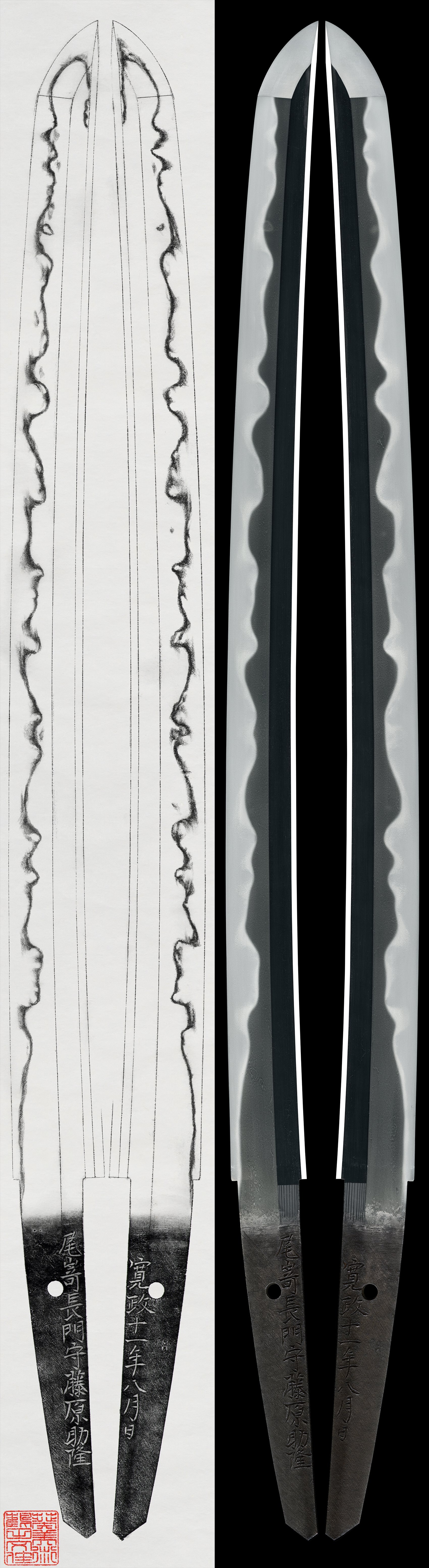
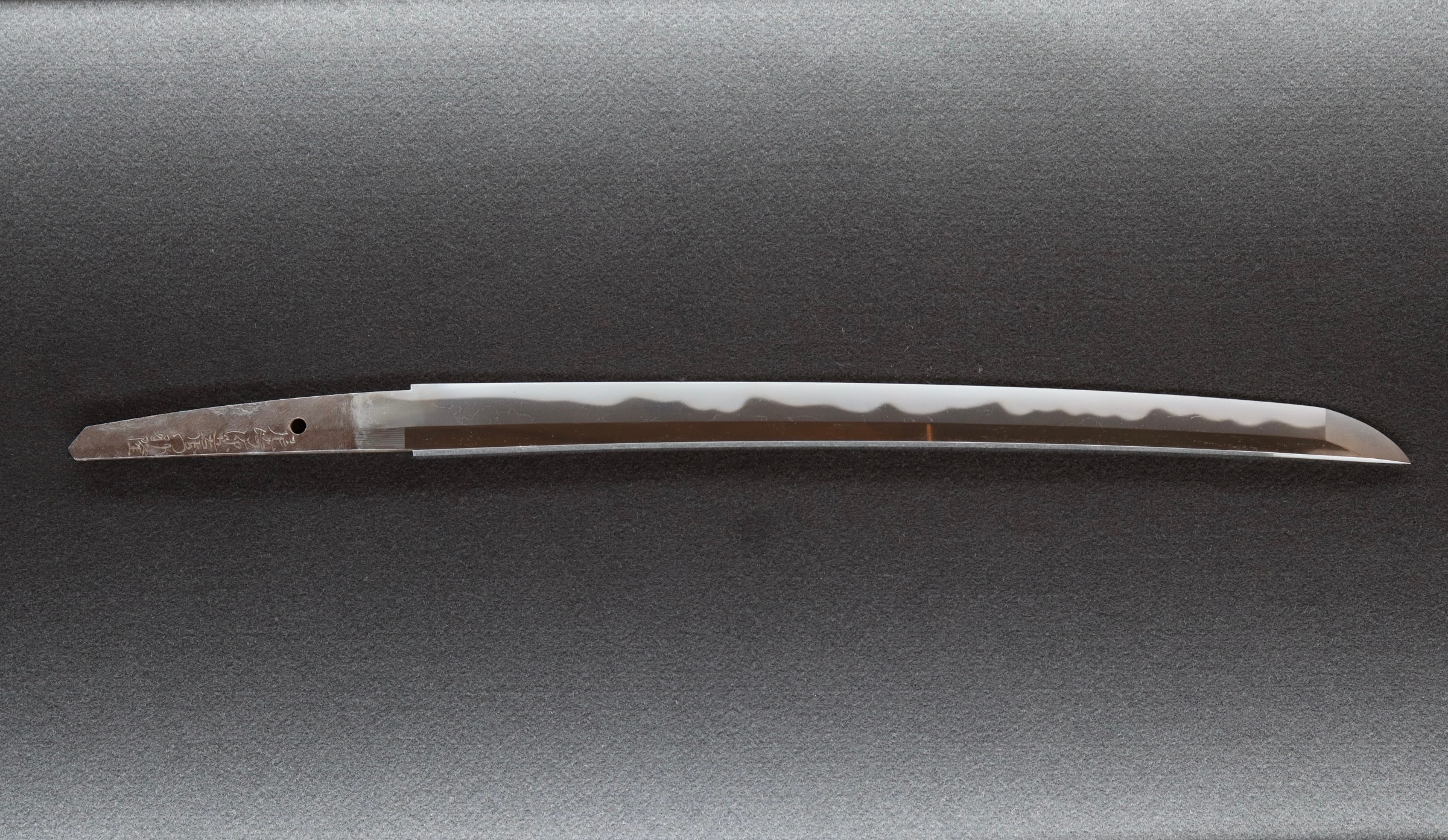
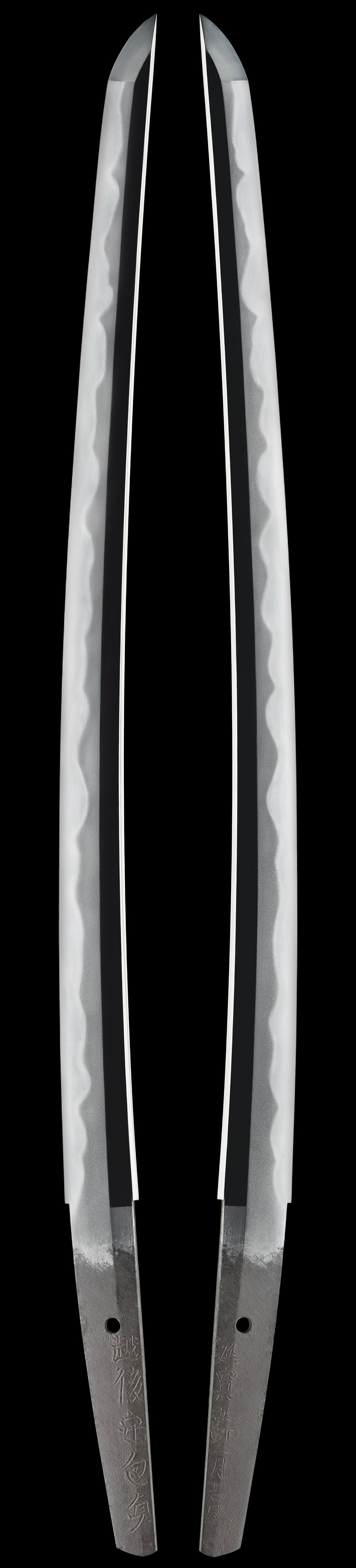
This is a wakizashi made by Ozaki Gengoemon Suketaka in Settsu province during the Shin-Shinto period. The blade features a toran-ba hamon and a ko-mokume jigane. It comes with a Tokubetsu Hozon certificate from the NBTHK and is recorded in the Shin-Shinto Taikan.
mei · Kansei (1789-1801) · nagasa 51cm · sori 0.6cm


Shinto · Settsu · around 1789-1803
Fujishiro Jo saku · Tōken Taikan top 31%
3 pieces on the market now
Suketaka's home province was Harima (Banshu). He studied under Kuroda Takazane, and in Kansei 10 (1798) received the honorary title Nagato no Kami. He died in Bunka 2 (1805) at the age of fifty-three. Throughout his career, Suketaka held Tsuda Echizen no Kami Sukehiro in deep private admiration, and this reverence defined his life's work. Among shinshinto period smiths who studied Sukehiro's toranba-style temper -- including Suishinshi Masahide and Tegarayama Masashige -- Suketaka is regarded as particularly skillful.
His blades consistently present a large-scaled taihai with somewhat wide mihaba, shallow sori, and an elongated chu-kissaki. The jihada is a ko-itame-hada so tightly forged it approaches muji, with ji-nie adhering and the jigane bright and clear. The hamon begins with a long yakidashi, then forms a toran-midare-like composition in which large gunome and gunome-choji intermix, creating conspicuous height variations and a billowing, wave-like effect. Thick ashi enter; the nioiguchi is deep; and nie adheres well, with ara-nie appearing in places. The nioiguchi is bright and clear throughout. The boshi is characteristically sugu with ko-maru, showing hakikake toward the tip. The long nakago and application of kesho-yasuri likewise emulate Sukehiro's manner.
The NBTHK notes that Suketaka's toran-midare is "truly so accomplished that it approaches the genuine article," though none among his contemporaries attains the degree of brightness seen in Sukehiro himself. His jigane is praised as carefully refined, evidencing high technical skill, and his works are consistently termed representative pieces. Matched daisho made as true pairs are noted as uncommon, adding to the documentary significance of such examples.
Where Suketaka stands among comparable artisans: across all of nihontō, and within tradition, era, and period. The tiers (Foremost · Leading · Major · Notable) weigh official designations from the NBTHK and Japan's Agency for Cultural Affairs, together with historical honors of lasting repute such as the Sansaku and Meibutsu-chō.
Select a lens to see how it's measured.
Years he was demonstrably active, proven by signed-and-dated blades
Shinto · Settsu
73 pieces on the market now
Osaka in the early-to-mid Edo period was a merchant capital, a city of commerce and capital rather than a castle town tied to a single daimyo house, and the swordsmiths who gathered there worked for a wealthy townsman clientele as much as for warriors. The grouping known as Osaka Shinto (大坂新刀) took shape in Settsu from two feeder currents. Learn more →
| Smith | Era | Designated |
|---|---|---|
| Shinkai真改 | 1649-1682 | 79 |
| Tadatsuna忠綱 | 1673-1717 | 53 |
| Kanesada包貞 | 1673-1682 | 78 |
| Kanesada包貞 | 1648-1652 | 10 |
| Kunisuke國助 | 1658-1663 | 10 |
A Hozon-certified blade judged to show notably superior workmanship and a better state of preservation. The bar is higher: re-tempered blades and most unsigned Muromachi/Edo works are excluded.
The NBTHK (Nihon Bijutsu Tōken Hozon Kyōkai, the Society for the Preservation of Japanese Art Swords) is a public-interest incorporated foundation founded in 1948 and supervised by Japan’s Agency for Cultural Affairs (Bunkachō); it is based at the Japanese Sword Museum in Tokyo. Its expert panels physically examine each submitted work (shinsa) and issue a certificate (kanteishō) ranking it by artistic and historical merit. NBTHK papers are the most widely recognized standard of authentication for Japanese swords and fittings.
NBTHK official siteIf the item is not to your liking, please feel free to return it for any reason. Return shipping is the customer's responsibility. After the item arrives and we confirm it is in the same condition as at the time of sale, we transfer the refund to your designated account the same day. Purchases made at the store are outside the scope of cooling-off.
This is a wakizashi made by Ozaki Gengoemon Suketaka in Settsu province during the Shin-Shinto period. The blade features a toran-ba hamon and a ko-mokume jigane. It comes with a Tokubetsu Hozon certificate from the NBTHK and is recorded in the Shin-Shinto Taikan.
mei · Kansei (1789-1801) · nagasa 51cm · sori 0.6cm


Shinto · Settsu · around 1789-1803
Fujishiro Jo saku · Tōken Taikan top 31%
3 pieces on the market now
Suketaka's home province was Harima (Banshu). He studied under Kuroda Takazane, and in Kansei 10 (1798) received the honorary title Nagato no Kami. He died in Bunka 2 (1805) at the age of fifty-three. Throughout his career, Suketaka held Tsuda Echizen no Kami Sukehiro in deep private admiration, and this reverence defined his life's work. Among shinshinto period smiths who studied Sukehiro's toranba-style temper -- including Suishinshi Masahide and Tegarayama Masashige -- Suketaka is regarded as particularly skillful.
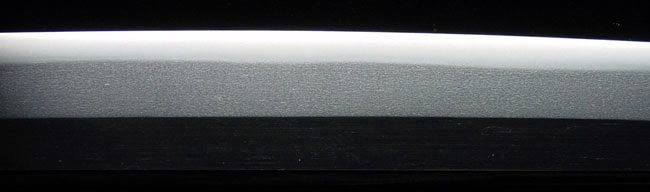
His blades consistently present a large-scaled taihai with somewhat wide mihaba, shallow sori, and an elongated chu-kissaki. The jihada is a ko-itame-hada so tightly forged it approaches muji, with ji-nie adhering and the jigane bright and clear. The hamon begins with a long yakidashi, then forms a toran-midare-like composition in which large gunome and gunome-choji intermix, creating conspicuous height variations and a billowing, wave-like effect. Thick ashi enter; the nioiguchi is deep; and nie adheres well, with ara-nie appearing in places. The nioiguchi is bright and clear throughout. The boshi is characteristically sugu with ko-maru, showing hakikake toward the tip. The long nakago and application of kesho-yasuri likewise emulate Sukehiro's manner.
The NBTHK notes that Suketaka's toran-midare is "truly so accomplished that it approaches the genuine article," though none among his contemporaries attains the degree of brightness seen in Sukehiro himself. His jigane is praised as carefully refined, evidencing high technical skill, and his works are consistently termed representative pieces. Matched daisho made as true pairs are noted as uncommon, adding to the documentary significance of such examples.
Where Suketaka stands among comparable artisans: across all of nihontō, and within tradition, era, and period. The tiers (Foremost · Leading · Major · Notable) weigh official designations from the NBTHK and Japan's Agency for Cultural Affairs, together with historical honors of lasting repute such as the Sansaku and Meibutsu-chō.
Select a lens to see how it's measured.
Years he was demonstrably active, proven by signed-and-dated blades
Shinto · Settsu
73 pieces on the market now
Osaka in the early-to-mid Edo period was a merchant capital, a city of commerce and capital rather than a castle town tied to a single daimyo house, and the swordsmiths who gathered there worked for a wealthy townsman clientele as much as for warriors. The grouping known as Osaka Shinto (大坂新刀) took shape in Settsu from two feeder currents. Learn more →
| Smith | Era | Designated |
|---|---|---|
| Shinkai真改 | 1649-1682 | 79 |
| Tadatsuna忠綱 | 1673-1717 | 53 |
| Kanesada包貞 | 1673-1682 | 78 |
| Kanesada包貞 | 1648-1652 | 10 |
| Kunisuke國助 | 1658-1663 | 10 |
A Hozon-certified blade judged to show notably superior workmanship and a better state of preservation. The bar is higher: re-tempered blades and most unsigned Muromachi/Edo works are excluded.
The NBTHK (Nihon Bijutsu Tōken Hozon Kyōkai, the Society for the Preservation of Japanese Art Swords) is a public-interest incorporated foundation founded in 1948 and supervised by Japan’s Agency for Cultural Affairs (Bunkachō); it is based at the Japanese Sword Museum in Tokyo. Its expert panels physically examine each submitted work (shinsa) and issue a certificate (kanteishō) ranking it by artistic and historical merit. NBTHK papers are the most widely recognized standard of authentication for Japanese swords and fittings.
NBTHK official siteIf the item is not to your liking, please feel free to return it for any reason. Return shipping is the customer's responsibility. After the item arrives and we confirm it is in the same condition as at the time of sale, we transfer the refund to your designated account the same day. Purchases made at the store are outside the scope of cooling-off.