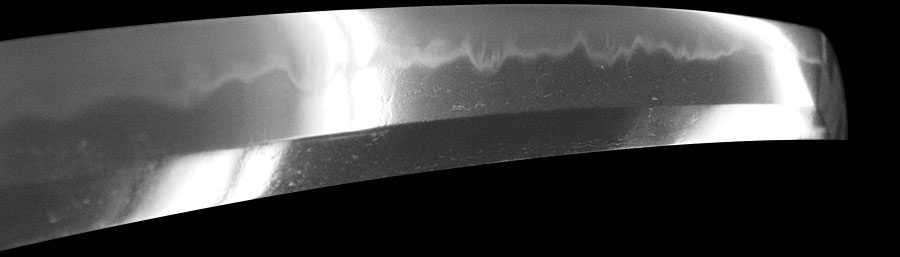
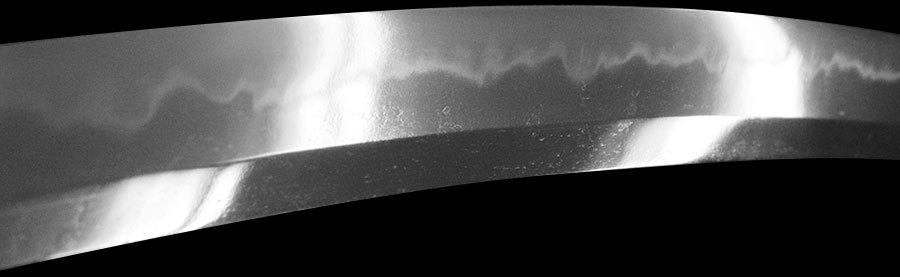
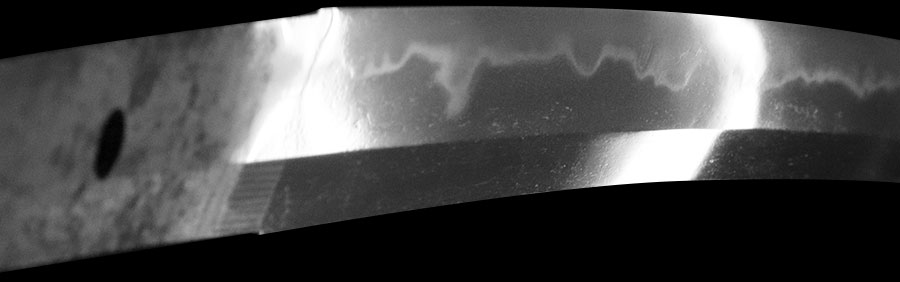
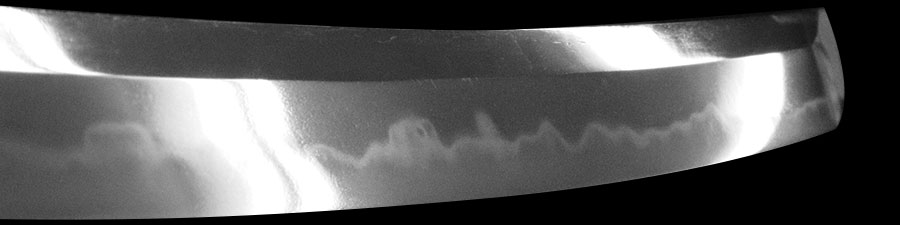
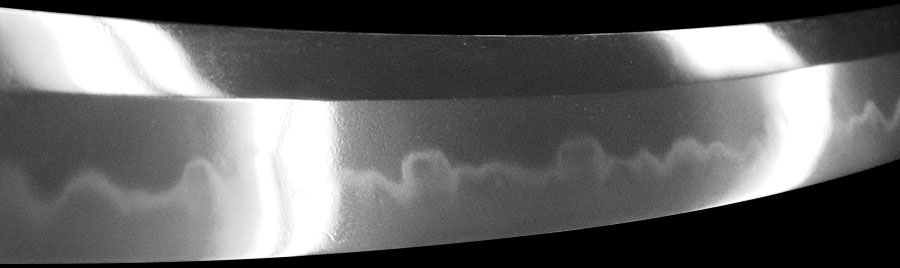
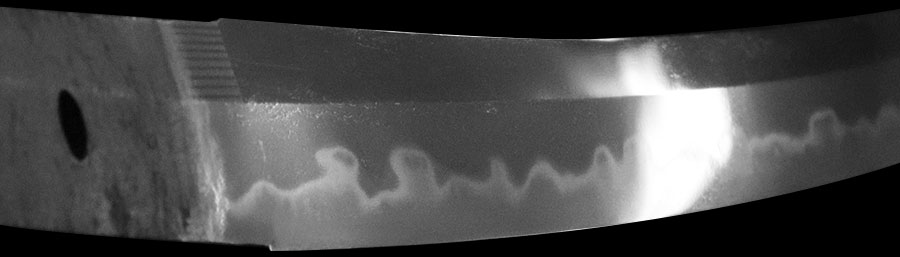
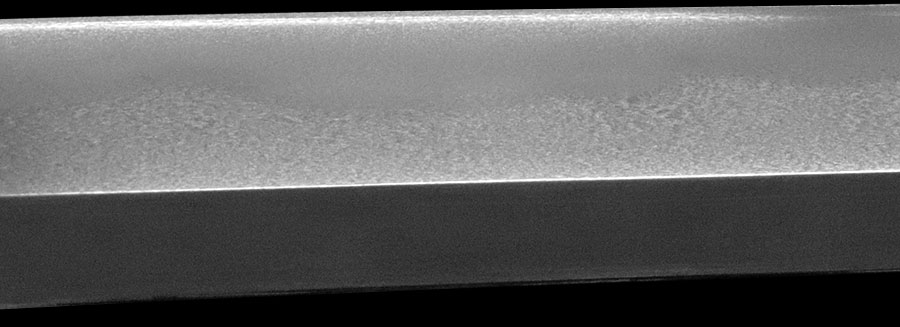
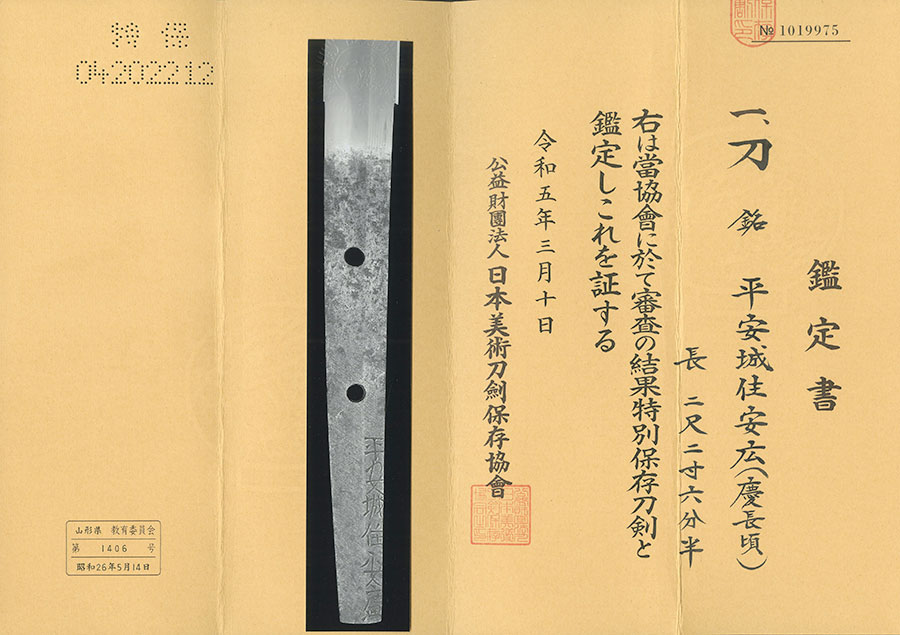
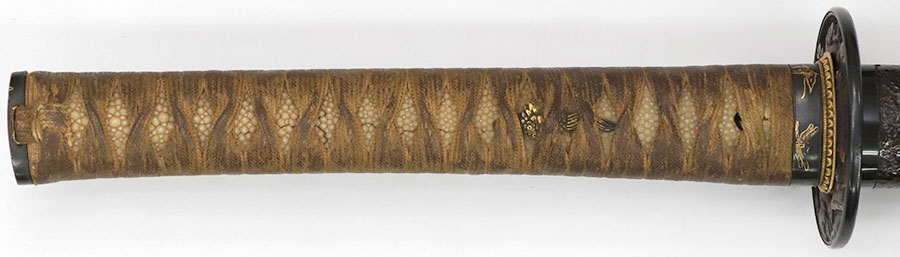
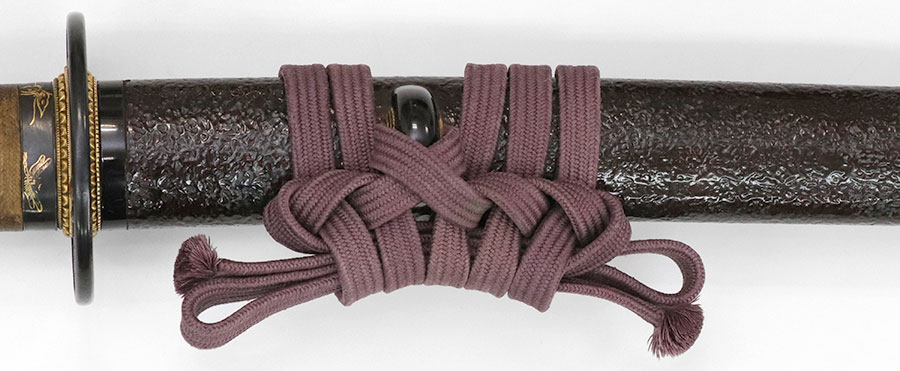
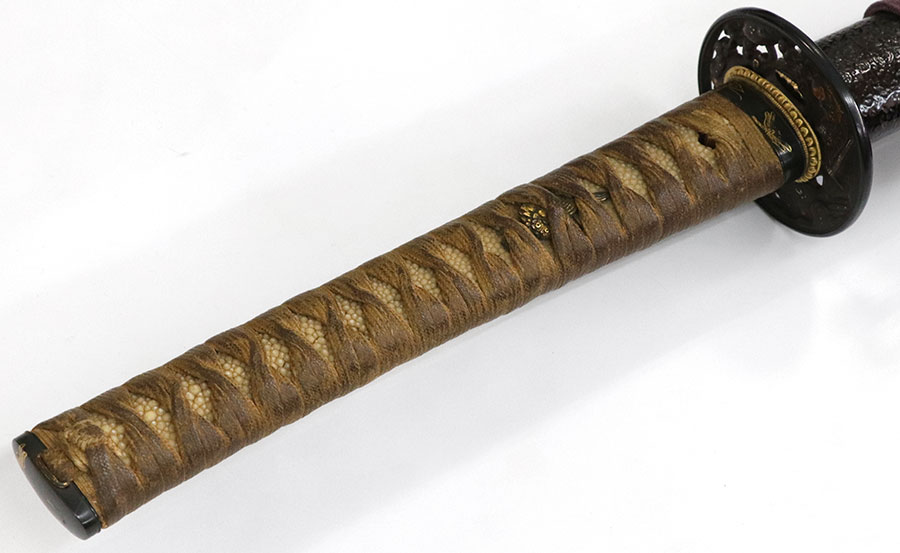
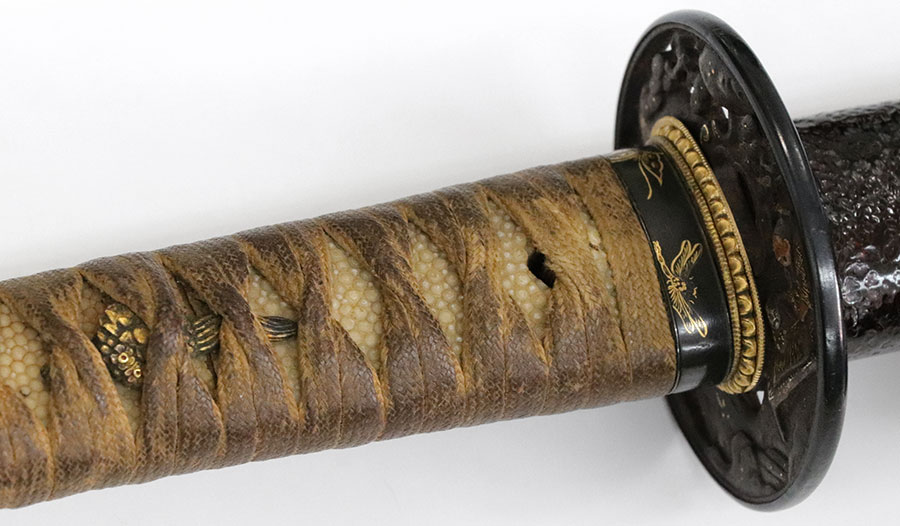
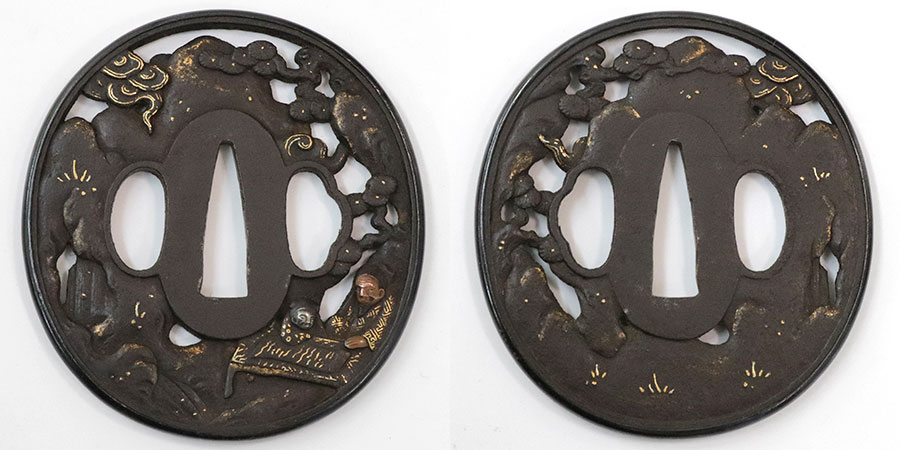
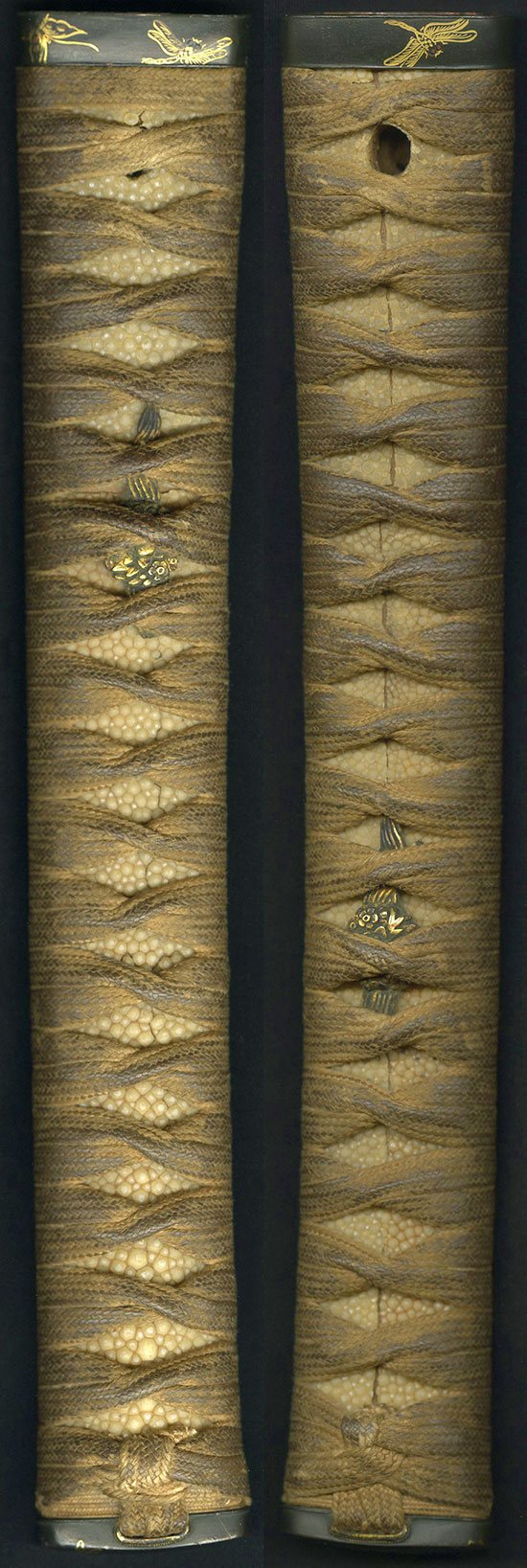
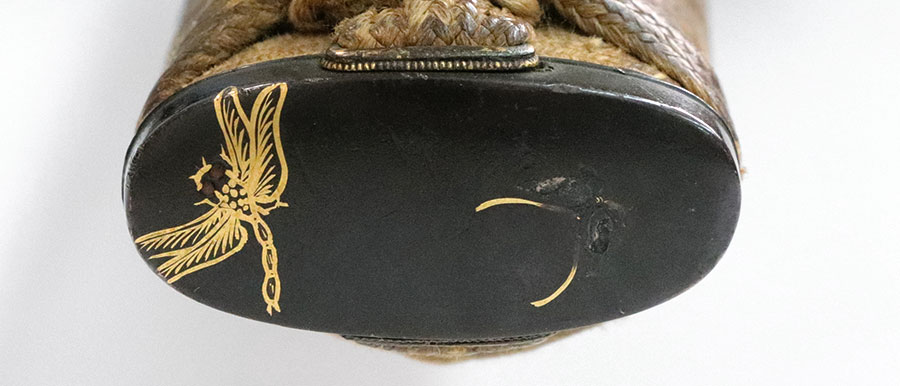
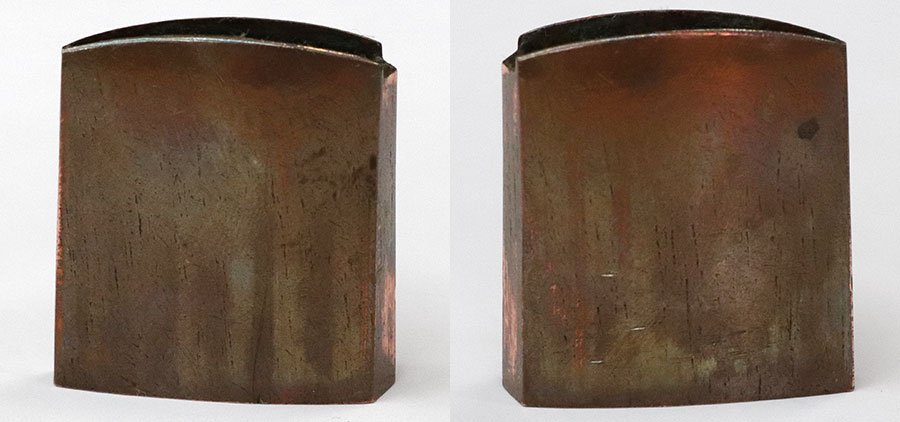
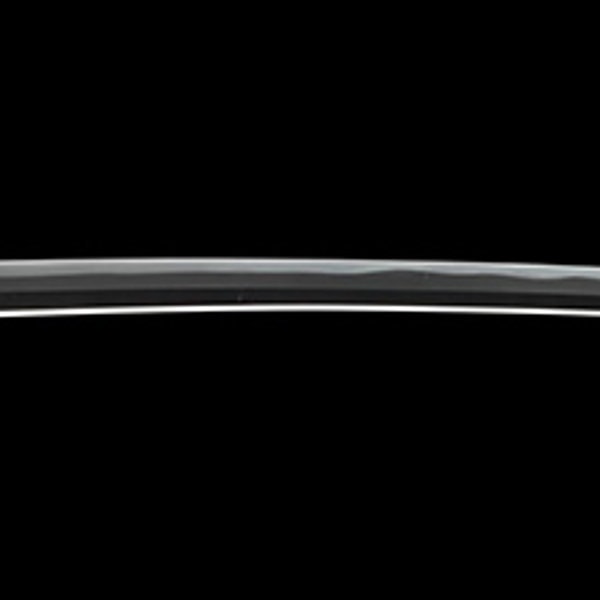
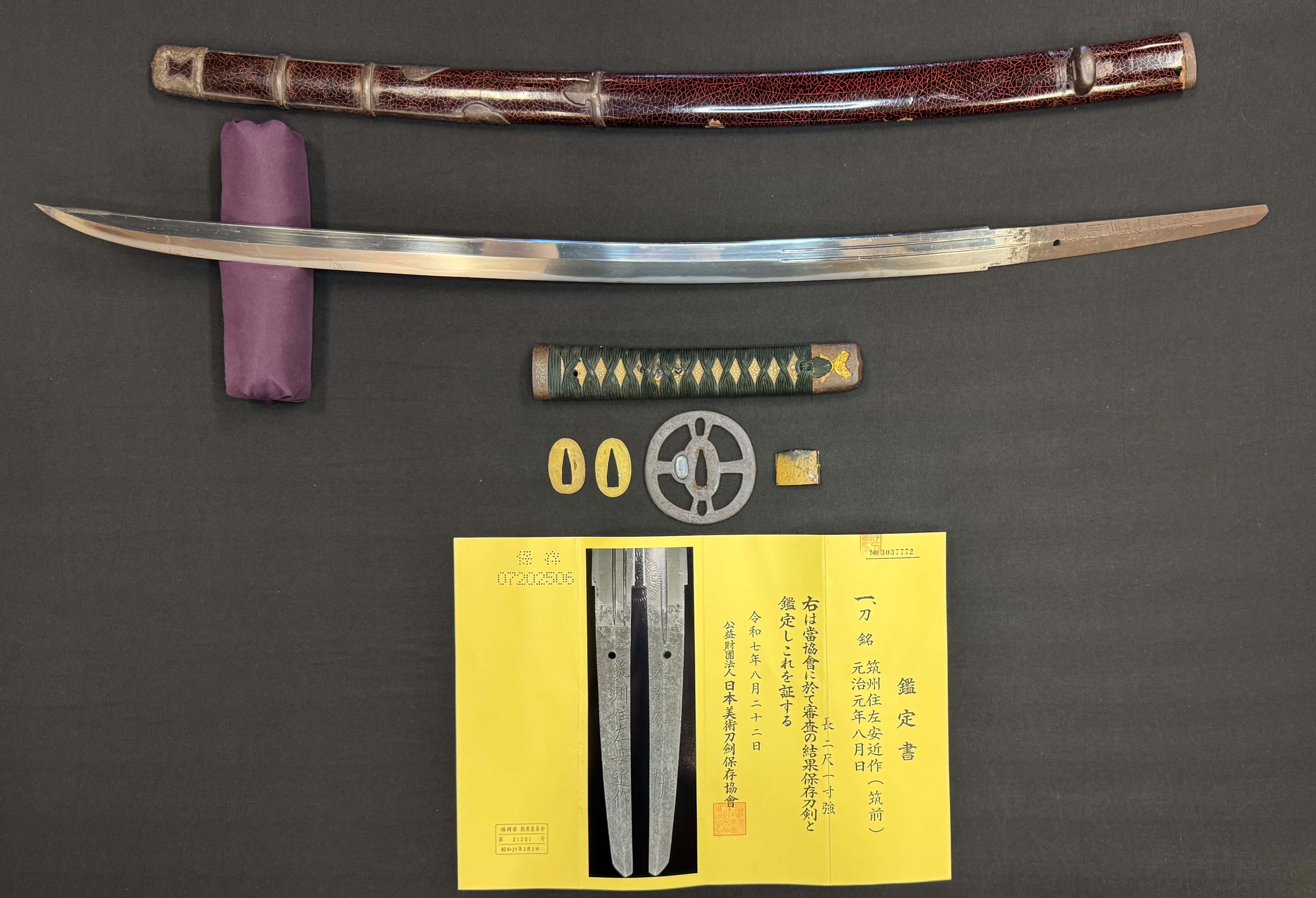
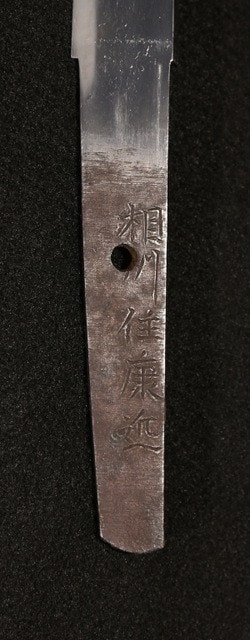
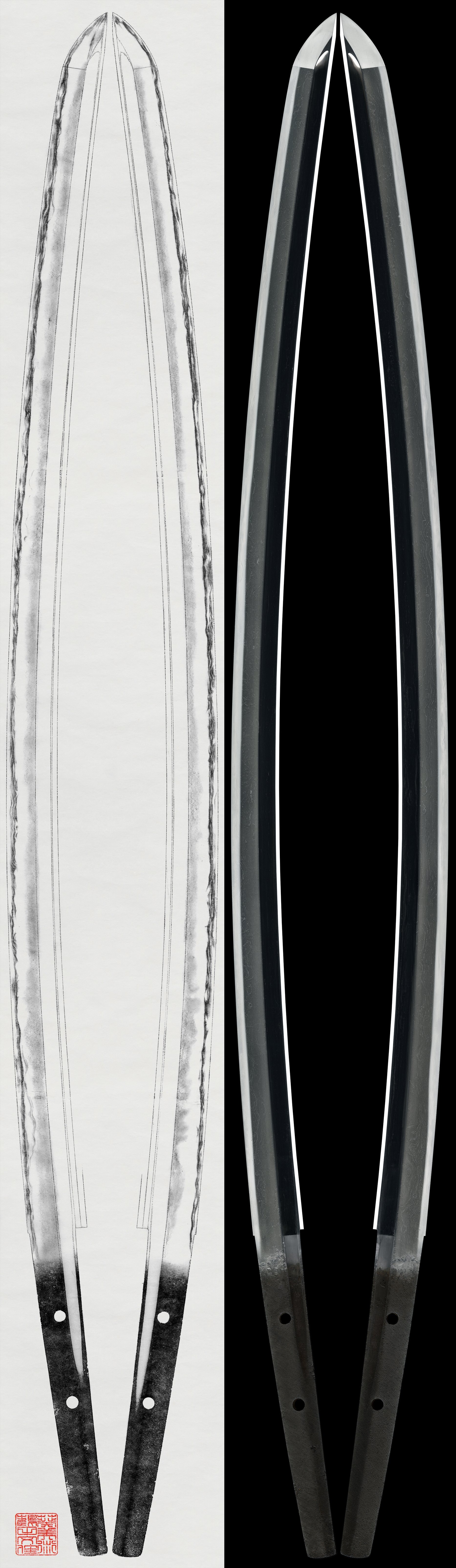
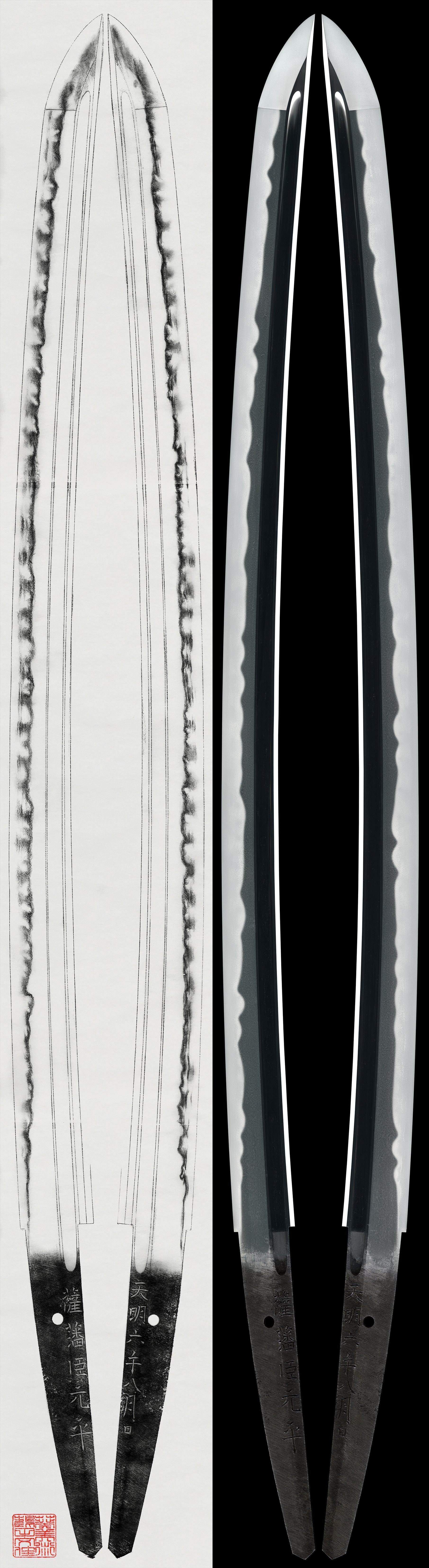
The swordsmith Heianjo-ju Yasuhiro has in recent years been regarded as a figure of utmost importance, serving as a collaborating smith for the famous Kishu master Nanki Shigekuni, a representative smith of Keicho Shinto. Yasuhiro is currently in the spotlight as the father of Yamatonokami Yasusada—the smith of the famous O-wazamono blade worn by Okita Soji, captain of the Shinsengumi's first unit, well-known through Touken Ranbu. The discovery that Yamatonokami Yasusada originated from the Kishu Ishido school was made possible precisely because a gassaku-to (collaboration blade) with this Heianjo-ju Yasuhiro was discovered. Because Yasuhiro served as a daisaku-sha (substitute smith) for Nanki Shigekuni, blades bearing the Yasuhiro mei are almost non-existent today. This sword stands as a representative work. Looking at the toroku-sho, the nagasa of this blade was originally a long 2 shaku 4 sun 5 bu; however, as it is a 1951 "Daimyo Registration" from Yamagata, it appears a high-ranking samurai of the Yamagata Shonai Domain shortened it to suit his own kenpo (swordsmanship style) for use as a haito. Despite this, the sugata retains the Keicho Shinto taihai, exhibiting a magnificent form with a wide moto-mihaba and saki-mihaba with an extended kissaki. The jigane is a well-forged, bright, and high-quality itame-hada. The hamon is a powerful Soshu-den style reminiscent of Nanki Shigekuni, featuring a consistent o-gunome midare-ba from moto to saki with nioi and ko-nie. Seeing how remarkably similar the swords of Yamatonokami Yasusada are to this blade, one can clearly understand the relationship between Nanki Shigekuni’s denpo and Yamatonokami Yasusada through the intermediary of Yasuhiro. The koshirae is a luxurious set featuring fuchi-kashira with a dragonfly (katsumushi) design—a favorite of Edo-period samurai—adding further splendor to this meito by Yasuhiro. Having received this on consignment from an old connoisseur with the request to pass it on affordably to the next generation, please enjoy this precious meito by Heianjo-ju Yasuhiro, the famous father of Yamatonokami Yasusada, which still carries the fragrant aura of the Keicho Shinto era.
Edo · nagasa 68.8cm · sori 1.2cm


Yamato-den · Satsuma · around 1716-1736
Tōken Taikan top 91%
2 pieces on the market now
Yamato-den · Satsuma
2 pieces on the market now
| Smith | Era | Designated |
|---|---|---|
| Yoshiyasu吉安 | 1394-1428 | 0 |
| Yoshiyuki吉行 | 1487-1489 | 0 |
| Yoshinari吉作 | 1504-1521 | 0 |
| Ietoshi家利 | 1532-1555 | 0 |
| Nobuyasu信安 | 1504-1521 | 0 |
A Hozon-certified blade judged to show notably superior workmanship and a better state of preservation. The bar is higher: re-tempered blades and most unsigned Muromachi/Edo works are excluded.
The NBTHK (Nihon Bijutsu Tōken Hozon Kyōkai, the Society for the Preservation of Japanese Art Swords) is a public-interest incorporated foundation founded in 1948 and supervised by Japan’s Agency for Cultural Affairs (Bunkachō); it is based at the Japanese Sword Museum in Tokyo. Its expert panels physically examine each submitted work (shinsa) and issue a certificate (kanteishō) ranking it by artistic and historical merit. NBTHK papers are the most widely recognized standard of authentication for Japanese swords and fittings.
NBTHK official siteFor returns due to customer circumstances, the cost is the customer's responsibility. For returns due to our mis-shipment or a defective item, we bear the cost.
The swordsmith Heianjo-ju Yasuhiro has in recent years been regarded as a figure of utmost importance, serving as a collaborating smith for the famous Kishu master Nanki Shigekuni, a representative smith of Keicho Shinto. Yasuhiro is currently in the spotlight as the father of Yamatonokami Yasusada—the smith of the famous O-wazamono blade worn by Okita Soji, captain of the Shinsengumi's first unit, well-known through Touken Ranbu. The discovery that Yamatonokami Yasusada originated from the Kishu Ishido school was made possible precisely because a gassaku-to (collaboration blade) with this Heianjo-ju Yasuhiro was discovered. Because Yasuhiro served as a daisaku-sha (substitute smith) for Nanki Shigekuni, blades bearing the Yasuhiro mei are almost non-existent today. This sword stands as a representative work. Looking at the toroku-sho, the nagasa of this blade was originally a long 2 shaku 4 sun 5 bu; however, as it is a 1951 "Daimyo Registration" from Yamagata, it appears a high-ranking samurai of the Yamagata Shonai Domain shortened it to suit his own kenpo (swordsmanship style) for use as a haito. Despite this, the sugata retains the Keicho Shinto taihai, exhibiting a magnificent form with a wide moto-mihaba and saki-mihaba with an extended kissaki. The jigane is a well-forged, bright, and high-quality itame-hada. The hamon is a powerful Soshu-den style reminiscent of Nanki Shigekuni, featuring a consistent o-gunome midare-ba from moto to saki with nioi and ko-nie. Seeing how remarkably similar the swords of Yamatonokami Yasusada are to this blade, one can clearly understand the relationship between Nanki Shigekuni’s denpo and Yamatonokami Yasusada through the intermediary of Yasuhiro. The koshirae is a luxurious set featuring fuchi-kashira with a dragonfly (katsumushi) design—a favorite of Edo-period samurai—adding further splendor to this meito by Yasuhiro. Having received this on consignment from an old connoisseur with the request to pass it on affordably to the next generation, please enjoy this precious meito by Heianjo-ju Yasuhiro, the famous father of Yamatonokami Yasusada, which still carries the fragrant aura of the Keicho Shinto era.
Edo · nagasa 68.8cm · sori 1.2cm


Yamato-den · Satsuma · around 1716-1736
Tōken Taikan top 91%
2 pieces on the market now
Yamato-den · Satsuma
2 pieces on the market now
| Smith | Era | Designated |
|---|---|---|
| Yoshiyasu吉安 | 1394-1428 | 0 |
| Yoshiyuki吉行 | 1487-1489 | 0 |
| Yoshinari吉作 | 1504-1521 | 0 |
| Ietoshi家利 | 1532-1555 | 0 |
| Nobuyasu信安 | 1504-1521 | 0 |
A Hozon-certified blade judged to show notably superior workmanship and a better state of preservation. The bar is higher: re-tempered blades and most unsigned Muromachi/Edo works are excluded.
The NBTHK (Nihon Bijutsu Tōken Hozon Kyōkai, the Society for the Preservation of Japanese Art Swords) is a public-interest incorporated foundation founded in 1948 and supervised by Japan’s Agency for Cultural Affairs (Bunkachō); it is based at the Japanese Sword Museum in Tokyo. Its expert panels physically examine each submitted work (shinsa) and issue a certificate (kanteishō) ranking it by artistic and historical merit. NBTHK papers are the most widely recognized standard of authentication for Japanese swords and fittings.
NBTHK official siteFor returns due to customer circumstances, the cost is the customer's responsibility. For returns due to our mis-shipment or a defective item, we bear the cost.