Two courts, sixty years of war, and the most dramatic silhouettes in the sword’s history: broad blades, extended points, true ōdachi later cut down into the majestic katana collectors prize. The Sōshū manner was the style of the age.
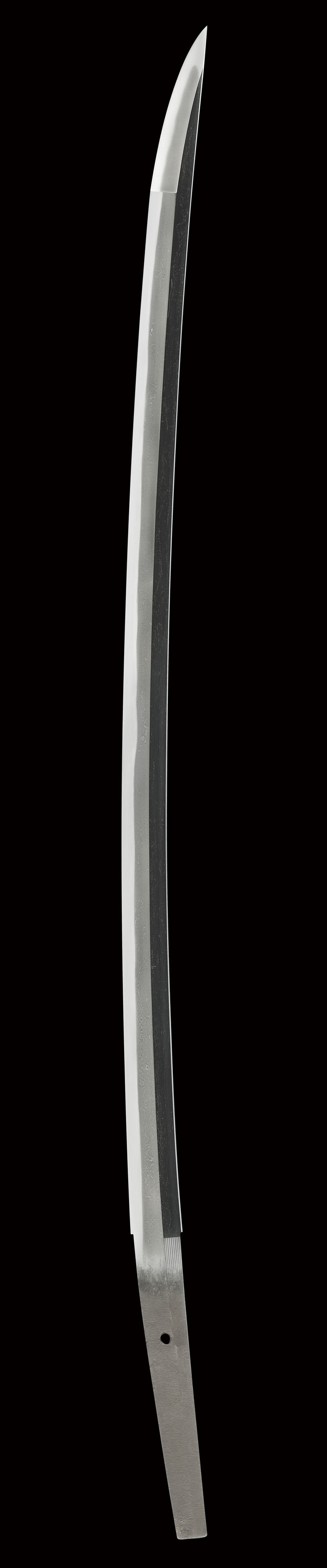
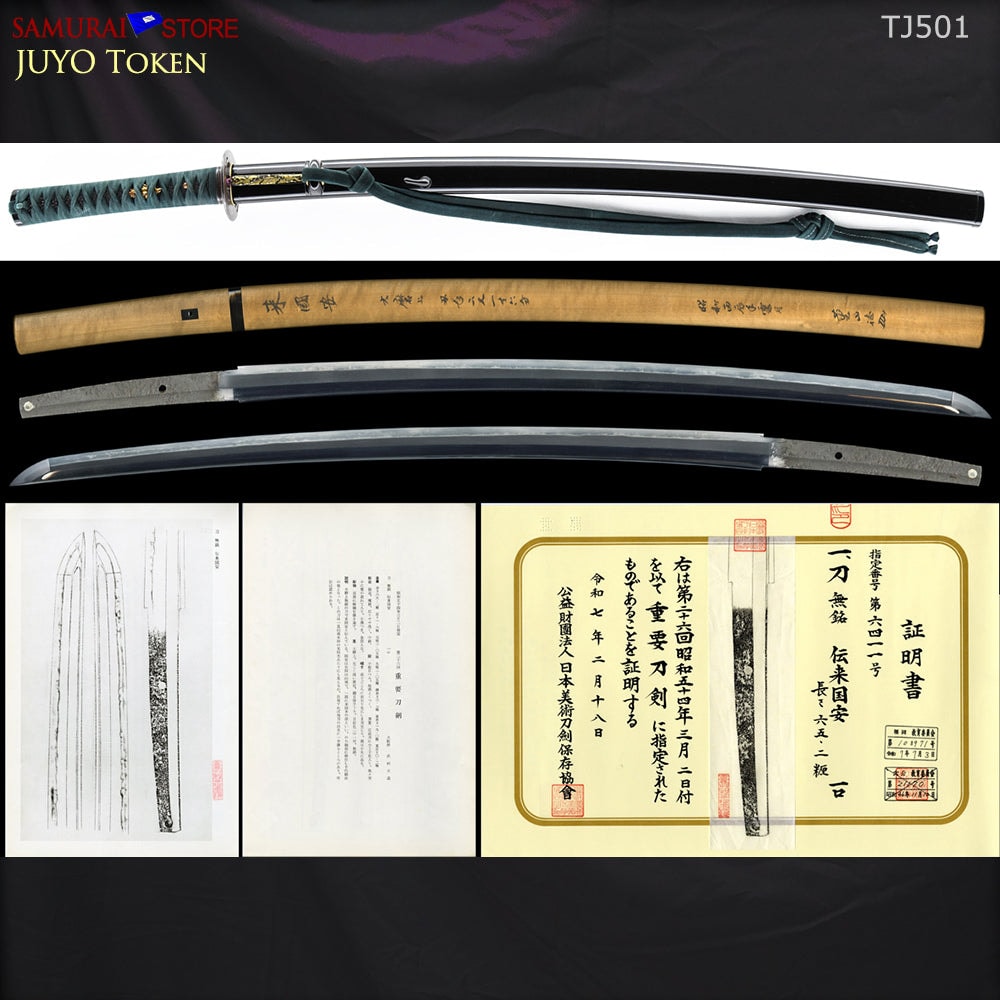
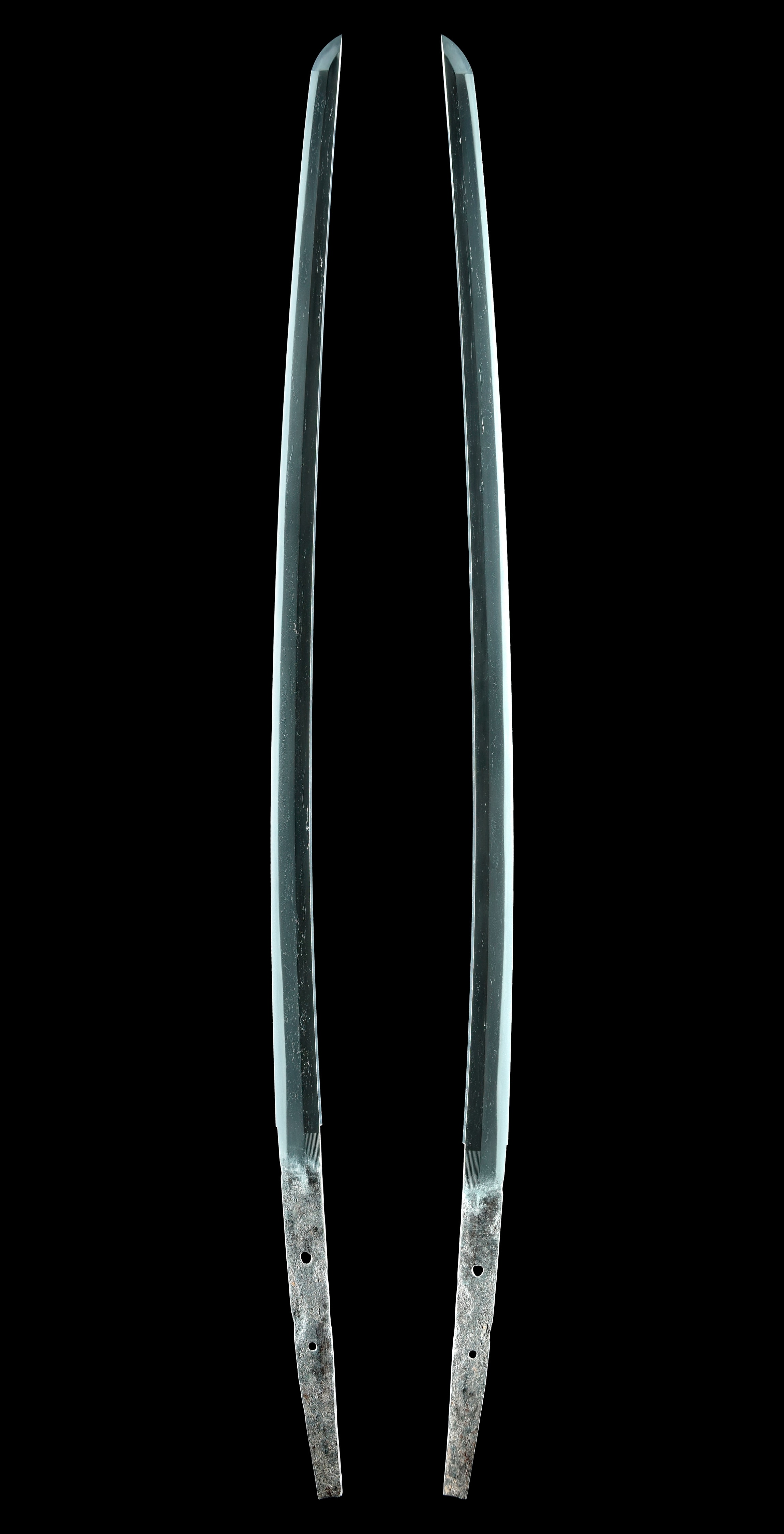
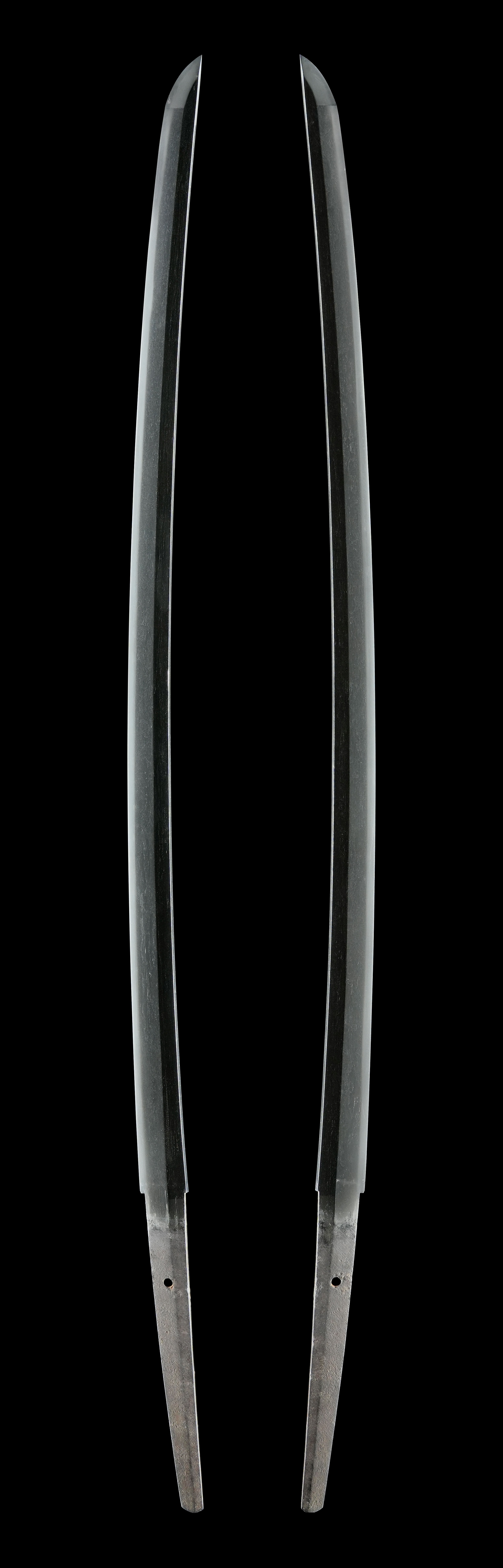
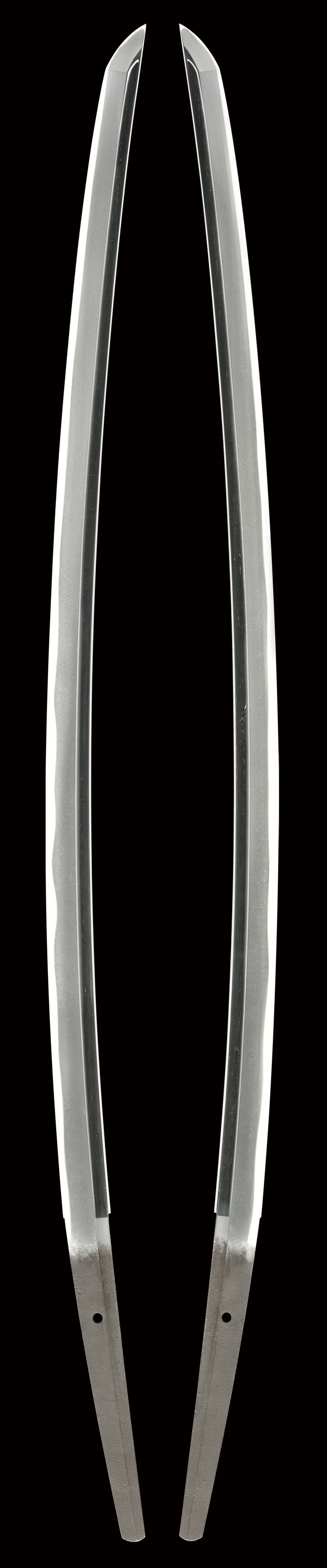
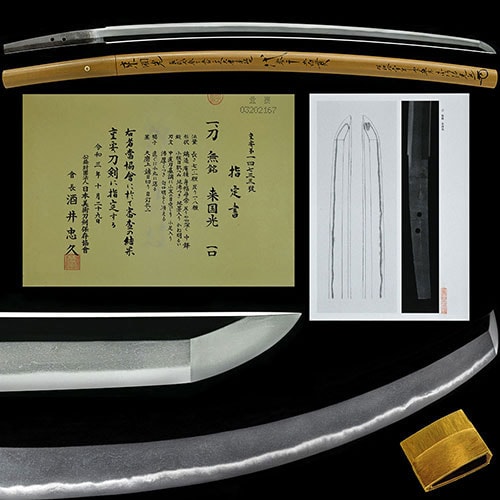
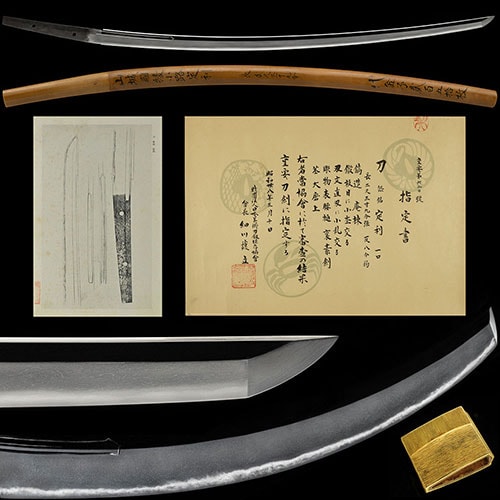
This is a katana attributed to Rai Kuniyasu from the early Nanbokucho period. The blade is o-suriage mumei with a deeply curved shape and bohi carved on both sides. It features a ko-itame-hada jigane and a nioi-based suguha hamon with ko-ashi.
 NihontoWatch



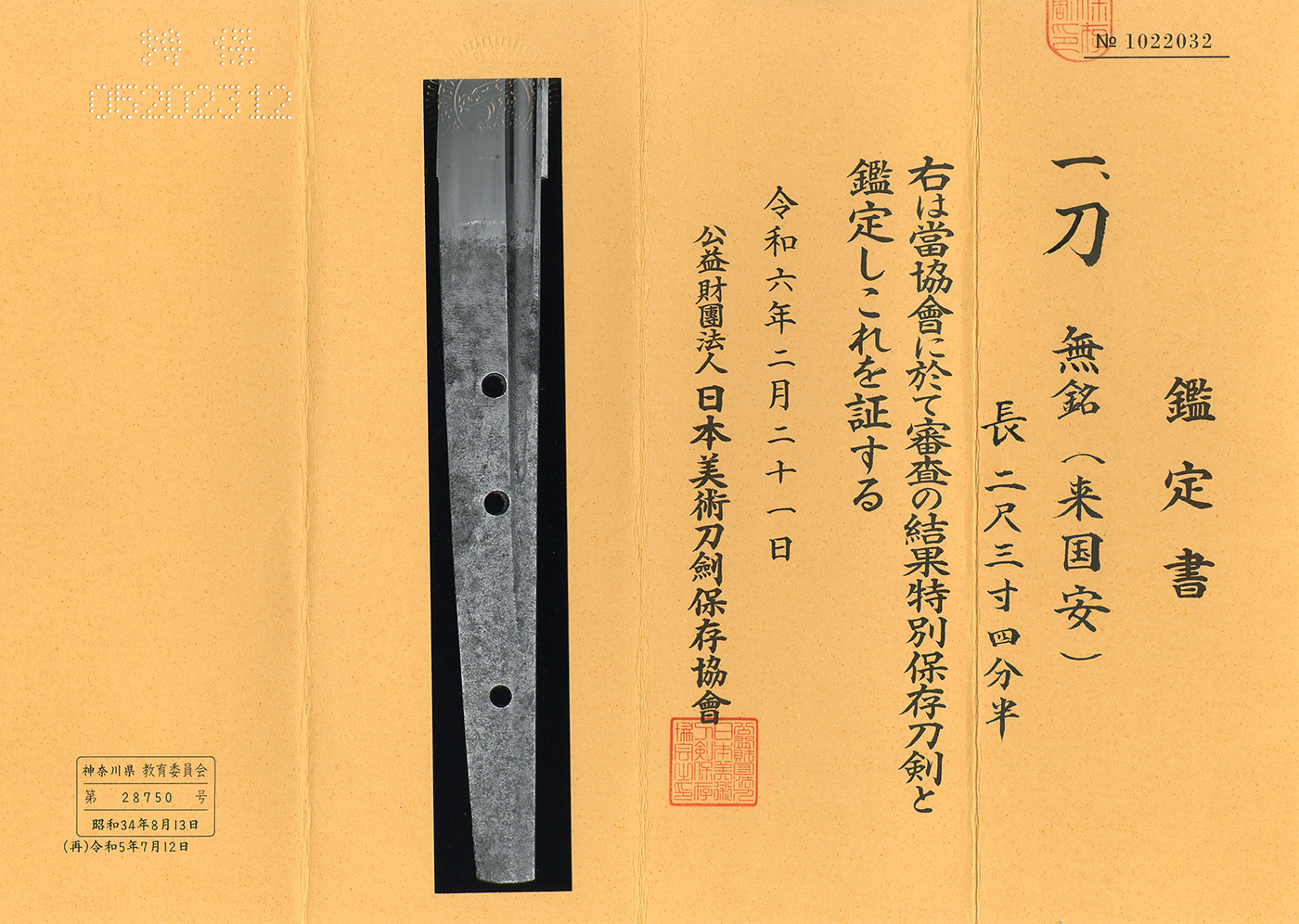
Chiyozuru (Echizen), Rai-derived · Echizen · around 1345-1350
Tōken Taikan top 17%
2 pieces on the market now
An o-dachi bearing the vermilion shu-mei 千代鶴国安 is preserved at Atsuta Jingu, the kind of dedicated great-sword in which the name of this smith survives most directly, for almost everything else on his designated record is a katana greatly shortened and left unsigned, handed down with the den attribution to Rai Kuniyasu. The published sources transmit Kuniyasu as a man born in Yamashiro Province and, by one tradition, a grandson of Rai Kunisue, who later "moved to Echizen and became the founder of the Chiyozuru lineage"[[c:1]]; the reference works place him around the Joji and Sadaji years of the Nanbokucho period, noting that "the sword reference works set his era around the Joji era"[[c:2]]. His is a hand read as the Rai tradition carried out of the Yamashiro capital and inflected by the province that received it, and at first glance a blade of his "can appear akin to works of the Yamashiro Rai homeland, particularly those around Rai Kunimitsu"[[c:3]], yielding only slightly on close examination, so that, as the published record puts it, the received tradition "is judged acceptable"[[c:4]].
The feature that marks him apart from that homeland is the jigane. Where the Yamashiro Rai smiths forge a tight, refined itame, Kuniyasu's itame is mixed with mokume and, in places, nagare-hada, and it stands somewhat open, a hada-dachi tendency the published sources read as his provincial flavor. Over this standing jigane the ji-nie forms thickly, at times dust-fine, and the chikei enter frequently, while the steel takes a slightly blackish tone and a whitish cast, the shirake-gokoro that recurs across his blades. The published commentary makes this the decisive point of appraisal: it is precisely because the grain stands and the steel turns whitish and dark that "here the appraisal to Rai Kuniyasu is confirmed"[[c:5]], the work judged not the homeland's but his.
The temper is a chu-suguha into which small ko-gunome mix, the base sometimes carrying an extremely shallow notare tendency. Along the habuchi the edge is restless beyond what the homeland shows: hotsure, kuichigai-ba and at times nijuba appear, ashi and yo enter, thick nie adheres and in places flares into a coarser, especially brilliant nie, while fine kinsuji and sunagashi run through a bright nioiguchi. The boshi ranges from a quiet ko-maru with hakikake to a far more active turnback, on one blade the nie growing strong and breaking up along the omote and running to vigorous hakikake on the ura with a flame-like, kaen impression. Of one Nanbokucho katana the published sources write that these features "clearly express the characteristics of Rai work of the Nanbokucho period"[[c:6]], the Rai inheritance still legible beneath the provincial cast.
Within this one prime manner the blades fan out along a single axis, from the restrained to the flamboyant. At the quiet end stand pieces whose chu-suguha runs nearly straight, the activity confined to slight hotsure and a kuichigai-ba nuance along the edge. At the active end stands the Joji-era katana of the 61st Juyo session, dated by the reference works to around the Sadaji era, in which "an especially brilliant, coarser nie"[[c:7]] sparkles here and there within the bright ha and the boshi turns to its flame-like form; of this blade the published sources observe that "a rusticity exceeding even the Yamashiro homeland is conspicuous even in the boshi"[[c:8]], naming the very excess of activity as the mark of the provincial workshop. The surviving blades are o-suriage and mumei almost without exception, so that the recognition rests on this reading of ji and ha rather than on a signature, the lone exception being the dedicated shu-mei o-dachi.
The published sources set Kuniyasu in relation to his school by resemblance and slight distinction rather than by contrast. Upstream he stands within the Yamashiro Rai line, near enough to Rai Kunimitsu that a first impression can mistake the two; the gap is one of refinement, the homeland's ji and ha holding a degree of polish his yield. Downstream he is the founder, the smith from whom the Chiyozuru workshop of Echizen descends, and the very features that distinguish his blades from the capital, the standing grain, the blackish whitish-cast steel, the rustic edge and boshi, are the provincial inflection that opens that local tradition. The bright midare activity and the brilliant coarse nie of his most active work set him apart on his own grounded terms, a Rai hand turned rustic in the north.
Fujishiro records no rating for him and his designated output is modest: five works carried to Juyo, with no National Treasure, no Important Cultural Property and no Tokubetsu Juyo among them, four of the five the o-suriage mumei katana that carry the Kuniyasu attribution and one the signed Mino piece that belongs to a different hand. No early daimyo provenance is recorded for his blades. What survives in a public sanctuary is the shu-mei o-dachi held at Atsuta Jingu, a great-sword preserved as patrimony rather than as a thing that trades, and it is in that dedicated piece, not in the market, that his name is read most plainly. None of his designated work is locked away as inalienable cultural property, so the handful of Juyo katana sit in the tradeable tiers; even so, a blade securely appraised to the founder of the Chiyozuru line is encountered only rarely, and the collector who meets one meets a Rai inheritance read through the steel of Echizen.
Where Kuniyasu stands among comparable artisans: across all of nihontō, and within tradition, era, and period. The tiers (Foremost · Leading · Major · Notable) weigh official designations from the NBTHK and Japan's Agency for Cultural Affairs, together with historical honors of lasting repute such as the Sansaku and Meibutsu-chō.
Select a lens to see how it's measured.
Yamashiro-den · Echizen
11 pieces on the market now
The Chiyozuru lineage took root in Echizen Province during the Nanbokuchō period, and the setsumei consistently trace its origin to Rai Kuniyasu (来国安). He is said to have been born in Yamashiro Province, with one tradition holding him a grandson of Rai Kunisue; he later moved to Echizen, where the meikan place him around the Jōji and Sadaji eras (ca. 1362 to 1368). A parallel tradition, recorded on the signed tachi attributed to Morihiro, names Chiyozuru Kuniyasu[[c:1]] as a disciple of Rai Kuniyasu and the founder of the line. From this root descend the smiths the blades document: Morihiro (守弘), placed in the Kuniyasu line across two generations, the first set in the Ōei era (1394 to 1428) and the second in the Kakitsu (1441 to 1444) and Bun'an (1444 to 1449) eras; and Mitsuyuki of Tsuruga[[c:2]], recorded as a student of Echizen Kuniyuki and known from a rare Kakei-dated tantō. The Yamashiro inheritance runs through the whole group, even as the workmanship moves away from the Kyoto homeland into a provincial Hokuriku register. Two stylistic strands run through the corpus, and recognizing the hand means reading where a given blade falls between them. The Rai-derived work, seen in the katana attributed to Rai Kuniyasu, shows itame mixed with mokume and nagare-hada, the grain tending to stand (hada-dachi) with thick ji-nie and frequent chikei; the steel carries a whitish or, in places, slightly blackish cast that the setsumei read as a provincial inflection of Yamashiro.
The hamon on these is a chū-suguha mixed with ko-gunome, the edge breaking into hotsure, kuichigai-ba, and nijūba, with ashi, yō, kinsuji, and sunagashi running through and a bright nioiguchi; the bōshi enters midare-komi or shallow notare-komi, turning in ko-maru with hakikake, at times vigorous enough to give a flame-like (kaen) impression. The Morihiro strand turns toward a gunome-based midareba with a chōji tendency, tobiyaki, and muneyaki, the forging moving toward masame near the edge; the setsumei mark this gunome-toned, nie-laden manner as differing in character from the Rai style and proper to the later line. For kantei, the setsumei set the diagnostic problem plainly: a Chiyozuru blade can at first glance resemble the orthodox Yamashiro Rai work, particularly around Rai Kunimitsu, yet careful reading of the standing grain, the whitish or blackish jigane, and the rustic activity in the bōshi beyond what the Kyoto homeland shows directs the attribution to Echizen. The boldest Nanbokuchō pieces, wide in mihaba with ō-kissaki and muneyaki, invite comparison with Hokuriku contemporaries such as Etchū Tametsugu (越中為継), but the character of ji and ha keeps them within the Chiyozuru fold. Signed examples anchor the line: Morihiro tachi and a Kakitsu 1 (1441) dated wakizashi carrying his Tōzaemon no Jō name, and the Mitsuyuki tantō whose Kakei date makes it documentary material of high value, dated works of the group being extremely scarce. The Morihiro tachi of Jūyō-Bijutsuhin standing is recorded in the Kōzan Oshigata, Kokon Kajibikō, and Kantō Zuiroku. Across the corpus the line holds a distinct place among Nanbokuchō and early Muromachi Hokuriku smiths, carrying a Yamashiro pedigree into a workmanship the appraisers read as its own. Learn more →
| Smith | Era | Designated |
|---|---|---|
| Kuniyasu國安 | 1345-1350 | 4 |
| Ieyoshi家吉 | 1429-1441 | 0 |
| Iemasa家正 | 1492-1501 | 0 |
| Ieyoshi家善 | 1487-1489 | 0 |
| Morihiro守弘 | 1394-1428 | 4 |
The Nanbokuchō period (1333 to 1392)
Two courts, sixty years of war, and the most dramatic silhouettes in the sword’s history: broad blades, extended points, true ōdachi later cut down into the majestic katana collectors prize. The Sōshū manner was the style of the age.
We could not find an authenticity certificate on the seller’s listing. Japanese swords and fittings are normally papered by the NBTHK (or the NTHK). Without one, the attribution is the seller’s own assessment and has not been independently verified — treat it with caution and ask the dealer about certification before buying.
If you wish to return an item, please notify us within 3 days of receipt. After this period we cannot accept cancellations. Please ship the return to us within 5 business days. Cancellation is conditional on the item being kept in the same condition as at the time of sale, so please handle it with care.

This is a katana attributed to Rai Kuniyasu from the early Nanbokucho period. The blade is o-suriage mumei with a deeply curved shape and bohi carved on both sides. It features a ko-itame-hada jigane and a nioi-based suguha hamon with ko-ashi.
NihontoWatchChiyozuru (Echizen), Rai-derived · Echizen · around 1345-1350
Tōken Taikan top 17%
2 pieces on the market now
An o-dachi bearing the vermilion shu-mei 千代鶴国安 is preserved at Atsuta Jingu, the kind of dedicated great-sword in which the name of this smith survives most directly, for almost everything else on his designated record is a katana greatly shortened and left unsigned, handed down with the den attribution to Rai Kuniyasu. The published sources transmit Kuniyasu as a man born in Yamashiro Province and, by one tradition, a grandson of Rai Kunisue, who later "moved to Echizen and became the founder of the Chiyozuru lineage"[[c:1]]; the reference works place him around the Joji and Sadaji years of the Nanbokucho period, noting that "the sword reference works set his era around the Joji era"[[c:2]]. His is a hand read as the Rai tradition carried out of the Yamashiro capital and inflected by the province that received it, and at first glance a blade of his "can appear akin to works of the Yamashiro Rai homeland, particularly those around Rai Kunimitsu"[[c:3]], yielding only slightly on close examination, so that, as the published record puts it, the received tradition "is judged acceptable"[[c:4]].
The feature that marks him apart from that homeland is the jigane. Where the Yamashiro Rai smiths forge a tight, refined itame, Kuniyasu's itame is mixed with mokume and, in places, nagare-hada, and it stands somewhat open, a hada-dachi tendency the published sources read as his provincial flavor. Over this standing jigane the ji-nie forms thickly, at times dust-fine, and the chikei enter frequently, while the steel takes a slightly blackish tone and a whitish cast, the shirake-gokoro that recurs across his blades. The published commentary makes this the decisive point of appraisal: it is precisely because the grain stands and the steel turns whitish and dark that "here the appraisal to Rai Kuniyasu is confirmed"[[c:5]], the work judged not the homeland's but his.
The temper is a chu-suguha into which small ko-gunome mix, the base sometimes carrying an extremely shallow notare tendency. Along the habuchi the edge is restless beyond what the homeland shows: hotsure, kuichigai-ba and at times nijuba appear, ashi and yo enter, thick nie adheres and in places flares into a coarser, especially brilliant nie, while fine kinsuji and sunagashi run through a bright nioiguchi. The boshi ranges from a quiet ko-maru with hakikake to a far more active turnback, on one blade the nie growing strong and breaking up along the omote and running to vigorous hakikake on the ura with a flame-like, kaen impression. Of one Nanbokucho katana the published sources write that these features "clearly express the characteristics of Rai work of the Nanbokucho period"[[c:6]], the Rai inheritance still legible beneath the provincial cast.
Within this one prime manner the blades fan out along a single axis, from the restrained to the flamboyant. At the quiet end stand pieces whose chu-suguha runs nearly straight, the activity confined to slight hotsure and a kuichigai-ba nuance along the edge. At the active end stands the Joji-era katana of the 61st Juyo session, dated by the reference works to around the Sadaji era, in which "an especially brilliant, coarser nie"[[c:7]] sparkles here and there within the bright ha and the boshi turns to its flame-like form; of this blade the published sources observe that "a rusticity exceeding even the Yamashiro homeland is conspicuous even in the boshi"[[c:8]], naming the very excess of activity as the mark of the provincial workshop. The surviving blades are o-suriage and mumei almost without exception, so that the recognition rests on this reading of ji and ha rather than on a signature, the lone exception being the dedicated shu-mei o-dachi.
The published sources set Kuniyasu in relation to his school by resemblance and slight distinction rather than by contrast. Upstream he stands within the Yamashiro Rai line, near enough to Rai Kunimitsu that a first impression can mistake the two; the gap is one of refinement, the homeland's ji and ha holding a degree of polish his yield. Downstream he is the founder, the smith from whom the Chiyozuru workshop of Echizen descends, and the very features that distinguish his blades from the capital, the standing grain, the blackish whitish-cast steel, the rustic edge and boshi, are the provincial inflection that opens that local tradition. The bright midare activity and the brilliant coarse nie of his most active work set him apart on his own grounded terms, a Rai hand turned rustic in the north.
Fujishiro records no rating for him and his designated output is modest: five works carried to Juyo, with no National Treasure, no Important Cultural Property and no Tokubetsu Juyo among them, four of the five the o-suriage mumei katana that carry the Kuniyasu attribution and one the signed Mino piece that belongs to a different hand. No early daimyo provenance is recorded for his blades. What survives in a public sanctuary is the shu-mei o-dachi held at Atsuta Jingu, a great-sword preserved as patrimony rather than as a thing that trades, and it is in that dedicated piece, not in the market, that his name is read most plainly. None of his designated work is locked away as inalienable cultural property, so the handful of Juyo katana sit in the tradeable tiers; even so, a blade securely appraised to the founder of the Chiyozuru line is encountered only rarely, and the collector who meets one meets a Rai inheritance read through the steel of Echizen.
Where Kuniyasu stands among comparable artisans: across all of nihontō, and within tradition, era, and period. The tiers (Foremost · Leading · Major · Notable) weigh official designations from the NBTHK and Japan's Agency for Cultural Affairs, together with historical honors of lasting repute such as the Sansaku and Meibutsu-chō.
Select a lens to see how it's measured.
Yamashiro-den · Echizen
11 pieces on the market now
The Chiyozuru lineage took root in Echizen Province during the Nanbokuchō period, and the setsumei consistently trace its origin to Rai Kuniyasu (来国安). He is said to have been born in Yamashiro Province, with one tradition holding him a grandson of Rai Kunisue; he later moved to Echizen, where the meikan place him around the Jōji and Sadaji eras (ca. 1362 to 1368). A parallel tradition, recorded on the signed tachi attributed to Morihiro, names Chiyozuru Kuniyasu[[c:1]] as a disciple of Rai Kuniyasu and the founder of the line. From this root descend the smiths the blades document: Morihiro (守弘), placed in the Kuniyasu line across two generations, the first set in the Ōei era (1394 to 1428) and the second in the Kakitsu (1441 to 1444) and Bun'an (1444 to 1449) eras; and Mitsuyuki of Tsuruga[[c:2]], recorded as a student of Echizen Kuniyuki and known from a rare Kakei-dated tantō. The Yamashiro inheritance runs through the whole group, even as the workmanship moves away from the Kyoto homeland into a provincial Hokuriku register. Two stylistic strands run through the corpus, and recognizing the hand means reading where a given blade falls between them. The Rai-derived work, seen in the katana attributed to Rai Kuniyasu, shows itame mixed with mokume and nagare-hada, the grain tending to stand (hada-dachi) with thick ji-nie and frequent chikei; the steel carries a whitish or, in places, slightly blackish cast that the setsumei read as a provincial inflection of Yamashiro.
The hamon on these is a chū-suguha mixed with ko-gunome, the edge breaking into hotsure, kuichigai-ba, and nijūba, with ashi, yō, kinsuji, and sunagashi running through and a bright nioiguchi; the bōshi enters midare-komi or shallow notare-komi, turning in ko-maru with hakikake, at times vigorous enough to give a flame-like (kaen) impression. The Morihiro strand turns toward a gunome-based midareba with a chōji tendency, tobiyaki, and muneyaki, the forging moving toward masame near the edge; the setsumei mark this gunome-toned, nie-laden manner as differing in character from the Rai style and proper to the later line. For kantei, the setsumei set the diagnostic problem plainly: a Chiyozuru blade can at first glance resemble the orthodox Yamashiro Rai work, particularly around Rai Kunimitsu, yet careful reading of the standing grain, the whitish or blackish jigane, and the rustic activity in the bōshi beyond what the Kyoto homeland shows directs the attribution to Echizen. The boldest Nanbokuchō pieces, wide in mihaba with ō-kissaki and muneyaki, invite comparison with Hokuriku contemporaries such as Etchū Tametsugu (越中為継), but the character of ji and ha keeps them within the Chiyozuru fold. Signed examples anchor the line: Morihiro tachi and a Kakitsu 1 (1441) dated wakizashi carrying his Tōzaemon no Jō name, and the Mitsuyuki tantō whose Kakei date makes it documentary material of high value, dated works of the group being extremely scarce. The Morihiro tachi of Jūyō-Bijutsuhin standing is recorded in the Kōzan Oshigata, Kokon Kajibikō, and Kantō Zuiroku. Across the corpus the line holds a distinct place among Nanbokuchō and early Muromachi Hokuriku smiths, carrying a Yamashiro pedigree into a workmanship the appraisers read as its own. Learn more →
| Smith | Era | Designated |
|---|---|---|
| Kuniyasu國安 | 1345-1350 | 4 |
| Ieyoshi家吉 | 1429-1441 | 0 |
| Iemasa家正 | 1492-1501 | 0 |
| Ieyoshi家善 | 1487-1489 | 0 |
| Morihiro守弘 | 1394-1428 | 4 |
The Nanbokuchō period (1333 to 1392)
Two courts, sixty years of war, and the most dramatic silhouettes in the sword’s history: broad blades, extended points, true ōdachi later cut down into the majestic katana collectors prize. The Sōshū manner was the style of the age.
We could not find an authenticity certificate on the seller’s listing. Japanese swords and fittings are normally papered by the NBTHK (or the NTHK). Without one, the attribution is the seller’s own assessment and has not been independently verified — treat it with caution and ask the dealer about certification before buying.
If you wish to return an item, please notify us within 3 days of receipt. After this period we cannot accept cancellations. Please ship the return to us within 5 business days. Cancellation is conditional on the item being kept in the same condition as at the time of sale, so please handle it with care.