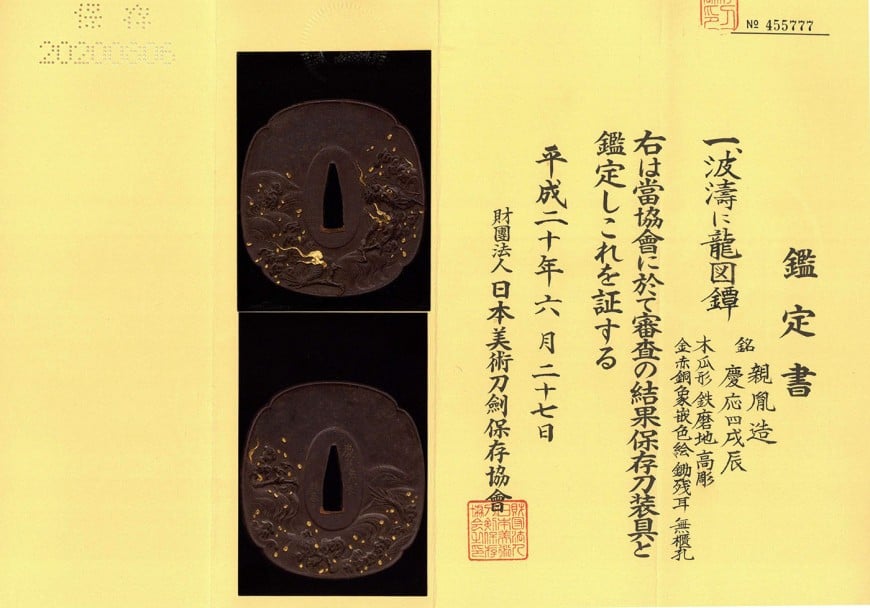
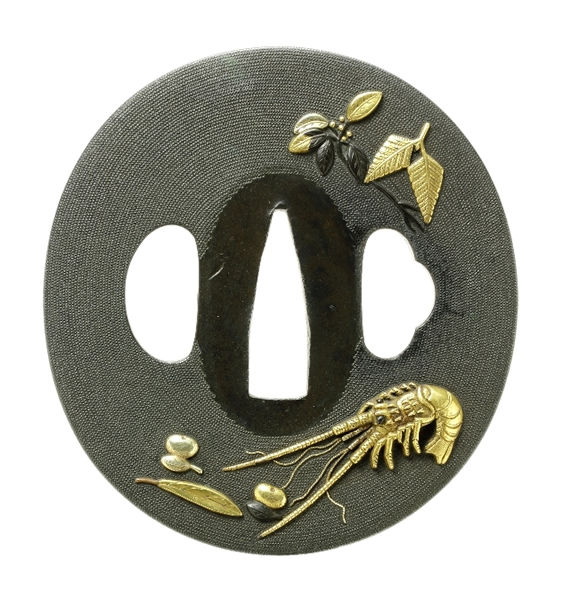
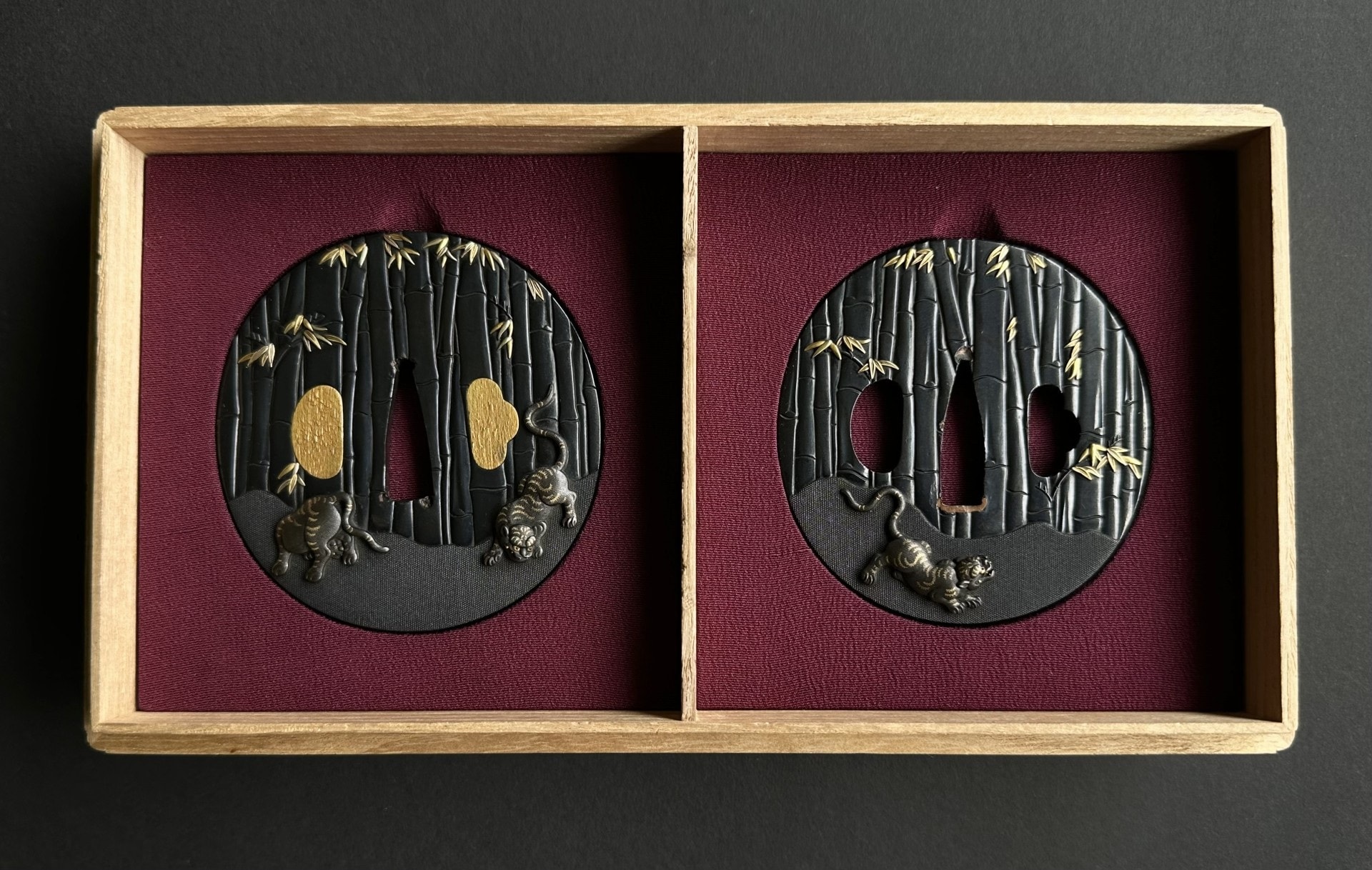
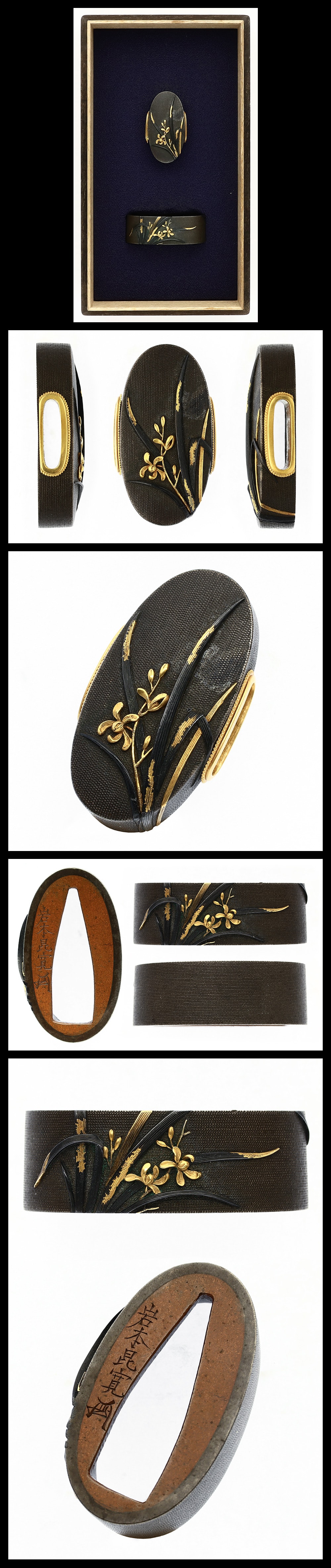
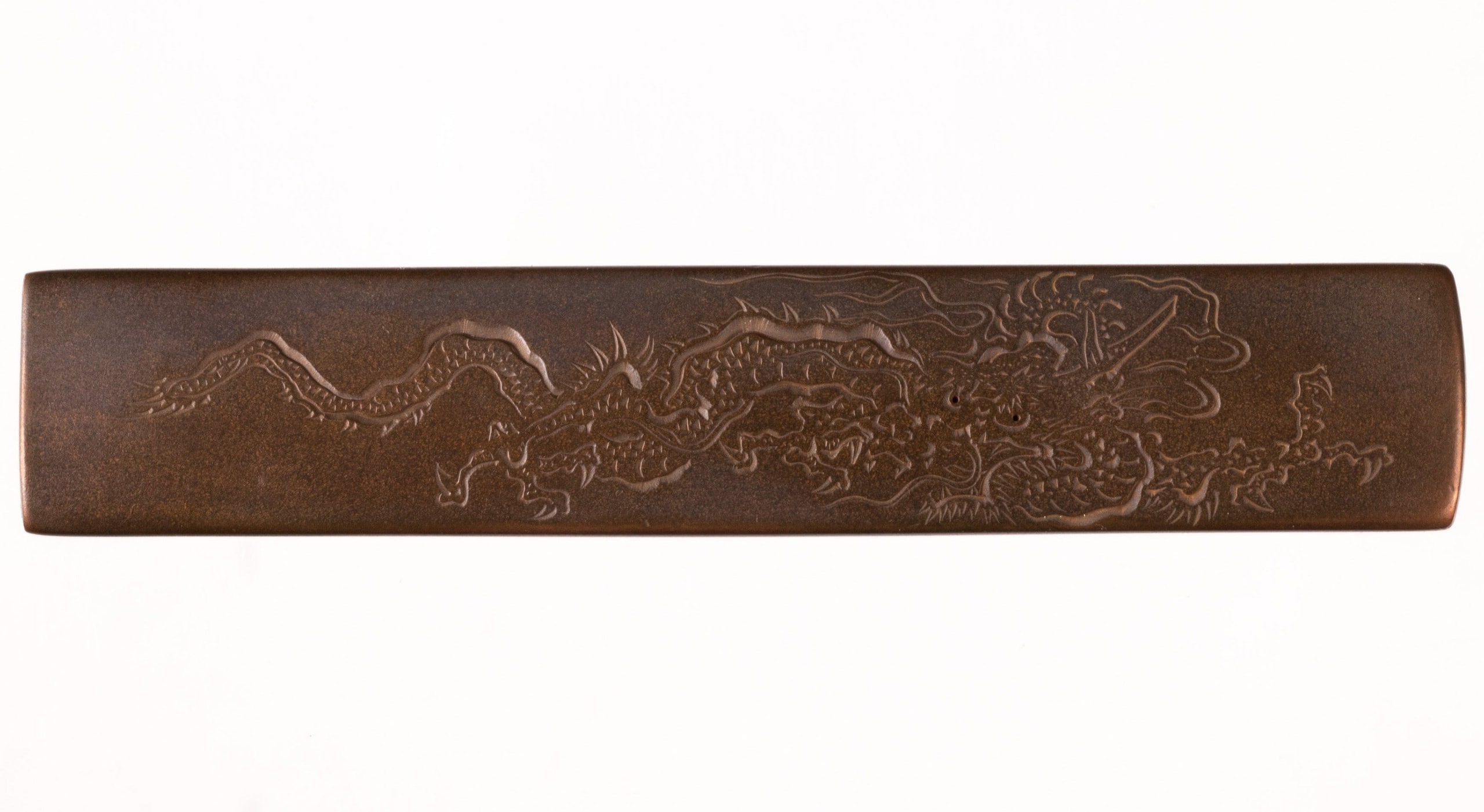
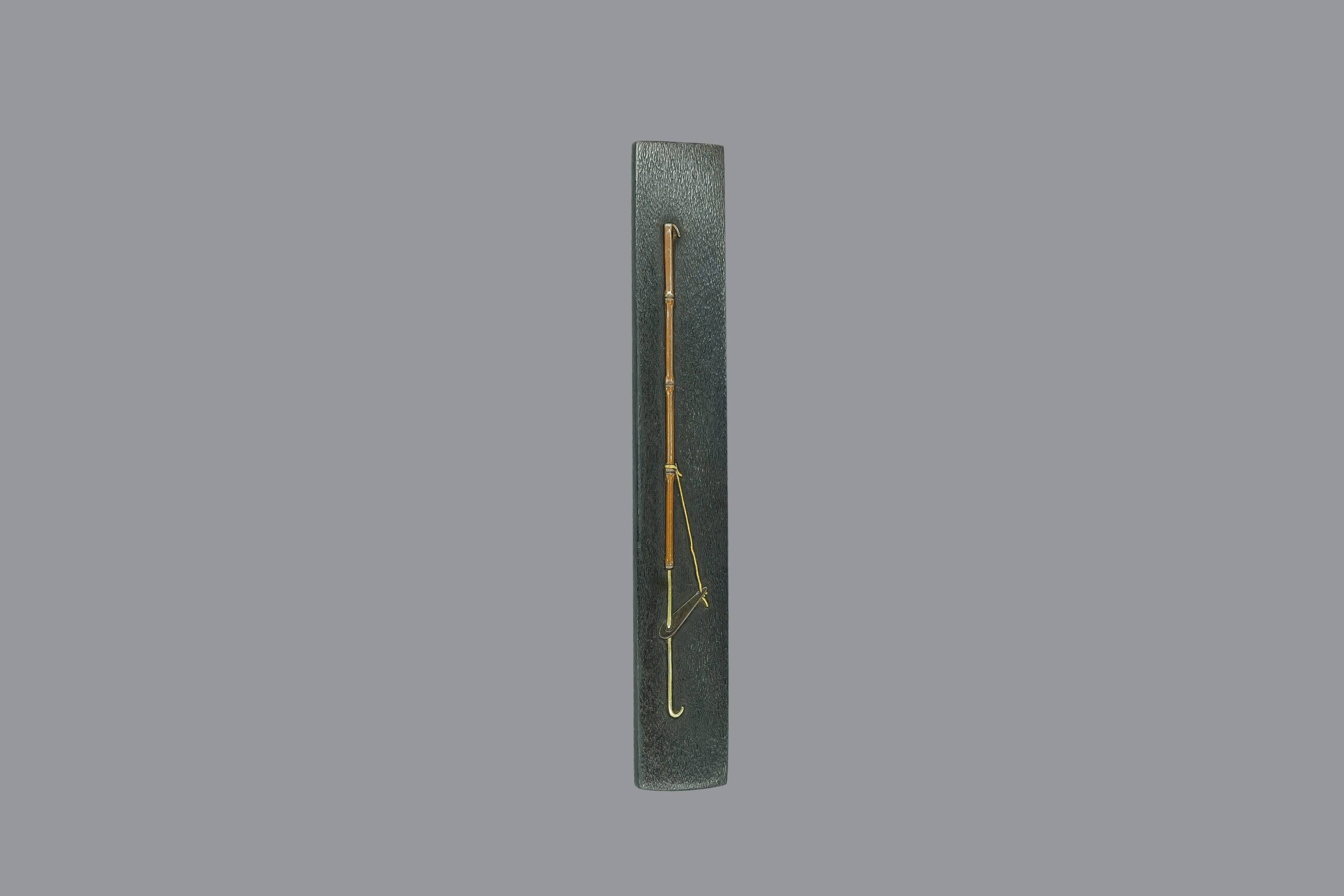
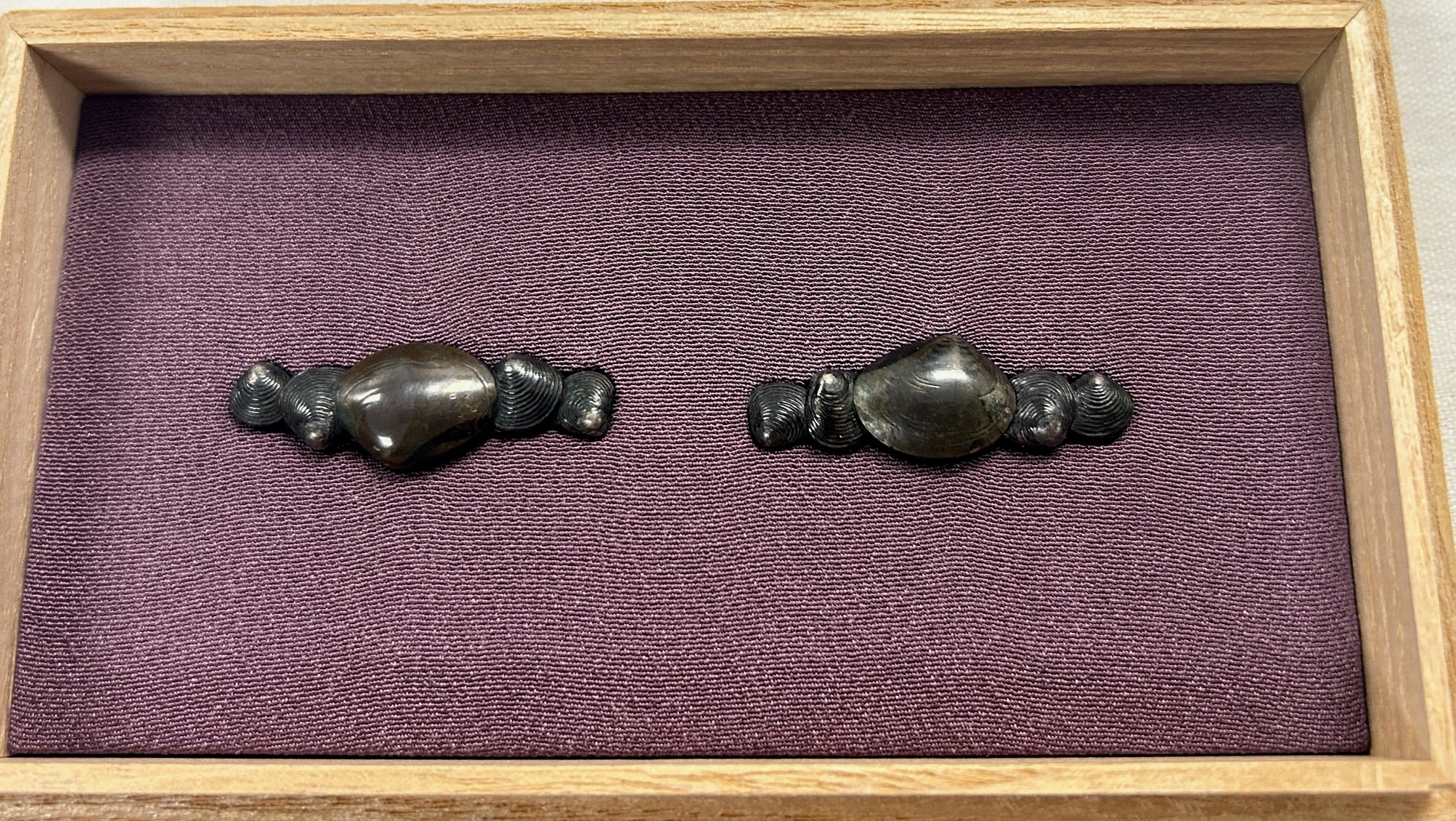
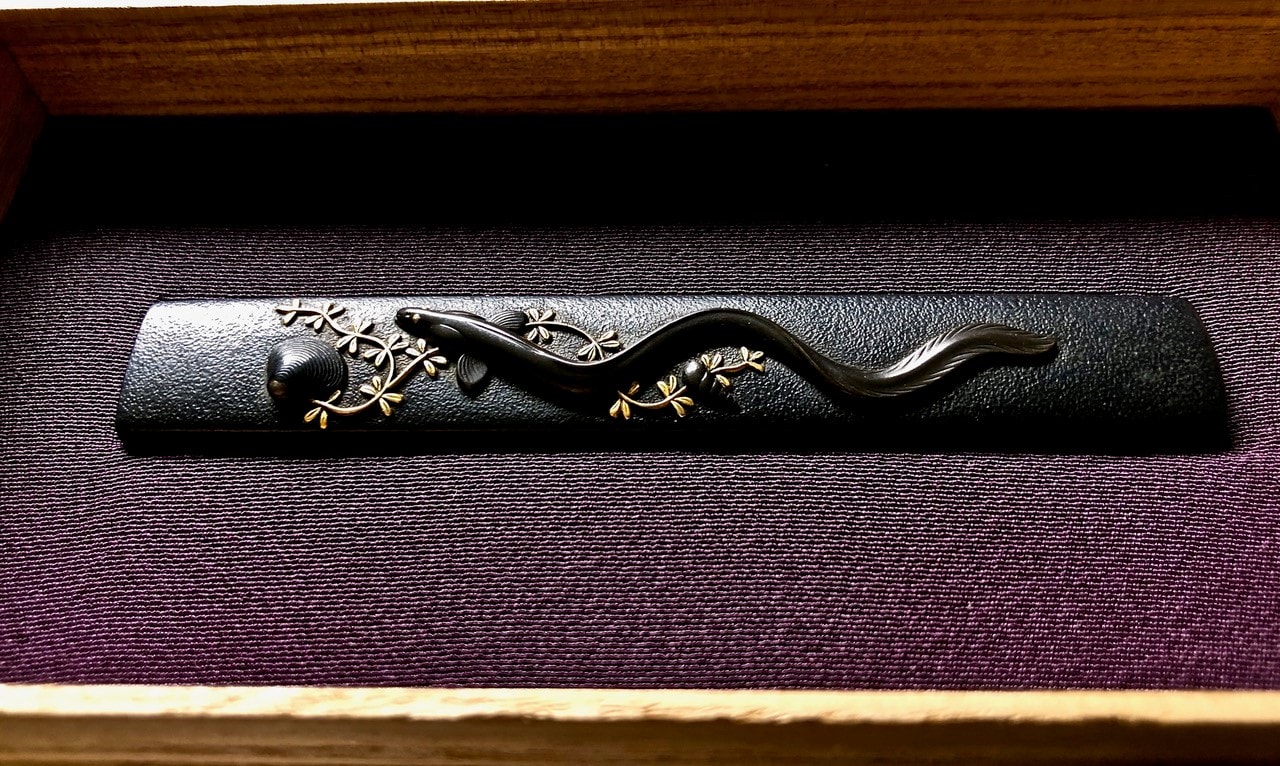
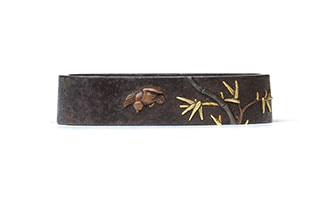
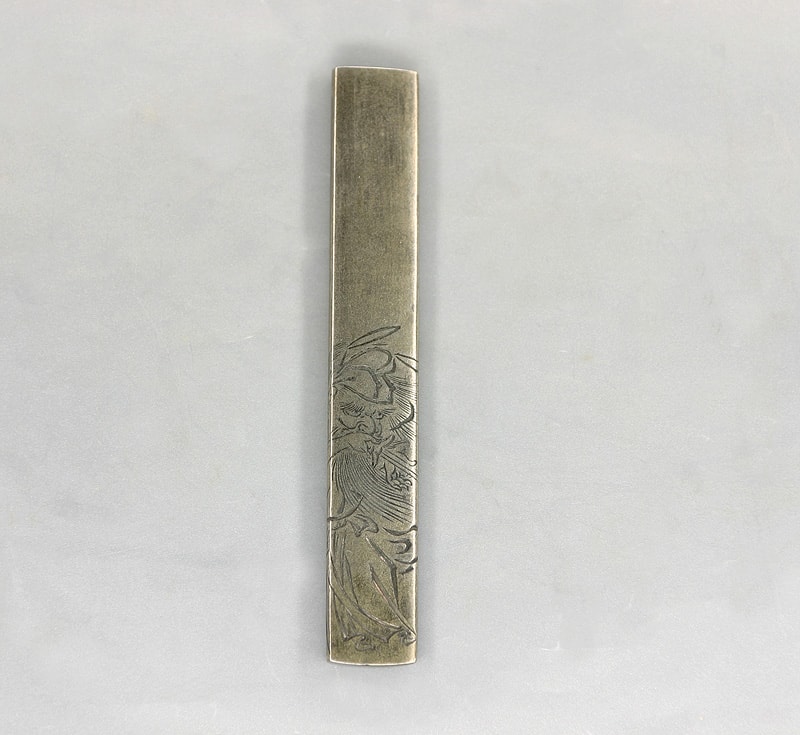
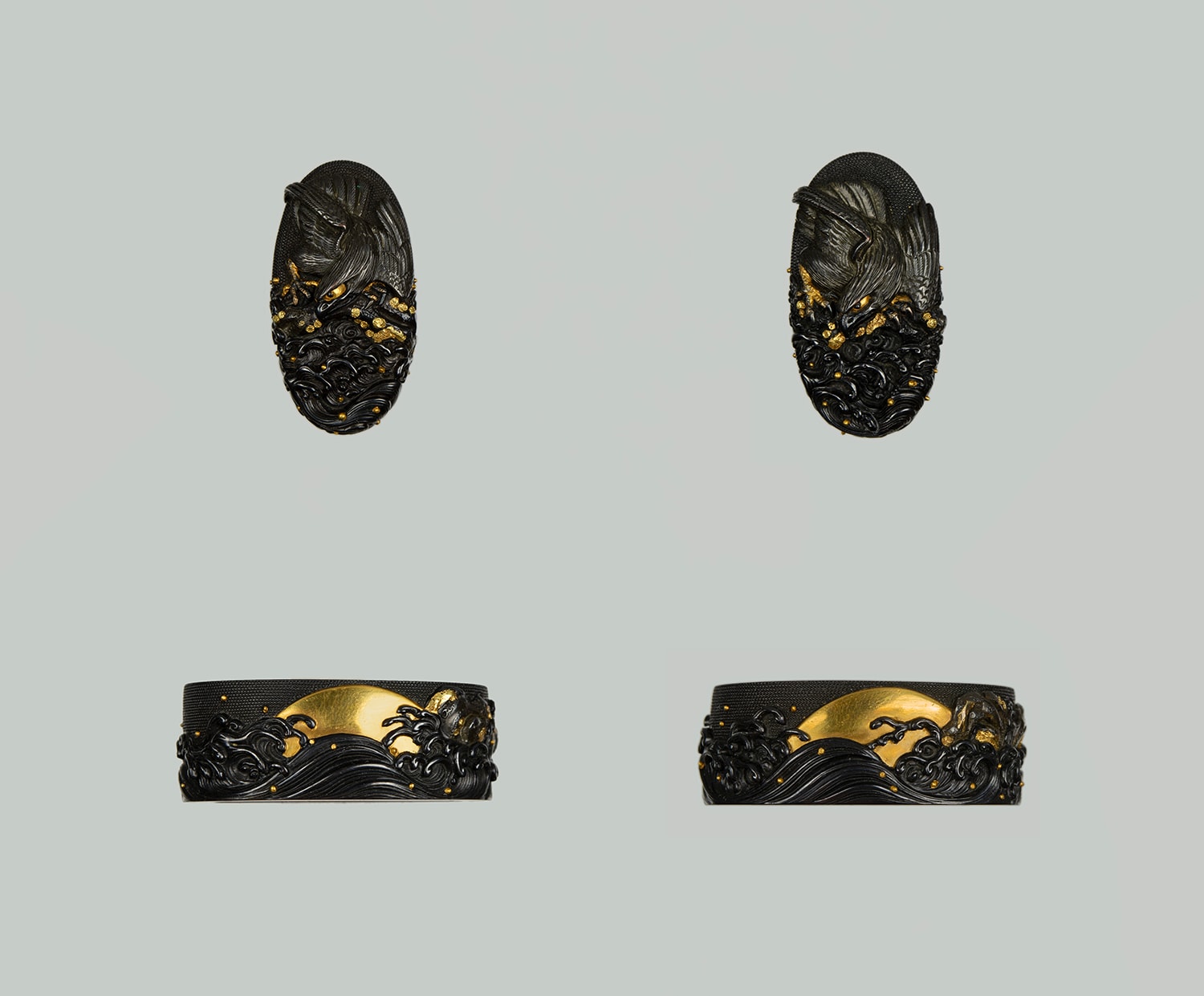
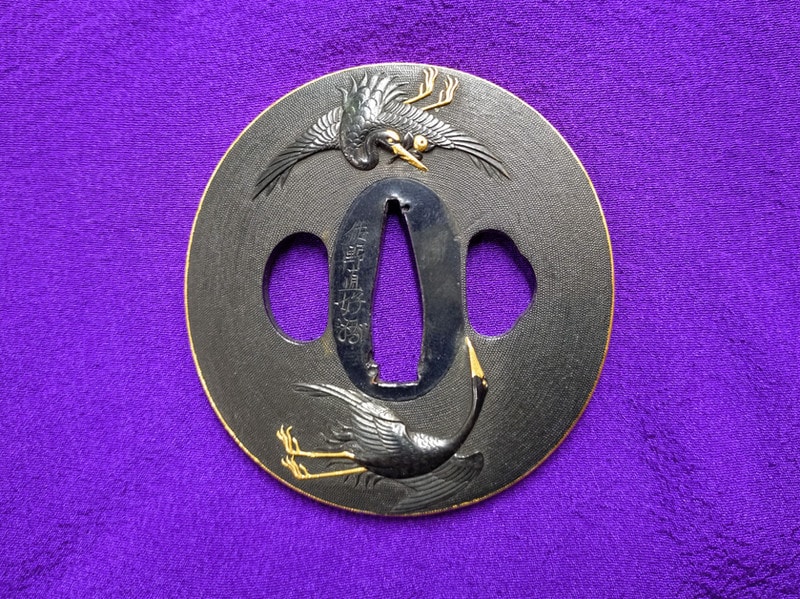
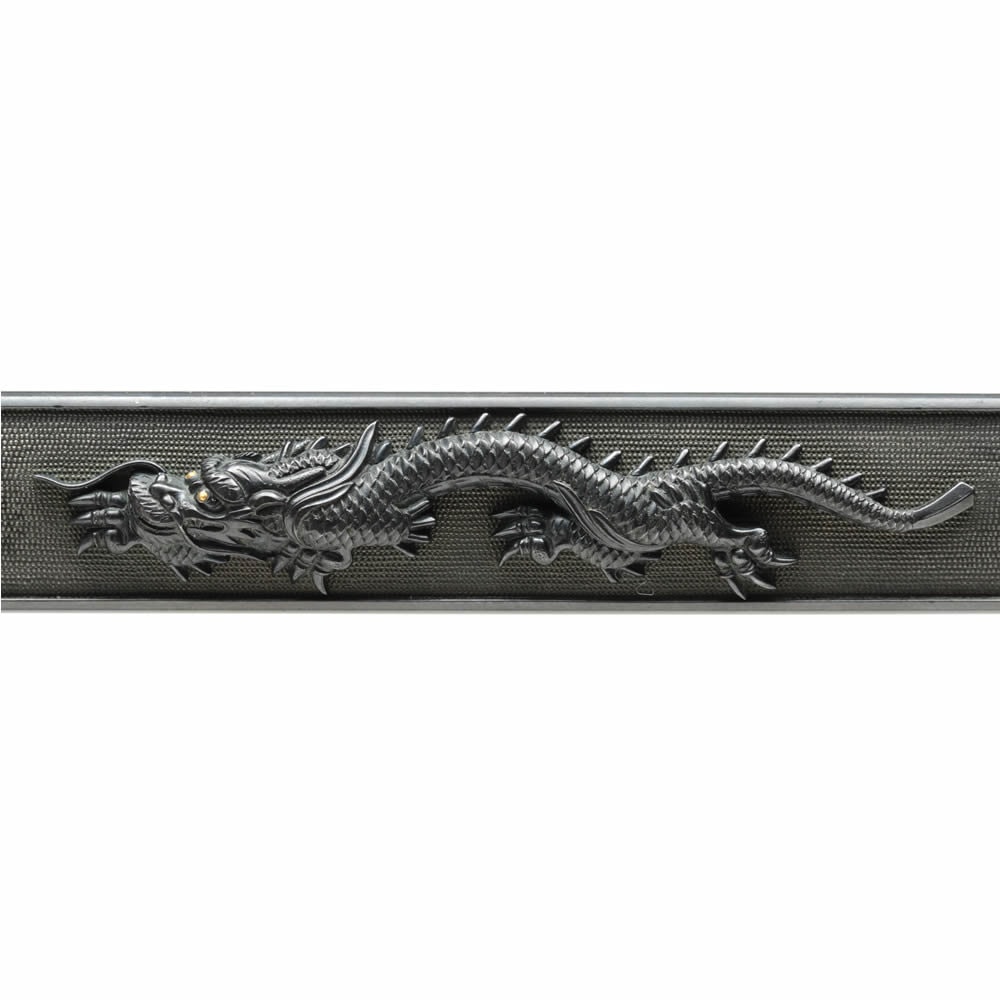
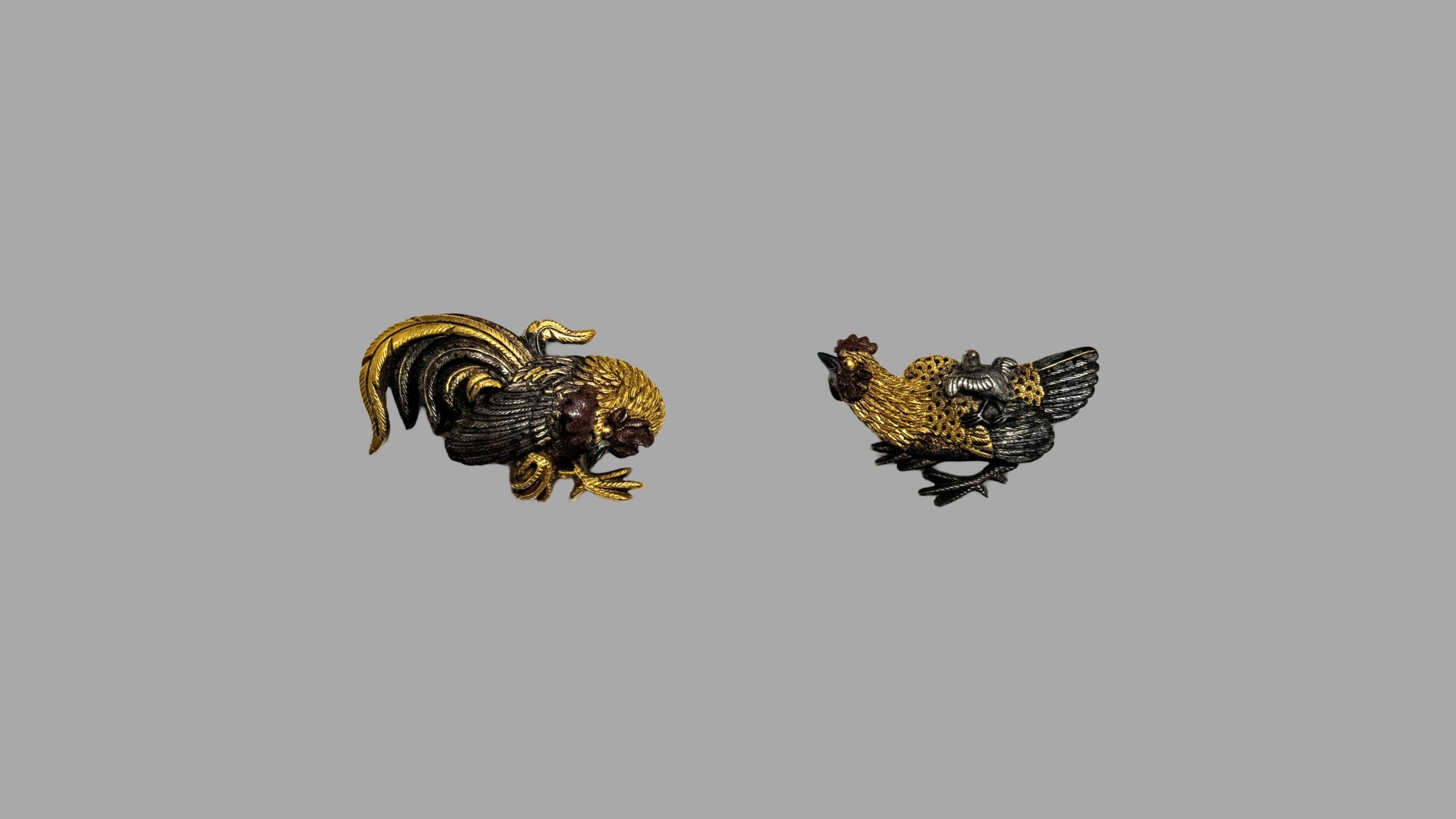
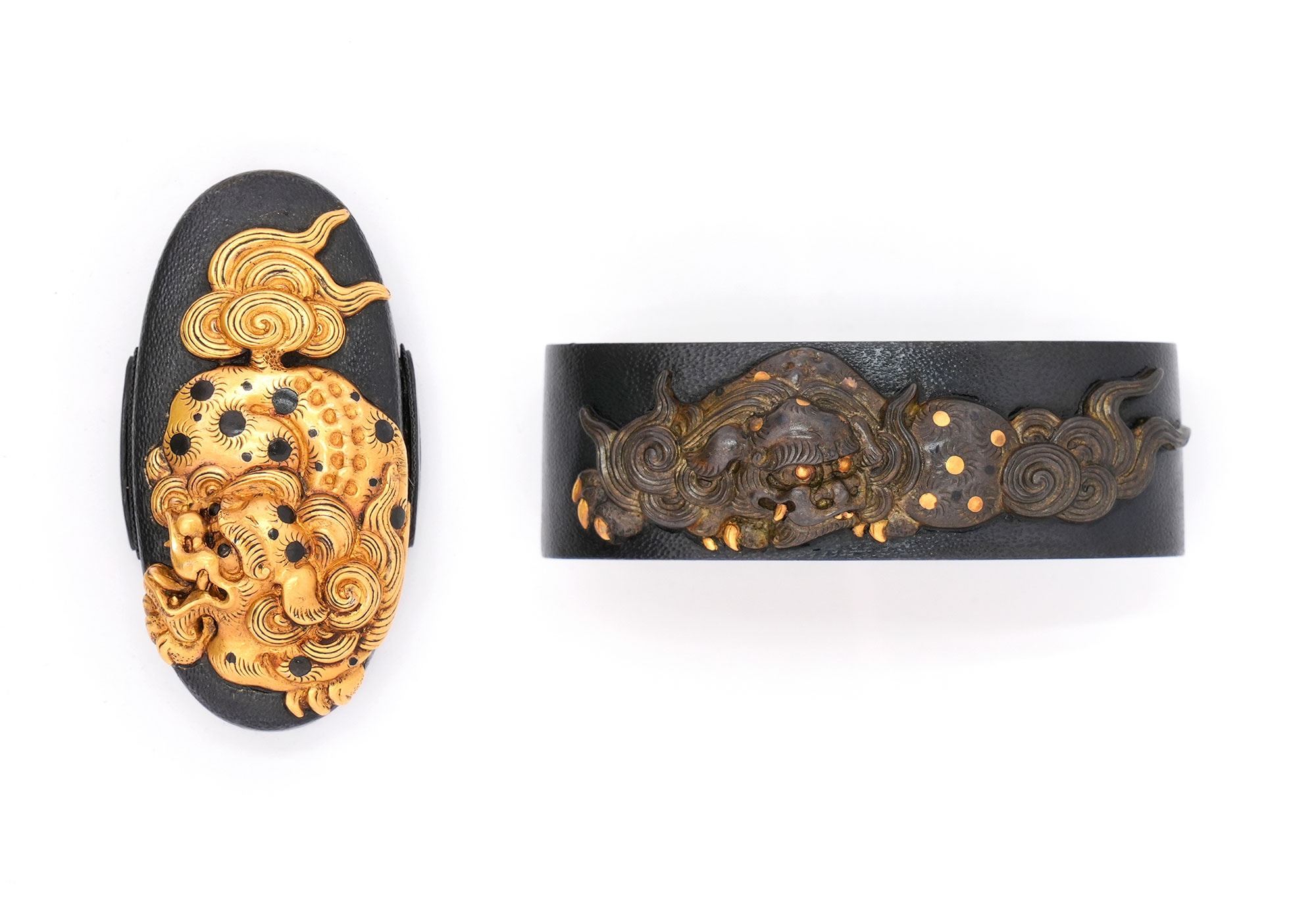
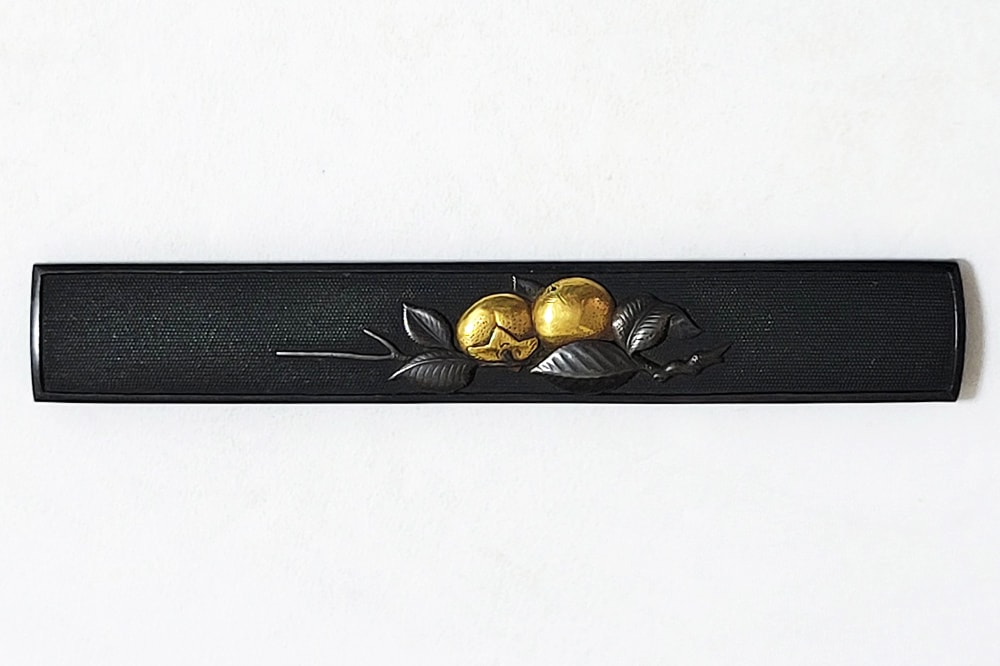
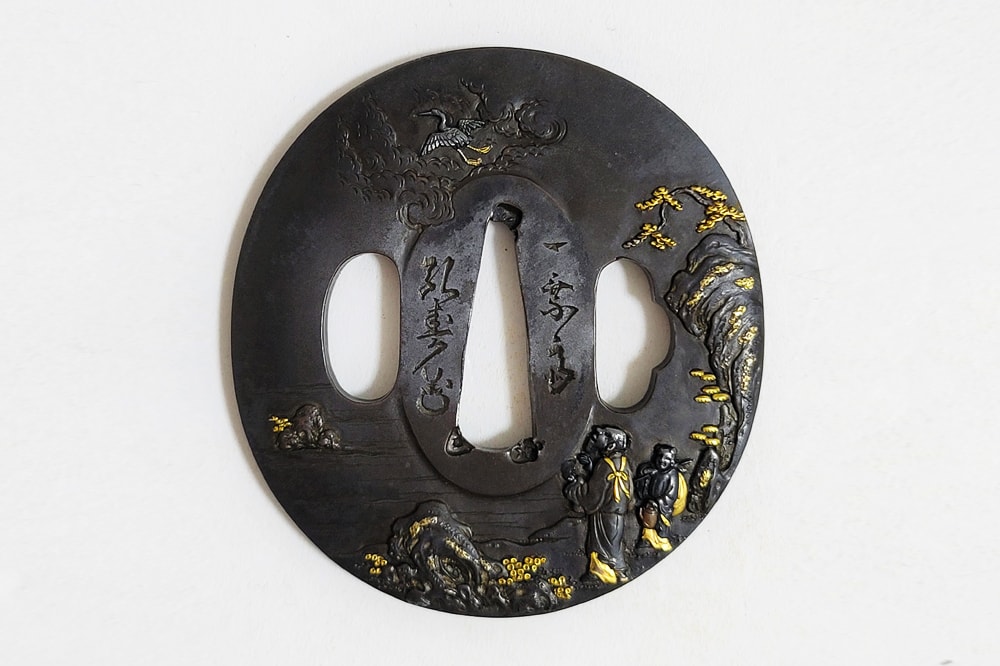
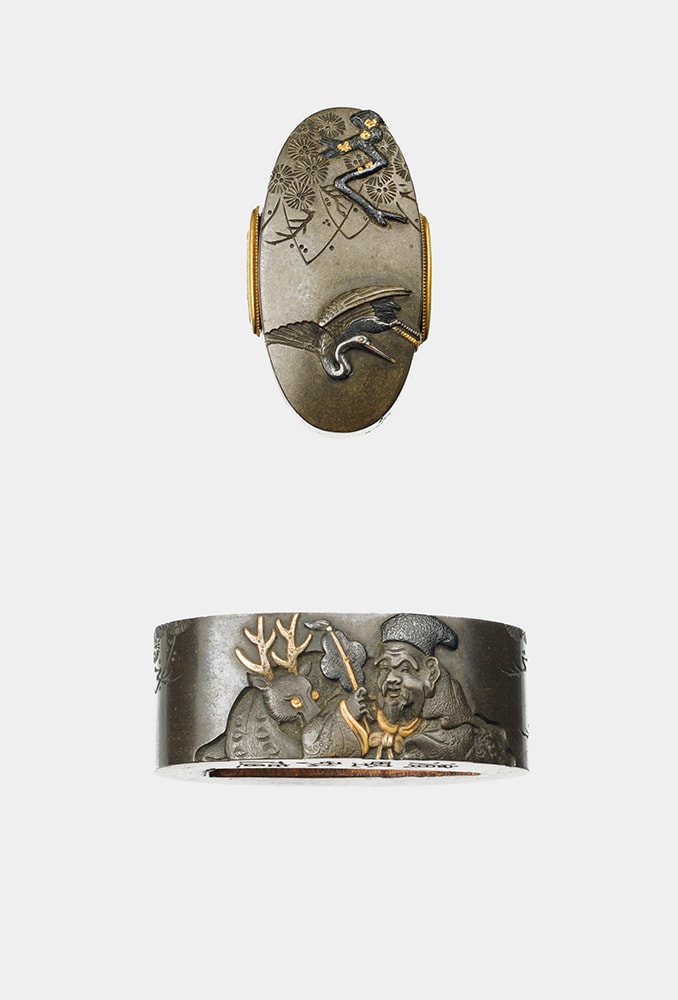
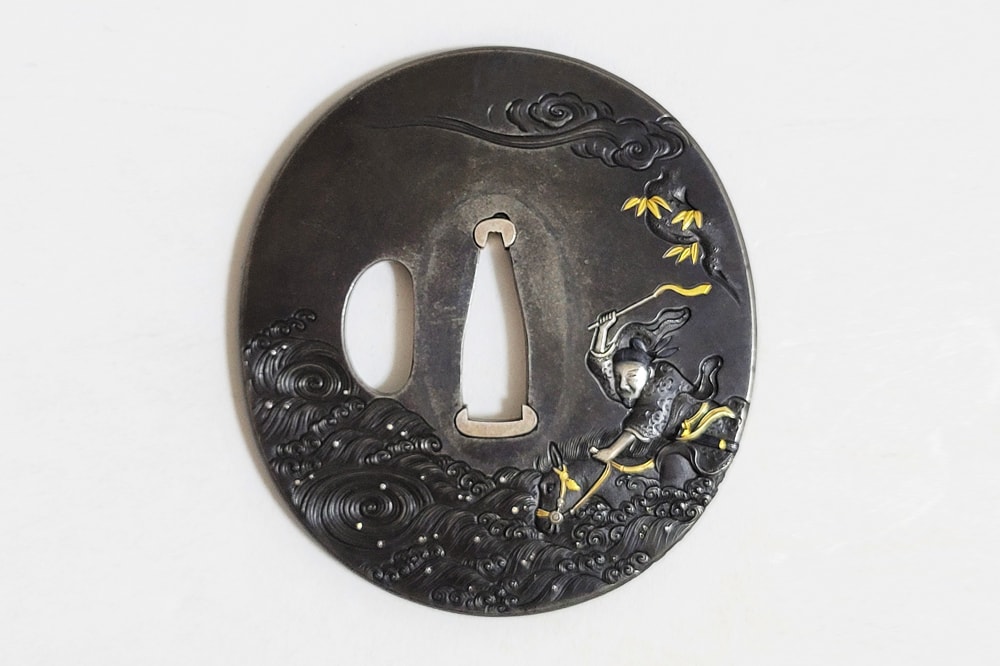
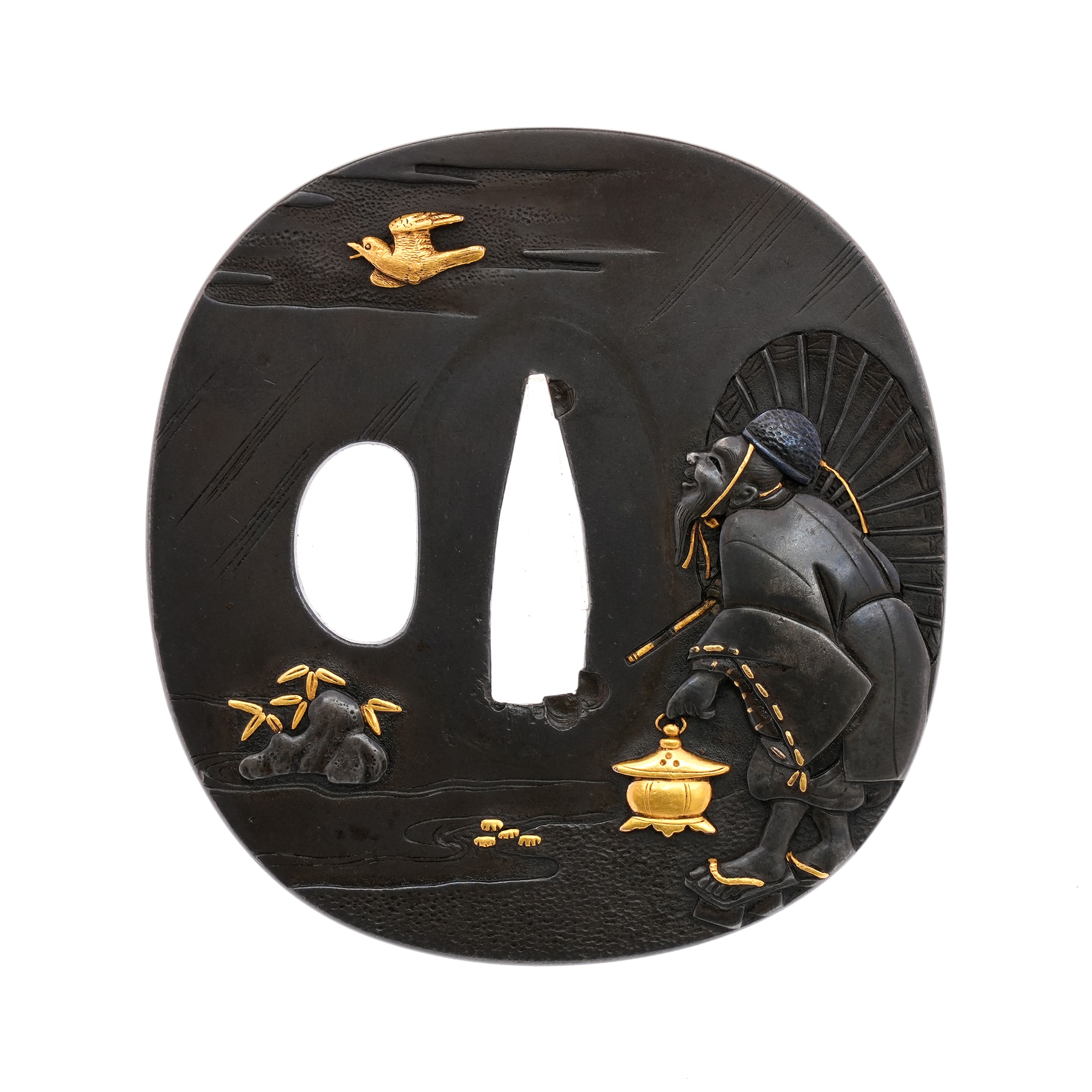
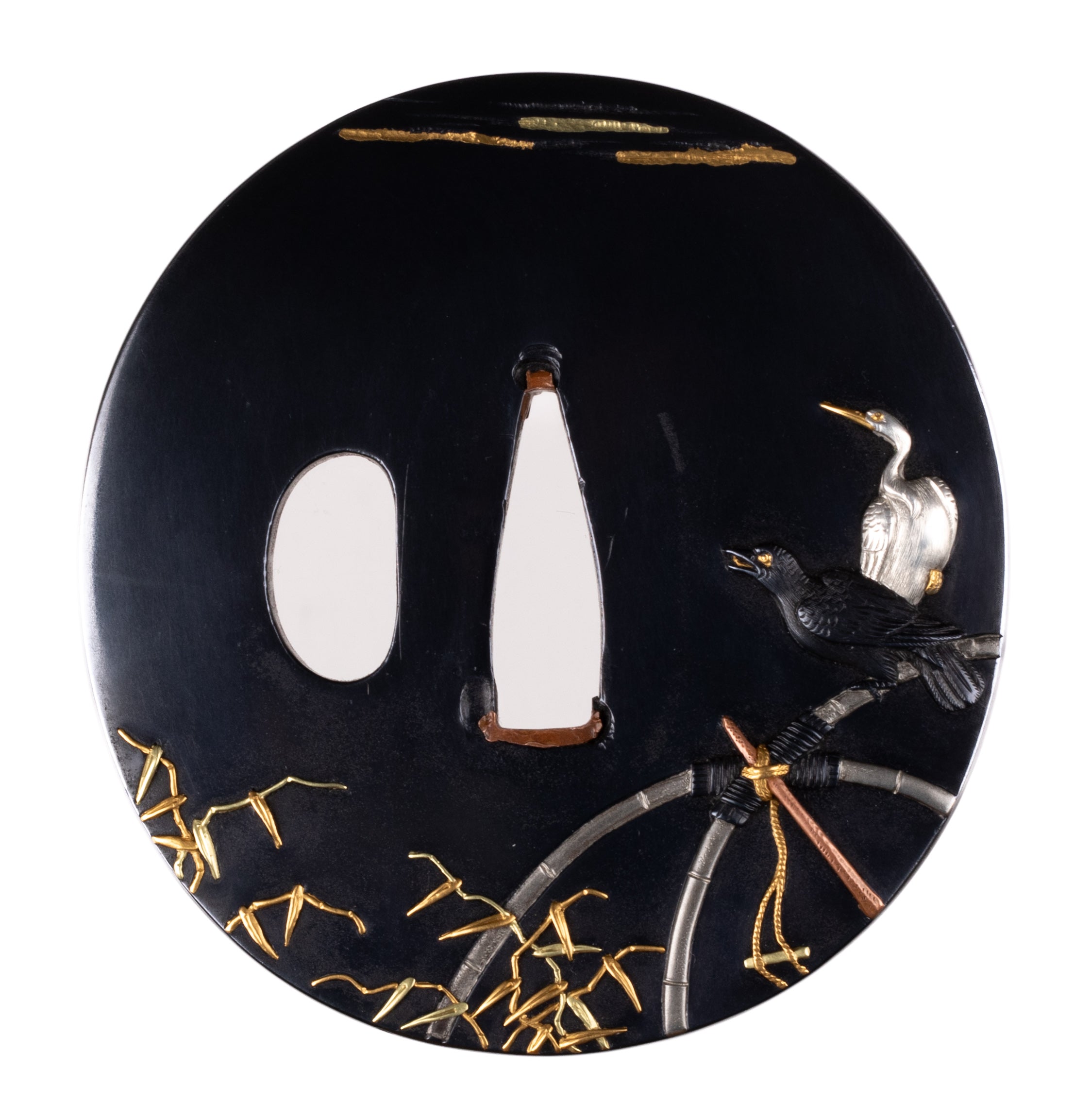
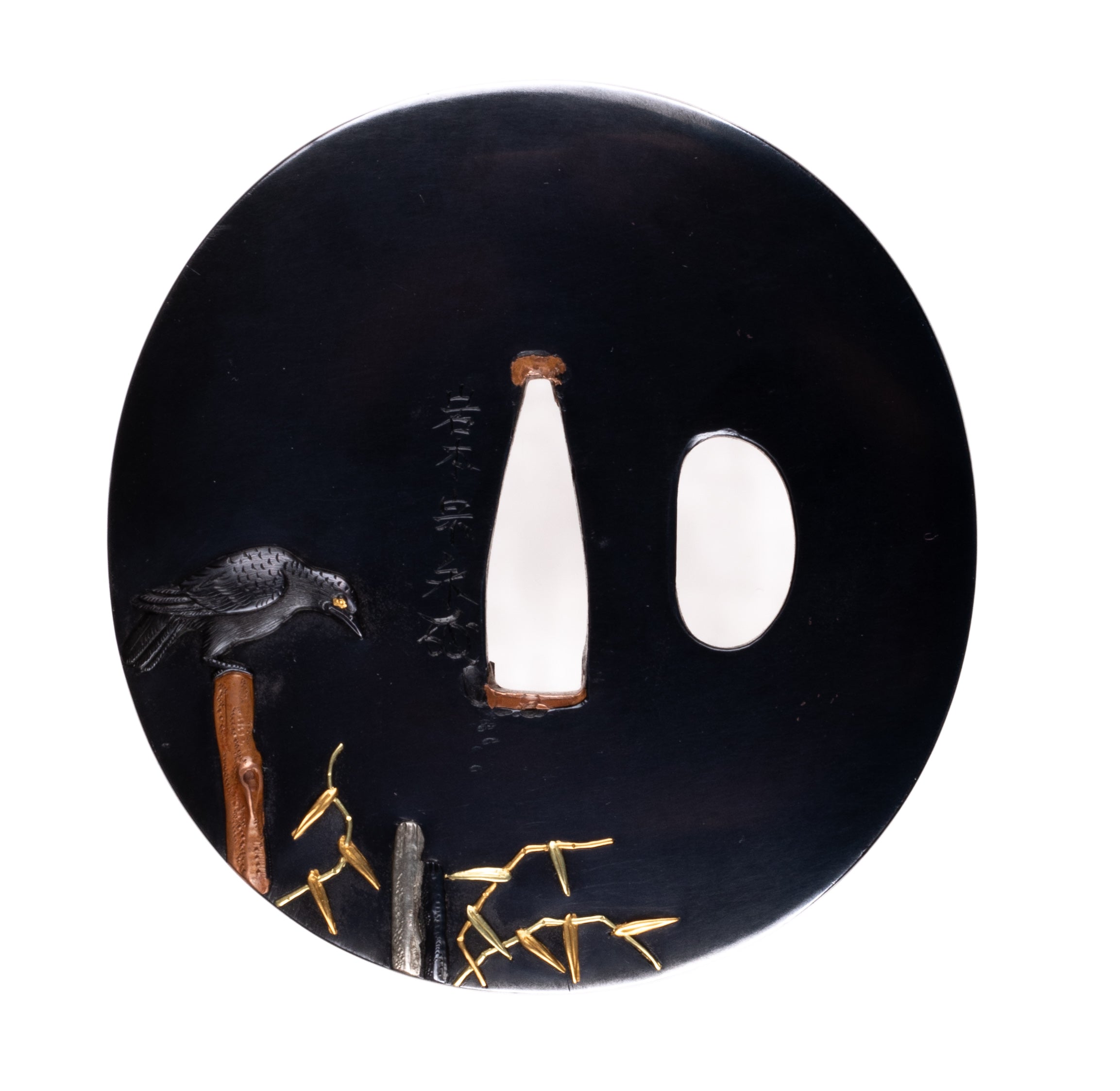
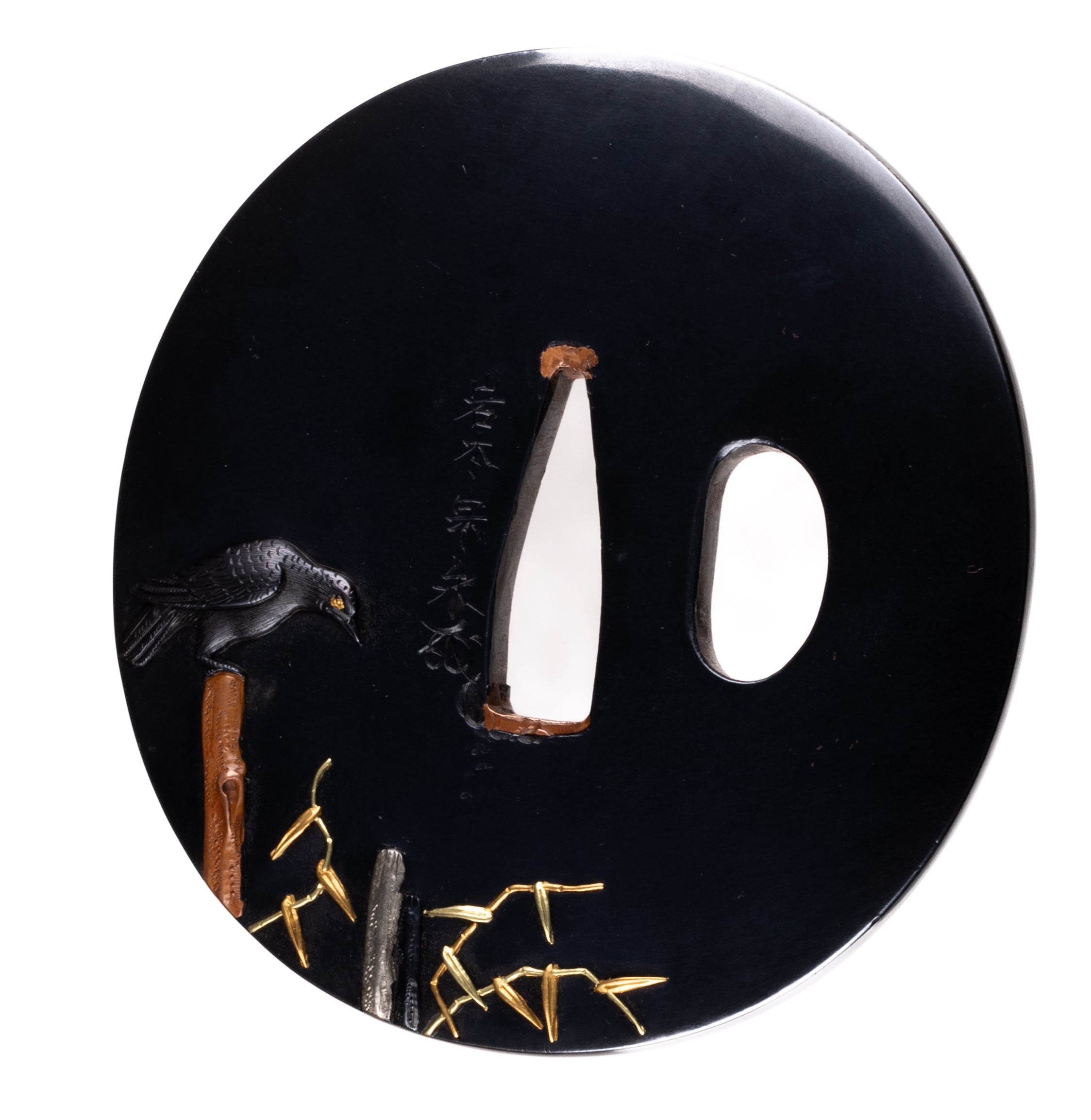
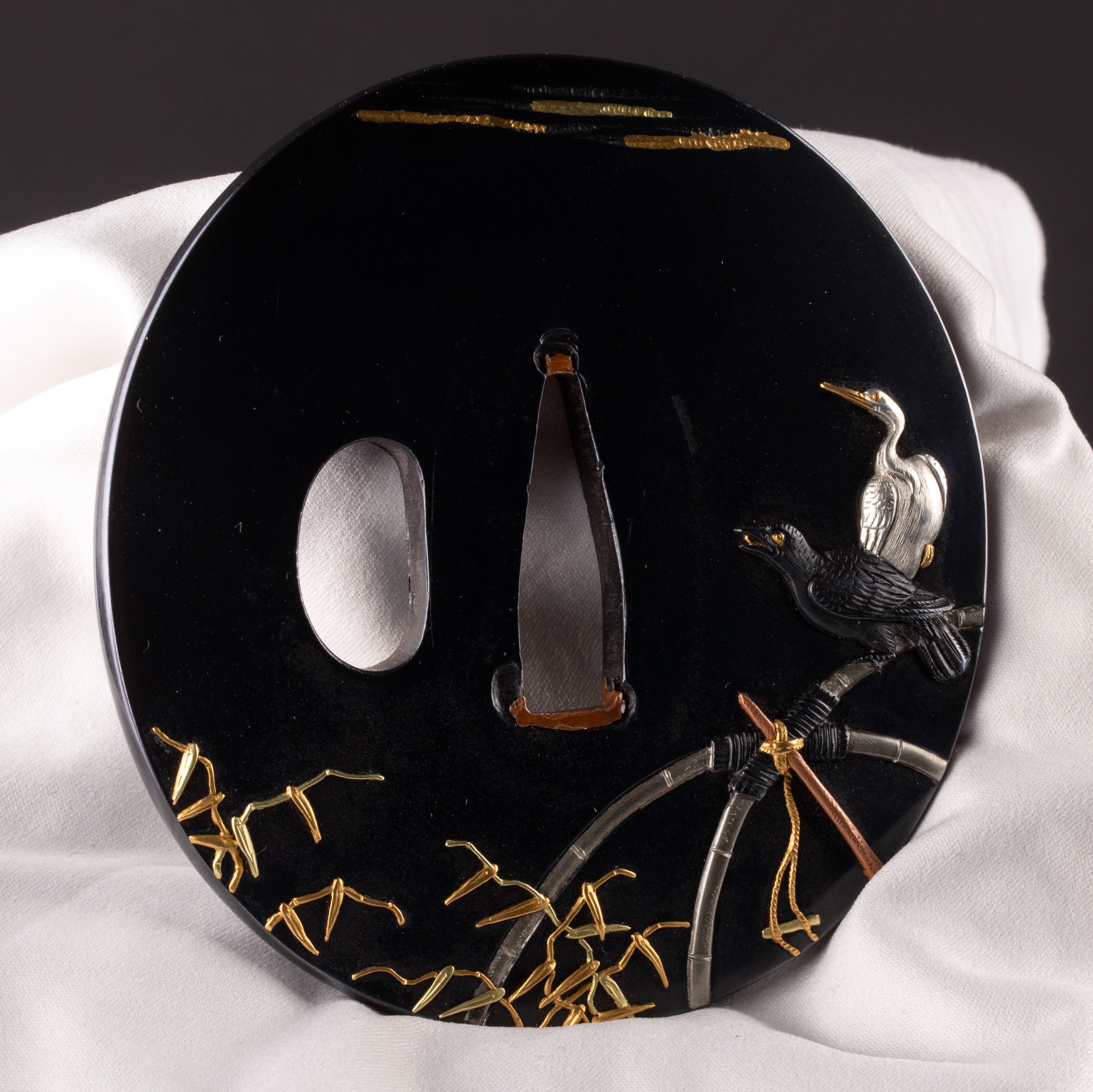
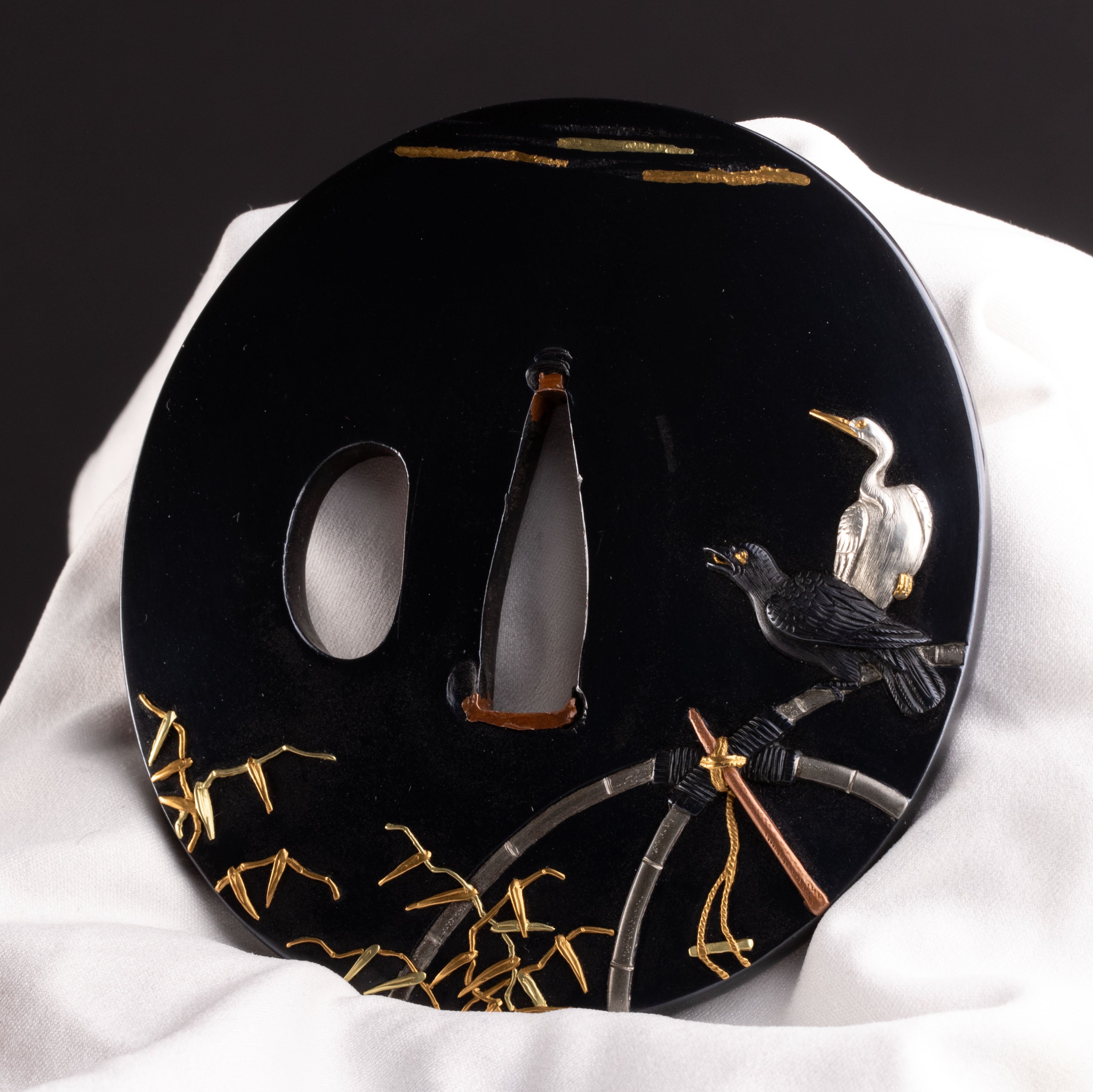
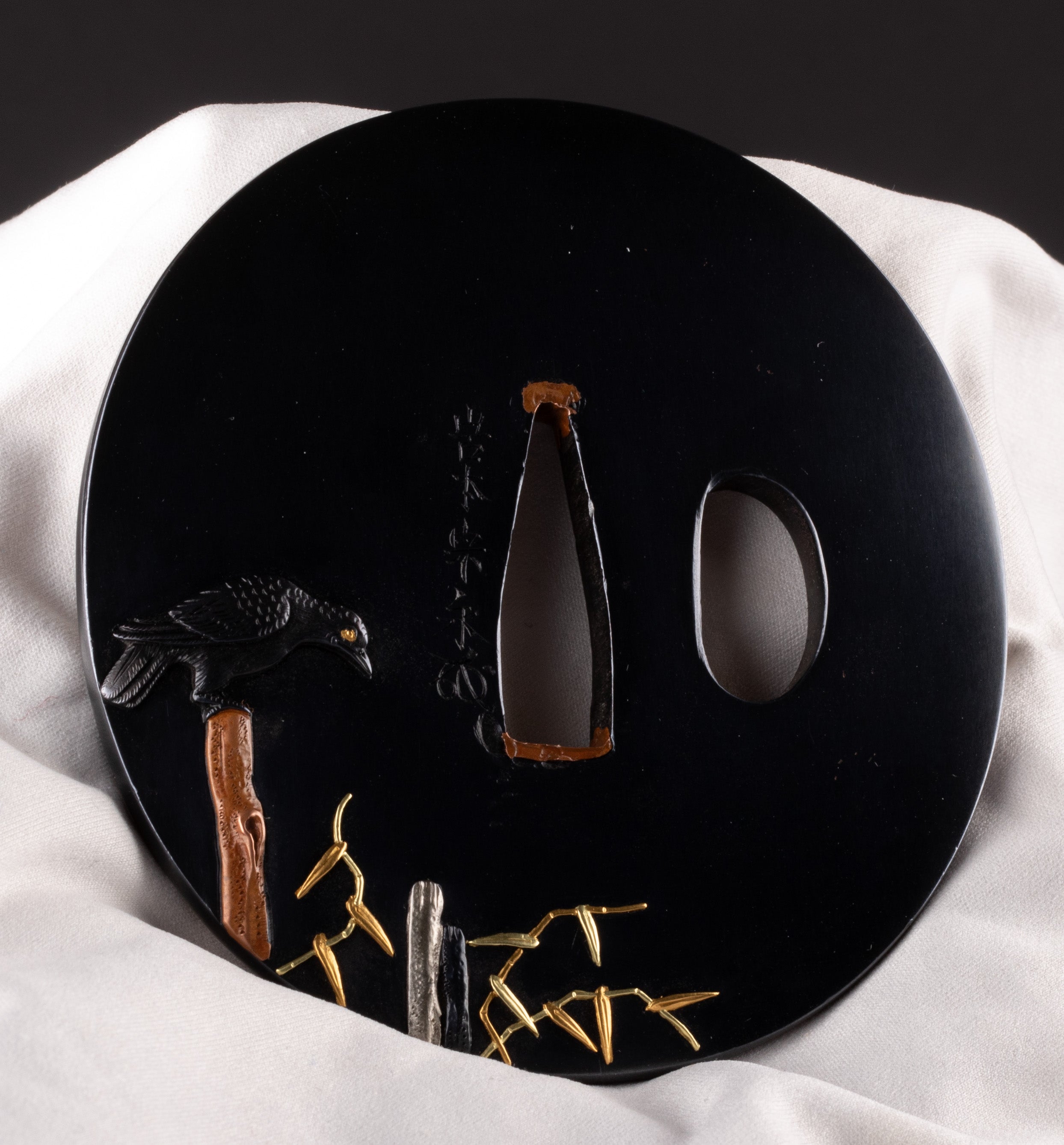
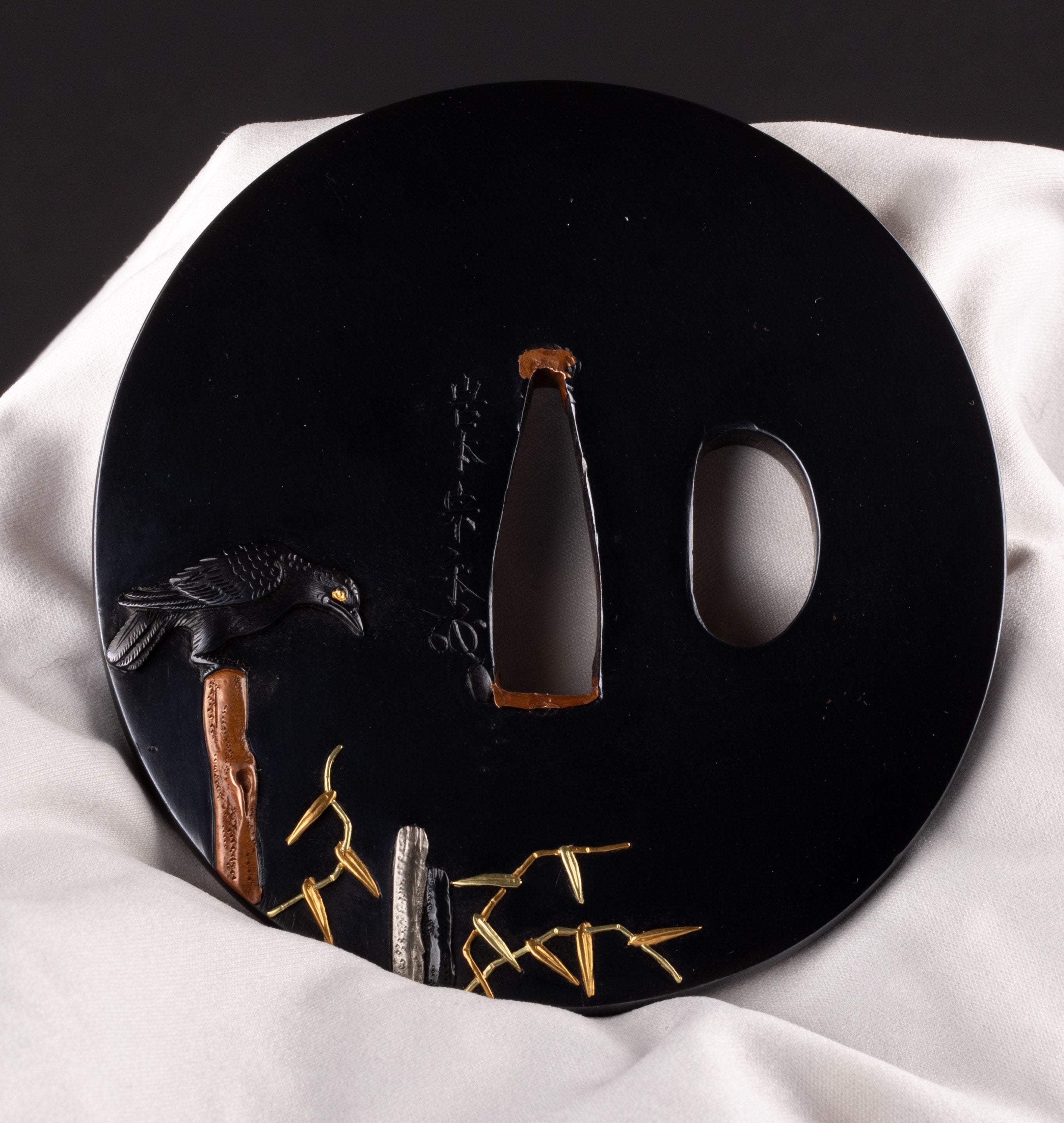
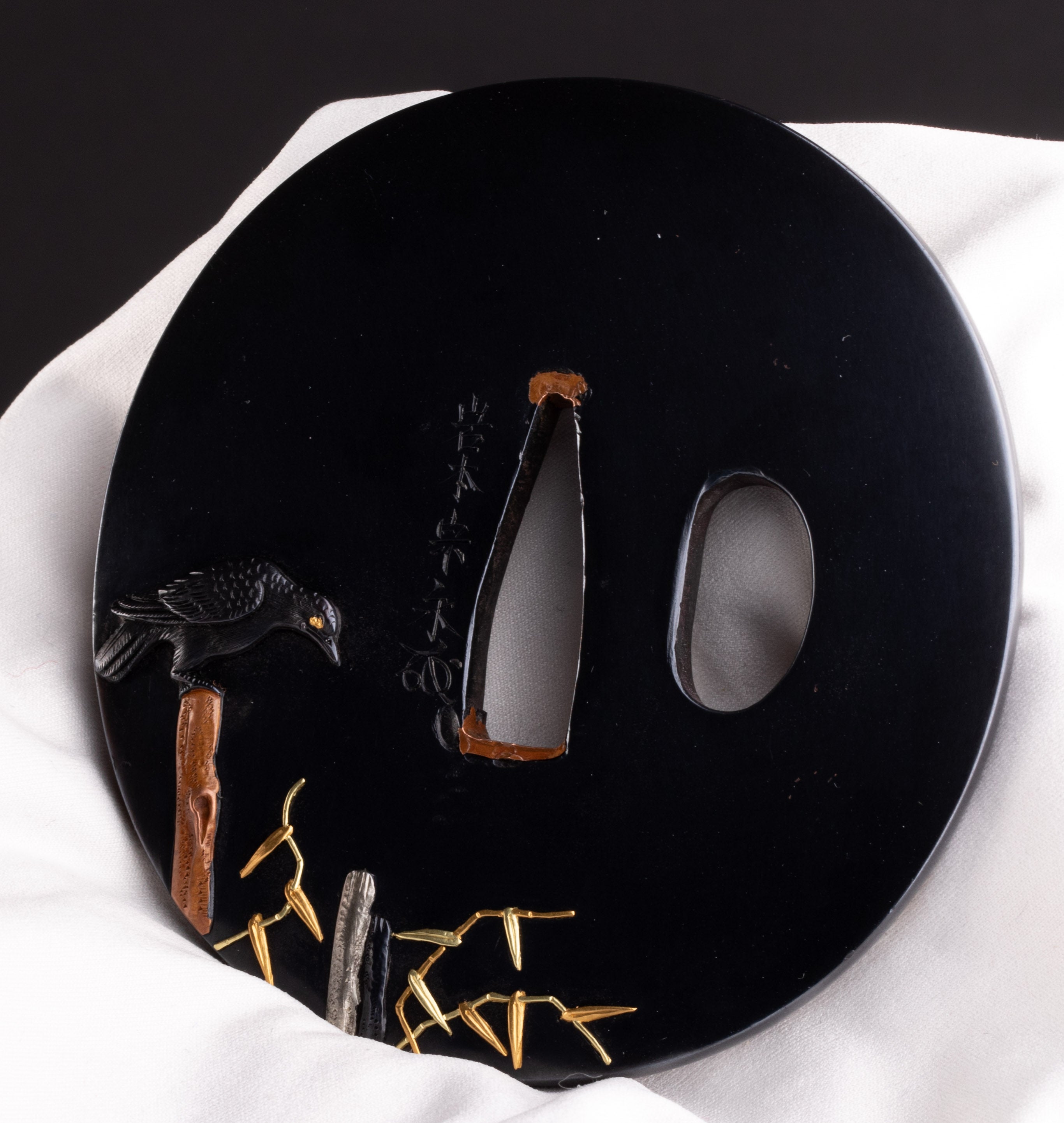
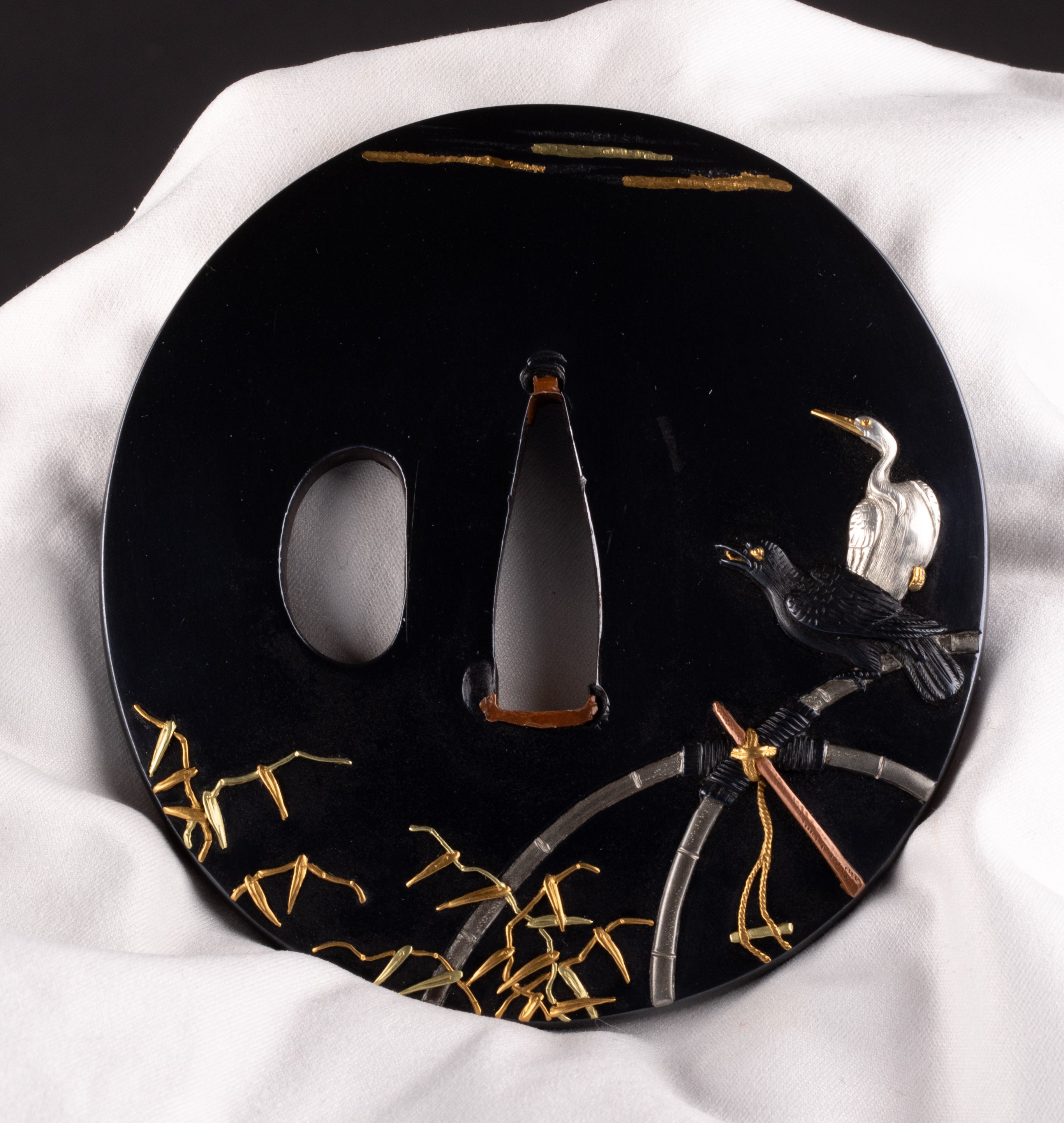
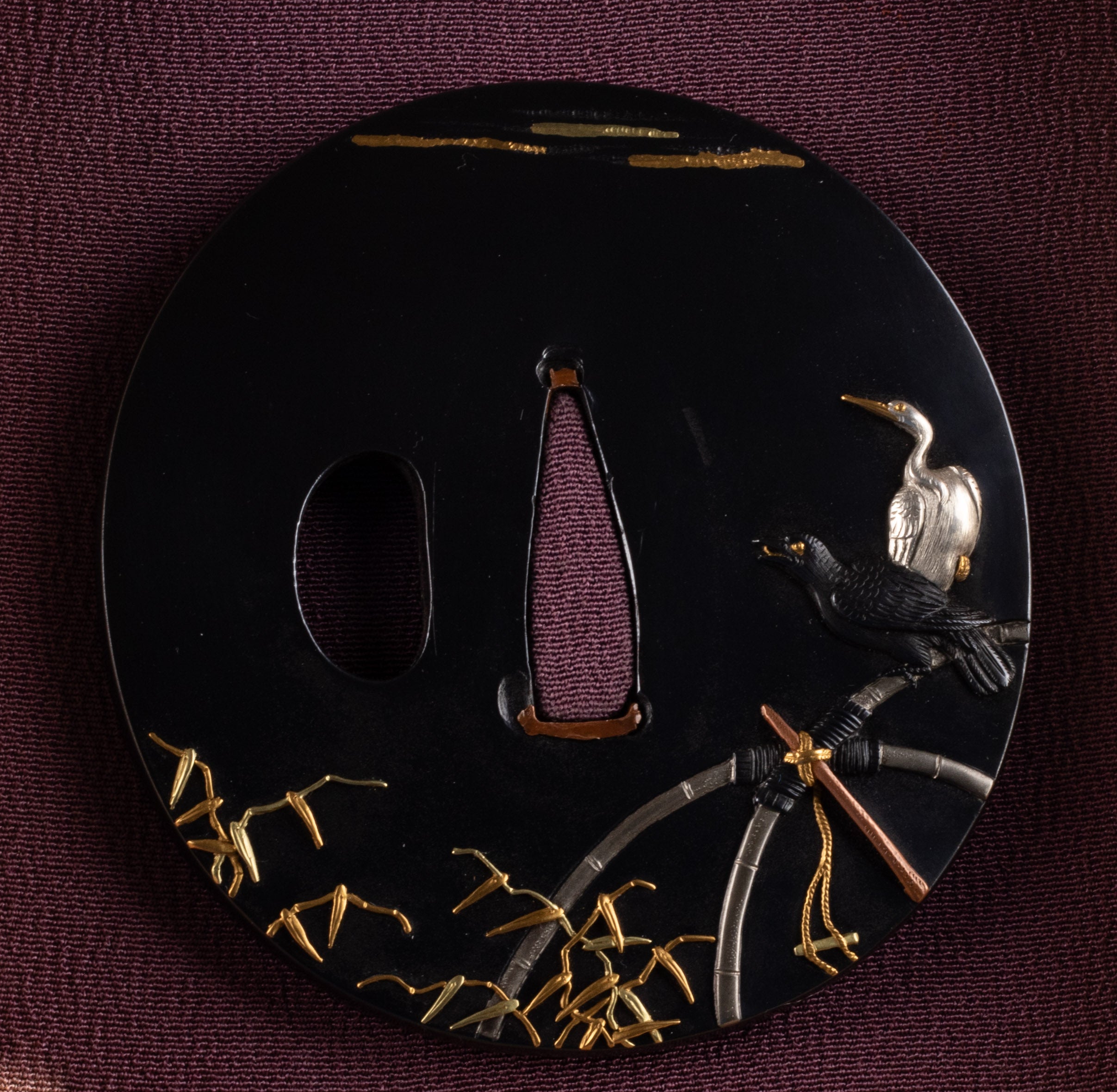
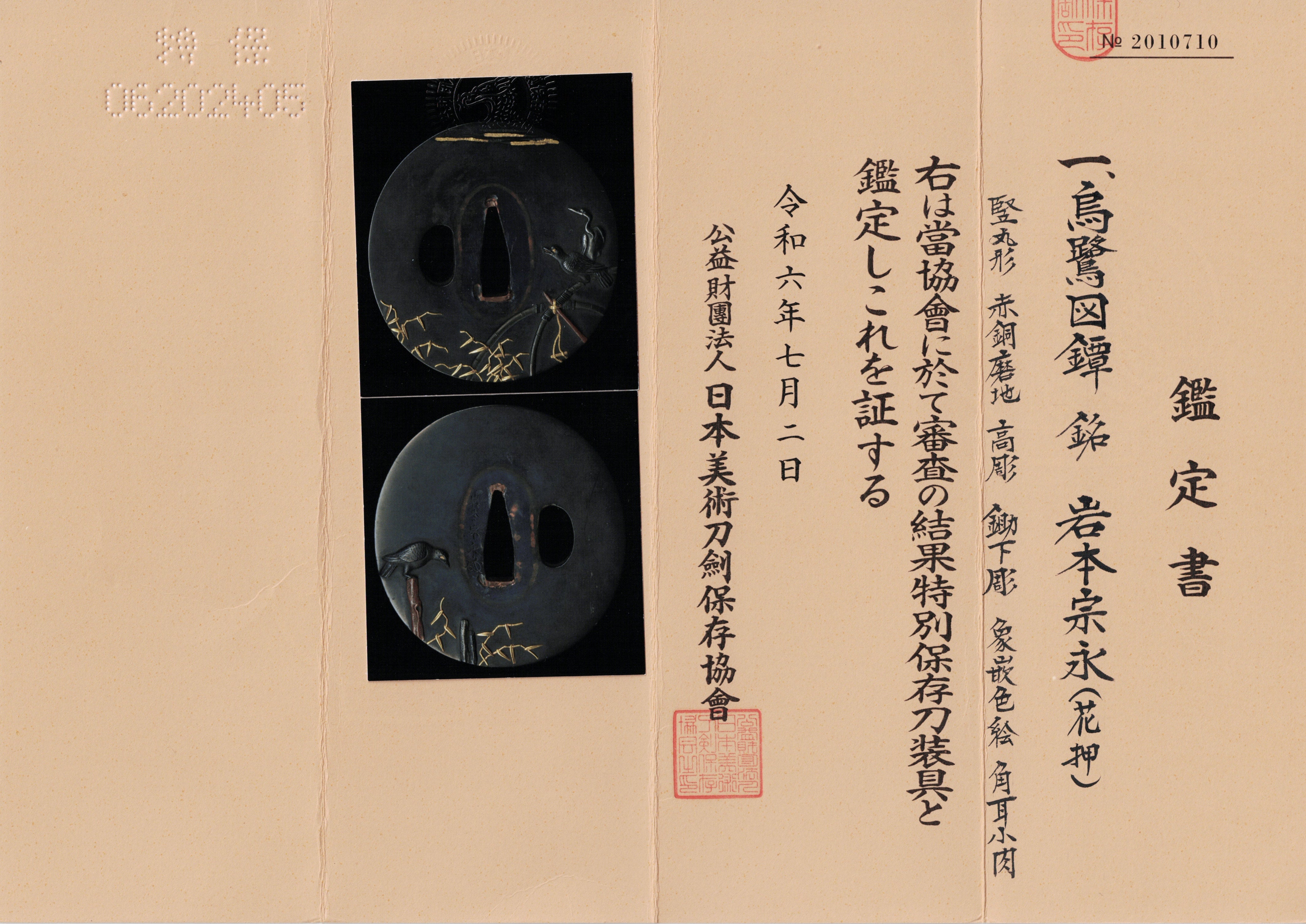
This is a shakudo tsuba signed by Iwamoto Munenaga, who was active around 1825 and a student of Iwamoto Kanri. The tsuba is decorated with crows and herons, a motif described by NBTHK as "Uro". It comes with NBTHK Tokubetsu Hozon Tosogu certification and is housed in a custom-made kiri box.
 NihontoWatch
mei · Edo
Machibori · Edo
12 pieces on the market now
The Iwamoto school was a house of Edo machibori (町彫) metalworkers, founded in the early eighteenth century by Iwamoto Chūbei, a pupil of the Yokoya school, and continuing through eight generations of headmasters. As the NBTHK setsumei state repeatedly, "the Iwamoto line was originally of the Yokoya tradition," and the school's history turns on a succession crisis within that lineage: when the fifth-generation master Ryōkan died young, his junior fellow-disciple succeeded as sixth head of the Iwamoto house. This was Iwamoto Konkan, born in Edo in Enkyō 1 (1744), whose original family name was Asai and who first used the name Ryō (also read Ryōun) before changing it to Konkan. " He also signed with the art names Shunshōdō (春曙堂) and Hakuhōtei (白峯亭). The line continued through Iwamoto Kanri, common name Kijūrō, who first studied under Konkan, was later adopted by him, and succeeded as seventh head; the school's orbit also included the pupil Konju, who lived at Kōjimachi in Edo. The school's collective style rests on this synthesis of Yokoya sculptural discipline and Nara-school carving methods. Its preferred vocabulary is shakudō (赤銅) with nanako-ji (魚子地) ground, worked in takabori (高彫) high relief with suemon-zōgan (据紋象嵌) and polychrome iroe (色絵) in gold, silver, shibuichi (四分一), and suaka (素銅) copper; but the setsumei attest an unusually broad range of grounds — shibuichi and iron in polished migaki-ji (磨地), chirimen-ishime-ji[[c:1]], brass ishime-ji, and gold — together with sukidashi-bori (鋤出彫), sukishita-bori, relief-carved openwork, fine kebori (毛彫), and inlaid aogai (青貝) mother-of-pearl, set even into the eyes of fish.
The distinctive triangular chisel (sankaku-tagane 三角鏨) recurs as a house hallmark, as does a masterful command of negative space and calculated composition, with obverse and reverse conceived in deliberate contrast. Favored subjects are drawn from nature observed with startling fidelity: the uo-zukushi (魚尽) arrays of fish "rendered with such precision that one feels each individual species could be identified," each scale and backbone carved line by line; herons among reeds; pheasants under a hazy moon; carp gliding through waterweed; alongside shishi, orchids, chrysanthemums, dragons, landscape narratives such as cormorant fishing and the Chōfu Tamagawa, and even Buddhist imagery of Dainichi Nyorai and Niō. The setsumei judge Konkan to have "ranked among the foremost artists of the naturalistic, sketch-from-life approach," while a fully matched aoi-crest mounting shows the school equally capable of orthodox, formal commissioned work. The Iwamoto school's place in the tosogu canon rests above all on Konkan, counted among the leading Edo metalworkers and habitually praised in the setsumei with the phrase "Edomae no iki" — the quintessential stylishness of Edo; his fame is further reflected in the extensive forgery of his signature. Works transmitted in the Tsugaru and Sakai daimyō families attest the esteem his oeuvre commanded. The tradition did not end with him: Kanri "followed his teacher's manner closely and, after Konkan, produced a number of powerful works," while Konju's carving, "taut and controlled" in the master's likeness, carried the inlay-centered iroe methods forward. Wide-ranging in subject and prolific in output, the school stands as one of the defining expressions of late-Edo machibori art — a lineage in which the strengths of the Yokoya and Nara traditions were fused into a single, unmistakably urbane style. Learn more →
| Smith | Era | Designated |
|---|---|---|
| Konkan昆寛 | — | 51 |
| Kanri寛利 | 1670 | 3 |
| Konju昆寿 | 1670 | 2 |
| Masakatsu政克 (Masamoto | — | 0 |
| Soei宗栄 | — | 0 |
A Hozon-certified fitting of notably superior craftsmanship and condition, often with signature or workmanship of high reference value.
The NBTHK (Nihon Bijutsu Tōken Hozon Kyōkai, the Society for the Preservation of Japanese Art Swords) is a public-interest incorporated foundation founded in 1948 and supervised by Japan’s Agency for Cultural Affairs (Bunkachō); it is based at the Japanese Sword Museum in Tokyo. Its expert panels physically examine each submitted work (shinsa) and issue a certificate (kanteishō) ranking it by artistic and historical merit. NBTHK papers are the most widely recognized standard of authentication for Japanese swords and fittings.
NBTHK official site30-day refund policy. Items must be returned in original condition and packaging; customized products are non-returnable. 2-week inspection window with full item refund (shipping costs non-refundable). Customer pays return shipping.
This is a shakudo tsuba signed by Iwamoto Munenaga, who was active around 1825 and a student of Iwamoto Kanri. The tsuba is decorated with crows and herons, a motif described by NBTHK as "Uro". It comes with NBTHK Tokubetsu Hozon Tosogu certification and is housed in a custom-made kiri box.
NihontoWatchmei · Edo
Machibori · Edo
12 pieces on the market now
The Iwamoto school was a house of Edo machibori (町彫) metalworkers, founded in the early eighteenth century by Iwamoto Chūbei, a pupil of the Yokoya school, and continuing through eight generations of headmasters. As the NBTHK setsumei state repeatedly, "the Iwamoto line was originally of the Yokoya tradition," and the school's history turns on a succession crisis within that lineage: when the fifth-generation master Ryōkan died young, his junior fellow-disciple succeeded as sixth head of the Iwamoto house. This was Iwamoto Konkan, born in Edo in Enkyō 1 (1744), whose original family name was Asai and who first used the name Ryō (also read Ryōun) before changing it to Konkan. " He also signed with the art names Shunshōdō (春曙堂) and Hakuhōtei (白峯亭). The line continued through Iwamoto Kanri, common name Kijūrō, who first studied under Konkan, was later adopted by him, and succeeded as seventh head; the school's orbit also included the pupil Konju, who lived at Kōjimachi in Edo. The school's collective style rests on this synthesis of Yokoya sculptural discipline and Nara-school carving methods. Its preferred vocabulary is shakudō (赤銅) with nanako-ji (魚子地) ground, worked in takabori (高彫) high relief with suemon-zōgan (据紋象嵌) and polychrome iroe (色絵) in gold, silver, shibuichi (四分一), and suaka (素銅) copper; but the setsumei attest an unusually broad range of grounds — shibuichi and iron in polished migaki-ji (磨地), chirimen-ishime-ji[[c:1]], brass ishime-ji, and gold — together with sukidashi-bori (鋤出彫), sukishita-bori, relief-carved openwork, fine kebori (毛彫), and inlaid aogai (青貝) mother-of-pearl, set even into the eyes of fish.
The distinctive triangular chisel (sankaku-tagane 三角鏨) recurs as a house hallmark, as does a masterful command of negative space and calculated composition, with obverse and reverse conceived in deliberate contrast. Favored subjects are drawn from nature observed with startling fidelity: the uo-zukushi (魚尽) arrays of fish "rendered with such precision that one feels each individual species could be identified," each scale and backbone carved line by line; herons among reeds; pheasants under a hazy moon; carp gliding through waterweed; alongside shishi, orchids, chrysanthemums, dragons, landscape narratives such as cormorant fishing and the Chōfu Tamagawa, and even Buddhist imagery of Dainichi Nyorai and Niō. The setsumei judge Konkan to have "ranked among the foremost artists of the naturalistic, sketch-from-life approach," while a fully matched aoi-crest mounting shows the school equally capable of orthodox, formal commissioned work. The Iwamoto school's place in the tosogu canon rests above all on Konkan, counted among the leading Edo metalworkers and habitually praised in the setsumei with the phrase "Edomae no iki" — the quintessential stylishness of Edo; his fame is further reflected in the extensive forgery of his signature. Works transmitted in the Tsugaru and Sakai daimyō families attest the esteem his oeuvre commanded. The tradition did not end with him: Kanri "followed his teacher's manner closely and, after Konkan, produced a number of powerful works," while Konju's carving, "taut and controlled" in the master's likeness, carried the inlay-centered iroe methods forward. Wide-ranging in subject and prolific in output, the school stands as one of the defining expressions of late-Edo machibori art — a lineage in which the strengths of the Yokoya and Nara traditions were fused into a single, unmistakably urbane style. Learn more →
| Smith | Era | Designated |
|---|---|---|
| Konkan昆寛 | — | 51 |
| Kanri寛利 | 1670 | 3 |
| Konju昆寿 | 1670 | 2 |
| Masakatsu政克 (Masamoto | — | 0 |
| Soei宗栄 | — | 0 |
A Hozon-certified fitting of notably superior craftsmanship and condition, often with signature or workmanship of high reference value.
The NBTHK (Nihon Bijutsu Tōken Hozon Kyōkai, the Society for the Preservation of Japanese Art Swords) is a public-interest incorporated foundation founded in 1948 and supervised by Japan’s Agency for Cultural Affairs (Bunkachō); it is based at the Japanese Sword Museum in Tokyo. Its expert panels physically examine each submitted work (shinsa) and issue a certificate (kanteishō) ranking it by artistic and historical merit. NBTHK papers are the most widely recognized standard of authentication for Japanese swords and fittings.
NBTHK official site30-day refund policy. Items must be returned in original condition and packaging; customized products are non-returnable. 2-week inspection window with full item refund (shipping costs non-refundable). Customer pays return shipping.