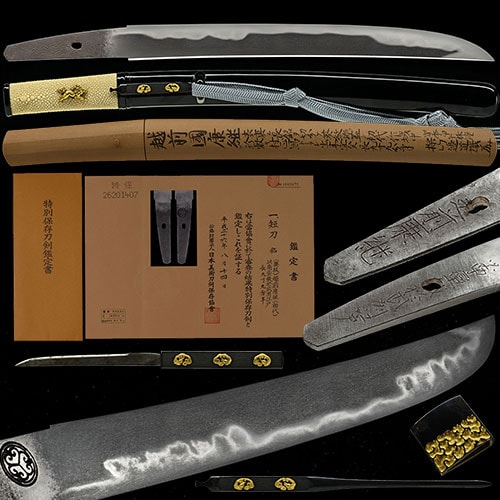
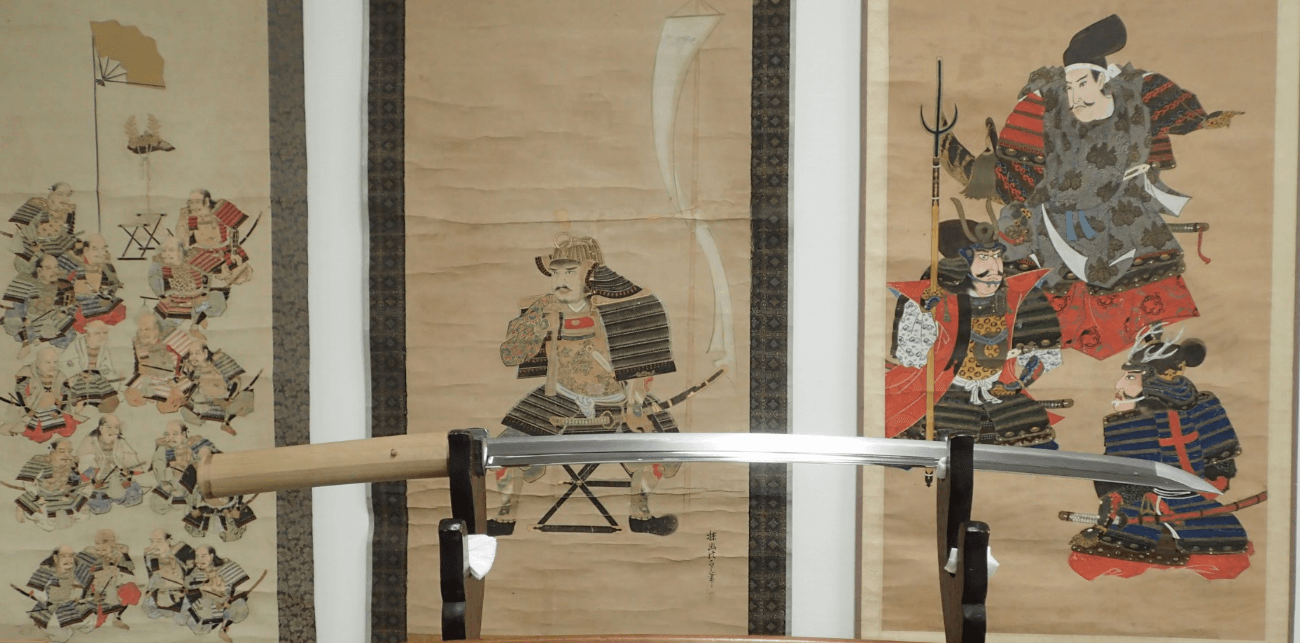
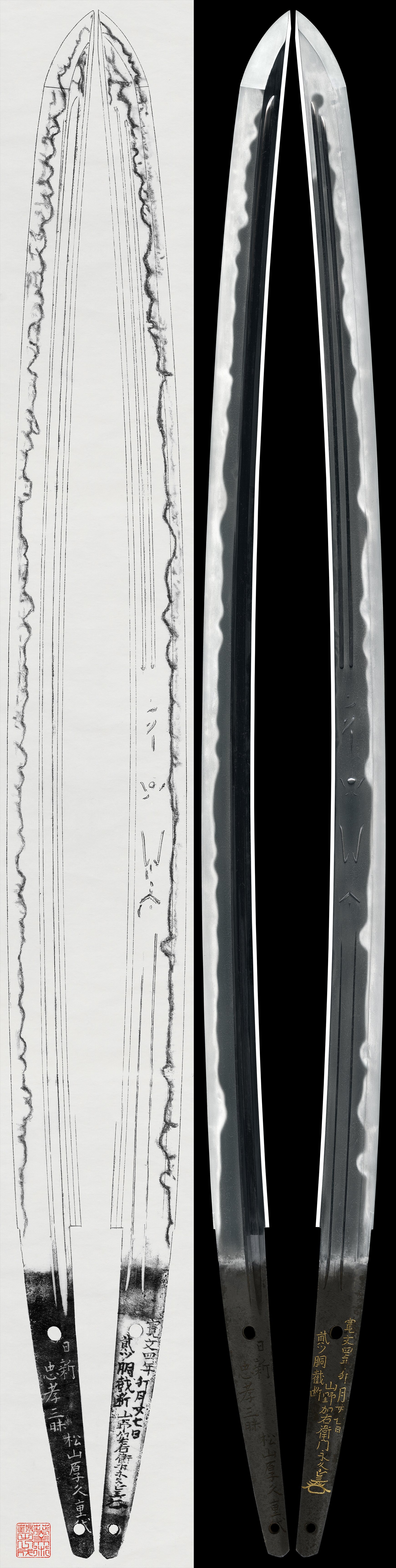
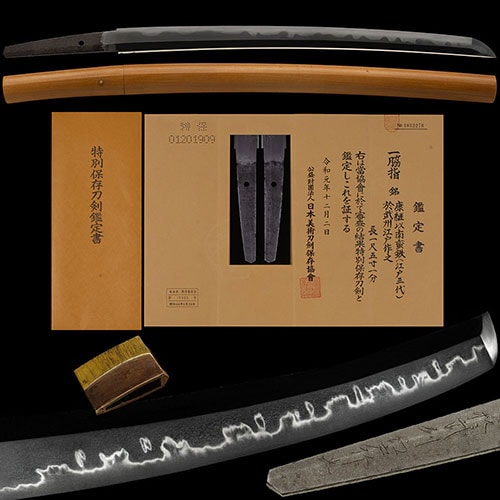
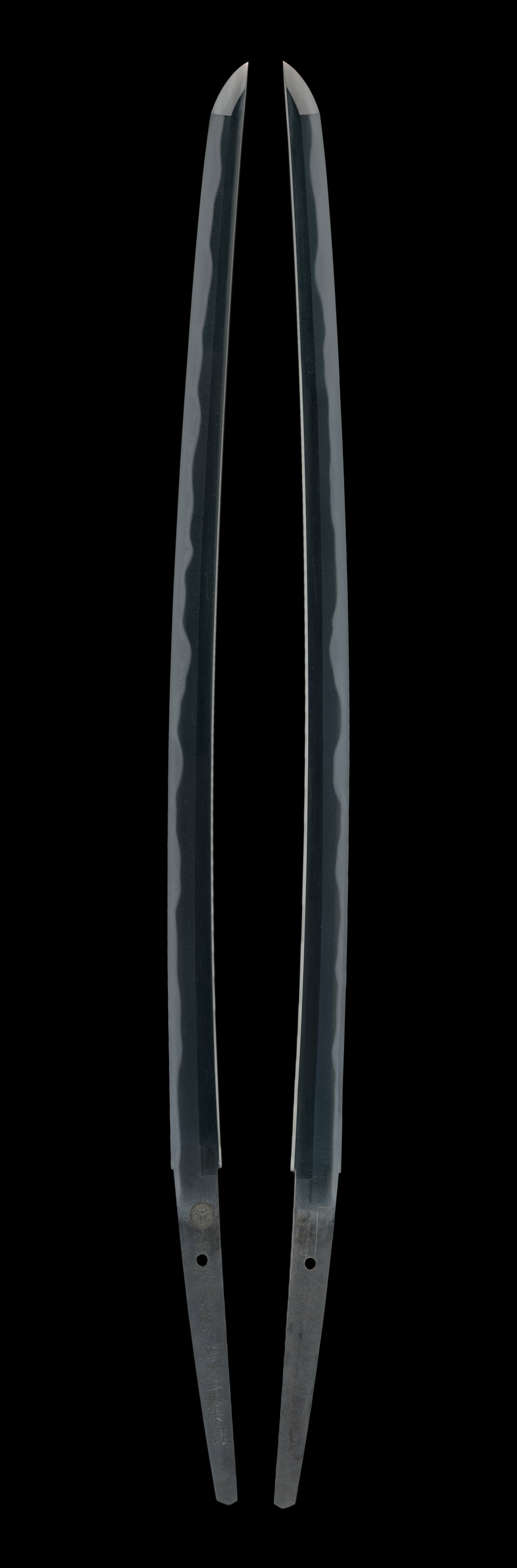
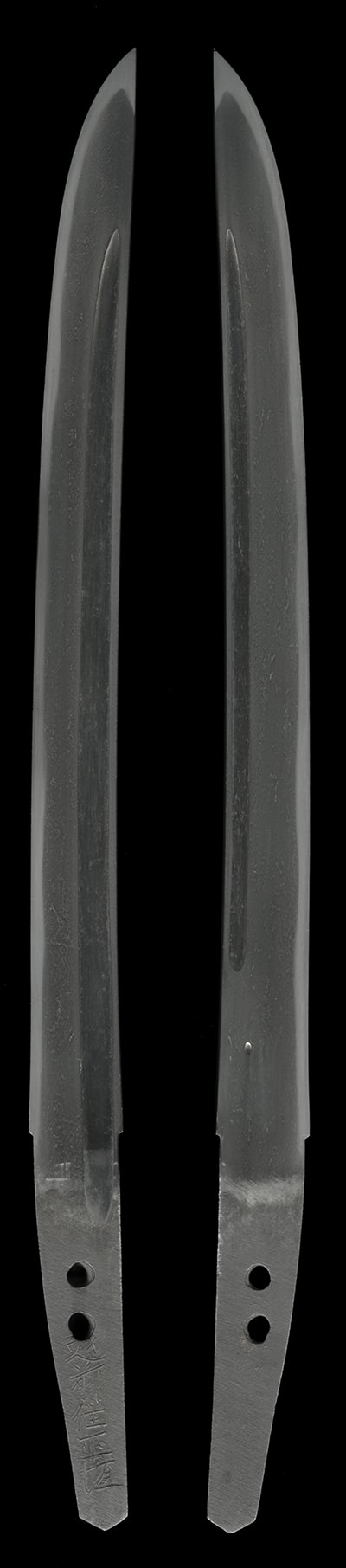
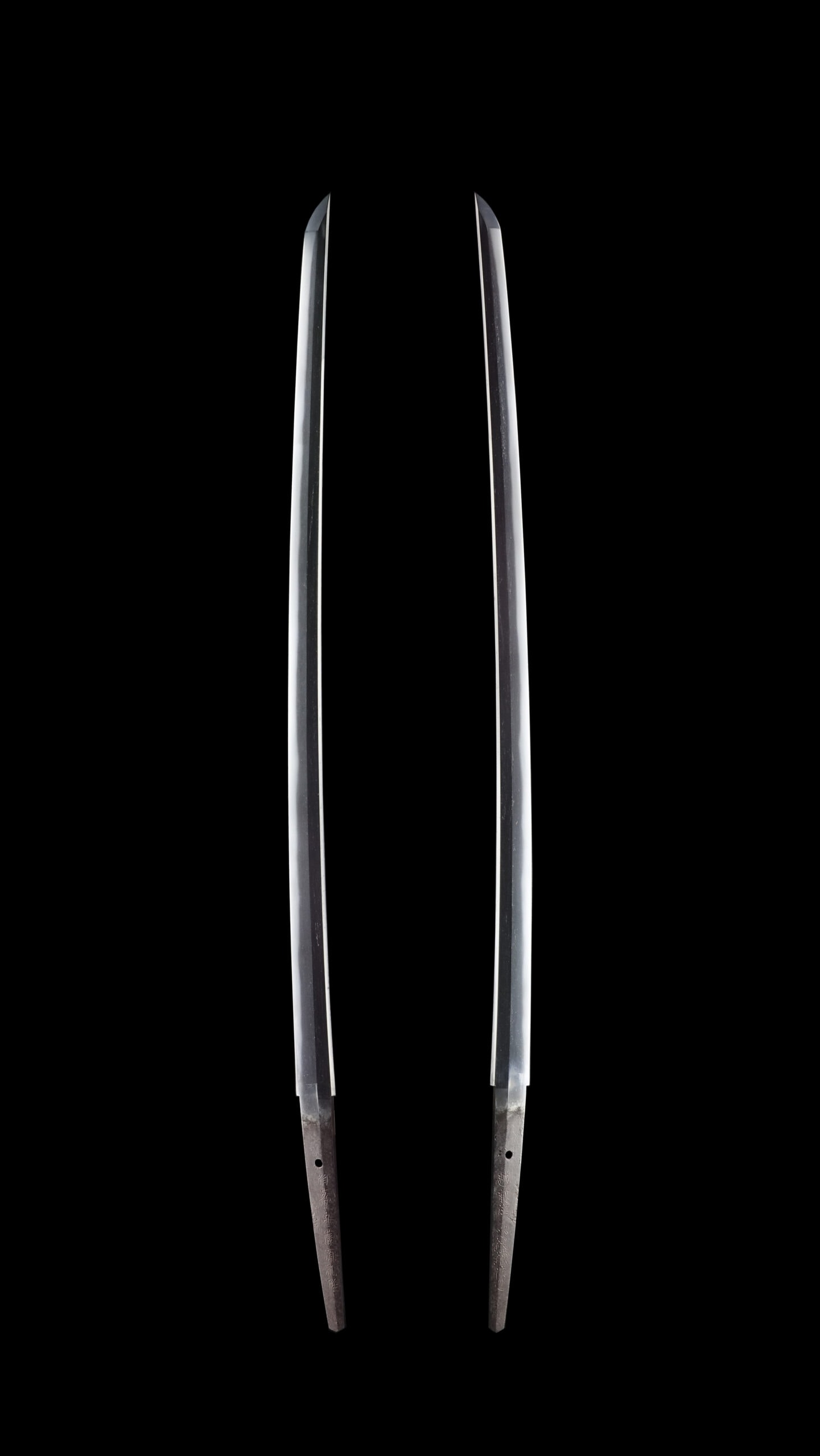
The first generation Yasutsugu was born in Shimosaka village of Sakata district in Omi and called himself Shimosaka Ichizaemon. He moved to Echizen, served Yuki Hideyasu, and in his early years signed Higo no Daijo Shimosaka[[c:1]]. Between Keicho 10 and 11 (1605 to 1606) he was summoned to Edo, forged before the two shoguns Tokugawa Ieyasu and Hidetada, and as a reward received the character Yasu from Ieyasu's name and the right to carve the Tokugawa hollyhock crest on his nakago, taking the name Yasutsugu. The published sources repeat this biography nearly word for word, and state what the grant came to mean: the world calls him Aoi-Shimosaka (葵下坂) and Go-mon Yasutsugu (御紋康継) for the hollyhock cut above his signature. He served the shogunal house as its retained smith until his death in Genna 7 (1621).
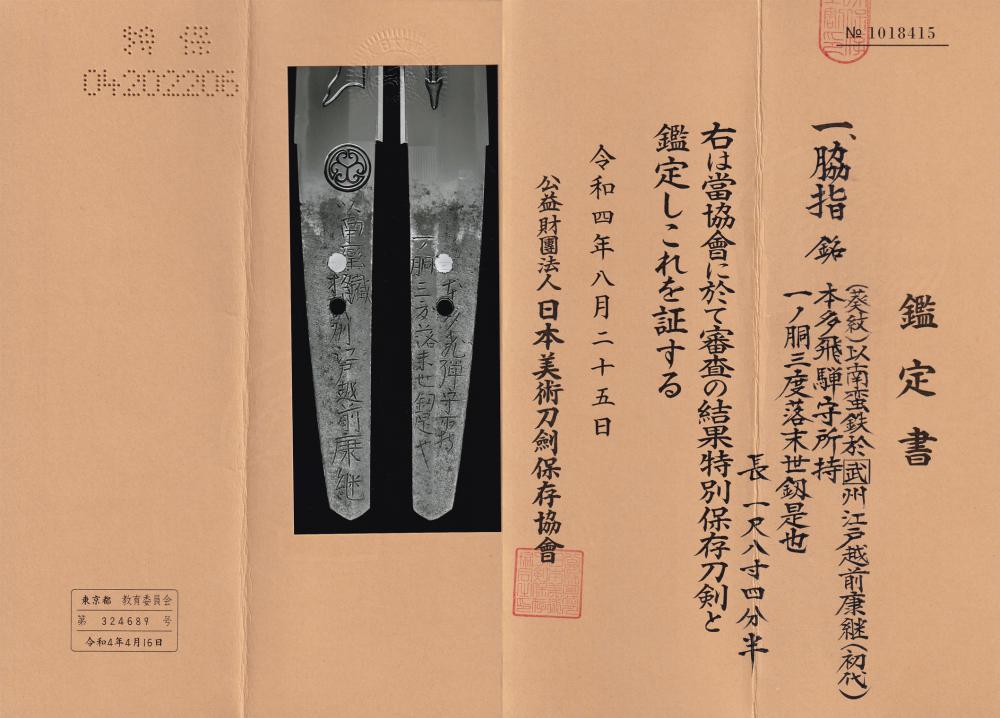
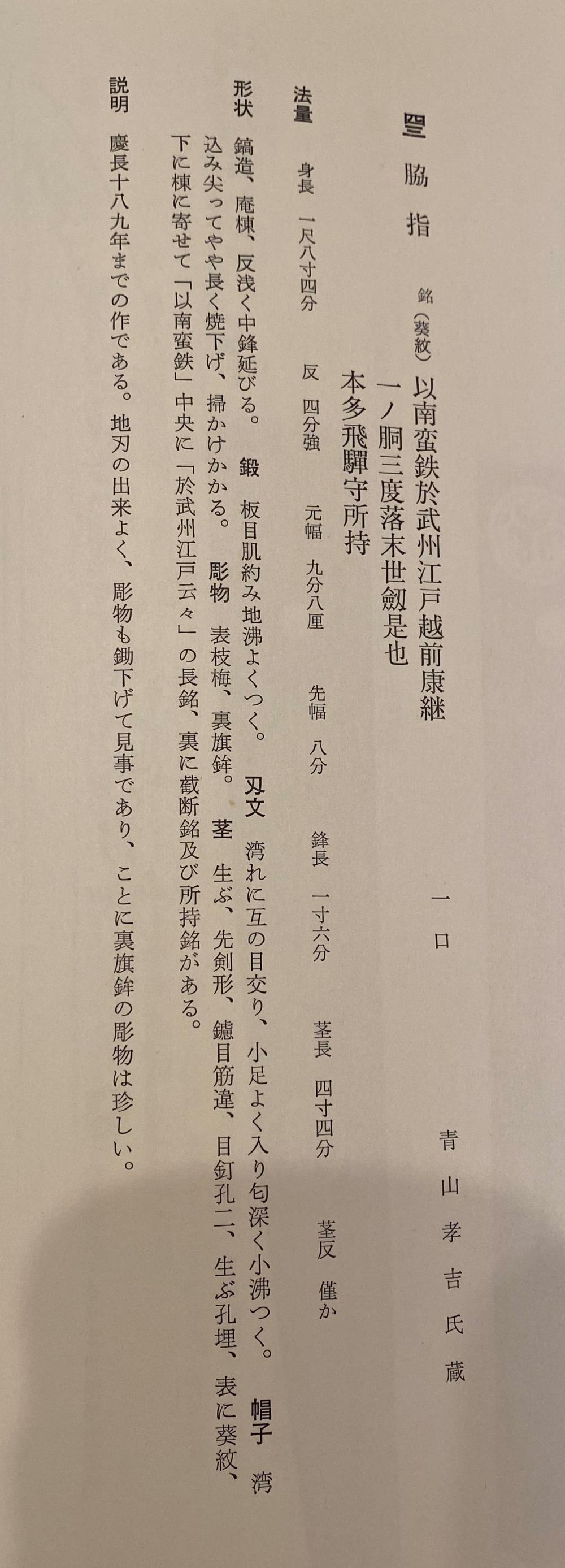
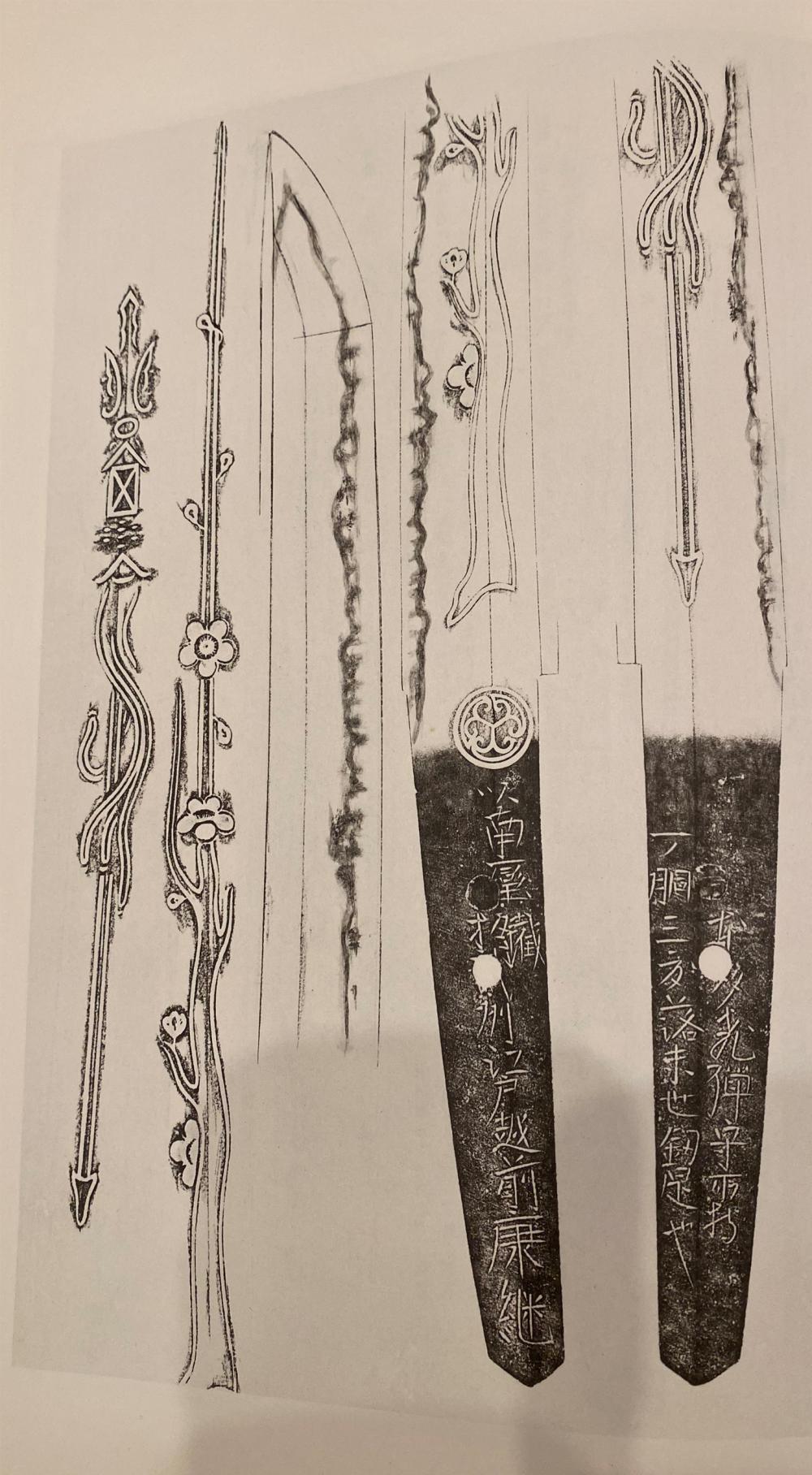
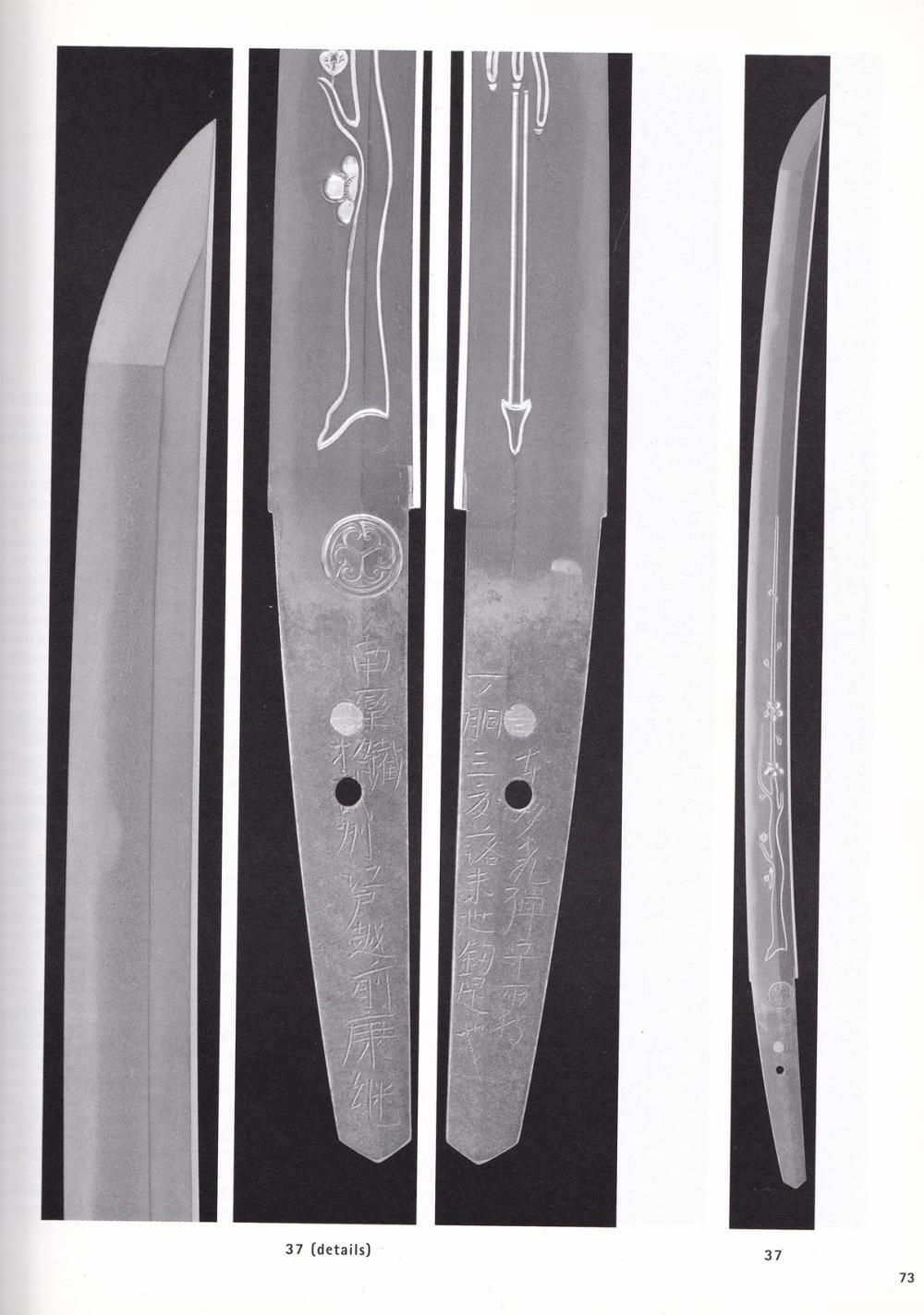
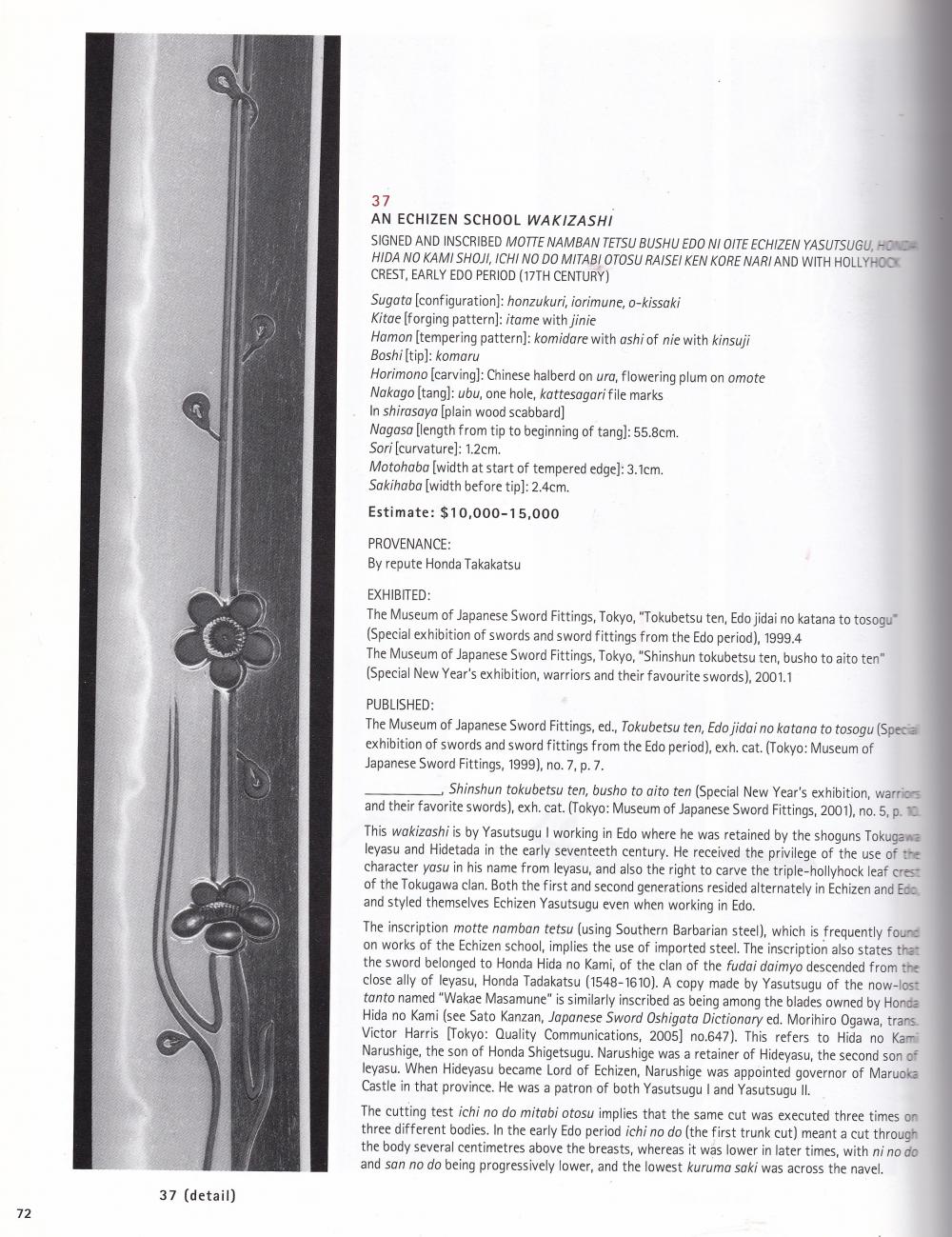
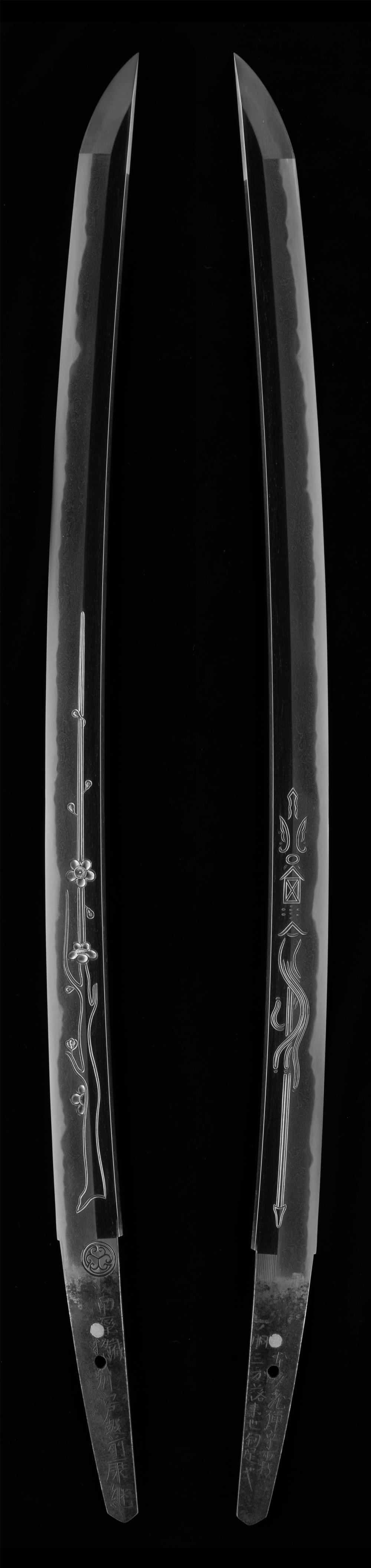
No other nakago of his day reads like his. The hollyhock is a granted crest carved above the signature, not part of the mei itself, and beside the signature he declared his material, the published record stating that he was then the only man boldly adding the words i nanban-tetsu (以南蛮鉄), made with nanban steel. Because he served Echizen and Edo in alternate years, the sources state, he cut Echizen-ju (越前住) on home-province work and Oite Bushu Edo[[c:2]] on Edo work, so the mei itself places and dates a blade. A third register is the Sunshu-uchi (駿州打), works forged at Sunpu while calling on the retired Ieyasu: only a few survive, the katana mostly long, their workmanship divided by the commentary into a refined and gentle type and a rougher, vigorously disordered one. One long Sunshu katana was among the Sunpu o-wakemono[[c:3]], Ieyasu's keepsake division, and descended in the Kishu Tokugawa family. Practically everything he made is signed, seventy-two of the seventy-four designated works on record against a single unsigned blade, with Keicho dates and gold-inlaid cutting-test attestations on the finest.
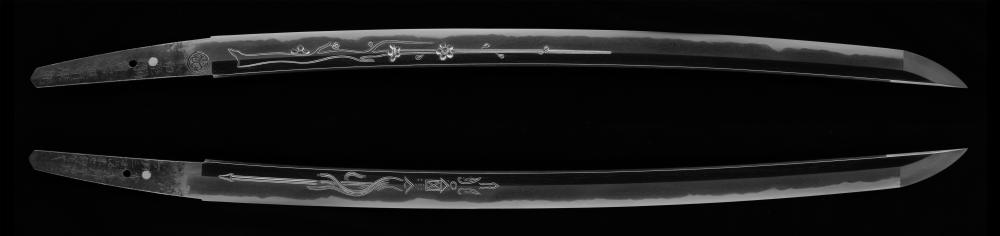
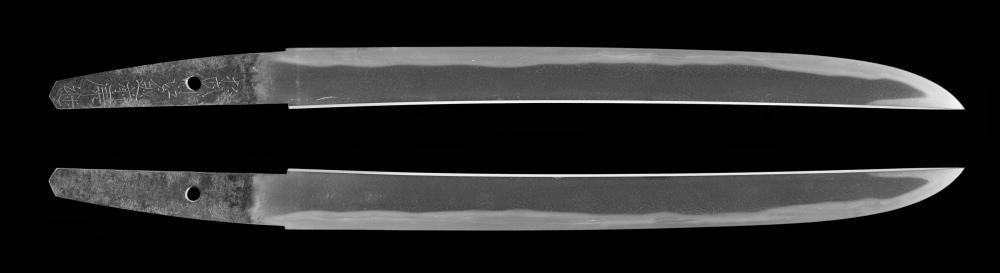
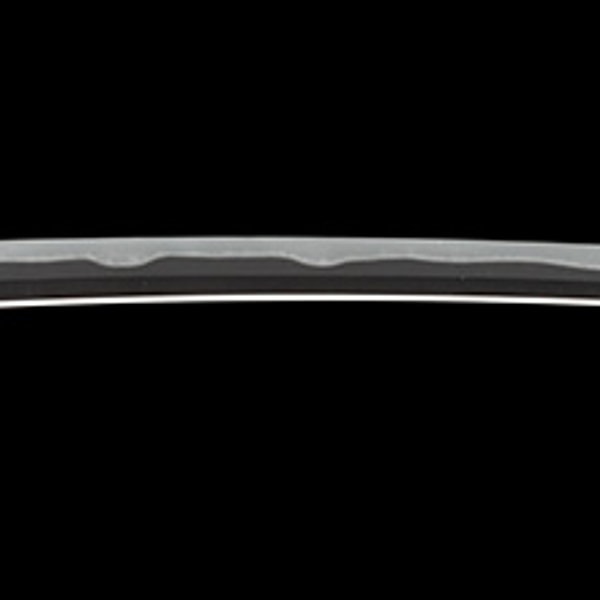
His own manner begins in the steel. The forging is itame with mokume standing out and a tendency for the grain to rise; ji-nie forms thickly, fine chikei enter, and the steel color carries a blackish tone, named outright by the published sources as the peculiarity of Echizen-gane (越前がね). Over it the hamon takes a shallow notare or chu-suguha as its base, with small gunome running linked in series, ko-ashi entering frequently and yo mixed in. The nie is thick, with rougher nie standing in uneven patches; fine kinsuji and sunagashi run, vigorous muneyaki and tobiyaki appear, at times to a hitatsura-like effect, and the nioiguchi takes on the sinking tendency[[c:4]] noted on blade after blade. The boshi undulates shallowly, the point sharpening in what the texts call a Sanpin-style manner, with hakikake and a long, strong return. The sugata is the Keicho-shinto build, wide with little taper, thick and shallow in sori, the point extended, the hira-zukuri wakizashi broad and sun-nobi. The commentary gathers all of this into a single phrase, the typical working range of the first generation Yasutsugu[[c:5]]. His horimono are deep, forceful and frequent, Fudo Myoo triads, kurikara, bonji and suken among them, many read as Kinai-line carving.
The range divides by period and by purpose. Before the grant his work is rare: the published record states that katana signed Higo no Daijo Shimosaka survive in no more than a handful, nearly all in the same comparatively calm, well-ordered manner, gentler than the granted-crest prime; the texts set these early signatures beside those of the fellow Echizen smiths Sadakuni and Kanenori, so alike that attribution rests on the mei style. The opposite pole is the copy program. Because he re-tempered many of the Taiko's treasured blades burned in the fall of Osaka castle, he attempted reproductions of various celebrated meibutsu, the sources stating that he was most skilled at the Sadamune copies. The Kiriha, Ataki, Umetake and Shishi Sadamune copies survive, beside the Wakae Masamune, known otherwise only from Hon'ami Kotoku's drawings, the Ebina Kokaji of Munechika, whose re-tempered original is preserved in the Tokugawa Art Museum, the Namazuo Toshiro and Oyako Toshiro of Yoshimitsu, and a hitatsura emulation of Hasebe. The NBTHK's judgment is explicit: in the ji and ha of his copies his own manner shows, and he does not idly imitate. The Namazuo Toshiro copy is faithful down to the placement of the mekugi-ana, yet the blackish steel, linked ko-gunome and sinking nioiguchi betray the Echizen hand; where the model is lost, as with the Oyako Toshiro, the copy itself is held particularly precious. To the same breadth belongs the konotegashiwa (児の手柏), the blade whose two faces are tempered in radically different manners, his example judged a model of the type.
Tanto are exceptional, for the record states that across the first and second generations tanto production was extremely small; one of the few evokes old Norishige in its jigane and hamon and carries the only dragon-mounted Fudo carving in his work. His son, the second Yasutsugu, carried the manner so faithfully that the texts judge his work at times separable from the father's only by the form of the character tsugu, and a famous wakizashi long taken for the Edo third generation is now strongly argued to be the father's work under the second's proxy signature. After the second generation the family divided into the Edo and Echizen Shimosaka houses, and the name prospered in both lines down to the end of the bakufu.
Fujishiro rates him Jo-jo saku. Seventy-four designated works stand on record: two Important Cultural Properties, thirteen Juyo Bijutsuhin, twelve Tokubetsu Juyo and forty-seven Juyo, so that fifty-nine blades occupy the Tokubetsu Juyo and Juyo tiers. Thirty blades carry recorded provenance, and the names trace his patronage. Honda Hida no Kami Narishige, the Echizen castellan and his great patron, left possession inscriptions on a number of his best pieces; the Tokuju Shishi Sadamune copy keeps its original Honda-crested koshirae. The katana with the go Furaijin (風雷神), carried by Matsudaira Tadamasa at the Summer Siege of Osaka, was long transmitted in the Echizen Matsudaira house; other blades passed through the Owari Tokugawa Reimeikai Foundation, Mitsui Takakimi and Enomoto Takeaki. He has no blade in the National Treasure class and his Important Cultural Properties are few, so what a collector meets is the signed Tokubetsu Juyo and Juyo body of katana and wakizashi, which comes to the market from time to time; the named-meibutsu copies, the Sunshu-uchi and the pieces bearing the Honda possession inscriptions surface only rarely, each an event for the field when it does.