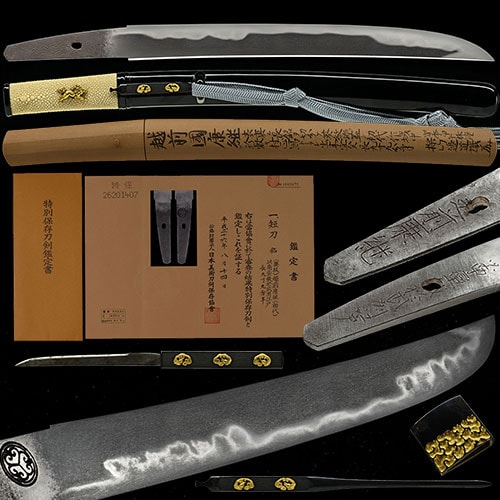
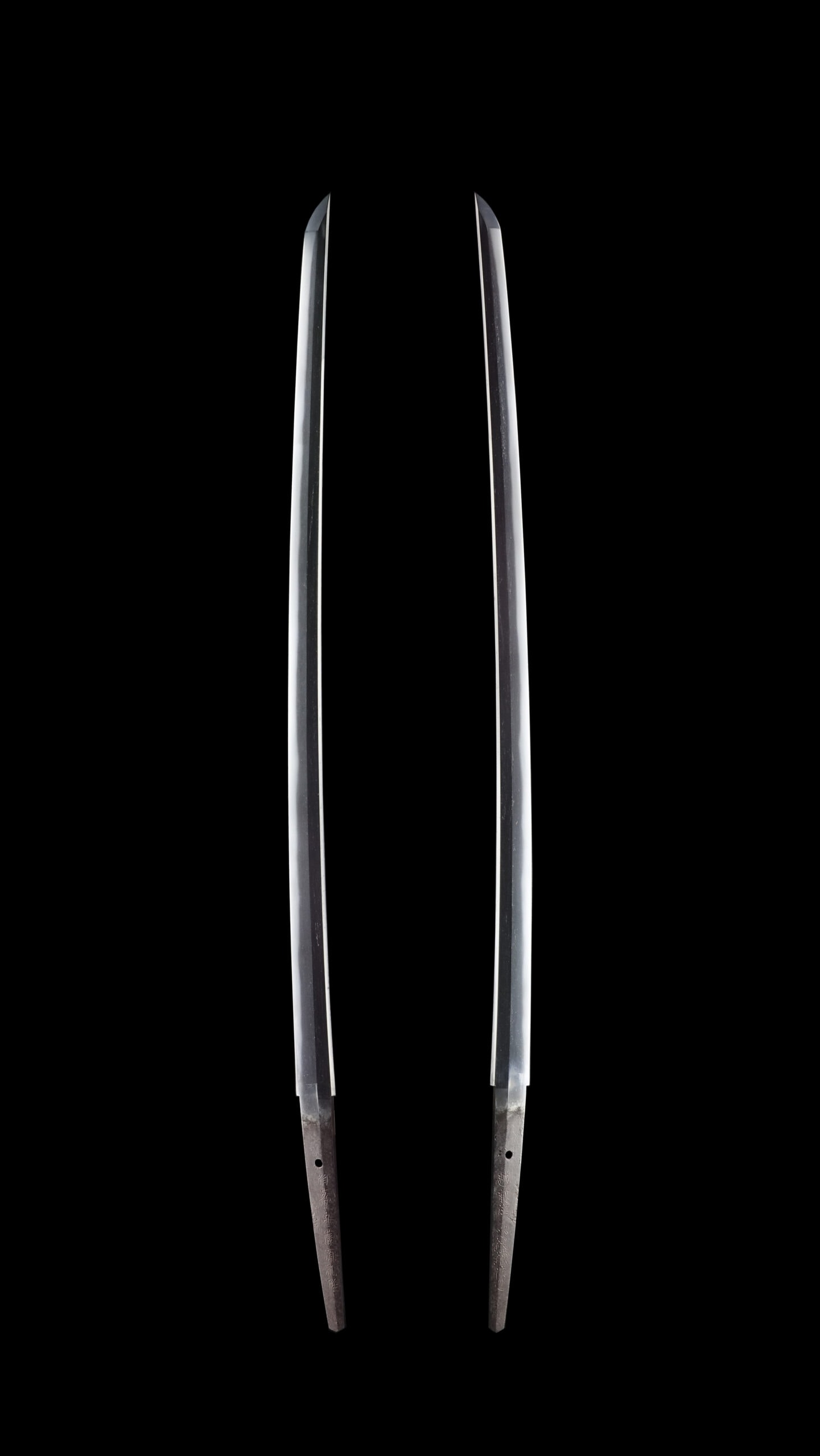
Around Keichō, the smith of the Shimosaka line was summoned to forge for Tokugawa Ieyasu and Hidetada, and as a result Ieyasu bestowed on him the character 康, whereupon he changed his name to Yasutsugu and was granted the right to cut the triple-hollyhock crest on his tang. The published sources record that the line originated in Ōmi, moved to under the patronage of Yūki Hideyasu, and thereafter served the shogunal house in alternating years between and , signing the long inscriptions that name the imported nanban-tetsu and of . The first generation, who re-tempered fire-damaged masterworks such as the Shishi Sadamune after the fall of Ōsaka, founded the house; this entry is read chiefly through the second generation, his legitimate heir Shimosaka Ichinojō, who took the tonsure as Kōetsu and died in Shōhō 3 (1646), and whose finest blades the published commentary holds difficult to tell from his father's.
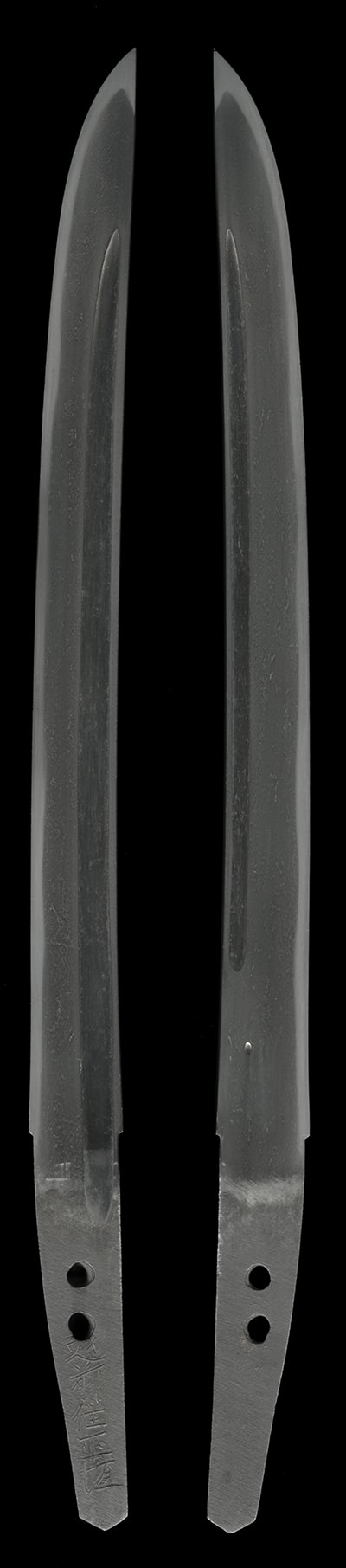
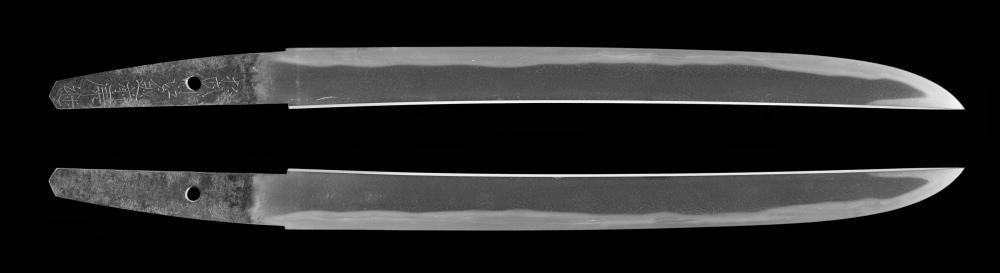
The hand is read in the first. It is an itame mixed with mokume that stands somewhat, in places flowing into nagare, with thick ji-nie, chikei entering, and at times jifu, the steel taking on the dark, blackish cast the published sources name as so-called Echizen steel. This dark, standing jigane is the constant across his work, and the commentary returns to it as the school's signature, noting again and again that the forging "displays the characteristics of Echizen steel"1. Over it the temper is built on notare into which gunome and ko-gunome are mixed, ko-ashi and yō entering, the nie strong with patches of coarse ara-nie gathering unevenly and scattering into the broken (basake) appearance that is his most personal effect; kinsuji and sunagashi run long, forming a striped course, the nioiguchi tending subdued (shizumi), with muneyaki along the back.
The bōshi is the surest single tell of the hand. It is most often a ko-maru, strongly swept in hakikake and turning back long, the published sources reading on one Jūyōkatana that the temper "enters in midare-komi, sweeps strongly in hakikake, and turns back long with a ko-maru at the tip"2; on the quieter suguha pieces it shows the so-called Sanpin flavor with the same long, strong return. The rounded, swept ko-maru with its long kaeri recurs across the corpus, the point at times pointed (togari) or running in as midare-komi, but the long swept return is constant, and the judges read it together with the dark Echizen steel as the smith's own. A second native register sits beside the notare manner, and the published sources call it his intrinsic style: a suguha base, at times a medium suguha, into which small connected gunome are mixed, ko-ashi entering vigorously, the back generally hardened and the nioiguchi again subdued. On one such wakizashi the commentary names this the very type of his proper hand, "the intrinsic workmanship of the second-generation Yasutsugu"3, the linked ko-gunome over a straight foundation, so that even where the temper quiets to suguha the steel keeps the smith's name.
The register the line is most celebrated for is its Sōshū-utsushi, the faithful copying of Sōshū masterworks at which the published sources say both the first and second generations excelled. The corpus holds reduced copies of the great meibutsu: an Ataka Sadamune katana carrying the gold-inlaid mark of the copy and a wakizashi reducing the same blade, and the only known second-generation copy of the Shishi Sadamune, whose burned original the first generation had re-tempered after the fall of Ōsaka. On these the forging tightens, the temper widens into notare mixed with gunome and large gunome and breaks into a large-pattern midare with tobiyaki and yubashiri toward a hitatsura feeling, the nie well adhered and the bōshi running almost as one sweep. On a tantō the judges read the deep nioi, the well-adhered nie and the kinsuji and sunagashi as an intent "aimed at the superior old Sōshū masters"4, while observing that the standing jihada and the subdued nioiguchi still betray the Echizen hand. Distinct again is the carving: the deep, forceful Kinai-bori executed with the engravers Kiuchi Chisō and Kinai Tomochika, the three-deity figures, bonji, the Kurikara dragon, gomabashi and suken, by which the commentary even separates the generations, since the first generation's three deities are limited to Fudō Myōō with his two attendants while the second combines Jizō, Bishamonten and Monju.
What sets the second generation apart, in the judges' own framing, is how close he comes to the first while never quite reaching his scale. The commentary repeatedly measures him against his father: one katana it calls the work among his that "shows the style closest to the first generation"5, and a late katana it praises as a blade in which "a level of skill not inferior to the first generation is demonstrated to the fullest"6. The signature itself carries the distinction, the form of the character 継 differing from the first generation's, and the line is read not against the old Sōshū it copied but by its own marks, the dark Echizen steel, the basakehabuchi, the striped sunagashi, the long swept ko-maru return, and the deep Kinai carving.
Fujishiro grades him Jō-jō saku, and the Tōkō Taikan rates him at the upper end of the shintō field. He carries no designations at the highest national tiers; his record runs instead through twenty-four blades at the Jūyō rank and two katana designated Jūyō Bijutsuhin before the war, the latter recorded in the Yasutsugu Taikan and held in the Kurokawa Institute of Ancient Cultures. The provenance roll is daimyō and warrior: the Honda house, with ownership inscriptions of Honda Hida-no-kami and Honda Shichizaemon, several blades carrying gold-inlaid cutting-test inscriptions, one bearing the eccentric added line "Fuji hikashi," the smith's boast that even Mount Fuji stands low beside his sword. These are not blades that come to market often; with none held back at the highest protected tier yet most kept in long-standing collections, a signed Yasutsugu with the aoi crest appears from time to time and with patience, the broad, dark, powerfully built work the commentary calls full of "force and rustic flavor"7 and well showing "the characteristics of Echizen work"8.
Kantei
the Echizen Shimosaka Yasutsugu hand, read mainly through the second generation: the dark itame Echizen-gane jigane and the subdued, basake notare-gunome temper of his native manner, set against two named registers the sources call his own, the Soshu-utsushi after Sadamune and the deep Kinai-bori carving program, all carried under the aoi crest and nanban-tetsu signature granted by the Tokugawa
Yasutsugu is the head of the Echizen Shimosaka line, the Tokugawa-favored shinto smith granted the character 康 and permission to cut the triple-hollyhock aoi crest on his tang, whose name passed down successive generations between Echizen and Edo. The published sources record that the first generation lived at Fukui in Echizen, was summoned about Keicho to forge for Ieyasu and Hidetada, received the 康 character and the aoi-mon, and thereafter served in alternating years between the two cities, and that after the second generation died in Shoho 3 the house divided into separate Edo and Echizen branches. The kantei picture the corpus draws is dominated by the second generation, the legitimate heir Shimosaka Ichinojo who took the tonsure as Koetsu, and it is read in the jigane first: an itame mixed with mokume that stands somewhat (hada-dachi), with thick ji-nie and chikei and the dark, blackish 'Echizen steel,' the school's tell. Over it the temper is a notare base mixed with gunome and ko-gunome, ko-ashi entering, the nie strong with patches of coarse ara-nie that scatter into a broken (basake) appearance, kinsuji and sunagashi running long into a striped effect, the nioiguchi subdued, the boshimidare-komi with hakikake and a long return. The line worked two further registers the sources name as its own: faithful Soshu-utsushi after Sadamune, including reduced copies of the meibutsu Ataka and Shishi Sadamune, and a program of deep, forceful Kinai-bori carvings, the three-deity figures and Kurikara, that the published commentary calls difficult to tell from the first generation's hand.
Diagnostic discriminators
黒みkuromi4
unique vs general shinto baseline (bright steel)
匂口沈みshizumi-gokoro4
26% of his works · 2.4× vs his own bright-nioiguchi pieces (akarui)
葵紋aoi-mon4
unique vs shinto smiths without shogunal grant
Observation by phase
His native Echizen manner (the second-generation prime)
The intrinsic hand the published sources call typical of the second generation is read in the jigane first. It is an itame mixed with mokume that stands somewhat, in places flowing toward nagare, with thick ji-nie, chikei entering, occasional jifu, and a steel color taking on the blackish cast the sources name 'Echizen steel.' Over it the temper is a notare base into which gunome and ko-gunome are mixed, ko-ashi and yo entering, the nie strong with patches of coarse ara-nie that gather unevenly and scatter into a broken (basake) appearance, the habuchi frayed in places; kinsuji and sunagashi run long and form a striped effect, the nioiguchi tending subdued, with muneyaki along the back. The boshi is most often a ko-maru, strongly swept (hakikake) and turning back long, at times pointed (togari) or running in as midare-komi. The construction is wide and powerful, thick in kasane, with sun-nobi and o-kissaki of Keicho feeling. The published sources call this broken, striped, subdued line the very mark of Echizen work; the wide bold blades are read as boldly uninhibited, full of force and a rustic flavor.
Soshu-utsushi after Sadamune (a register the sources call his own)
The published sources single out faithful Soshu copies as a register in which both the first and second generations excelled. The corpus holds reduced-scale copies of the celebrated meibutsu, an Ataka Sadamune katana with its gold-inlaid 'Ataki-utsushi' and a wakizashi reducing the same blade, and the only known second-generation copy of the Shishi Sadamune, the original of which the first generation re-tempered after the fall of Osaka Castle. There are katakiriba Sadamune utsushi as well. On these the forging tightens to a dense itame with ji-nie, the temper widens into a notare mixed with gunome and large gunome, breaking into a large-pattern midare with tobiyaki and yubashiri toward a hitatsura feeling, the nie well adhered, sunagashi and kinsuji frequent, the boshi running in an ichimai manner. On one tanto the sources read deep nioi, well-adhered nie and the presence of kinsuji and sunagashi as an intention to aim at the refined Soshu masters such as Sadamune, while noting that the standing jihada and subdued nioiguchi still betray the Echizen hand.
The suguha-based register (called his intrinsic style)
Alongside the notare manner the published sources name a second native register and call it the intrinsic style of the second generation: a suguha base into which small connected gunome are mixed (a chu-suguha mixed with running ko-gunome), ko-ashi entering vigorously, ko-nie adhering, patches of coarser nie creating unevenness, slight sunagashi and occasional kinsuji, the back generally hardened in muneyaki and the nioiguchi subdued. On these the boshi shows a 'Sanpin' flavor and returns long, the hand recognizable in the long, strong return. The sources tie examples of this register together by their shared Nyudo signature, placing them at roughly the same date, and read the suguha base with connected ko-gunome and vigorous ko-ashi as the proper, intrinsic manner of the second generation.
A defining register of the line is its carving, executed in the early years with the collaborating engravers of the Kinai school, Kiuchi (Kinai) Chiso and Kinai Tomochika, whose names some blades bear. The horimono are deeply cut and forceful: three-deity figures, bonji, the Kurikara dragon often within a groove, gomabashi, suken, and on later pieces plum and bamboo. The published sources distinguish the generations by their carving repertoire, noting that the first generation's three-deity carvings are limited to Fudo Myoo with the two attendant youths, while the second's combine other deities such as Jizo, Bishamonten and Monju, with ingenuity in carving method and placement. The sources call these carvings difficult to distinguish from the first generation's and a valuable documentary aid for the study of Yasutsugu.
Scholarship
The published sources treat the second generation as so close to the first that the two are difficult to tell apart, distinguishing them chiefly by the form of the character 継 and by the carving repertoire, and they question whether the smith in fact traveled between Edo and Fukui in alternating years; the corpus also records eccentric touches such as the 'Fuji hikashi' (Mount Fuji is low) added inscription, read as the smith's boast.2
On a tanto the sources read deep nioi, well-adhered nie, kinsuji and sunagashi as an intention to aim at the refined Soshu masters such as Sadamune, while the standing jihada, the locally basake nie within the ha, the vigorous sunagashi and the subdued nioiguchi still allow the characteristic features of Echizen work to be discerned.2
Dated Works
Years he was demonstrably active, proven by signed-and-dated blades
Active period
1630Editorial estimate: 1624–1644
1 of 25 designated works carry a date
1630
寛永七年Juyo session 1, item 23
Historical importance
Where Yasutsugu stands among comparable artisans: across all of nihontō, and within tradition, era, and period. The tiers (Foremost · Leading · Major · Notable) weigh official designations from the NBTHK and Japan's Agency for Cultural Affairs, together with historical honors of lasting repute such as the Sansaku and Meibutsu-chō.
随一
Foremost
屈指
Leading
有数
Major
ShintōKan'ei
著名
Notable
All nihontō
Select a lens to see how it's measured.
Designations
Kokuhō—
Jūyō Bunkazai—
Jūyō Bijutsuhin2
Gyobutsu1
Tokubetsu Jūyō—
Jūyō Tōken24
Elite Standing
0.13 across 27 designated works
Top 15% among smiths
Provenance
5 documented provenances across certified works by Yasutsugu
▸Imperial1
Shogunal—
Premier Daimyō—
Major Daimyō—
▸Other Daimyō2
Zaibatsu—
▸Institutions1
▸Named Collectors1
Provenance Standing
1 works held in elite collections across 5 documented provenances