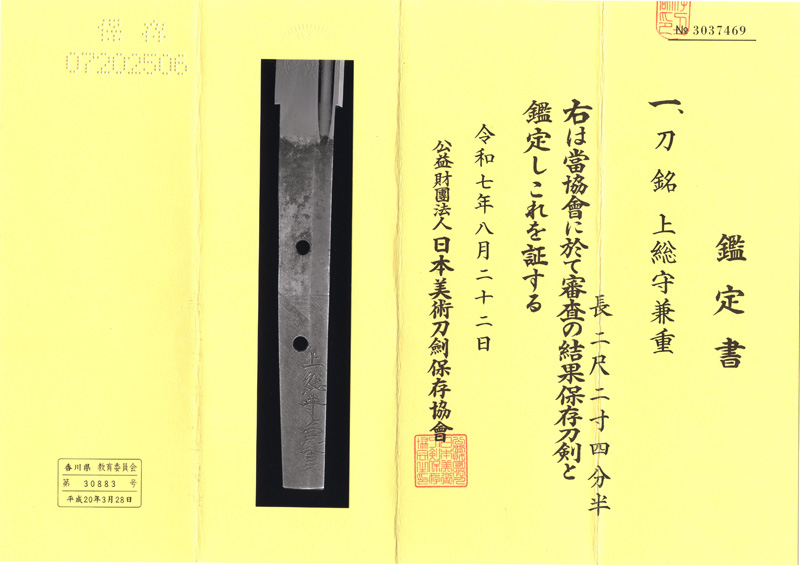
Kazusa no Suke Fujiwara Kaneshige, who also signed Kazusa no Kami, is the second generation of the Edo Kaneshige line, and the published sources settle his identity first: "Izumi no Kami Kaneshige and Kazusa no Suke Kaneshige are different men, probably son or pupil"[[c:1]]. The old account made them one smith who changed his title out of deference to his lord Tōdō Izumi no Kami; signed and age-stated works show Kazusa no Suke born in Kan'ei 3, and "his work begins around Meireki, and the Kanbun and Enpō years are his period of activity"[[c:2]]. He was thus a contemporary of Nagasone Kotetsu, and on one wakizashi the published sources even judge that "the long-held view that Kazusa no Suke Kaneshige was Kotetsu's teacher seems correct"[[c:3]].
His temper is the juzu-ba. Over a suguha-toned base he runs round-headed gunome linked in series like rosary beads, with thick ashi entering, deep nioi, thick nie, kinsuji and sunagashi, and a bright nioiguchi. The published sources describe the rhythm exactly: he tempers one gunome and then two, again and again, "repeating one, two, a fixed rhythm is seen, and this is the great point of appreciation of this smith"[[c:4]]. They hold that the manner grew from his predecessor's, that he "inherited the style of the first-generation Kaneshige, raised its completion further and established his own domain"[[c:5]]. Among his works a wakizashi with a gold-inlaid cutting test by Yamano Kaemon Nagahisa dated Manji 4 already bears a complete juzu-ba, which they set ahead of Kotetsu's; that his manner then "exerted a great influence is not hard to imagine"[[c:6]].
Beside the juzu-ba proper runs a broader register of gunome with thick ashi. The published sources describe its character simply: "the characteristic style of gunome with thick ashi entering, well covered in nie"[[c:7]], and they place him among the Edo smiths of his day who, "resembling the Hōjōji group, tempered a gunome-midare in the so-called juzu-ba manner"[[c:8]]. A joint work signed with Sukekuro Kanetsune and carrying a cutting test in the name of the Hōjōji smith Masateru is read as close to both, "its workmanship looking like the Hōjōji group and also like Kazusa no Suke"[[c:9]]. The jigane is a tight ko-itame, standing slightly in places, with ji-nie that is at times dust-fine and chikei. The sugata is the typical Kanbun-shintō form of ordinary width, clear taper, shallow sori and a slightly compact chū-kissaki, and the bōshi runs straight to a ko-maru swept at the tip.
His wakizashi hold a particular place. Of the Manji 4 piece the published sources write that it is "a typical and representative work among his works"[[c:10]], adding that "that his wakizashi include especially fine works tells of the character of the age"[[c:11]]. He also worked away from Edo, some blades bearing the added inscription "made at Anotsu in Seishū"[[c:12]].
The published sources treat the boundary between the two generations as open. Recent comparison of the signatures, they report, "places the generational change in the Keian era"[[c:13]], holds that the second generation also signed Izumi no Kami in his early years before alternating Kazusa no Kami and Kazusa no Suke, and goes so far as "to point to dai-mei of the second-generation Kaneshige by Sukekuro Kanetsune"[[c:14]], transmitted as his son; they close that "further research is awaited"[[c:15]].
Fujishiro grades him Jō saku, and his designated record lies in the Jūyō tier. Several of his blades carry the gold-inlaid tests of the great Edo cutters, among them a Kanbun 11 test by Maejima Hachirō Tomotsugu. For a collector a signed juzu-ba katana of his comes to light from time to time and is the natural point of comparison with Kotetsu, while the Manji 4 wakizashi stands as a document of the temper's origins.



 NihontoWatch