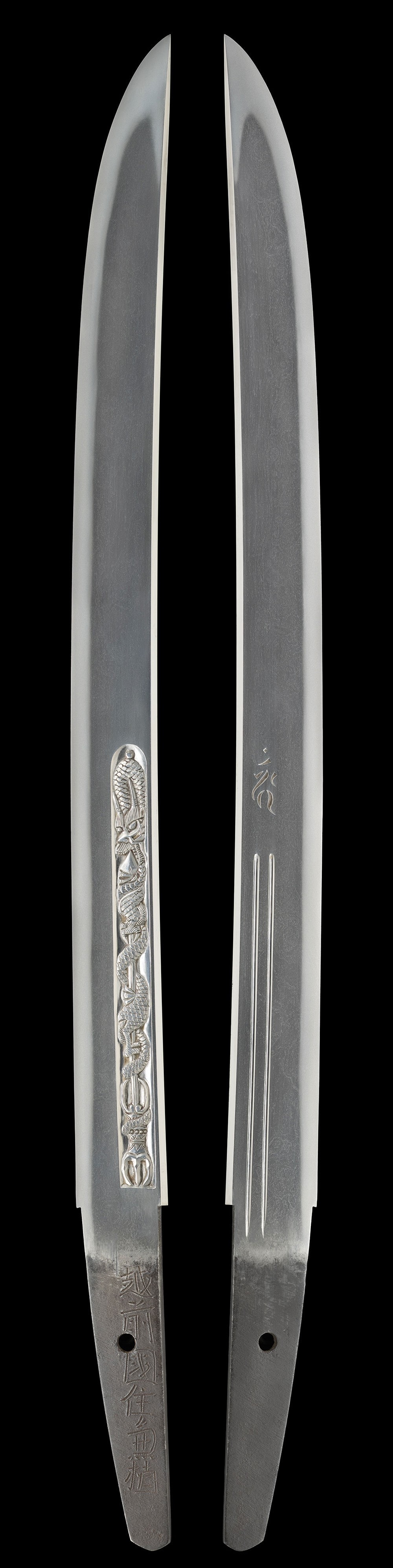
The earliest dated work that survives under this smith's hand is a inscribed 'ei 2, 1625, and the seven blades gathered here, all signed Izumi no Kami or Izumi no Kami Fujiwara Kaneshige, are the work of the alone. The published sources place him directly after the Yasutsugu and Hankei as the next smith of consequence; tradition holds that he came from , where he had been a yanone-kaji, a maker of arrowheads, before going to and turning to forging blades, an account the Kokon Kajibikō preserves. He is rated Jō- by Fujishiro, and by long tradition he is the teacher of Nagasone Kotetsu. The name carries a second smith after him, his pupil Kazusa no Suke, also Kazusa no Kami, Fujiwara Kaneshige, and the two were for centuries treated as a single man, the change of title explained as deference to his lord Tōdō Izumi no Kami. The published sources set that story aside: signed and age-stated works, among them a katana of Kanbun 6, 1666, show the younger smith was born in Kan'ei 3, 1626, while the elder already bears Kan'ei dates, so the two are different individuals, and this profile is the first generation only.
The published sources draw his range as two manners, and the distinction governs how his work is read. The first is a notare-based temper carrying linked gunome, with ashi entering well, the nioi deep and the nie laid thick, and in his fullest pieces fine kinsuji and sunagashi running through the band with patches of coarser ara-nie, the nioiguchi bright and clear. On a katana of this manner the published sources find the workmanship so close to Kotetsu that it recalls him at a glance, 「一見徹を髣髴させる作域」1, and read in the hardened edge a sense of strength and spirit. The second manner is a suguha base, sometimes a wide straight temper bearing the faintest notare and sometimes a chū-suguha of almost no movement at all, the nioi deep and the ko-nie well gathered, with a slight yakikomi at the machi and a bright, clearly defined nioiguchi. The constant across both is that clarity of the nioiguchi, the saeru quality the published sources tie to his Kotetsu-like character and name as the mark of Kaneshige at his best.
The jigane beneath both manners is a ko-itame, closely and well forged, with fine ji-nie laid thickly and chikei entering, in places flowing into nagare-hada and tending slightly to stand, mokume mixed in here and there. It is the controlled urban steel of an Edo master, the faint standing of the grain keeping the surface alive without breaking it open. The bōshi runs straight to a ko-maru, the kaeri at times long, the point swept with hakikake. The sugata is the transitional form of the Kan'ei and Shōhō years, of standard mihaba with a markedly pronounced taper, a retained funbari, rather deep sori and a compact chū-kissaki, which the published sources read as the passage from Keichō shintō to Kanbunshintō form and offer as a point of appreciation of his shape. The nakago is ubu, finished with ō-sujikai file marks already carrying a kesho-like tendency the published sources read as an early prototype of the later ornamental kesho-yasuri, and the long signature is cut with a fine chisel in a distinctive reisho clerical script of seven characters.
The two manners are registers, not periods, and the published sources name which a given blade exemplifies. The wide-suguhakatana of the 61st Jūyō session they call a typical example of the former, the notare-gunome hand, its broad straight band mixed with notare and ko-gunome conveying an overflowing vigor; the deep-nioisuguha of the 43rd session they call a typical example of the latter, where the nioi runs especially deep and the nioiguchi becomes vividly clear. A third register is form rather than temper: his work is almost wholly shinogi-zukurikatana and wakizashi with tantō unseen, so that the broad, sun-nobihira-zukuriwakizashi of the 31st session is a rare construction in which, the published sources note, its ko-notare mixed with gunome and bright nioiguchi show his true forte. Even within the notare-gunome manner there are blades of an entirely pure straight temper, 「純然たる直刃」, as the published sources remark of a Yamano cutting-test katana, so that the two hands shade into one another rather than dividing his career.
What sets him apart is best stated from his own grounded features. His tell is the pairing of a deep nioi with a bright, clear nioiguchi, carried equally over the calm wide suguha and the more active notare-gunome, and beneath it the densely ji-nie-laden ko-itame with its fine chikei and slight standing of the grain. The published sources frame his place in the school through Kotetsu at every turn: he is by tradition the teacher, his ji and ha deep in nioi and clear in the Kotetsu manner, and a katana of his is judged to recall Kotetsu at a glance. The line he founded ran on past him, his pupil Kazusa no Suke carrying it into the Kanbun years and perfecting the juzu-ba, the rosary-bead temper for which the second generation is best known and which the published sources hold could be mistaken for Kotetsu, so that the shodai's restrained two manners stand at the head of a school whose later fame rests on a temper he himself did not work. Recent study has gone to sorting the two hands apart, by which the elder's seven blades here are now read as the first generation's alone.
Kaneshige is among the leading Edoshintō names, and the shodai's reputation is inseparable from the cutting-tests that ride on his blades. Two of the seven here carry the gold-inlaid setsudan-mei of Yamano Kanjūrō, the name the great tester Kaemon used before the Shōhō era, recording a mitsu-dō three-body cut felled in two strokes and the inscription 「前代未聞剣 山野勘十郎切之」2, an unprecedented sharpness cut by Yamano Kanjūrō, a provenance as much as an honor. On record under his name stand seven blades at the Jūyō rank and no higher designation, almost all shinogi-zukurikatana and wakizashi, with no National Treasure or Important Cultural Property among them and no recorded daimyō provenance, which is to say that what survives of him is the designated Jūyō blade rather than the museum-held icon. These are held mostly in long-standing private collections and come to market only from time to time, a signed Kaneshige bearing one of the famous Yamano cutting-test inscriptions the example most sought. He is not beyond the reach of a patient collector, but a piece of his, and above all one carrying the Yamano inlay, is a landmark when it appears.
Kantei
the shodai Izumi no Kami's two manners as the published sources draw them, both read over one dense ko-itame: a notare-based gunome-midare worked deep in nie, with ashi entering and long kinsuji and sunagashi, and a calm suguha base bearing a shallow notare, deep in nioi with a bright clear nioiguchi, the whole carried on the transitional Kan'ei to Shoho sugata and tied to the Yamano cutting tests
This is the shodai Izumi no Kami Fujiwara Kaneshige, the EdoShinto smith the published sources place after the shodai Yasutsugu and Hankei, an Echizen arrowhead smith by tradition who came to Edo and turned to forging blades, his earliest surviving dated work a naginata of Kan'ei 2 (1625) and his signed pieces running into the Meireki era. He is the first generation only: the published sources now hold that he and the later Kazusa no Suke Kaneshige, his pupil, long taken for one man, were different individuals, the long account of a title change out of deference to his lord Todo Izumi no Kami set aside by signed and age-stated works. Almost his whole record is shinogi-zukurikatana and wakizashi, with tanto unseen, and the long signature is cut in a distinctive reisho clerical script. Over a dense ko-itame thick with ji-nie and fine chikei, in places flowing and slightly standing, he tempers the two manners the published sources name explicitly: a notare-based gunome-midare with ashi entering, deep nioi, thick nie and abundant kinsuji and sunagashi within the temper, and a suguha base bearing a shallow notare, the nioi deep and the nioiguchi bright and clear. His sugata is the transitional one of the Kan'ei to Shoho years, of standard width with marked taper, retained funbari and a compact chu-kissaki, which the published sources read as the passage from Keicho-shinto to Kanbun-shinto form. The line is bound to the great Edo cutting-testers, many blades carrying the gold-inlaid setsudan-mei of Yamano Kanjuro, later Kaemon, and the shodai is by long tradition the teacher of Nagasone Kotetsu.
Diagnostic discriminators
匂口明るいnioiguchi akarui5
砂流しsunagashi4
截断銘saidan-mei2
29% of his works
隷書reisho3
43% of his works
Observation by phase
The notare-based gunome-midare (deep nie, long kinsuji and sunagashi)
The first of the two manners the published sources name is a notare-based gunome-midare. Over a ko-itame that is well forged, in places flowing and slightly standing, with ji-nie and fine chikei entering, he tempers a shallow notare into which gunome and small gunome run, ashi entering well, the nioi deep and nie thick, and at the front near the cutting edge long, vigorous kinsuji and sunagashi with patches of coarser nie, the nioiguchi bright and clear. The boshi runs straight to a ko-maru, the kaeri sometimes long, the tip swept with hakikake. The published sources call this the typical example of the manner of linked gunome, and read in it the force and spirit the line shares with Kotetsu, on a sugata of standard width with marked taper and retained funbari they place at the passage from Keicho to Kanbun form. The hira-zukuriwakizashi of broad mihaba and elongated proportions, a rare construction in his work, belongs here, its small notare with gunome and ashi the full expression of his domain.
The suguha base with a shallow notare (deep nioi, a bright clear nioiguchi)
The second manner is a suguha base, sometimes a pure chu-suguha and sometimes a straight temper bearing a very shallow notare. Over a ko-itame closely forged with ji-nie, the temper is a middle-width suguha, the nioi deep, small nie well gathered, the nioiguchi bright and clear, with a slight yakikomi at the machi. The boshi turns straight to a small round. The published sources call the pieces carrying the Yamano cutting test outstanding examples of this restrained hand, and note that even within a manner built on notare-gunome there are blades, like these, of an entirely pure straight temper. The earliest of his dated works belongs here, the signed katana of Kan'ei 17 (1640) with a shallow notare crossed by kuichigai-ba and a touch of hakikake, well made. This is the calmer of his two domains, and where the brightness and clarity of the nioiguchi, the feature the line shares with Kotetsu, shows most plainly.
The published sources hold that Izumi no Kami Kaneshige and Kazusa no Suke Kaneshige, long treated as one man, were in fact two individuals in a master-pupil relation. The old account that the smith changed his title from Izumi no Kami to Kazusa out of deference to his lord Todo Izumi no Kami is set against a pair of signed and age-stated works, a wakizashi and a katana of Kanbun 6 (1666), from which Kazusa no Suke is shown to have been born in Kan'ei 3 (1626), while Izumi no Kami already bears Kan'ei dates, so that the two are understood to be distinct. On this reading the seven blades here, all signed Izumi no Kami or Izumi no Kami Fujiwara Kaneshige, are the work of the first generation alone.3
On his style the published sources are explicit that there are two manners. His work is mostly shinogi-zukuri katana and wakizashi, tanto unseen, and the style divides into a notare-base with linked gunome and ashi entering, and a deep-nioi suguha bearing a shallow notare with a bright clear nioiguchi. A piece is the typical example of one or the other, the published sources naming which: the wide-suguha katana of Juyo 61 the former, the deep-nioi suguha of Juyo 43 the latter. The transitional Kan'ei to Shoho sugata, of standard width with marked taper, retained funbari and a compact chu-kissaki, they read as the passage from Keicho-shinto to Kanbun-shinto form.3
Dated Works
Years he was demonstrably active, proven by signed-and-dated blades
Active period
1640Editorial estimate: 1624–1661
1 of 5 designated works carry a date
1640
寛永十七年Juyo session 14, item 321
Historical importance
Where Kaneshige stands among comparable artisans: across all of nihontō, and within tradition, era, and period. The tiers (Foremost · Leading · Major · Notable) weigh official designations from the NBTHK and Japan's Agency for Cultural Affairs, together with historical honors of lasting repute such as the Sansaku and Meibutsu-chō.