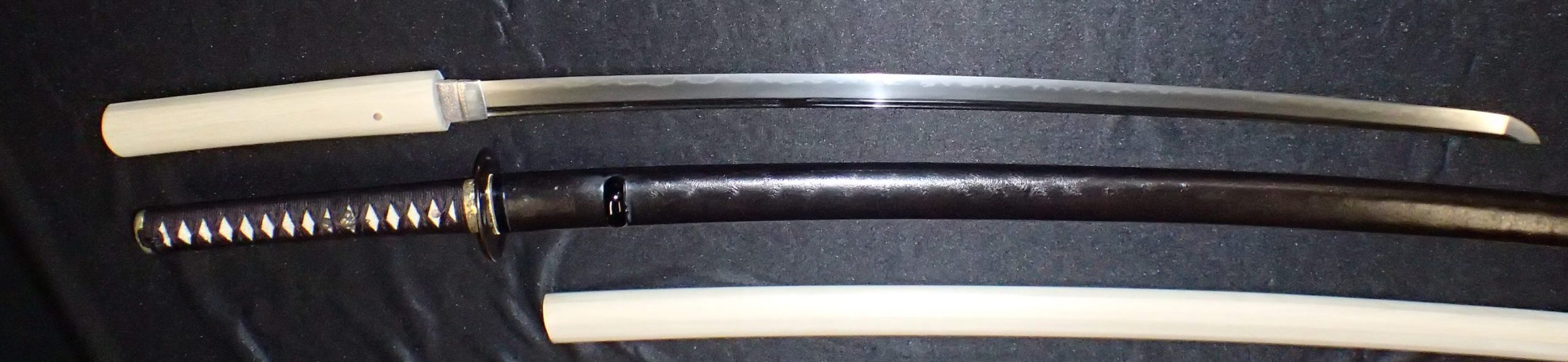
脇差 信国
¥250,000
Smith
Specifications
Nagasa
34.1 cm
Sori
0.4 cm
【Product Description】 Blade Classification: Wakizashi Mei: Mumei (Den: Enju) Appraisal: NBTHK Tokubetsu Hozon Token Nagasa: 45.1 cm Sori: 1.0 cm Motohaba: 2.8 cm Sakihaba: 2.0 cm Motokasane: 0.6 cm Sakikasane: 0.4 cm Weight: 405 g Era: Late Kamakura period Country: Higo Province [Sugata] Shinogi-zukuri, Iori-mune. The nagasa is standard, the sori is shallow, and the chu-kissaki is slightly extended. [Jigane] Itame-hada mixed with mokume, becoming fine and dense. The hada is well-refined with jinie and shirake-utsuri appearing. [Hamon] Suguha based with a gentle chu-suguha tone. The habuchi is bright with fine nie, containing hotsure and uchi-no-ke. The nioiguchi is clear. [Boshi] Straight with a small, rounded kaeri. [Koshirae] Black Ishime-ji Lacquer Uchigatana Koshirae Tsuba: Mokko-gata, iron base with gold nunome-zogan. Fuchi-Kashira: Shakudo nanako-ji, autumn insects design in takabori and iro-e. Menuki: Shakudo, floral design in takabori and iro-e. Kozuka: Shakudo nanako-ji, autumn insects design in takabori and iro-e. [Explanation] The Enju school was founded by Taro Kunimura, the grandson of Rai Kunitoshi, who moved from Yamashiro to Higo Province (Kikuchi-gun) during the late Kamakura period. They served as the exclusive swordsmiths for the Kikuchi clan. This blade is mumei but has been attributed to Enju by the NBTHK. The jigane shows a refined itame with shirake-utsuri, and the hamon is a graceful suguha with a bright nioiguchi, clearly exhibiting the characteristics of the Rai school lineage. It is a masterpiece that combines the elegance of the Yamashiro tradition with the robust spirit of the Higo smiths. The koshirae is also high quality, featuring unified autumn insect motifs in shakudo.
 NihontoWatchBETA
¥250,000
34.1 cm
0.4 cm
【Product Description】 Blade Classification: Wakizashi Mei: Mumei (Den: Enju) Appraisal: NBTHK Tokubetsu Hozon Token Nagasa: 45.1 cm Sori: 1.0 cm Motohaba: 2.8 cm Sakihaba: 2.0 cm Motokasane: 0.6 cm Sakikasane: 0.4 cm Weight: 405 g Era: Late Kamakura period Country: Higo Province [Sugata] Shinogi-zukuri, Iori-mune. The nagasa is standard, the sori is shallow, and the chu-kissaki is slightly extended. [Jigane] Itame-hada mixed with mokume, becoming fine and dense. The hada is well-refined with jinie and shirake-utsuri appearing. [Hamon] Suguha based with a gentle chu-suguha tone. The habuchi is bright with fine nie, containing hotsure and uchi-no-ke. The nioiguchi is clear. [Boshi] Straight with a small, rounded kaeri. [Koshirae] Black Ishime-ji Lacquer Uchigatana Koshirae Tsuba: Mokko-gata, iron base with gold nunome-zogan. Fuchi-Kashira: Shakudo nanako-ji, autumn insects design in takabori and iro-e. Menuki: Shakudo, floral design in takabori and iro-e. Kozuka: Shakudo nanako-ji, autumn insects design in takabori and iro-e. [Explanation] The Enju school was founded by Taro Kunimura, the grandson of Rai Kunitoshi, who moved from Yamashiro to Higo Province (Kikuchi-gun) during the late Kamakura period. They served as the exclusive swordsmiths for the Kikuchi clan. This blade is mumei but has been attributed to Enju by the NBTHK. The jigane shows a refined itame with shirake-utsuri, and the hamon is a graceful suguha with a bright nioiguchi, clearly exhibiting the characteristics of the Rai school lineage. It is a masterpiece that combines the elegance of the Yamashiro tradition with the robust spirit of the Higo smiths. The koshirae is also high quality, featuring unified autumn insect motifs in shakudo.
NihontoWatchBETA¥250,000
34.1 cm
0.4 cm