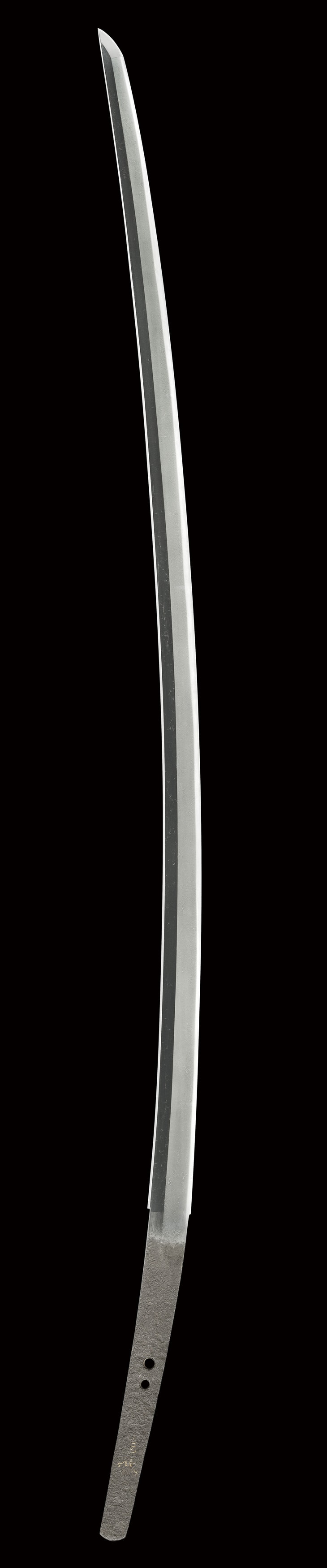
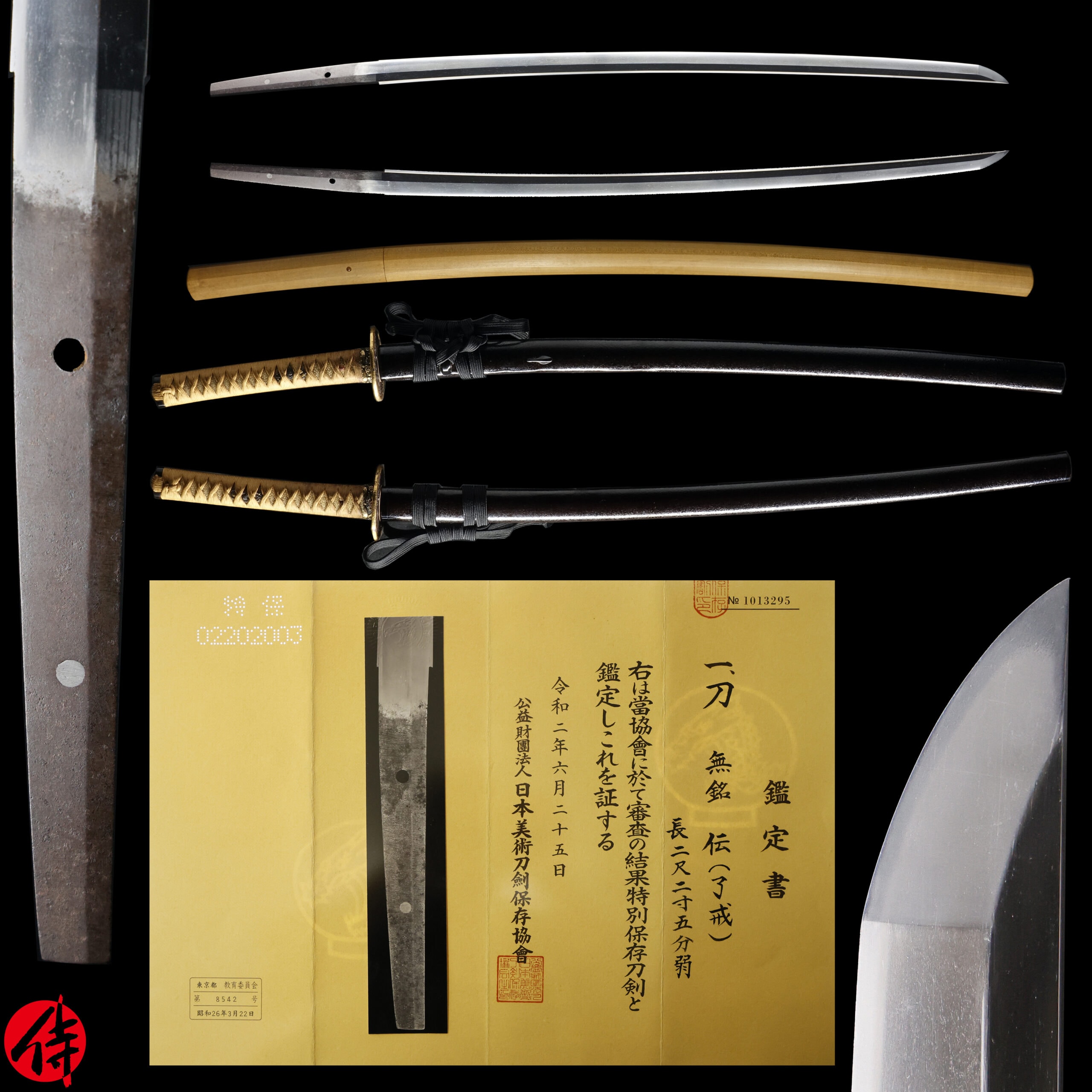
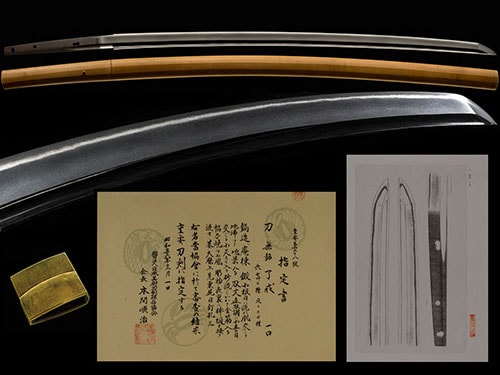
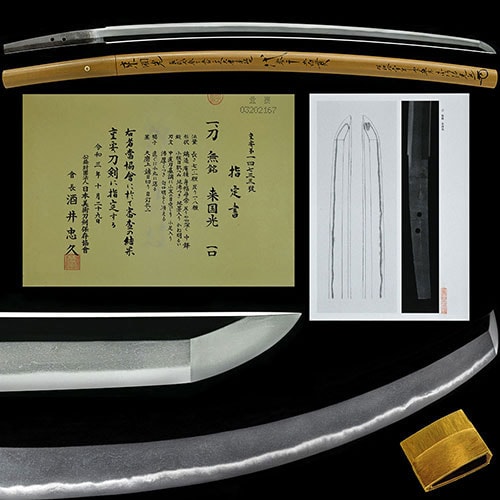
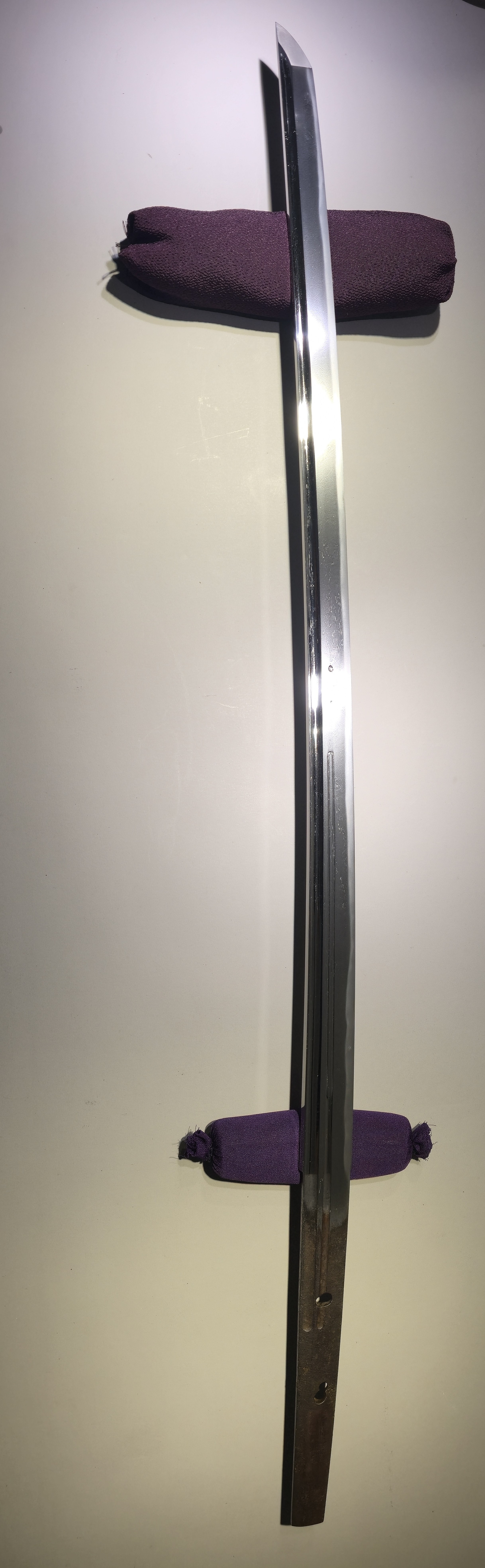
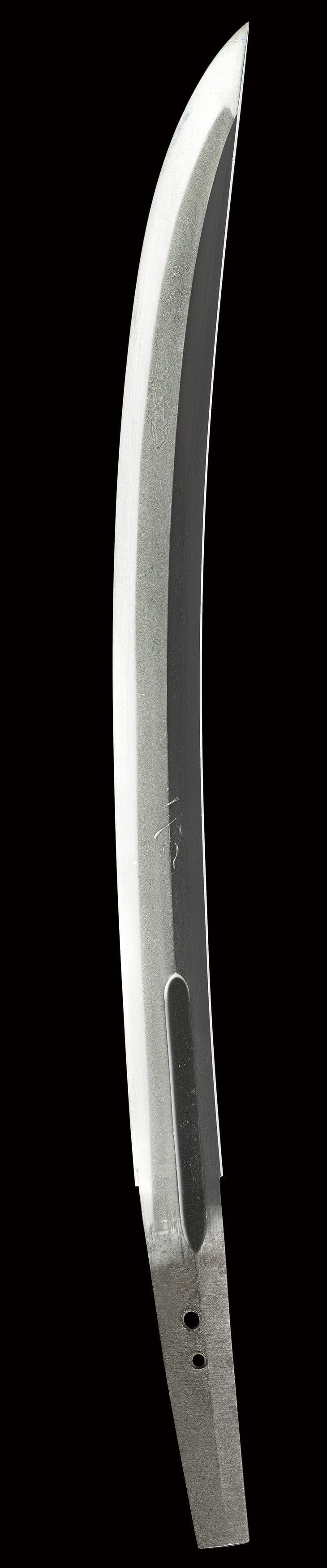
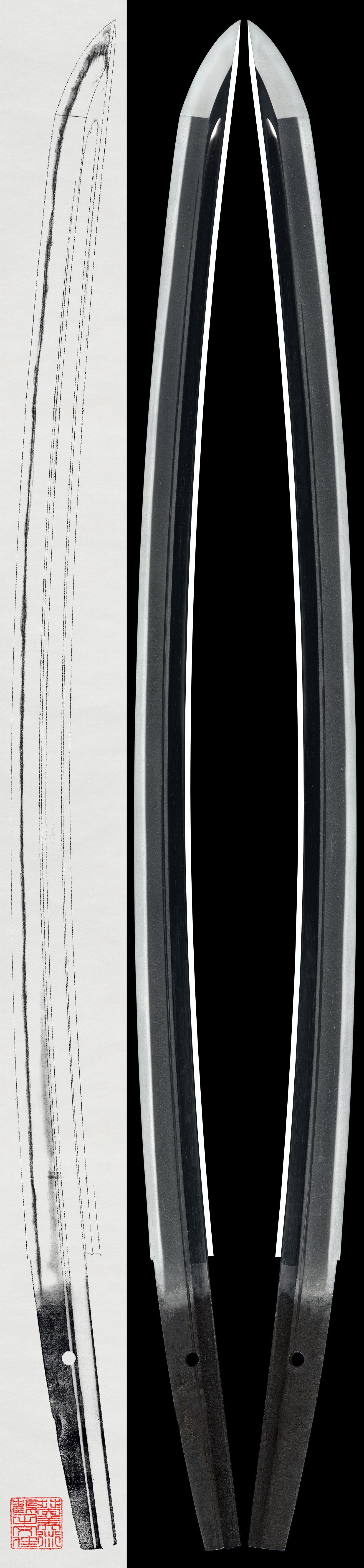
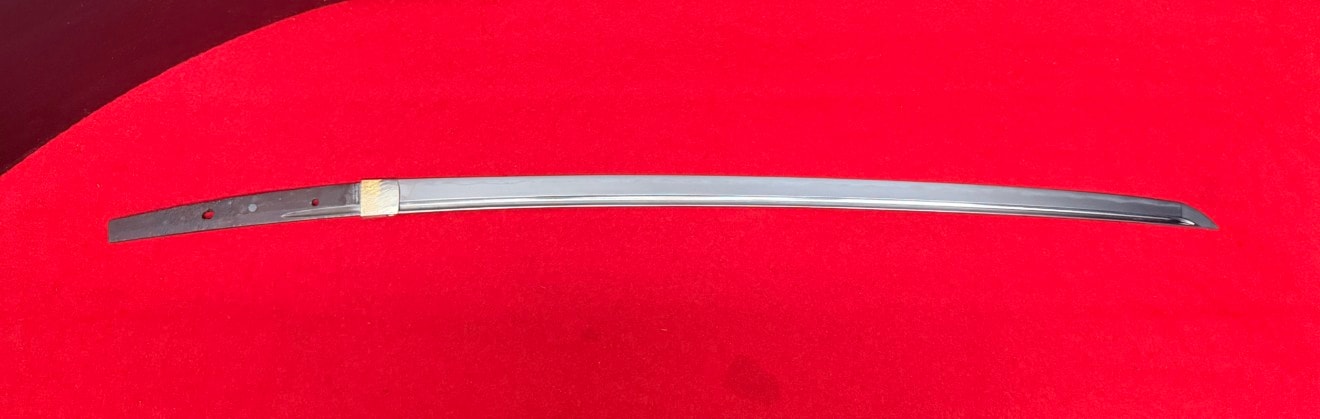
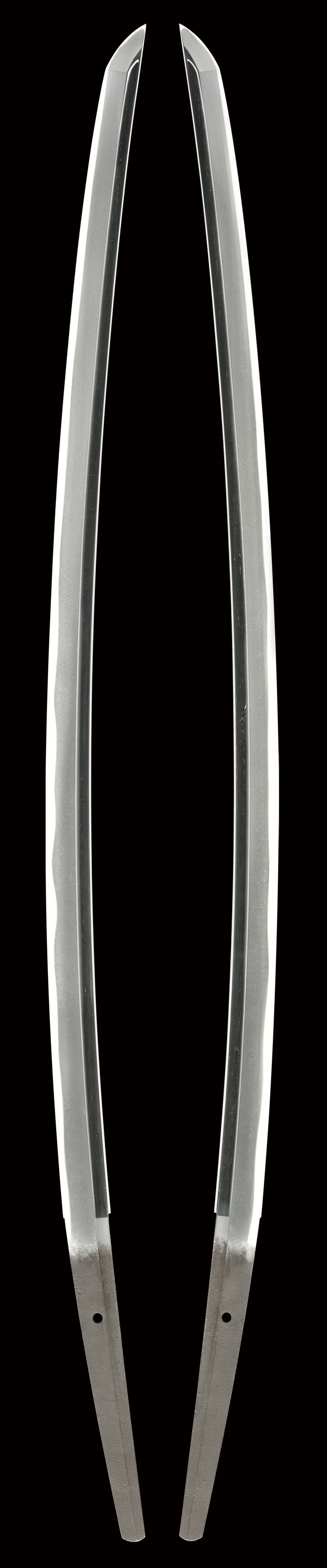
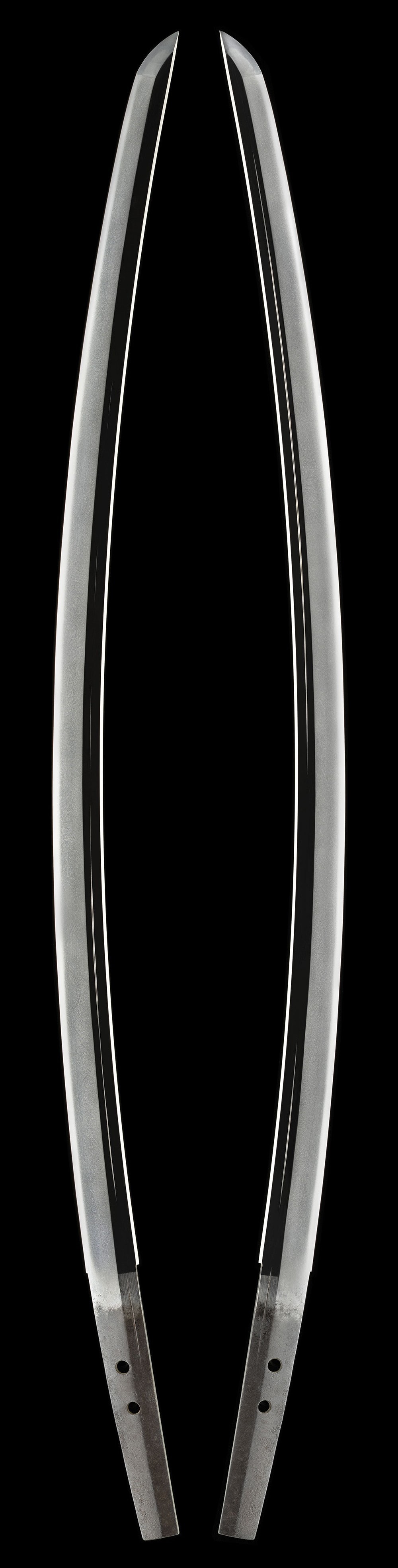
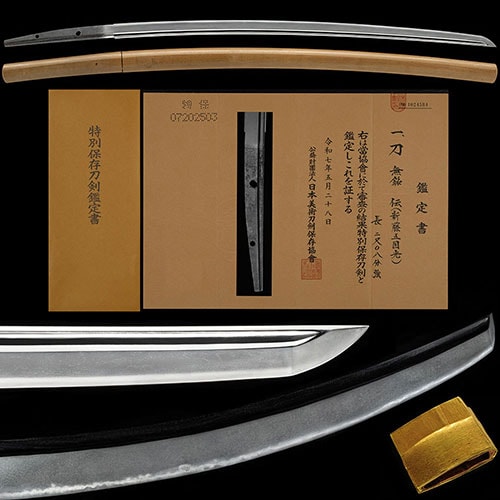
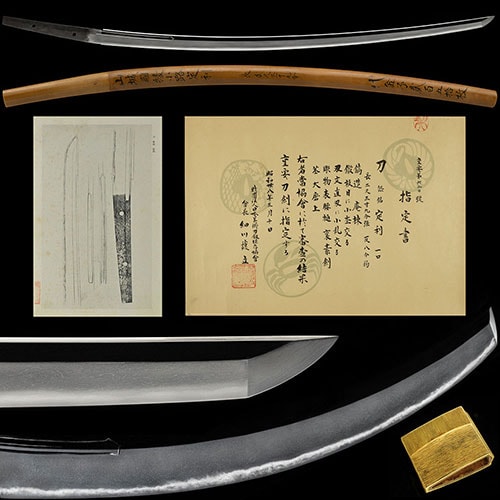
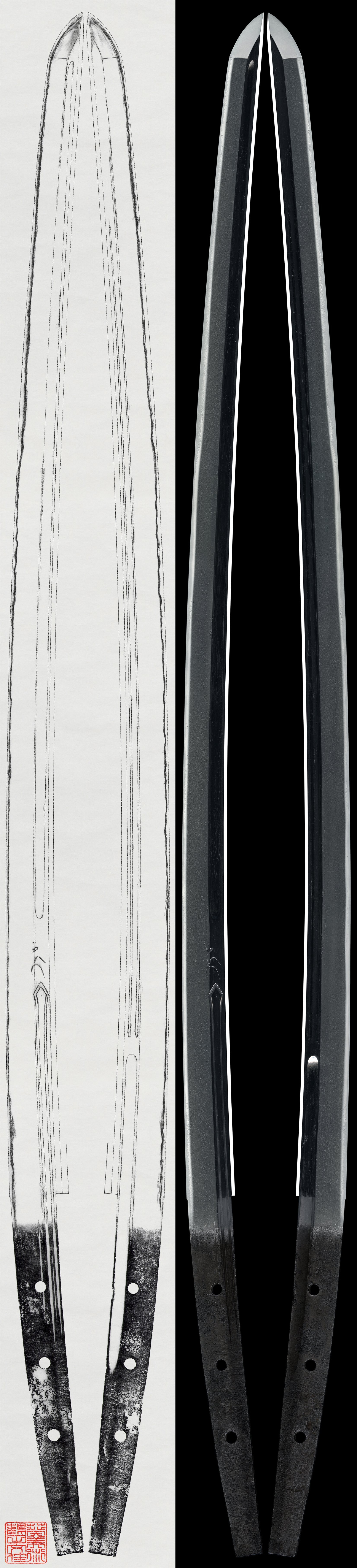
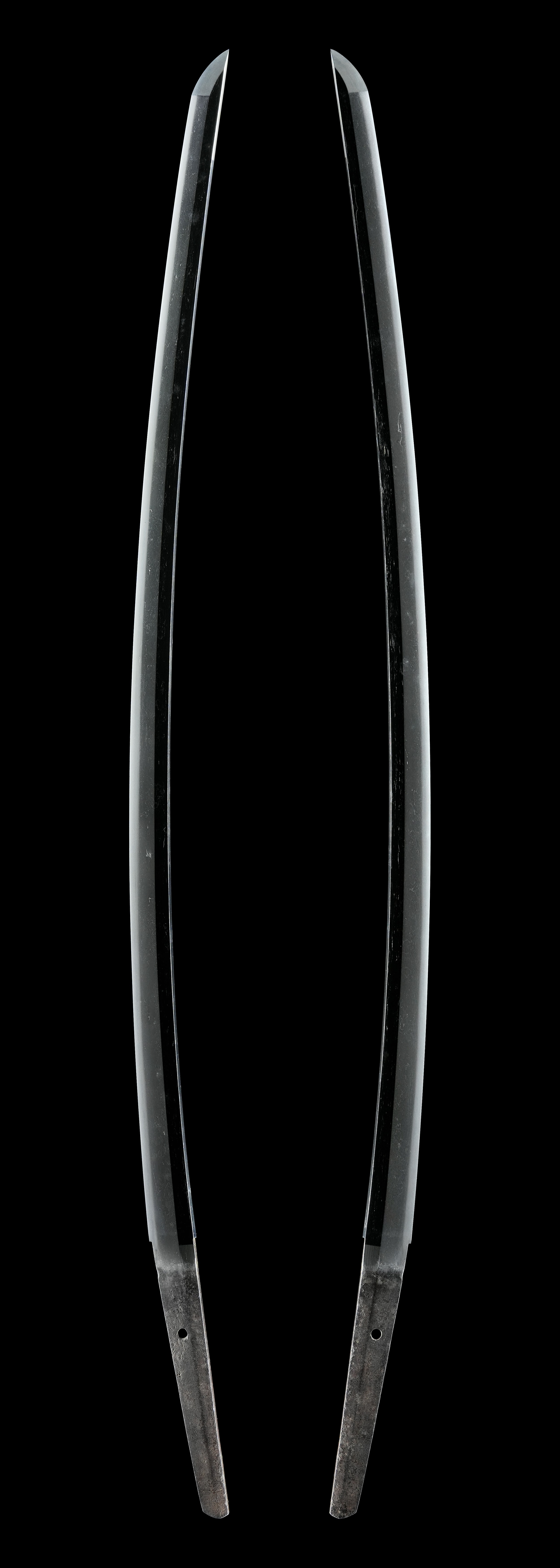
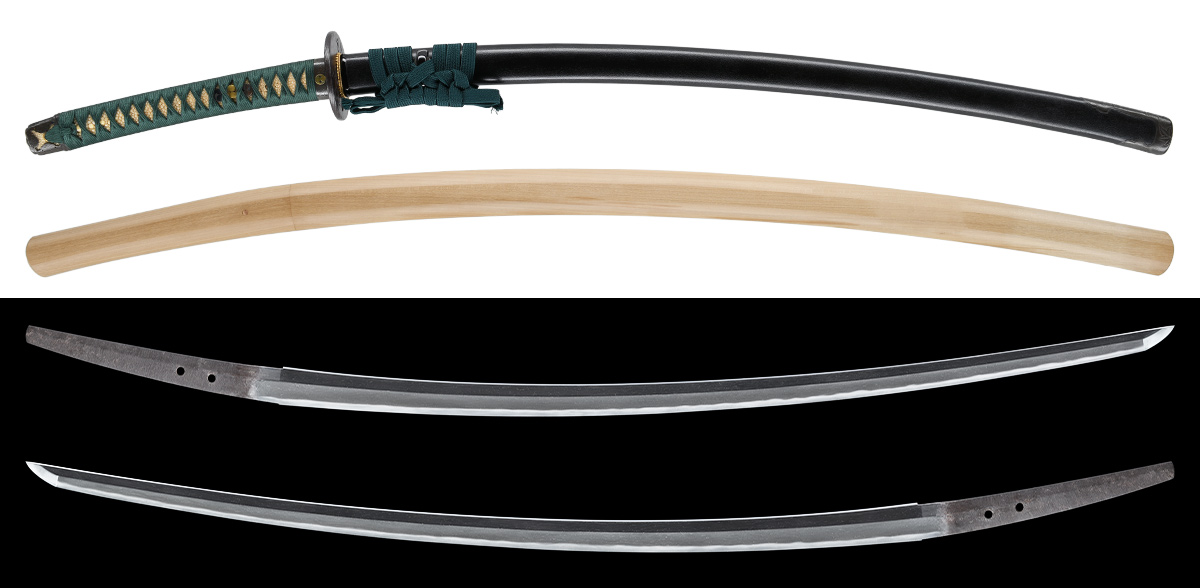
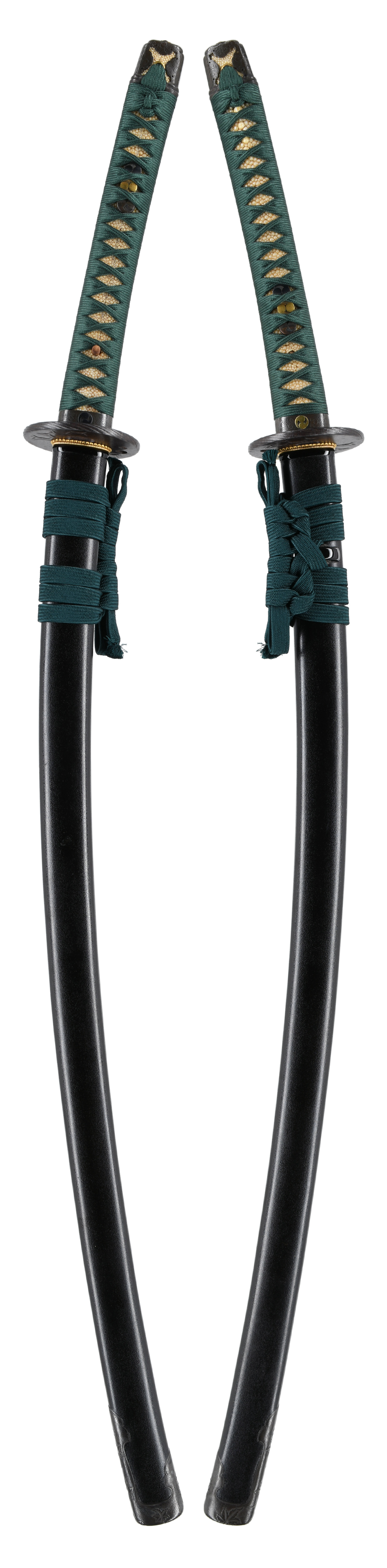
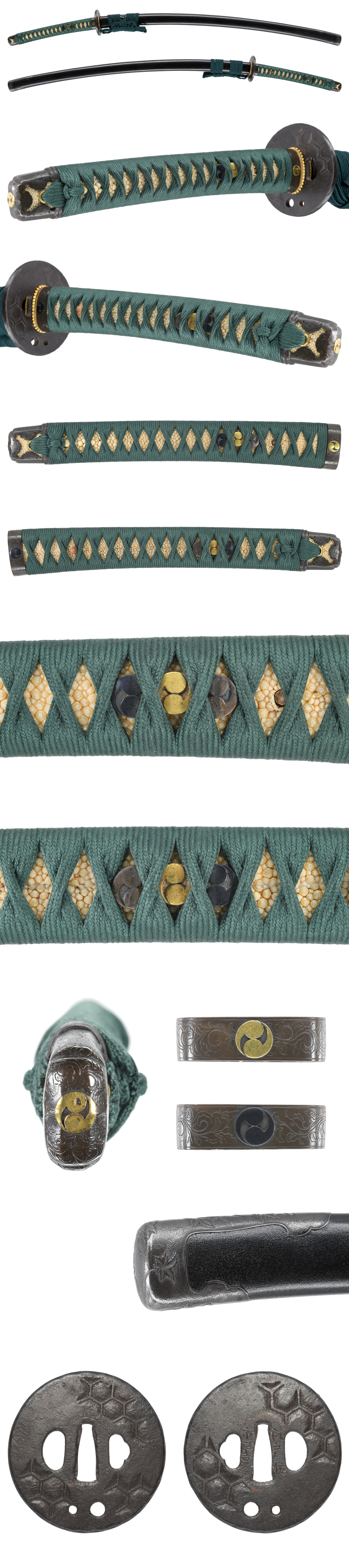
This is a Tachi attributed to Ryokai, a smith of the Rai school from Yamashiro province, active during the late Kamakura period (around 1293). It features a healthy and elegant form with a deep curve and rich niku. The blade comes with a gold-plated habaki, shirasaya, and a black ishime-ji nuri hantachi koshirae, and is accompanied by an NBTHK Tokubetsu Hozon Token certificate.
 NihontoWatchBETA
mumei · Rai · Kamakura · nagasa 76cm · sori 3cm

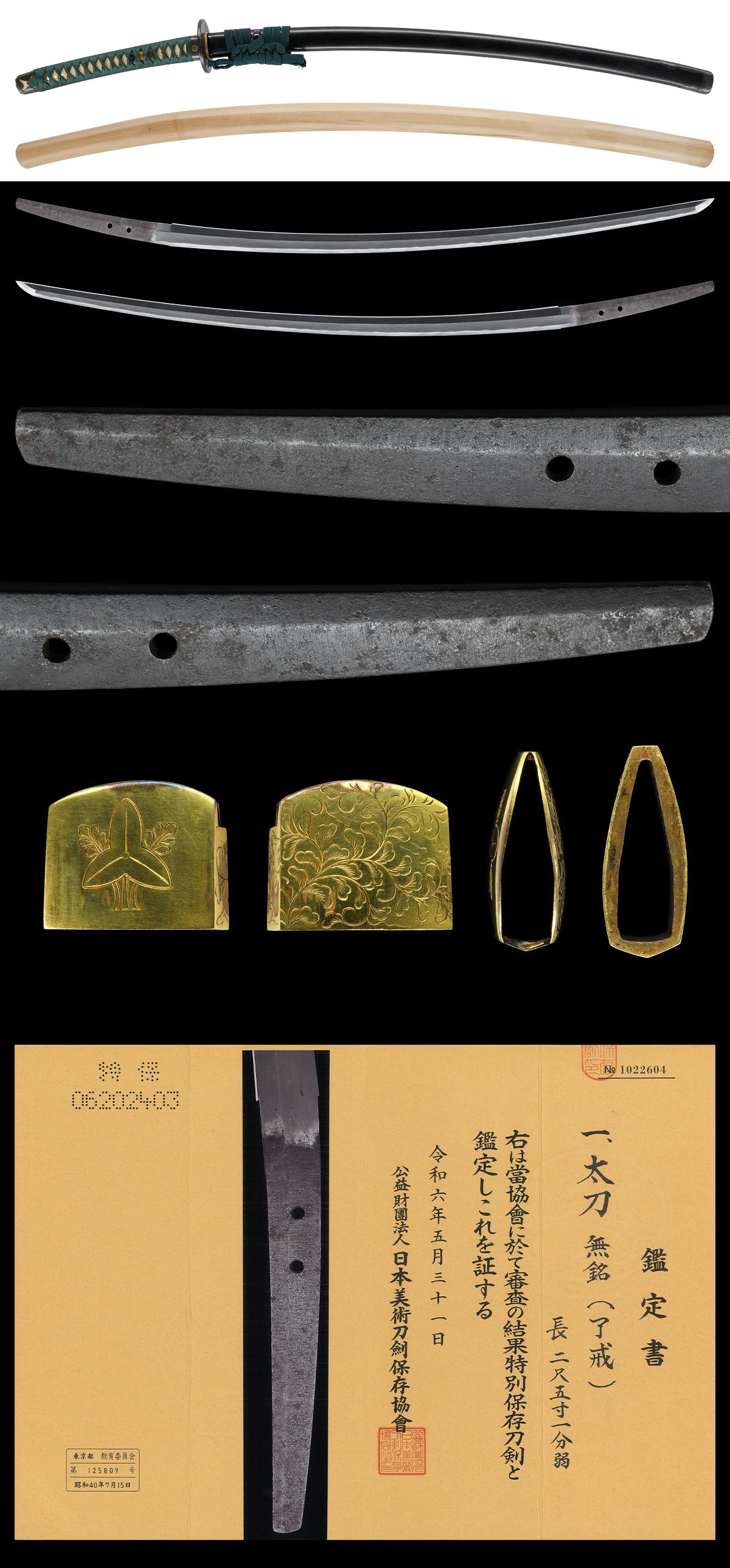
Ryokai (Yamashiro) · Yamashiro · around 1288-1305
Fujishiro Jo saku · Tōken Taikan top 14%
2 pieces on the market now
Ryōkai of Yamashiro Province founded the Ryōkai school, one of the Rai offshoots of the late Kamakura capital, and worked in the same years as Rai Kunitoshi: his surviving dated blades carry the era names Shōō, Einin, Kagen and Engen. The old account makes him a son or a pupil of Rai Kunitoshi, but the published sources note that the dated pieces place him almost level with Kunitoshi, so that he reads more naturally as a fellow disciple (aitedeshi); and if the 'two-character Kunitoshi' and Rai Kunitoshi are taken as different men, Ryōkai would instead be the son of the two-character Kunitoshi. Either way his is the Rai Yamashiro hand softened a degree, and the published record fixes the difference precisely, noting that with him 'the ji and ha can feel somewhat less forceful'[[c:1]] than Kunitoshi's. He is Jō-saku in Fujishiro's grading, the head from whom the Ryōkai line descends.
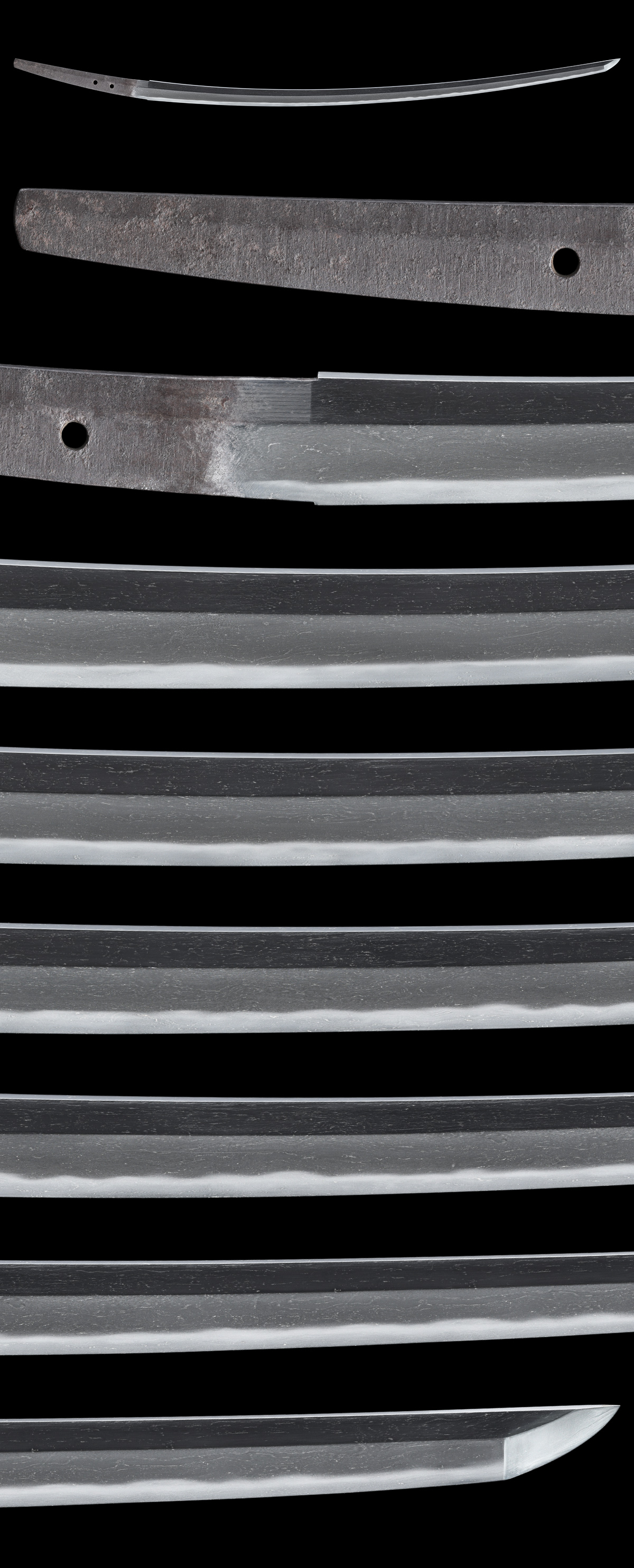
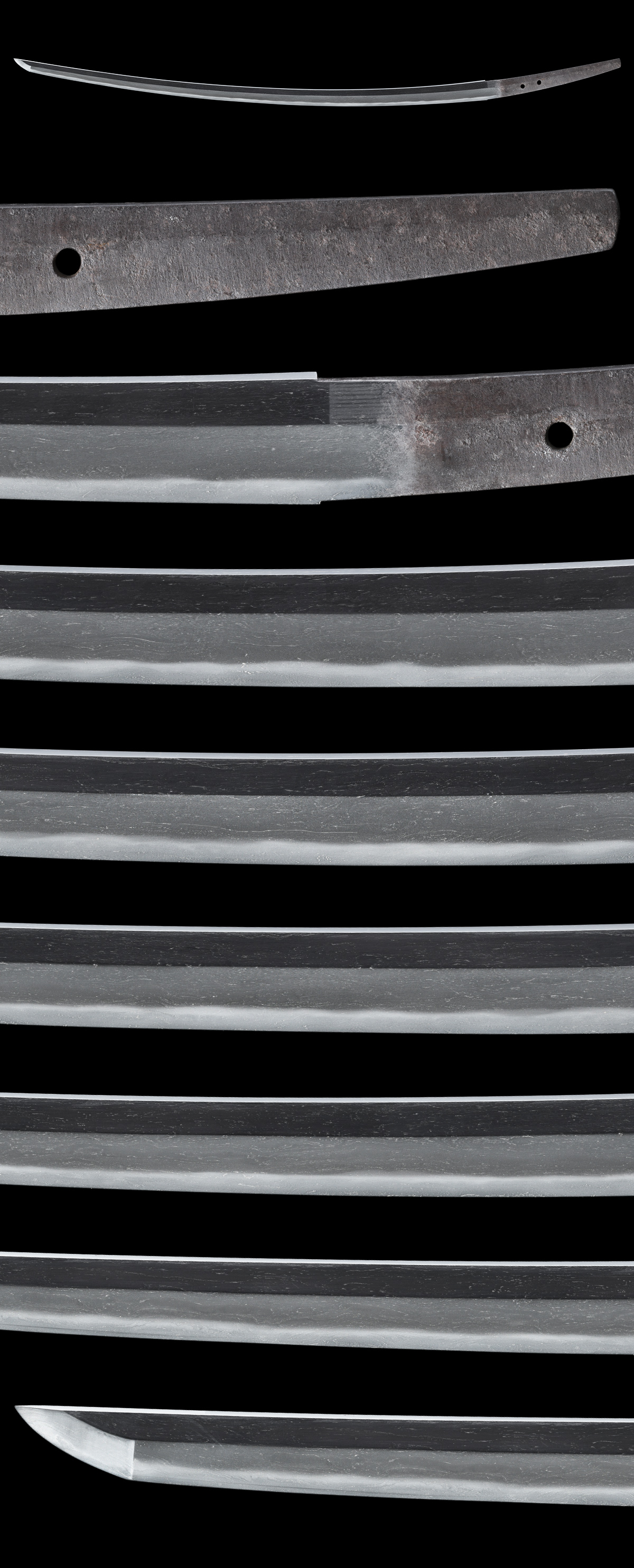
The hand the published descriptions assign him is a quiet one. Over a packed itame or ko-itame, often flowing toward masame and standing a little open, fine ji-nie adheres thickly and fine chikei enter, and a whitish shirake-utsuri stands in the ji. The temper is a calm chū- or hoso-suguha, mixing here a small ko-chōji, ko-gunome or ko-midare, with ko-ashi and yō entering, sometimes a Kyoto-style reverse ashi along the edge. Its distinguishing mark is the nioiguchi: it tightens and grows austere, and in places clouds into urumi, that moist, soft quality the published sources name again and again as a Ryōkai point. The judges set the contrast with the parent Rai exactly, writing that compared with Kunitoshi 'the nioiguchi is one degree tighter and the activity within the temper lonelier, breaking in places into urumi'[[c:2]]. The boshi closes sugu into a ko-maru, often brushed with a little hakikake.
The ji is where the school turns from Rai toward Yamato. The forging carries masame mixed into the itame, the published record observing that the jihada 'shows more masame tendency than in Rai Kunitoshi' and takes on a whitish cast, and the shirake-utsuri that rises with it is the first thing that separates a Ryōkai blade from its parent: where Rai keeps a clear, bright midare- or jifu-utsuri, Ryōkai stands a paler, drier shirake. On the finest tachi the steel shows ko-itame in a piled manner with chikei and a faint jifu-utsuri, the Kyoto refinement still legible beneath the school's drift; on the plainer katana the grain flows openly toward masame and the utsuri whitens further. Fine kinsuji and sunagashi run within a tight, bright nioiguchi, faint hotsure and kuichigai-ba fray the habuchi, and the boshi keeps to its ko-maru.
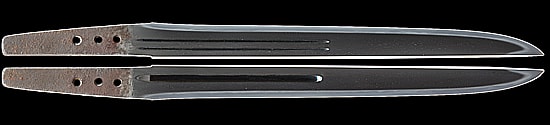
His work survives in two registers of the one manner. The signed pieces are slender ubu tachi and tantō, the mei a boldly cut two-character Ryō-kai set toward the mune above the first mekugi-ana; the tachi keep a high koshizori toward a small kissaki, the tantō run in uchizori with a thick kasane, the typical late-Kamakura Kyoto tantō, several carved with bonji and suken on the omote and gomabashi on the ura. Of one such tantō the published sources write that, complete in every part, it is 'altogether elegant'[[c:3]], a work that 'may well be called a representative work of Ryōkai'[[c:4]], adding that 'the signature too is of the archetypal type'[[c:5]]. The second register, and the bulk of the designated record, is ōsuriage mumei katana given to him on the hand: the wa-zori and Kyoto air recall Rai at first glance, but the tightening, sinking, clouding nioiguchi, the flowing masame and the shirake settle the attribution to Ryōkai. A small number of collaborative dated blades signed with his son Hisanobu also survive, the work close to the father's suguha, signed examples of the son being very rare.
The distinction the judges draw most often is the one against Rai itself, for the school stands so close to its parent that the two are confused at sight. The published record states it plainly: Ryōkai 'is often mistaken for Rai Kunitoshi'[[c:6]], the attribution then settled not by any single feature but by the softer ji and ha, the masame in the jihada, the whitish utsuri and the clouding line, since 'the nioiguchi has an urumi quality, and the ji carries more masame than Rai Kunitoshi'[[c:7]]. His own grounded tells separate him from the sister Enju school as cleanly: where Enju turns the boshi in a large, deep o-maru, Ryōkai closes sugu into a small ko-maru, and his suguha clouds into the urumi that Enju leaves bright. Downstream the Ryōkai name ran for several generations, his son Ryō Hisanobu next, and by the Nanbokuchō and Muromachi eras a Kyushu branch had formed, the Chikushi Ryōkai of Bungo and Buzen descended from the Kyoto line.
Ryōkai is a smith of real standing whose designated work can still be encountered, though sparingly. Of his blades on the official record, two are Important Cultural Properties, among them the famed Akita Ryōkai tantō; four are Tokubetsu Jūyō and eighty-three Jūyō, eighty-seven across the Tokujū and Jūyō tiers. The Important Cultural Properties are patrimony, held and studied rather than traded, and most of the designated blades, signed or attributed, are kept in long-held public and private collections, among them the Tokyo National Museum, the Sano Art Museum and Monobe Jinja, with prewar Jūyō-Bijutsuhin pieces recorded against the Maeda and other houses. One tachi preserves a tradition that it was 'a sword worn by Miyamoto Musashi'[[c:8]], and his blades pass through the Isahaya, Date and Maeda families. Of the works whose whereabouts are recorded, only the Tokubetsu Jūyō and Jūyō tier reaches the market, and then rarely; a signed ubu Ryōkai tachi or tantō in particular is among the scarcer things a collector of Kyoto Kamakura work will meet, coming to hand only with patience.
Where Ryokai stands among comparable artisans: across all of nihontō, and within tradition, era, and period. The tiers (Foremost · Leading · Major · Notable) weigh official designations from the NBTHK and Japan's Agency for Cultural Affairs, together with historical honors of lasting repute such as the Sansaku and Meibutsu-chō.
Select a lens to see how it's measured.
Years he was demonstrably active, proven by signed-and-dated blades
Yamashiro-den · Yamashiro
13 pieces on the market now
The Ryokai school (了戒) took shape in the late-Kamakura capital of Kyoto, in Yamashiro Province, around the smith Ryokai, who worked through the era names Shoo, Einin, Kagen, Enkyo and Ocho at the turn of the fourteenth century. The old account makes him a son or a pupil of Rai Kunitoshi, and one version has him adopted into Kunitoshi's house; because his dated blades place him almost level with Kunitoshi, however, the NBTHK reads him more naturally as a contemporary (an aitedeshi, a fellow disciple) who formed his own line within the wider Rai circle. Learn more →
| Smith | Era | Designated |
|---|---|---|
| Ryokai了戒 | 1288-1305 | 97 |
| Hisanobu久信 | 1304-1308 | 5 |
| Nobuyoshi宣能 | 1444-1449 | 0 |
| Sadayoshi定能 | 1469-1487 | 0 |
| Nobumasa信正 | 1390-1394 | 0 |
A Hozon-certified blade judged to show notably superior workmanship and a better state of preservation. The bar is higher: re-tempered blades and most unsigned Muromachi/Edo works are excluded.
The NBTHK (Nihon Bijutsu Tōken Hozon Kyōkai, the Society for the Preservation of Japanese Art Swords) is a public-interest incorporated foundation founded in 1948 and supervised by Japan’s Agency for Cultural Affairs (Bunkachō); it is based at the Japanese Sword Museum in Tokyo. Its expert panels physically examine each submitted work (shinsa) and issue a certificate (kanteishō) ranking it by artistic and historical merit. NBTHK papers are the most widely recognized standard of authentication for Japanese swords and fittings.
NBTHK official siteNo cooling-off period or returns; refund only if the purchased sword is proven fake, capped at purchase price (excludes commission sales, accessories, auction items).
This is a Tachi attributed to Ryokai, a smith of the Rai school from Yamashiro province, active during the late Kamakura period (around 1293). It features a healthy and elegant form with a deep curve and rich niku. The blade comes with a gold-plated habaki, shirasaya, and a black ishime-ji nuri hantachi koshirae, and is accompanied by an NBTHK Tokubetsu Hozon Token certificate.
NihontoWatchBETAmumei · Rai · Kamakura · nagasa 76cm · sori 3cm
Ryokai (Yamashiro) · Yamashiro · around 1288-1305
Fujishiro Jo saku · Tōken Taikan top 14%
2 pieces on the market now
Ryōkai of Yamashiro Province founded the Ryōkai school, one of the Rai offshoots of the late Kamakura capital, and worked in the same years as Rai Kunitoshi: his surviving dated blades carry the era names Shōō, Einin, Kagen and Engen. The old account makes him a son or a pupil of Rai Kunitoshi, but the published sources note that the dated pieces place him almost level with Kunitoshi, so that he reads more naturally as a fellow disciple (aitedeshi); and if the 'two-character Kunitoshi' and Rai Kunitoshi are taken as different men, Ryōkai would instead be the son of the two-character Kunitoshi. Either way his is the Rai Yamashiro hand softened a degree, and the published record fixes the difference precisely, noting that with him 'the ji and ha can feel somewhat less forceful'[[c:1]] than Kunitoshi's. He is Jō-saku in Fujishiro's grading, the head from whom the Ryōkai line descends.
The hand the published descriptions assign him is a quiet one. Over a packed itame or ko-itame, often flowing toward masame and standing a little open, fine ji-nie adheres thickly and fine chikei enter, and a whitish shirake-utsuri stands in the ji. The temper is a calm chū- or hoso-suguha, mixing here a small ko-chōji, ko-gunome or ko-midare, with ko-ashi and yō entering, sometimes a Kyoto-style reverse ashi along the edge. Its distinguishing mark is the nioiguchi: it tightens and grows austere, and in places clouds into urumi, that moist, soft quality the published sources name again and again as a Ryōkai point. The judges set the contrast with the parent Rai exactly, writing that compared with Kunitoshi 'the nioiguchi is one degree tighter and the activity within the temper lonelier, breaking in places into urumi'[[c:2]]. The boshi closes sugu into a ko-maru, often brushed with a little hakikake.
The ji is where the school turns from Rai toward Yamato. The forging carries masame mixed into the itame, the published record observing that the jihada 'shows more masame tendency than in Rai Kunitoshi' and takes on a whitish cast, and the shirake-utsuri that rises with it is the first thing that separates a Ryōkai blade from its parent: where Rai keeps a clear, bright midare- or jifu-utsuri, Ryōkai stands a paler, drier shirake. On the finest tachi the steel shows ko-itame in a piled manner with chikei and a faint jifu-utsuri, the Kyoto refinement still legible beneath the school's drift; on the plainer katana the grain flows openly toward masame and the utsuri whitens further. Fine kinsuji and sunagashi run within a tight, bright nioiguchi, faint hotsure and kuichigai-ba fray the habuchi, and the boshi keeps to its ko-maru.
His work survives in two registers of the one manner. The signed pieces are slender ubu tachi and tantō, the mei a boldly cut two-character Ryō-kai set toward the mune above the first mekugi-ana; the tachi keep a high koshizori toward a small kissaki, the tantō run in uchizori with a thick kasane, the typical late-Kamakura Kyoto tantō, several carved with bonji and suken on the omote and gomabashi on the ura. Of one such tantō the published sources write that, complete in every part, it is 'altogether elegant'[[c:3]], a work that 'may well be called a representative work of Ryōkai'[[c:4]], adding that 'the signature too is of the archetypal type'[[c:5]]. The second register, and the bulk of the designated record, is ōsuriage mumei katana given to him on the hand: the wa-zori and Kyoto air recall Rai at first glance, but the tightening, sinking, clouding nioiguchi, the flowing masame and the shirake settle the attribution to Ryōkai. A small number of collaborative dated blades signed with his son Hisanobu also survive, the work close to the father's suguha, signed examples of the son being very rare.
The distinction the judges draw most often is the one against Rai itself, for the school stands so close to its parent that the two are confused at sight. The published record states it plainly: Ryōkai 'is often mistaken for Rai Kunitoshi'[[c:6]], the attribution then settled not by any single feature but by the softer ji and ha, the masame in the jihada, the whitish utsuri and the clouding line, since 'the nioiguchi has an urumi quality, and the ji carries more masame than Rai Kunitoshi'[[c:7]]. His own grounded tells separate him from the sister Enju school as cleanly: where Enju turns the boshi in a large, deep o-maru, Ryōkai closes sugu into a small ko-maru, and his suguha clouds into the urumi that Enju leaves bright. Downstream the Ryōkai name ran for several generations, his son Ryō Hisanobu next, and by the Nanbokuchō and Muromachi eras a Kyushu branch had formed, the Chikushi Ryōkai of Bungo and Buzen descended from the Kyoto line.
Ryōkai is a smith of real standing whose designated work can still be encountered, though sparingly. Of his blades on the official record, two are Important Cultural Properties, among them the famed Akita Ryōkai tantō; four are Tokubetsu Jūyō and eighty-three Jūyō, eighty-seven across the Tokujū and Jūyō tiers. The Important Cultural Properties are patrimony, held and studied rather than traded, and most of the designated blades, signed or attributed, are kept in long-held public and private collections, among them the Tokyo National Museum, the Sano Art Museum and Monobe Jinja, with prewar Jūyō-Bijutsuhin pieces recorded against the Maeda and other houses. One tachi preserves a tradition that it was 'a sword worn by Miyamoto Musashi'[[c:8]], and his blades pass through the Isahaya, Date and Maeda families. Of the works whose whereabouts are recorded, only the Tokubetsu Jūyō and Jūyō tier reaches the market, and then rarely; a signed ubu Ryōkai tachi or tantō in particular is among the scarcer things a collector of Kyoto Kamakura work will meet, coming to hand only with patience.
Where Ryokai stands among comparable artisans: across all of nihontō, and within tradition, era, and period. The tiers (Foremost · Leading · Major · Notable) weigh official designations from the NBTHK and Japan's Agency for Cultural Affairs, together with historical honors of lasting repute such as the Sansaku and Meibutsu-chō.
Select a lens to see how it's measured.
Years he was demonstrably active, proven by signed-and-dated blades
Yamashiro-den · Yamashiro
13 pieces on the market now
The Ryokai school (了戒) took shape in the late-Kamakura capital of Kyoto, in Yamashiro Province, around the smith Ryokai, who worked through the era names Shoo, Einin, Kagen, Enkyo and Ocho at the turn of the fourteenth century. The old account makes him a son or a pupil of Rai Kunitoshi, and one version has him adopted into Kunitoshi's house; because his dated blades place him almost level with Kunitoshi, however, the NBTHK reads him more naturally as a contemporary (an aitedeshi, a fellow disciple) who formed his own line within the wider Rai circle. Learn more →
| Smith | Era | Designated |
|---|---|---|
| Ryokai了戒 | 1288-1305 | 97 |
| Hisanobu久信 | 1304-1308 | 5 |
| Nobuyoshi宣能 | 1444-1449 | 0 |
| Sadayoshi定能 | 1469-1487 | 0 |
| Nobumasa信正 | 1390-1394 | 0 |
A Hozon-certified blade judged to show notably superior workmanship and a better state of preservation. The bar is higher: re-tempered blades and most unsigned Muromachi/Edo works are excluded.
The NBTHK (Nihon Bijutsu Tōken Hozon Kyōkai, the Society for the Preservation of Japanese Art Swords) is a public-interest incorporated foundation founded in 1948 and supervised by Japan’s Agency for Cultural Affairs (Bunkachō); it is based at the Japanese Sword Museum in Tokyo. Its expert panels physically examine each submitted work (shinsa) and issue a certificate (kanteishō) ranking it by artistic and historical merit. NBTHK papers are the most widely recognized standard of authentication for Japanese swords and fittings.
NBTHK official siteNo cooling-off period or returns; refund only if the purchased sword is proven fake, capped at purchase price (excludes commission sales, accessories, auction items).