NihontoWatch Mon

NihontoWatch

Market
Encyclopedia
Kantei
NihontoWatch Mon

NihontoWatch

Market
Encyclopedia
Kantei

Description

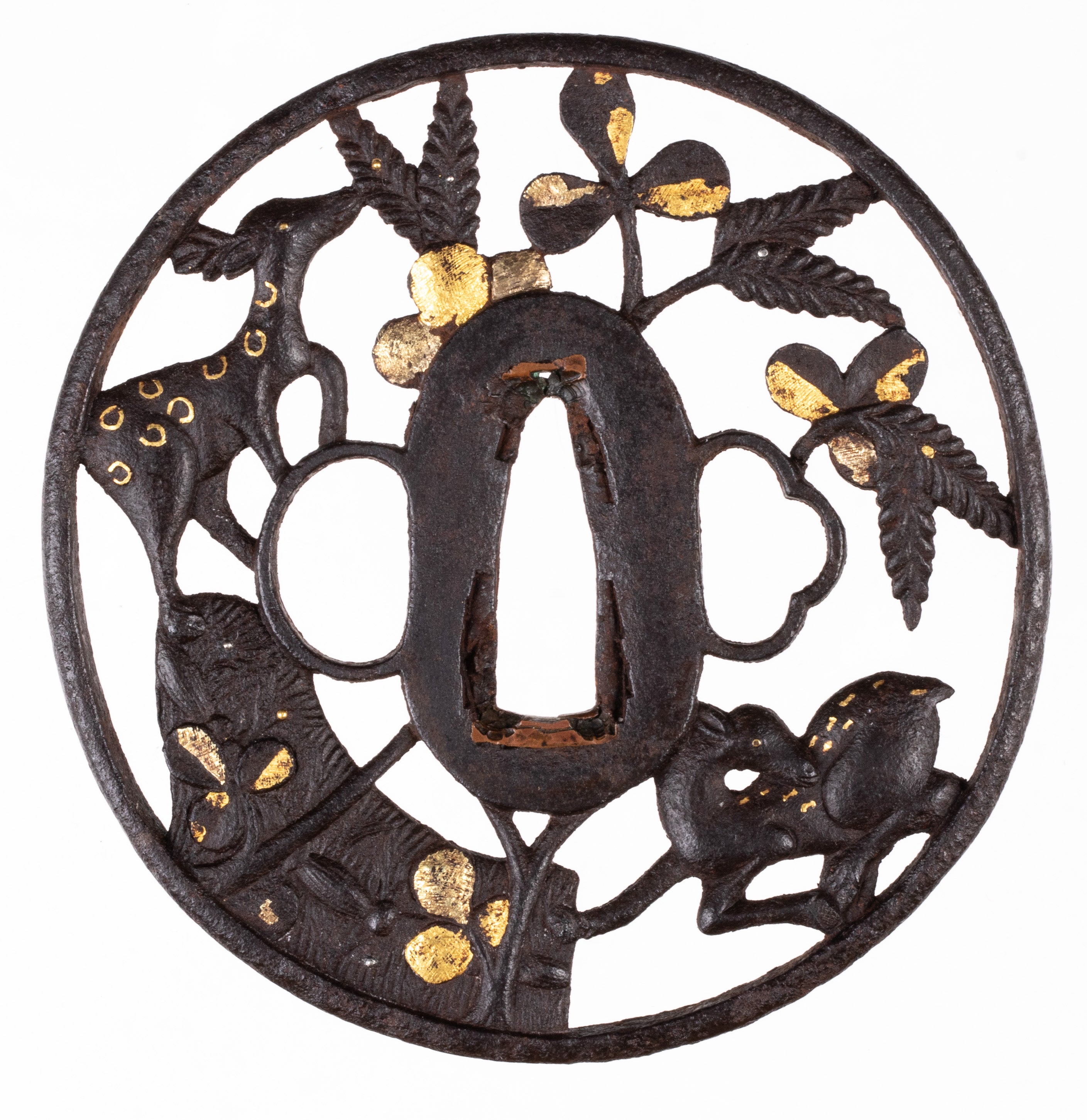
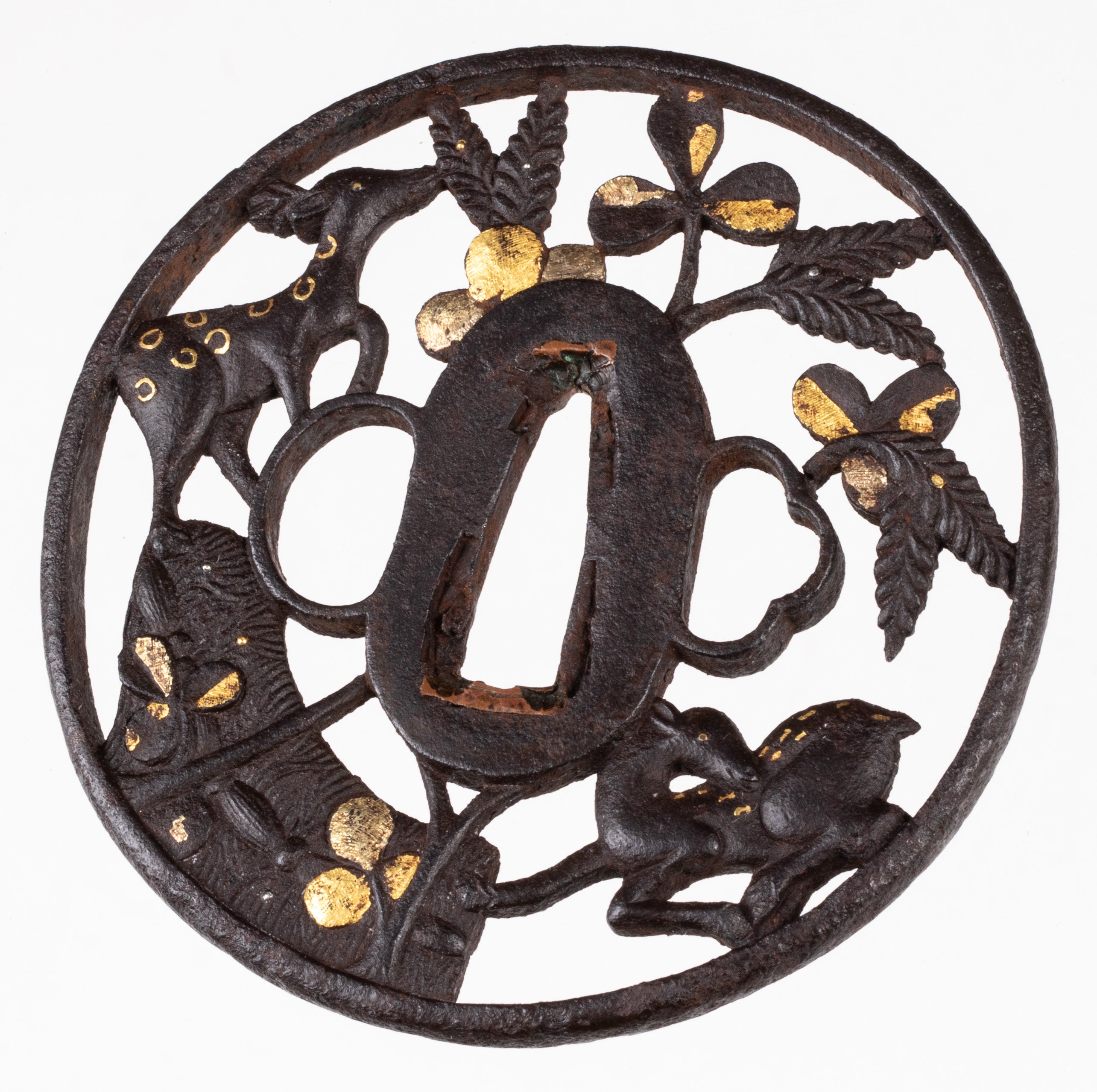
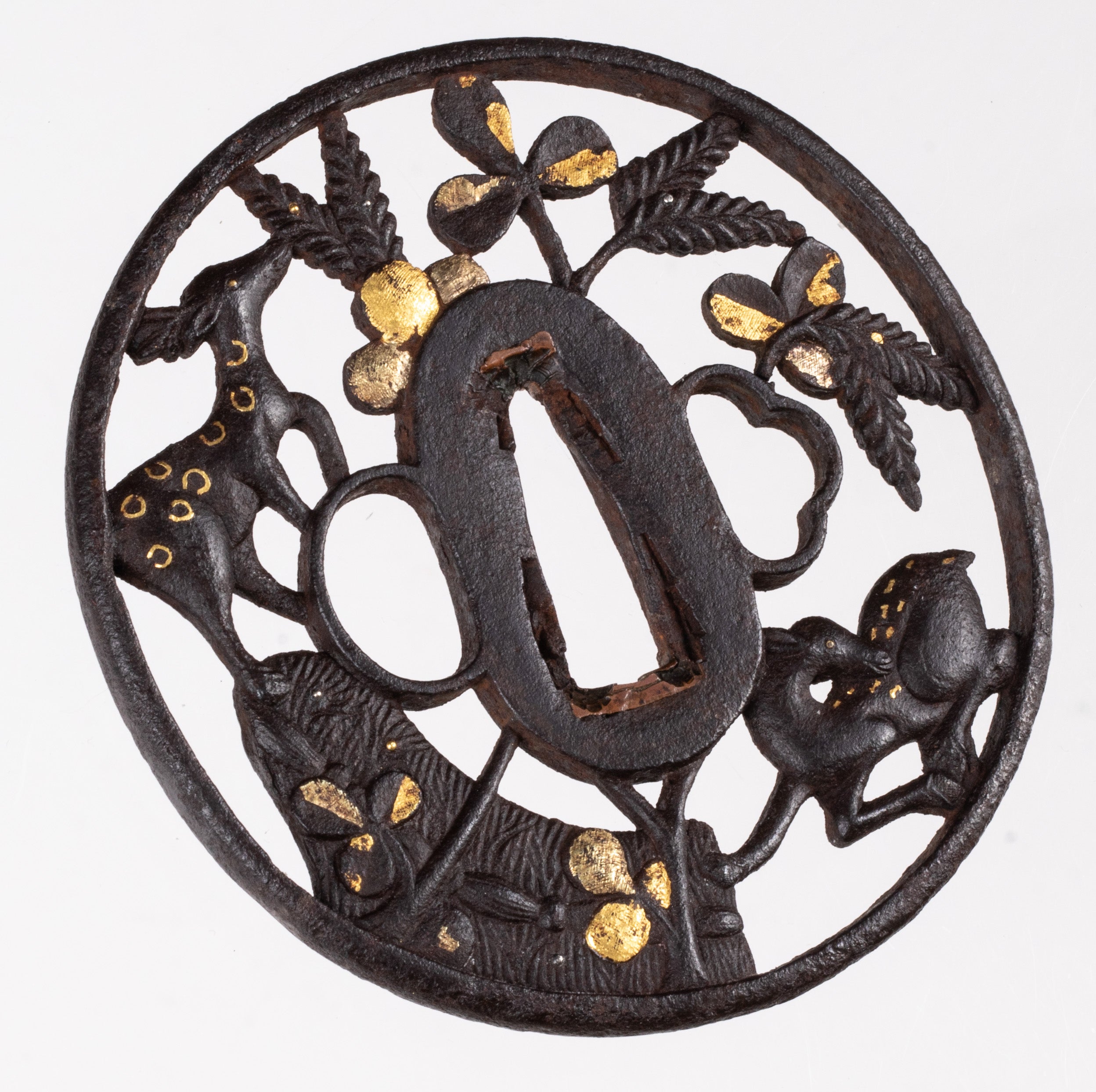
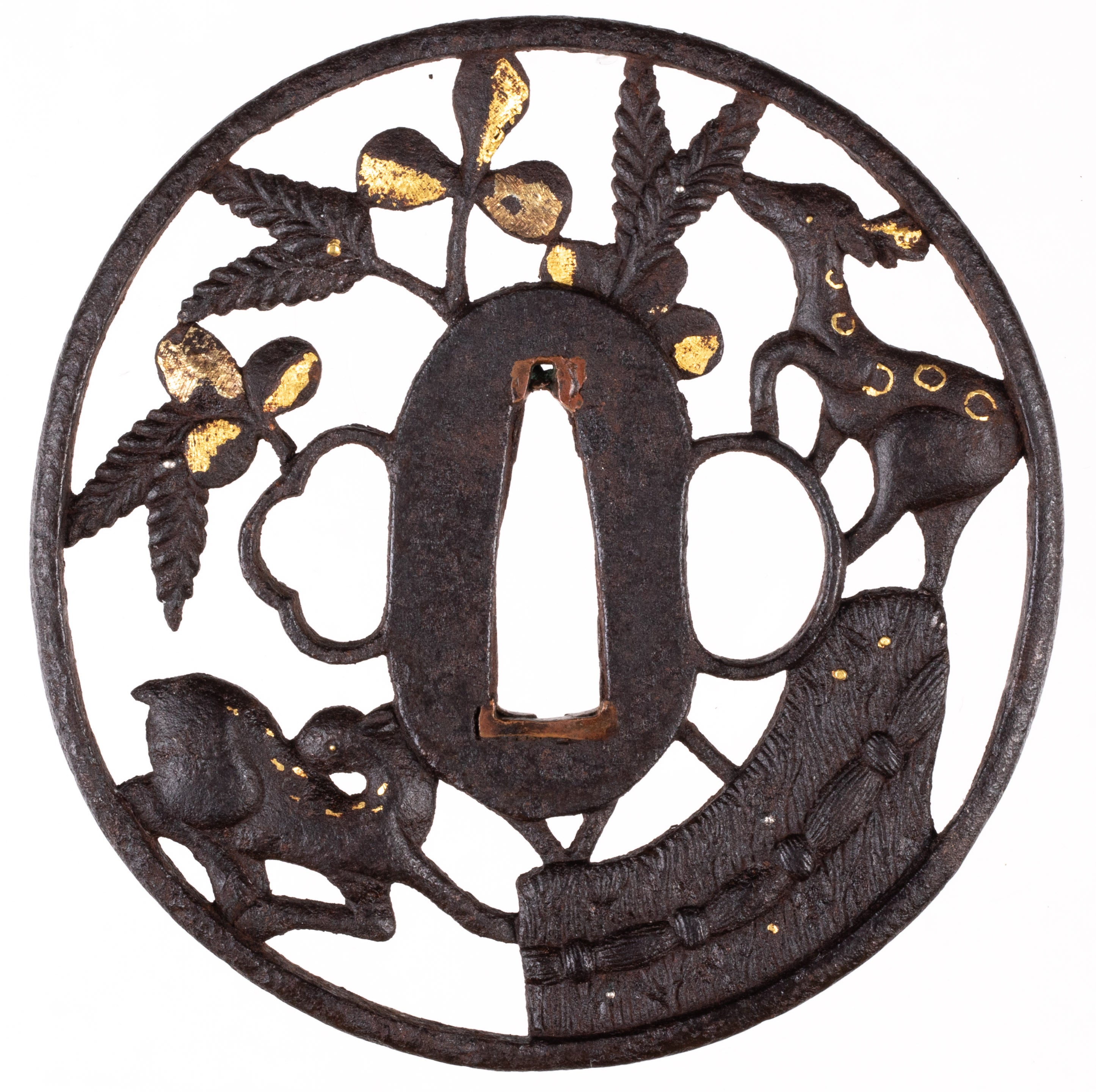
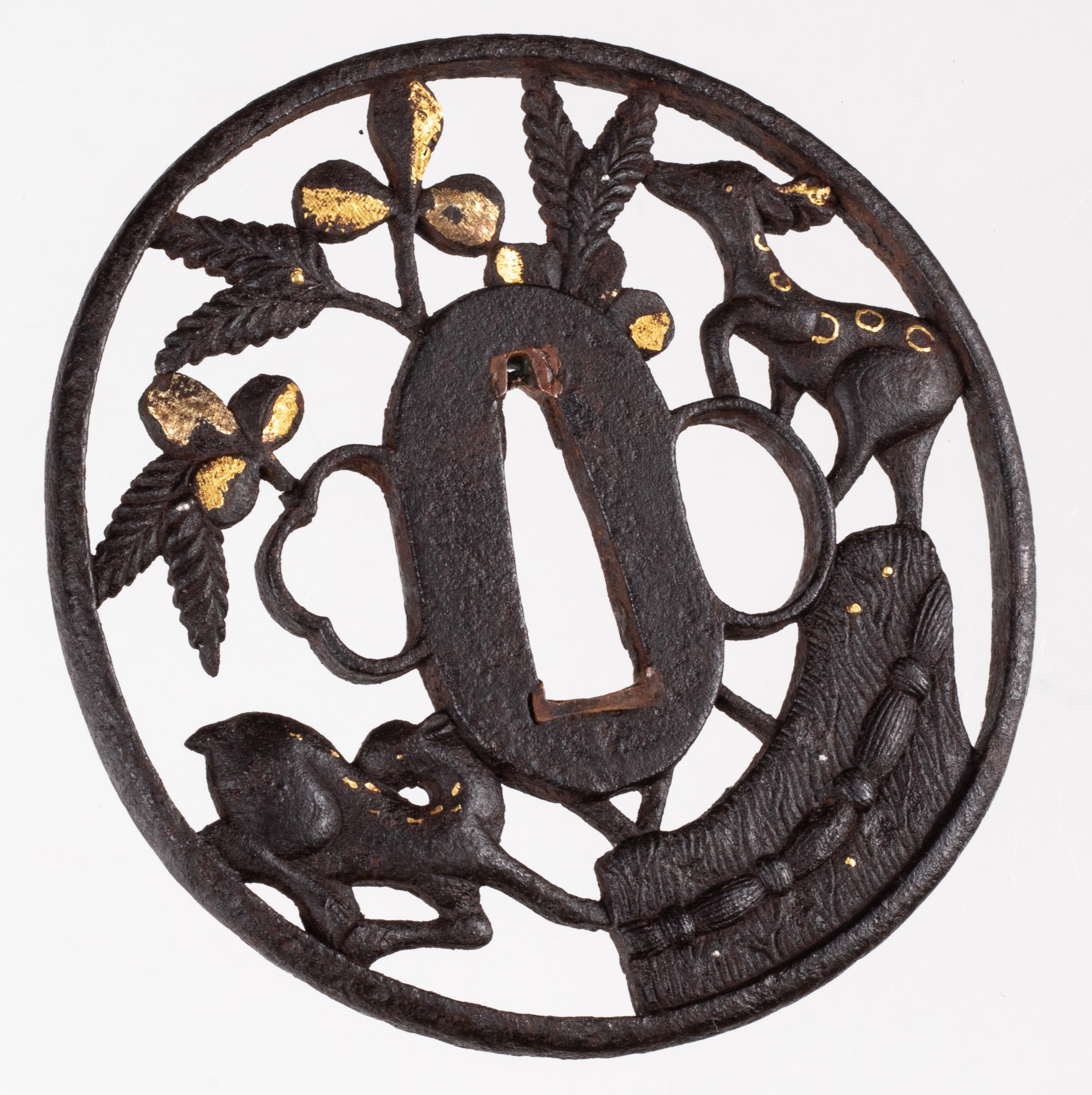
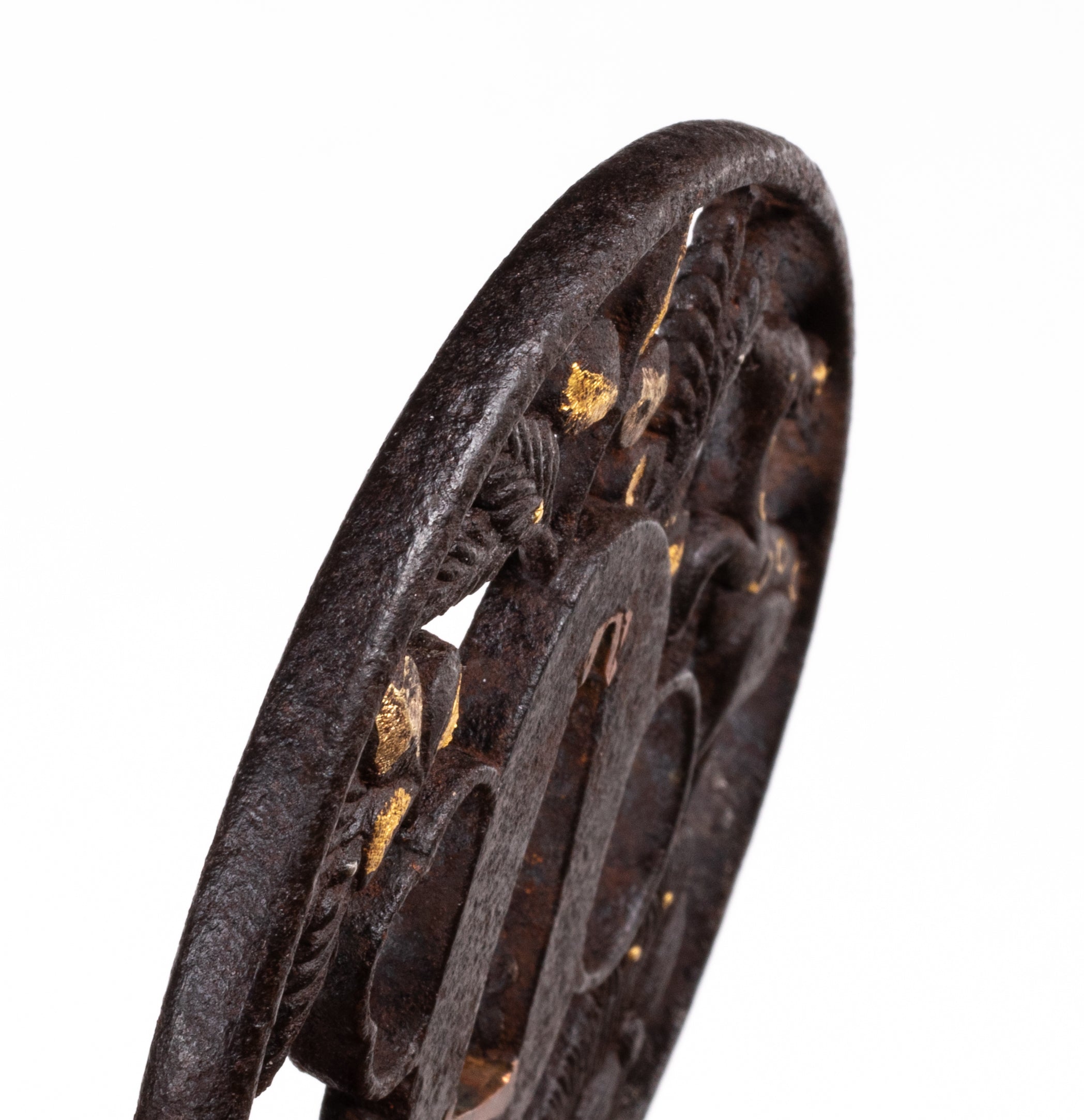
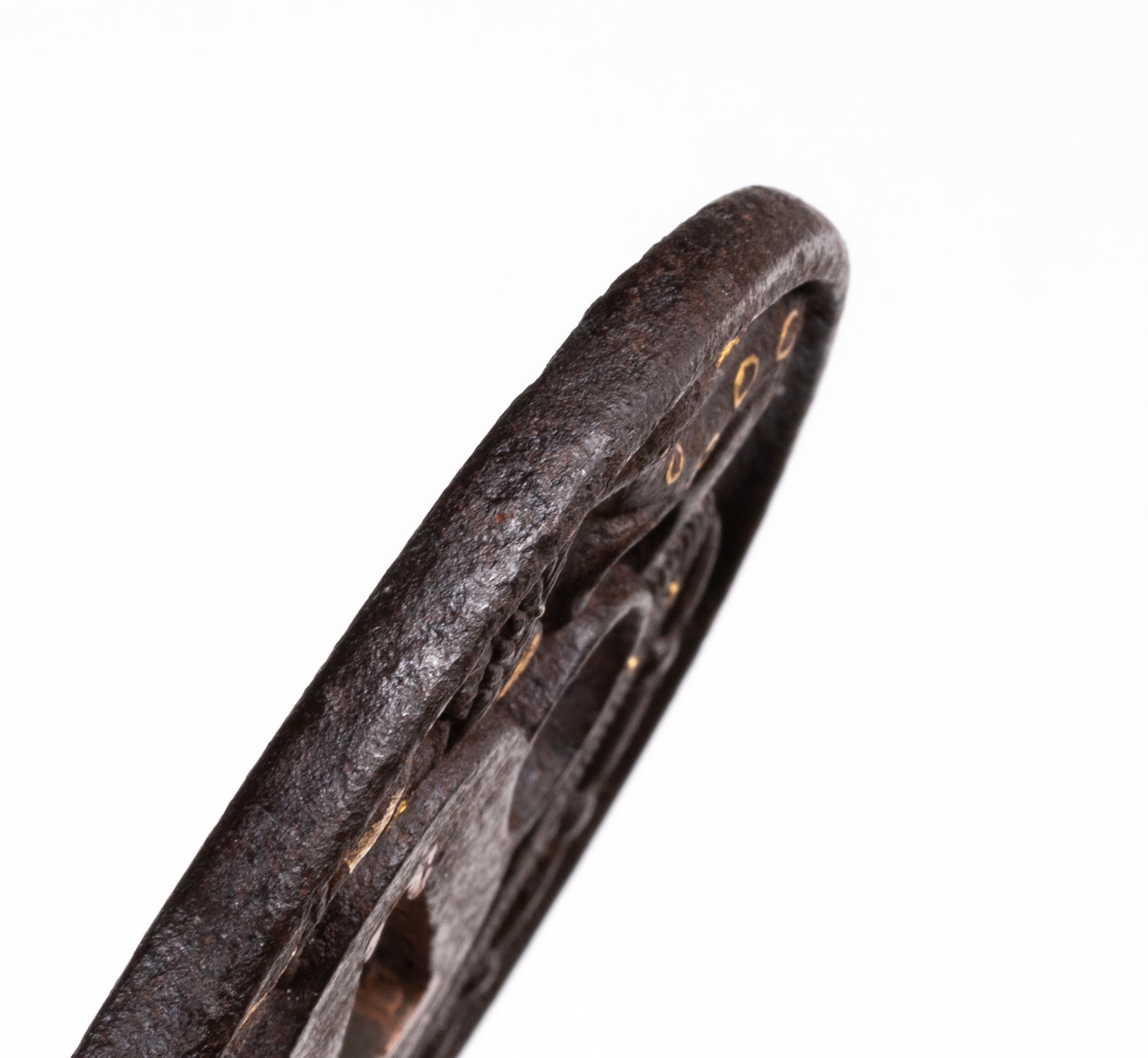
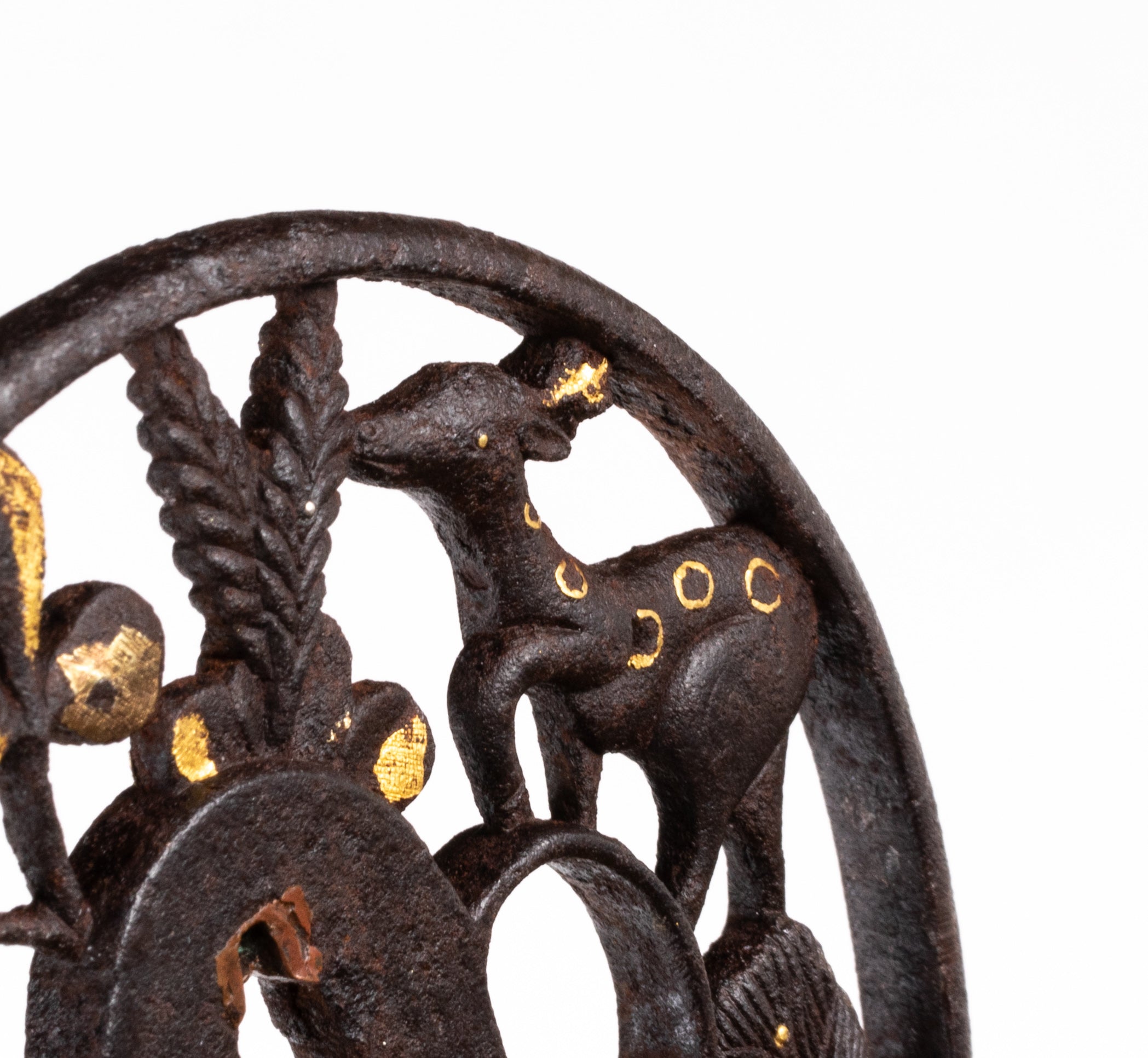
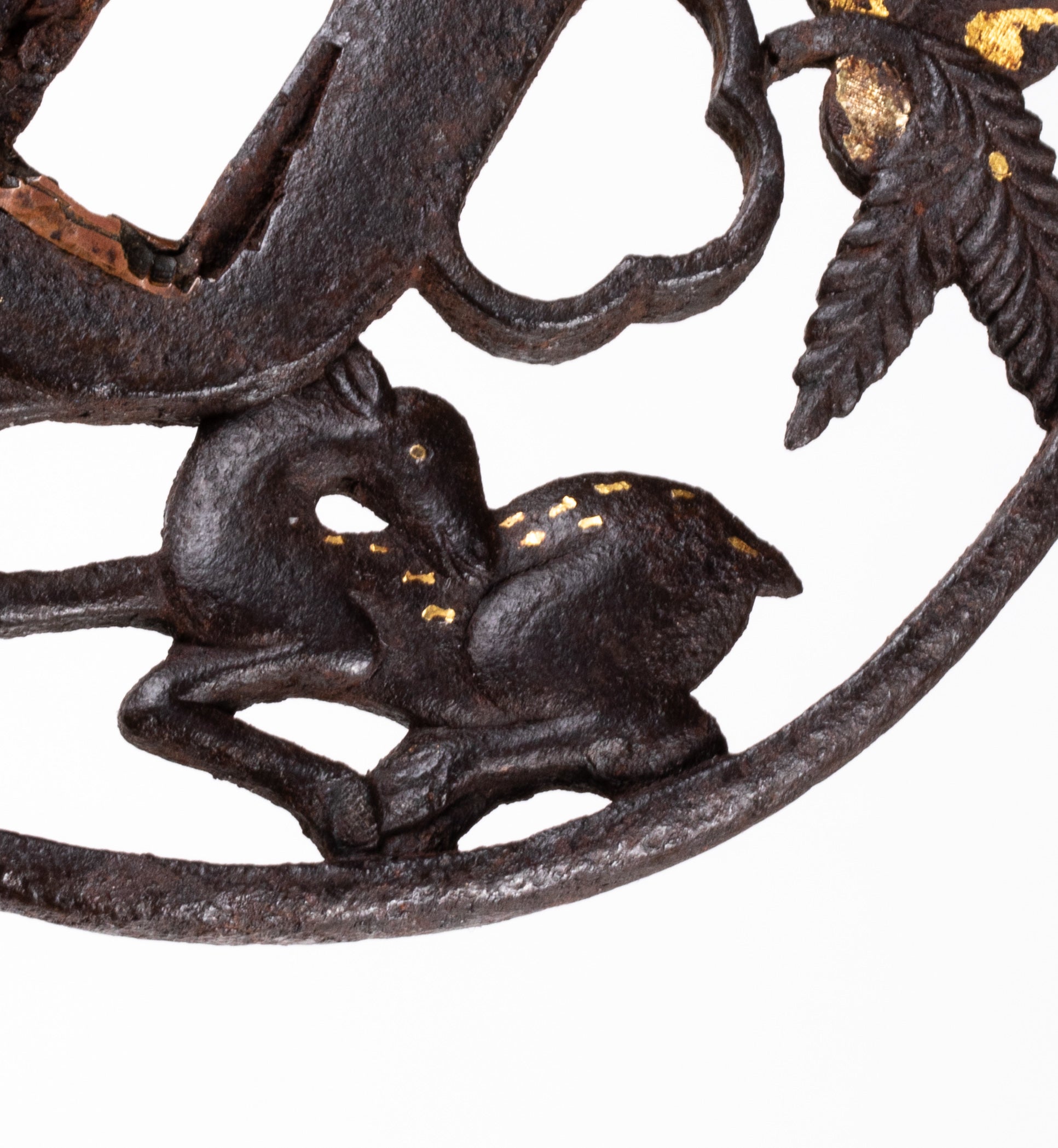
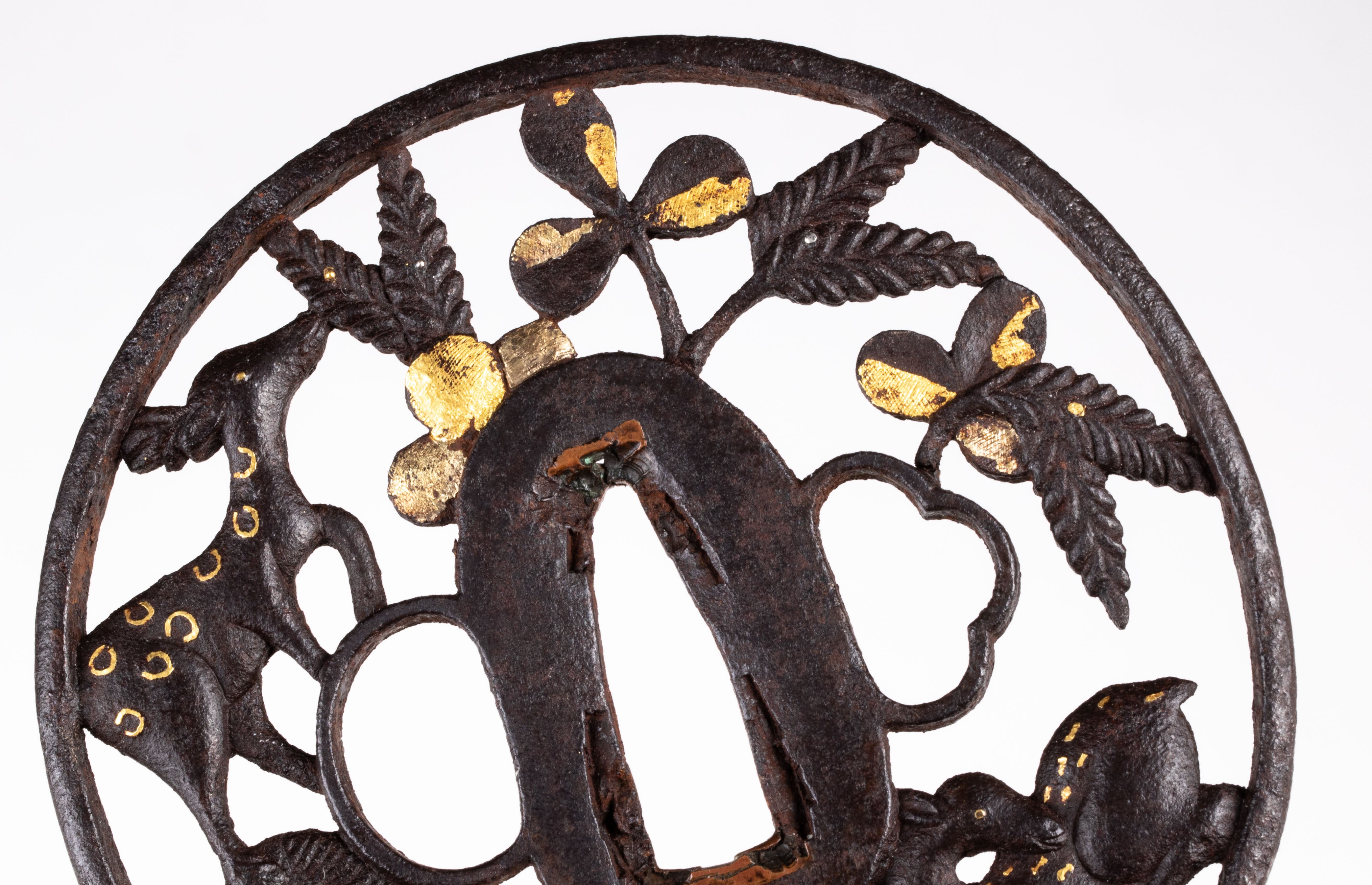
This is an iron Kyo-Shoami tsuba featuring a design of two deers and bush clover, enhanced with gold and silver inlay. It dates to the early Edo period and measures 8.3 cm x 8.1 cm x 0.5 cm. A very similar tsuba is referenced in 'Tosogu Classroom vol. 1' by Fukushi Shigeo, plate nr. 50 on page 159.

NihontoWatch MonNihontoWatch
MarketEncyclopediaKantei
Fittings›Shoami›Kyo-Shoami›Kyo-Shoami Tsuba decorated with two deers and bush clover
tsuba
Shoami School

Kyo-Shoami Tsuba decorated with two deers and bush clover

mumei · Kyo-Shoami · Edo

SOLD
Shoami School — 1 of 10
Shoami School — 2 of 10
Shoami School — 3 of 10
Shoami School — 4 of 10
Shoami School — 5 of 10
Shoami School — 6 of 10
Shoami School — 7 of 10
Shoami School — 8 of 10
Shoami School — 9 of 10
Shoami School — 10 of 10
1 / 10
1 / 10
Shoami School — 1 of 10Shoami School — 2 of 10Shoami School — 3 of 10Shoami School — 4 of 10Shoami School — 5 of 10Shoami School — 6 of 10Shoami School — 7 of 10Shoami School — 8 of 10Shoami School — 9 of 10Shoami School — 10 of 10
Measurements & details
Maker

Shoami School

Era

Edo

Signature

Unsigned

Description

This is an iron Kyo-Shoami tsuba featuring a design of two deers and bush clover, enhanced with gold and silver inlay. It dates to the early Edo period and measures 8.3 cm x 8.1 cm x 0.5 cm. A very similar tsuba is referenced in 'Tosogu Classroom vol. 1' by Fukushi Shigeo, plate nr. 50 on page 159.

About the school

Shoami

正阿弥

Iron-tsuba · Kyoto

190 pieces on the market now

›

The Shoami (正阿弥) school arose in Kyoto as one of the principal lineages among the specialist tsuba makers who came to the fore from the middle through the late Muromachi period. Its roots lie in the capital's communities of ami-shū, who served as dōbōshū (attendant artisans) and within whose circles Shōami lineages existed; the prevailing view today is that these artisans originally worked as makers of tōsōgu in general and later became specialized tsuba craftsmen. Works of this early Kyoto phase are customarily referred to as Ko-Shōami ("Old Shōami") — a corpus without widely celebrated signed masterpieces, yet one that defines the school's foundation. In the Momoyama period the group prospered in Kyoto: the maker Hikojūrō, whose tachi tsuba and ō-seppa bear the date Keichō 8 (1603), belonged to this flourishing. Entering the Edo period, the school's craftsmen migrated and formed flourishing offshoots in many regions — chief among them, in the setsumei, the Akita Shōami, founded in effect by Denbei Shigeyoshi, an officially retained artisan of the Satake lords from Enpō 3 (1675) whose main line continued through Dennai Shigetaka, Denshichi Shigetsune, and Kakitsu Shigeō, and the Okayama Shōami, whose Tōshirō (Fujishirō) house served the Ikeda domain into the nineteenth century. Surveying the style of works termed Ko-Shōami, the usual practice is to pierce the iron plate with openwork carving and then apply nunome-zōgan (textile-pattern inlay) in gold, silver, and other metals. Characteristic are thin, well-forged plates of polished ground (migaki-ji) with daring large openwork — paired square seals, namako apertures, four-petaled flowers, diamond clouds with warabite — enlivened by hizashi-yasuri ("sun-ray" file marks) with shakudō inlay, rope-pattern silver inlay on the rim, or linked thunder-pattern (raimon-tsunagi) gold nunome-zōgan. The school equally commanded the formal soft-metal idiom: tachi fittings and itomaki tachi koshirae suites associated with Hikojūrō, Chōemon, and the Akita master Rokumi are executed in shakudō nanako-ji with family crests scattered in gold iroe.

The regional branches developed distinct vocabularies. Shōami Denbei — born in Shōnai in Keian 4 (1651), trained in Edo under Shōami Yoshinaga, and Akita's foremost metalworker — rendered local subjects such as Akita's famed butterbur (fuki) and cloud-and-dragon themes in nikubori ji-sukashi with inlay, produced guri-bori achieving effects reminiscent of lacquer tsuishu, and deployed line inlay, nunome-zōgan, and gold cloisonné inlay entirely identical to the methods of the main Hirata lineage. In Okayama, Shōami Katsuyoshi united weighty takabori with painstakingly meticulous inlay in gold, silver, shakudō, suaka, and shibuichi, absorbing aspects of Gotō Ichijō's manner through his elder brother Katsuzane. The setsumei attest the school's standing at the highest levels of warrior culture: Ko-Shōami guards grace mountings transmitted in the Higo Hosokawa family and the "Great Tokugawa" house, a Higo koshirae modeled on the "Nobunaga koshirae," and the personal mounting of Terao Nobuyuki, senior disciple of Miyamoto Musashi. Dated works — Hikojūrō's Keichō 8 set, judged of exceptionally high documentary value for the advancement of Shōami studies, and Rokumi's guard of Tenmei 2 (1782) — anchor the school's chronology. Denbei's work is praised as conveying the well-practiced hand of traditions inherited from the Shōami forebears, adding elegance to the ideal of practical beauty, while the narrative guards of Denshichi and Shigeteru sustained the Akita line's assured composition and carving under Satake patronage. The tradition closed with Katsuyoshi, ninth head of the Okayama Shōami, who ceased making sword fittings upon the Haitōrei of Meiji 9 (1876); masterpieces such as his Jikokuten guard and the Naniwa-gata uta-e tsuba carved in his seventy-third year stand among the summits of late metalwork, securing this widespread network — to which perhaps a tenth of all surviving tsuba is attributed — an enduring place in the tosogu canon. Learn more →

11 recorded smiths42 designated works
Leading smiths
SmithEraDesignated
Denbei傳兵衛—13
Shoami Katsuyoshi正阿弥勝義—7
Matashichi又七—0
Yoshikazu吉一—0
Jihachiro治八郎—0
Explore the Shoami school →
Warning — certificate not found

We could not find an authenticity certificate on the seller’s listing. Japanese swords and fittings are normally papered by the NBTHK (or the NTHK). Without one, the attribution is the seller’s own assessment and has not been independently verified — treat it with caution and ask the dealer about certification before buying.

Seller
S
Soryu
🇵🇱Ships from Poland
›
✓Verified dealersoryu.pl
✓Ships worldwide✓English supportCredit card
Return policy

30-day refund policy. Items must be returned in original condition and packaging; customized products are non-returnable. 2-week inspection window with full item refund (shipping costs non-refundable). Customer pays return shipping.

View all of Soryu’s listings→View this item on the dealer’s site→

Previously sold — Shoami School

View all →
Yamasiroya
Hozon
Tsuba - Hozon - by Shoami School - Oumi Landscape - Ikkou (Shoami)Tsuba - Hozon - by Shoami School - Oumi Landscape - Ikkou (Shoami)
Sold

Tsuba

ByShoami School
SOLD
Toushin
Tokuho
Tsuba - Tokuho - by Shoami School - Daisho Tsuba: Unsigned (Aizu Shoami) - Rice Planting SceneTsuba - Tokuho - by Shoami School - Daisho Tsuba: Unsigned (Aizu Shoami) - Rice Planting Scene
Sold

Tsuba

ByShoami School
SOLD
Choshuya
Tokuho
Tsuba - Tokuho - by Shoami School - Sacred Beast Design, Signed Nagayo (Gold Seal)Tsuba - Tokuho - by Shoami School - Sacred Beast Design, Signed Nagayo (Gold Seal)
Sold

Tsuba

ByShoami School
SOLD
Japanese Sword Books and Tsuba
Tsuba - by Shoami School - Iron Sukashi Tsuba, Kyo ShoamiTsuba - by Shoami School - Iron Sukashi Tsuba, Kyo Shoami
Sold

Tsuba

ByShoami School
SOLD
Soryu
Hozon
Fuchi-Kashira - Hozon - by Shoami School - Fuchi-Kashira: Issho Nakagawa Katsuyoshi - Plum and Nightingale with NBTHK Hozon TosoguFuchi-Kashira - Hozon - by Shoami School - Fuchi-Kashira: Issho Nakagawa Katsuyoshi - Plum and Nightingale with NBTHK Hozon Tosogu
Sold

Fuchi-Kashira

ByShoami School
SOLD
Nihonto Art
Hozon
Tsuba - Hozon - by Shoami School - Aizu Shoami - Horse, Flowers, Cherry Tree, NBTHK HozonTsuba - Hozon - by Shoami School - Aizu Shoami - Horse, Flowers, Cherry Tree, NBTHK Hozon
Sold

Tsuba

ByShoami School
SOLD
Japanese Sword Books and Tsuba
Tsuba - by Shoami School - Ko Shoami Tsuba, Jumbo ShrimpTsuba - by Shoami School - Ko Shoami Tsuba, Jumbo Shrimp
Sold

Tsuba

ByShoami School
SOLD
Japanese Sword Books and Tsuba
Tsuba - by Shoami School - Awa Shoami Tsuba, Very FineTsuba - by Shoami School - Awa Shoami Tsuba, Very Fine
Sold

Tsuba

ByShoami School
SOLD

More from the Shoami school

View all →
Eirakudo
Tokuho
Tsuba - Tokuho - by Shoami Denbei - Mei Dewa Akita jyu Shoami Denbee Sayu Kan Sukashi Tsuba, Tokubetsu Hozon TosoguTsuba - Tokuho - by Shoami Denbei - Mei Dewa Akita jyu Shoami Denbee Sayu Kan Sukashi Tsuba, Tokubetsu Hozon Tosogu

Tsuba

ByShoami Denbei
¥1,500,000
Toukentakarado
Tsuba - by Akita-Shoami School - Akita Shoami School by Shigehiro with Three Tomoe DesignTsuba - by Akita-Shoami School - Akita Shoami School by Shigehiro with Three Tomoe Design

Tsuba

ByAkita-Shoami School
¥950,000
Toushin
Tokuho
Tsuba - Tokuho - by Shoami - Tsuba Daisho with Rice Planting Scene - Mumei (Aizu Shoami)Tsuba - Tokuho - by Shoami - Tsuba Daisho with Rice Planting Scene - Mumei (Aizu Shoami)

Tsuba

ByShoami
¥660,000
Toyuukai
Tokuho
Tsuba - Tokuho - by Kyo-Shoami School - No signature, 6 quince fruits, Kyo Shoami, NBTHK Tokubetsu HozonTsuba - Tokuho - by Kyo-Shoami School - No signature, 6 quince fruits, Kyo Shoami, NBTHK Tokubetsu Hozon

Tsuba

ByKyo-Shoami School
¥300,000
Toukentakarado
Tokuho
Tsuba - Tokuho - by Ko-Shoami School - Mumei Ko-Shoami Nami-sukashiTsuba - Tokuho - by Ko-Shoami School - Mumei Ko-Shoami Nami-sukashi

Tsuba

ByKo-Shoami School
¥130,000
Choshuya
Tsuba - by Shoami School - Lotus Leaf with Frog Design, Mumei, Shoami Denbei SchoolTsuba - by Shoami School - Lotus Leaf with Frog Design, Mumei, Shoami Denbei School

Tsuba

ByShoami School
¥120,000
Touken Matsumoto
Hozon
Tsuba - Hozon - by Bushu School - Aoi Leaf Sukashi TsubaTsuba - Hozon - by Bushu School - Aoi Leaf Sukashi Tsuba

Tsuba

ByBushu School
¥200,000
Nosyudo
Hozon
Tsuba - Hozon - by Shoami School - Wisteria Crest Design, Signed: Aizu-ju Shoami KaneyoshiTsuba - Hozon - by Shoami School - Wisteria Crest Design, Signed: Aizu-ju Shoami Kaneyoshi

Tsuba

ByShoami School
¥88,000

Swords

  • Katana
  • Wakizashi
  • Tantō
  • Tachi
  • Naginata
  • Yari

Fittings

  • Tsuba
  • Fuchi-Kashira
  • Kozuka
  • Menuki

Armor

  • Kabuto
  • Samurai Armor

By Certification

  • Tokujū
  • Jūyō
  • Tokuho
  • Hozon

Resources

  • Dealer Directory
  • Artist Directory
  • The Daily Kantei
  • Glossary
  • Browse All
Nihontowatch© 2026
TermsPrivacyCookiesAbout

Description

This is an iron Kyo-Shoami tsuba featuring a design of two deers and bush clover, enhanced with gold and silver inlay. It dates to the early Edo period and measures 8.3 cm x 8.1 cm x 0.5 cm. A very similar tsuba is referenced in 'Tosogu Classroom vol. 1' by Fukushi Shigeo, plate nr. 50 on page 159.

NihontoWatch MonNihontoWatch
MarketEncyclopediaKantei
Fittings›Shoami›Kyo-Shoami›Kyo-Shoami Tsuba decorated with two deers and bush clover
tsuba
Shoami School

Kyo-Shoami Tsuba decorated with two deers and bush clover

mumei · Kyo-Shoami · Edo

SOLD
Shoami School — 1 of 10
Shoami School — 2 of 10
Shoami School — 3 of 10
Shoami School — 4 of 10
Shoami School — 5 of 10
Shoami School — 6 of 10
Shoami School — 7 of 10
Shoami School — 8 of 10
Shoami School — 9 of 10
Shoami School — 10 of 10
1 / 10
1 / 10
Shoami School — 1 of 10Shoami School — 2 of 10Shoami School — 3 of 10Shoami School — 4 of 10Shoami School — 5 of 10Shoami School — 6 of 10Shoami School — 7 of 10Shoami School — 8 of 10Shoami School — 9 of 10Shoami School — 10 of 10
Measurements & details
Maker

Shoami School

Era

Edo

Signature

Unsigned

Description

This is an iron Kyo-Shoami tsuba featuring a design of two deers and bush clover, enhanced with gold and silver inlay. It dates to the early Edo period and measures 8.3 cm x 8.1 cm x 0.5 cm. A very similar tsuba is referenced in 'Tosogu Classroom vol. 1' by Fukushi Shigeo, plate nr. 50 on page 159.

About the school

Shoami

正阿弥

Iron-tsuba · Kyoto

190 pieces on the market now

›

The Shoami (正阿弥) school arose in Kyoto as one of the principal lineages among the specialist tsuba makers who came to the fore from the middle through the late Muromachi period. Its roots lie in the capital's communities of ami-shū, who served as dōbōshū (attendant artisans) and within whose circles Shōami lineages existed; the prevailing view today is that these artisans originally worked as makers of tōsōgu in general and later became specialized tsuba craftsmen. Works of this early Kyoto phase are customarily referred to as Ko-Shōami ("Old Shōami") — a corpus without widely celebrated signed masterpieces, yet one that defines the school's foundation. In the Momoyama period the group prospered in Kyoto: the maker Hikojūrō, whose tachi tsuba and ō-seppa bear the date Keichō 8 (1603), belonged to this flourishing. Entering the Edo period, the school's craftsmen migrated and formed flourishing offshoots in many regions — chief among them, in the setsumei, the Akita Shōami, founded in effect by Denbei Shigeyoshi, an officially retained artisan of the Satake lords from Enpō 3 (1675) whose main line continued through Dennai Shigetaka, Denshichi Shigetsune, and Kakitsu Shigeō, and the Okayama Shōami, whose Tōshirō (Fujishirō) house served the Ikeda domain into the nineteenth century. Surveying the style of works termed Ko-Shōami, the usual practice is to pierce the iron plate with openwork carving and then apply nunome-zōgan (textile-pattern inlay) in gold, silver, and other metals. Characteristic are thin, well-forged plates of polished ground (migaki-ji) with daring large openwork — paired square seals, namako apertures, four-petaled flowers, diamond clouds with warabite — enlivened by hizashi-yasuri ("sun-ray" file marks) with shakudō inlay, rope-pattern silver inlay on the rim, or linked thunder-pattern (raimon-tsunagi) gold nunome-zōgan. The school equally commanded the formal soft-metal idiom: tachi fittings and itomaki tachi koshirae suites associated with Hikojūrō, Chōemon, and the Akita master Rokumi are executed in shakudō nanako-ji with family crests scattered in gold iroe.

The regional branches developed distinct vocabularies. Shōami Denbei — born in Shōnai in Keian 4 (1651), trained in Edo under Shōami Yoshinaga, and Akita's foremost metalworker — rendered local subjects such as Akita's famed butterbur (fuki) and cloud-and-dragon themes in nikubori ji-sukashi with inlay, produced guri-bori achieving effects reminiscent of lacquer tsuishu, and deployed line inlay, nunome-zōgan, and gold cloisonné inlay entirely identical to the methods of the main Hirata lineage. In Okayama, Shōami Katsuyoshi united weighty takabori with painstakingly meticulous inlay in gold, silver, shakudō, suaka, and shibuichi, absorbing aspects of Gotō Ichijō's manner through his elder brother Katsuzane. The setsumei attest the school's standing at the highest levels of warrior culture: Ko-Shōami guards grace mountings transmitted in the Higo Hosokawa family and the "Great Tokugawa" house, a Higo koshirae modeled on the "Nobunaga koshirae," and the personal mounting of Terao Nobuyuki, senior disciple of Miyamoto Musashi. Dated works — Hikojūrō's Keichō 8 set, judged of exceptionally high documentary value for the advancement of Shōami studies, and Rokumi's guard of Tenmei 2 (1782) — anchor the school's chronology. Denbei's work is praised as conveying the well-practiced hand of traditions inherited from the Shōami forebears, adding elegance to the ideal of practical beauty, while the narrative guards of Denshichi and Shigeteru sustained the Akita line's assured composition and carving under Satake patronage. The tradition closed with Katsuyoshi, ninth head of the Okayama Shōami, who ceased making sword fittings upon the Haitōrei of Meiji 9 (1876); masterpieces such as his Jikokuten guard and the Naniwa-gata uta-e tsuba carved in his seventy-third year stand among the summits of late metalwork, securing this widespread network — to which perhaps a tenth of all surviving tsuba is attributed — an enduring place in the tosogu canon. Learn more →

11 recorded smiths42 designated works
Leading smiths
SmithEraDesignated
Denbei傳兵衛—13
Shoami Katsuyoshi正阿弥勝義—7
Matashichi又七—0
Yoshikazu吉一—0
Jihachiro治八郎—0
Explore the Shoami school →
Warning — certificate not found

We could not find an authenticity certificate on the seller’s listing. Japanese swords and fittings are normally papered by the NBTHK (or the NTHK). Without one, the attribution is the seller’s own assessment and has not been independently verified — treat it with caution and ask the dealer about certification before buying.

Seller
S
Soryu
🇵🇱Ships from Poland
›
✓Verified dealersoryu.pl
✓Ships worldwide✓English supportCredit card
Return policy

30-day refund policy. Items must be returned in original condition and packaging; customized products are non-returnable. 2-week inspection window with full item refund (shipping costs non-refundable). Customer pays return shipping.

View all of Soryu’s listings→View this item on the dealer’s site→

Previously sold — Shoami School

View all →
Yamasiroya
Hozon
Tsuba - Hozon - by Shoami School - Oumi Landscape - Ikkou (Shoami)Tsuba - Hozon - by Shoami School - Oumi Landscape - Ikkou (Shoami)
Sold

Tsuba

ByShoami School
SOLD
Toushin
Tokuho
Tsuba - Tokuho - by Shoami School - Daisho Tsuba: Unsigned (Aizu Shoami) - Rice Planting SceneTsuba - Tokuho - by Shoami School - Daisho Tsuba: Unsigned (Aizu Shoami) - Rice Planting Scene
Sold

Tsuba

ByShoami School
SOLD
Choshuya
Tokuho
Tsuba - Tokuho - by Shoami School - Sacred Beast Design, Signed Nagayo (Gold Seal)Tsuba - Tokuho - by Shoami School - Sacred Beast Design, Signed Nagayo (Gold Seal)
Sold

Tsuba

ByShoami School
SOLD
Japanese Sword Books and Tsuba
Tsuba - by Shoami School - Iron Sukashi Tsuba, Kyo ShoamiTsuba - by Shoami School - Iron Sukashi Tsuba, Kyo Shoami
Sold

Tsuba

ByShoami School
SOLD
Soryu
Hozon
Fuchi-Kashira - Hozon - by Shoami School - Fuchi-Kashira: Issho Nakagawa Katsuyoshi - Plum and Nightingale with NBTHK Hozon TosoguFuchi-Kashira - Hozon - by Shoami School - Fuchi-Kashira: Issho Nakagawa Katsuyoshi - Plum and Nightingale with NBTHK Hozon Tosogu
Sold

Fuchi-Kashira

ByShoami School
SOLD
Nihonto Art
Hozon
Tsuba - Hozon - by Shoami School - Aizu Shoami - Horse, Flowers, Cherry Tree, NBTHK HozonTsuba - Hozon - by Shoami School - Aizu Shoami - Horse, Flowers, Cherry Tree, NBTHK Hozon
Sold

Tsuba

ByShoami School
SOLD
Japanese Sword Books and Tsuba
Tsuba - by Shoami School - Ko Shoami Tsuba, Jumbo ShrimpTsuba - by Shoami School - Ko Shoami Tsuba, Jumbo Shrimp
Sold

Tsuba

ByShoami School
SOLD
Japanese Sword Books and Tsuba
Tsuba - by Shoami School - Awa Shoami Tsuba, Very FineTsuba - by Shoami School - Awa Shoami Tsuba, Very Fine
Sold

Tsuba

ByShoami School
SOLD

More from the Shoami school

View all →
Eirakudo
Tokuho
Tsuba - Tokuho - by Shoami Denbei - Mei Dewa Akita jyu Shoami Denbee Sayu Kan Sukashi Tsuba, Tokubetsu Hozon TosoguTsuba - Tokuho - by Shoami Denbei - Mei Dewa Akita jyu Shoami Denbee Sayu Kan Sukashi Tsuba, Tokubetsu Hozon Tosogu

Tsuba

ByShoami Denbei
¥1,500,000
Toukentakarado
Tsuba - by Akita-Shoami School - Akita Shoami School by Shigehiro with Three Tomoe DesignTsuba - by Akita-Shoami School - Akita Shoami School by Shigehiro with Three Tomoe Design

Tsuba

ByAkita-Shoami School
¥950,000
Toushin
Tokuho
Tsuba - Tokuho - by Shoami - Tsuba Daisho with Rice Planting Scene - Mumei (Aizu Shoami)Tsuba - Tokuho - by Shoami - Tsuba Daisho with Rice Planting Scene - Mumei (Aizu Shoami)

Tsuba

ByShoami
¥660,000
Toyuukai
Tokuho
Tsuba - Tokuho - by Kyo-Shoami School - No signature, 6 quince fruits, Kyo Shoami, NBTHK Tokubetsu HozonTsuba - Tokuho - by Kyo-Shoami School - No signature, 6 quince fruits, Kyo Shoami, NBTHK Tokubetsu Hozon

Tsuba

ByKyo-Shoami School
¥300,000
Toukentakarado
Tokuho
Tsuba - Tokuho - by Ko-Shoami School - Mumei Ko-Shoami Nami-sukashiTsuba - Tokuho - by Ko-Shoami School - Mumei Ko-Shoami Nami-sukashi

Tsuba

ByKo-Shoami School
¥130,000
Choshuya
Tsuba - by Shoami School - Lotus Leaf with Frog Design, Mumei, Shoami Denbei SchoolTsuba - by Shoami School - Lotus Leaf with Frog Design, Mumei, Shoami Denbei School

Tsuba

ByShoami School
¥120,000
Touken Matsumoto
Hozon
Tsuba - Hozon - by Bushu School - Aoi Leaf Sukashi TsubaTsuba - Hozon - by Bushu School - Aoi Leaf Sukashi Tsuba

Tsuba

ByBushu School
¥200,000
Nosyudo
Hozon
Tsuba - Hozon - by Shoami School - Wisteria Crest Design, Signed: Aizu-ju Shoami KaneyoshiTsuba - Hozon - by Shoami School - Wisteria Crest Design, Signed: Aizu-ju Shoami Kaneyoshi

Tsuba

ByShoami School
¥88,000

Swords

  • Katana
  • Wakizashi
  • Tantō
  • Tachi
  • Naginata
  • Yari

Fittings

  • Tsuba
  • Fuchi-Kashira
  • Kozuka
  • Menuki

Armor

  • Kabuto
  • Samurai Armor

By Certification

  • Tokujū
  • Jūyō
  • Tokuho
  • Hozon

Resources

  • Dealer Directory
  • Artist Directory
  • The Daily Kantei
  • Glossary
  • Browse All
Nihontowatch© 2026
TermsPrivacyCookiesAbout
NihontoWatch Mon

NihontoWatch

Market
Encyclopedia
Kantei
NihontoWatch Mon

NihontoWatch

Market
Encyclopedia
Kantei