NihontoWatch Mon

NihontoWatchBETA

Market
Encyclopedia
NihontoWatch Mon

NihontoWatchBETA

Market
Encyclopedia

Description

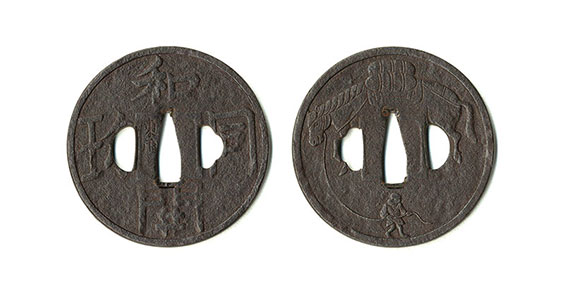
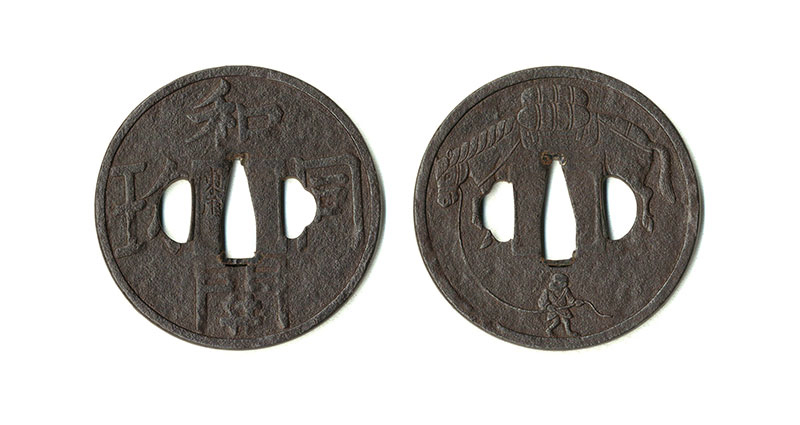
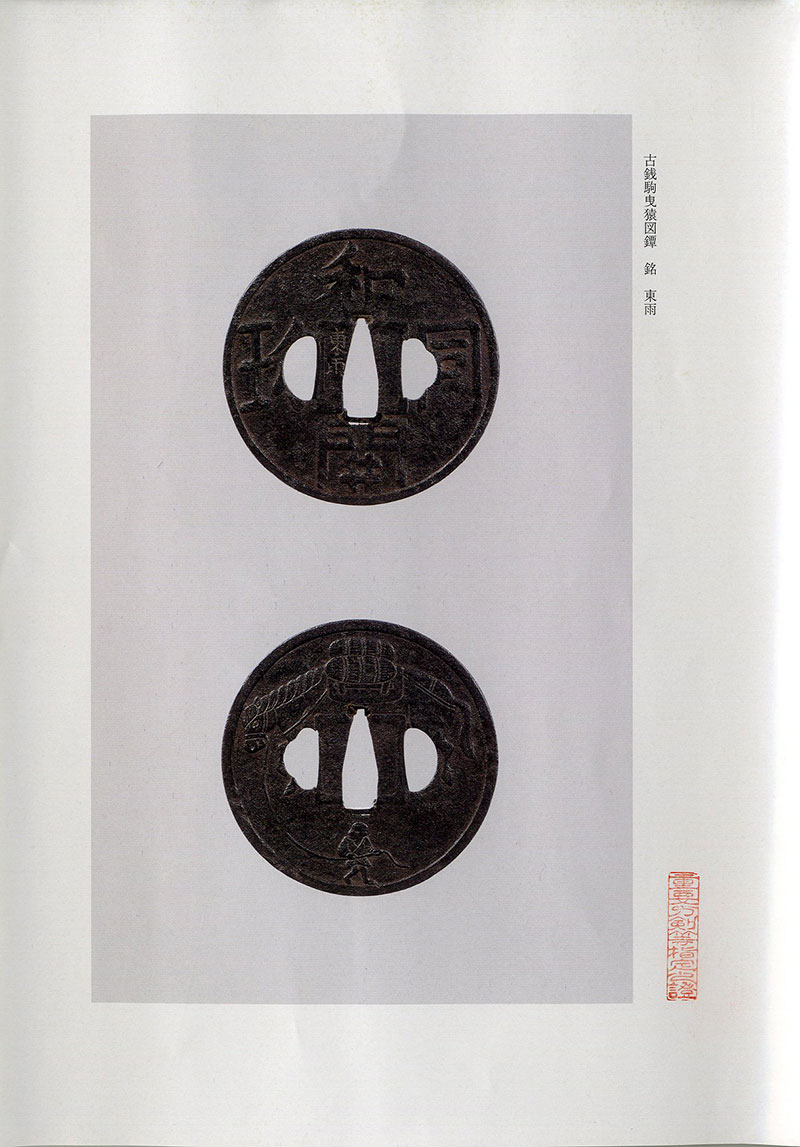
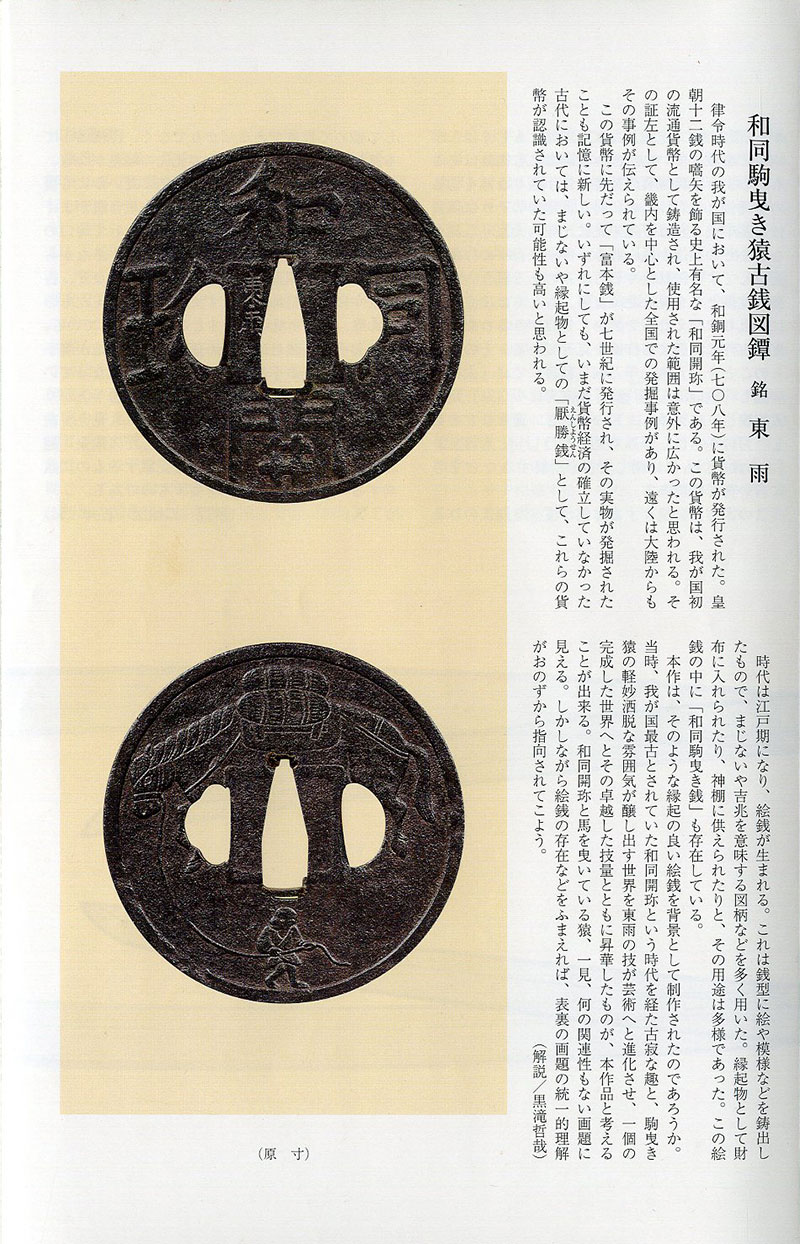
This is a Juyo Tosogu designated work by Yasuchika, a master of the Nara school, known as one of the 'Nara Sansaku' alongside Nara Toshiju and Sugiura Joi. This tsuba, signed 'Tou', is a late-period work by Yasuchika, created after he shaved his head at 61. It features auspicious designs of ancient Japanese coins, the 'Wado Kaichin' and 'Komahiki Saruzeni', with a unique anthropomorphic monkey wearing clothes, showcasing Yasuchika's mature skill in sukedashi-bori and subtle surface textures.

NBTHK Setsumei

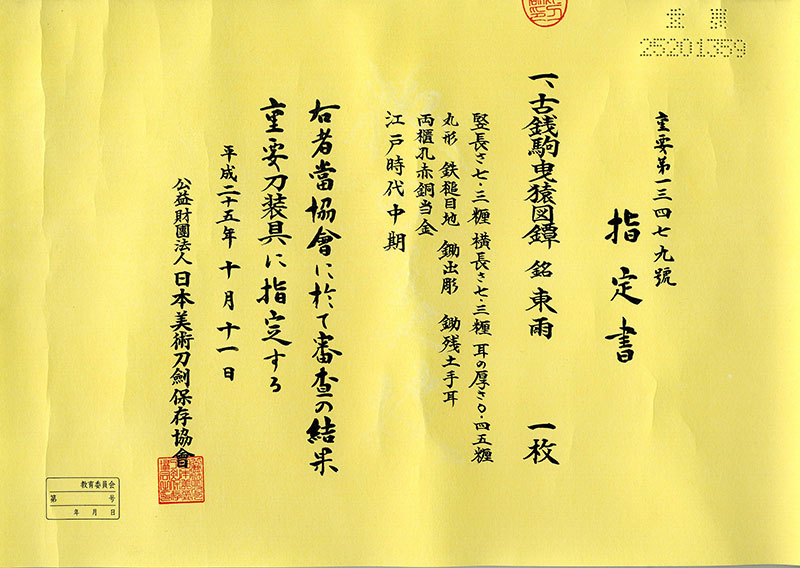
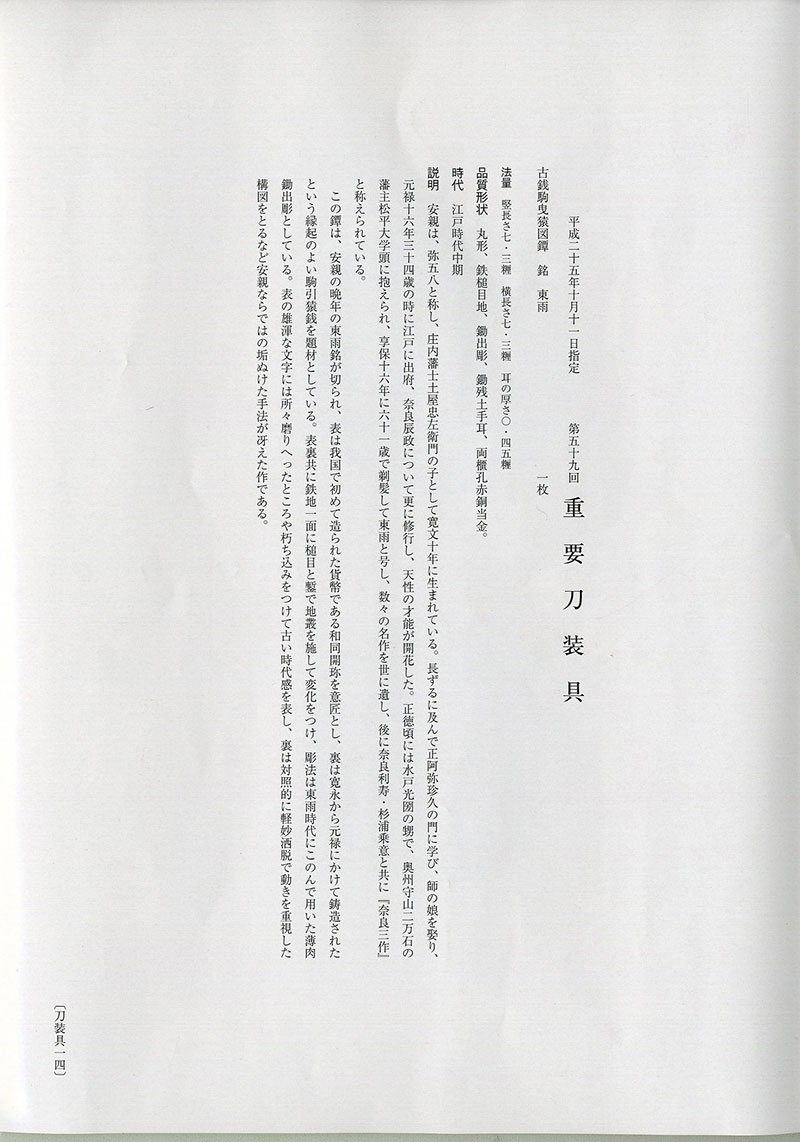
Jūyō-Tōsōgu, 59th Session — Designated October 11, 2013 Tsuba, mei: Tōu (東雨) Measurements Tate (height): 7.3 cm Yoko (width): 7.3 cm Mimi thickness: 0.45 cm Description Form: maru-gata Material: iron Construction: ichimai; ground finished in tsuchime-ji (hammered surface) Design: On the omote, the inscription of Wadō Kaichin (和同開珎), Japan’s first minted coin; on the ura, the auspicious Komabiki-zaru coin design (駒曳猿銭), said to have been cast from the Kan’ei era through the Genroku era Decoration: the entire iron ground is given variation through tsuchime and chisel texturing (tagane work) producing clustered ground effects; carving is in the thin-relief sukidashi-bori favored in the Tōu period Rim: dote-mimi formed by sukinokoshi (leaving the rim standing) Hitsu-ana: two openings, fitted with shakudō plugs (shakudō ategane) Signature: mei “Tōu” (東雨) Artisan Nara school; Nara Yasuchika (安親), working under the gō Tōu (東雨) Era Mid-Edo period Explanation Yasuchika (安親) also used the name Yagohachi (弥五八). He was born in Kanbun 10 (1670) as the son of Tsuchiya Chūzaemon, a retainer of the Shōnai domain. As he grew up, he studied under Shōami Chinkyū (正阿弥珍久) and married his teacher’s daughter. In Genroku 16 (1703), at the age of thirty-four, he went up to Edo, where he undertook further training under Nara Tatsumasa (奈良辰政), and his innate talent came fully into bloom. Around the Shōtoku era (1711–1716), he entered the service of Matsudaira Daigaku-no-kami (松平大学頭), nephew of Tokugawa Mitsukuni (水戸光圀) and lord of 20,000 koku at Moriyama in Ōshū. In Kyōhō 16 (1731), at sixty-one years of age, Yasuchika shaved his head, adopted the art name Tōu (東雨), left many masterpieces to the world, and was later praised together with Nara Toshihisa (奈良利寿) and Sugiura Jōi (杉浦乗意) as the “Three Great Masters of Nara” (Nara Sansaku, 奈良三作). This tsuba bears the late-life signature “Tōu” used by Yasuchika in his final years. The omote takes as its motif Wadō Kaichin, the earliest coinage produced in Japan, while the ura is based on the felicitous Komabiki-zaru coin design, said to have been cast from the Kan’ei era through the Genroku era. On both sides, the iron surface is worked overall with hammering and chisel texturing to create varied effects in the ground. The carving method is thin-relief sukidashi-bori, a technique Tōu particularly favored during this period. The vigorous characters on the front are intentionally given areas of wear and pitting, expressing an atmosphere of great age. In contrast, the back adopts a light, stylish composition that emphasizes movement. The work displays the polished and distinctive approach unique to Yasuchika, here brought into especially sharp focus. Category:

NihontoWatch MonNihontoWatchBETA
MarketEncyclopedia
Fittings›Machibori›Nara›Tsuba: Tou (Yasuchika's later inscription)
tsubaJūyō
Nara School

Tsuba: Tou (Yasuchika's later inscription)

mei · Nara · Edo

SOLD
Nara School — 1 of 6
Nara School — 2 of 6
Nara School — 3 of 6
Nara School — 4 of 6
Nara School — 5 of 6
Nara School — 6 of 6
1 / 6
1 / 6
Nara School — 1 of 6Nara School — 2 of 6Nara School — 3 of 6Nara School — 4 of 6Nara School — 5 of 6Nara School — 6 of 6
Measurements & details
Maker

Nara School

Era

Edo

Province

Dewano Kuni

Signature

Signed

Papers

Jūyō #59 (NBTHK)

Description

This is a Juyo Tosogu designated work by Yasuchika, a master of the Nara school, known as one of the 'Nara Sansaku' alongside Nara Toshiju and Sugiura Joi. This tsuba, signed 'Tou', is a late-period work by Yasuchika, created after he shaved his head at 61. It features auspicious designs of ancient Japanese coins, the 'Wado Kaichin' and 'Komahiki Saruzeni', with a unique anthropomorphic monkey wearing clothes, showcasing Yasuchika's mature skill in sukedashi-bori and subtle surface textures.

NBTHK Zufu Commentary

Juyo #59

AI translation — may contain errors

-Tōsōgu, 59th Session — Designated October 11, 2013

, : Tōu (東雨)

Measurements (height): 7.3 cm (width): 7.3 cm Mimi thickness: 0.45 cm

Description Form: Material: iron Construction: ; ground finished in (hammered surface) Design: On the , the inscription of Wadō Kaichin (和同開珎), Japan’s first minted coin; on the , the auspicious Komabiki-zaru coin design (駒曳猿銭), said to have been cast from the ’ei era through the Genroku era Decoration: the entire iron ground is given variation through and chisel texturing ( work) producing clustered ground effects; carving is in the thin-relief favored in the Tōu period Rim: dote-mimi formed by sukinokoshi (leaving the rim standing) : two openings, fitted with plugs ( ategane) Signature: “Tōu” (東雨)

Artisan Nara school; Nara Yasuchika (安親), working under the gō Tōu (東雨)

Era Mid- period

Explanation Yasuchika (安親) also used the name (弥五八). He was born in 10 (1670) as the son of Tsuchiya Chūzaemon, a retainer of the Shōnai domain. As he grew up, he studied under Shōami Chinkyū (正阿弥珍久) and married his teacher’s daughter.

In Genroku 16 (1703), at the age of thirty-four, he went up to , where he undertook further training under Nara Tatsumasa (奈良辰政), and his innate talent came fully into bloom. Around the Shōtoku era (1711–1716), he entered the service of Matsudaira Daigaku-no-kami (松平大学頭), nephew of Tokugawa Mitsukuni (水戸光圀) and lord of 20,000 at Moriyama in Ōshū. In Kyōhō 16 (1731), at sixty-one years of age, Yasuchika shaved his head, adopted the art name Tōu (東雨), left many masterpieces to the world, and was later praised together with Nara Toshihisa (奈良利寿) and Sugiura Jōi (杉浦乗意) as the “Three Great Masters of Nara” (Nara Sansaku, 奈良三作).

This bears the late-life signature “Tōu” used by Yasuchika in his final years. The takes as its motif Wadō Kaichin, the earliest coinage produced in Japan, while the is based on the felicitous Komabiki-zaru coin design, said to have been cast from the ’ei era through the Genroku era. On both sides, the iron surface is worked overall with hammering and chisel texturing to create varied effects in the ground. The carving method is thin-relief , a technique Tōu particularly favored during this period.

The vigorous characters on the front are intentionally given areas of wear and pitting, expressing an atmosphere of great age. In contrast, the back adopts a light, stylish composition that emphasizes movement. The work displays the polished and distinctive approach unique to Yasuchika, here brought into especially sharp focus.

Category: [Tōsōgu XIV]

About the school

Nara

奈良

Machibori · Edo

80 pieces on the market now

›

The Nara school of kinko (metalwork) emerged in the mid-Edo period as one of the most celebrated independent traditions of sword-fitting craftsmanship, its masters working outside the patronage structures that governed the Goto house. The school coalesced around the figure of Nara Toshihisa (1667--1736), also known as Tahee, who as head master during its creative zenith defined the mature idiom of the lineage. Learn more →

23 recorded smiths181 designated works
Leading smiths
SmithEraDesignated
Yasuchika安親—85
Joi乗意—12
Toshinaga利寿—28
Toshiyoshi利善—0
Shigechika重親—0
Explore the Nara school →
NBTHK Certificate
Jūyō Tōsōgu重要刀装具
Important Fitting
›

Exceptional craft of very high artistic value, judged to rank with a nationally recognized Important Art Object (Jūyō Bijutsuhin).

About the NBTHK›

The NBTHK (Nihon Bijutsu Tōken Hozon Kyōkai, the Society for the Preservation of Japanese Art Swords) is a public-interest incorporated foundation founded in 1948 and supervised by Japan’s Agency for Cultural Affairs (Bunkachō); it is based at the Japanese Sword Museum in Tokyo. Its expert panels physically examine each submitted work (shinsa) and issue a certificate (kanteishō) ranking it by artistic and historical merit. NBTHK papers are the most widely recognized standard of authentication for Japanese swords and fittings.

NBTHK official site→
Seller
I
Iida Koendo
Established 1880 · 146 yrs on the market
🇯🇵Ships from Japan
›
✓Verified dealeriidakoendo.com
✓Ships worldwide✓English supportWire transfer
Return policy

Customer-initiated returns accepted within two days of arrival; return shipping paid by customer and fees non-refundable. Returns/refunds unavailable for overseas deliveries.

View all of Iida Koendo’s listings→View this item on the dealer’s site→

Previously sold — Nara School

Japanese Sword Books and Tsuba
Tsuba - by Nara School - Yamagane Kinko Tsuba signed JoiTsuba - by Nara School - Yamagane Kinko Tsuba signed Joi
Sold

Tsuba

ByNara School
SOLD
Soryu
Tsuba - by Nara School - "Honrai Muichimotsu" Daruma TsubaTsuba - by Nara School - "Honrai Muichimotsu" Daruma Tsuba
Sold

Tsuba

ByNara School
SOLD
Soryu
Tosogu - by Nara School - Sentoku Kozuka with Landscape DesignTosogu - by Nara School - Sentoku Kozuka with Landscape Design
Sold

Tosogu

ByNara School
SOLD
Choshuya
Tokuho
Tsuba - Tokuho - by Nara School - Dragonflies on the Waterside by Otsuryuken MibokuTsuba - Tokuho - by Nara School - Dragonflies on the Waterside by Otsuryuken Miboku
Sold

Tsuba

ByNara School
SOLD
Soryu
Fuchi-Kashira - by Nara School - Shibuichi Fuchi Kashira with Kusazuri Biki Scene from Soga MonogatariFuchi-Kashira - by Nara School - Shibuichi Fuchi Kashira with Kusazuri Biki Scene from Soga Monogatari
Sold

Fuchi-Kashira

ByNara School
SOLD
Japanese Sword Books and Tsuba
Hozon
Fuchi-Kashira - Hozon - by Nara School - Fuchi Kashira with Hozon PaperFuchi-Kashira - Hozon - by Nara School - Fuchi Kashira with Hozon Paper
Sold

Fuchi-Kashira

ByNara School
SOLD
Soryu
Tsuba - by Nara School - Iron with Benkei and Mii-Dera BellTsuba - by Nara School - Iron with Benkei and Mii-Dera Bell
Sold

Tsuba

ByNara School
SOLD
Samurai Nippon
Tokuho
Tsuba - Tokuho - by Nara School - Kanu ZuTsuba - Tokuho - by Nara School - Kanu Zu
Sold

Tsuba

ByNara School
SOLD

More from the Nara school

View all →
Connoisseur Arms
Jūyō
Tsuba - Jūyō - by Hamano Sekibun - Masterpiece Tsuba by Yurakusai SekibunTsuba - Jūyō - by Hamano Sekibun - Masterpiece Tsuba by Yurakusai Sekibun

Tsuba

ByHamano Sekibun
Ask
Touken Matsumoto
Hozon
Fuchi-Kashira - Hozon - by Nara Munetoshi - Fuchi Kashira: Waterside Village SceneFuchi-Kashira - Hozon - by Nara Munetoshi - Fuchi Kashira: Waterside Village Scene

Fuchi-Kashira

ByNara Munetoshi
¥75,000
Choshuya
Tokuho
Fuchi-Kashira - Tokuho - by Hamano Shozui - Fuchi-Kashira: Ebisu & Daikoku Rusumoyo-zu, Signed ShozuiFuchi-Kashira - Tokuho - by Hamano Shozui - Fuchi-Kashira: Ebisu & Daikoku Rusumoyo-zu, Signed Shozui

Fuchi-Kashira

ByHamano Shozui
Ask
Samurai Nippon
Tokuho
Tsuba - Tokuho - by Hamano School - Kashorin ZuTsuba - Tokuho - by Hamano School - Kashorin Zu

Tsuba

ByHamano School
¥820,000
Connoisseur Arms
Tokuho
Tsuba - Tokuho - by Hamano Sekibun - Dragon in Waves by Yurakusai SekibunTsuba - Tokuho - by Hamano Sekibun - Dragon in Waves by Yurakusai Sekibun

Tsuba

ByHamano Sekibun
Ask
Toushin
Tsuba - by Hamano Naoyuki - Tsuba with Seven Gods of Fortune Design by Naoyuki (Kao)Tsuba - by Hamano Naoyuki - Tsuba with Seven Gods of Fortune Design by Naoyuki (Kao)

Tsuba

ByHamano Naoyuki
Ask
Choshuya
Tokuho
Kozuka - Tokuho - by Hamano Sekibun - Kozuka with Hagoromo Design, Signed Yurakusai Sekibun (with Kao)Kozuka - Tokuho - by Hamano Sekibun - Kozuka with Hagoromo Design, Signed Yurakusai Sekibun (with Kao)

Kozuka

ByHamano Sekibun
Ask
Nihontocraft
Tokuho
Fuchi-Kashira - Tokuho - by Hamano Hiroyuki - Fuchi Kashira: Hamano YasuyukiFuchi-Kashira - Tokuho - by Hamano Hiroyuki - Fuchi Kashira: Hamano Yasuyuki

Fuchi-Kashira

ByHamano Hiroyuki
¥2,900

More from the Machibori tradition

View all →
Nihontocraft
Jūyō
Fuchi-Kashira - Jūyō - by Omori Teruhide - Omori Eishu (Teruhide)Fuchi-Kashira - Jūyō - by Omori Teruhide - Omori Eishu (Teruhide)

Fuchi-Kashira

ByOmori Teruhide
¥55,000
Yamasiroya
Hozon
Fuchi-Kashira - Hozon - by Kikuoka Mitsumasa - Fuchi-Kashira: Unryu Zu, Signed RinsendoFuchi-Kashira - Hozon - by Kikuoka Mitsumasa - Fuchi-Kashira: Unryu Zu, Signed Rinsendo

Fuchi-Kashira

ByKikuoka Mitsumasa
¥140,000
Wakeidou
Tokuho
Tsuba - Tokuho - by Otsuki Tokuoki - TokuokiTsuba - Tokuho - by Otsuki Tokuoki - Tokuoki

Tsuba

ByOtsuki Tokuoki
¥700,000
Ginza Seikodo
Tokuho
Kozuka - Tokuho - by Yokoya Somin - Somin - Depiction of Shoki (Zhong Kui)Kozuka - Tokuho - by Yokoya Somin - Somin - Depiction of Shoki (Zhong Kui)

Kozuka

ByYokoya Somin
¥1,500,000
Wakeidou
Hozon
Fuchi-Kashira - Hozon - by Omori Hidetomo - Fuchi-Kashira: Hinode Hansen zuFuchi-Kashira - Hozon - by Omori Hidetomo - Fuchi-Kashira: Hinode Hansen zu

Fuchi-Kashira

ByOmori Hidetomo
¥480,000
Toyuukai
Tokuho
Fuchi-Kashira - Tokuho - by Mito School - Kabuto Design Fuchi-Kashira, Mumei, Mito, Tokubetsu Hozon Tosogu CertificateFuchi-Kashira - Tokuho - by Mito School - Kabuto Design Fuchi-Kashira, Mumei, Mito, Tokubetsu Hozon Tosogu Certificate

Fuchi-Kashira

ByMito School
¥200,000
Choshuya
Hozon
Kozuka - Hozon - by Yokoya School - Kozuka with Kinuta (Fulling Block) Design, Signed Riuzai Minkoku (Kao)Kozuka - Hozon - by Yokoya School - Kozuka with Kinuta (Fulling Block) Design, Signed Riuzai Minkoku (Kao)

Kozuka

ByYokoya School
¥300,000
Samurai Nippon
Tokubetsu Kichō
Kozuka - Tokubetsu Kichō - by Otsuki Mitsuhiro - Wave and Plover DesignKozuka - Tokubetsu Kichō - by Otsuki Mitsuhiro - Wave and Plover Design

Kozuka

ByOtsuki Mitsuhiro
¥85,000

Swords

  • Katana
  • Wakizashi
  • Tantō
  • Tachi
  • Naginata
  • Yari

Fittings

  • Tsuba
  • Fuchi-Kashira
  • Kozuka
  • Menuki

Armor

  • Kabuto
  • Samurai Armor

By Certification

  • Tokujū
  • Jūyō
  • Tokuho
  • Hozon

Resources

  • Dealer Directory
  • Artist Directory
  • Glossary
  • Browse All
Nihontowatch© 2026
TermsPrivacyCookiesAbout

Description

This is a Juyo Tosogu designated work by Yasuchika, a master of the Nara school, known as one of the 'Nara Sansaku' alongside Nara Toshiju and Sugiura Joi. This tsuba, signed 'Tou', is a late-period work by Yasuchika, created after he shaved his head at 61. It features auspicious designs of ancient Japanese coins, the 'Wado Kaichin' and 'Komahiki Saruzeni', with a unique anthropomorphic monkey wearing clothes, showcasing Yasuchika's mature skill in sukedashi-bori and subtle surface textures.

NBTHK Setsumei

Jūyō-Tōsōgu, 59th Session — Designated October 11, 2013 Tsuba, mei: Tōu (東雨) Measurements Tate (height): 7.3 cm Yoko (width): 7.3 cm Mimi thickness: 0.45 cm Description Form: maru-gata Material: iron Construction: ichimai; ground finished in tsuchime-ji (hammered surface) Design: On the omote, the inscription of Wadō Kaichin (和同開珎), Japan’s first minted coin; on the ura, the auspicious Komabiki-zaru coin design (駒曳猿銭), said to have been cast from the Kan’ei era through the Genroku era Decoration: the entire iron ground is given variation through tsuchime and chisel texturing (tagane work) producing clustered ground effects; carving is in the thin-relief sukidashi-bori favored in the Tōu period Rim: dote-mimi formed by sukinokoshi (leaving the rim standing) Hitsu-ana: two openings, fitted with shakudō plugs (shakudō ategane) Signature: mei “Tōu” (東雨) Artisan Nara school; Nara Yasuchika (安親), working under the gō Tōu (東雨) Era Mid-Edo period Explanation Yasuchika (安親) also used the name Yagohachi (弥五八). He was born in Kanbun 10 (1670) as the son of Tsuchiya Chūzaemon, a retainer of the Shōnai domain. As he grew up, he studied under Shōami Chinkyū (正阿弥珍久) and married his teacher’s daughter. In Genroku 16 (1703), at the age of thirty-four, he went up to Edo, where he undertook further training under Nara Tatsumasa (奈良辰政), and his innate talent came fully into bloom. Around the Shōtoku era (1711–1716), he entered the service of Matsudaira Daigaku-no-kami (松平大学頭), nephew of Tokugawa Mitsukuni (水戸光圀) and lord of 20,000 koku at Moriyama in Ōshū. In Kyōhō 16 (1731), at sixty-one years of age, Yasuchika shaved his head, adopted the art name Tōu (東雨), left many masterpieces to the world, and was later praised together with Nara Toshihisa (奈良利寿) and Sugiura Jōi (杉浦乗意) as the “Three Great Masters of Nara” (Nara Sansaku, 奈良三作). This tsuba bears the late-life signature “Tōu” used by Yasuchika in his final years. The omote takes as its motif Wadō Kaichin, the earliest coinage produced in Japan, while the ura is based on the felicitous Komabiki-zaru coin design, said to have been cast from the Kan’ei era through the Genroku era. On both sides, the iron surface is worked overall with hammering and chisel texturing to create varied effects in the ground. The carving method is thin-relief sukidashi-bori, a technique Tōu particularly favored during this period. The vigorous characters on the front are intentionally given areas of wear and pitting, expressing an atmosphere of great age. In contrast, the back adopts a light, stylish composition that emphasizes movement. The work displays the polished and distinctive approach unique to Yasuchika, here brought into especially sharp focus. Category:

NihontoWatch MonNihontoWatchBETA
MarketEncyclopedia
Fittings›Machibori›Nara›Tsuba: Tou (Yasuchika's later inscription)
tsubaJūyō
Nara School

Tsuba: Tou (Yasuchika's later inscription)

mei · Nara · Edo

SOLD
Nara School — 1 of 6
Nara School — 2 of 6
Nara School — 3 of 6
Nara School — 4 of 6
Nara School — 5 of 6
Nara School — 6 of 6
1 / 6
1 / 6
Nara School — 1 of 6Nara School — 2 of 6Nara School — 3 of 6Nara School — 4 of 6Nara School — 5 of 6Nara School — 6 of 6
Measurements & details
Maker

Nara School

Era

Edo

Province

Dewano Kuni

Signature

Signed

Papers

Jūyō #59 (NBTHK)

Description

This is a Juyo Tosogu designated work by Yasuchika, a master of the Nara school, known as one of the 'Nara Sansaku' alongside Nara Toshiju and Sugiura Joi. This tsuba, signed 'Tou', is a late-period work by Yasuchika, created after he shaved his head at 61. It features auspicious designs of ancient Japanese coins, the 'Wado Kaichin' and 'Komahiki Saruzeni', with a unique anthropomorphic monkey wearing clothes, showcasing Yasuchika's mature skill in sukedashi-bori and subtle surface textures.

NBTHK Zufu Commentary

Juyo #59

AI translation — may contain errors

-Tōsōgu, 59th Session — Designated October 11, 2013

, : Tōu (東雨)

Measurements (height): 7.3 cm (width): 7.3 cm Mimi thickness: 0.45 cm

Description Form: Material: iron Construction: ; ground finished in (hammered surface) Design: On the , the inscription of Wadō Kaichin (和同開珎), Japan’s first minted coin; on the , the auspicious Komabiki-zaru coin design (駒曳猿銭), said to have been cast from the ’ei era through the Genroku era Decoration: the entire iron ground is given variation through and chisel texturing ( work) producing clustered ground effects; carving is in the thin-relief favored in the Tōu period Rim: dote-mimi formed by sukinokoshi (leaving the rim standing) : two openings, fitted with plugs ( ategane) Signature: “Tōu” (東雨)

Artisan Nara school; Nara Yasuchika (安親), working under the gō Tōu (東雨)

Era Mid- period

Explanation Yasuchika (安親) also used the name (弥五八). He was born in 10 (1670) as the son of Tsuchiya Chūzaemon, a retainer of the Shōnai domain. As he grew up, he studied under Shōami Chinkyū (正阿弥珍久) and married his teacher’s daughter.

In Genroku 16 (1703), at the age of thirty-four, he went up to , where he undertook further training under Nara Tatsumasa (奈良辰政), and his innate talent came fully into bloom. Around the Shōtoku era (1711–1716), he entered the service of Matsudaira Daigaku-no-kami (松平大学頭), nephew of Tokugawa Mitsukuni (水戸光圀) and lord of 20,000 at Moriyama in Ōshū. In Kyōhō 16 (1731), at sixty-one years of age, Yasuchika shaved his head, adopted the art name Tōu (東雨), left many masterpieces to the world, and was later praised together with Nara Toshihisa (奈良利寿) and Sugiura Jōi (杉浦乗意) as the “Three Great Masters of Nara” (Nara Sansaku, 奈良三作).

This bears the late-life signature “Tōu” used by Yasuchika in his final years. The takes as its motif Wadō Kaichin, the earliest coinage produced in Japan, while the is based on the felicitous Komabiki-zaru coin design, said to have been cast from the ’ei era through the Genroku era. On both sides, the iron surface is worked overall with hammering and chisel texturing to create varied effects in the ground. The carving method is thin-relief , a technique Tōu particularly favored during this period.

The vigorous characters on the front are intentionally given areas of wear and pitting, expressing an atmosphere of great age. In contrast, the back adopts a light, stylish composition that emphasizes movement. The work displays the polished and distinctive approach unique to Yasuchika, here brought into especially sharp focus.

Category: [Tōsōgu XIV]

About the school

Nara

奈良

Machibori · Edo

80 pieces on the market now

›

The Nara school of kinko (metalwork) emerged in the mid-Edo period as one of the most celebrated independent traditions of sword-fitting craftsmanship, its masters working outside the patronage structures that governed the Goto house. The school coalesced around the figure of Nara Toshihisa (1667--1736), also known as Tahee, who as head master during its creative zenith defined the mature idiom of the lineage. Learn more →

23 recorded smiths181 designated works
Leading smiths
SmithEraDesignated
Yasuchika安親—85
Joi乗意—12
Toshinaga利寿—28
Toshiyoshi利善—0
Shigechika重親—0
Explore the Nara school →
NBTHK Certificate
Jūyō Tōsōgu重要刀装具
Important Fitting
›

Exceptional craft of very high artistic value, judged to rank with a nationally recognized Important Art Object (Jūyō Bijutsuhin).

About the NBTHK›

The NBTHK (Nihon Bijutsu Tōken Hozon Kyōkai, the Society for the Preservation of Japanese Art Swords) is a public-interest incorporated foundation founded in 1948 and supervised by Japan’s Agency for Cultural Affairs (Bunkachō); it is based at the Japanese Sword Museum in Tokyo. Its expert panels physically examine each submitted work (shinsa) and issue a certificate (kanteishō) ranking it by artistic and historical merit. NBTHK papers are the most widely recognized standard of authentication for Japanese swords and fittings.

NBTHK official site→
Seller
I
Iida Koendo
Established 1880 · 146 yrs on the market
🇯🇵Ships from Japan
›
✓Verified dealeriidakoendo.com
✓Ships worldwide✓English supportWire transfer
Return policy

Customer-initiated returns accepted within two days of arrival; return shipping paid by customer and fees non-refundable. Returns/refunds unavailable for overseas deliveries.

View all of Iida Koendo’s listings→View this item on the dealer’s site→

Previously sold — Nara School

Japanese Sword Books and Tsuba
Tsuba - by Nara School - Yamagane Kinko Tsuba signed JoiTsuba - by Nara School - Yamagane Kinko Tsuba signed Joi
Sold

Tsuba

ByNara School
SOLD
Soryu
Tsuba - by Nara School - "Honrai Muichimotsu" Daruma TsubaTsuba - by Nara School - "Honrai Muichimotsu" Daruma Tsuba
Sold

Tsuba

ByNara School
SOLD
Soryu
Tosogu - by Nara School - Sentoku Kozuka with Landscape DesignTosogu - by Nara School - Sentoku Kozuka with Landscape Design
Sold

Tosogu

ByNara School
SOLD
Choshuya
Tokuho
Tsuba - Tokuho - by Nara School - Dragonflies on the Waterside by Otsuryuken MibokuTsuba - Tokuho - by Nara School - Dragonflies on the Waterside by Otsuryuken Miboku
Sold

Tsuba

ByNara School
SOLD
Soryu
Fuchi-Kashira - by Nara School - Shibuichi Fuchi Kashira with Kusazuri Biki Scene from Soga MonogatariFuchi-Kashira - by Nara School - Shibuichi Fuchi Kashira with Kusazuri Biki Scene from Soga Monogatari
Sold

Fuchi-Kashira

ByNara School
SOLD
Japanese Sword Books and Tsuba
Hozon
Fuchi-Kashira - Hozon - by Nara School - Fuchi Kashira with Hozon PaperFuchi-Kashira - Hozon - by Nara School - Fuchi Kashira with Hozon Paper
Sold

Fuchi-Kashira

ByNara School
SOLD
Soryu
Tsuba - by Nara School - Iron with Benkei and Mii-Dera BellTsuba - by Nara School - Iron with Benkei and Mii-Dera Bell
Sold

Tsuba

ByNara School
SOLD
Samurai Nippon
Tokuho
Tsuba - Tokuho - by Nara School - Kanu ZuTsuba - Tokuho - by Nara School - Kanu Zu
Sold

Tsuba

ByNara School
SOLD

More from the Nara school

View all →
Connoisseur Arms
Jūyō
Tsuba - Jūyō - by Hamano Sekibun - Masterpiece Tsuba by Yurakusai SekibunTsuba - Jūyō - by Hamano Sekibun - Masterpiece Tsuba by Yurakusai Sekibun

Tsuba

ByHamano Sekibun
Ask
Touken Matsumoto
Hozon
Fuchi-Kashira - Hozon - by Nara Munetoshi - Fuchi Kashira: Waterside Village SceneFuchi-Kashira - Hozon - by Nara Munetoshi - Fuchi Kashira: Waterside Village Scene

Fuchi-Kashira

ByNara Munetoshi
¥75,000
Choshuya
Tokuho
Fuchi-Kashira - Tokuho - by Hamano Shozui - Fuchi-Kashira: Ebisu & Daikoku Rusumoyo-zu, Signed ShozuiFuchi-Kashira - Tokuho - by Hamano Shozui - Fuchi-Kashira: Ebisu & Daikoku Rusumoyo-zu, Signed Shozui

Fuchi-Kashira

ByHamano Shozui
Ask
Samurai Nippon
Tokuho
Tsuba - Tokuho - by Hamano School - Kashorin ZuTsuba - Tokuho - by Hamano School - Kashorin Zu

Tsuba

ByHamano School
¥820,000
Connoisseur Arms
Tokuho
Tsuba - Tokuho - by Hamano Sekibun - Dragon in Waves by Yurakusai SekibunTsuba - Tokuho - by Hamano Sekibun - Dragon in Waves by Yurakusai Sekibun

Tsuba

ByHamano Sekibun
Ask
Toushin
Tsuba - by Hamano Naoyuki - Tsuba with Seven Gods of Fortune Design by Naoyuki (Kao)Tsuba - by Hamano Naoyuki - Tsuba with Seven Gods of Fortune Design by Naoyuki (Kao)

Tsuba

ByHamano Naoyuki
Ask
Choshuya
Tokuho
Kozuka - Tokuho - by Hamano Sekibun - Kozuka with Hagoromo Design, Signed Yurakusai Sekibun (with Kao)Kozuka - Tokuho - by Hamano Sekibun - Kozuka with Hagoromo Design, Signed Yurakusai Sekibun (with Kao)

Kozuka

ByHamano Sekibun
Ask
Nihontocraft
Tokuho
Fuchi-Kashira - Tokuho - by Hamano Hiroyuki - Fuchi Kashira: Hamano YasuyukiFuchi-Kashira - Tokuho - by Hamano Hiroyuki - Fuchi Kashira: Hamano Yasuyuki

Fuchi-Kashira

ByHamano Hiroyuki
¥2,900

More from the Machibori tradition

View all →
Nihontocraft
Jūyō
Fuchi-Kashira - Jūyō - by Omori Teruhide - Omori Eishu (Teruhide)Fuchi-Kashira - Jūyō - by Omori Teruhide - Omori Eishu (Teruhide)

Fuchi-Kashira

ByOmori Teruhide
¥55,000
Yamasiroya
Hozon
Fuchi-Kashira - Hozon - by Kikuoka Mitsumasa - Fuchi-Kashira: Unryu Zu, Signed RinsendoFuchi-Kashira - Hozon - by Kikuoka Mitsumasa - Fuchi-Kashira: Unryu Zu, Signed Rinsendo

Fuchi-Kashira

ByKikuoka Mitsumasa
¥140,000
Wakeidou
Tokuho
Tsuba - Tokuho - by Otsuki Tokuoki - TokuokiTsuba - Tokuho - by Otsuki Tokuoki - Tokuoki

Tsuba

ByOtsuki Tokuoki
¥700,000
Ginza Seikodo
Tokuho
Kozuka - Tokuho - by Yokoya Somin - Somin - Depiction of Shoki (Zhong Kui)Kozuka - Tokuho - by Yokoya Somin - Somin - Depiction of Shoki (Zhong Kui)

Kozuka

ByYokoya Somin
¥1,500,000
Wakeidou
Hozon
Fuchi-Kashira - Hozon - by Omori Hidetomo - Fuchi-Kashira: Hinode Hansen zuFuchi-Kashira - Hozon - by Omori Hidetomo - Fuchi-Kashira: Hinode Hansen zu

Fuchi-Kashira

ByOmori Hidetomo
¥480,000
Toyuukai
Tokuho
Fuchi-Kashira - Tokuho - by Mito School - Kabuto Design Fuchi-Kashira, Mumei, Mito, Tokubetsu Hozon Tosogu CertificateFuchi-Kashira - Tokuho - by Mito School - Kabuto Design Fuchi-Kashira, Mumei, Mito, Tokubetsu Hozon Tosogu Certificate

Fuchi-Kashira

ByMito School
¥200,000
Choshuya
Hozon
Kozuka - Hozon - by Yokoya School - Kozuka with Kinuta (Fulling Block) Design, Signed Riuzai Minkoku (Kao)Kozuka - Hozon - by Yokoya School - Kozuka with Kinuta (Fulling Block) Design, Signed Riuzai Minkoku (Kao)

Kozuka

ByYokoya School
¥300,000
Samurai Nippon
Tokubetsu Kichō
Kozuka - Tokubetsu Kichō - by Otsuki Mitsuhiro - Wave and Plover DesignKozuka - Tokubetsu Kichō - by Otsuki Mitsuhiro - Wave and Plover Design

Kozuka

ByOtsuki Mitsuhiro
¥85,000

Swords

  • Katana
  • Wakizashi
  • Tantō
  • Tachi
  • Naginata
  • Yari

Fittings

  • Tsuba
  • Fuchi-Kashira
  • Kozuka
  • Menuki

Armor

  • Kabuto
  • Samurai Armor

By Certification

  • Tokujū
  • Jūyō
  • Tokuho
  • Hozon

Resources

  • Dealer Directory
  • Artist Directory
  • Glossary
  • Browse All
Nihontowatch© 2026
TermsPrivacyCookiesAbout
NihontoWatch Mon

NihontoWatchBETA

Market
Encyclopedia
NihontoWatch Mon

NihontoWatchBETA

Market
Encyclopedia