NihontoWatch Mon

NihontoWatch

Market
Encyclopedia
Kantei
NihontoWatch Mon

NihontoWatch

Market
Encyclopedia
Kantei

Description

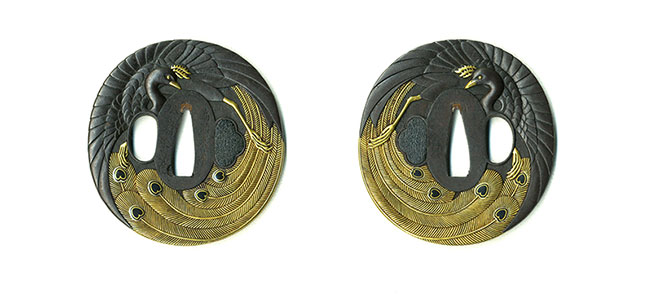
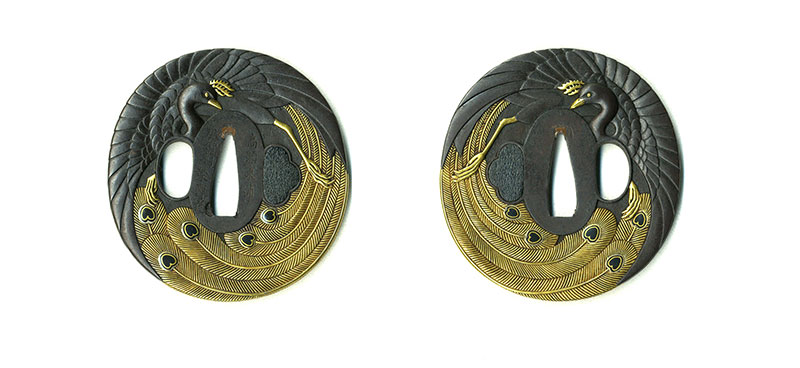
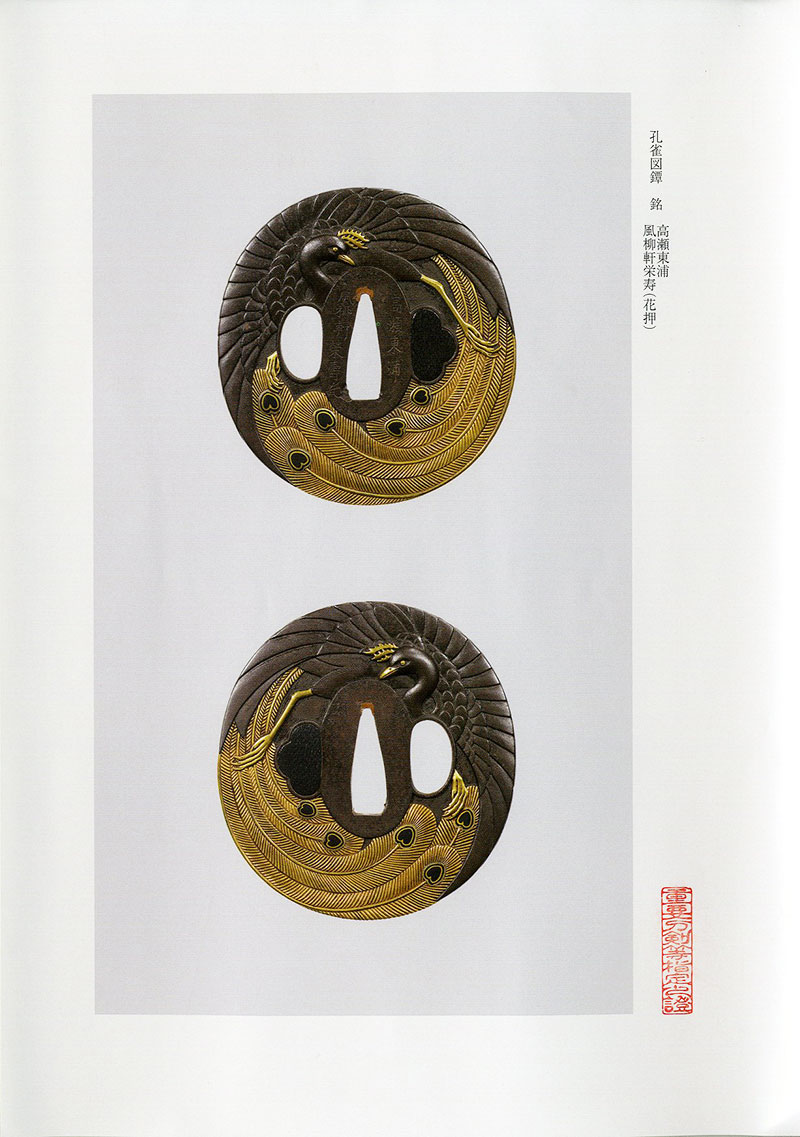
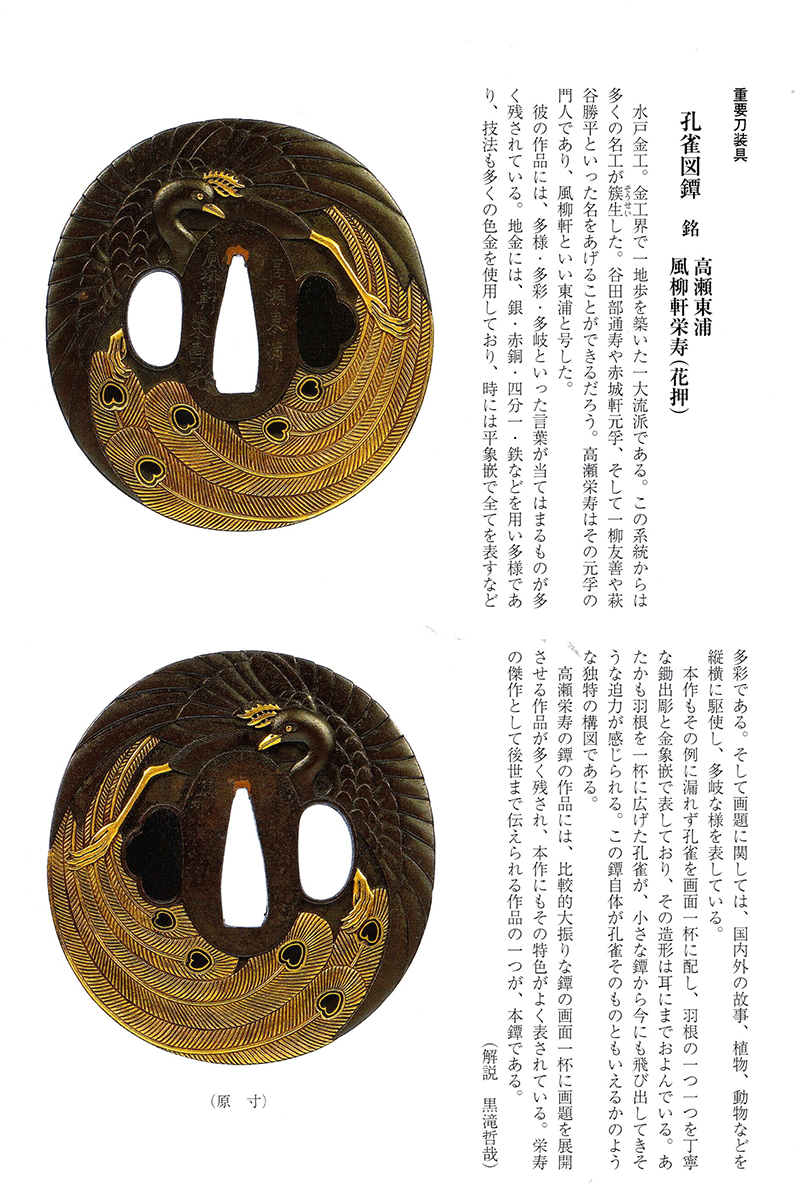
This is a Juyo Token designated tsuba by Takase Eijyu, a Mito kinko artist from the late Edo period. Eijyu, also known as Furyuken, was a student of Akagiken Genfu, the second generation of the Taizan family. This tsuba, made of iron, uniquely expresses the splendor of a peacock using sukidashi-bori, showcasing a rare style within his work that often favored Goto-style pieces.

NBTHK Setsumei

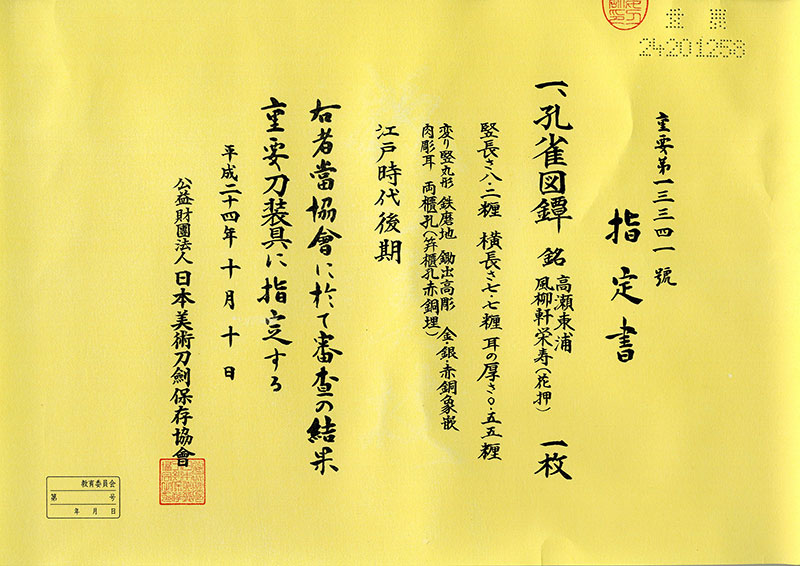
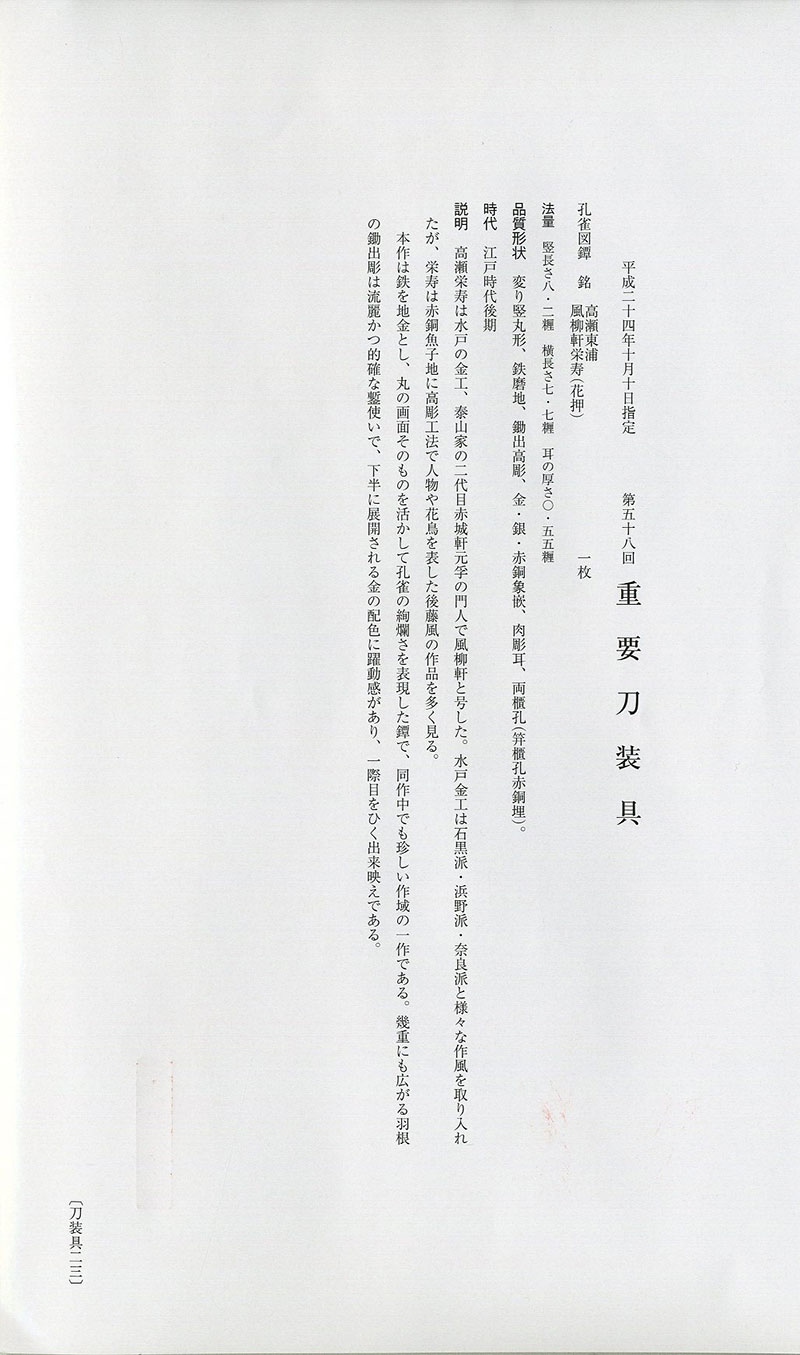
Jūyō-Tōsōgu, 58th Session — Designated October 10, 2012 Category: Tōsōgu 23 Tsuba, mei: Takase Tōho, Furyūken Eiju (花押) (高瀬東浦 風柳軒栄寿) Measurements Tate (height): 8.2 cm Yoko (width): 7.7 cm Mimi thickness: 0.55 cm Description Form: kawari tatemaru-gata (variant vertical-round form) Material: iron, polished ground (tetsu migaki-ji) Construction: ichimai (single-plate) Design: peacock Decoration: sukidashi-bori in high relief (takabori), with inlay (zōgan) in gold, silver, and shakudō Rim: niku-bori mimi (rounded, carved rim) Hitsu-ana: two; kōgai-hitsu plugged with shakudō Signature: “Takase Tōho” and “Furyūken Eiju” with kaō Artisan Takase Eiju, art name Furyūken—Mito metalworker; pupil of Akagiken Motogaku, second-generation master of the Taizan family line. Era Late Edo period. Explanation Takase Eiju was a Mito metalsmith. He studied under Akagiken Motogaku, the second-generation master of the Taizan family, and used the art name Furyūken. Mito metalworkers incorporated a variety of styles—such as those of the Ishiguro, Hamano, and Nara schools—yet in Eiju’s work one often finds Gotō-inspired pieces: figures and bird-and-flower subjects rendered in high relief on a ground of shakudō nanako-ji. This tsuba, however, is made with iron as the base metal, and it is a work that conveys the splendor of the peacock by fully exploiting the circular pictorial field itself. Even among Eiju’s output, it represents an unusual area of expression. The sukidashi-bori of the feathers, spreading in layered bands, is graceful and precise in chisel handling, while the gold coloration deployed in the lower portion creates a sense of lively motion—resulting in an especially eye-catching piece.

NihontoWatch MonNihontoWatch
MarketEncyclopediaKantei
Fittings›Machibori›Mito›Tosogu: NBTHK Juyo Token No.58, Signed Takase Tou Furyuken Eijyu
tsubaJūyō
Mito School

Tosogu: NBTHK Juyo Token No.58, Signed Takase Tou Furyuken Eijyu

mei · Mito · Edo

SOLD
Mito School — 1 of 7
Mito School — 2 of 7
Mito School — 3 of 7
Mito School — 4 of 7
Mito School — 5 of 7
Mito School — 6 of 7
Mito School — 7 of 7
1 / 7
1 / 7
Mito School — 1 of 7Mito School — 2 of 7Mito School — 3 of 7Mito School — 4 of 7Mito School — 5 of 7Mito School — 6 of 7Mito School — 7 of 7
Measurements & details
Maker

Mito School

Era

Edo

Province

Hitachi

Signature

Signed

Papers

Jūyō #58 (NBTHK)

Description

This is a Juyo Token designated tsuba by Takase Eijyu, a Mito kinko artist from the late Edo period. Eijyu, also known as Furyuken, was a student of Akagiken Genfu, the second generation of the Taizan family. This tsuba, made of iron, uniquely expresses the splendor of a peacock using sukidashi-bori, showcasing a rare style within his work that often favored Goto-style pieces.

NBTHK Zufu Commentary

Juyo #58

AI translation — may contain errors

-Tōsōgu, 58th Session — Designated October 10, 2012

Category: ** Tōsōgu 23

, : Takase Tōho, Furyūken Eiju (花押) (高瀬東浦 風柳軒栄寿)

Measurements (height): 8.2 cm (width): 7.7 cm Mimi thickness: 0.55 cm

Description Form: kawari (variant vertical-round form) Material: iron, polished ground (tetsu ) Construction: (single-plate) Design: peacock Decoration: in high relief (), with inlay () in gold, silver, and Rim: -bori mimi (rounded, carved rim) : two; plugged with Signature: “Takase Tōho” and “Furyūken Eiju” with

Artisan Takase Eiju, art name Furyūken—Mito metalworker; pupil of Akagiken Motogaku, second-generation master of the Taizan family line.

Era Late period.

Explanation Takase Eiju was a Mito metalsmith. He studied under Akagiken Motogaku, the second-generation master of the Taizan family, and used the art name Furyūken. Mito metalworkers incorporated a variety of styles—such as those of the Ishiguro, Hamano, and Nara schools—yet in Eiju’s work one often finds Gotō-inspired pieces: figures and bird-and-flower subjects rendered in high relief on a ground of .

This , however, is made with iron as the base metal, and it is a work that conveys the splendor of the peacock by fully exploiting the circular pictorial field itself. Even among Eiju’s output, it represents an unusual area of expression. The of the feathers, spreading in layered bands, is graceful and precise in chisel handling, while the gold coloration deployed in the lower portion creates a sense of lively motion—resulting in an especially eye-catching piece.

About the school

Mito

水戸

Machibori · Hitachi

78 pieces on the market now

›

The Mito school of sword-fitting makers emerged as an officially sponsored tradition in the domains of the Tokugawa family's Mito branch, achieving particular prominence in the late Edo period. The school's lineage traces through Shinozaki Katsushige and his successors, who served as goyō horimonoshi (official engravers) to the domain. Unlike the privately patronized workshops of Edo and Kyoto, Mito metalworkers operated within a system of domain service, producing both presentation fittings for formal occasions and richly decorated works for commission. This institutional foundation fostered both technical rigor and stylistic continuity, as masters such as Hagiya Katsuhei and his pupils transmitted the school's methods through direct apprenticeship. The Mito aesthetic is characterized by meticulous shakudō nanako-ji grounds upon which high-relief carving (takabori) is combined with precise gold and silver iroe to yield compositions of exceptional textural depth. The school showed particular mastery in figural subjects—immortals, deities, and mythological beasts—rendered with close attention to anatomical realism and dynamic poses.

The nanako punch-work is notably disciplined, each grain laid in orderly arrangement, while the relief carving rises to striking heights, with elements such as lion manes and peony petals executed in fully three-dimensional chiselwork. Color inlays are applied with exacting accuracy, and thematic coordination across entire fitting sets demonstrates a sophisticated understanding of decorative unity. The Mito school's influence extended well into the Meiji period through the achievements of second-generation masters. Hagiya Katsuhei's circle produced such celebrated artists as Namekawa Sadakatsu and Unno Shōmin, who carried the school's technical standards and stylistic vocabulary into new contexts. The tradition's emphasis on figural carving, inherited from the Tamagawa lineage, and its adherence to orthodox forms for formal presentation fittings established the Mito school as one of the principal regional traditions of late-period Japanese sword-fitting production. Learn more →

12 recorded smiths47 designated works
Leading smiths
SmithEraDesignated
Katsuhira勝平1804-188613
Shomin勝珉1844-191511
Teikan貞幹—5
Tomoyoshi友善1716-c.19200
Hirotoshi弘寿16701
Explore the Mito school →
NBTHK Certificate
Jūyō Tōsōgu重要刀装具
Important Fitting
›

Exceptional craft of very high artistic value, judged to rank with a nationally recognized Important Art Object (Jūyō Bijutsuhin).

About the NBTHK›

The NBTHK (Nihon Bijutsu Tōken Hozon Kyōkai, the Society for the Preservation of Japanese Art Swords) is a public-interest incorporated foundation founded in 1948 and supervised by Japan’s Agency for Cultural Affairs (Bunkachō); it is based at the Japanese Sword Museum in Tokyo. Its expert panels physically examine each submitted work (shinsa) and issue a certificate (kanteishō) ranking it by artistic and historical merit. NBTHK papers are the most widely recognized standard of authentication for Japanese swords and fittings.

NBTHK official site→
Seller
I
Iida Koendo
Established 1880 · 146 yrs on the market
🇯🇵Ships from Japan
›
✓Verified dealeriidakoendo.com
✓Ships worldwide✓English supportWire transfer
Return policy

Customer-initiated returns accepted within two days of arrival; return shipping paid by customer and fees non-refundable. Returns/refunds unavailable for overseas deliveries.

View all of Iida Koendo’s listings→View this item on the dealer’s site→

Previously sold — Mito School

View all →
World Seiyudo
Hozon
Menuki - Hozon - by Mito School - Mito Ithirin-Botan-zu (Single Bloom Peony)Menuki - Hozon - by Mito School - Mito Ithirin-Botan-zu (Single Bloom Peony)
Sold

Menuki

ByMito School
SOLD
Eirakudo
Hozon
Tsuba - Hozon - by Mito School - Mito: Sudden Rain Tsuba - Hozon TosoguTsuba - Hozon - by Mito School - Mito: Sudden Rain Tsuba - Hozon Tosogu
Sold

Tsuba

ByMito School
SOLD
Toushin
Hozon
Tsuba - Hozon - by Mito School - Mumei (Mito) - Sunrise over Meoto Iwa RocksTsuba - Hozon - by Mito School - Mumei (Mito) - Sunrise over Meoto Iwa Rocks
Sold

Tsuba

ByMito School
SOLD
Choshuya
Hozon
Tsuba - Hozon - by Mito School - Gama Sennin (Toad Hermit) - Mumei, MitoTsuba - Hozon - by Mito School - Gama Sennin (Toad Hermit) - Mumei, Mito
Sold

Tsuba

ByMito School
SOLD
Aoi Art
Tosogu - by Mito School - Unsigned (Mito School)Tosogu - by Mito School - Unsigned (Mito School)
Sold

Tosogu

ByMito School
SOLD
Toushin
Hozon
Tsuba - Hozon - by Mito School - Tsuba with Moso design, Mumei (Mito)Tsuba - Hozon - by Mito School - Tsuba with Moso design, Mumei (Mito)
Sold

Tsuba

ByMito School
SOLD
Soryu
Hozon
Tsuba - Hozon - by Mito School - Mito School Tsuba with Daruma and NBTHK Hozon TosoguTsuba - Hozon - by Mito School - Mito School Tsuba with Daruma and NBTHK Hozon Tosogu
Sold

Tsuba

ByMito School
SOLD
Touken Matsumoto
Hozon
Tsuba - Hozon - by Mito School - Cherry Blossom Design, Signed Masakatsu (Kao)Tsuba - Hozon - by Mito School - Cherry Blossom Design, Signed Masakatsu (Kao)
Sold

Tsuba

ByMito School
SOLD

More from the Mito school

View all →
Nihonto Art
Tokuho
Tsuba - Tokuho - by Mito School - Edo Mito Unsigned Willow and Waterfowl - NBTHK Tokubetsu HozonTsuba - Tokuho - by Mito School - Edo Mito Unsigned Willow and Waterfowl - NBTHK Tokubetsu Hozon

Tsuba

ByMito School
¥2,250
Eirakudo
Tokuho
Tsuba - Tokuho - by Mito Hirotoshi - Iwamoto HirotoshiTsuba - Tokuho - by Mito Hirotoshi - Iwamoto Hirotoshi

Tsuba

ByMito Hirotoshi
¥700,000
Samurai Nippon
Kozuka - by Mito School - Bakuro ZuKozuka - by Mito School - Bakuro Zu

Kozuka

ByMito School
¥75,000
Nosyudo
Hozon
Fuchi-Kashira - Hozon - by Mito Hashizume Tomoyoshi - Fuchi-Kashira: Shishi (Lion) Design (Signed: Hashizume Tomoyoshi)Fuchi-Kashira - Hozon - by Mito Hashizume Tomoyoshi - Fuchi-Kashira: Shishi (Lion) Design (Signed: Hashizume Tomoyoshi)

Fuchi-Kashira

ByMito Hashizume Tomoyoshi
¥420,000
Nihonto.com
Hozon
Tsuba - Hozon - by Mito School - Beautifully Carved Mito TsubaTsuba - Hozon - by Mito School - Beautifully Carved Mito Tsuba

Tsuba

ByMito School
¥2,450
Toushin
Hozon
Tsuba - Hozon - by Mito School - Tsuba with Meng Zong Design, Mumei (Mito)Tsuba - Hozon - by Mito School - Tsuba with Meng Zong Design, Mumei (Mito)

Tsuba

ByMito School
¥396,000
Toyuukai
Tokuho
Fuchi-Kashira - Tokuho - by Mito School - Kabuto Design Fuchi-Kashira, Mumei, Mito, Tokubetsu Hozon Tosogu CertificateFuchi-Kashira - Tokuho - by Mito School - Kabuto Design Fuchi-Kashira, Mumei, Mito, Tokubetsu Hozon Tosogu Certificate

Fuchi-Kashira

ByMito School
¥200,000
Toushin
Hozon
Fuchi-Kashira - Hozon - by Mito School - Fuchi-Kashira: Atsumori Kumagai-zu, Mumei (Mito)Fuchi-Kashira - Hozon - by Mito School - Fuchi-Kashira: Atsumori Kumagai-zu, Mumei (Mito)

Fuchi-Kashira

ByMito School
¥330,000

More from the Machibori tradition

View all →
Nihontocraft
Jūyō
Fuchi-Kashira - Jūyō - by Omori Teruhide - Omori Eishu (Teruhide)Fuchi-Kashira - Jūyō - by Omori Teruhide - Omori Eishu (Teruhide)

Fuchi-Kashira

ByOmori Teruhide
¥55,000
Ginza Seikodo
Tokuho
Kozuka - Tokuho - by Yokoya Somin - Somin - Depiction of Shoki (Zhong Kui)Kozuka - Tokuho - by Yokoya Somin - Somin - Depiction of Shoki (Zhong Kui)

Kozuka

ByYokoya Somin
¥1,500,000
Wakeidou
Tokuho
Tsuba - Tokuho - by Otsuki Tokuoki - TokuokiTsuba - Tokuho - by Otsuki Tokuoki - Tokuoki

Tsuba

ByOtsuki Tokuoki
¥700,000
Yamasiroya
Hozon
Fuchi-Kashira - Hozon - by Kikuoka Mitsumasa - Fuchi-Kashira: Unryu Zu, Signed RinsendoFuchi-Kashira - Hozon - by Kikuoka Mitsumasa - Fuchi-Kashira: Unryu Zu, Signed Rinsendo

Fuchi-Kashira

ByKikuoka Mitsumasa
¥140,000
Connoisseur Arms
Jūyō
Tsuba - Jūyō - by Hamano Sekibun - Masterpiece Tsuba by Yurakusai SekibunTsuba - Jūyō - by Hamano Sekibun - Masterpiece Tsuba by Yurakusai Sekibun

Tsuba

ByHamano Sekibun
Ask
Wakeidou
Hozon
Fuchi-Kashira - Hozon - by Omori Hidetoshi - Fuchi-Kashira: Hidetoshi (Kao) - Sunrise Sailboat DesignFuchi-Kashira - Hozon - by Omori Hidetoshi - Fuchi-Kashira: Hidetoshi (Kao) - Sunrise Sailboat Design

Fuchi-Kashira

ByOmori Hidetoshi
¥450,000
Samurai Nippon
Tokuho
Tsuba - Tokuho - by Hamano School - Kashorin ZuTsuba - Tokuho - by Hamano School - Kashorin Zu

Tsuba

ByHamano School
¥820,000
Touken Matsumoto
Hozon
Fuchi-Kashira - Hozon - by Nara Munetoshi - Fuchi Kashira: Waterside Village SceneFuchi-Kashira - Hozon - by Nara Munetoshi - Fuchi Kashira: Waterside Village Scene

Fuchi-Kashira

ByNara Munetoshi
¥75,000

Swords

  • Katana
  • Wakizashi
  • Tantō
  • Tachi
  • Naginata
  • Yari

Fittings

  • Tsuba
  • Fuchi-Kashira
  • Kozuka
  • Menuki

Armor

  • Kabuto
  • Samurai Armor

By Certification

  • Tokujū
  • Jūyō
  • Tokuho
  • Hozon

Resources

  • Dealer Directory
  • Artist Directory
  • The Daily Kantei
  • Glossary
  • Browse All
Nihontowatch© 2026
TermsPrivacyCookiesAbout

Description

This is a Juyo Token designated tsuba by Takase Eijyu, a Mito kinko artist from the late Edo period. Eijyu, also known as Furyuken, was a student of Akagiken Genfu, the second generation of the Taizan family. This tsuba, made of iron, uniquely expresses the splendor of a peacock using sukidashi-bori, showcasing a rare style within his work that often favored Goto-style pieces.

NBTHK Setsumei

Jūyō-Tōsōgu, 58th Session — Designated October 10, 2012 Category: Tōsōgu 23 Tsuba, mei: Takase Tōho, Furyūken Eiju (花押) (高瀬東浦 風柳軒栄寿) Measurements Tate (height): 8.2 cm Yoko (width): 7.7 cm Mimi thickness: 0.55 cm Description Form: kawari tatemaru-gata (variant vertical-round form) Material: iron, polished ground (tetsu migaki-ji) Construction: ichimai (single-plate) Design: peacock Decoration: sukidashi-bori in high relief (takabori), with inlay (zōgan) in gold, silver, and shakudō Rim: niku-bori mimi (rounded, carved rim) Hitsu-ana: two; kōgai-hitsu plugged with shakudō Signature: “Takase Tōho” and “Furyūken Eiju” with kaō Artisan Takase Eiju, art name Furyūken—Mito metalworker; pupil of Akagiken Motogaku, second-generation master of the Taizan family line. Era Late Edo period. Explanation Takase Eiju was a Mito metalsmith. He studied under Akagiken Motogaku, the second-generation master of the Taizan family, and used the art name Furyūken. Mito metalworkers incorporated a variety of styles—such as those of the Ishiguro, Hamano, and Nara schools—yet in Eiju’s work one often finds Gotō-inspired pieces: figures and bird-and-flower subjects rendered in high relief on a ground of shakudō nanako-ji. This tsuba, however, is made with iron as the base metal, and it is a work that conveys the splendor of the peacock by fully exploiting the circular pictorial field itself. Even among Eiju’s output, it represents an unusual area of expression. The sukidashi-bori of the feathers, spreading in layered bands, is graceful and precise in chisel handling, while the gold coloration deployed in the lower portion creates a sense of lively motion—resulting in an especially eye-catching piece.

NihontoWatch MonNihontoWatch
MarketEncyclopediaKantei
Fittings›Machibori›Mito›Tosogu: NBTHK Juyo Token No.58, Signed Takase Tou Furyuken Eijyu
tsubaJūyō
Mito School

Tosogu: NBTHK Juyo Token No.58, Signed Takase Tou Furyuken Eijyu

mei · Mito · Edo

SOLD
Mito School — 1 of 7
Mito School — 2 of 7
Mito School — 3 of 7
Mito School — 4 of 7
Mito School — 5 of 7
Mito School — 6 of 7
Mito School — 7 of 7
1 / 7
1 / 7
Mito School — 1 of 7Mito School — 2 of 7Mito School — 3 of 7Mito School — 4 of 7Mito School — 5 of 7Mito School — 6 of 7Mito School — 7 of 7
Measurements & details
Maker

Mito School

Era

Edo

Province

Hitachi

Signature

Signed

Papers

Jūyō #58 (NBTHK)

Description

This is a Juyo Token designated tsuba by Takase Eijyu, a Mito kinko artist from the late Edo period. Eijyu, also known as Furyuken, was a student of Akagiken Genfu, the second generation of the Taizan family. This tsuba, made of iron, uniquely expresses the splendor of a peacock using sukidashi-bori, showcasing a rare style within his work that often favored Goto-style pieces.

NBTHK Zufu Commentary

Juyo #58

AI translation — may contain errors

-Tōsōgu, 58th Session — Designated October 10, 2012

Category: ** Tōsōgu 23

, : Takase Tōho, Furyūken Eiju (花押) (高瀬東浦 風柳軒栄寿)

Measurements (height): 8.2 cm (width): 7.7 cm Mimi thickness: 0.55 cm

Description Form: kawari (variant vertical-round form) Material: iron, polished ground (tetsu ) Construction: (single-plate) Design: peacock Decoration: in high relief (), with inlay () in gold, silver, and Rim: -bori mimi (rounded, carved rim) : two; plugged with Signature: “Takase Tōho” and “Furyūken Eiju” with

Artisan Takase Eiju, art name Furyūken—Mito metalworker; pupil of Akagiken Motogaku, second-generation master of the Taizan family line.

Era Late period.

Explanation Takase Eiju was a Mito metalsmith. He studied under Akagiken Motogaku, the second-generation master of the Taizan family, and used the art name Furyūken. Mito metalworkers incorporated a variety of styles—such as those of the Ishiguro, Hamano, and Nara schools—yet in Eiju’s work one often finds Gotō-inspired pieces: figures and bird-and-flower subjects rendered in high relief on a ground of .

This , however, is made with iron as the base metal, and it is a work that conveys the splendor of the peacock by fully exploiting the circular pictorial field itself. Even among Eiju’s output, it represents an unusual area of expression. The of the feathers, spreading in layered bands, is graceful and precise in chisel handling, while the gold coloration deployed in the lower portion creates a sense of lively motion—resulting in an especially eye-catching piece.

About the school

Mito

水戸

Machibori · Hitachi

78 pieces on the market now

›

The Mito school of sword-fitting makers emerged as an officially sponsored tradition in the domains of the Tokugawa family's Mito branch, achieving particular prominence in the late Edo period. The school's lineage traces through Shinozaki Katsushige and his successors, who served as goyō horimonoshi (official engravers) to the domain. Unlike the privately patronized workshops of Edo and Kyoto, Mito metalworkers operated within a system of domain service, producing both presentation fittings for formal occasions and richly decorated works for commission. This institutional foundation fostered both technical rigor and stylistic continuity, as masters such as Hagiya Katsuhei and his pupils transmitted the school's methods through direct apprenticeship. The Mito aesthetic is characterized by meticulous shakudō nanako-ji grounds upon which high-relief carving (takabori) is combined with precise gold and silver iroe to yield compositions of exceptional textural depth. The school showed particular mastery in figural subjects—immortals, deities, and mythological beasts—rendered with close attention to anatomical realism and dynamic poses.

The nanako punch-work is notably disciplined, each grain laid in orderly arrangement, while the relief carving rises to striking heights, with elements such as lion manes and peony petals executed in fully three-dimensional chiselwork. Color inlays are applied with exacting accuracy, and thematic coordination across entire fitting sets demonstrates a sophisticated understanding of decorative unity. The Mito school's influence extended well into the Meiji period through the achievements of second-generation masters. Hagiya Katsuhei's circle produced such celebrated artists as Namekawa Sadakatsu and Unno Shōmin, who carried the school's technical standards and stylistic vocabulary into new contexts. The tradition's emphasis on figural carving, inherited from the Tamagawa lineage, and its adherence to orthodox forms for formal presentation fittings established the Mito school as one of the principal regional traditions of late-period Japanese sword-fitting production. Learn more →

12 recorded smiths47 designated works
Leading smiths
SmithEraDesignated
Katsuhira勝平1804-188613
Shomin勝珉1844-191511
Teikan貞幹—5
Tomoyoshi友善1716-c.19200
Hirotoshi弘寿16701
Explore the Mito school →
NBTHK Certificate
Jūyō Tōsōgu重要刀装具
Important Fitting
›

Exceptional craft of very high artistic value, judged to rank with a nationally recognized Important Art Object (Jūyō Bijutsuhin).

About the NBTHK›

The NBTHK (Nihon Bijutsu Tōken Hozon Kyōkai, the Society for the Preservation of Japanese Art Swords) is a public-interest incorporated foundation founded in 1948 and supervised by Japan’s Agency for Cultural Affairs (Bunkachō); it is based at the Japanese Sword Museum in Tokyo. Its expert panels physically examine each submitted work (shinsa) and issue a certificate (kanteishō) ranking it by artistic and historical merit. NBTHK papers are the most widely recognized standard of authentication for Japanese swords and fittings.

NBTHK official site→
Seller
I
Iida Koendo
Established 1880 · 146 yrs on the market
🇯🇵Ships from Japan
›
✓Verified dealeriidakoendo.com
✓Ships worldwide✓English supportWire transfer
Return policy

Customer-initiated returns accepted within two days of arrival; return shipping paid by customer and fees non-refundable. Returns/refunds unavailable for overseas deliveries.

View all of Iida Koendo’s listings→View this item on the dealer’s site→

Previously sold — Mito School

View all →
World Seiyudo
Hozon
Menuki - Hozon - by Mito School - Mito Ithirin-Botan-zu (Single Bloom Peony)Menuki - Hozon - by Mito School - Mito Ithirin-Botan-zu (Single Bloom Peony)
Sold

Menuki

ByMito School
SOLD
Eirakudo
Hozon
Tsuba - Hozon - by Mito School - Mito: Sudden Rain Tsuba - Hozon TosoguTsuba - Hozon - by Mito School - Mito: Sudden Rain Tsuba - Hozon Tosogu
Sold

Tsuba

ByMito School
SOLD
Toushin
Hozon
Tsuba - Hozon - by Mito School - Mumei (Mito) - Sunrise over Meoto Iwa RocksTsuba - Hozon - by Mito School - Mumei (Mito) - Sunrise over Meoto Iwa Rocks
Sold

Tsuba

ByMito School
SOLD
Choshuya
Hozon
Tsuba - Hozon - by Mito School - Gama Sennin (Toad Hermit) - Mumei, MitoTsuba - Hozon - by Mito School - Gama Sennin (Toad Hermit) - Mumei, Mito
Sold

Tsuba

ByMito School
SOLD
Aoi Art
Tosogu - by Mito School - Unsigned (Mito School)Tosogu - by Mito School - Unsigned (Mito School)
Sold

Tosogu

ByMito School
SOLD
Toushin
Hozon
Tsuba - Hozon - by Mito School - Tsuba with Moso design, Mumei (Mito)Tsuba - Hozon - by Mito School - Tsuba with Moso design, Mumei (Mito)
Sold

Tsuba

ByMito School
SOLD
Soryu
Hozon
Tsuba - Hozon - by Mito School - Mito School Tsuba with Daruma and NBTHK Hozon TosoguTsuba - Hozon - by Mito School - Mito School Tsuba with Daruma and NBTHK Hozon Tosogu
Sold

Tsuba

ByMito School
SOLD
Touken Matsumoto
Hozon
Tsuba - Hozon - by Mito School - Cherry Blossom Design, Signed Masakatsu (Kao)Tsuba - Hozon - by Mito School - Cherry Blossom Design, Signed Masakatsu (Kao)
Sold

Tsuba

ByMito School
SOLD

More from the Mito school

View all →
Nihonto Art
Tokuho
Tsuba - Tokuho - by Mito School - Edo Mito Unsigned Willow and Waterfowl - NBTHK Tokubetsu HozonTsuba - Tokuho - by Mito School - Edo Mito Unsigned Willow and Waterfowl - NBTHK Tokubetsu Hozon

Tsuba

ByMito School
¥2,250
Eirakudo
Tokuho
Tsuba - Tokuho - by Mito Hirotoshi - Iwamoto HirotoshiTsuba - Tokuho - by Mito Hirotoshi - Iwamoto Hirotoshi

Tsuba

ByMito Hirotoshi
¥700,000
Samurai Nippon
Kozuka - by Mito School - Bakuro ZuKozuka - by Mito School - Bakuro Zu

Kozuka

ByMito School
¥75,000
Nosyudo
Hozon
Fuchi-Kashira - Hozon - by Mito Hashizume Tomoyoshi - Fuchi-Kashira: Shishi (Lion) Design (Signed: Hashizume Tomoyoshi)Fuchi-Kashira - Hozon - by Mito Hashizume Tomoyoshi - Fuchi-Kashira: Shishi (Lion) Design (Signed: Hashizume Tomoyoshi)

Fuchi-Kashira

ByMito Hashizume Tomoyoshi
¥420,000
Nihonto.com
Hozon
Tsuba - Hozon - by Mito School - Beautifully Carved Mito TsubaTsuba - Hozon - by Mito School - Beautifully Carved Mito Tsuba

Tsuba

ByMito School
¥2,450
Toushin
Hozon
Tsuba - Hozon - by Mito School - Tsuba with Meng Zong Design, Mumei (Mito)Tsuba - Hozon - by Mito School - Tsuba with Meng Zong Design, Mumei (Mito)

Tsuba

ByMito School
¥396,000
Toyuukai
Tokuho
Fuchi-Kashira - Tokuho - by Mito School - Kabuto Design Fuchi-Kashira, Mumei, Mito, Tokubetsu Hozon Tosogu CertificateFuchi-Kashira - Tokuho - by Mito School - Kabuto Design Fuchi-Kashira, Mumei, Mito, Tokubetsu Hozon Tosogu Certificate

Fuchi-Kashira

ByMito School
¥200,000
Toushin
Hozon
Fuchi-Kashira - Hozon - by Mito School - Fuchi-Kashira: Atsumori Kumagai-zu, Mumei (Mito)Fuchi-Kashira - Hozon - by Mito School - Fuchi-Kashira: Atsumori Kumagai-zu, Mumei (Mito)

Fuchi-Kashira

ByMito School
¥330,000

More from the Machibori tradition

View all →
Nihontocraft
Jūyō
Fuchi-Kashira - Jūyō - by Omori Teruhide - Omori Eishu (Teruhide)Fuchi-Kashira - Jūyō - by Omori Teruhide - Omori Eishu (Teruhide)

Fuchi-Kashira

ByOmori Teruhide
¥55,000
Ginza Seikodo
Tokuho
Kozuka - Tokuho - by Yokoya Somin - Somin - Depiction of Shoki (Zhong Kui)Kozuka - Tokuho - by Yokoya Somin - Somin - Depiction of Shoki (Zhong Kui)

Kozuka

ByYokoya Somin
¥1,500,000
Wakeidou
Tokuho
Tsuba - Tokuho - by Otsuki Tokuoki - TokuokiTsuba - Tokuho - by Otsuki Tokuoki - Tokuoki

Tsuba

ByOtsuki Tokuoki
¥700,000
Yamasiroya
Hozon
Fuchi-Kashira - Hozon - by Kikuoka Mitsumasa - Fuchi-Kashira: Unryu Zu, Signed RinsendoFuchi-Kashira - Hozon - by Kikuoka Mitsumasa - Fuchi-Kashira: Unryu Zu, Signed Rinsendo

Fuchi-Kashira

ByKikuoka Mitsumasa
¥140,000
Connoisseur Arms
Jūyō
Tsuba - Jūyō - by Hamano Sekibun - Masterpiece Tsuba by Yurakusai SekibunTsuba - Jūyō - by Hamano Sekibun - Masterpiece Tsuba by Yurakusai Sekibun

Tsuba

ByHamano Sekibun
Ask
Wakeidou
Hozon
Fuchi-Kashira - Hozon - by Omori Hidetoshi - Fuchi-Kashira: Hidetoshi (Kao) - Sunrise Sailboat DesignFuchi-Kashira - Hozon - by Omori Hidetoshi - Fuchi-Kashira: Hidetoshi (Kao) - Sunrise Sailboat Design

Fuchi-Kashira

ByOmori Hidetoshi
¥450,000
Samurai Nippon
Tokuho
Tsuba - Tokuho - by Hamano School - Kashorin ZuTsuba - Tokuho - by Hamano School - Kashorin Zu

Tsuba

ByHamano School
¥820,000
Touken Matsumoto
Hozon
Fuchi-Kashira - Hozon - by Nara Munetoshi - Fuchi Kashira: Waterside Village SceneFuchi-Kashira - Hozon - by Nara Munetoshi - Fuchi Kashira: Waterside Village Scene

Fuchi-Kashira

ByNara Munetoshi
¥75,000

Swords

  • Katana
  • Wakizashi
  • Tantō
  • Tachi
  • Naginata
  • Yari

Fittings

  • Tsuba
  • Fuchi-Kashira
  • Kozuka
  • Menuki

Armor

  • Kabuto
  • Samurai Armor

By Certification

  • Tokujū
  • Jūyō
  • Tokuho
  • Hozon

Resources

  • Dealer Directory
  • Artist Directory
  • The Daily Kantei
  • Glossary
  • Browse All
Nihontowatch© 2026
TermsPrivacyCookiesAbout
NihontoWatch Mon

NihontoWatch

Market
Encyclopedia
Kantei
NihontoWatch Mon

NihontoWatch

Market
Encyclopedia
Kantei