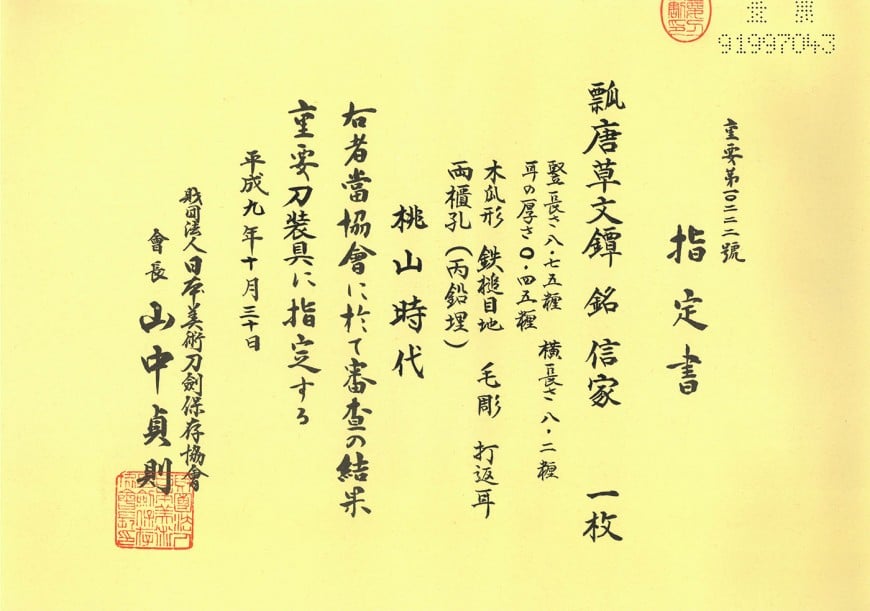
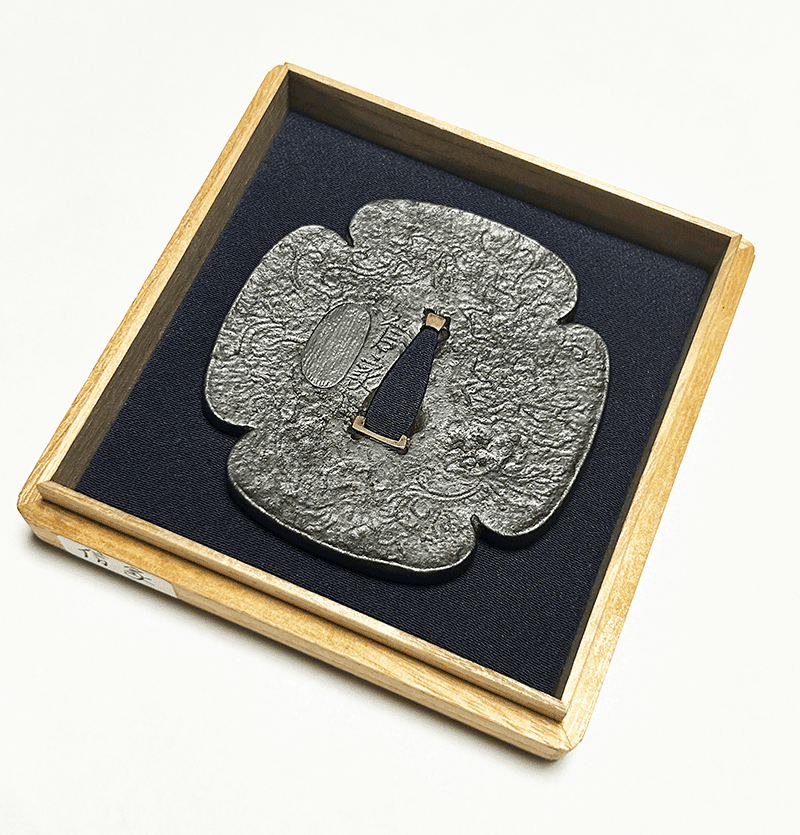
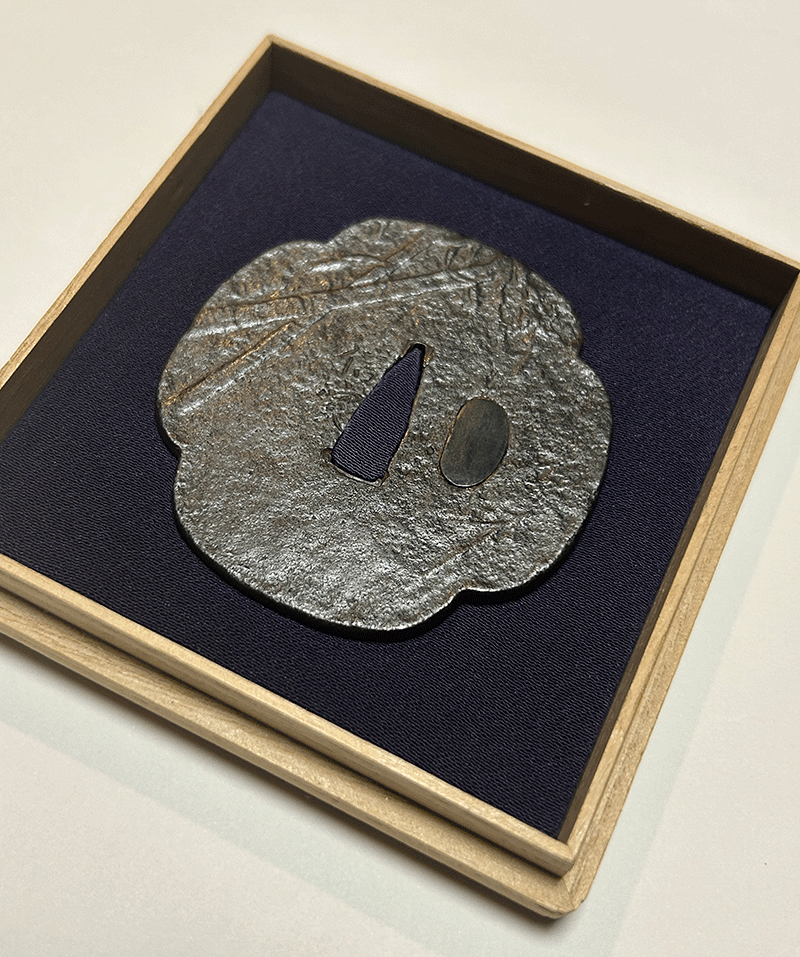
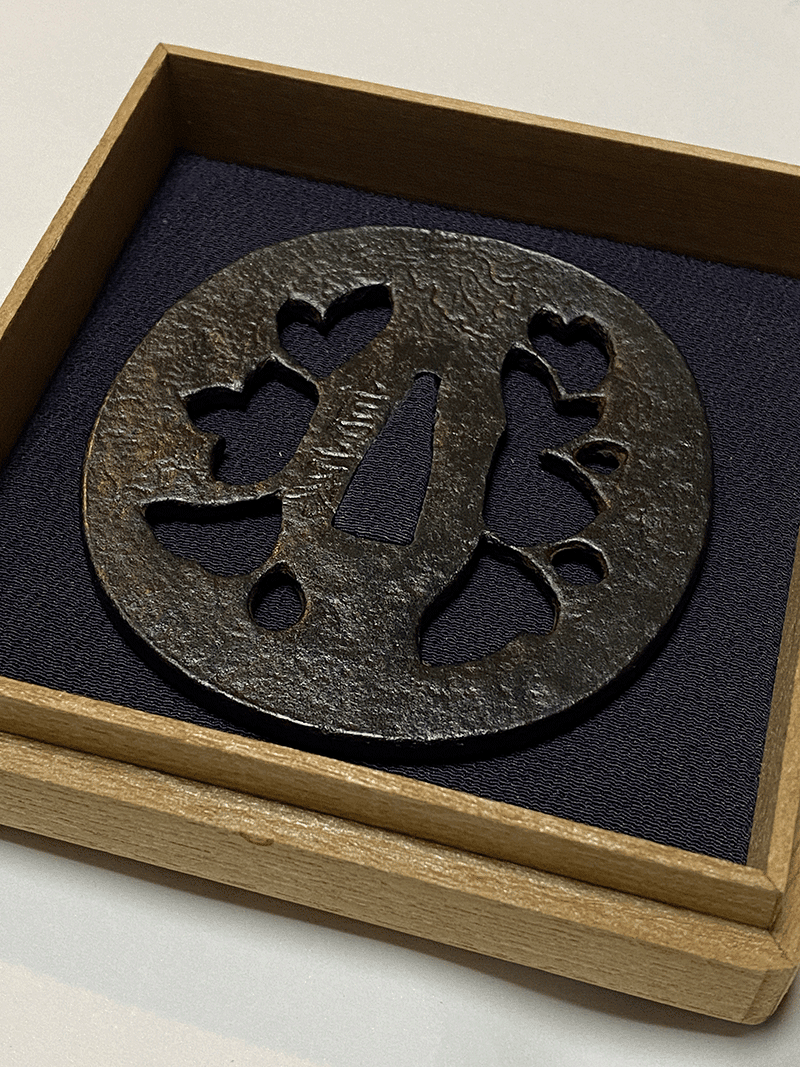
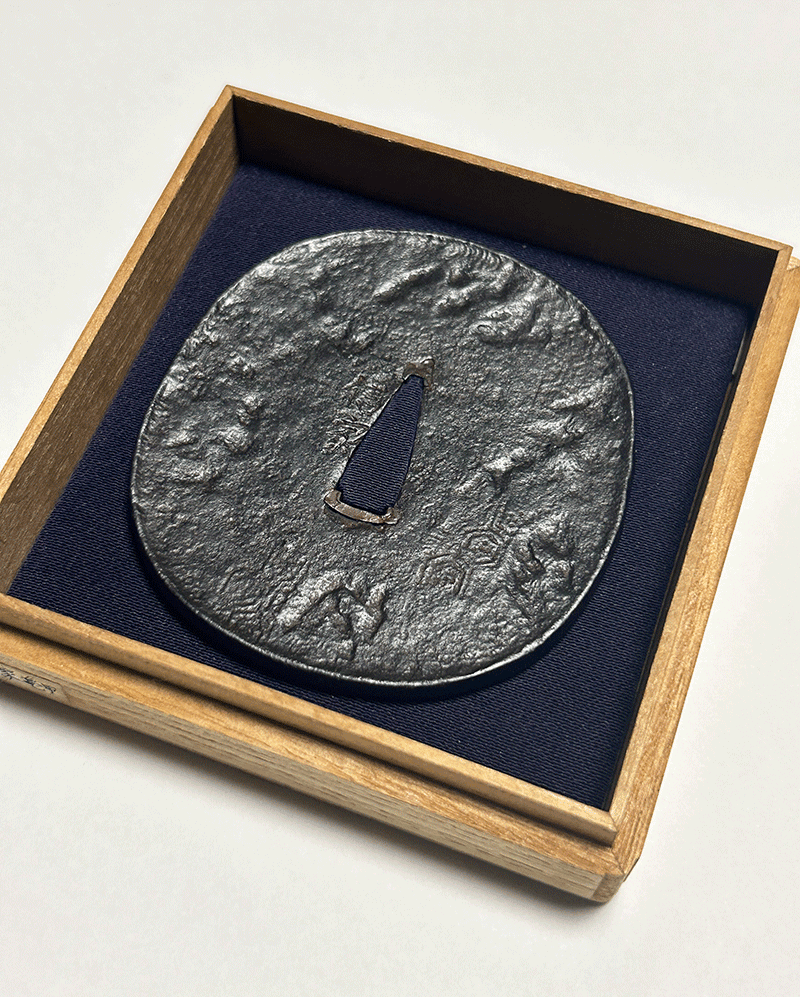
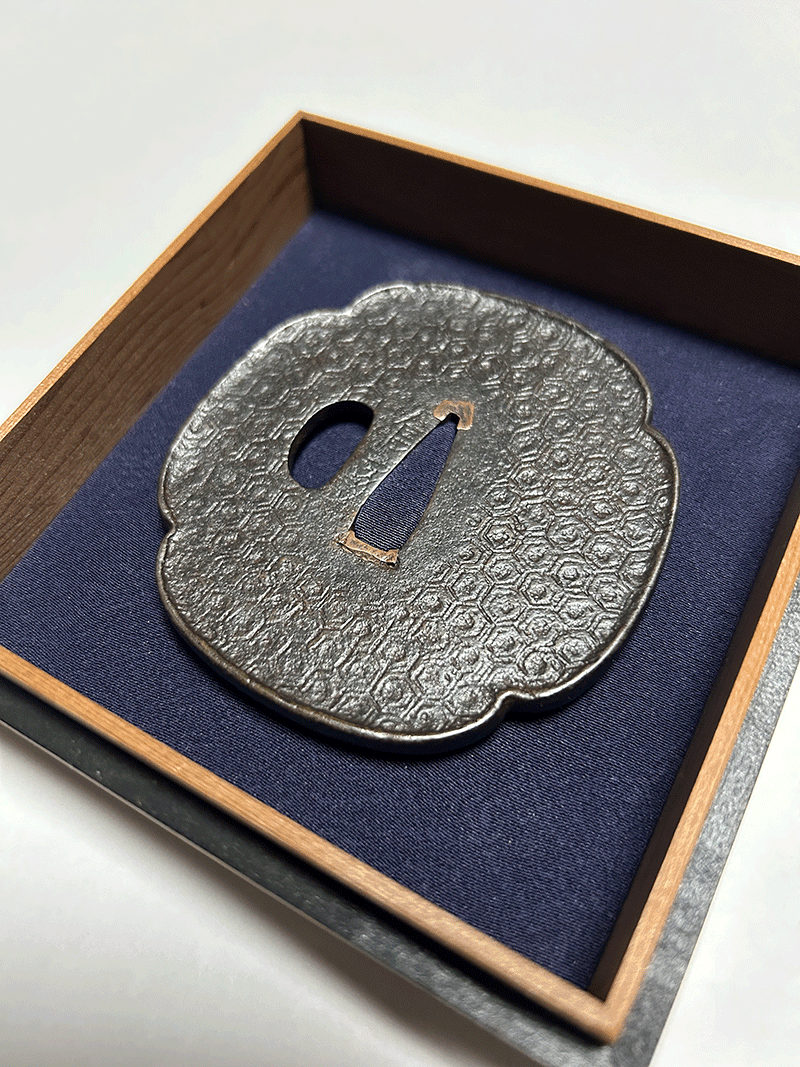
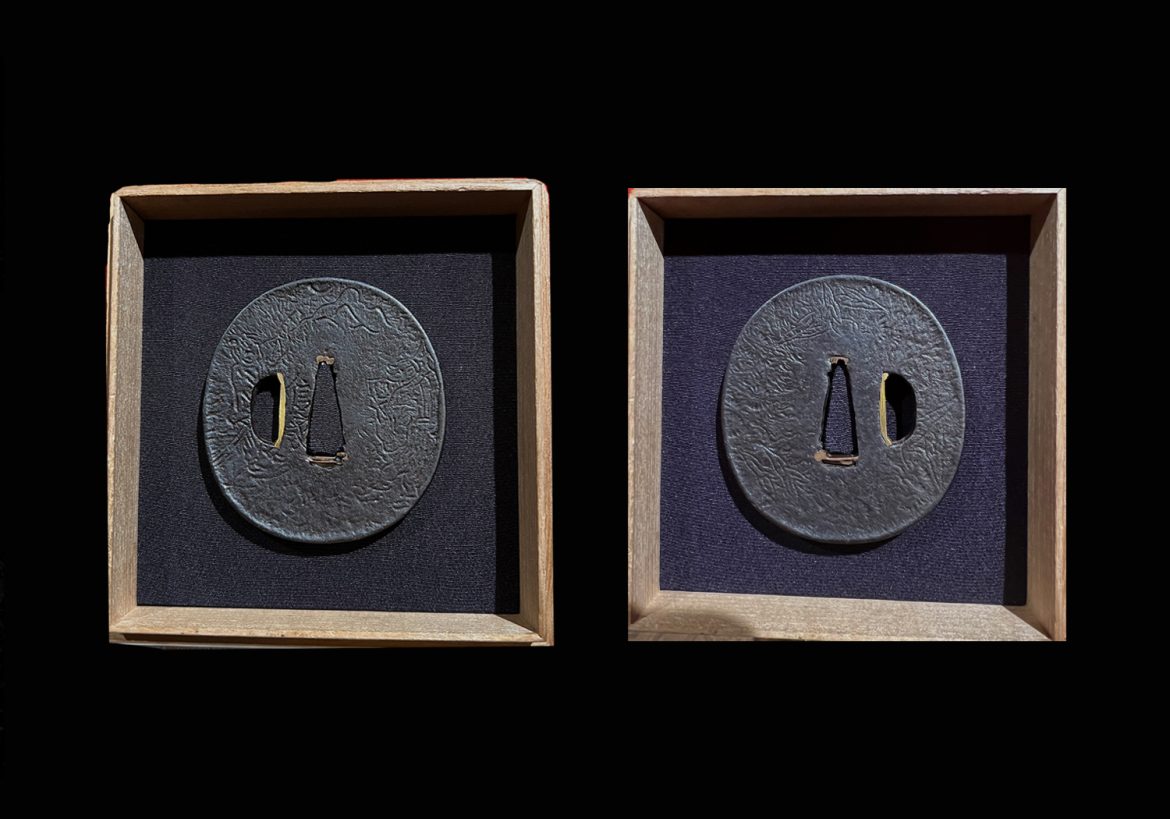
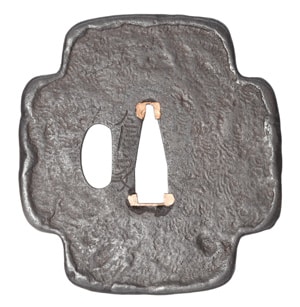
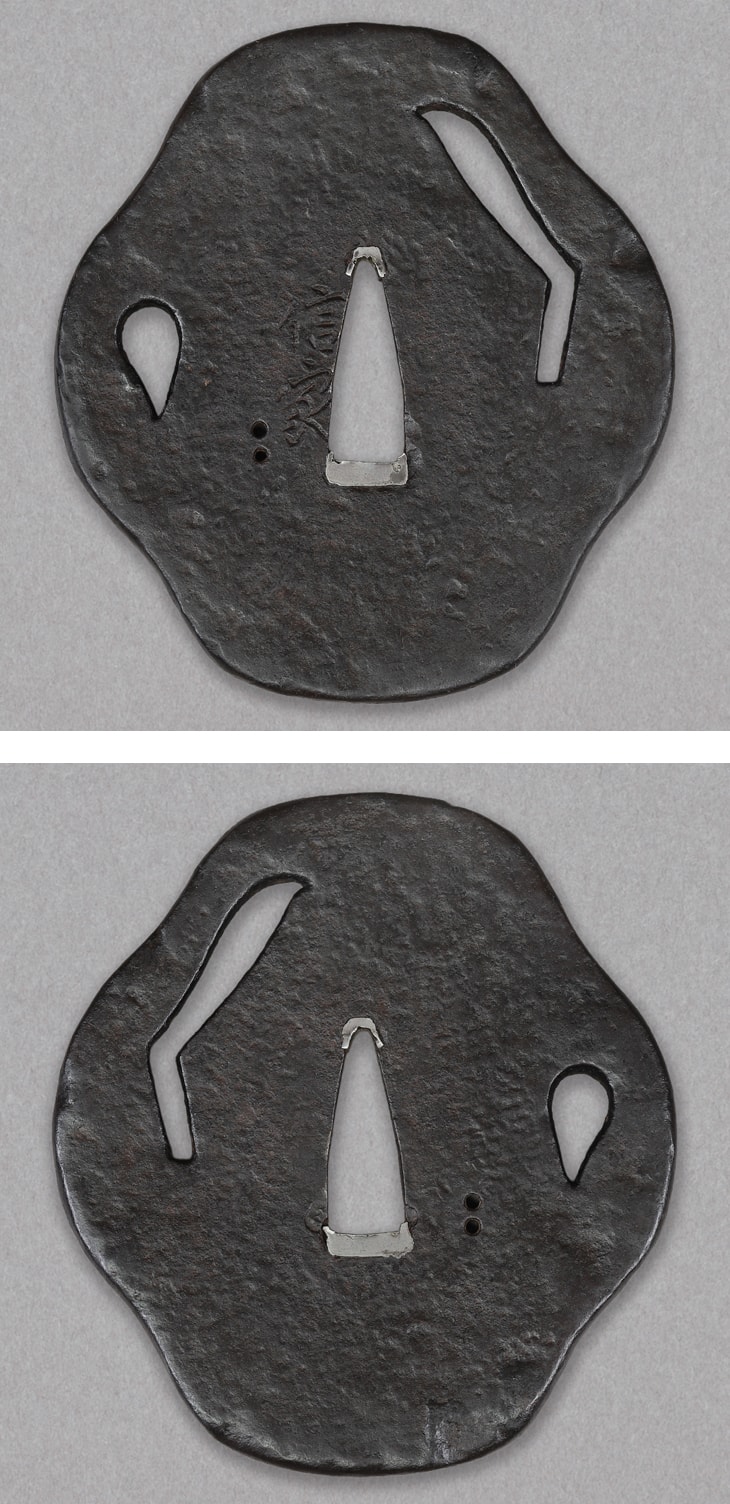
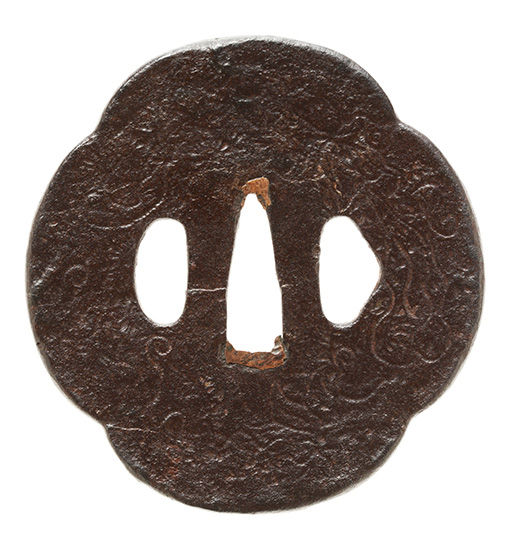
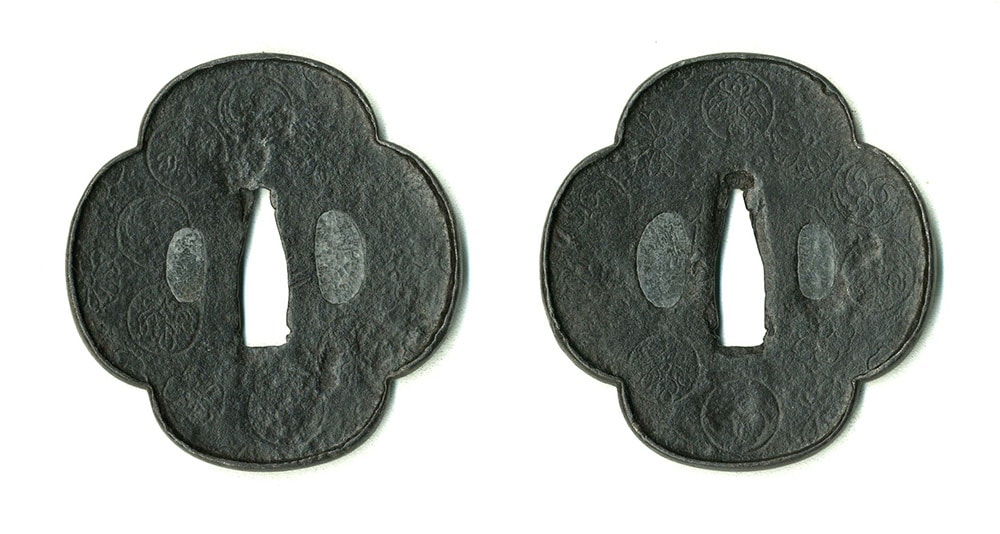
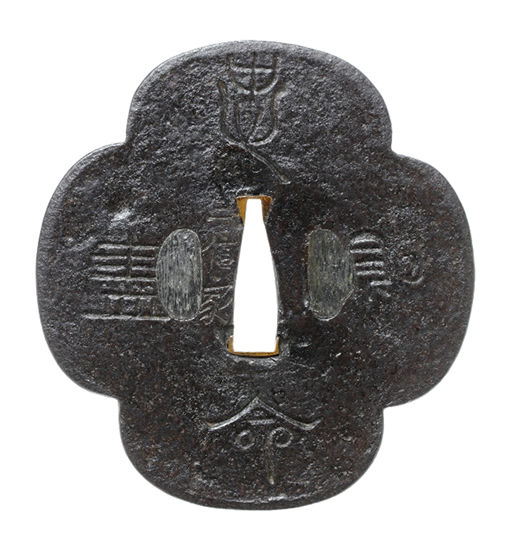
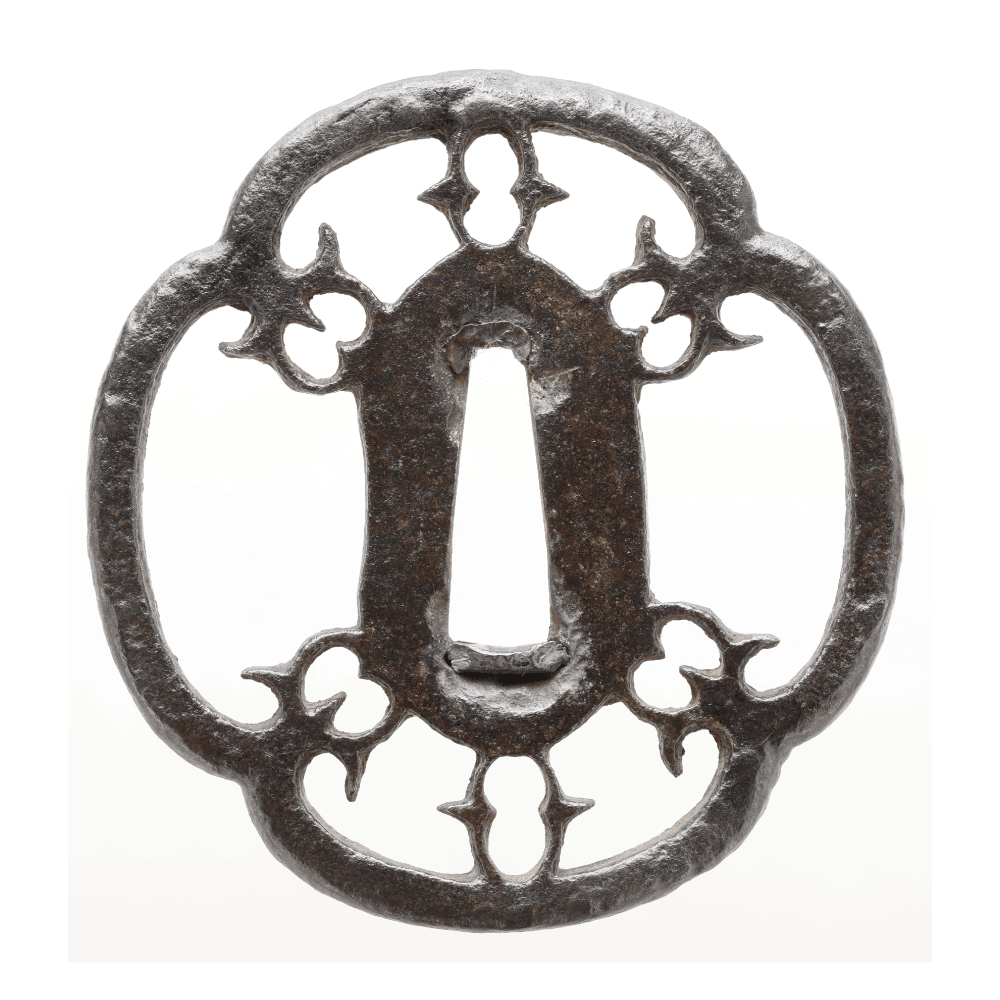
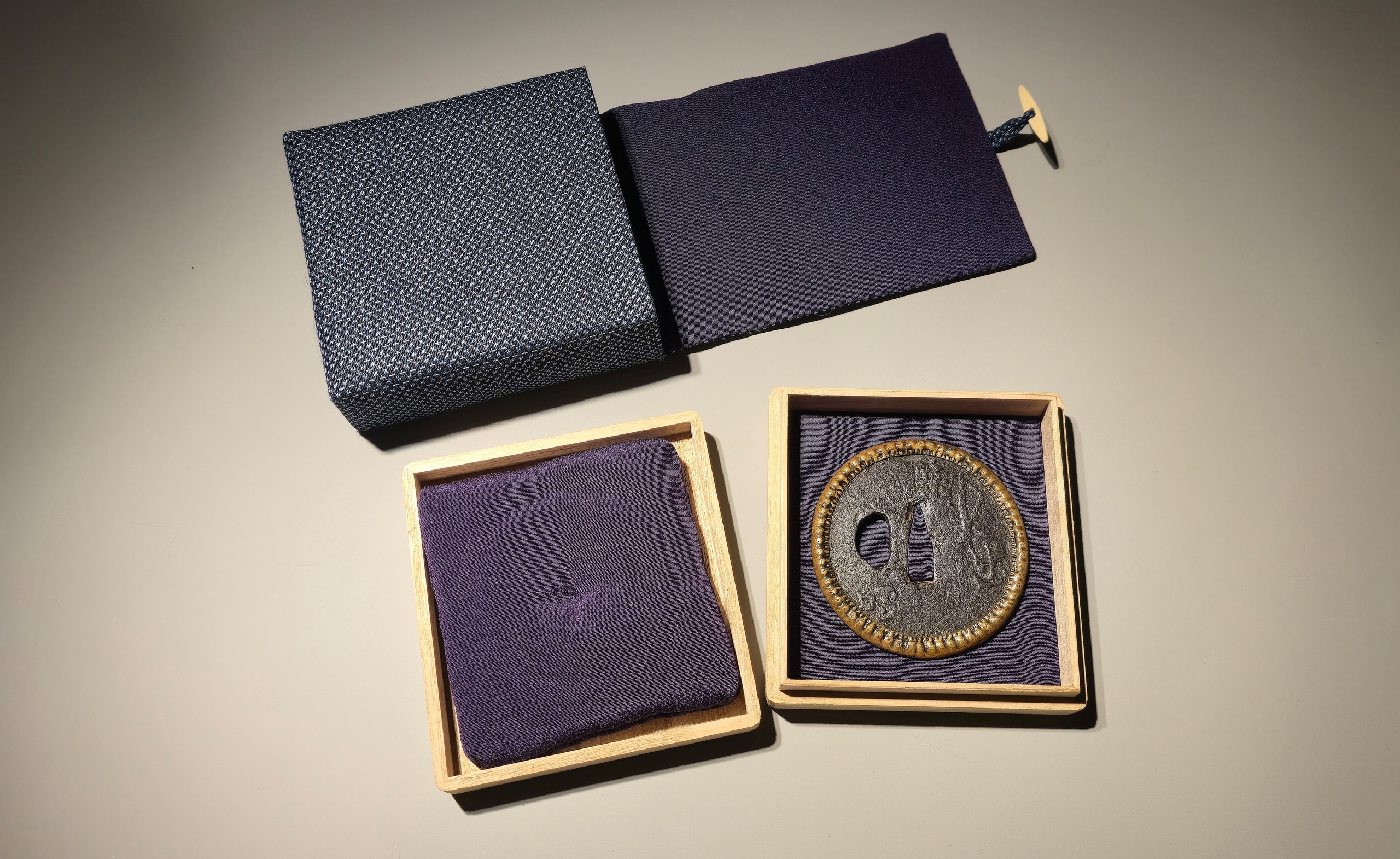
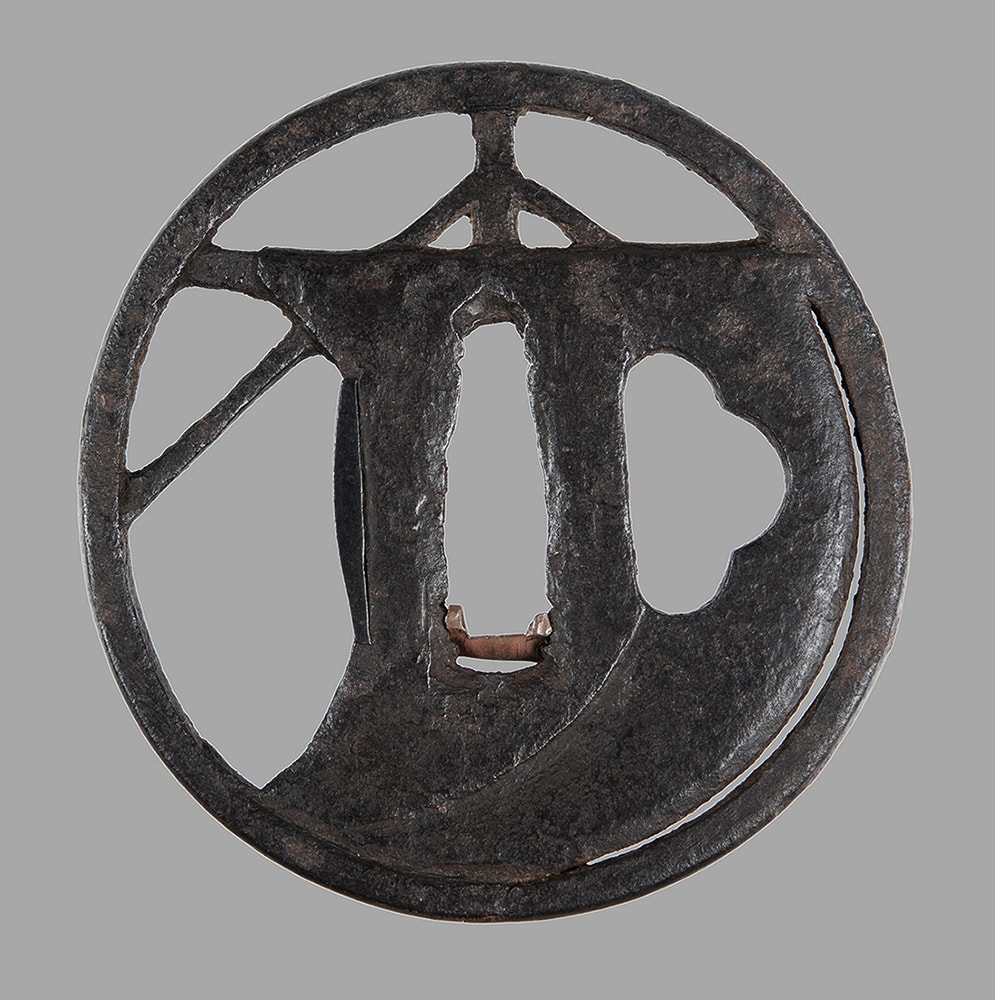
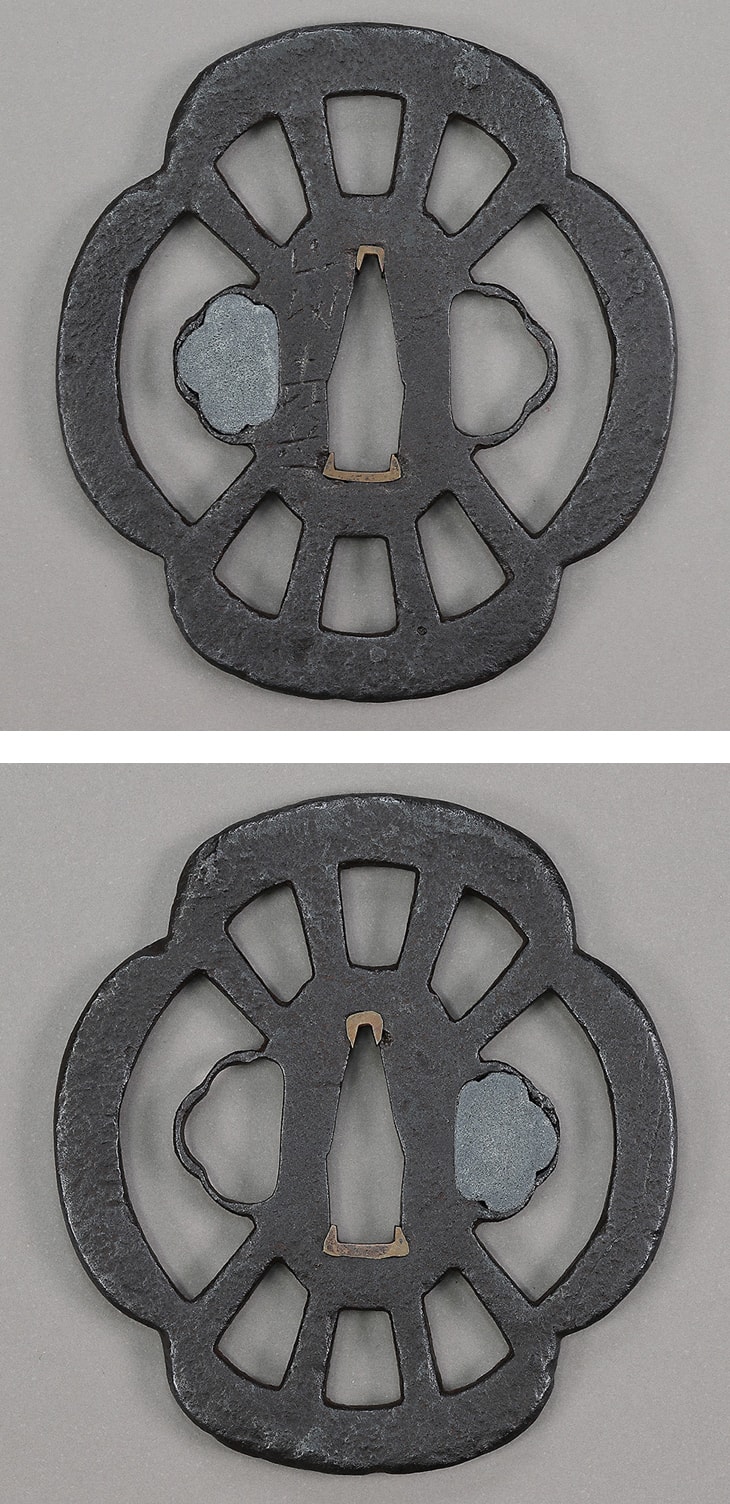
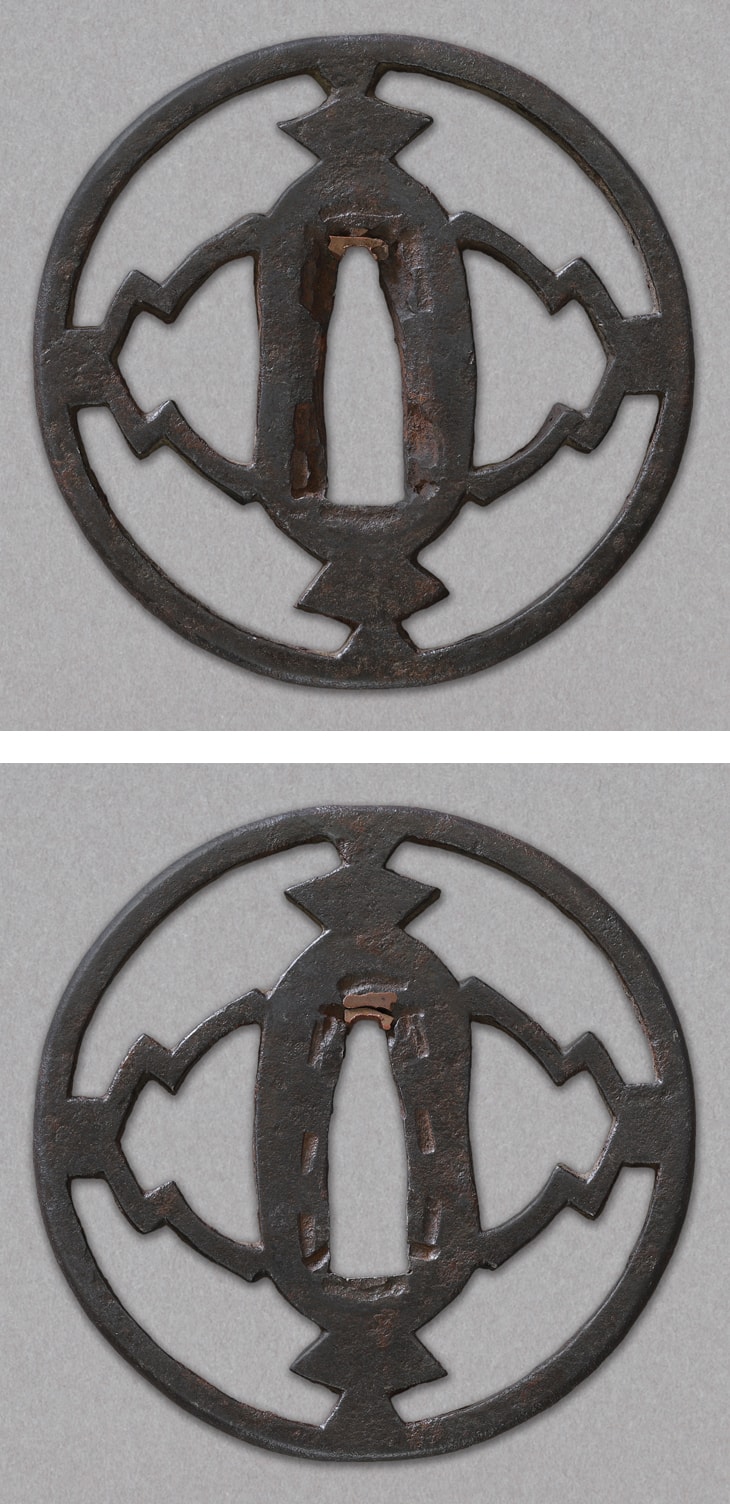
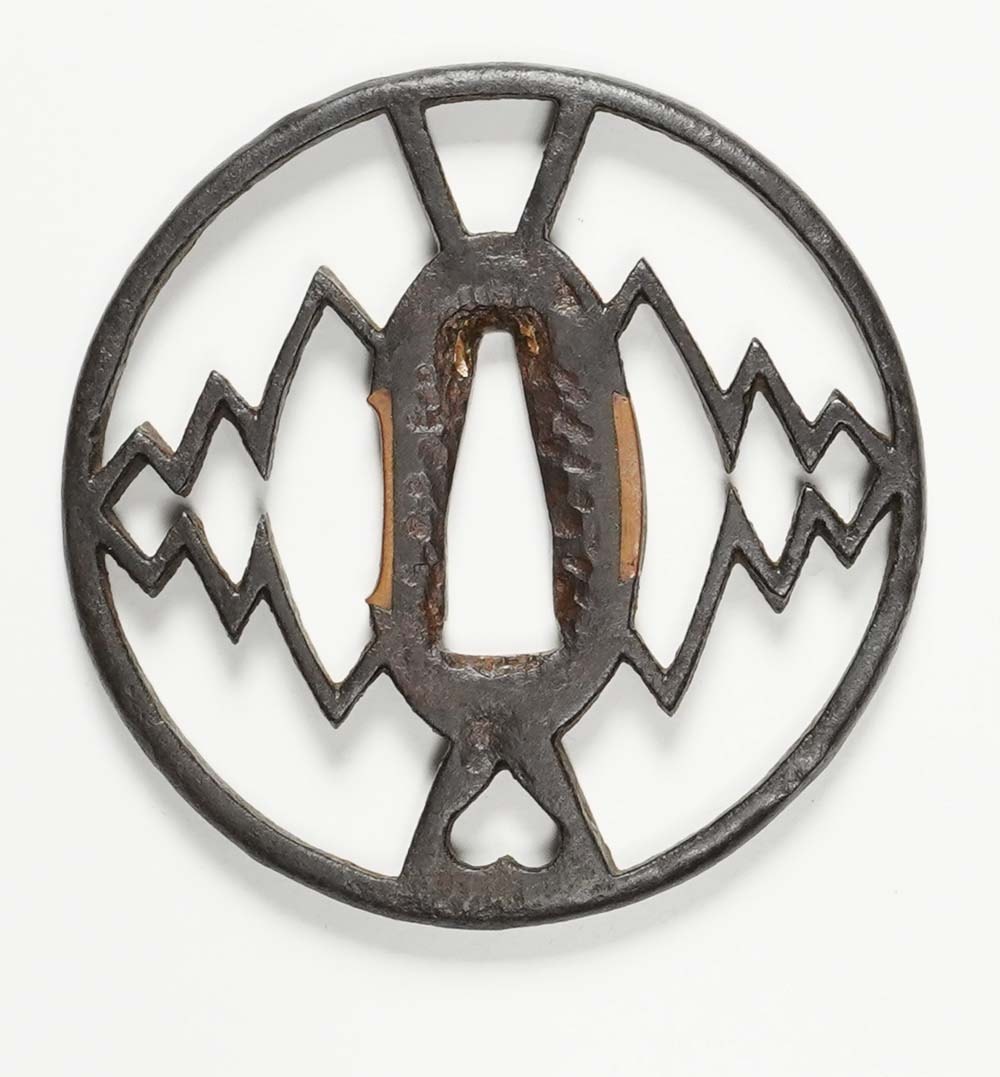
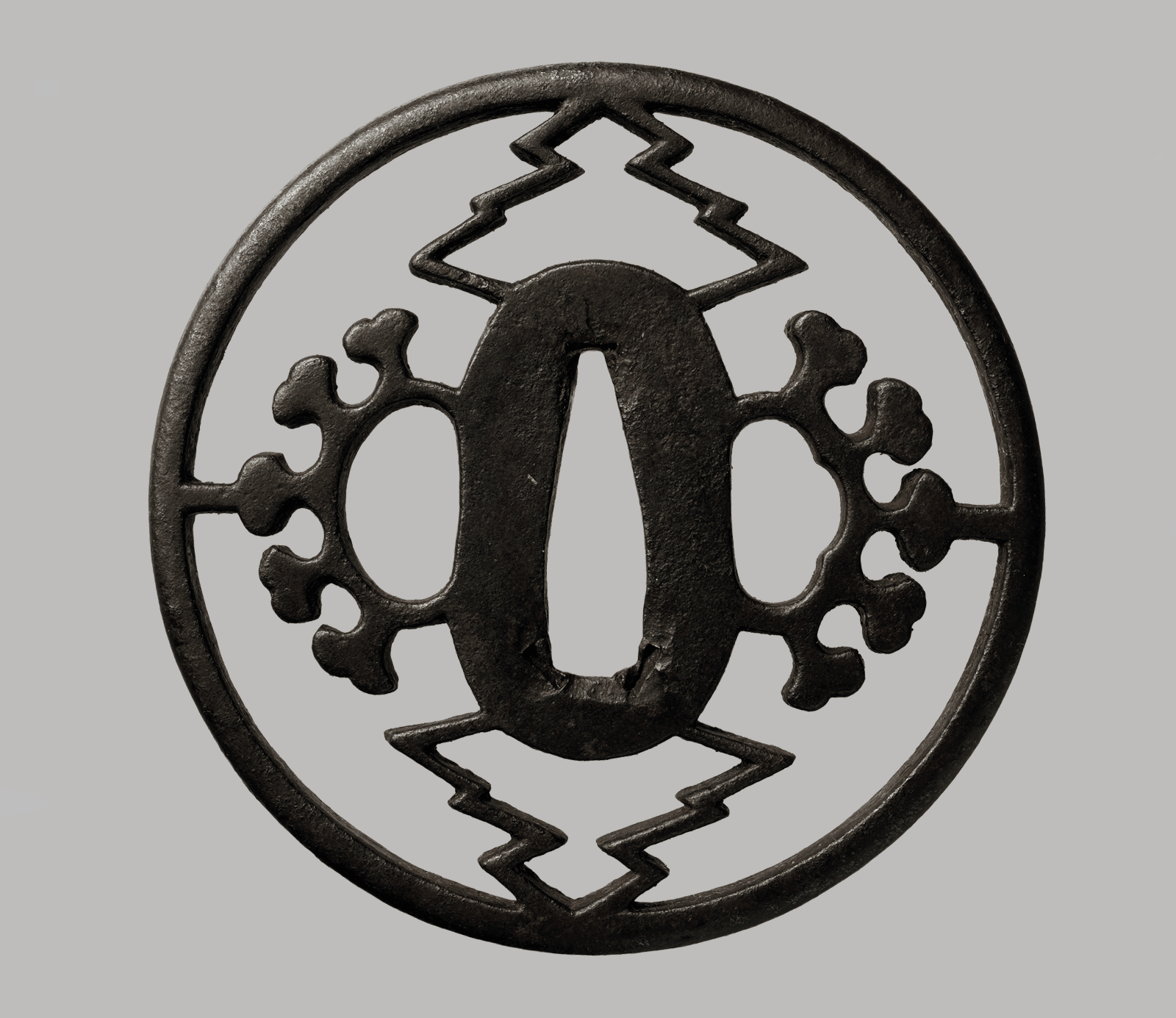
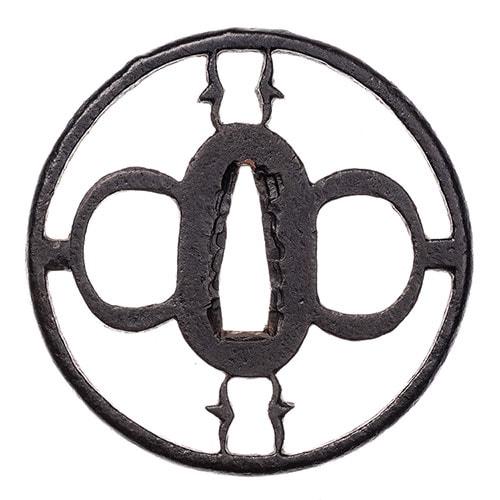
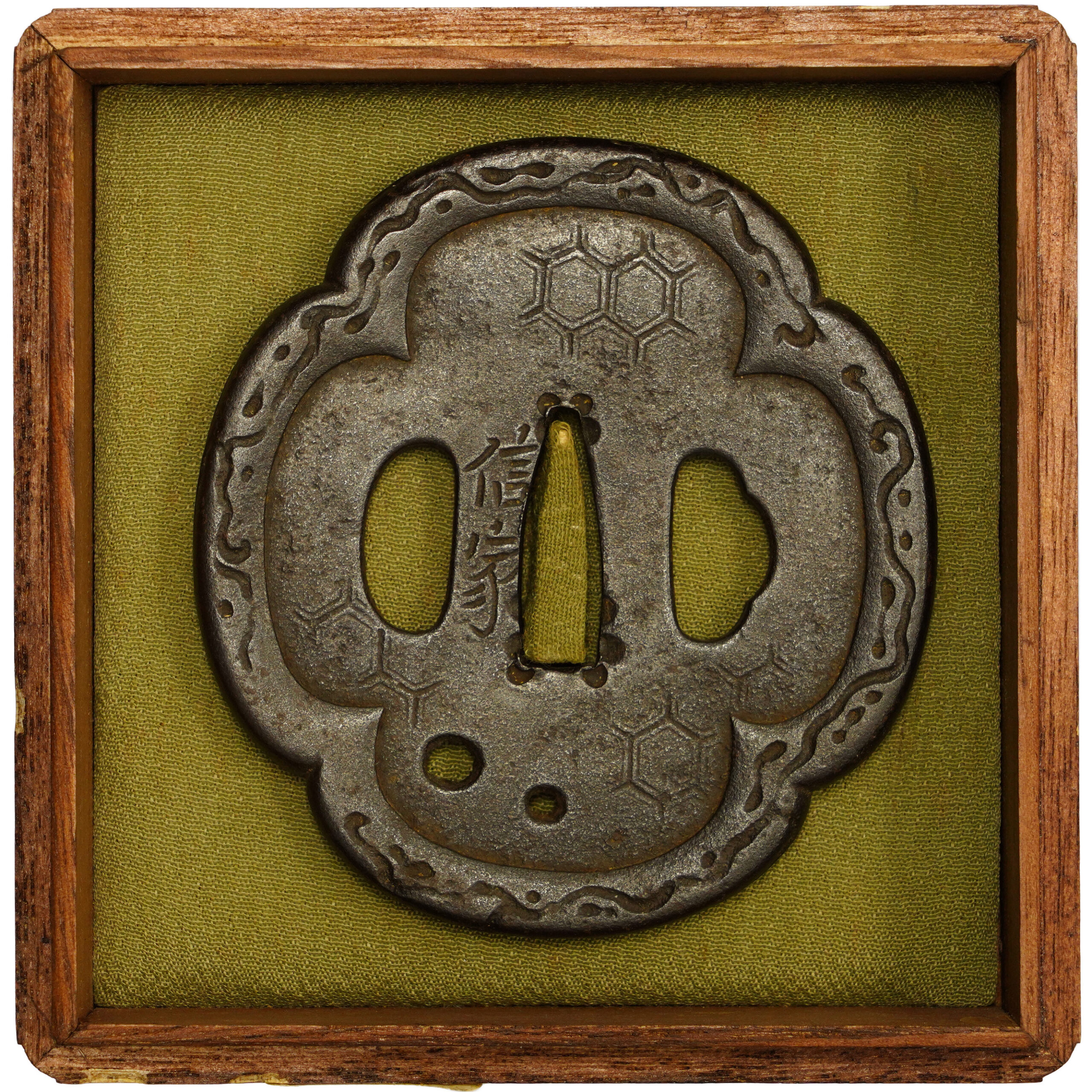
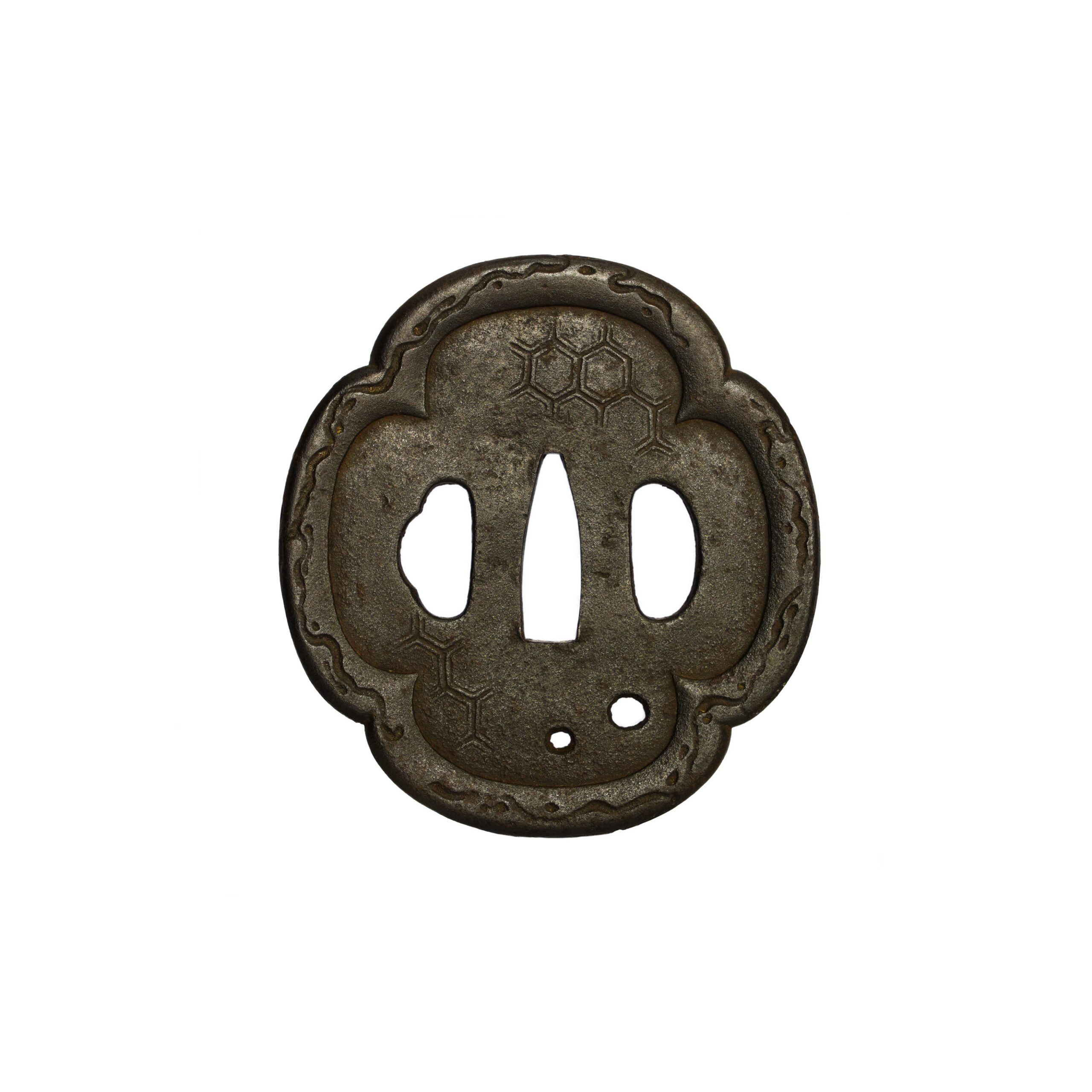
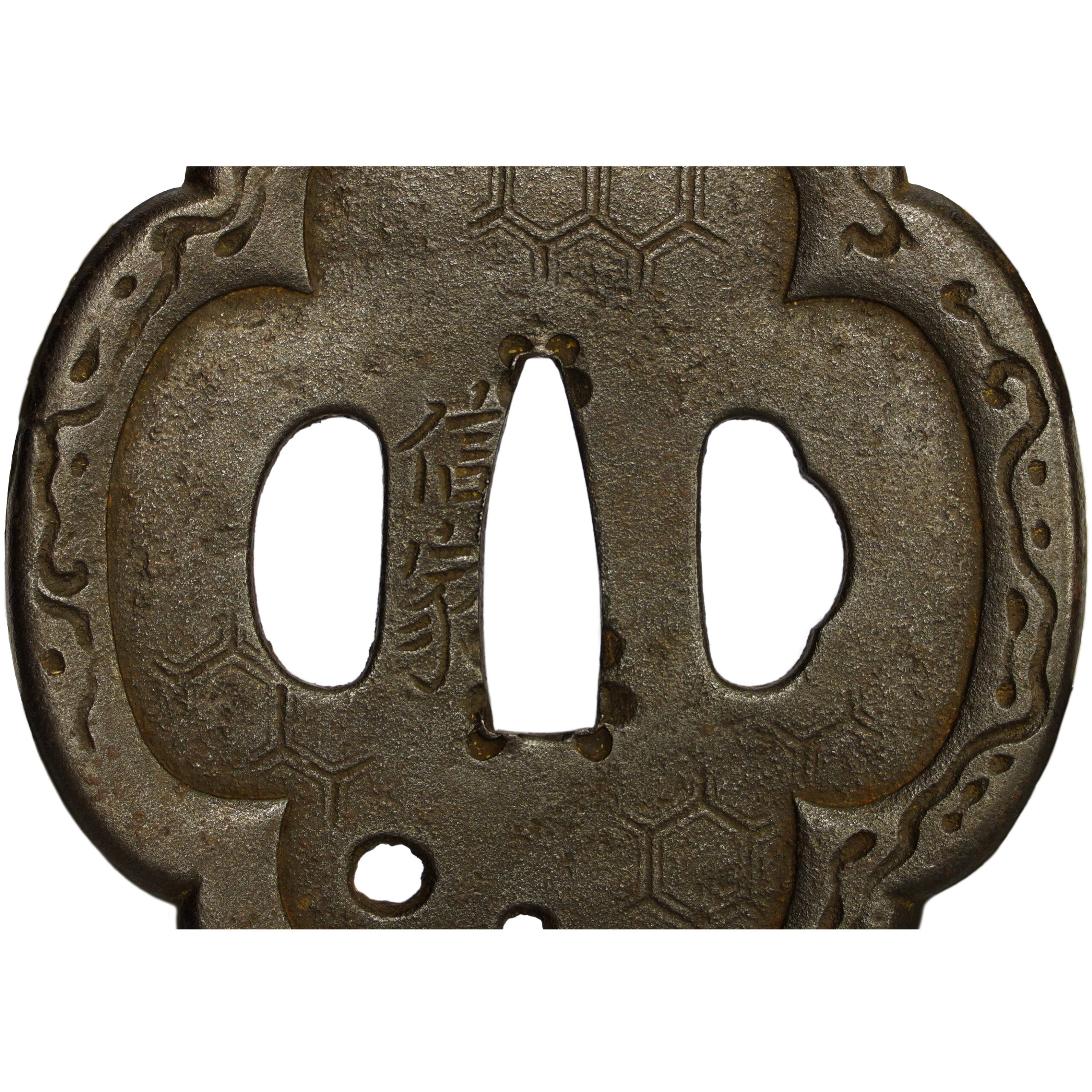
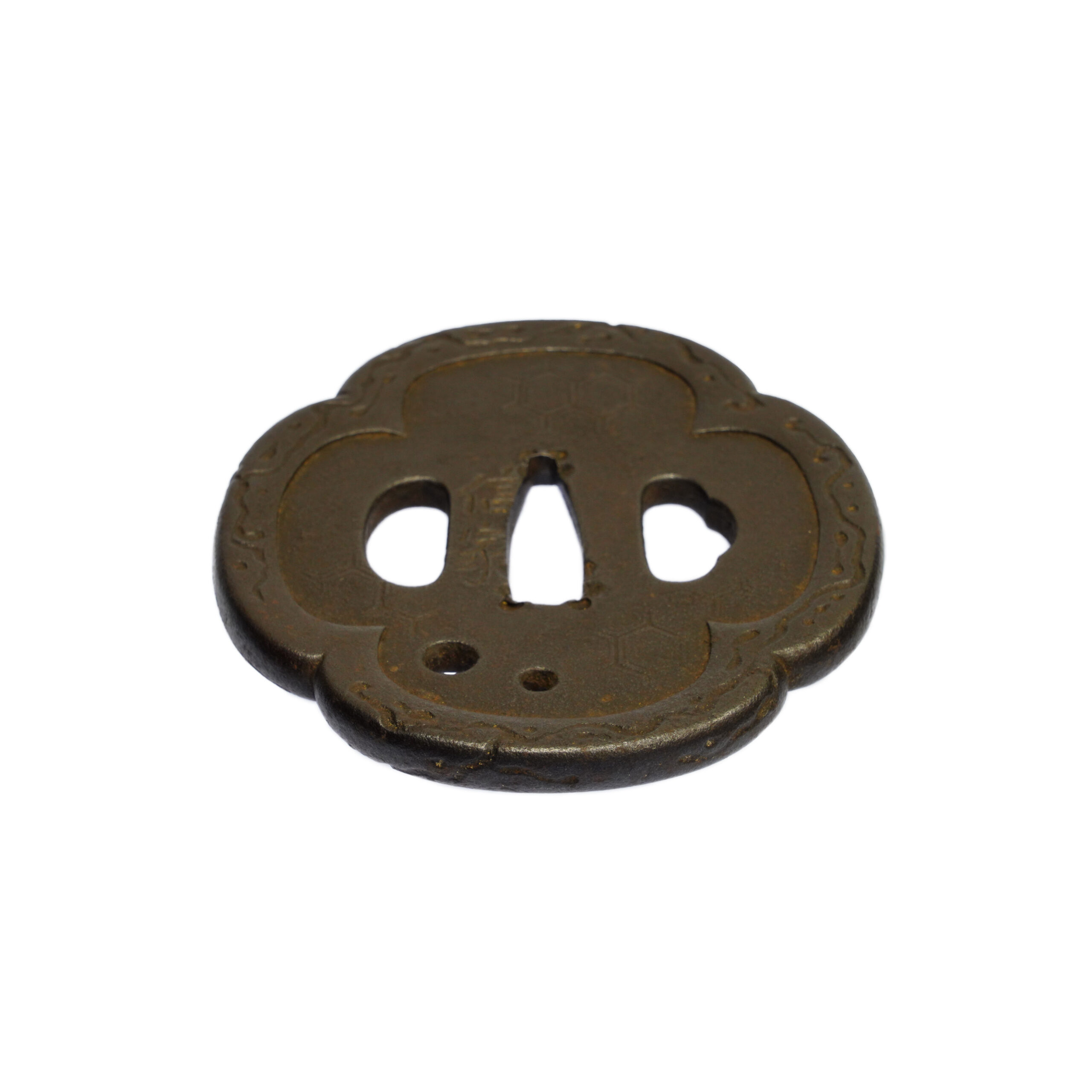
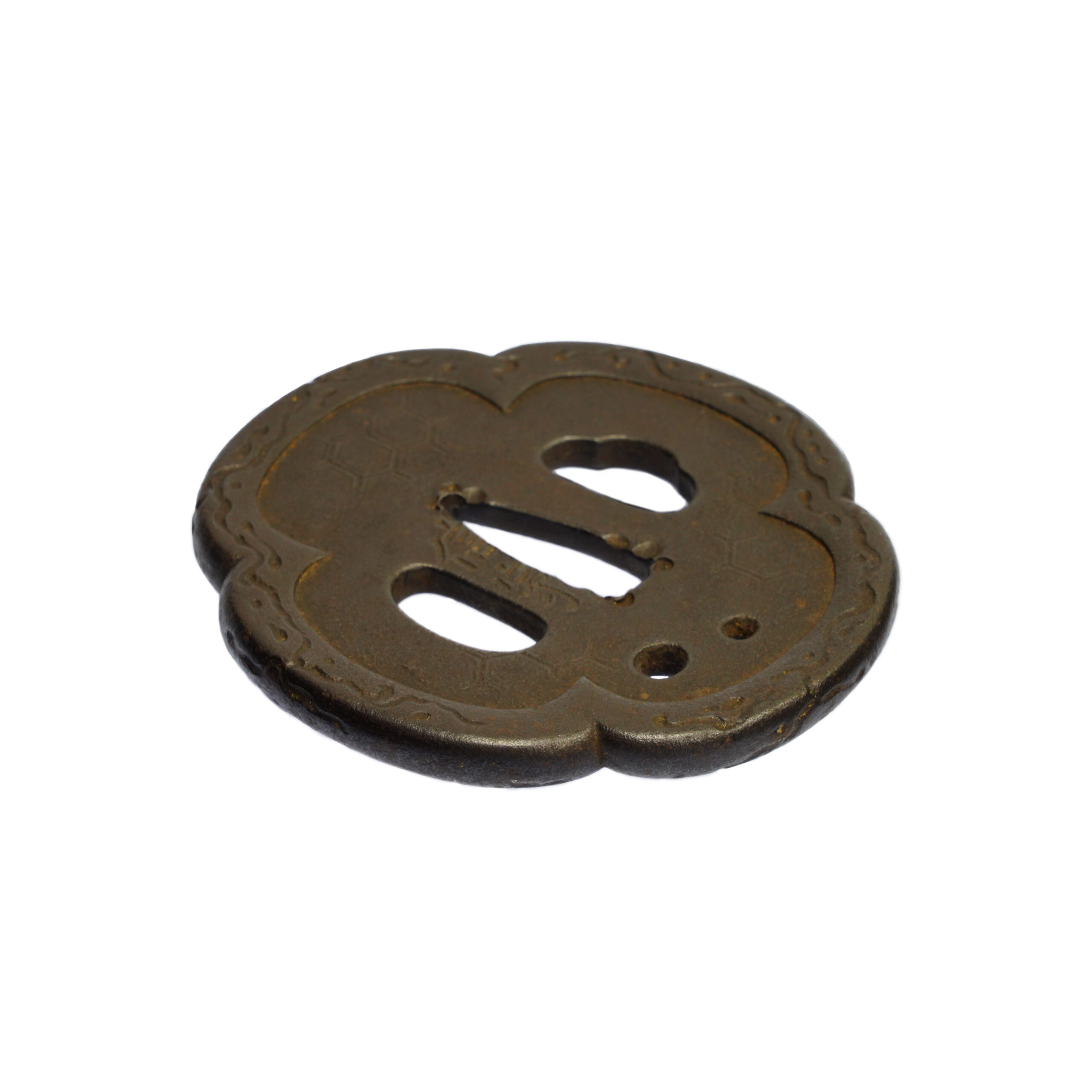
This antique iron tsuba features a mokkou shape with a thick mimi and a continuous hexagonal Kikkou Mon (turtle shell) pattern, symbolizing longevity and prosperity. It is signed by Nobuie (信家), a renowned tsuba maker from Owari province active from the late Muromachi to Momoyama period. The tsuba exhibits an elegant texture and well-preserved carvings, reflecting its age and craftsmanship.
 NihontoWatch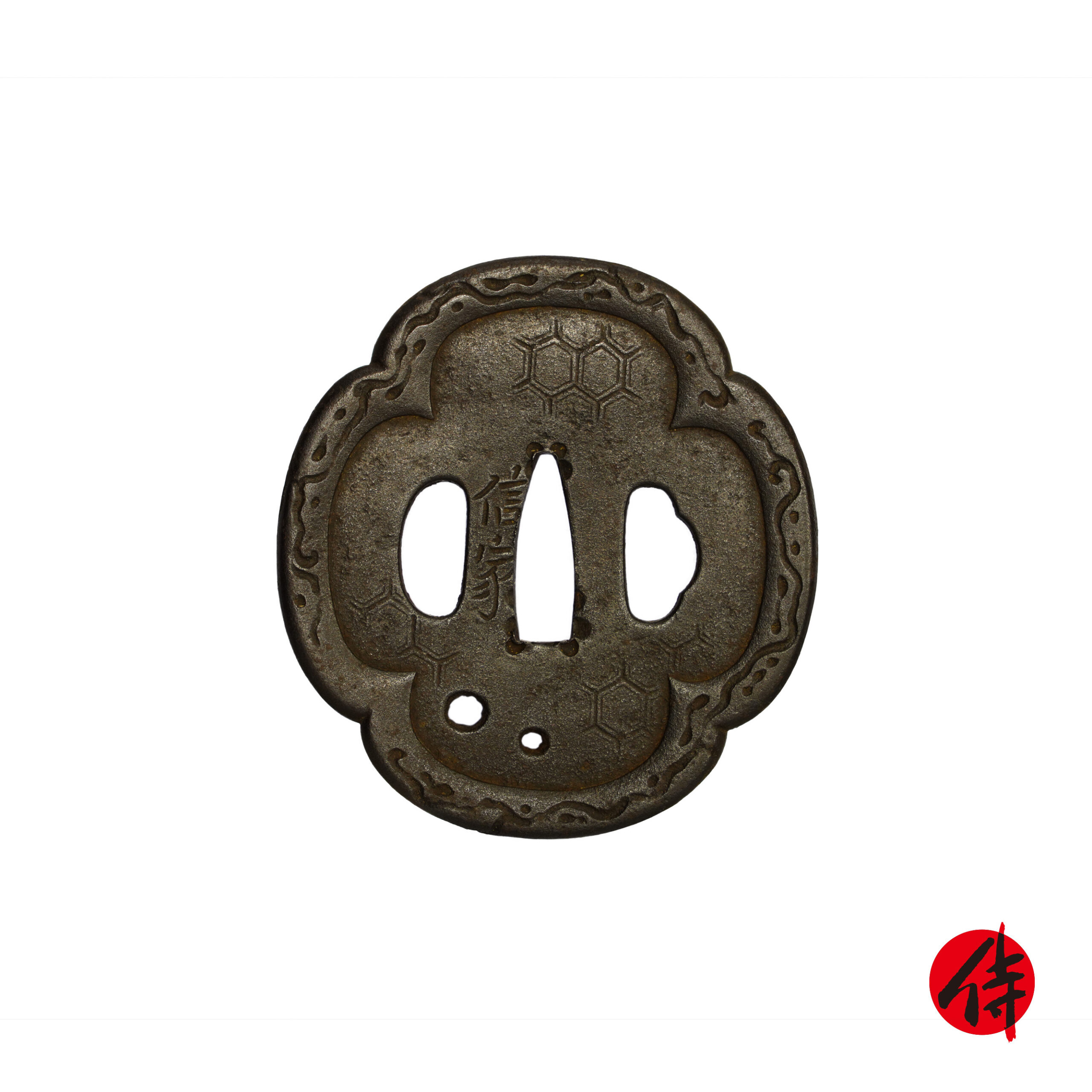
Nobuie
Momoyama, Eiroku-Tensho (1558-1592)
Owari
Signed
Iron-tsuba · Owari
11 pieces on the market now
Nobuie is an Owari Province tsubako active from the late Muromachi through the Momoyama period, celebrated alongside Kaneie of Kyoto-Fushimi as one of the "twin peaks" (soheki) of iron tsuba. He is associated with the Kofujita school. Where Kaneie pioneered the pictorial (e-fu) style and favored relatively thin plates, Nobuie's tsuba are generally thicker, possessing what the NBTHK repeatedly characterizes as "a strong sense of mass." His preferred forms are mokko-gata and maru-gata, with rarer variants including kemari-gata and the shodeigata type in which the lower edge flares outward. His signatures are almost always two-character mei, broadly divisible into two types: the hanare-mei ("spaced" or "detached" signature) and the futoji-mei ("bold-character" signature), each associated with distinct stylistic tendencies within his oeuvre.
The defining technical characteristic of Nobuie tsuba, affirmed across every NBTHK evaluation, is "the peerless quality of the forged iron": the surface texture yields "abundant visual effects" and the jihada presents rich "scenery" (jimon no keshiki). His plates are finished in tsuchime-ji (hammered ground), and the iron is worked to achieve a deep, weighty rust patina described as possessing "an elegant taste." Decorative repertoire includes kebori (hairline engraving) of floral motifs, scrolling karakusa, and kikkomon patterns, as well as sukidashi-bori (pushed-up relief) and occasional ji-sukashi (openwork through the plate). Among his most distinctive features are inscribed divine titles such as "Hachiman Daibosatsu" and the Nichiren invocation "Namu Myoho Renge Kyo," together with doka (didactic verses) expressing the essentials of swordsmanship and the prevailing thought of the Sengoku age. The uchikaeshi-mimi (turned-back rim) is singled out as a hallmark: "regarded as the very essence of Nobuie's art," its vigorous modeling and active tekkotsu (iron bones) serve to tighten the pictorial field and complete each work as a unified sculptural statement. His attention extends beyond surface quality to fully three-dimensional modeling, with the subtle nikudori (shaping of the plate) from rim inward toward the nakago-ana noted as "unique to Nobuie."
The NBTHK consistently positions Nobuie tsuba as "works through which one may most fully appreciate the allure of iron tsuba from the late Muromachi through Momoyama periods[[c:1]]." Evaluators praise a quality that transcends technical mastery: the iron is not merely well forged but communicates spiritual content, "quietly conveying the detached spiritual composure of the warrior who lived through the Warring States era." Individual pieces are said to evoke "the bearing of an old warrior" and a spirit akin to kenzen ichinyo (the unity of sword and Zen) and mushin (no-mind). The recurring evaluative refrain describes works that are simultaneously "forceful" and "elegant," combining "a powerful dignity" with "a rich antique fragrance." That these tsuba show to best advantage on uchigatana koshirae[[c:2]] -- the practical mounting of the Sengoku battlefield -- underscores the unity of martial function and aesthetic refinement that defines Nobuie's enduring significance within the tradition of Japanese iron tsuba.
Where Nobuie stands among comparable artisans: across all of nihontō, and within tradition, era, and period. The tiers (Foremost · Leading · Major · Notable) weigh official designations from the NBTHK and Japan's Agency for Cultural Affairs, together with historical honors of lasting repute such as the Sansaku and Meibutsu-chō.
Select a lens to see how it's measured.
Iron-tsuba · Owari
93 pieces on the market now
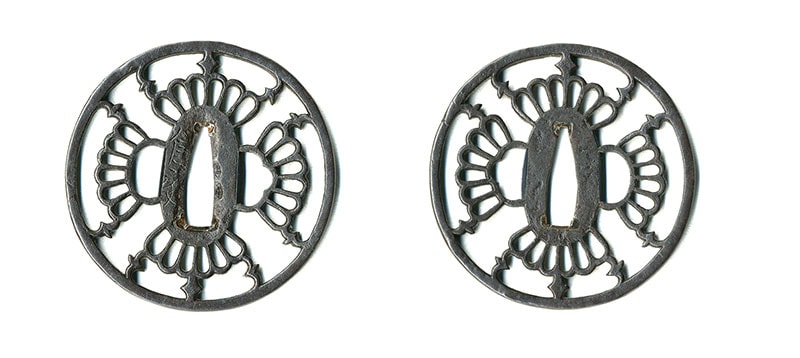
The Owari school represents one of the twin pillars of Japanese iron openwork tsuba production, standing alongside the Kyō tradition as a defining force in the art of ji-sukashi (ground openwork) guards. The school's origins lie in the Owari province (modern Aichi prefecture), where production began in the early to middle Muromachi period and continued across a sustained span extending into the Edo period. While Kyō sukashi is characterized by delicacy and graceful elegance, Owari guards distinguish themselves through a tasteful refinement that conceals inner strength—a quality often described as possessing both dignity and rustic vigor. The tradition's most celebrated artisan, Yamakichibee, worked alongside contemporaries such as Hoan to establish technical standards that would define the school's reputation. Early signatures appear in forms such as "Yamasaka Kichibee" and abbreviated variants "Yama Kichibee," with the character へ understood as a shortening of 衛, suggesting generational succession across the late Muromachi and Momoyama periods. The technical achievements of Owari tsuba center on the mastery of iron itself, expressed through distinctive forging methods and surface treatment. The school's craftsmen employed a characteristic modeling technique called nikuoki, in which the central area of the plate is made slightly lower while the outer rim is raised, creating subtle variations in relief that enhance both visual depth and structural integrity.
This treatment is complemented by the dramatic appearance of tekkotsu (iron bones)—crystalline grain structures that emerge along the kaku-mimi ko-niku rim (angular rim with slight rounding) through controlled annealing or yakite finishing. These iron bones manifest in multiple forms: granular, clumped, linear, and pronounced masame (straight-grain) patterns, often appearing in lively activity across both the rim and the plate surface. The forged iron develops a deep, thick purple rust patina (murasaki-sabi) of exceptional beauty, while the plate itself may be finished with tsuchime (hammer texturing) or gently dished surfaces that create a melting, softened effect. The school's openwork compositions range from geometric patterned designs—such as flower petals, kozane (lamellar scales), and net patterns (amime-sukashi)—to boldly pictorial narratives incorporating the seppa-dai into unified compositions depicting catfish (namazu), crabs, wild geese (karigane), and literary themes such as the "Mount Utsu" scene from the Ise monogatari. The Owari tradition's influence extended well beyond the technical sphere, establishing aesthetic standards that defined connoisseurship and collecting practices for centuries. The school's guards were prized for what setsumei authors describe as an "antique, tasteful character" (koga no ajiwai)—a quality combining power, compact control, and the subtle fascination of fine iron that set them apart from contemporaneous work. While the school's original strengths began to diminish from the beginning of the Edo period, mature-phase examples from the late Muromachi and Momoyama periods demonstrate the full range of Owari excellence: stately presence achieved through imposing forms and thick construction, dynamic spatial effects created through kage-sukashi (shadow-like silhouette piercing), and an audacious, unconventional character that attracted eccentric taste (sukisha). Learn more →
| Smith | Era | Designated |
|---|---|---|
| Nobuie信家 | — | 56 |
| Sadahiro貞広 | — | 1 |
| Tomoyasu友休 | 1670 | 1 |
| Nobuie信家 | 1588 | 2 |
| Jizaemon次左衛門 | — | 0 |
We could not find an authenticity certificate on the seller’s listing. Japanese swords and fittings are normally papered by the NBTHK (or the NTHK). Without one, the attribution is the seller’s own assessment and has not been independently verified — treat it with caution and ask the dealer about certification before buying.
Returns/exchanges limited to defects caused by shipping (except willful misconduct or gross negligence by the company); customers must contact within 72 hours of receiving the product.
This antique iron tsuba features a mokkou shape with a thick mimi and a continuous hexagonal Kikkou Mon (turtle shell) pattern, symbolizing longevity and prosperity. It is signed by Nobuie (信家), a renowned tsuba maker from Owari province active from the late Muromachi to Momoyama period. The tsuba exhibits an elegant texture and well-preserved carvings, reflecting its age and craftsmanship.
NihontoWatchNobuie
Momoyama, Eiroku-Tensho (1558-1592)
Owari
Signed
Iron-tsuba · Owari
11 pieces on the market now
Nobuie is an Owari Province tsubako active from the late Muromachi through the Momoyama period, celebrated alongside Kaneie of Kyoto-Fushimi as one of the "twin peaks" (soheki) of iron tsuba. He is associated with the Kofujita school. Where Kaneie pioneered the pictorial (e-fu) style and favored relatively thin plates, Nobuie's tsuba are generally thicker, possessing what the NBTHK repeatedly characterizes as "a strong sense of mass." His preferred forms are mokko-gata and maru-gata, with rarer variants including kemari-gata and the shodeigata type in which the lower edge flares outward. His signatures are almost always two-character mei, broadly divisible into two types: the hanare-mei ("spaced" or "detached" signature) and the futoji-mei ("bold-character" signature), each associated with distinct stylistic tendencies within his oeuvre.
The defining technical characteristic of Nobuie tsuba, affirmed across every NBTHK evaluation, is "the peerless quality of the forged iron": the surface texture yields "abundant visual effects" and the jihada presents rich "scenery" (jimon no keshiki). His plates are finished in tsuchime-ji (hammered ground), and the iron is worked to achieve a deep, weighty rust patina described as possessing "an elegant taste." Decorative repertoire includes kebori (hairline engraving) of floral motifs, scrolling karakusa, and kikkomon patterns, as well as sukidashi-bori (pushed-up relief) and occasional ji-sukashi (openwork through the plate). Among his most distinctive features are inscribed divine titles such as "Hachiman Daibosatsu" and the Nichiren invocation "Namu Myoho Renge Kyo," together with doka (didactic verses) expressing the essentials of swordsmanship and the prevailing thought of the Sengoku age. The uchikaeshi-mimi (turned-back rim) is singled out as a hallmark: "regarded as the very essence of Nobuie's art," its vigorous modeling and active tekkotsu (iron bones) serve to tighten the pictorial field and complete each work as a unified sculptural statement. His attention extends beyond surface quality to fully three-dimensional modeling, with the subtle nikudori (shaping of the plate) from rim inward toward the nakago-ana noted as "unique to Nobuie."
The NBTHK consistently positions Nobuie tsuba as "works through which one may most fully appreciate the allure of iron tsuba from the late Muromachi through Momoyama periods[[c:1]]." Evaluators praise a quality that transcends technical mastery: the iron is not merely well forged but communicates spiritual content, "quietly conveying the detached spiritual composure of the warrior who lived through the Warring States era." Individual pieces are said to evoke "the bearing of an old warrior" and a spirit akin to kenzen ichinyo (the unity of sword and Zen) and mushin (no-mind). The recurring evaluative refrain describes works that are simultaneously "forceful" and "elegant," combining "a powerful dignity" with "a rich antique fragrance." That these tsuba show to best advantage on uchigatana koshirae[[c:2]] -- the practical mounting of the Sengoku battlefield -- underscores the unity of martial function and aesthetic refinement that defines Nobuie's enduring significance within the tradition of Japanese iron tsuba.
Where Nobuie stands among comparable artisans: across all of nihontō, and within tradition, era, and period. The tiers (Foremost · Leading · Major · Notable) weigh official designations from the NBTHK and Japan's Agency for Cultural Affairs, together with historical honors of lasting repute such as the Sansaku and Meibutsu-chō.
Select a lens to see how it's measured.
Iron-tsuba · Owari
93 pieces on the market now
The Owari school represents one of the twin pillars of Japanese iron openwork tsuba production, standing alongside the Kyō tradition as a defining force in the art of ji-sukashi (ground openwork) guards. The school's origins lie in the Owari province (modern Aichi prefecture), where production began in the early to middle Muromachi period and continued across a sustained span extending into the Edo period. While Kyō sukashi is characterized by delicacy and graceful elegance, Owari guards distinguish themselves through a tasteful refinement that conceals inner strength—a quality often described as possessing both dignity and rustic vigor. The tradition's most celebrated artisan, Yamakichibee, worked alongside contemporaries such as Hoan to establish technical standards that would define the school's reputation. Early signatures appear in forms such as "Yamasaka Kichibee" and abbreviated variants "Yama Kichibee," with the character へ understood as a shortening of 衛, suggesting generational succession across the late Muromachi and Momoyama periods. The technical achievements of Owari tsuba center on the mastery of iron itself, expressed through distinctive forging methods and surface treatment. The school's craftsmen employed a characteristic modeling technique called nikuoki, in which the central area of the plate is made slightly lower while the outer rim is raised, creating subtle variations in relief that enhance both visual depth and structural integrity.
This treatment is complemented by the dramatic appearance of tekkotsu (iron bones)—crystalline grain structures that emerge along the kaku-mimi ko-niku rim (angular rim with slight rounding) through controlled annealing or yakite finishing. These iron bones manifest in multiple forms: granular, clumped, linear, and pronounced masame (straight-grain) patterns, often appearing in lively activity across both the rim and the plate surface. The forged iron develops a deep, thick purple rust patina (murasaki-sabi) of exceptional beauty, while the plate itself may be finished with tsuchime (hammer texturing) or gently dished surfaces that create a melting, softened effect. The school's openwork compositions range from geometric patterned designs—such as flower petals, kozane (lamellar scales), and net patterns (amime-sukashi)—to boldly pictorial narratives incorporating the seppa-dai into unified compositions depicting catfish (namazu), crabs, wild geese (karigane), and literary themes such as the "Mount Utsu" scene from the Ise monogatari. The Owari tradition's influence extended well beyond the technical sphere, establishing aesthetic standards that defined connoisseurship and collecting practices for centuries. The school's guards were prized for what setsumei authors describe as an "antique, tasteful character" (koga no ajiwai)—a quality combining power, compact control, and the subtle fascination of fine iron that set them apart from contemporaneous work. While the school's original strengths began to diminish from the beginning of the Edo period, mature-phase examples from the late Muromachi and Momoyama periods demonstrate the full range of Owari excellence: stately presence achieved through imposing forms and thick construction, dynamic spatial effects created through kage-sukashi (shadow-like silhouette piercing), and an audacious, unconventional character that attracted eccentric taste (sukisha). Learn more →
| Smith | Era | Designated |
|---|---|---|
| Nobuie信家 | — | 56 |
| Sadahiro貞広 | — | 1 |
| Tomoyasu友休 | 1670 | 1 |
| Nobuie信家 | 1588 | 2 |
| Jizaemon次左衛門 | — | 0 |
We could not find an authenticity certificate on the seller’s listing. Japanese swords and fittings are normally papered by the NBTHK (or the NTHK). Without one, the attribution is the seller’s own assessment and has not been independently verified — treat it with caution and ask the dealer about certification before buying.
Returns/exchanges limited to defects caused by shipping (except willful misconduct or gross negligence by the company); customers must contact within 72 hours of receiving the product.