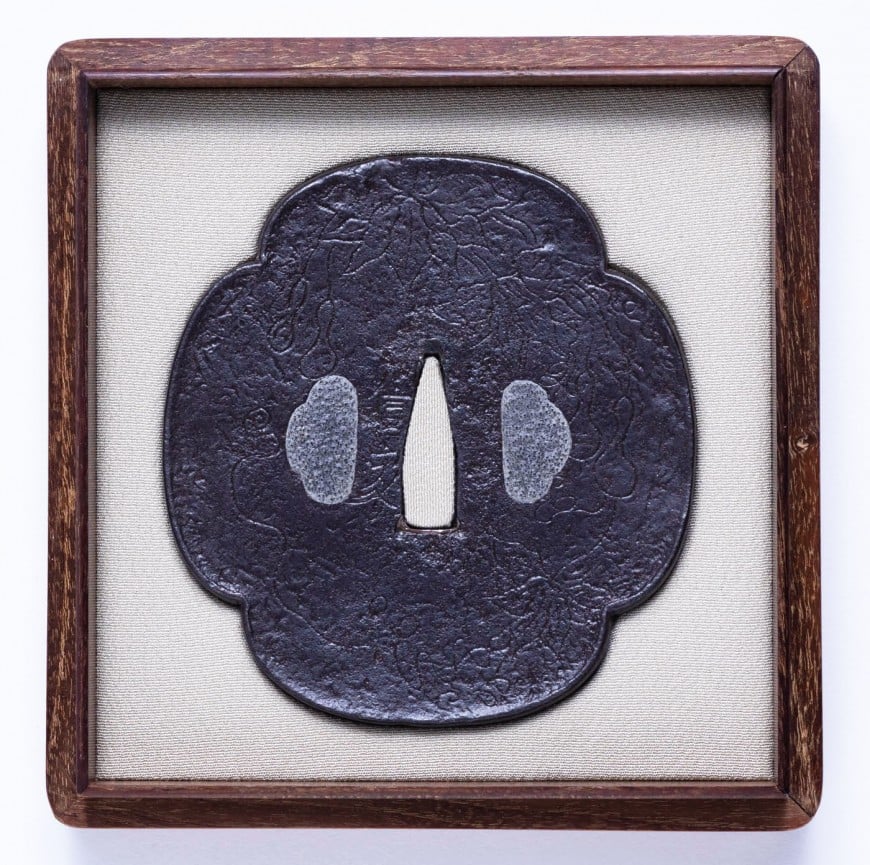
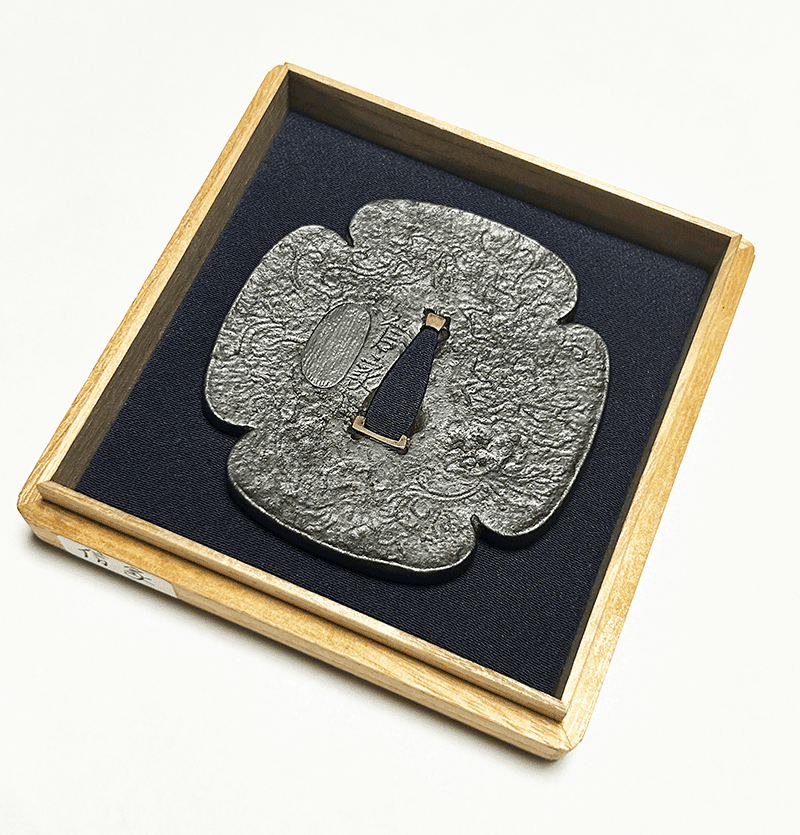
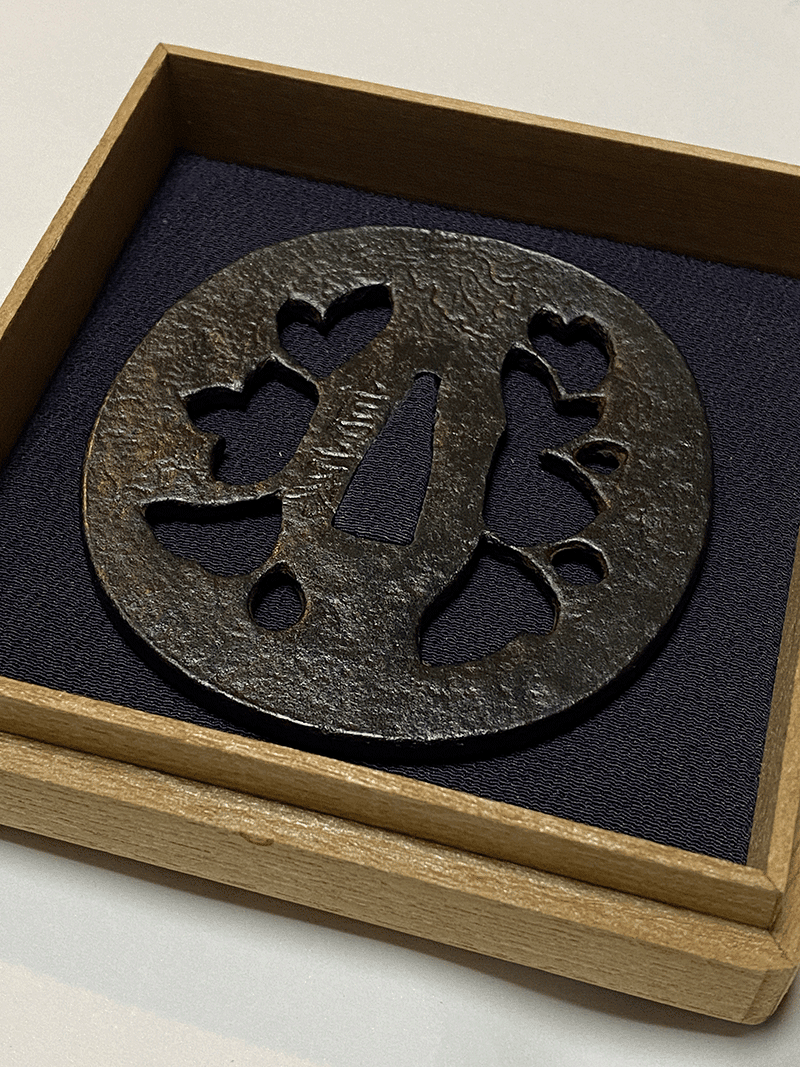
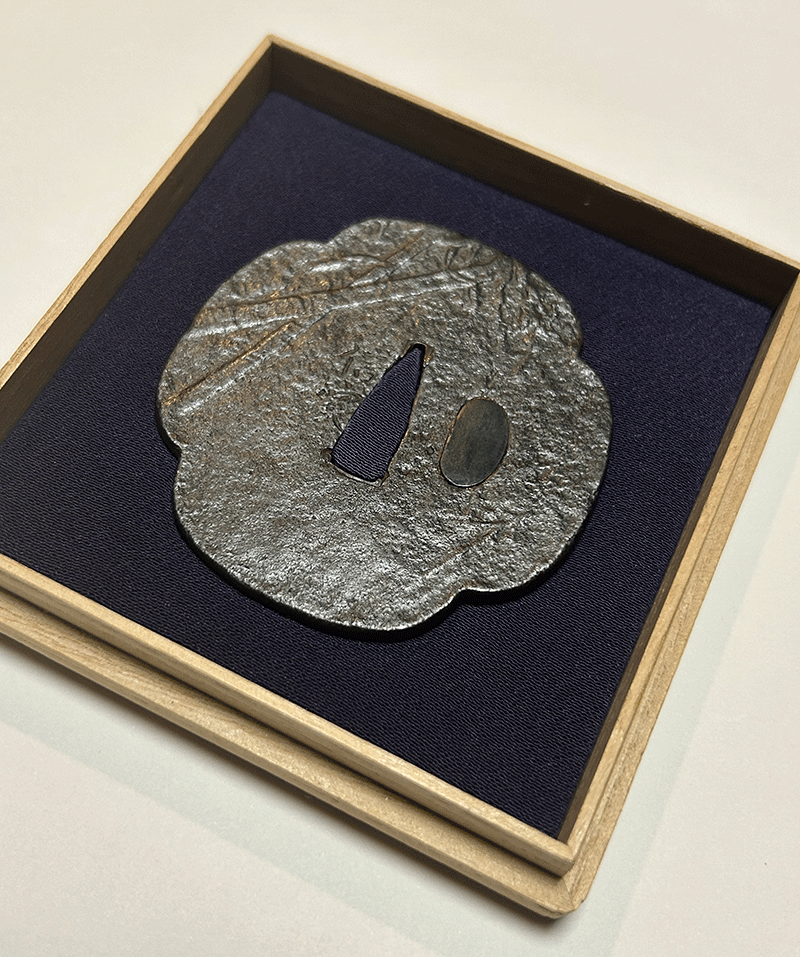
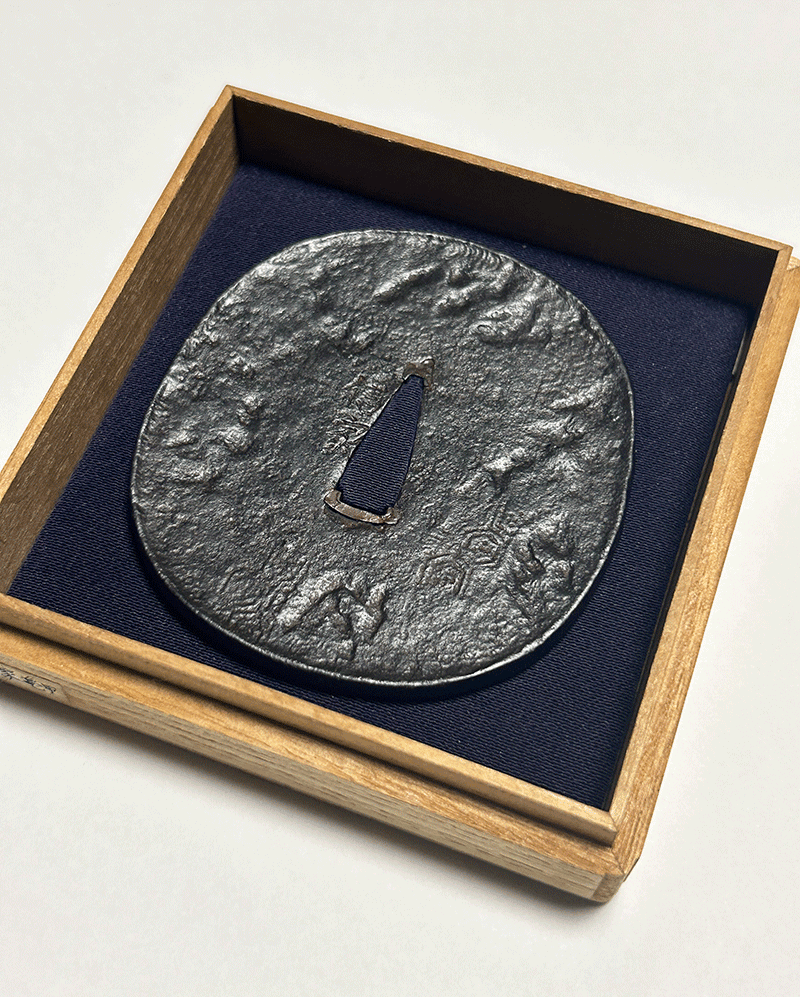
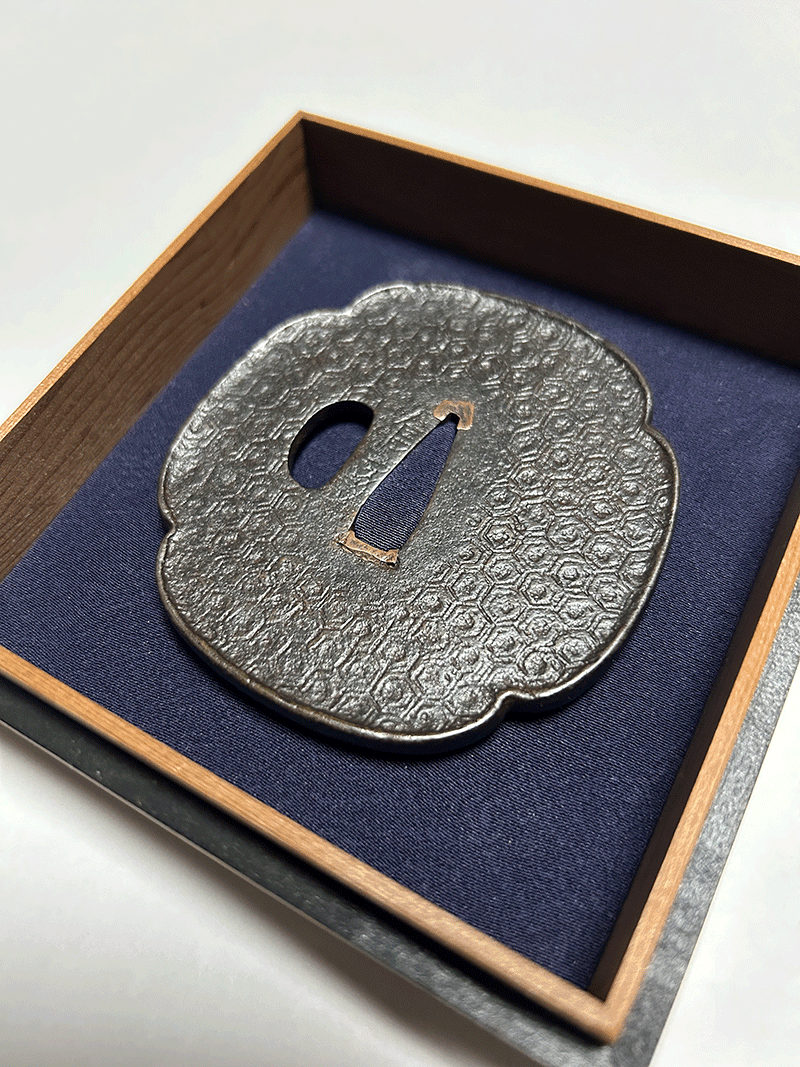
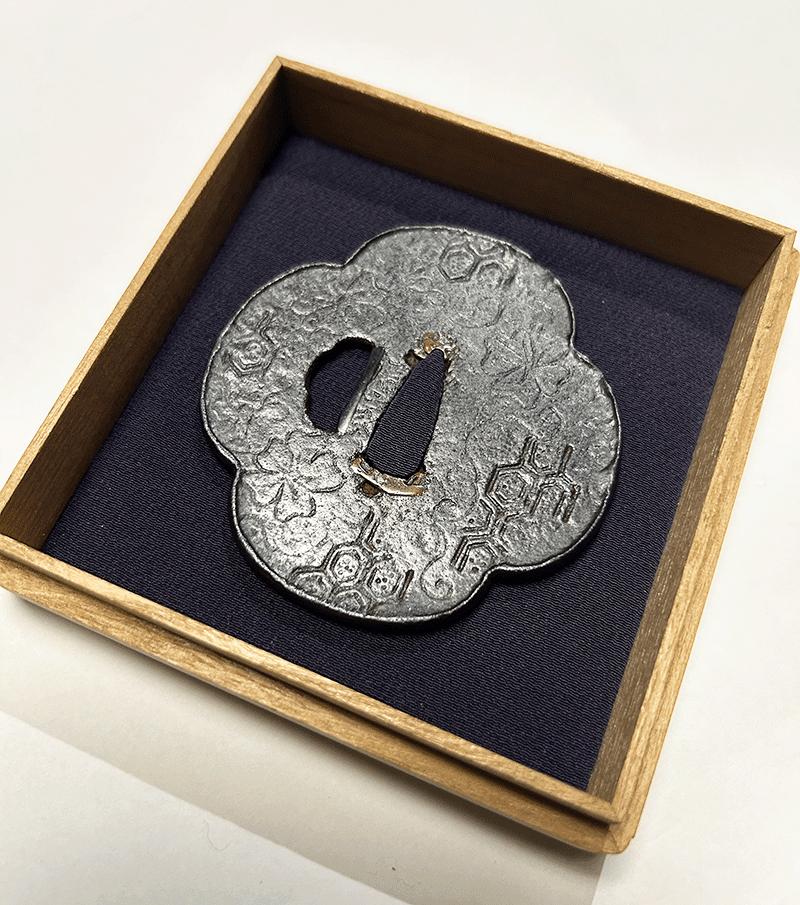
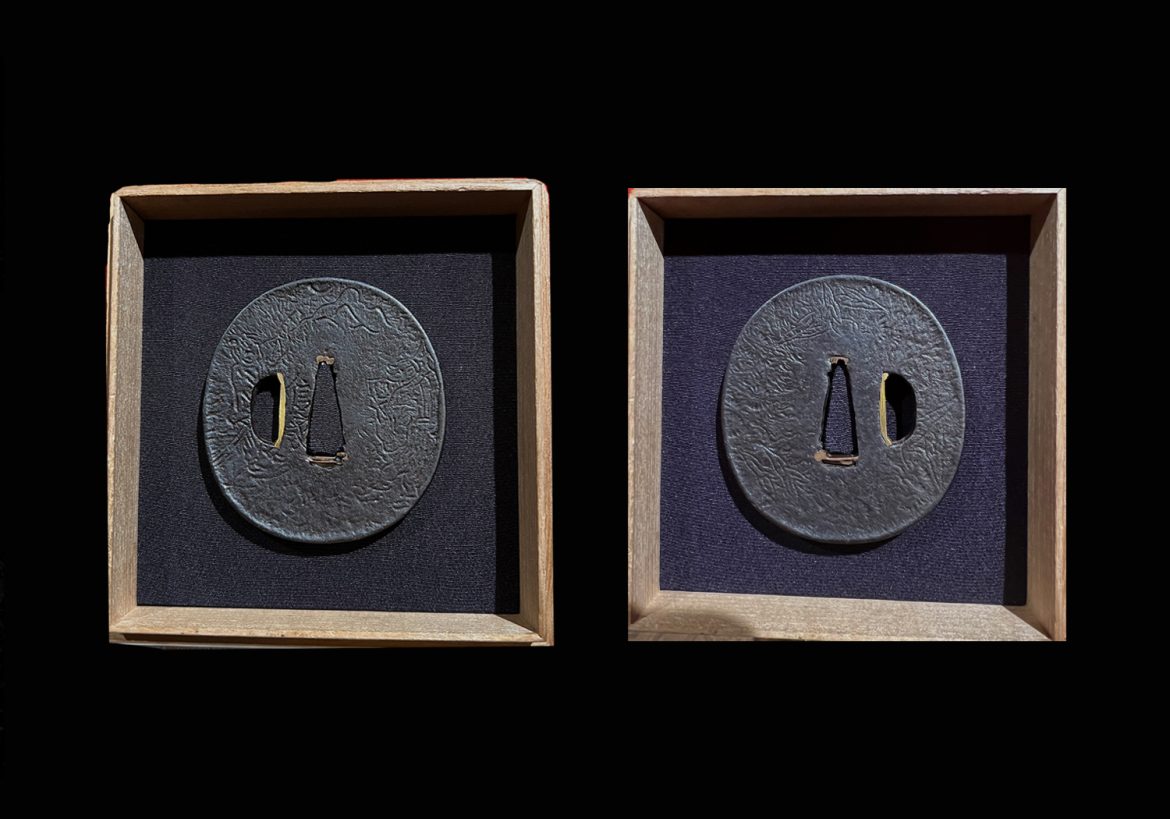
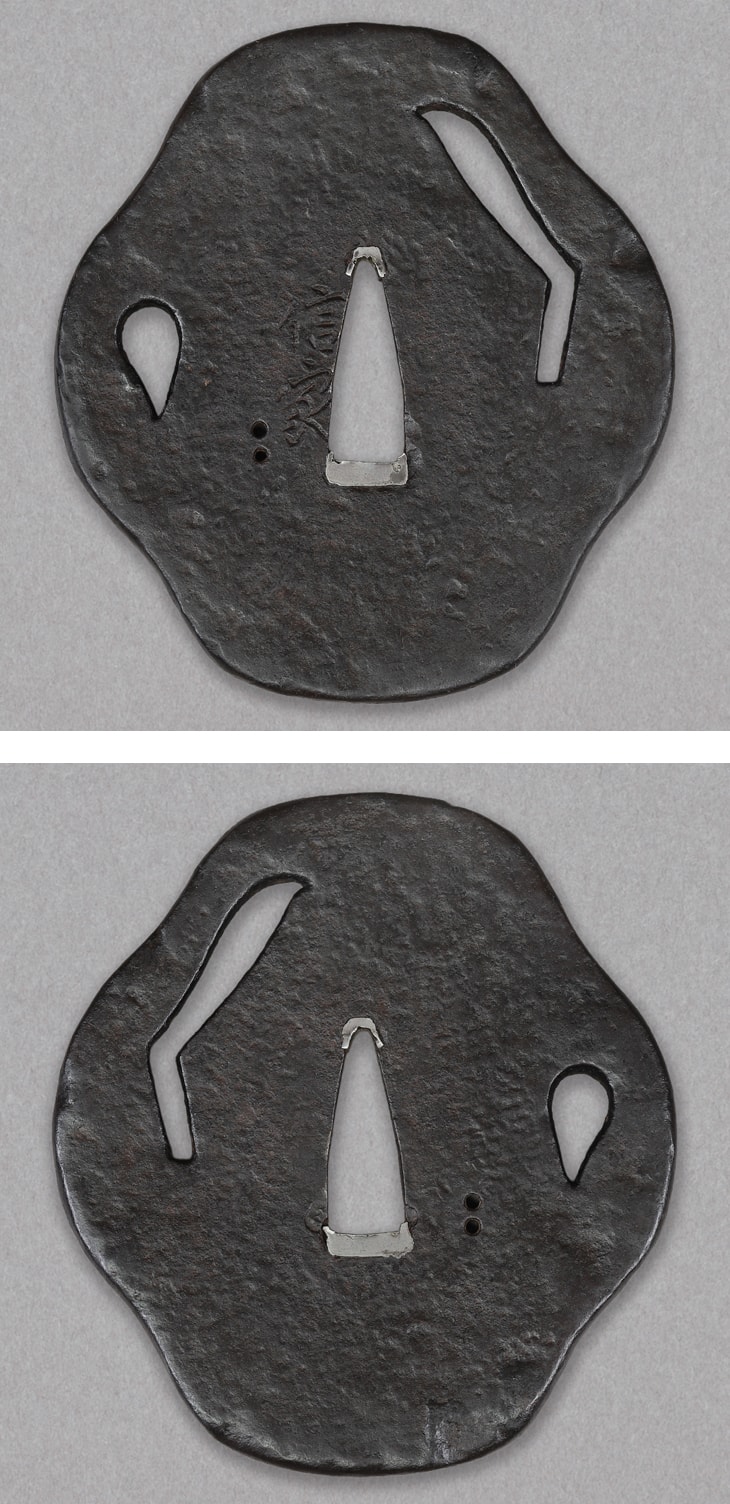
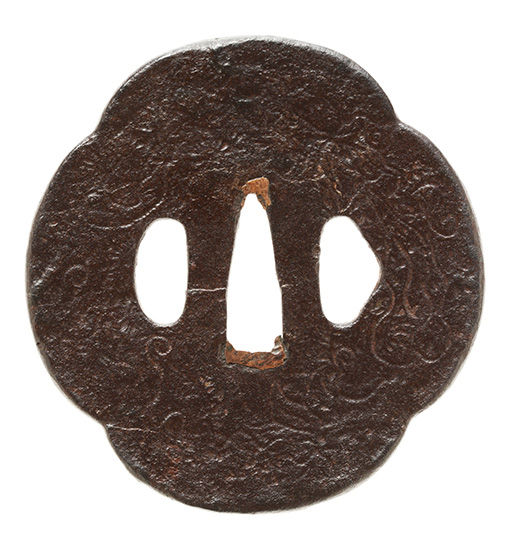
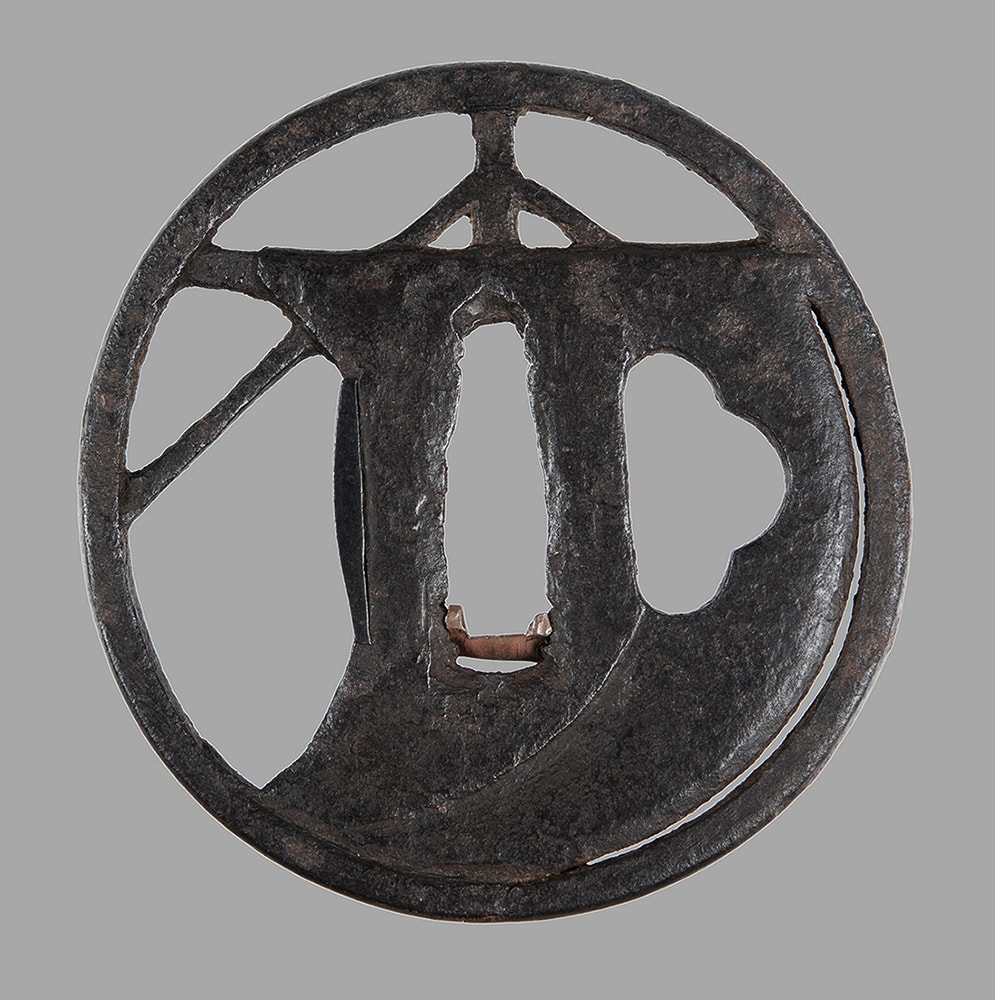
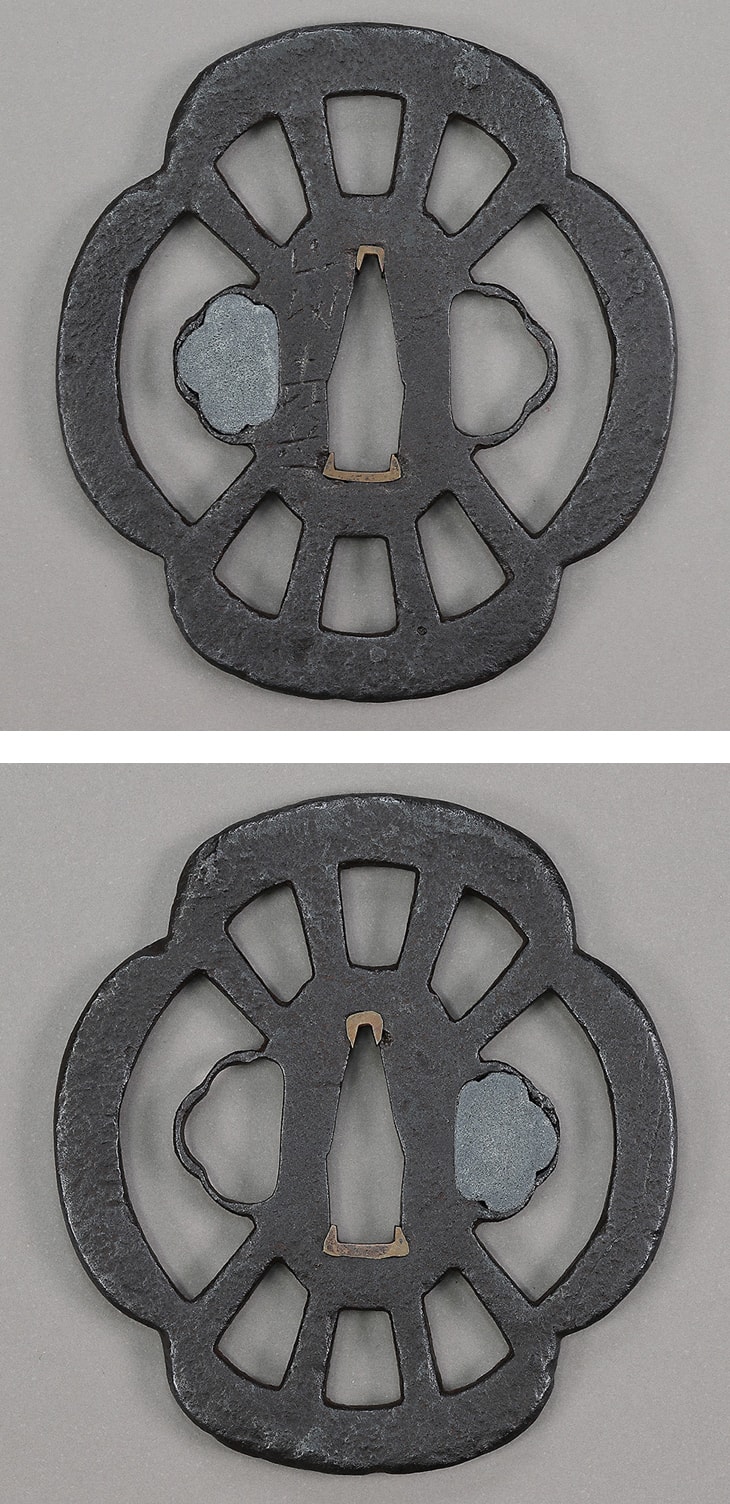
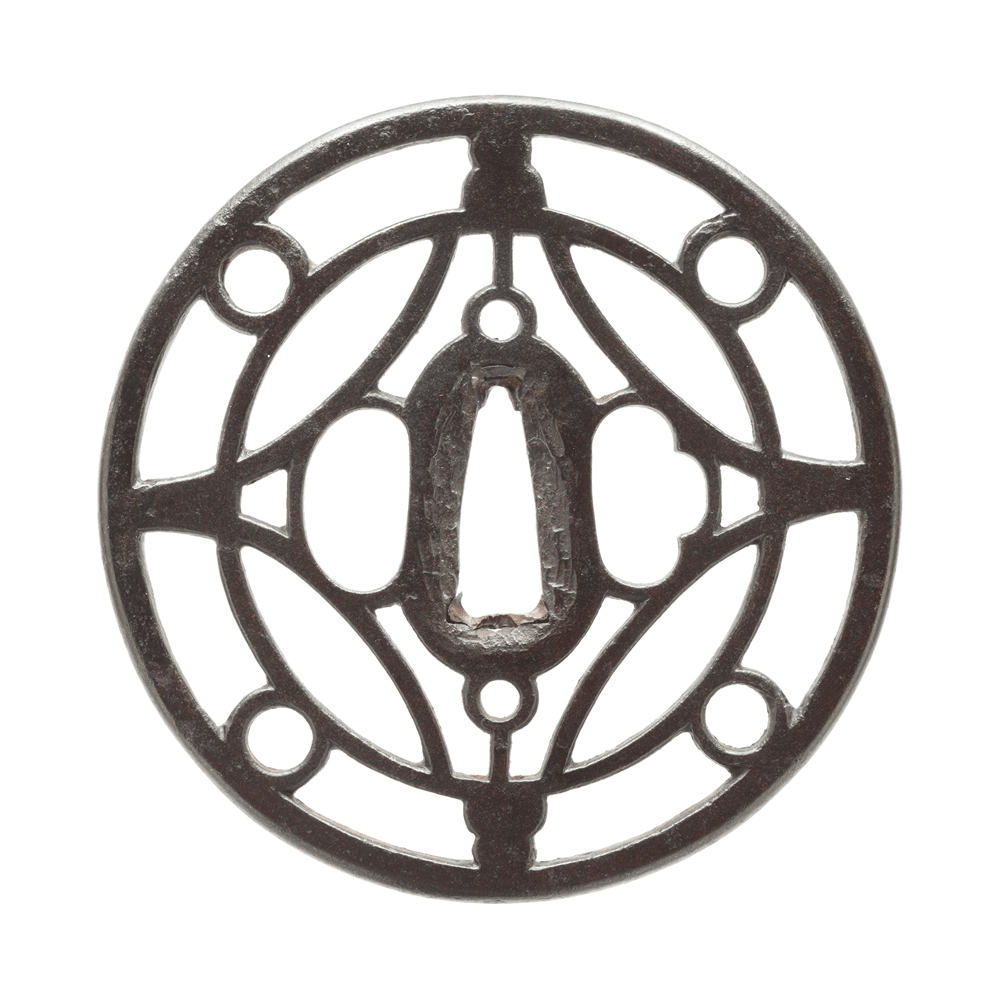
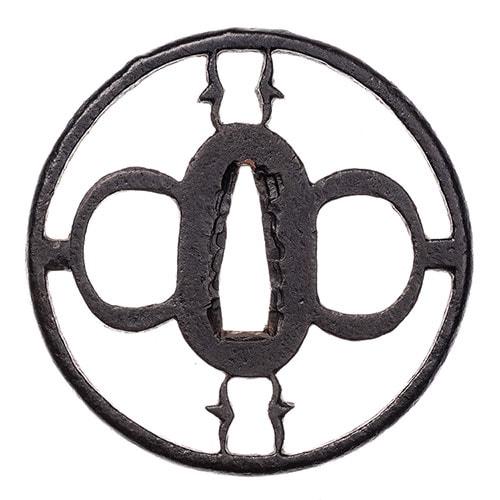
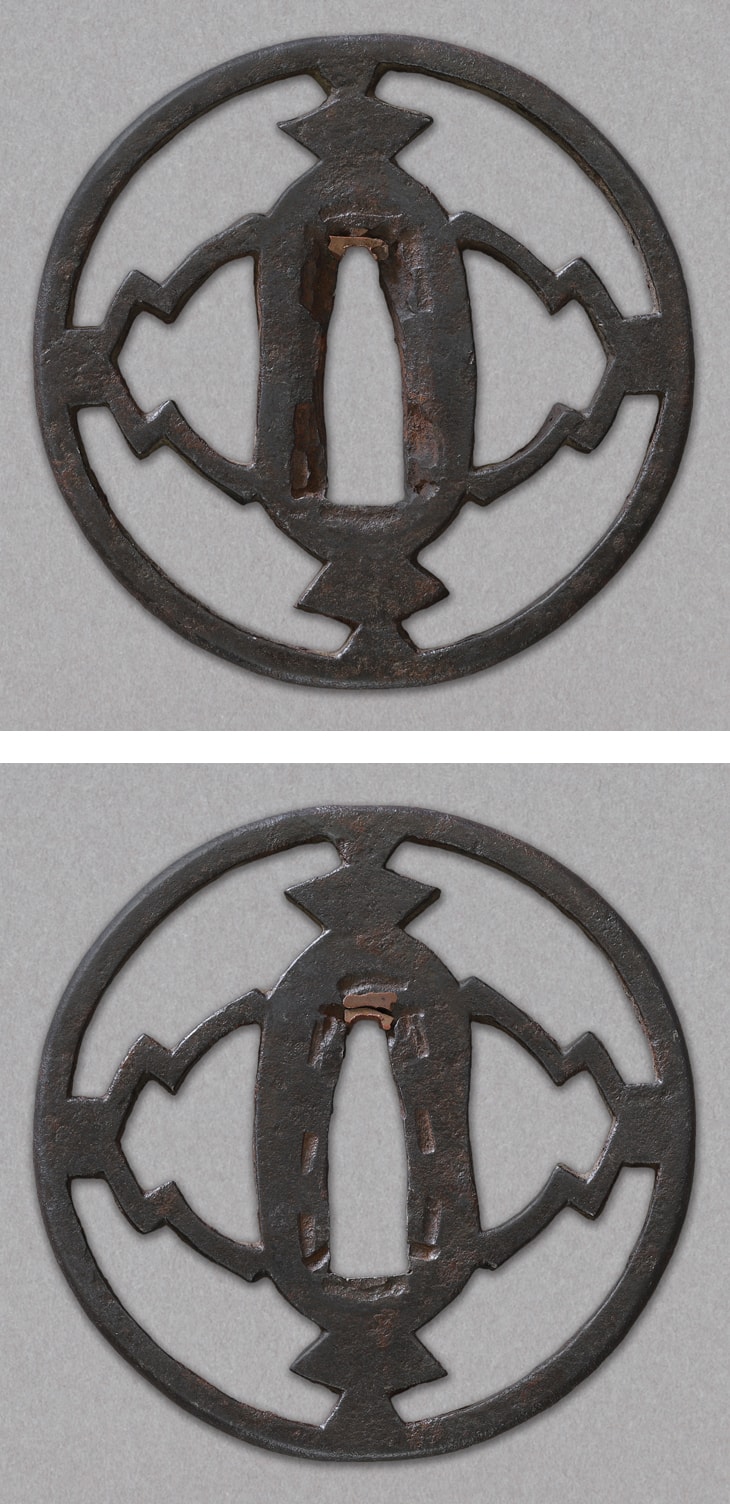
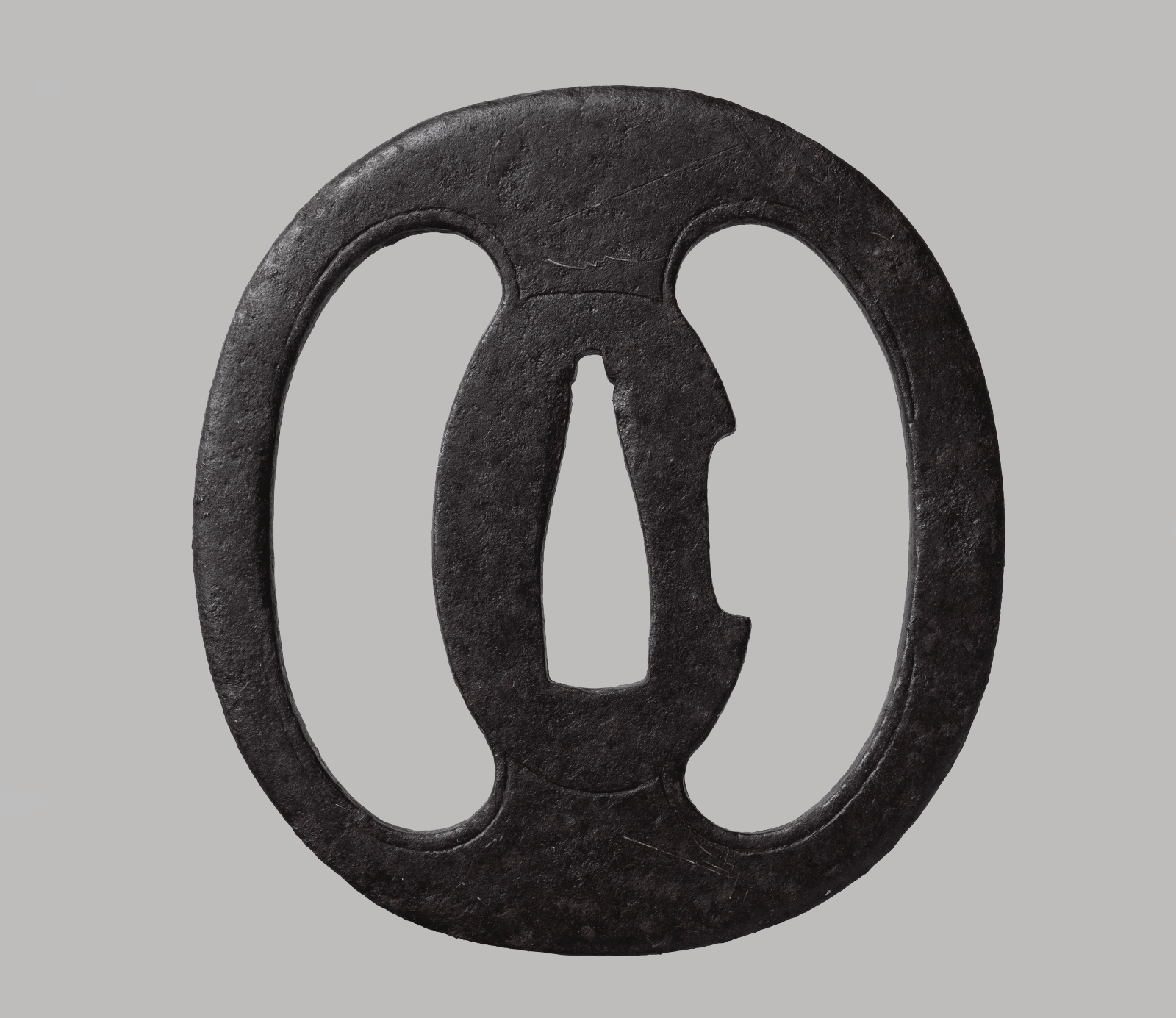
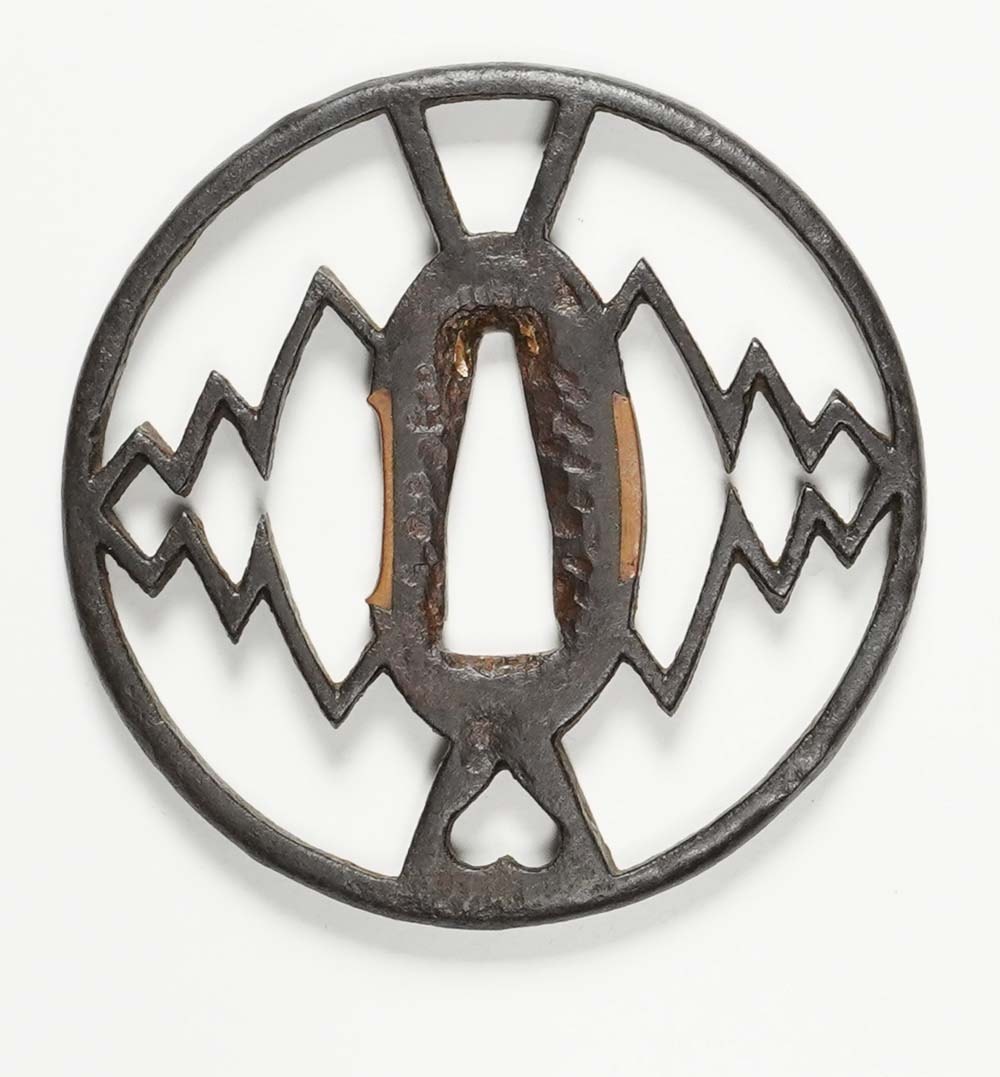
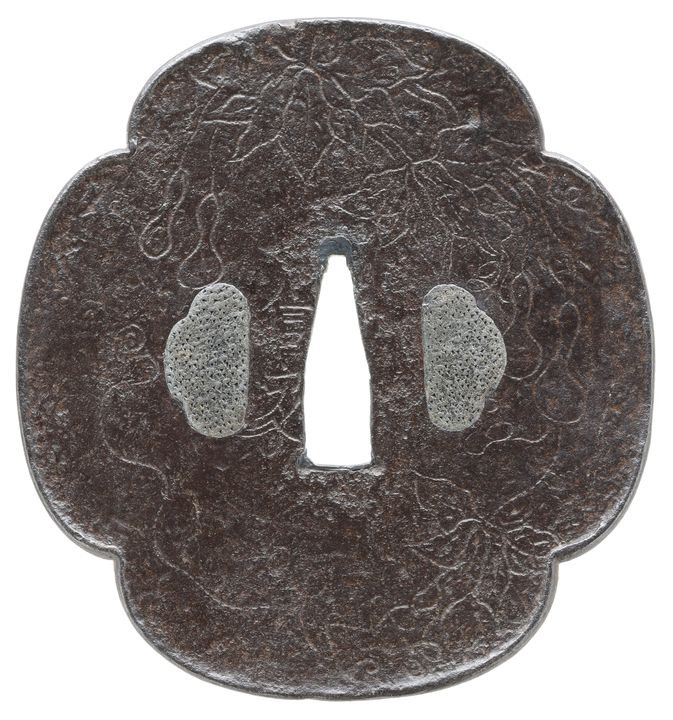
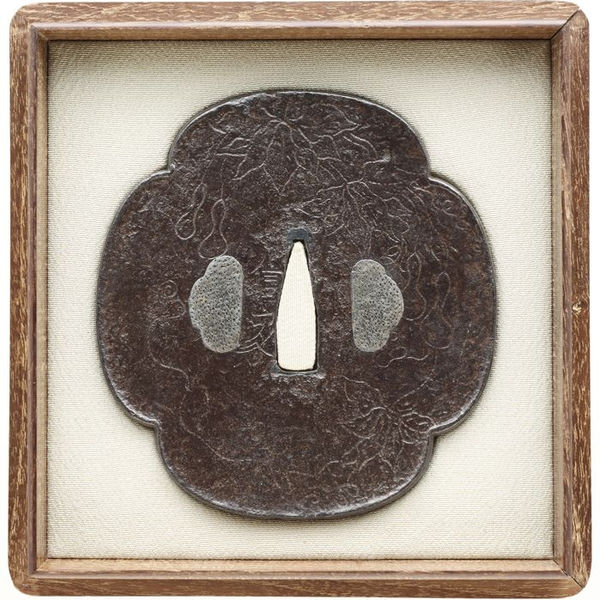
This tsuba, signed Nobuie, dates to the Momoyama period and features a gourd and arabesque design carved in kebori on an iron mokko-shaped ground. It is accompanied by a wooden box with calligraphy by Dr. Kanzan Sato. The piece showcases the transition from practical to decorative art, characteristic of the Momoyama era, with its robust construction and fine iron quality.
 NihontoWatch
mei · Momoyama
Iron-tsuba · Owari
12 pieces on the market now
Nobuie of Owari is named in the published sources, together with Kaneie of Fushimi in Kyoto, as one of the twin pinnacles of the iron tsuba, and his designated record of fifty-six guards is built almost wholly on forged iron. The commentary places his production chiefly in the Sengoku period, from the end of Muromachi into Momoyama. Who he was is less certain than what he made. The common account makes him the seventeenth generation of the Myochin armourers, who took the character Nobu from Takeda Shingen, and another tradition has him leave Owari for Kai at Shingen's invitation; the published sources report both as tradition and call the move unproven. They also state that the name was not one man's. Several smiths signed Nobuie at nearly the same time at the end of Muromachi, others did so in the Edo period, and they probably lived in several provinces beginning with Owari. Armourer's helmets signed Nobuie, some dated in the Tenbun era, survive, but neither their signatures nor their kao match those on the tsuba, and forgeries made since the Edo period have further clouded the study. One guard in the record is described as the work of the first-generation Owari tsuba maker, signed in the so-called left-leaning hand.
His merit is stated in a sentence the published sources repeat, in close variants, in forty-five of the sixty records: the forging of the iron is without equal, the surface pattern of the plate (jimon) is rich in scenery and elegance, and the guard shows to best advantage on an uchigatana mounting. Set against Kaneie, whom they credit with founding the pictorial tsuba on thin plates, Nobuie's guards are thick and carry a sense of mass. The plate is most often a hammered tsuchime-ji, its hammer marks described as alive and moving, and the working of the iron throws up iron bones (tekkotsu) at the rim and across the flat. The patina is deep and heavy, at times purple with a reddish cast, and one record calls this beautiful rust "the very life of the Nobuie tsuba." Of a plain guard with water-drop openwork the commentary writes that "few tsuba make known how strong and beautiful iron can be." Of a tortoise-shell guard with Amida file marks, the piece the late Akiyama Kyusaku treasured above all his others, it speaks of "the skill of no skill."
His shapes are mostly mokko and round, rarely the kemari form or the aori form whose lower edge flares, and the published sources note that plate guards far outnumber openwork. The modelling is low at the centre and high toward the rim, and the rim is hammered tight and turned back as an uchikaeshi-mimi, often with a small raised edge. One record calls this lively turned-back rim "what is called the true essence of Nobuie," and another finds the curve running from rim to nakago-ana peculiar to him, the sign of a maker who attended to the whole three-dimensional form and not only to the iron. On this plate he cuts kebori, the hairline engraving he favoured: gourds, morning glory and arrowhead, tortoise-shell and broken tortoise-shell, pine needles and seaweed, arabesque of paulownia and ivy, plum, maple and the horned owl in a tree. Chrysanthemum stamps scattered across the surface, which the commentary associates with the hanare signature, add to the pattern of the plate. Sukidashi relief and small openwork appear more rarely, and a guard of cherry blossom and water wheel inlaid in brass is called "an extremely rare technique among Nobuie tsuba."
The inscribed guard forms a second register, which the published sources name a major point of interest in his work: the divine name Hachiman Daibosatsu, the daimoku Namu Myoho Renge Kyo, and verses on the secrets of the sword and the thought of the age, all cut in kebori. One guard sets the daimoku on the front and the five-element characters on the back; another carries the proverb of the old man of the frontier and his horse[[c:1]]; a third shows three skulls in relief on the front and a seven-character daimoku on the back. Of the Tokubetsu Juyo guard bearing the Yumiya Hachiman verse, the commentary writes that "the composure of the warrior who lived through the Warring States comes through, quiet and grave." His signature is almost always the two characters Nobuie. Many character forms are accepted, but they divide broadly into the hanare-mei and the futoji-mei; Akiyama Kyusaku sorted them into seven types, among them a tsumari-mei, after Nakamura Kakudayu had compiled his Nobuie Tsuba-shu at the end of the Edo period. Only one guard in the record carries a kao beside the name.
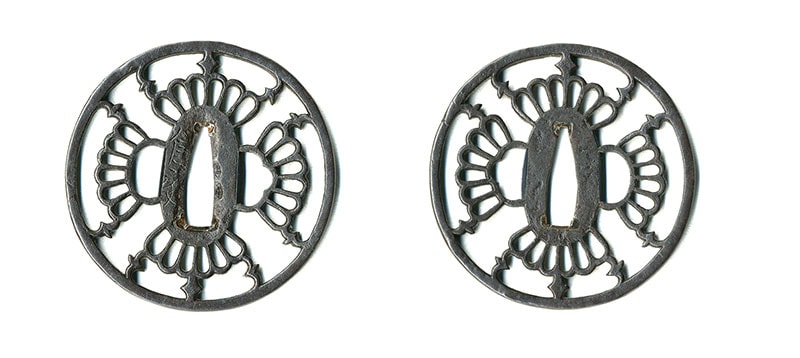
The wheel openwork (kuruma-sukashi) places him among his Owari contemporaries, for the published sources find the same design in the work of Hoan, Yamayoshi and Kanayama. His own examples, with fourteen or sixteen spokes, stand apart for their heavy outer ring and the uneven run of the spokes, and the fourteen-spoke Tokubetsu Juyo guard is called among the finest of his works. The commentary also records why warriors favoured him: a Nobuie guard suited a mounting of any taste and was valued for that harmony and for its strength. The repeated judgment is that these are the works in which "the appeal of the iron tsuba from the end of Muromachi through Momoyama can be savoured to the full."
For the collector, Nobuie's record is fifty-six guards designated Juyo Tosogu, four of them raised to Tokubetsu Juyo; he has no National Treasures and no Important Cultural Properties. Provenance is recorded for only a few: a daimoku guard handed down in the ducal Date family, the tortoise-shell guard from the collection of Akiyama Kyusaku, and the fourteen-spoke wheel guard, which Nakamura's book records passing from Hamada Motohichi of Osaka to Tsunaya and which was kept in the Furukawa family. No current holder is recorded against his name. Among tsuba makers his designated guards are relatively numerous, and one may come forward from time to time; a signed plate of fine hammered iron with a lively turned-back rim, in either signature class, shows the side of his art the published sources praise most.
Where Nobuie stands among comparable artisans: across all of nihontō, and within tradition, era, and period. The tiers (Foremost · Leading · Major · Notable) weigh official designations from the NBTHK and Japan's Agency for Cultural Affairs, together with historical honors of lasting repute such as the Sansaku and Meibutsu-chō.
Select a lens to see how it's measured.
Iron-tsuba · Owari
93 pieces on the market now
The Owari school represents one of the twin pillars of Japanese iron openwork tsuba production, standing alongside the Kyō tradition as a defining force in the art of ji-sukashi (ground openwork) guards. The school's origins lie in the Owari province (modern Aichi prefecture), where production began in the early to middle Muromachi period and continued across a sustained span extending into the Edo period. While Kyō sukashi is characterized by delicacy and graceful elegance, Owari guards distinguish themselves through a tasteful refinement that conceals inner strength—a quality often described as possessing both dignity and rustic vigor. The tradition's most celebrated artisan, Yamakichibee, worked alongside contemporaries such as Hoan to establish technical standards that would define the school's reputation. Early signatures appear in forms such as "Yamasaka Kichibee" and abbreviated variants "Yama Kichibee," with the character へ understood as a shortening of 衛, suggesting generational succession across the late Muromachi and Momoyama periods. The technical achievements of Owari tsuba center on the mastery of iron itself, expressed through distinctive forging methods and surface treatment. The school's craftsmen employed a characteristic modeling technique called nikuoki, in which the central area of the plate is made slightly lower while the outer rim is raised, creating subtle variations in relief that enhance both visual depth and structural integrity.
This treatment is complemented by the dramatic appearance of tekkotsu (iron bones)—crystalline grain structures that emerge along the kaku-mimi ko-niku rim (angular rim with slight rounding) through controlled annealing or yakite finishing. These iron bones manifest in multiple forms: granular, clumped, linear, and pronounced masame (straight-grain) patterns, often appearing in lively activity across both the rim and the plate surface. The forged iron develops a deep, thick purple rust patina (murasaki-sabi) of exceptional beauty, while the plate itself may be finished with tsuchime (hammer texturing) or gently dished surfaces that create a melting, softened effect. The school's openwork compositions range from geometric patterned designs—such as flower petals, kozane (lamellar scales), and net patterns (amime-sukashi)—to boldly pictorial narratives incorporating the seppa-dai into unified compositions depicting catfish (namazu), crabs, wild geese (karigane), and literary themes such as the "Mount Utsu" scene from the Ise monogatari. The Owari tradition's influence extended well beyond the technical sphere, establishing aesthetic standards that defined connoisseurship and collecting practices for centuries. The school's guards were prized for what setsumei authors describe as an "antique, tasteful character" (koga no ajiwai)—a quality combining power, compact control, and the subtle fascination of fine iron that set them apart from contemporaneous work. While the school's original strengths began to diminish from the beginning of the Edo period, mature-phase examples from the late Muromachi and Momoyama periods demonstrate the full range of Owari excellence: stately presence achieved through imposing forms and thick construction, dynamic spatial effects created through kage-sukashi (shadow-like silhouette piercing), and an audacious, unconventional character that attracted eccentric taste (sukisha). Learn more →
| Smith | Era | Designated |
|---|---|---|
| Nobuie信家 | — | 56 |
| Hiko’emon彦右衛門 | — | 0 |
| Katsuaki克明 | — | 0 |
| Shigemasa重正 | — | 0 |
| Norisuke則亮 (Norisuke/Koreyoshi | — | 0 |
Exceptional craft of very high artistic value, judged to rank with a nationally recognized Important Art Object (Jūyō Bijutsuhin).
The NBTHK (Nihon Bijutsu Tōken Hozon Kyōkai, the Society for the Preservation of Japanese Art Swords) is a public-interest incorporated foundation founded in 1948 and supervised by Japan’s Agency for Cultural Affairs (Bunkachō); it is based at the Japanese Sword Museum in Tokyo. Its expert panels physically examine each submitted work (shinsa) and issue a certificate (kanteishō) ranking it by artistic and historical merit. NBTHK papers are the most widely recognized standard of authentication for Japanese swords and fittings.
NBTHK official siteIf, due to our fault, the item differs significantly from its proper condition, the item may be returned. Cooling-off is within one week of the item's arrival.
Price on request