NihontoWatch Mon

NihontoWatch

MarketAuctions
Encyclopedia
NihontoWatch Mon

NihontoWatch

MarketAuctions
Encyclopedia

Description

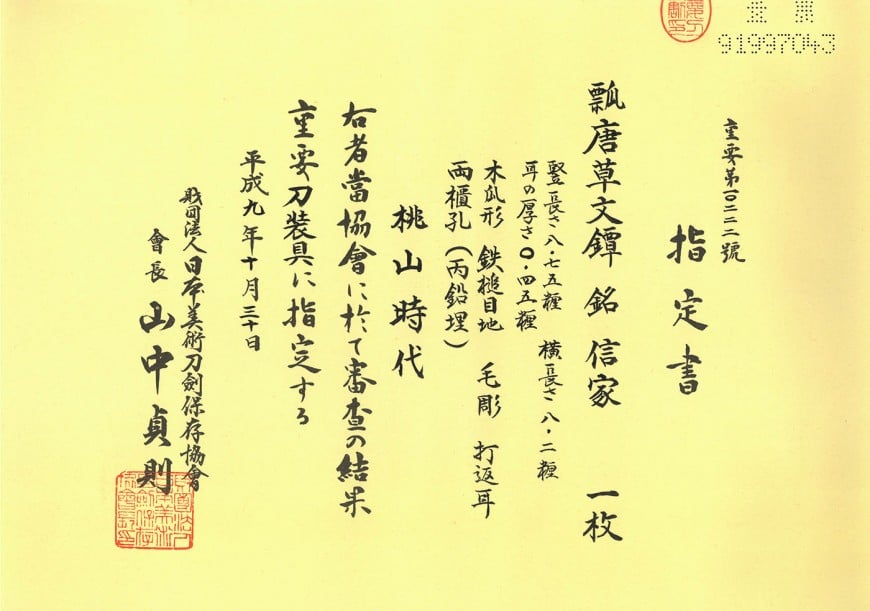
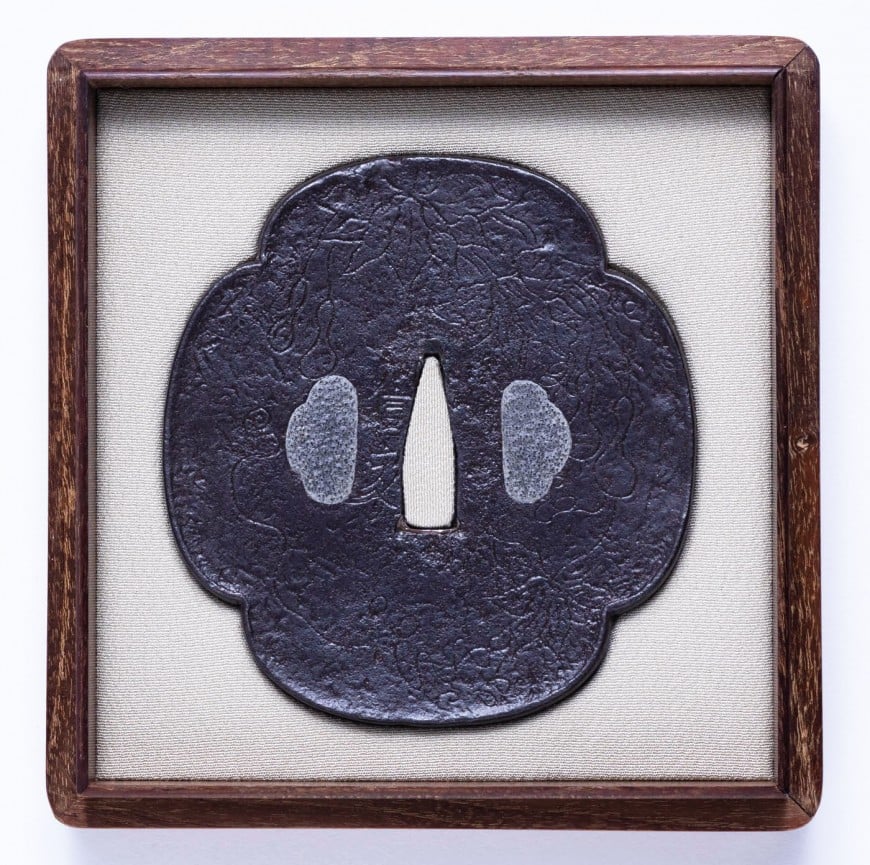
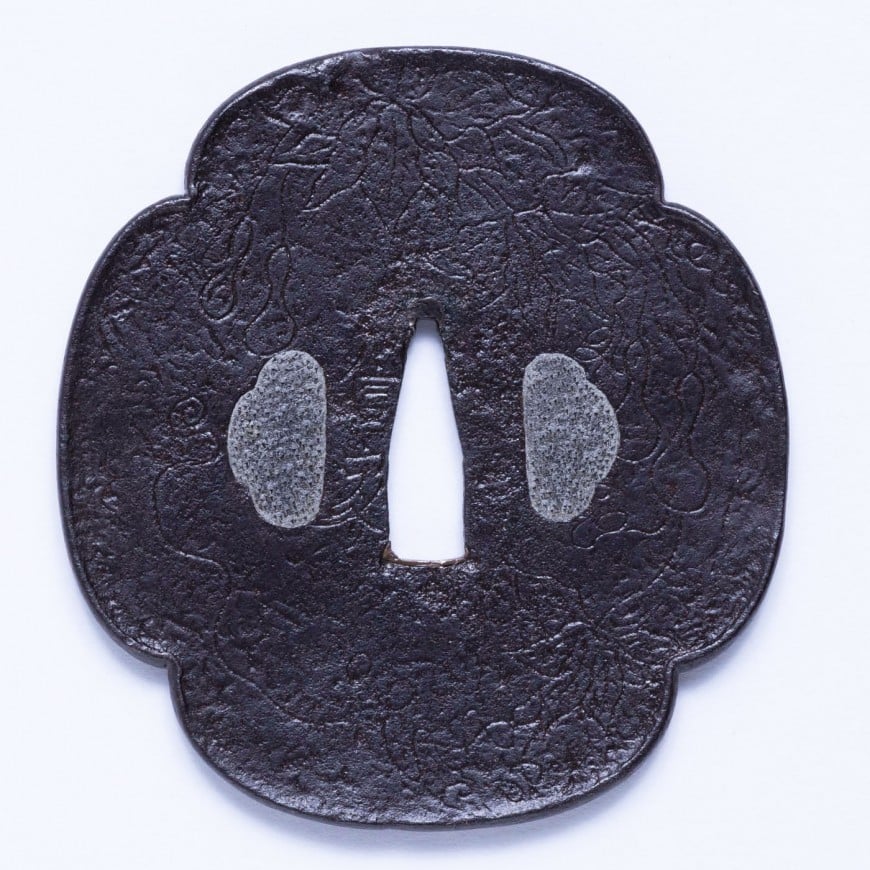
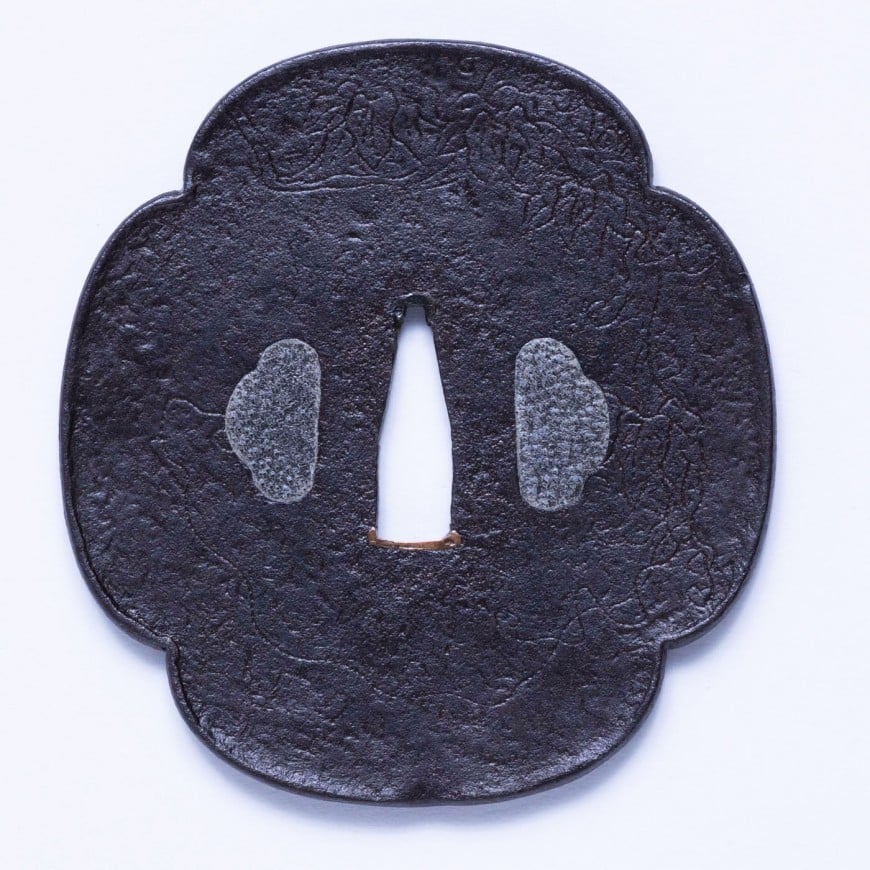
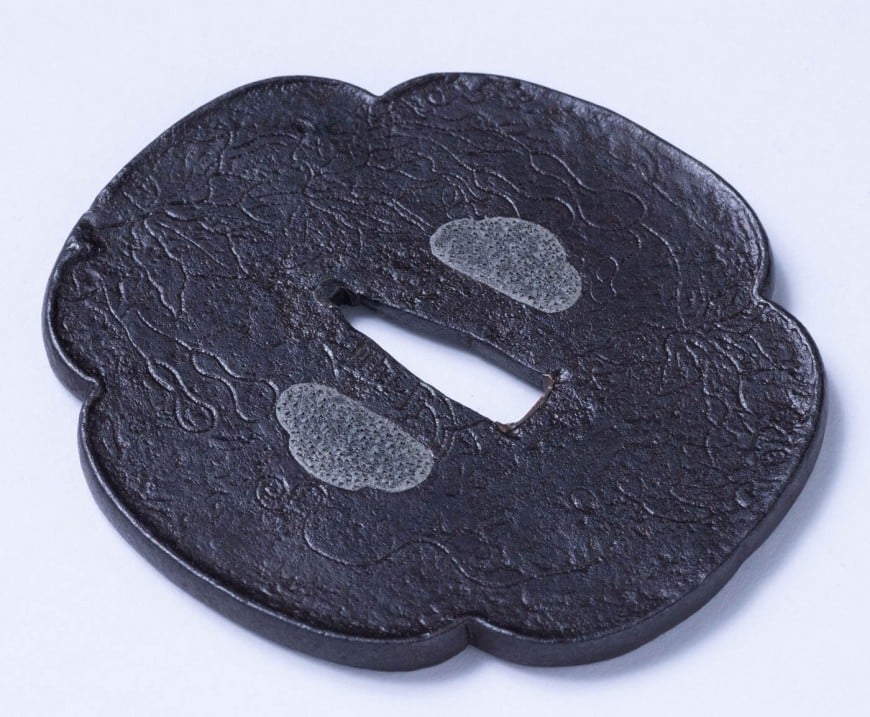
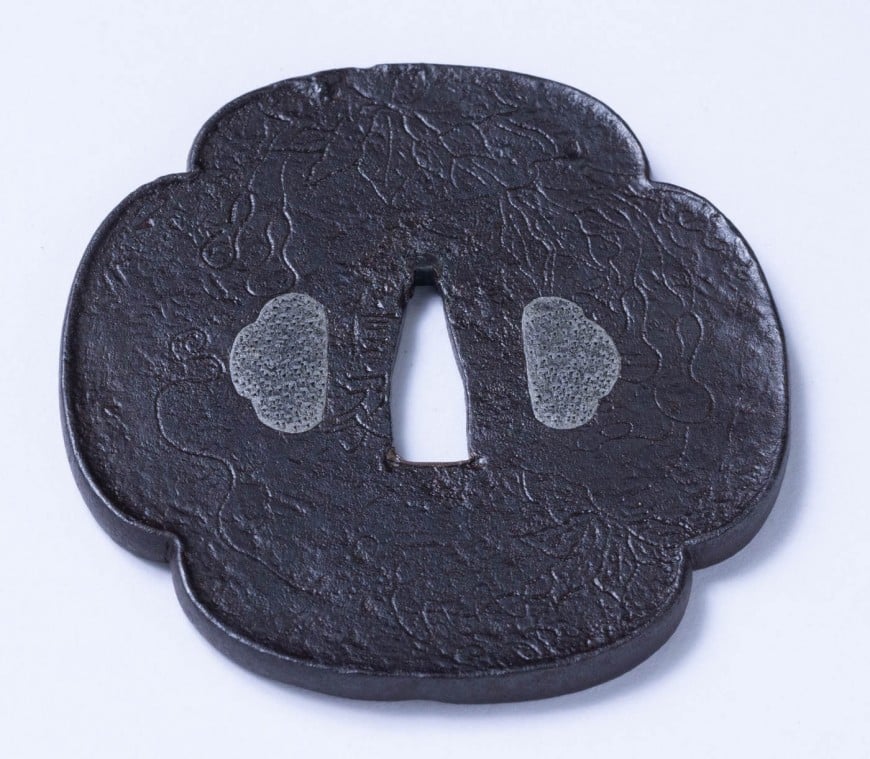
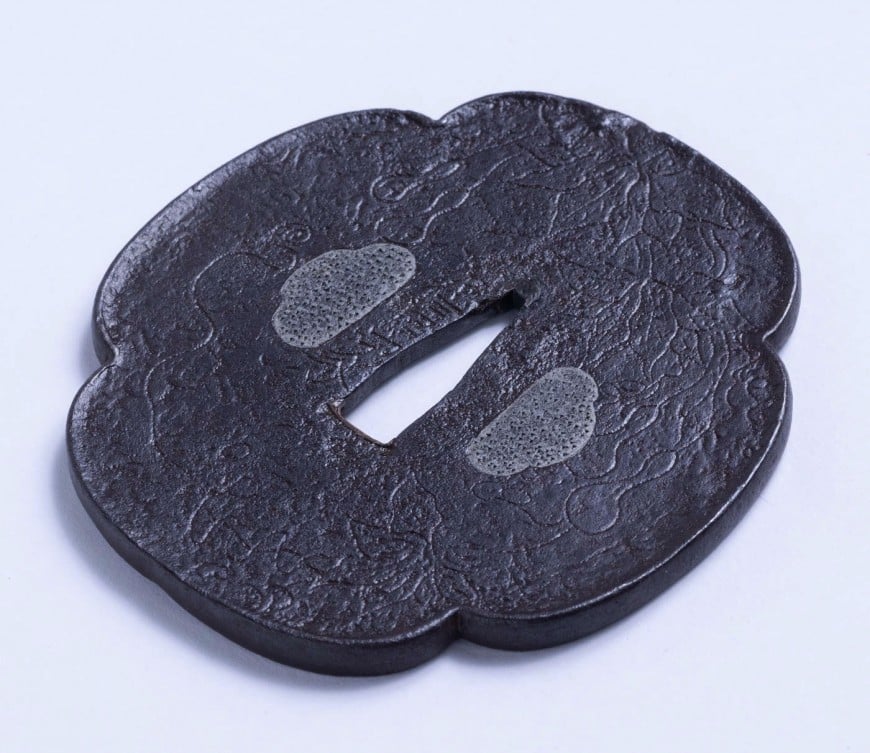
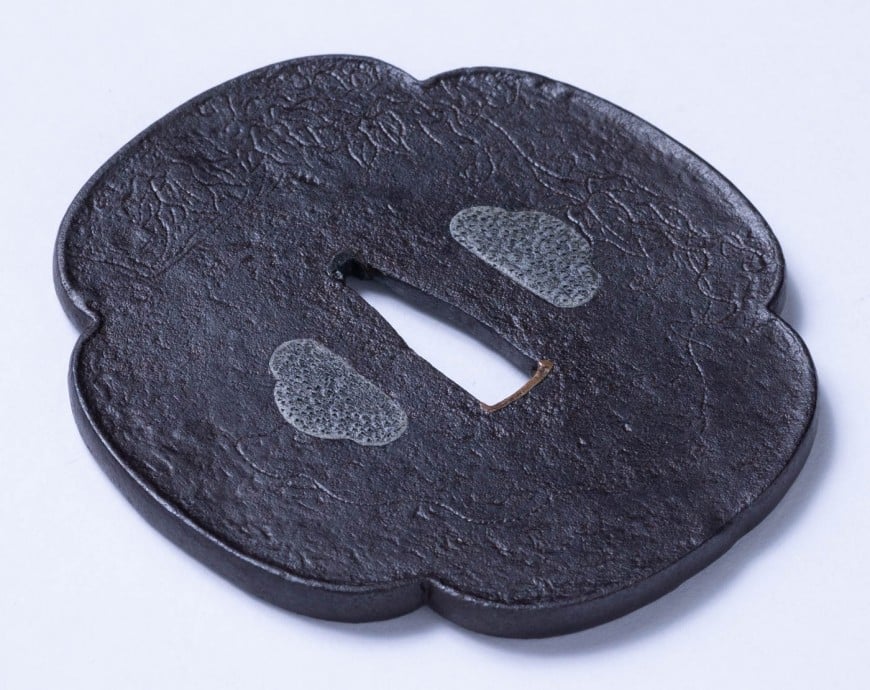
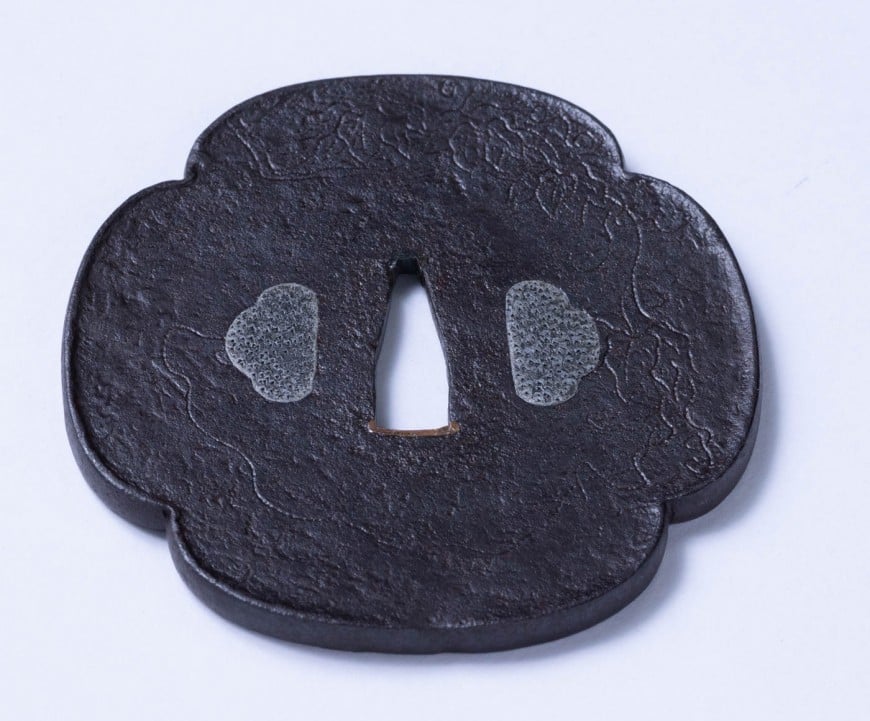
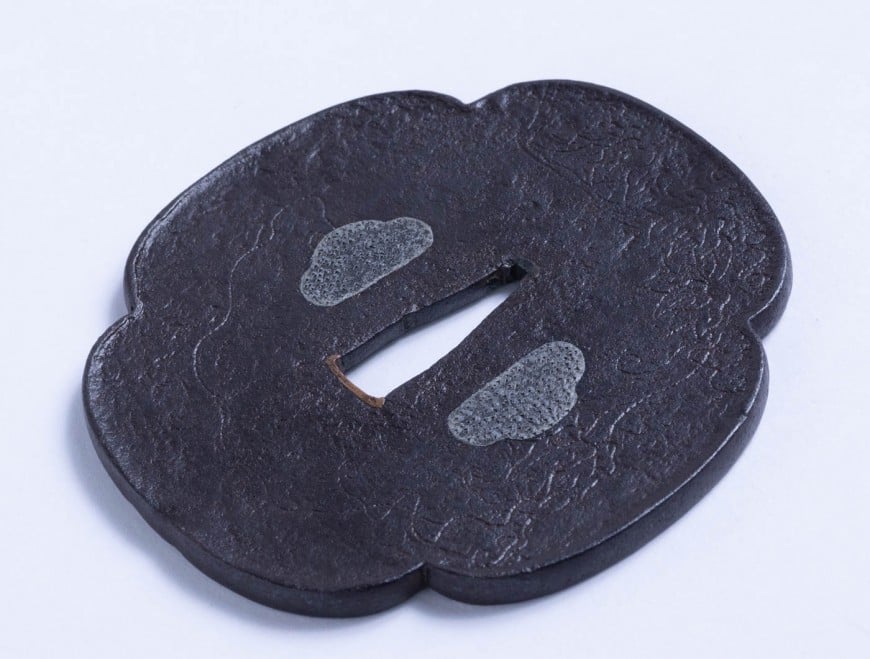
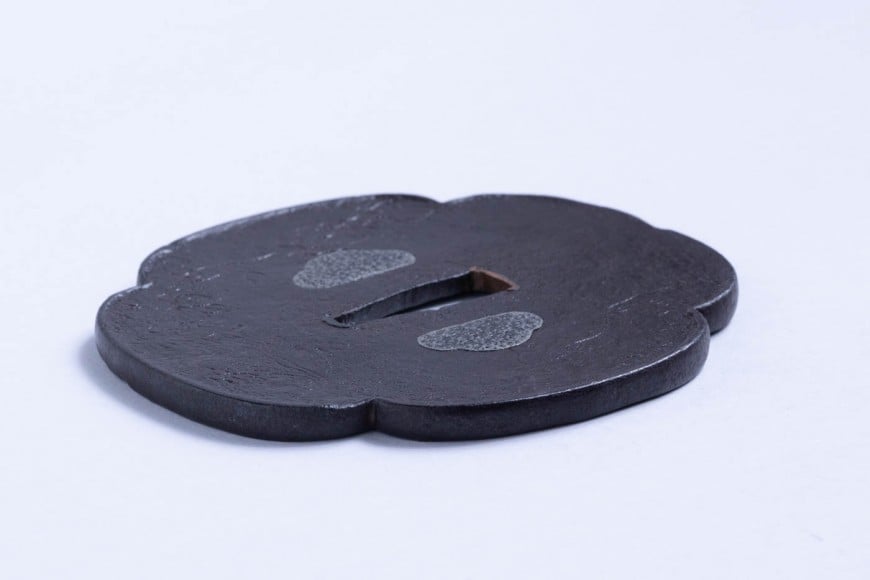
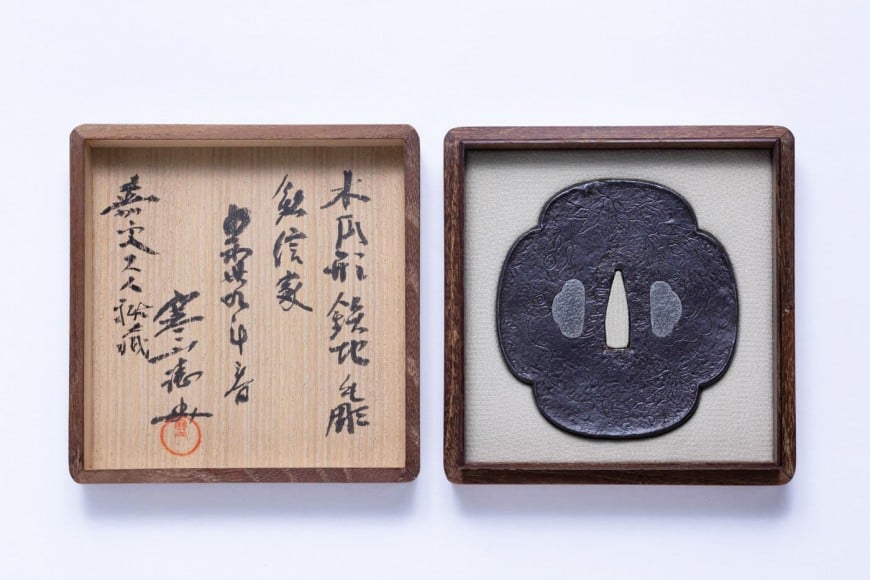
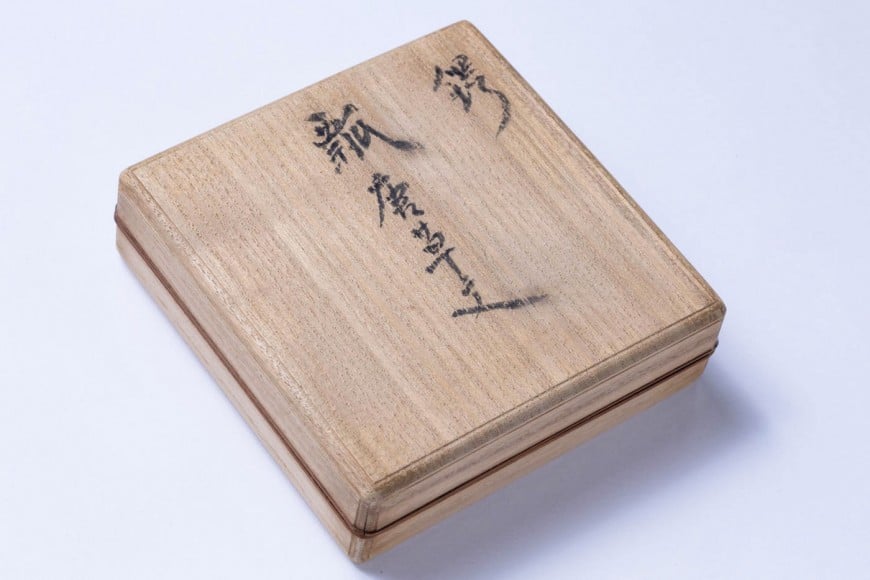
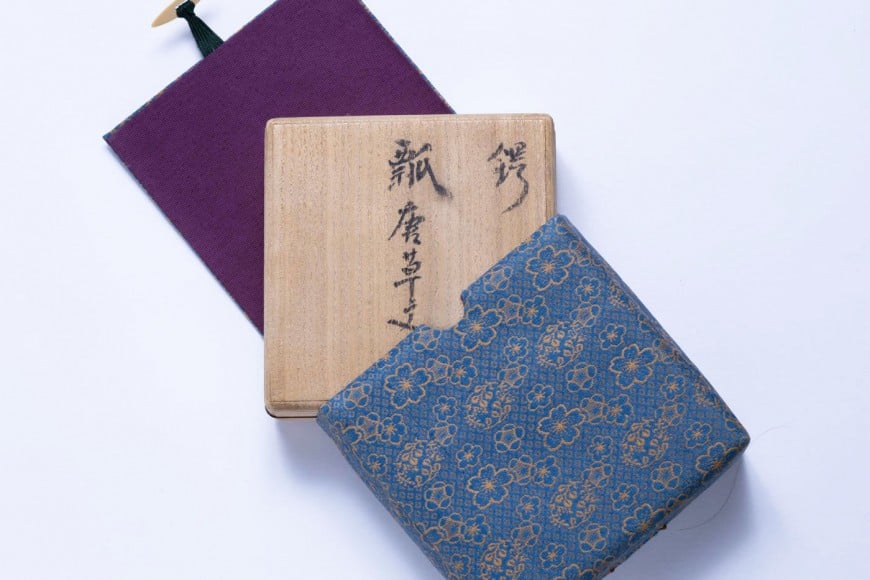
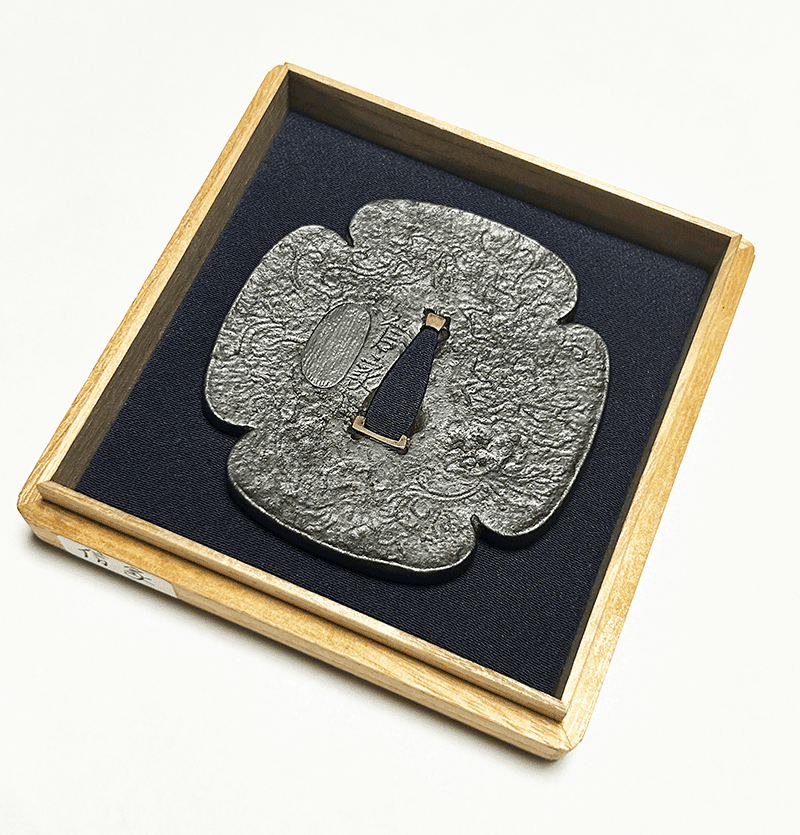
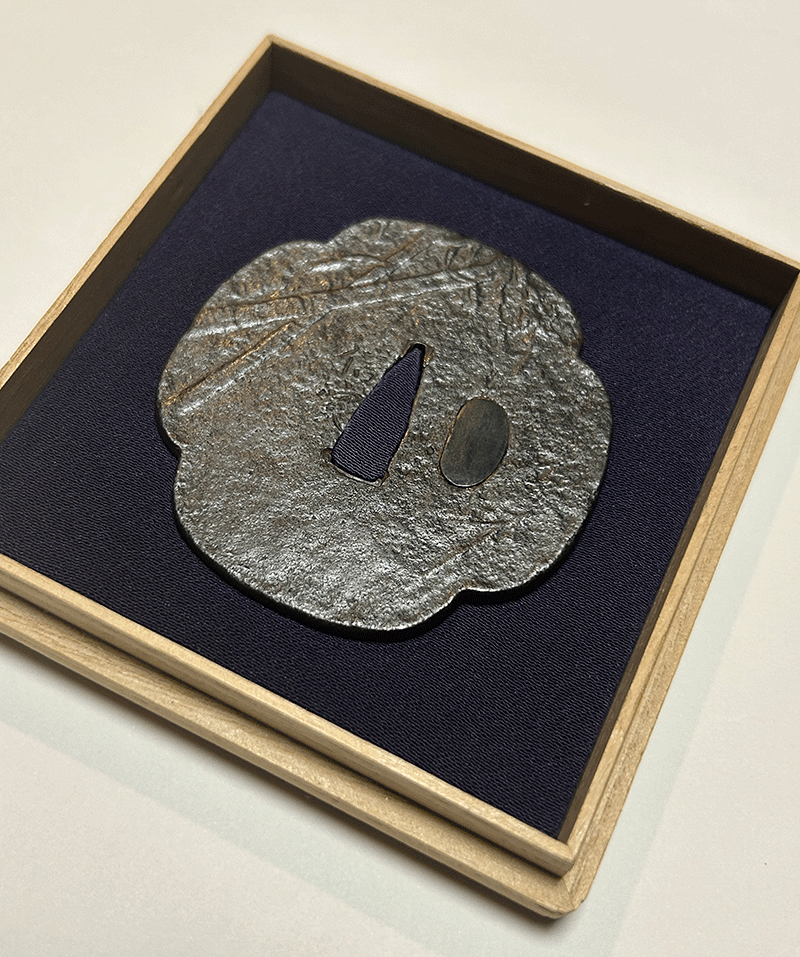
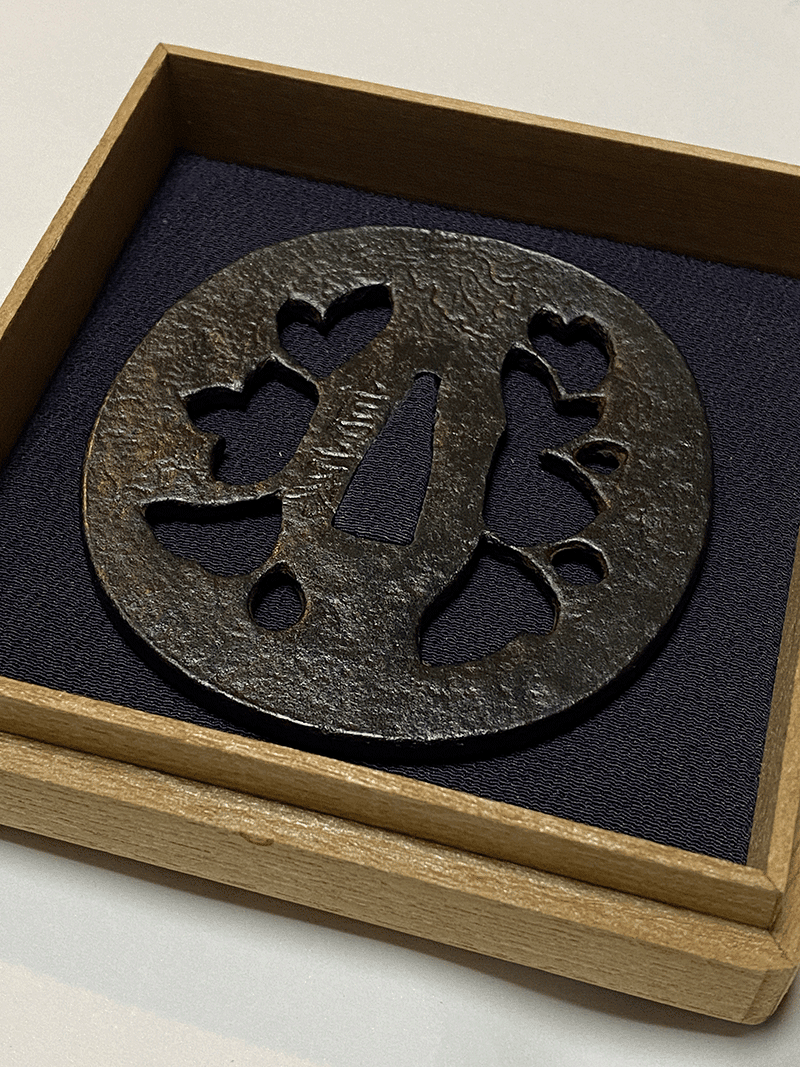
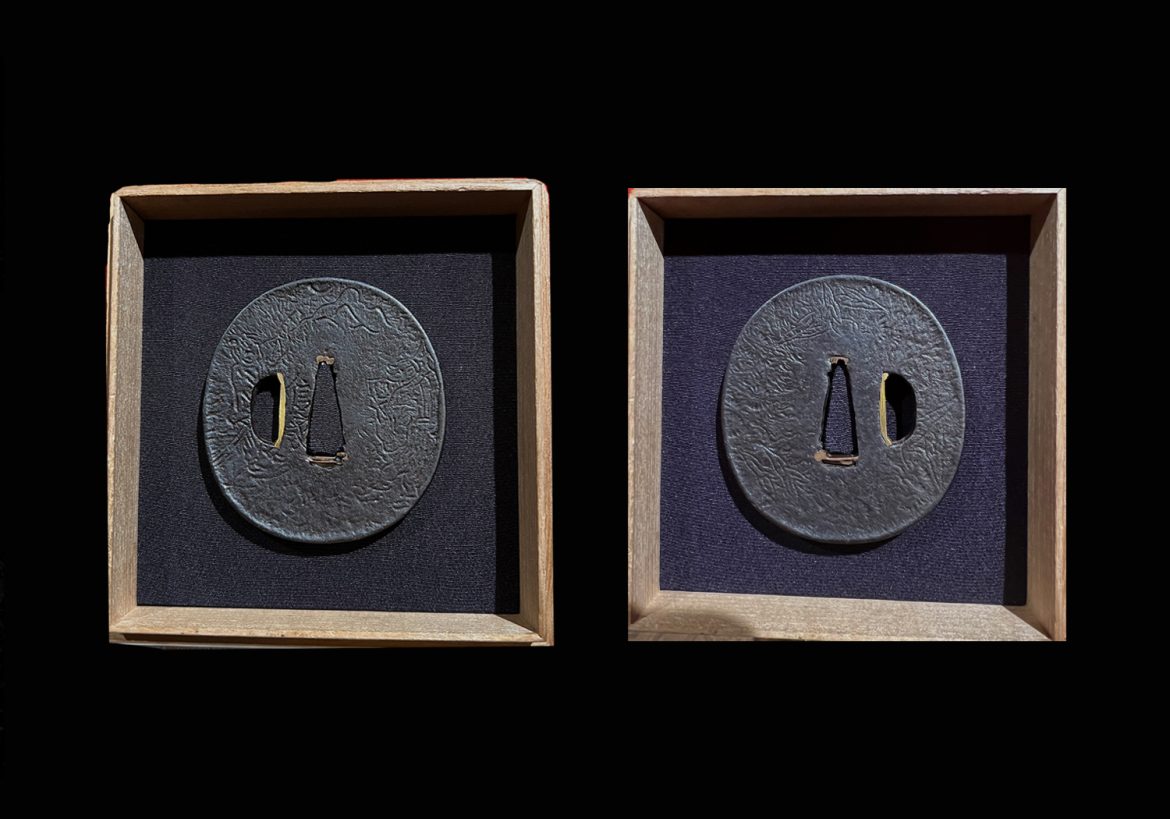
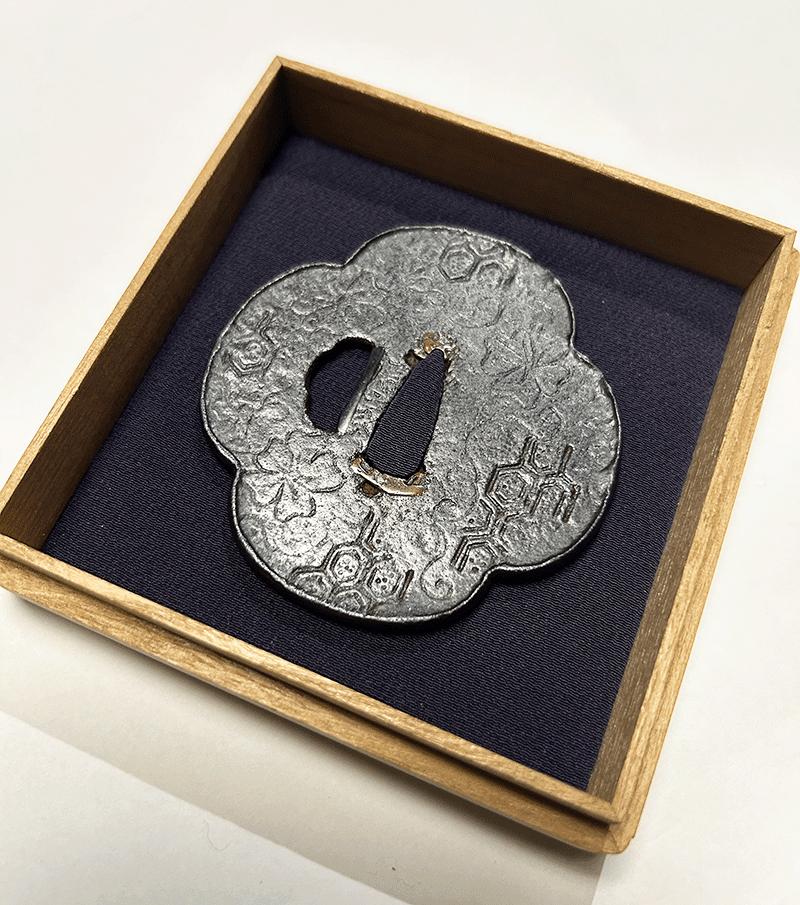
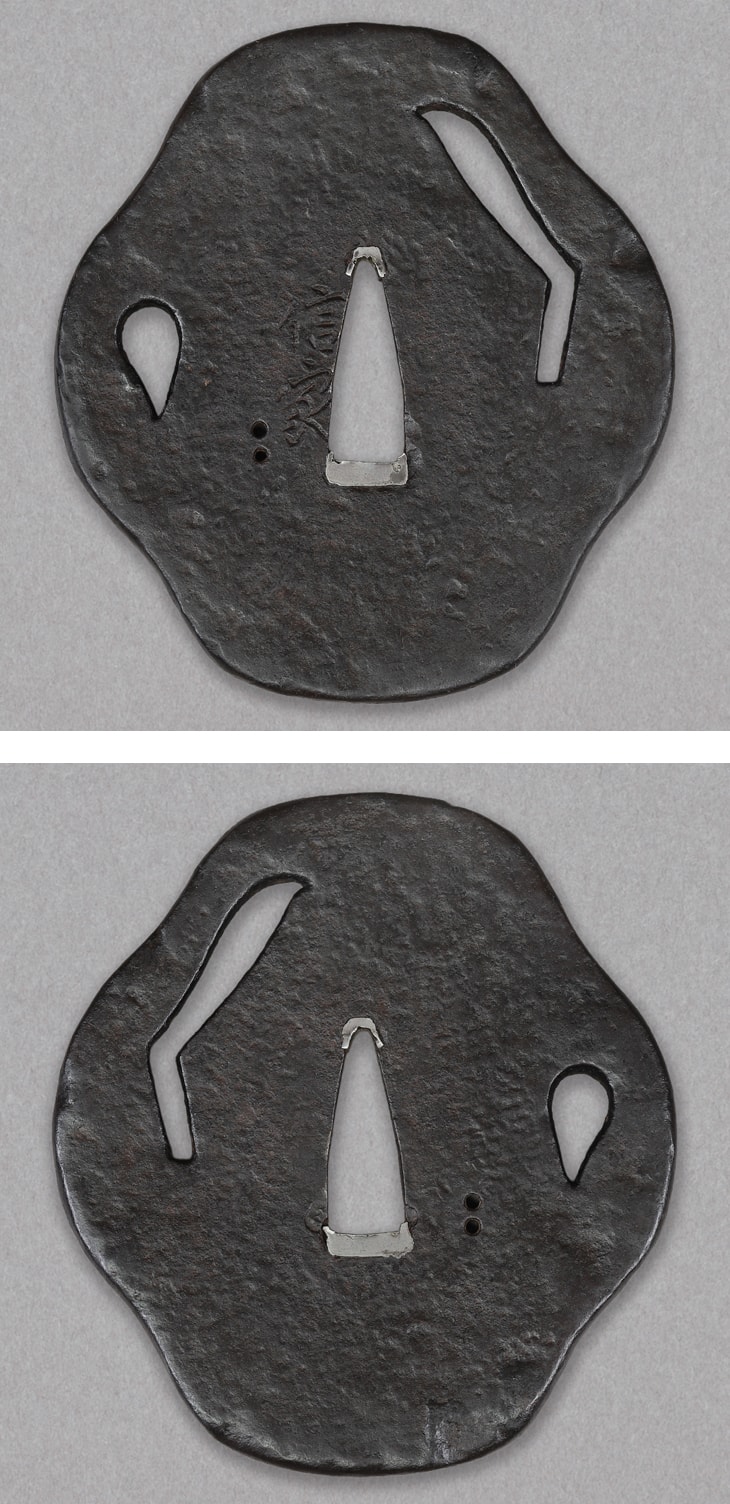
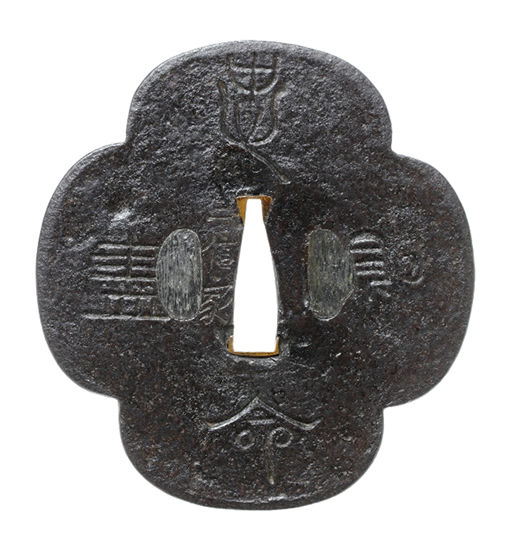
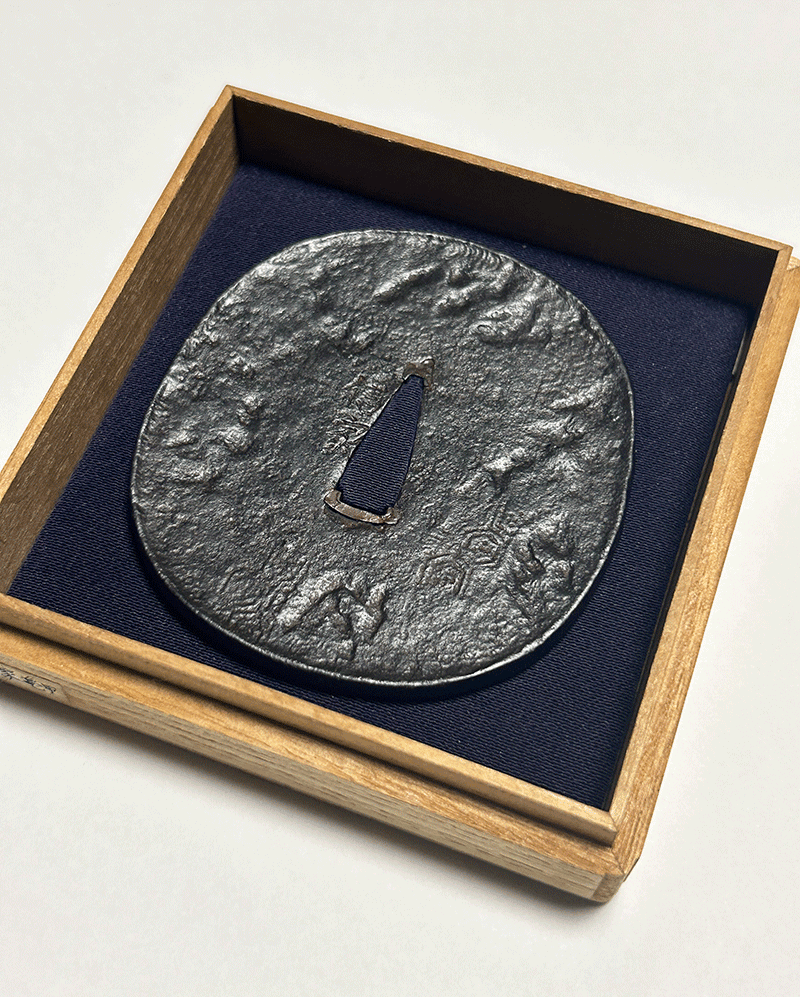
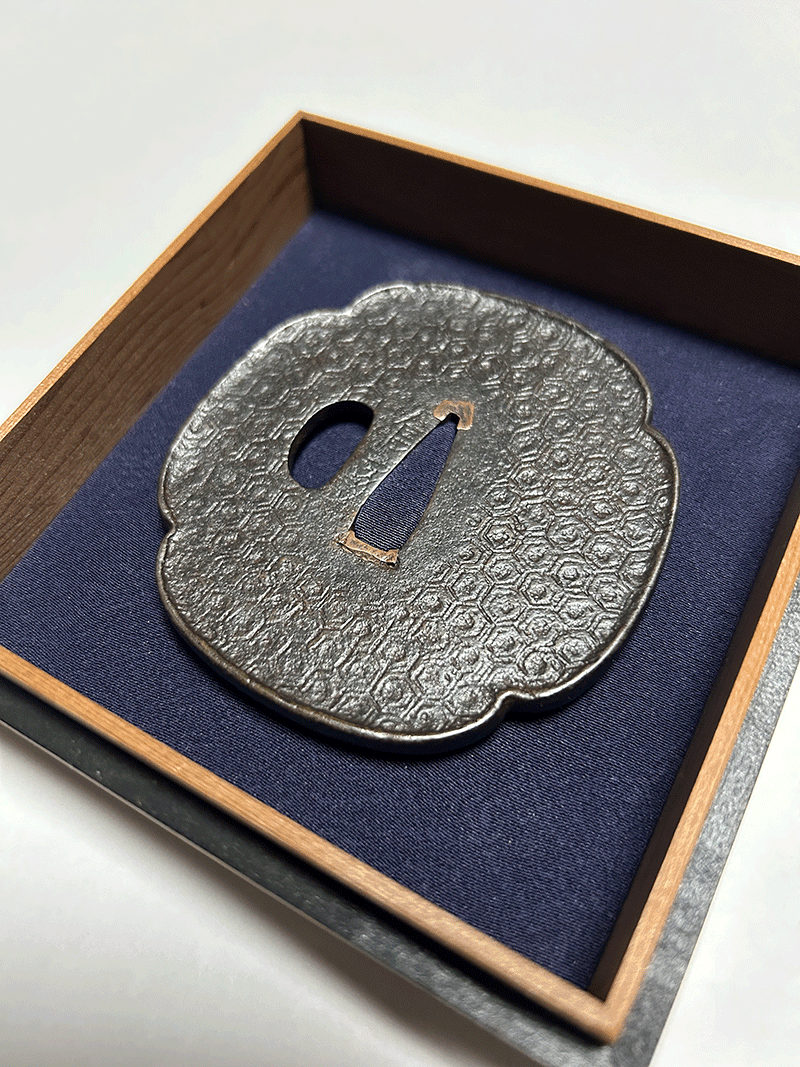
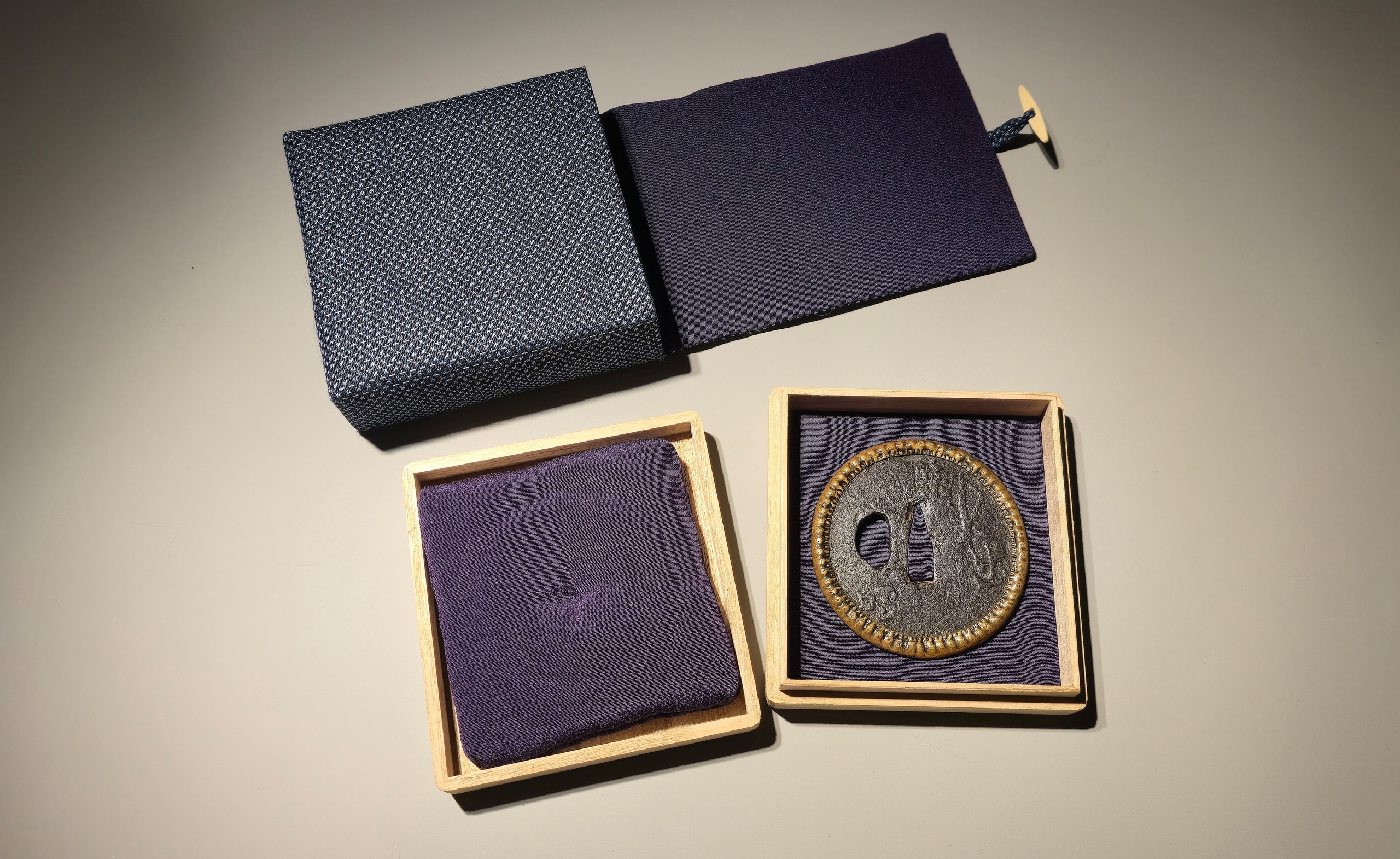
This is a Momoyama period tsuba by the renowned Owari smith Nobuie, known for his exceptional iron forging. It features a mokko-gata (melon shape) form with a gourd karakusa (vine) design carved in kebori. The tsuba is accompanied by a Juyo Tosogu certificate from the NBTHK and has a hakogaki by Sato Kanzan, noting it was treasured by Suzuki Yoshijo.

NBTHK Setsumei

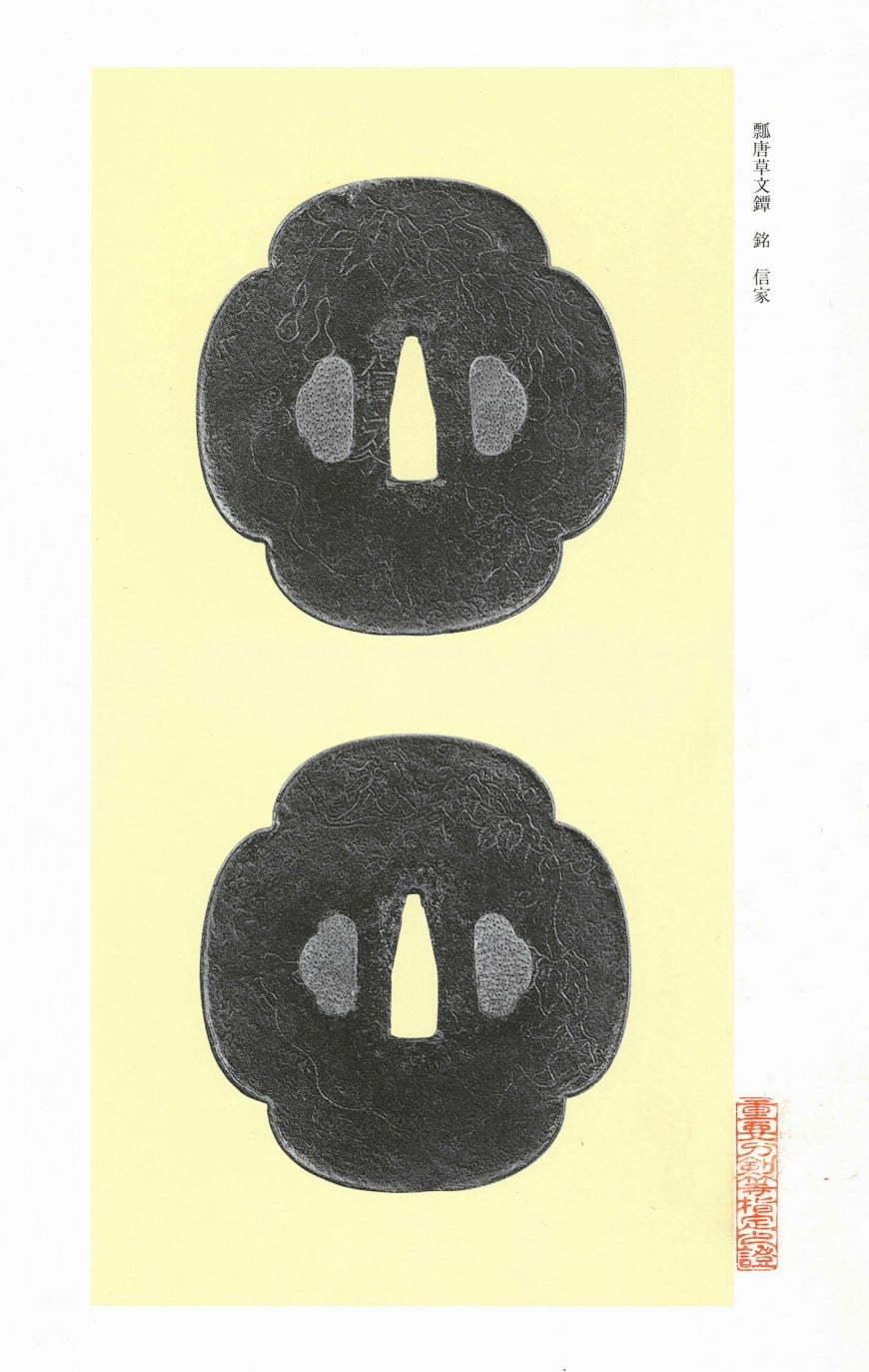
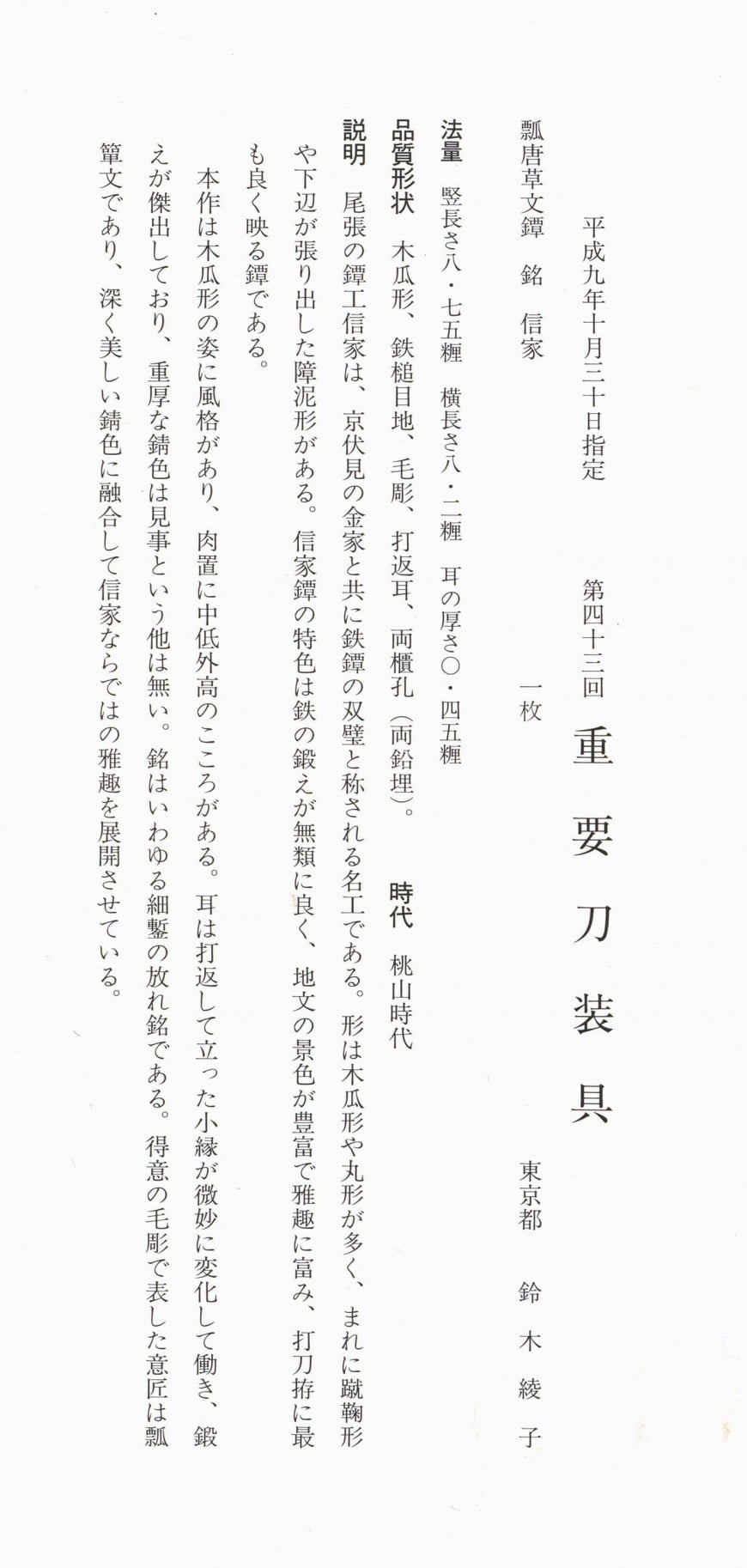
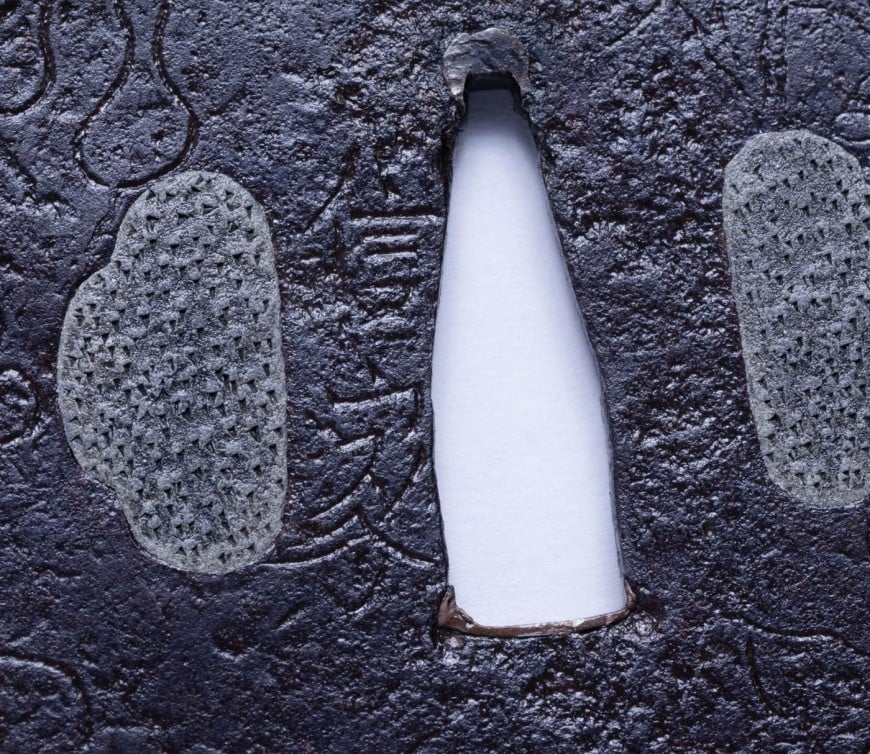
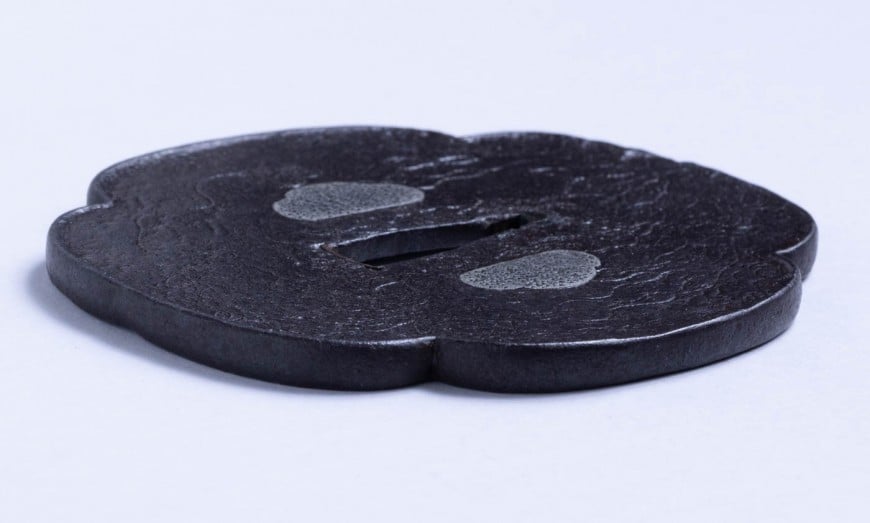
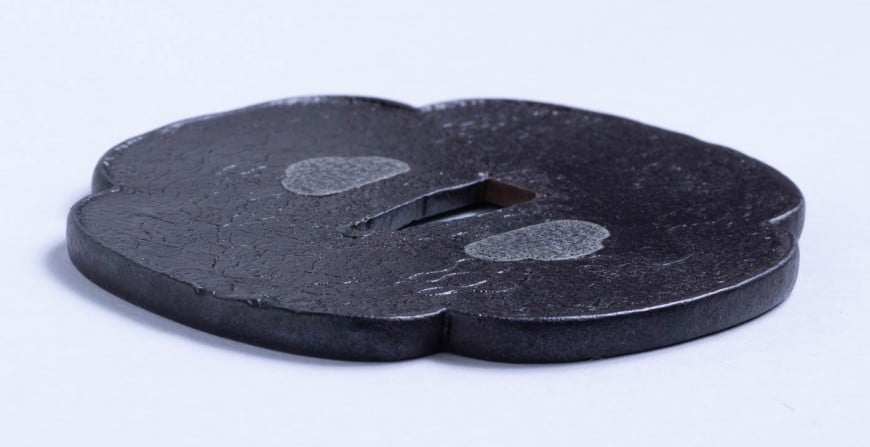
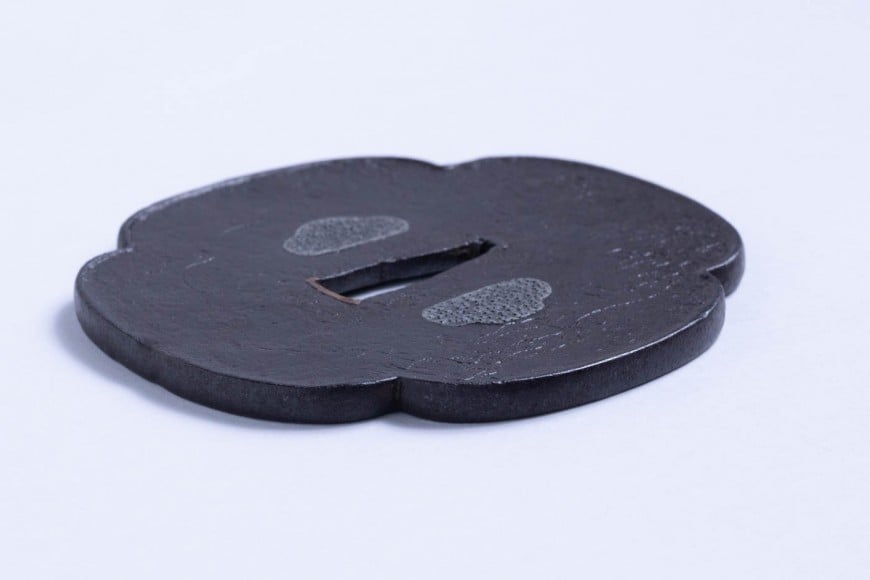
Juyo-Tosogu, 43rd Session — Designated October 30, 1997 Tsuba, mei: Nobuie (信家) Measurements Tate (height): 8.75 cm Yoko (width): 8.2 cm Mimi thickness: 0.45 cm Description Form: mokko-gata Material: iron Surface: tsuchime-ji (hammered ground) Design: hyōtan karakusa-mon (gourd-and-arabesque design) rendered in kebori (hairline engraving) Rim: uchikaeshi-mimi (turned-back rim), forming a standing, subtly varied small rim edge Hitsu-ana: two, both lead-plugged Signature: Nobuie; executed in the so-called fine-chisel “detached” style (hosotagane no hanare-mei) Artisan Nobie (信家), Owari tsuba maker. Era Momoyama period. Explanation Nobuie of Owari is a master tsuba maker celebrated—together with Kaneie of Fushimi in Kyoto—as one of the two foremost figures in iron tsuba. Commonly encountered shapes are mokko-gata and round forms, with rarer examples including kemari-gata and aori-gata (with a flared lower edge). The distinguishing qualities of Nobuie tsuba lie in their peerlessly fine forging: the surface shows abundant and varied jihada scenery, yielding a refined elegance, and such guards are especially becoming on uchigatana mountings. This work, in mokko-gata, possesses an imposing presence. The carving of volume (nikuoki) shows an intention of moderate height at the center with greater height toward the outer areas. The rim is turned back, and the standing small edge exhibits subtle variations and activity; the forging is outstanding, and the rich, weighty rust coloration can only be called magnificent. The signature is in the so-called fine-chisel “detached” style. The favored motif—gourd vines (hyōtan karakusa)—is expressed through Nobuie’s accomplished kebori and, melding with the deep and beautiful patina, unfolds an elegant taste that is unmistakably his.

NihontoWatch MonNihontoWatch
MarketAuctionsEncyclopedia
Fittings›Owari›Nobuie›Tsuba: Nobuie - Gourd Karakusa Design
tsubaJūyō
Nobuie

Tsuba: Nobuie - Gourd Karakusa Design

mei · Momoyama

¥7,000,000
Visit seller website →
Nobuie — 1 of 21
Nobuie — 2 of 21
Nobuie — 3 of 21
Nobuie — 4 of 21
Nobuie — 5 of 21
Nobuie — 6 of 21
Nobuie — 7 of 21
Nobuie — 8 of 21
Nobuie — 9 of 21
Nobuie — 10 of 21
Nobuie — 11 of 21
Nobuie — 12 of 21
Nobuie — 13 of 21
Nobuie — 14 of 21
Nobuie — 15 of 21
Nobuie — 16 of 21
Nobuie — 17 of 21
Nobuie — 18 of 21
Nobuie — 19 of 21
Nobuie — 20 of 21
Nobuie — 21 of 21
1 / 21
1 / 21
Nobuie — 1 of 21Nobuie — 2 of 21Nobuie — 3 of 21Nobuie — 4 of 21Nobuie — 5 of 21Nobuie — 6 of 21Nobuie — 7 of 21Nobuie — 8 of 21Nobuie — 9 of 21Nobuie — 10 of 21Nobuie — 11 of 21Nobuie — 12 of 21Nobuie — 13 of 21Nobuie — 14 of 21Nobuie — 15 of 21Nobuie — 16 of 21Nobuie — 17 of 21Nobuie — 18 of 21Nobuie — 19 of 21Nobuie — 20 of 21Nobuie — 21 of 21
Measurements & details
Maker

Nobuie

Era

Momoyama

Province

Owari

Signature

Signed

Papers

Jūyō #43 (NBTHK)

Description

This is a Momoyama period tsuba by the renowned Owari smith Nobuie, known for his exceptional iron forging. It features a mokko-gata (melon shape) form with a gourd karakusa (vine) design carved in kebori. The tsuba is accompanied by a Juyo Tosogu certificate from the NBTHK and has a hakogaki by Sato Kanzan, noting it was treasured by Suzuki Yoshijo.

NBTHK Zufu Commentary

Juyo #43

AI translation — may contain errors

-Tosogu, 43rd Session — Designated October 30, 1997

, : Nobuie (信家)

Measurements (height): 8.75 cm (width): 8.2 cm Mimi thickness: 0.45 cm

Description Form: Material: iron Surface: (hammered ground) Design: hyōtan - (gourd-and-arabesque design) rendered in (hairline engraving) Rim: (turned-back rim), forming a standing, subtly varied small rim edge : two, both lead-plugged Signature: Nobuie; executed in the so-called fine-chisel “detached” style (hosotagane no )

Artisan Nobie (信家), Owari maker.

Era period.

Explanation Nobuie of Owari is a master maker celebrated—together with Kaneie of Fushimi in Kyoto—as one of the two foremost figures in iron . Commonly encountered shapes are and round forms, with rarer examples including kemari-gata and (with a flared lower edge). The distinguishing qualities of Nobuie lie in their peerlessly fine forging: the surface shows abundant and varied scenery, yielding a refined elegance, and such guards are especially becoming on mountings.

This work, in , possesses an imposing presence. The carving of volume () shows an intention of moderate height at the center with greater height toward the outer areas. The rim is turned back, and the standing small edge exhibits subtle variations and activity; the forging is outstanding, and the rich, weighty rust coloration can only be called magnificent. The signature is in the so-called fine-chisel “detached” style. The favored motif—gourd vines (hyōtan )—is expressed through Nobuie’s accomplished and, melding with the deep and beautiful patina, unfolds an elegant taste that is unmistakably his.

About the maker

Nobuie

信家

Iron-tsuba · Owari

11 pieces on the market now

›

Nobuie is an Owari Province tsubako active from the late Muromachi through the Momoyama period, celebrated alongside Kaneie of Kyoto-Fushimi as one of the "twin peaks" (soheki) of iron tsuba. He is associated with the Kofujita school. Where Kaneie pioneered the pictorial (e-fu) style and favored relatively thin plates, Nobuie's tsuba are generally thicker, possessing what the NBTHK repeatedly characterizes as "a strong sense of mass." His preferred forms are mokko-gata and maru-gata, with rarer variants including kemari-gata and the shodeigata type in which the lower edge flares outward. His signatures are almost always two-character mei, broadly divisible into two types: the hanare-mei ("spaced" or "detached" signature) and the futoji-mei ("bold-character" signature), each associated with distinct stylistic tendencies within his oeuvre.

The defining technical characteristic of Nobuie tsuba, affirmed across every NBTHK evaluation, is "the peerless quality of the forged iron": the surface texture yields "abundant visual effects" and the jihada presents rich "scenery" (jimon no keshiki). His plates are finished in tsuchime-ji (hammered ground), and the iron is worked to achieve a deep, weighty rust patina described as possessing "an elegant taste." Decorative repertoire includes kebori (hairline engraving) of floral motifs, scrolling karakusa, and kikkomon patterns, as well as sukidashi-bori (pushed-up relief) and occasional ji-sukashi (openwork through the plate). Among his most distinctive features are inscribed divine titles such as "Hachiman Daibosatsu" and the Nichiren invocation "Namu Myoho Renge Kyo," together with doka (didactic verses) expressing the essentials of swordsmanship and the prevailing thought of the Sengoku age. The uchikaeshi-mimi (turned-back rim) is singled out as a hallmark: "regarded as the very essence of Nobuie's art," its vigorous modeling and active tekkotsu (iron bones) serve to tighten the pictorial field and complete each work as a unified sculptural statement. His attention extends beyond surface quality to fully three-dimensional modeling, with the subtle nikudori (shaping of the plate) from rim inward toward the nakago-ana noted as "unique to Nobuie."

The NBTHK consistently positions Nobuie tsuba as "works through which one may most fully appreciate the allure of iron tsuba from the late Muromachi through Momoyama periods[[c:1]]." Evaluators praise a quality that transcends technical mastery: the iron is not merely well forged but communicates spiritual content, "quietly conveying the detached spiritual composure of the warrior who lived through the Warring States era." Individual pieces are said to evoke "the bearing of an old warrior" and a spirit akin to kenzen ichinyo (the unity of sword and Zen) and mushin (no-mind). The recurring evaluative refrain describes works that are simultaneously "forceful" and "elegant," combining "a powerful dignity" with "a rich antique fragrance." That these tsuba show to best advantage on uchigatana koshirae[[c:2]] -- the practical mounting of the Sengoku battlefield -- underscores the unity of martial function and aesthetic refinement that defines Nobuie's enduring significance within the tradition of Japanese iron tsuba.

Historical importance

Where Nobuie stands among comparable artisans: across all of nihontō, and within tradition, era, and period. The tiers (Foremost · Leading · Major · Notable) weigh official designations from the NBTHK and Japan's Agency for Cultural Affairs, together with historical honors of lasting repute such as the Sansaku and Meibutsu-chō.

随一
Foremost
屈指
Leading
有数
Major
著名
Notable

Select a lens to see how it's measured.

Designation record
56 designated works
Tokubetsu Jūyō
4
Jūyō
52
11 works by Nobuie on the market→
Nobuie — full profileIron-tsuba school
About the school

Owari

尾張

Iron-tsuba · Owari

87 pieces on the market now

›

The Owari school represents one of the twin pillars of Japanese iron openwork tsuba production, standing alongside the Kyō tradition as a defining force in the art of ji-sukashi (ground openwork) guards. The school's origins lie in the Owari province (modern Aichi prefecture), where production began in the early to middle Muromachi period and continued across a sustained span extending into the Edo period. Learn more →
7 recorded smiths105 designated works
Leading smiths
SmithEraDesignated
Nobuie信家—56
Hiko’emon彦右衛門—0
Katsuaki克明—0
Shigemasa重正—0
Norisuke則亮 (Norisuke/Koreyoshi—0
Explore the Owari school →
NBTHK Certificate
Jūyō Tōsōgu重要刀装具
Important Fitting
›

Exceptional craft of very high artistic value, judged to rank with a nationally recognized Important Art Object (Jūyō Bijutsuhin).

About the NBTHK›

The NBTHK (Nihon Bijutsu Tōken Hozon Kyōkai, the Society for the Preservation of Japanese Art Swords) is a public-interest incorporated foundation founded in 1948 and supervised by Japan’s Agency for Cultural Affairs (Bunkachō); it is based at the Japanese Sword Museum in Tokyo. Its expert panels physically examine each submitted work (shinsa) and issue a certificate (kanteishō) ranking it by artistic and historical merit. NBTHK papers are the most widely recognized standard of authentication for Japanese swords and fittings.

NBTHK official site→
Seller
W
Wakeidou
Established 1953 · 73 yrs on the market
🇯🇵Ships from Japan
›
✓Verified dealerwakeidou.com
Settles in JPY
Wire transferPayPalCredit card
Return policy

Returns accepted within 7 days for internet purchases.

View all of Wakeidou’s listings→View this item on the dealer’s site→

More works by Nobuie

View all →
Iida Koendo
Tokuho
Tsuba - Tokuho - by Nobuie - Nobuie - Momoyama Period, Owari ProvinceTsuba - Tokuho - by Nobuie - Nobuie - Momoyama Period, Owari Province

Tsuba

ByNobuie
¥3,850,000
Iida Koendo
Tokuho
Tsuba - Tokuho - by Nobuie - Tosogu: NBTHK Tokubetsu Hozon Tsuba by NobuieTsuba - Tokuho - by Nobuie - Tosogu: NBTHK Tokubetsu Hozon Tsuba by Nobuie

Tsuba

ByNobuie
¥3,300,000
Iida Koendo
Tokuho
Tsuba - Tokuho - by Nobuie - Nobuie - Momoyama period, Owari ProvinceTsuba - Tokuho - by Nobuie - Nobuie - Momoyama period, Owari Province

Tsuba

ByNobuie
¥3,850,000
Iida Koendo
Jūyō
Tsuba - Jūyō - by Nobuie - Tosogu: NobuieTsuba - Jūyō - by Nobuie - Tosogu: Nobuie

Tsuba

ByNobuie
Ask
Iida Koendo
Tokuho
Tsuba - Tokuho - by Nobuie - Tosogu: NobuieTsuba - Tokuho - by Nobuie - Tosogu: Nobuie

Tsuba

ByNobuie
¥2,750,000
Nihonto.com
Tokuho
Tsuba - Tokuho - by Nobuie - Unusual Tsuba by NobuieTsuba - Tokuho - by Nobuie - Unusual Tsuba by Nobuie

Tsuba

ByNobuie
¥19,750
Iida Koendo
Tokuho
Tsuba - Tokuho - by Nobuie - Nobuie - Momoyama period, Owari ProvinceTsuba - Tokuho - by Nobuie - Nobuie - Momoyama period, Owari Province

Tsuba

ByNobuie
¥2,750,000
Iida Koendo
Tokuho
Tsuba - Tokuho - by Nobuie - Tosogu: NobuieTsuba - Tokuho - by Nobuie - Tosogu: Nobuie

Tsuba

ByNobuie
¥4,400,000

Previously sold by Nobuie

Japanese Sword Books and Tsuba
Tokuho
Tsuba - Tokuho - by Nobuie - Signed Nobuie Tsuba with Tokubetsu Hozon PaperTsuba - Tokuho - by Nobuie - Signed Nobuie Tsuba with Tokubetsu Hozon Paper
Sold

Tsuba

ByNobuie
SOLD
Iida Koendo
Tokuho
Tsuba - Tokuho - by Nobuie - Tosogu: Nobuie Tsuba (Hanare Mei) - NBTHK Tokubetsu HozonTsuba - Tokuho - by Nobuie - Tosogu: Nobuie Tsuba (Hanare Mei) - NBTHK Tokubetsu Hozon
Sold

Tsuba

ByNobuie
SOLD
Samurai Nippon
Jūyō
Tsuba - Jūyō - by Nobuie - Nata ZuTsuba - Jūyō - by Nobuie - Nata Zu
Sold

Tsuba

ByNobuie
SOLD
Choshuya
Tokuho
Tsuba - Tokuho - by Nobuie - Gourd and Morning Glory Design, Signed NobuieTsuba - Tokuho - by Nobuie - Gourd and Morning Glory Design, Signed Nobuie
Sold

Tsuba

ByNobuie
SOLD
Eirakudo
Tokuho
Tsuba - Tokuho - by Nobuie - Tokubetsu Hozon Tosogu: Nobuie Tsuba with Scattered Drawings of People and MotifsTsuba - Tokuho - by Nobuie - Tokubetsu Hozon Tosogu: Nobuie Tsuba with Scattered Drawings of People and Motifs
Sold

Tsuba

ByNobuie
SOLD
Iida Koendo
Tokuho
Tsuba - Tokuho - by Nobuie - Tosogu: Tsuba by NobuieTsuba - Tokuho - by Nobuie - Tosogu: Tsuba by Nobuie
Sold

Tsuba

ByNobuie
SOLD
Choshuya
Tsuba - by Nobuie - Tadanori Jinmei Zu Tsuba, Signed San-NobuieTsuba - by Nobuie - Tadanori Jinmei Zu Tsuba, Signed San-Nobuie
Sold

Tsuba

ByNobuie
SOLD
Iida Koendo
Tokuho
Tsuba - Tokuho - by Nobuie - NobuieTsuba - Tokuho - by Nobuie - Nobuie
Sold

Tsuba

ByNobuie
SOLD

More from the Owari school

View all →
Nihontocraft
Tokuho
Tsuba - Tokuho - by Kanayama School - Kanayama Tsuba with Tea Jar MotifTsuba - Tokuho - by Kanayama School - Kanayama Tsuba with Tea Jar Motif

Tsuba

ByKanayama School
¥2,500
Samurai Nippon
Tokuho
Tsuba - Tokuho - by Owari Norisuke - Mon Chirashi Sukashi ZuTsuba - Tokuho - by Owari Norisuke - Mon Chirashi Sukashi Zu

Tsuba

ByOwari Norisuke
¥210,000
Samurai Nippon
Jūyō
Tsuba - Jūyō - by Yamakichi Yamakichibei - Kuruma Sukashi ZuTsuba - Jūyō - by Yamakichi Yamakichibei - Kuruma Sukashi Zu

Tsuba

ByYamakichi Yamakichibei
Ask
Choshuya
Hozon
Tsuba - Hozon - by Kanayama School - Shiho Kotoji Sukashi Zu Tsuba - Mumei KanayamaTsuba - Hozon - by Kanayama School - Shiho Kotoji Sukashi Zu Tsuba - Mumei Kanayama

Tsuba

ByKanayama School
¥200,000
Samurai Nippon
Tokuho
Tsuba - Tokuho - by Owari School - Shochiku Sekka Sukashi ZuTsuba - Tokuho - by Owari School - Shochiku Sekka Sukashi Zu

Tsuba

ByOwari School
¥330,000
Yamasiroya
Hozon
Tsuba - Hozon - by Owari School - Owari Tsuba: Left and Right Mitsugai-hishi SukashiTsuba - Hozon - by Owari School - Owari Tsuba: Left and Right Mitsugai-hishi Sukashi

Tsuba

ByOwari School
¥420,000
Choshuya
Hozon
Tsuba - Hozon - by Hoan Hisatsugu - Yugao Sukashi Tsuba, Signed Choshu Hagi ju Hisatsugu SakuTsuba - Hozon - by Hoan Hisatsugu - Yugao Sukashi Tsuba, Signed Choshu Hagi ju Hisatsugu Saku

Tsuba

ByHoan Hisatsugu
¥220,000
Eirakudo
Hozon
Tsuba - Hozon - by Owari School - Owari Sangai-Sukashi Tsuba Hozon TosoguTsuba - Hozon - by Owari School - Owari Sangai-Sukashi Tsuba Hozon Tosogu

Tsuba

ByOwari School
¥170,000

Swords

  • Katana
  • Wakizashi
  • Tantō
  • Tachi
  • Naginata
  • Yari

Fittings

  • Tsuba
  • Fuchi-Kashira
  • Kozuka
  • Menuki

By Certification

  • Tokujū
  • Jūyō
  • Tokuho
  • Hozon

Resources

  • Dealer Directory
  • Artist Directory
  • Glossary
  • Browse All
Nihontowatch© 2026
TermsPrivacyCookiesAbout

Description

This is a Momoyama period tsuba by the renowned Owari smith Nobuie, known for his exceptional iron forging. It features a mokko-gata (melon shape) form with a gourd karakusa (vine) design carved in kebori. The tsuba is accompanied by a Juyo Tosogu certificate from the NBTHK and has a hakogaki by Sato Kanzan, noting it was treasured by Suzuki Yoshijo.

NBTHK Setsumei

Juyo-Tosogu, 43rd Session — Designated October 30, 1997 Tsuba, mei: Nobuie (信家) Measurements Tate (height): 8.75 cm Yoko (width): 8.2 cm Mimi thickness: 0.45 cm Description Form: mokko-gata Material: iron Surface: tsuchime-ji (hammered ground) Design: hyōtan karakusa-mon (gourd-and-arabesque design) rendered in kebori (hairline engraving) Rim: uchikaeshi-mimi (turned-back rim), forming a standing, subtly varied small rim edge Hitsu-ana: two, both lead-plugged Signature: Nobuie; executed in the so-called fine-chisel “detached” style (hosotagane no hanare-mei) Artisan Nobie (信家), Owari tsuba maker. Era Momoyama period. Explanation Nobuie of Owari is a master tsuba maker celebrated—together with Kaneie of Fushimi in Kyoto—as one of the two foremost figures in iron tsuba. Commonly encountered shapes are mokko-gata and round forms, with rarer examples including kemari-gata and aori-gata (with a flared lower edge). The distinguishing qualities of Nobuie tsuba lie in their peerlessly fine forging: the surface shows abundant and varied jihada scenery, yielding a refined elegance, and such guards are especially becoming on uchigatana mountings. This work, in mokko-gata, possesses an imposing presence. The carving of volume (nikuoki) shows an intention of moderate height at the center with greater height toward the outer areas. The rim is turned back, and the standing small edge exhibits subtle variations and activity; the forging is outstanding, and the rich, weighty rust coloration can only be called magnificent. The signature is in the so-called fine-chisel “detached” style. The favored motif—gourd vines (hyōtan karakusa)—is expressed through Nobuie’s accomplished kebori and, melding with the deep and beautiful patina, unfolds an elegant taste that is unmistakably his.

NihontoWatch MonNihontoWatch
MarketAuctionsEncyclopedia
Fittings›Owari›Nobuie›Tsuba: Nobuie - Gourd Karakusa Design
tsubaJūyō
Nobuie

Tsuba: Nobuie - Gourd Karakusa Design

mei · Momoyama

¥7,000,000
Visit seller website →
Nobuie — 1 of 21
Nobuie — 2 of 21
Nobuie — 3 of 21
Nobuie — 4 of 21
Nobuie — 5 of 21
Nobuie — 6 of 21
Nobuie — 7 of 21
Nobuie — 8 of 21
Nobuie — 9 of 21
Nobuie — 10 of 21
Nobuie — 11 of 21
Nobuie — 12 of 21
Nobuie — 13 of 21
Nobuie — 14 of 21
Nobuie — 15 of 21
Nobuie — 16 of 21
Nobuie — 17 of 21
Nobuie — 18 of 21
Nobuie — 19 of 21
Nobuie — 20 of 21
Nobuie — 21 of 21
1 / 21
1 / 21
Nobuie — 1 of 21Nobuie — 2 of 21Nobuie — 3 of 21Nobuie — 4 of 21Nobuie — 5 of 21Nobuie — 6 of 21Nobuie — 7 of 21Nobuie — 8 of 21Nobuie — 9 of 21Nobuie — 10 of 21Nobuie — 11 of 21Nobuie — 12 of 21Nobuie — 13 of 21Nobuie — 14 of 21Nobuie — 15 of 21Nobuie — 16 of 21Nobuie — 17 of 21Nobuie — 18 of 21Nobuie — 19 of 21Nobuie — 20 of 21Nobuie — 21 of 21
Measurements & details
Maker

Nobuie

Era

Momoyama

Province

Owari

Signature

Signed

Papers

Jūyō #43 (NBTHK)

Description

This is a Momoyama period tsuba by the renowned Owari smith Nobuie, known for his exceptional iron forging. It features a mokko-gata (melon shape) form with a gourd karakusa (vine) design carved in kebori. The tsuba is accompanied by a Juyo Tosogu certificate from the NBTHK and has a hakogaki by Sato Kanzan, noting it was treasured by Suzuki Yoshijo.

NBTHK Zufu Commentary

Juyo #43

AI translation — may contain errors

-Tosogu, 43rd Session — Designated October 30, 1997

, : Nobuie (信家)

Measurements (height): 8.75 cm (width): 8.2 cm Mimi thickness: 0.45 cm

Description Form: Material: iron Surface: (hammered ground) Design: hyōtan - (gourd-and-arabesque design) rendered in (hairline engraving) Rim: (turned-back rim), forming a standing, subtly varied small rim edge : two, both lead-plugged Signature: Nobuie; executed in the so-called fine-chisel “detached” style (hosotagane no )

Artisan Nobie (信家), Owari maker.

Era period.

Explanation Nobuie of Owari is a master maker celebrated—together with Kaneie of Fushimi in Kyoto—as one of the two foremost figures in iron . Commonly encountered shapes are and round forms, with rarer examples including kemari-gata and (with a flared lower edge). The distinguishing qualities of Nobuie lie in their peerlessly fine forging: the surface shows abundant and varied scenery, yielding a refined elegance, and such guards are especially becoming on mountings.

This work, in , possesses an imposing presence. The carving of volume () shows an intention of moderate height at the center with greater height toward the outer areas. The rim is turned back, and the standing small edge exhibits subtle variations and activity; the forging is outstanding, and the rich, weighty rust coloration can only be called magnificent. The signature is in the so-called fine-chisel “detached” style. The favored motif—gourd vines (hyōtan )—is expressed through Nobuie’s accomplished and, melding with the deep and beautiful patina, unfolds an elegant taste that is unmistakably his.

About the maker

Nobuie

信家

Iron-tsuba · Owari

11 pieces on the market now

›

Nobuie is an Owari Province tsubako active from the late Muromachi through the Momoyama period, celebrated alongside Kaneie of Kyoto-Fushimi as one of the "twin peaks" (soheki) of iron tsuba. He is associated with the Kofujita school. Where Kaneie pioneered the pictorial (e-fu) style and favored relatively thin plates, Nobuie's tsuba are generally thicker, possessing what the NBTHK repeatedly characterizes as "a strong sense of mass." His preferred forms are mokko-gata and maru-gata, with rarer variants including kemari-gata and the shodeigata type in which the lower edge flares outward. His signatures are almost always two-character mei, broadly divisible into two types: the hanare-mei ("spaced" or "detached" signature) and the futoji-mei ("bold-character" signature), each associated with distinct stylistic tendencies within his oeuvre.

The defining technical characteristic of Nobuie tsuba, affirmed across every NBTHK evaluation, is "the peerless quality of the forged iron": the surface texture yields "abundant visual effects" and the jihada presents rich "scenery" (jimon no keshiki). His plates are finished in tsuchime-ji (hammered ground), and the iron is worked to achieve a deep, weighty rust patina described as possessing "an elegant taste." Decorative repertoire includes kebori (hairline engraving) of floral motifs, scrolling karakusa, and kikkomon patterns, as well as sukidashi-bori (pushed-up relief) and occasional ji-sukashi (openwork through the plate). Among his most distinctive features are inscribed divine titles such as "Hachiman Daibosatsu" and the Nichiren invocation "Namu Myoho Renge Kyo," together with doka (didactic verses) expressing the essentials of swordsmanship and the prevailing thought of the Sengoku age. The uchikaeshi-mimi (turned-back rim) is singled out as a hallmark: "regarded as the very essence of Nobuie's art," its vigorous modeling and active tekkotsu (iron bones) serve to tighten the pictorial field and complete each work as a unified sculptural statement. His attention extends beyond surface quality to fully three-dimensional modeling, with the subtle nikudori (shaping of the plate) from rim inward toward the nakago-ana noted as "unique to Nobuie."

The NBTHK consistently positions Nobuie tsuba as "works through which one may most fully appreciate the allure of iron tsuba from the late Muromachi through Momoyama periods[[c:1]]." Evaluators praise a quality that transcends technical mastery: the iron is not merely well forged but communicates spiritual content, "quietly conveying the detached spiritual composure of the warrior who lived through the Warring States era." Individual pieces are said to evoke "the bearing of an old warrior" and a spirit akin to kenzen ichinyo (the unity of sword and Zen) and mushin (no-mind). The recurring evaluative refrain describes works that are simultaneously "forceful" and "elegant," combining "a powerful dignity" with "a rich antique fragrance." That these tsuba show to best advantage on uchigatana koshirae[[c:2]] -- the practical mounting of the Sengoku battlefield -- underscores the unity of martial function and aesthetic refinement that defines Nobuie's enduring significance within the tradition of Japanese iron tsuba.

Historical importance

Where Nobuie stands among comparable artisans: across all of nihontō, and within tradition, era, and period. The tiers (Foremost · Leading · Major · Notable) weigh official designations from the NBTHK and Japan's Agency for Cultural Affairs, together with historical honors of lasting repute such as the Sansaku and Meibutsu-chō.

随一
Foremost
屈指
Leading
有数
Major
著名
Notable

Select a lens to see how it's measured.

Designation record
56 designated works
Tokubetsu Jūyō
4
Jūyō
52
11 works by Nobuie on the market→
Nobuie — full profileIron-tsuba school
About the school

Owari

尾張

Iron-tsuba · Owari

87 pieces on the market now

›

The Owari school represents one of the twin pillars of Japanese iron openwork tsuba production, standing alongside the Kyō tradition as a defining force in the art of ji-sukashi (ground openwork) guards. The school's origins lie in the Owari province (modern Aichi prefecture), where production began in the early to middle Muromachi period and continued across a sustained span extending into the Edo period. Learn more →
7 recorded smiths105 designated works
Leading smiths
SmithEraDesignated
Nobuie信家—56
Hiko’emon彦右衛門—0
Katsuaki克明—0
Shigemasa重正—0
Norisuke則亮 (Norisuke/Koreyoshi—0
Explore the Owari school →
NBTHK Certificate
Jūyō Tōsōgu重要刀装具
Important Fitting
›

Exceptional craft of very high artistic value, judged to rank with a nationally recognized Important Art Object (Jūyō Bijutsuhin).

About the NBTHK›

The NBTHK (Nihon Bijutsu Tōken Hozon Kyōkai, the Society for the Preservation of Japanese Art Swords) is a public-interest incorporated foundation founded in 1948 and supervised by Japan’s Agency for Cultural Affairs (Bunkachō); it is based at the Japanese Sword Museum in Tokyo. Its expert panels physically examine each submitted work (shinsa) and issue a certificate (kanteishō) ranking it by artistic and historical merit. NBTHK papers are the most widely recognized standard of authentication for Japanese swords and fittings.

NBTHK official site→
Seller
W
Wakeidou
Established 1953 · 73 yrs on the market
🇯🇵Ships from Japan
›
✓Verified dealerwakeidou.com
Settles in JPY
Wire transferPayPalCredit card
Return policy

Returns accepted within 7 days for internet purchases.

View all of Wakeidou’s listings→View this item on the dealer’s site→

More works by Nobuie

View all →
Iida Koendo
Tokuho
Tsuba - Tokuho - by Nobuie - Nobuie - Momoyama Period, Owari ProvinceTsuba - Tokuho - by Nobuie - Nobuie - Momoyama Period, Owari Province

Tsuba

ByNobuie
¥3,850,000
Iida Koendo
Tokuho
Tsuba - Tokuho - by Nobuie - Tosogu: NBTHK Tokubetsu Hozon Tsuba by NobuieTsuba - Tokuho - by Nobuie - Tosogu: NBTHK Tokubetsu Hozon Tsuba by Nobuie

Tsuba

ByNobuie
¥3,300,000
Iida Koendo
Tokuho
Tsuba - Tokuho - by Nobuie - Nobuie - Momoyama period, Owari ProvinceTsuba - Tokuho - by Nobuie - Nobuie - Momoyama period, Owari Province

Tsuba

ByNobuie
¥3,850,000
Iida Koendo
Jūyō
Tsuba - Jūyō - by Nobuie - Tosogu: NobuieTsuba - Jūyō - by Nobuie - Tosogu: Nobuie

Tsuba

ByNobuie
Ask
Iida Koendo
Tokuho
Tsuba - Tokuho - by Nobuie - Tosogu: NobuieTsuba - Tokuho - by Nobuie - Tosogu: Nobuie

Tsuba

ByNobuie
¥2,750,000
Nihonto.com
Tokuho
Tsuba - Tokuho - by Nobuie - Unusual Tsuba by NobuieTsuba - Tokuho - by Nobuie - Unusual Tsuba by Nobuie

Tsuba

ByNobuie
¥19,750
Iida Koendo
Tokuho
Tsuba - Tokuho - by Nobuie - Nobuie - Momoyama period, Owari ProvinceTsuba - Tokuho - by Nobuie - Nobuie - Momoyama period, Owari Province

Tsuba

ByNobuie
¥2,750,000
Iida Koendo
Tokuho
Tsuba - Tokuho - by Nobuie - Tosogu: NobuieTsuba - Tokuho - by Nobuie - Tosogu: Nobuie

Tsuba

ByNobuie
¥4,400,000

Previously sold by Nobuie

Japanese Sword Books and Tsuba
Tokuho
Tsuba - Tokuho - by Nobuie - Signed Nobuie Tsuba with Tokubetsu Hozon PaperTsuba - Tokuho - by Nobuie - Signed Nobuie Tsuba with Tokubetsu Hozon Paper
Sold

Tsuba

ByNobuie
SOLD
Iida Koendo
Tokuho
Tsuba - Tokuho - by Nobuie - Tosogu: Nobuie Tsuba (Hanare Mei) - NBTHK Tokubetsu HozonTsuba - Tokuho - by Nobuie - Tosogu: Nobuie Tsuba (Hanare Mei) - NBTHK Tokubetsu Hozon
Sold

Tsuba

ByNobuie
SOLD
Samurai Nippon
Jūyō
Tsuba - Jūyō - by Nobuie - Nata ZuTsuba - Jūyō - by Nobuie - Nata Zu
Sold

Tsuba

ByNobuie
SOLD
Choshuya
Tokuho
Tsuba - Tokuho - by Nobuie - Gourd and Morning Glory Design, Signed NobuieTsuba - Tokuho - by Nobuie - Gourd and Morning Glory Design, Signed Nobuie
Sold

Tsuba

ByNobuie
SOLD
Eirakudo
Tokuho
Tsuba - Tokuho - by Nobuie - Tokubetsu Hozon Tosogu: Nobuie Tsuba with Scattered Drawings of People and MotifsTsuba - Tokuho - by Nobuie - Tokubetsu Hozon Tosogu: Nobuie Tsuba with Scattered Drawings of People and Motifs
Sold

Tsuba

ByNobuie
SOLD
Iida Koendo
Tokuho
Tsuba - Tokuho - by Nobuie - Tosogu: Tsuba by NobuieTsuba - Tokuho - by Nobuie - Tosogu: Tsuba by Nobuie
Sold

Tsuba

ByNobuie
SOLD
Choshuya
Tsuba - by Nobuie - Tadanori Jinmei Zu Tsuba, Signed San-NobuieTsuba - by Nobuie - Tadanori Jinmei Zu Tsuba, Signed San-Nobuie
Sold

Tsuba

ByNobuie
SOLD
Iida Koendo
Tokuho
Tsuba - Tokuho - by Nobuie - NobuieTsuba - Tokuho - by Nobuie - Nobuie
Sold

Tsuba

ByNobuie
SOLD

More from the Owari school

View all →
Nihontocraft
Tokuho
Tsuba - Tokuho - by Kanayama School - Kanayama Tsuba with Tea Jar MotifTsuba - Tokuho - by Kanayama School - Kanayama Tsuba with Tea Jar Motif

Tsuba

ByKanayama School
¥2,500
Samurai Nippon
Tokuho
Tsuba - Tokuho - by Owari Norisuke - Mon Chirashi Sukashi ZuTsuba - Tokuho - by Owari Norisuke - Mon Chirashi Sukashi Zu

Tsuba

ByOwari Norisuke
¥210,000
Samurai Nippon
Jūyō
Tsuba - Jūyō - by Yamakichi Yamakichibei - Kuruma Sukashi ZuTsuba - Jūyō - by Yamakichi Yamakichibei - Kuruma Sukashi Zu

Tsuba

ByYamakichi Yamakichibei
Ask
Choshuya
Hozon
Tsuba - Hozon - by Kanayama School - Shiho Kotoji Sukashi Zu Tsuba - Mumei KanayamaTsuba - Hozon - by Kanayama School - Shiho Kotoji Sukashi Zu Tsuba - Mumei Kanayama

Tsuba

ByKanayama School
¥200,000
Samurai Nippon
Tokuho
Tsuba - Tokuho - by Owari School - Shochiku Sekka Sukashi ZuTsuba - Tokuho - by Owari School - Shochiku Sekka Sukashi Zu

Tsuba

ByOwari School
¥330,000
Yamasiroya
Hozon
Tsuba - Hozon - by Owari School - Owari Tsuba: Left and Right Mitsugai-hishi SukashiTsuba - Hozon - by Owari School - Owari Tsuba: Left and Right Mitsugai-hishi Sukashi

Tsuba

ByOwari School
¥420,000
Choshuya
Hozon
Tsuba - Hozon - by Hoan Hisatsugu - Yugao Sukashi Tsuba, Signed Choshu Hagi ju Hisatsugu SakuTsuba - Hozon - by Hoan Hisatsugu - Yugao Sukashi Tsuba, Signed Choshu Hagi ju Hisatsugu Saku

Tsuba

ByHoan Hisatsugu
¥220,000
Eirakudo
Hozon
Tsuba - Hozon - by Owari School - Owari Sangai-Sukashi Tsuba Hozon TosoguTsuba - Hozon - by Owari School - Owari Sangai-Sukashi Tsuba Hozon Tosogu

Tsuba

ByOwari School
¥170,000

Swords

  • Katana
  • Wakizashi
  • Tantō
  • Tachi
  • Naginata
  • Yari

Fittings

  • Tsuba
  • Fuchi-Kashira
  • Kozuka
  • Menuki

By Certification

  • Tokujū
  • Jūyō
  • Tokuho
  • Hozon

Resources

  • Dealer Directory
  • Artist Directory
  • Glossary
  • Browse All
Nihontowatch© 2026
TermsPrivacyCookiesAbout
NihontoWatch Mon

NihontoWatch

MarketAuctions
Encyclopedia
NihontoWatch Mon

NihontoWatch

MarketAuctions
Encyclopedia