Perry’s arrival in 1853 unraveled the Tokugawa peace and created the first mass demand for working swords in two centuries. Kiyomaro, called the Masamune of Yotsuya, died on its eve; Munetsugu and Yukihide carried the boom to the end.
 NihontoWatchNihontoWatch
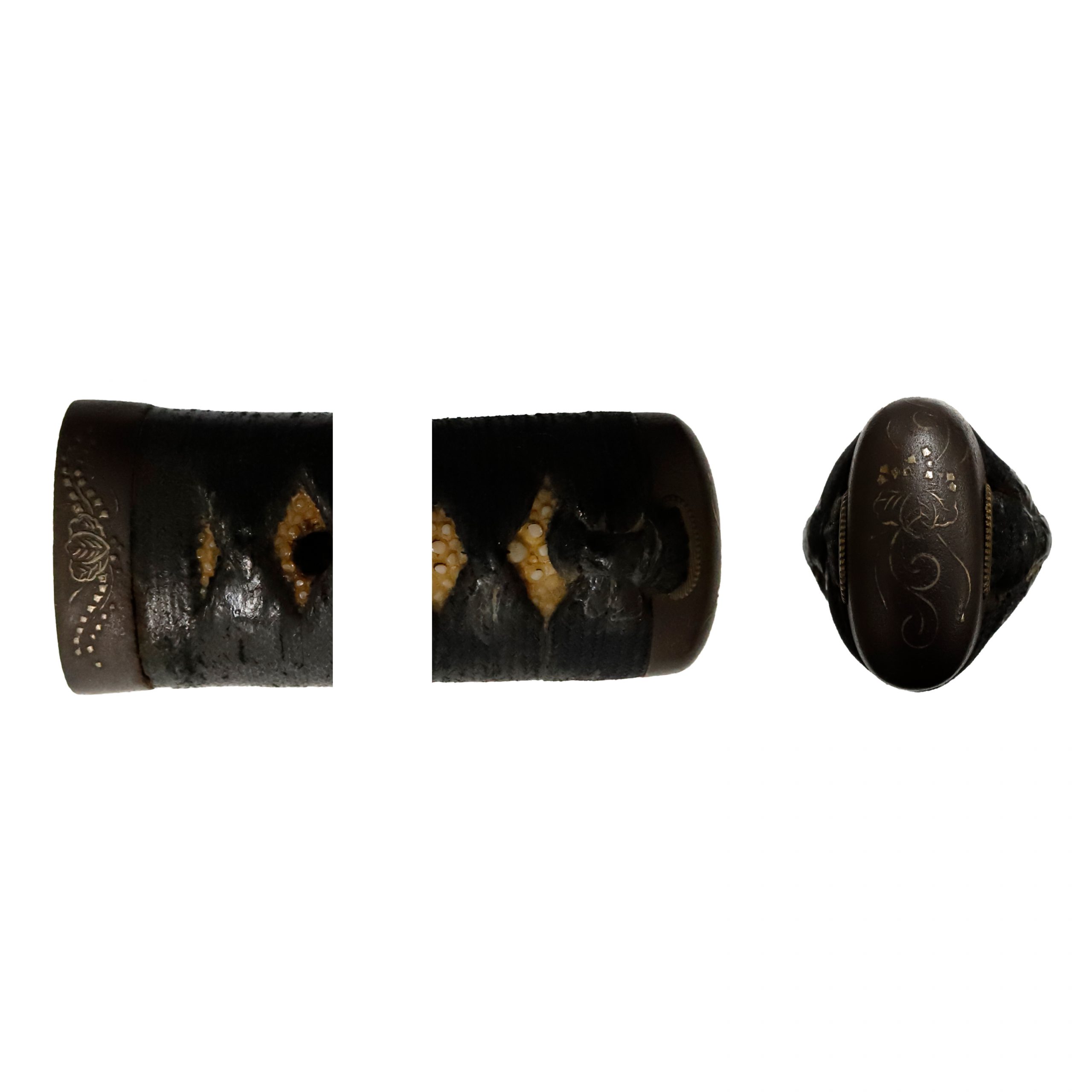
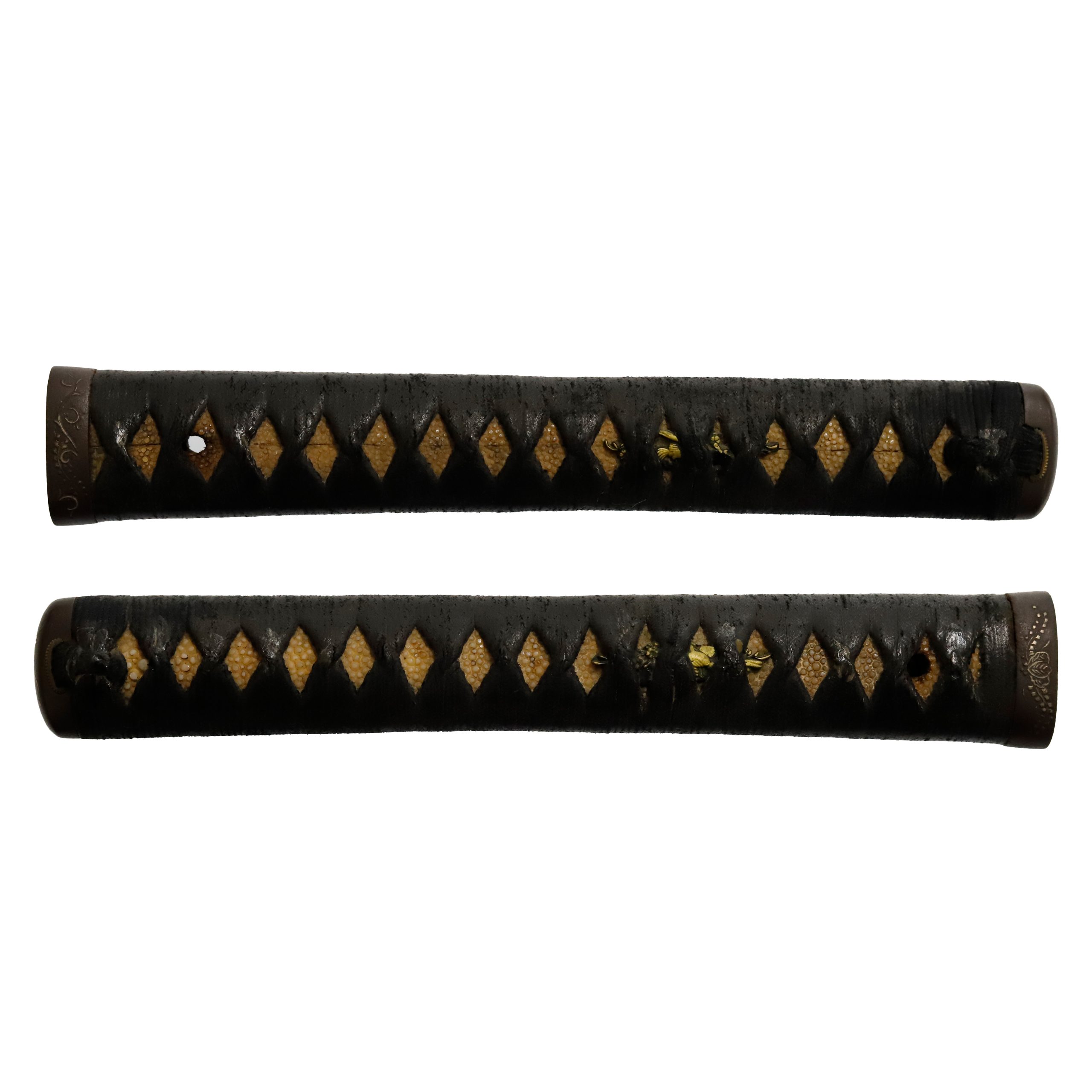
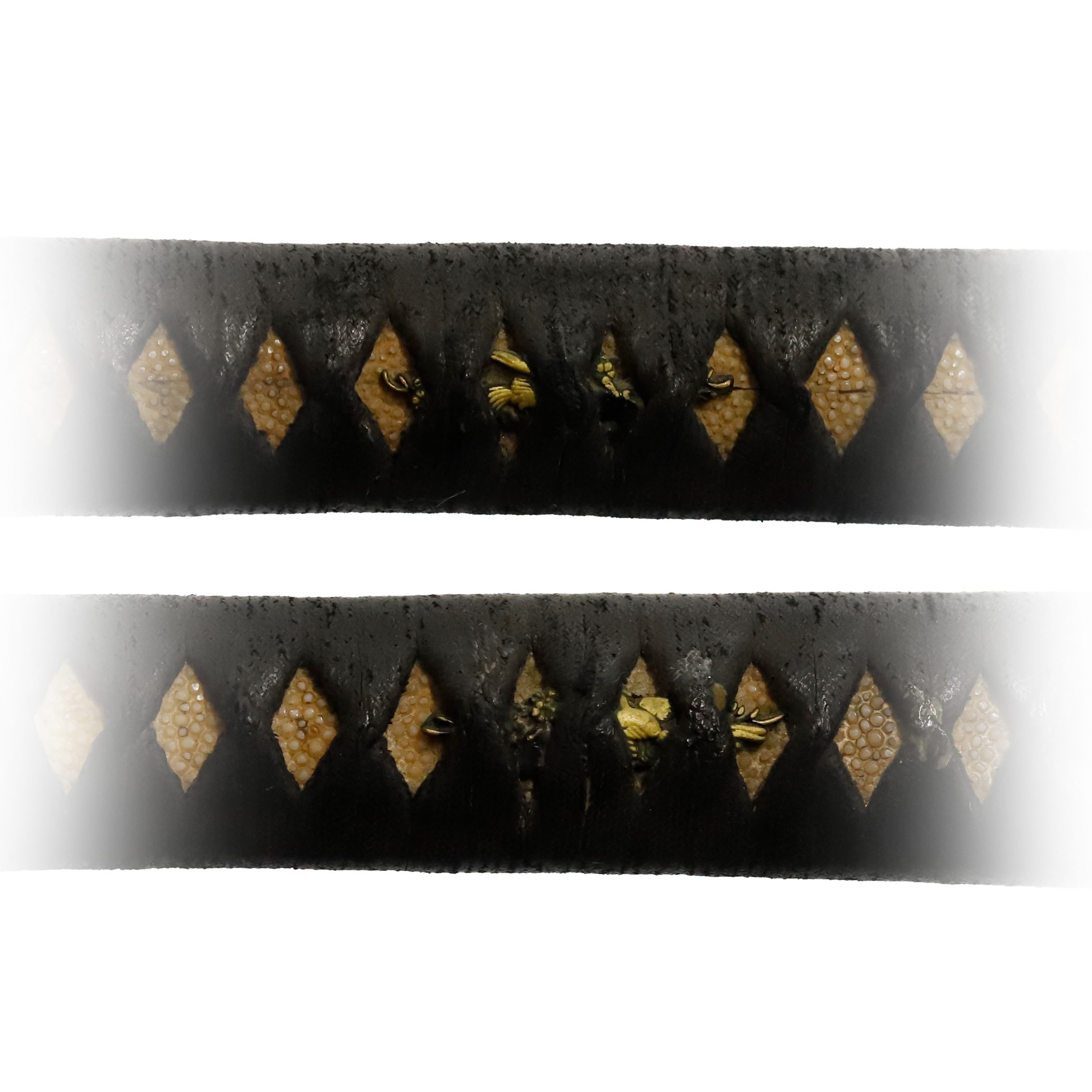
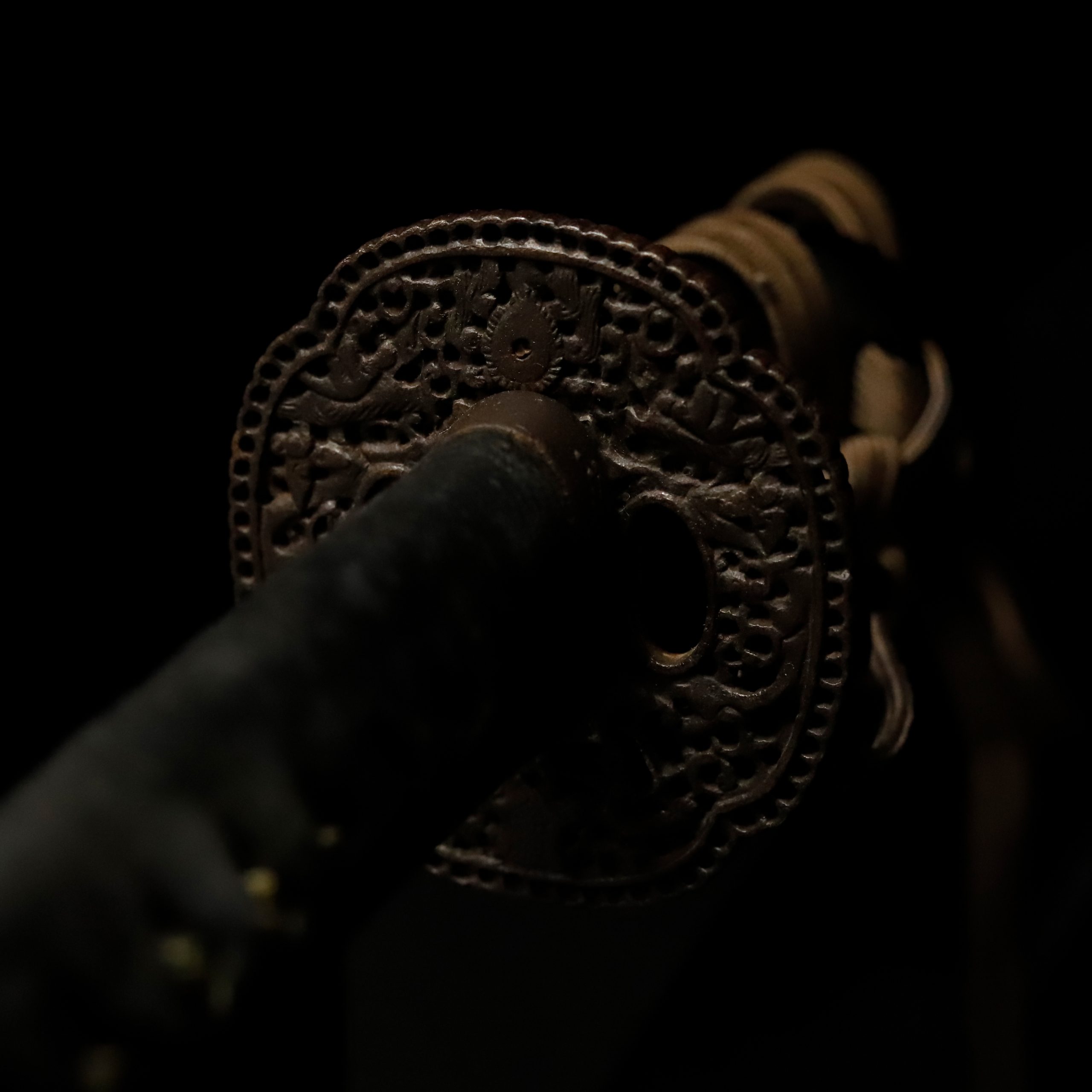
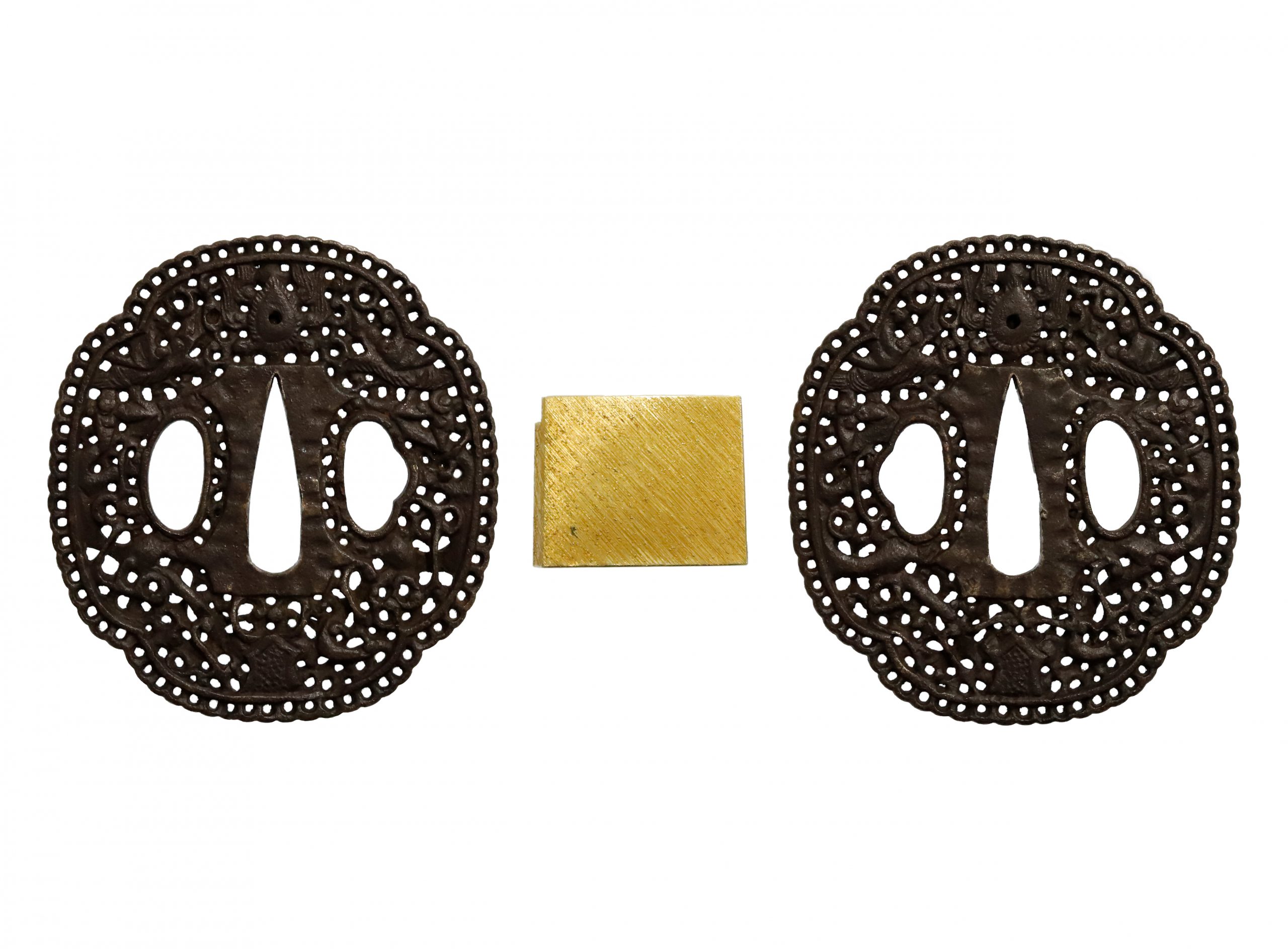
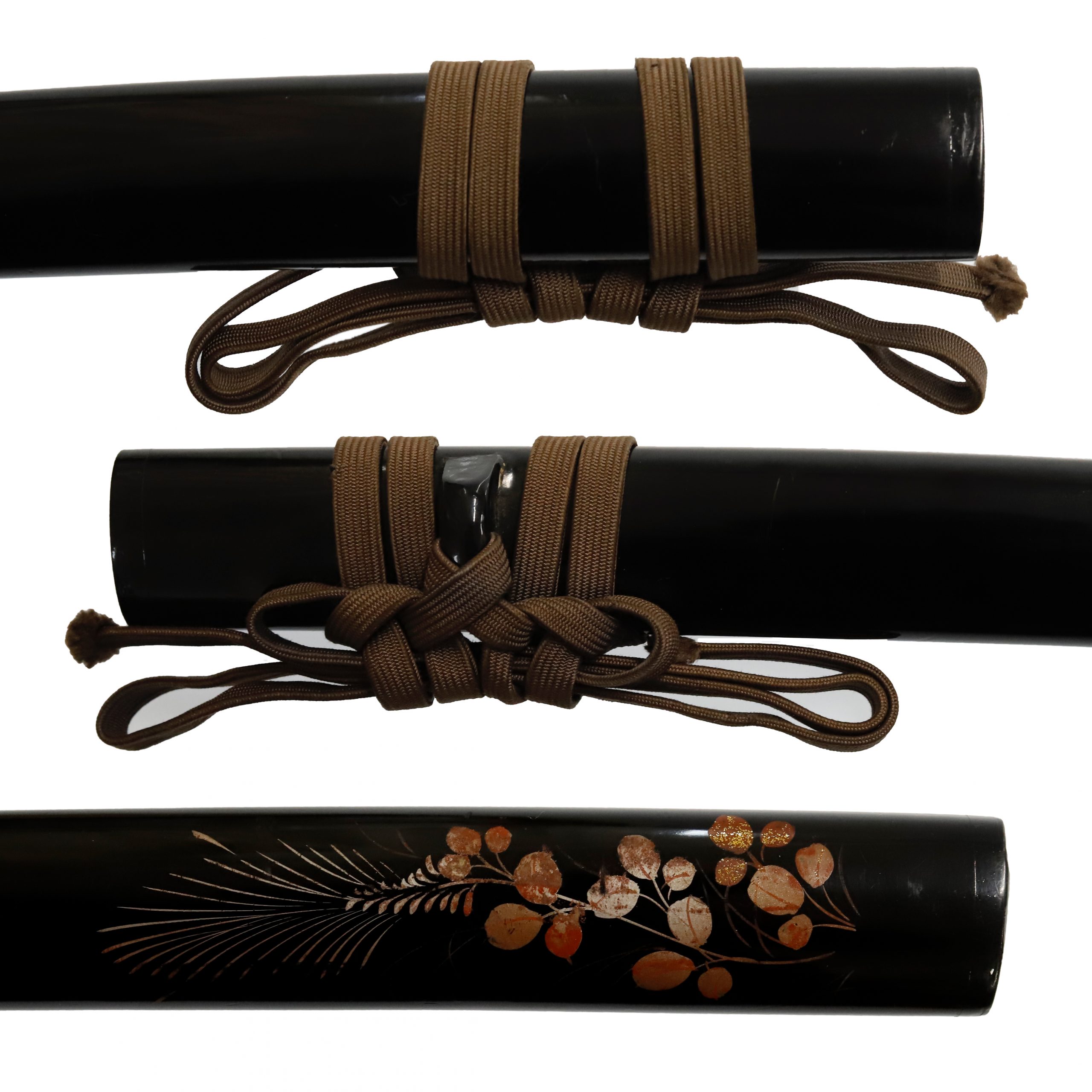
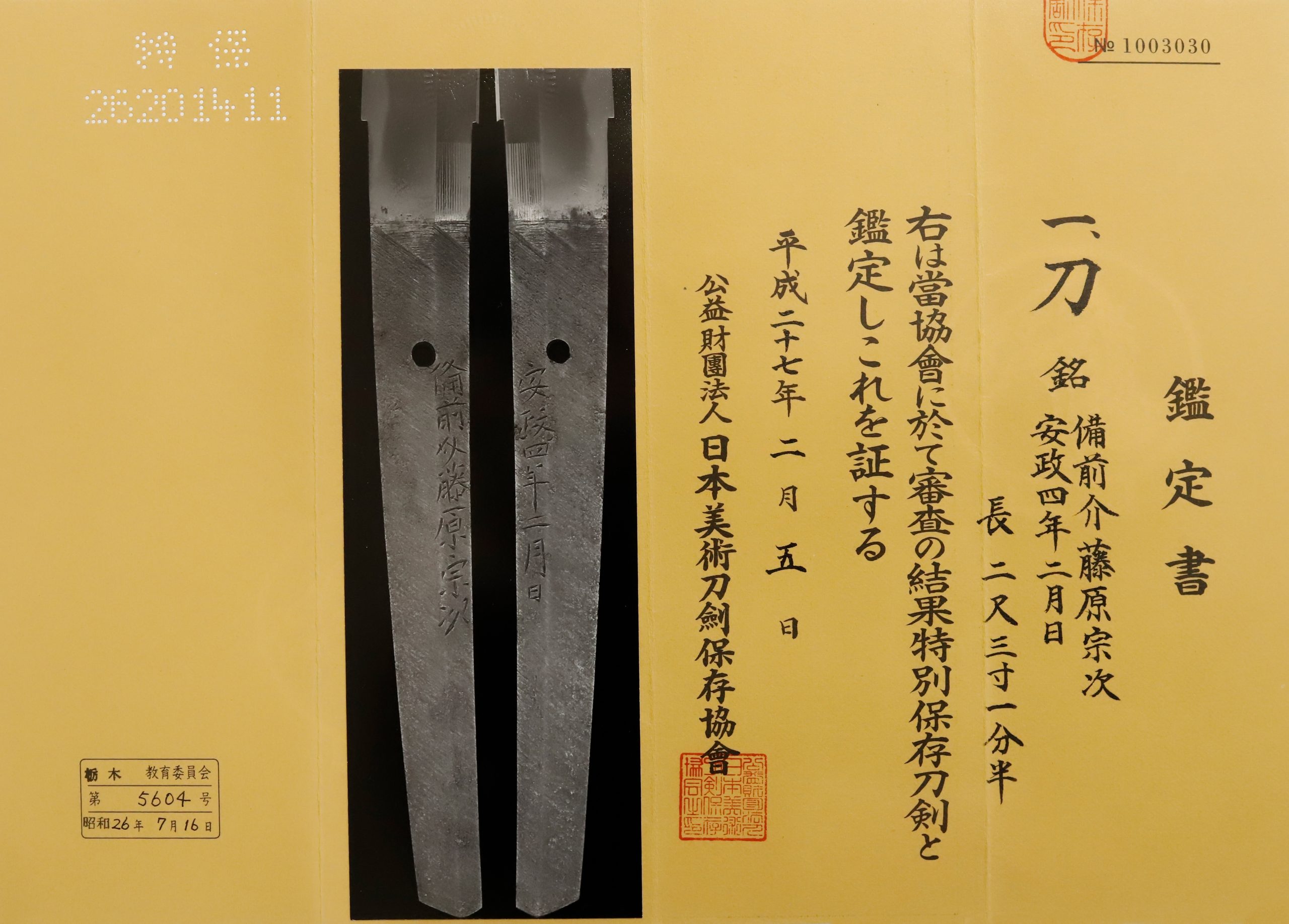
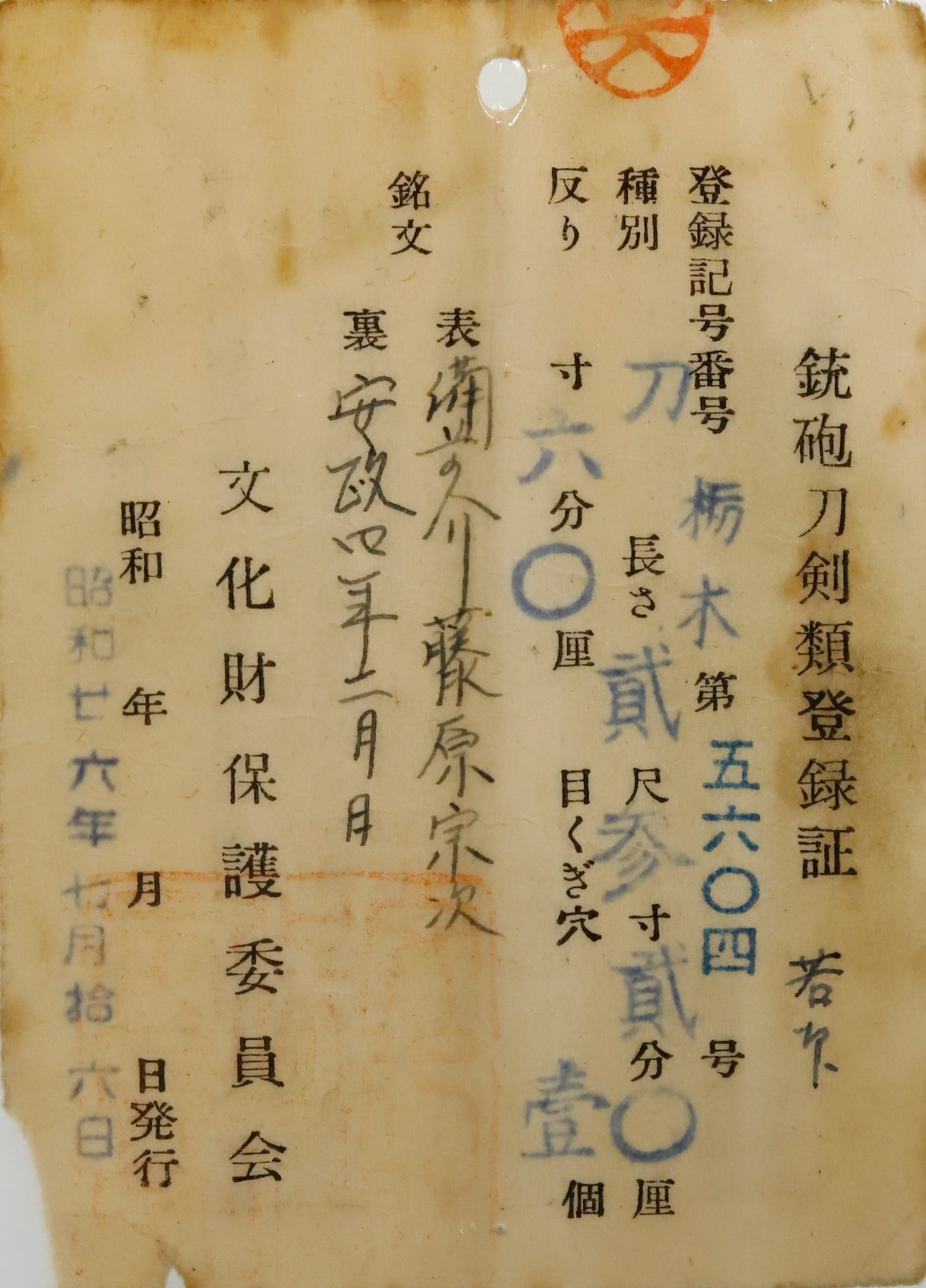
About Munetsugu This blade was signed by Bizen no Suke Fujiwara Munetsugu(備前助藤原宗次) in the fourth year of the Ansei era(1857). He is also known as Koyama Munetsugu(固山宗次). His given name was Koyama Sobei(固山宗兵衛). He was born as the third son of Koyama Munehira(固山宗平) in Shirakawa domain in Mutsu province(today’s Fukushima prefecture) in 1802. He had Koyama Munehira (固山宗平) and Koyama Munetoshi (固山宗俊) as older brothers. It is said that he learned the sword-forging technique from Kato Tsunahide(加藤綱英) first and was also an apprentice of Chounsai Tsunatoshi (長運斎綱俊), a younger brother of Tsunahide to improve his craftsmanship. He first served Shirakawa Matsudaira(白河松平家) clan as Hanko(藩工:retained swordsmith). After Matsudaira clan was ordered to relocate to Kuwana domain(Today’s Mie prefecture), Munetsugu became a swordsmith for that domain. However, he eventually settled in Edo city from the second year of the Koka era(1845) by working for Matsudaira clan of the Kuwana family. Because of these historical records, we believe this blade was made in Edo city. Munetsugu received an honorable title of Bizen no Suke(備前助) in the same year when he moved to Edo city(1845). His work reflects Bizen Den, one of the five most traditional Japanese sword-forging techniques (五箇伝). He was excellent at forging blades with Choji Gunome Midare tempering line, one of the most noticeable characteristics of Bizen Tradition. He was active in sword-forging during 1830-1870. He is arguably the finest smith working in the Bizen tradition at the end of the Edo period. Munetsugu was one of the most popular and famous swordsmiths in Edo city during the end Edo period. His swords have been known for their sharpness. There are many records of his swords passing the test cutting process(Tameshigiri). In his career, he pursued and researched sword-forging to make extremely sharp blades that were practically effective in battles to meet up the demands of the clan. There was a record of him studying to improve the sharpness of his swords from the seventh-gen Yamada Asaemon, who is a master of Tameshigiri and an author of Owazamono. He often received orders from feudal lords or famous figures during the end of the Edo period. Munetsugu has been highly regarded among Japanese sword collectors and experts. It is said that his level of craftsmanship is close to or at least equivalent to Sushinshi Masahide, Naotane and other very selected swordsmiths from the end of the Edo period. This blade is appraised as a Tokubetsu Hozon Token(特別保存刀剣) issued by NBTHK(Nihon Bijutsu Touken Hozon Kyokai:日本美術刀剣保存協会). Fuchi-Kashira The Kiri (桐, paulownia) pattern is designed for this Fuchi Kashira. This pattern is generally composed of three standing straight inflorescences and three leaves. The number of flowers that are blooming at each inflorescence means the ranks of this design. The Kiri pattern that decorates this Fuchi Kashira is categorized as the Gosan-no-Kiri (五三の桐) design. It is a popular design that the paulownia motif is used. This pattern was once used by the imperial family and people in authority at that time. Today, it is permitted to use by ordinary households and is appreciated as their family crests. According to a tradition, Houou (鳳凰, Fenghuang, a kind of sacred beast) rests its wings at the paulownia tree; therefore, it has come to be regarded as a holy plant. Tsuka and Menuki Seeing from the gaps of the Tsukamaki thread, we think it is a combination of flowers and birds. Although several parts of its surface color have already flaked off, it shows its long history, and we hope you would enjoy it as an antique texture. Tsuba and Habaki Yotsu-Mkkou-shaped Tsuba that has Kozuka and Kougai holes. We assume this Tsuba is categorized as the Nanban-style Tsuba. Nanban Tsuba generally has a circle shape or Mokkou shape as this work. Dragons, foreign letters, or arabesque designs are often engraved and inlaid with gold or silver on the thin iron. This style’s Tsuba has a foreign atmosphere. At the top of this Tsuba, you would find a waterdrop-shaped mark is designed. It is probably the Nyoi Houju (如意宝珠, Cintāmaṇi). It is a fantasy jewel that fulfills any desire, gives out treasure, clothes, food, and drink. Moreover, it heals illness and suffering, removes evils, purifies muddy water, and prevents disasters. It is said this magical item is taken from the brain of the king of the dragon. In this Tsuba, it seems dragons are engraved in abstracted designs. As mentioned above, the dragon is often seen in the Nanban-style Tsuba. Initially, the dragon is an imaginary creature found in ancient traditions or myths. Furthermore, it is regarded as a symbolic beast of auspicious signs. Its body is likened to nine animals: antlers are deer, the head is a camel, eyes are demons, the neck is a snake, belly is the Mizuchi (蛟, mythical animal in Japan which looks like a snake and have a horn and four legs), scales are fish, claws are falcons, palms are tigers, and ears are cows. It was thought that the dragon would reign at the top of all animals because of its odd-looking appearance. Saya A kind of plant is painted by the Makie (蒔絵) technique on the beautiful black lacquered scabbard. The Makie is a typical Japanese lacquer art technique developed uniquely in Japan for about 1200 years. Firstly, it needs to draw a picture with lacquer on the surface with a thin brush. Next, sprinkle the gold powder from above to show the pattern before the lacquer hardens. This technique makes a gorgeous and elegant look to works as you see in this work. We hope you would appreciate such detail too. Authentication Paper They authenticated the blade on Feb 5th in the 27th year of Heisei (2015). They appraised it as Tokubetsu Hozon Touken, the blade especially worth preserving for Japanese society.
Offered by Samurai Museum
This piece has sold
Get an email when a new Koyama Munetsugu piece hits the market.

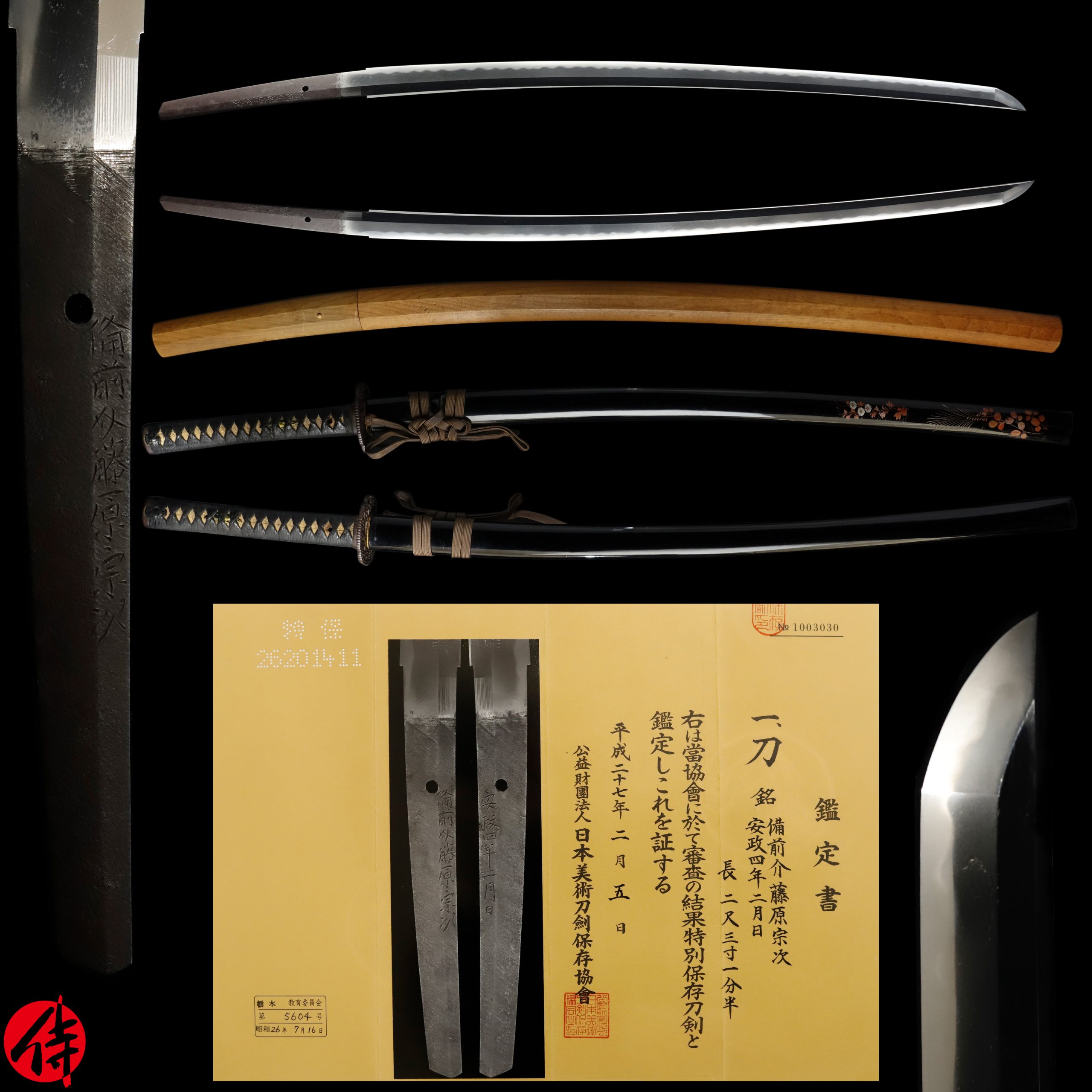
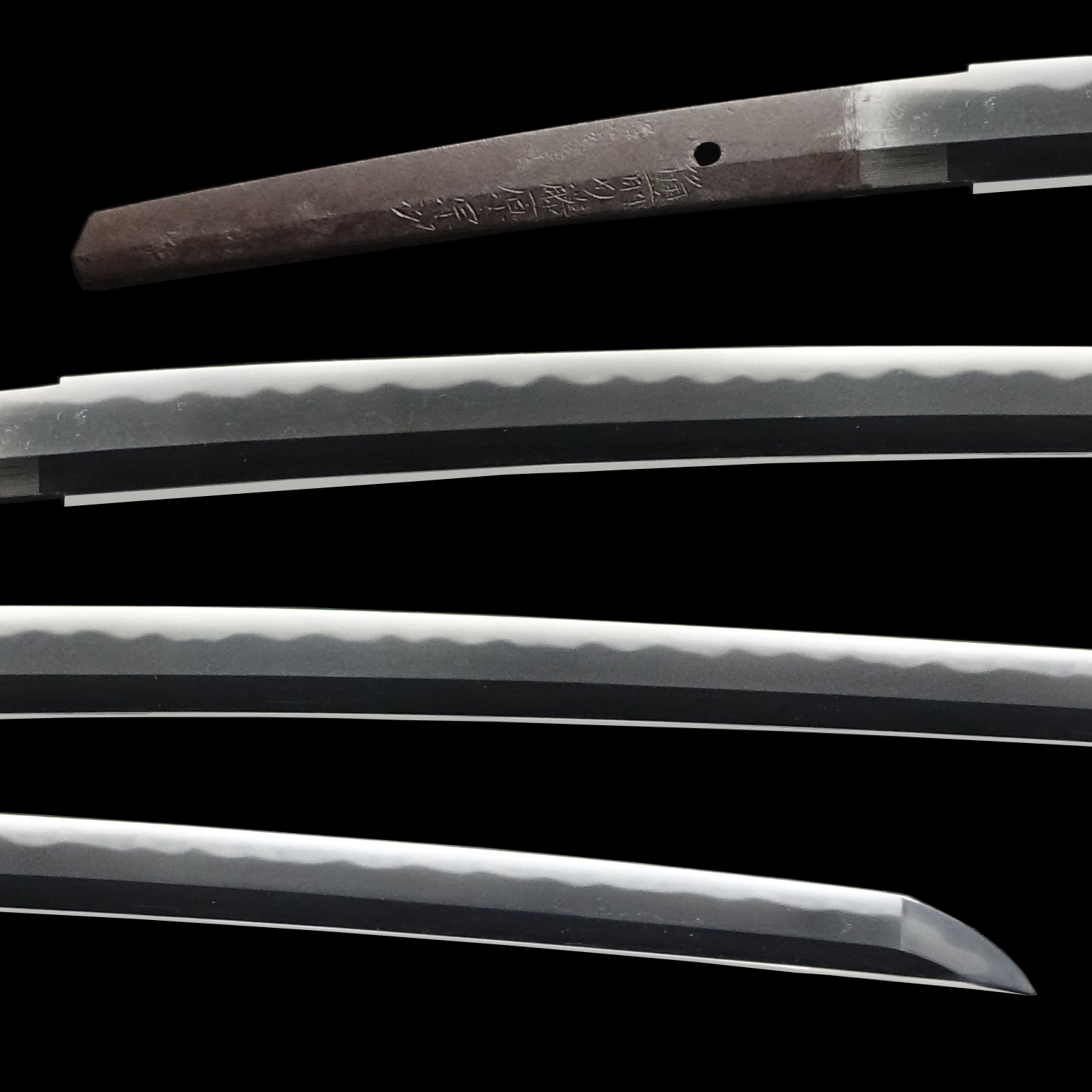
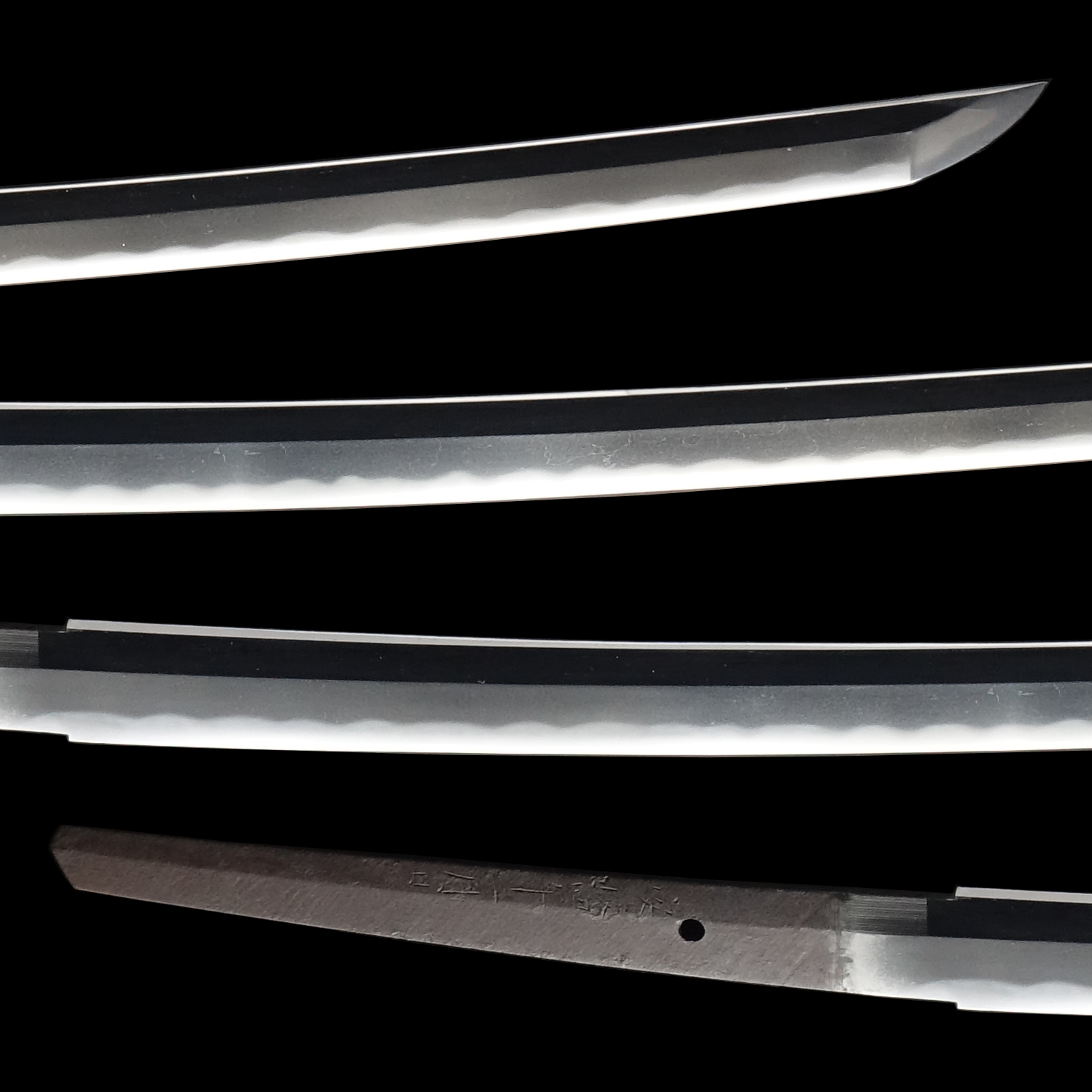
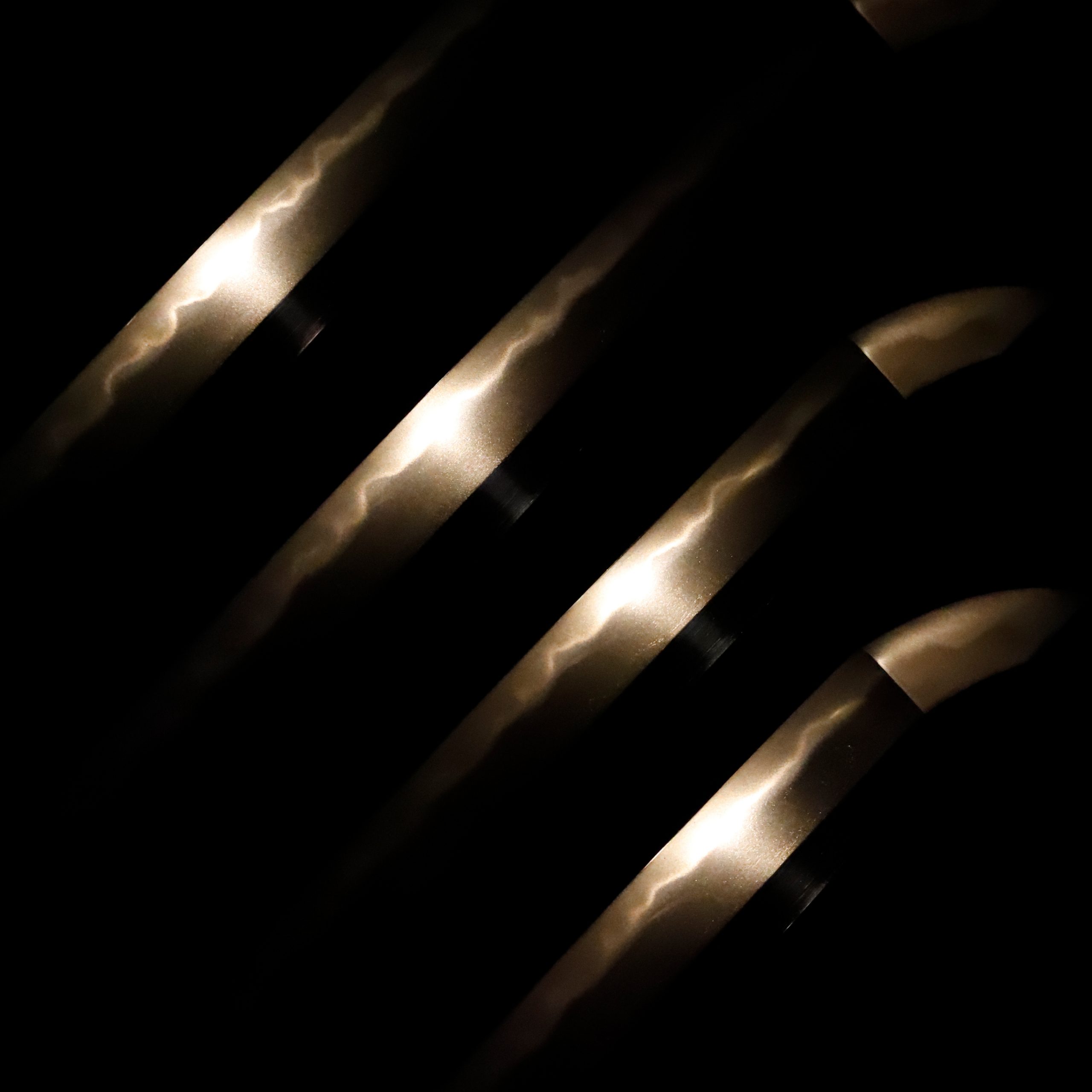
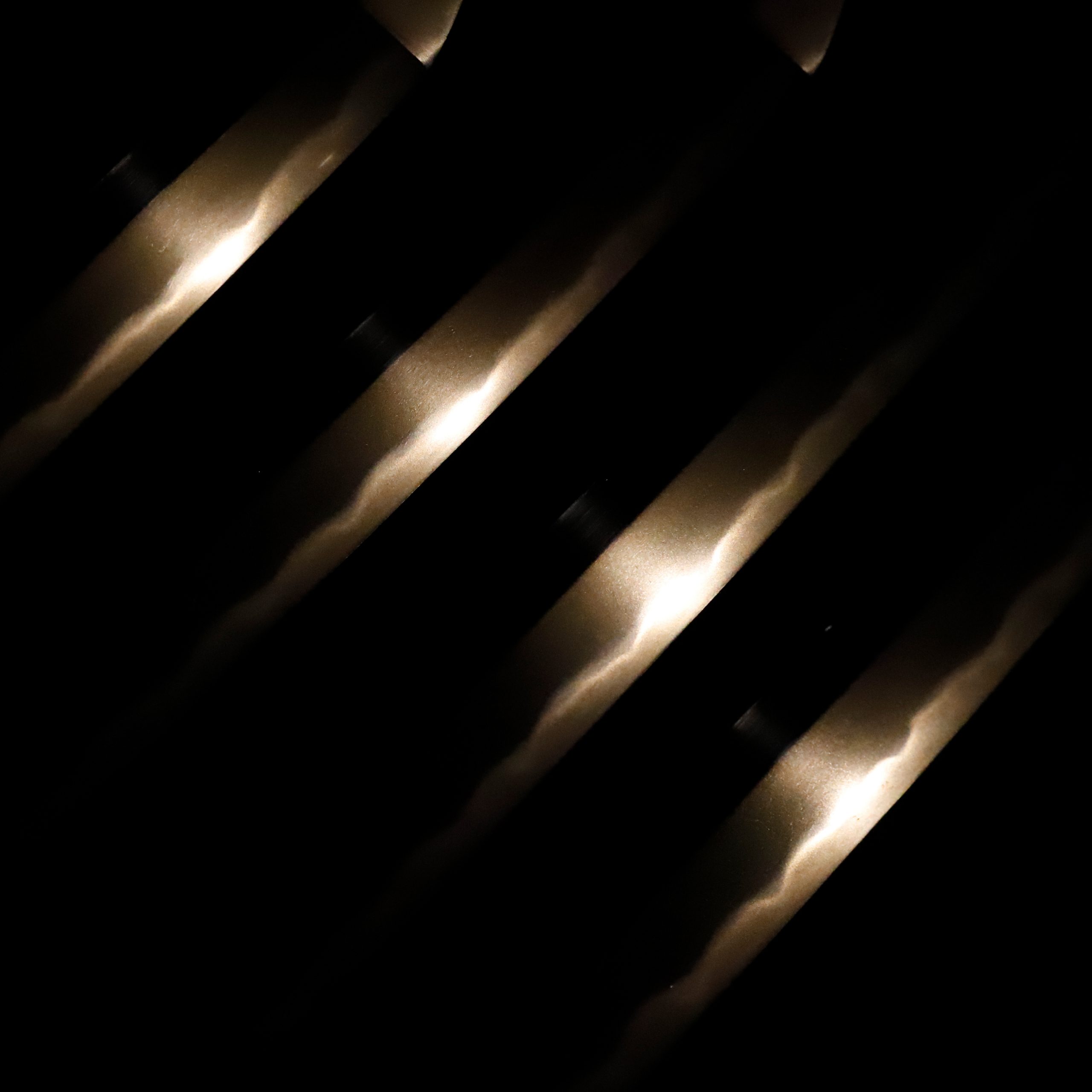
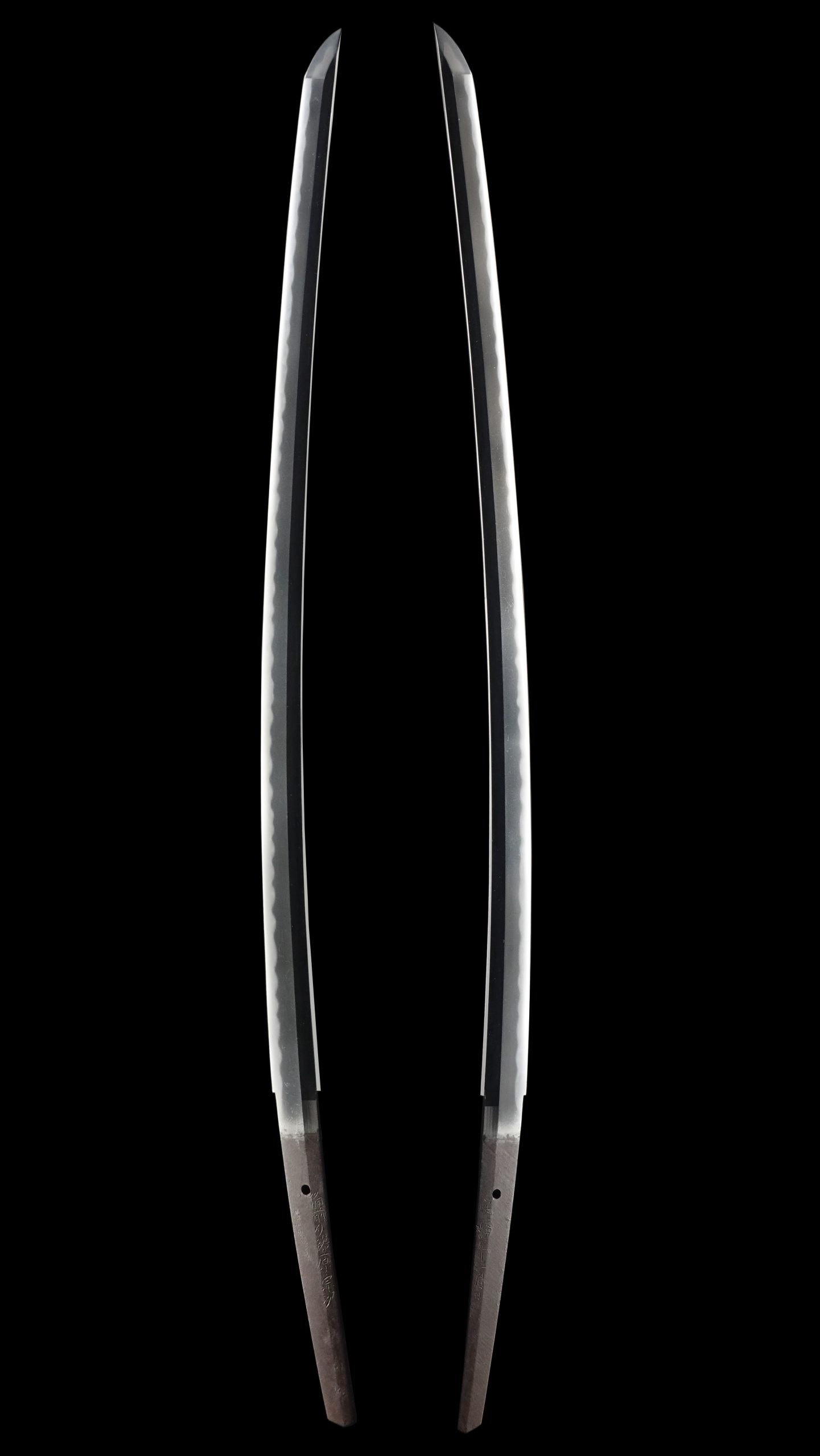
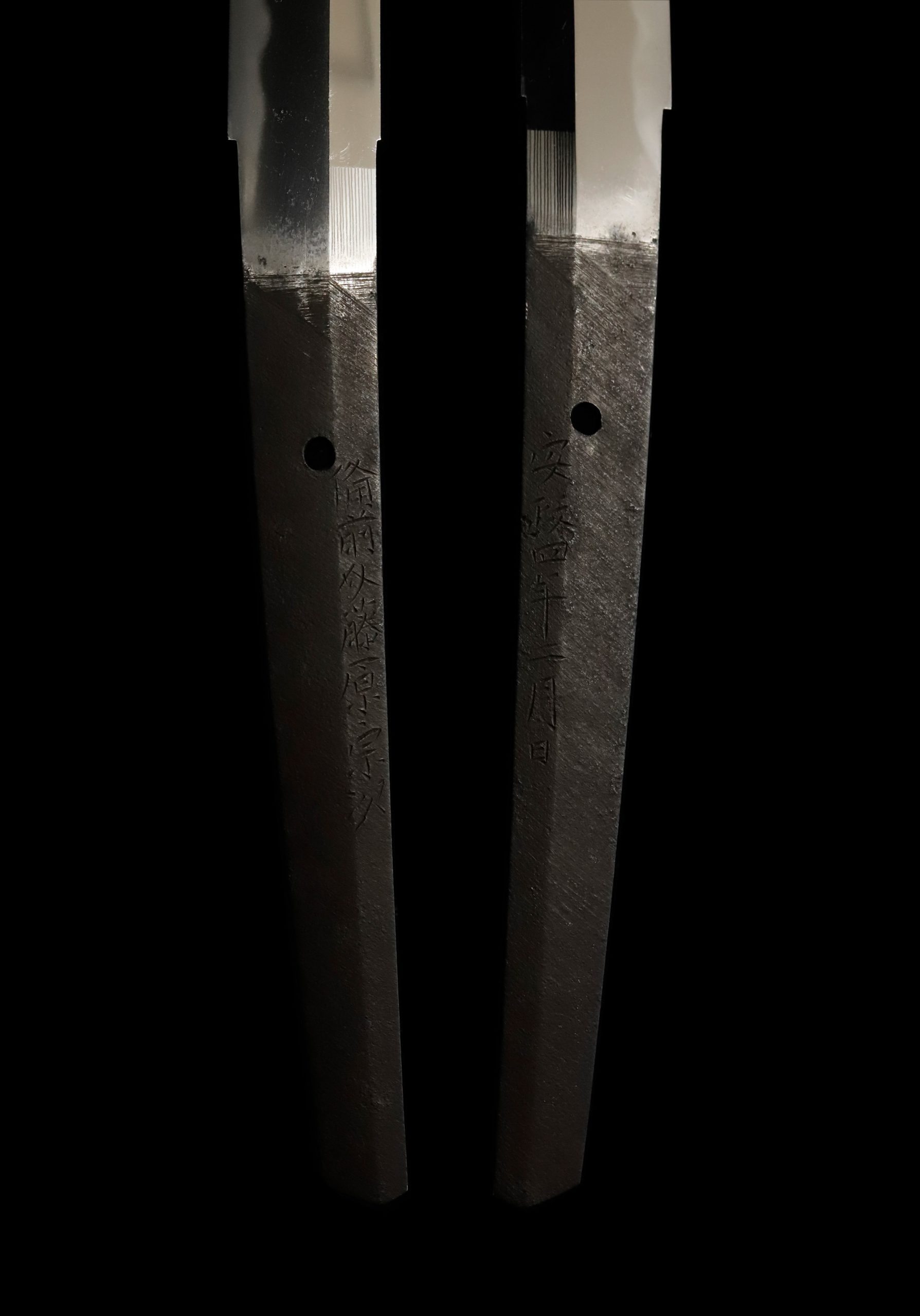
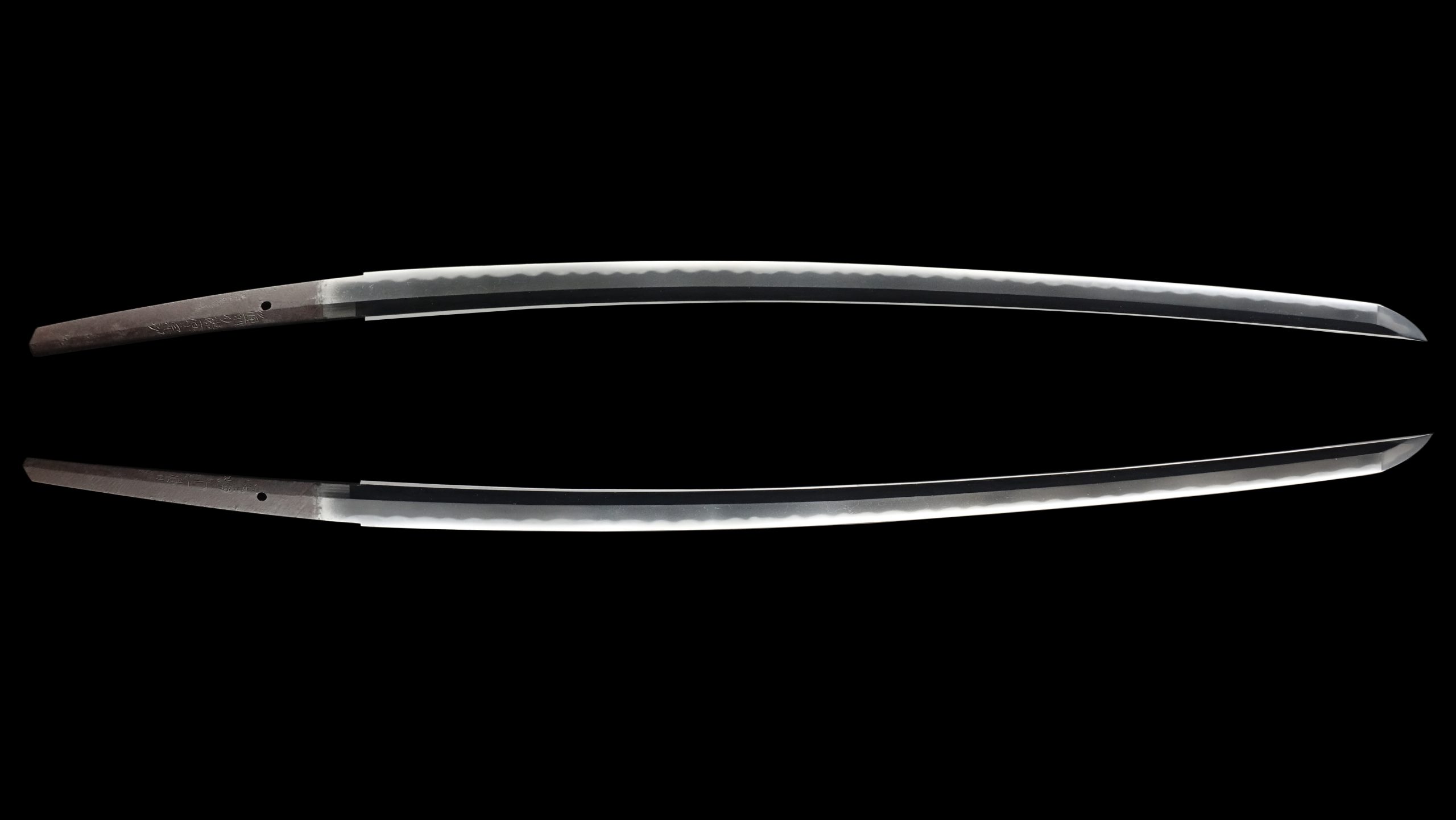
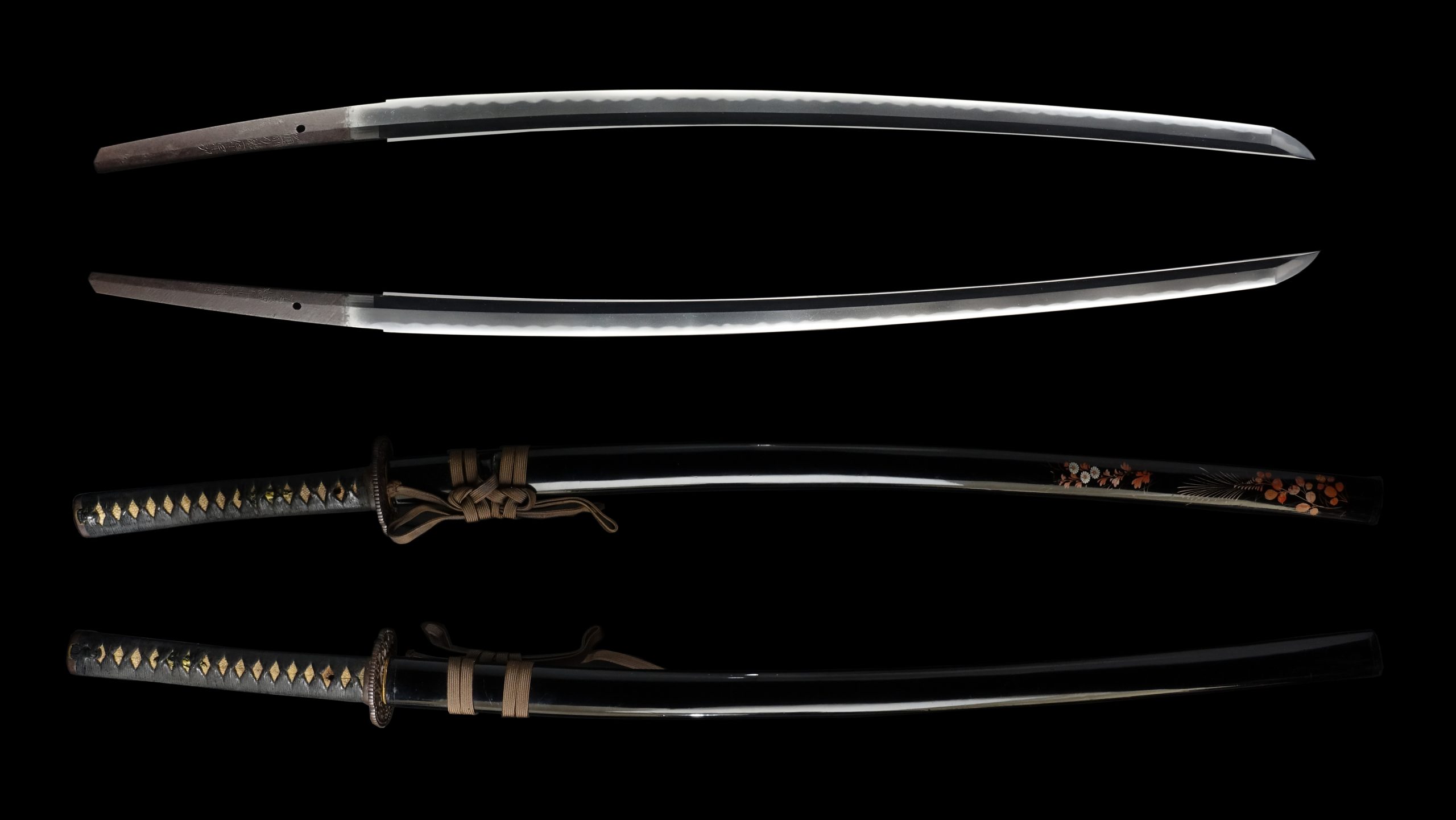
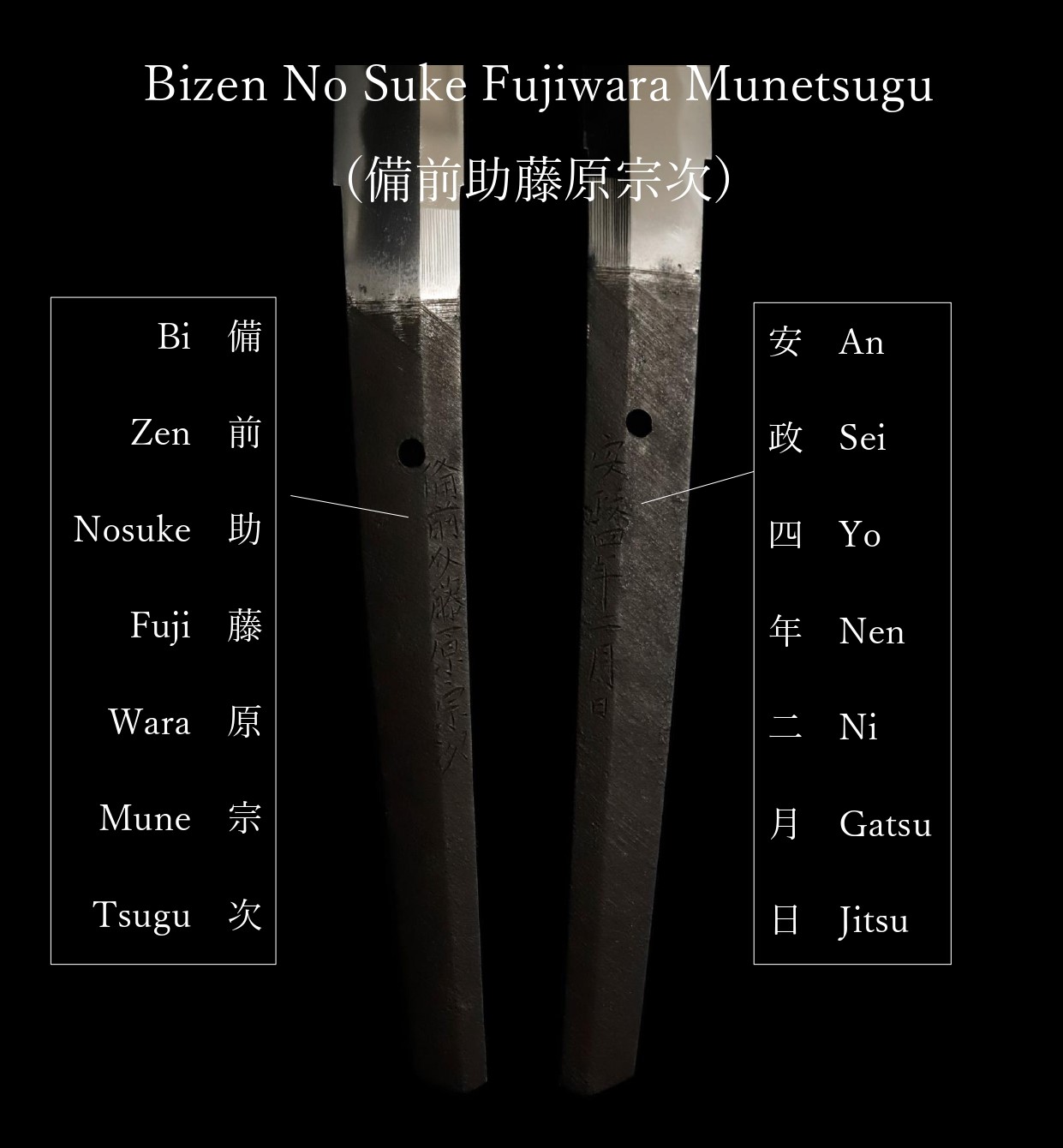
Koyama Munetsugu (shinshinto Bizen-den, Shirakawa / Edo) · Musashi · around 1830-1870
Fujishiro Jo-jo saku · Tōken Taikan top 17%
6 pieces on the market now
Koyama Munetsugu was born in Kyowa 3 (1803) at Shirakawa in Oshu, common name Sobe, with the art names Issensai and Seiryosai. The published sources record that his teacher is said to have been Kato Tsunahide of Yonezawa, but add that, judging from his manner of work, "the influence of the younger brother Kato Tsunatoshi was rather the greater"[[c:1]]. He served first the Matsudaira house of Shirakawa, and when that domain was transferred he became a smith for the Kuwana fief in Ise, living in Edo at Azabu Nagasaka. In Koka 2 (1845) he received the title Bizen no Suke. He worked from the latter half of the Bunsei era into the early Meiji years, signing as Nishiyama, as Koyama, and as Bizen no Suke Fujiwara Munetsugu, and the sources note that his surviving works are extremely numerous. They sum up his career in one phrase: "his style was consistently Bizen-den"[[c:2]].
His characteristic hand is a choji and gunome-choji in the Bizen manner. He sets choji mixed with gunome, pointed elements, ko-choji and ko-gunome, with ashi entering long and well, and one entry likens a gunome-choji of his to the manner of Bizen Kanemitsu. The temper is nioi-dominant with ko-nie adhering, and what the published sources return to most often is the nioiguchi: bright and clear on the majority of his blades, and on a number of them described as tight as well. On one Tenpo katana finished in his showiest vein, the sources write that he has "finished it in a midareba more flamboyantly choji-dominant than usual"[[c:3]], noting kinsuji in the upper half and a bright nioiguchi.
The jigane is his other constant. His usual jigane is a well-packed ko-itame, so finely forged that it often looks almost plain, with fine ji-nie and at times fine chikei. The published sources summarise his success on exactly these two elements together, saying that "over a well-packed, beautiful forging he tempers a nioi-dominant choji-midare, and succeeds"[[c:4]]. The boshi runs in midare-komi to a ko-maru turnback, at times pointed with hakikake. Carving, where present, is a bo-hi or a paired groove, sometimes with bonji, goma-bashi, kurikara or a sacred invocation, and his son Yoshitsugu supplied the carving on some blades.
Besides his mainline he was a deliberate copyist. Of one daisho the published sources say that "this daisho is typical of Munetsugu's copy-work"[[c:5]]: the katana takes Sue-Bizen, especially Yosozaemon no Jo Sukesada, as its model, and the wakizashi copies the Oei-Bizen masters Morimitsu and Yasumitsu, succeeding in producing utsuri. A wakizashi of Tenpo 11 copies the large hocho-shaped blade attributed to Masamune that is a treasure of the Egara shrine in Kamakura, and was dedicated at the Shiba Shinmei shrine in Edo. A separate vein is the broad, long blades of the Tenpo years, wide in body with a thick kasane, in which the jigane departs from his usual tight grain into an itame mixed with mokume and flowing grain, standing and with ji-nie and chikei. The sources say this is often seen in his Tenpo work. A quieter suguha register survives as well but is rare.
His place in the bakumatsu rests on the completeness of his Bizen revival and on the documentary richness of his blades. The sources note that he "seems to have been well known as a master of Bizen-den"[[c:6]], and he forged a daisho at the command of the lord of Koga. Many of his blades carry cutting-test inscriptions by the Yamada house, tried at Senju and elsewhere. One katana was forged at the command of Lord Date Munenari of Uwajima from the ring-iron of a foreign ship, an inscription the sources call "precious also for the history of the bakumatsu"[[c:7]]. His bright choji-midare over a near-plain ko-itame sets his work apart from the deeper, softer nioiguchi of the Kamakura blades he studied.
For the collector Munetsugu is a signed and abundant master rather than a rarity. Fujishiro grades him Jo-jo saku. He has no National Treasures and no Important Cultural Properties; his standing on the designation record runs through the Juyo rank, where fifty-two of his works are held, all signed, the broad choji-midare katana named his typical and representative work. His recorded provenance reaches the lord of Koga and a Koga retainer, Matsudaira Chikanai of the Shonai domain, and Lord Date Munenari of Uwajima. Because so many were made and so many survive, a signed and dated Munetsugu of good workmanship comes to market from time to time, and remains one of the more attainable ways for a collector to hold a documented, cutting-tested bakumatsu Bizen-den blade.
Where Munetsugu stands among comparable artisans: across all of nihontō, and within tradition, era, and period. The tiers (Foremost · Leading · Major · Notable) weigh official designations from the NBTHK and Japan's Agency for Cultural Affairs, together with historical honors of lasting repute such as the Sansaku and Meibutsu-chō.
Select a lens to see how it's measured.
Years he was demonstrably active, proven by signed-and-dated blades
Shinshinto · Musashi
20 pieces on the market now
Born in Kyōwa 3 (1803) at Shirakawa in Ōshū, Koyama Munetsugu (固山宗次) carried a smith's name read variously in the setsumei as Munobei or Sōbei, working under the art-names Issensai and Seiryōsai. He came up alongside elder brothers Munehira and Munetoshi, and although his teacher is traditionally given as Katō Tsunahide, the NBTHK readers repeatedly note that the hand of Katō Tsunatoshi shows through his work more plainly. He first served the Matsudaira house of Shirakawa as a retained smith; when that domain was transferred to Kuwana in Ise, he settled in Edo at Azabu Nagasaka and forged as a Kuwana domain smith. In Kōka 2 (1845) he received the court title Bizen no Suke, the signature Bizen no Suke Fujiwara Munetsugu recurring on the dated katana from that point. His production runs from the latter half of Bunsei into the early Meiji years, and the program it serves is the Bakumatsu fukko revival of Bizen-den: a deliberate return, from an Edo workshop, to the chōji tempering of the old Bizen masters. The shared idiom is consistent across the line. Construction tends to a wide mihaba, thick kasane, shallow sori and an extended chū-kissaki or ō-kissaki, giving the heavy-in-hand shinshintō bearing the readers call taihai. The ground is a tightly packed ko-itame, sometimes flowing toward nagare or masame, carrying extremely fine mijin-grade ji-nie and frequent chikei; faint utsuri rises on a number of blades.
The temper is the heart of the recognition: a nioi-dominant chōji-midare or gunome-chōji, with ko-chōji, togariba and angular heads mixed in, long ashi and yō entering, fine sunagashi and kinsuji, and a bright, clear nioiguchi. To read his hand, the setsumei flag particular chōji shapes (the kawazuko tadpole-head and the kobushi fist-shaped chōji clustered near Keiō-dated work), a midare-komi bōshi turning in ko-maru with hakikake, and the bold, thick-chiseled signatures with prominent chisel-pillows. Cutting-test inscriptions are common, several tied to the connoisseur Iga Norishige, who is recorded learning swordmaking from Munetsugu. His pupils carry the same vocabulary: Tairyūsai Sōkan (宗寛, also Munekane), son of Ōno Heizō and later a Koga/Furukawa domain smith, whose blades add a faint midare-utsuri and a smaller-pattern late temper; and the likely student Kongōsai Munehiro, who copied the same shrine original his master did. For kantei, the discriminating points are the orderly yet varied chōji arrayed shoulder-to-shoulder, the nie-laden Tenpō-era pieces whose habuchi has not yet settled, and a deliberate allusion to the second-generation Kunisuke when kobushi-like chōji appear. The named works root the line in documented copying: an utsushi of the National Treasure Koryū Kagemitsu, reconstructed to its original ubu state with kurikara and bonji carved by Sōkan; and a Tenpō 11 (1840) wakizashi copying the hōchō-shaped Masamune of Egara Tenmangū in Kamakura, carved by Tōryūsai Seiju and dedicated by Nomura Toshikatsu, a rare pairing of two Edo masters. Provenance inscriptions name patrons such as Miyake Takuma and the Furukawa domain on the Sōkan side. Across the NBTHK register, the work stands as a disciplined Edo restatement of the Bizen chōji tradition, prized for the brightness of its nioiguchi and for the documentary value of its dated, commissioned and trial-cut tangs. Learn more →
| Smith | Era | Designated |
|---|---|---|
| Munetsugu宗次 | 1830-1870 | 52 |
| Sokan宗寛 | 1850-1868 | 5 |
Bakumatsu: the last war market
Perry’s arrival in 1853 unraveled the Tokugawa peace and created the first mass demand for working swords in two centuries. Kiyomaro, called the Masamune of Yotsuya, died on its eve; Munetsugu and Yukihide carried the boom to the end.
A Hozon-certified blade judged to show notably superior workmanship and a better state of preservation. The bar is higher: re-tempered blades and most unsigned Muromachi/Edo works are excluded.
The NBTHK (Nihon Bijutsu Tōken Hozon Kyōkai, the Society for the Preservation of Japanese Art Swords) is a public-interest incorporated foundation founded in 1948 and supervised by Japan’s Agency for Cultural Affairs (Bunkachō); it is based at the Japanese Sword Museum in Tokyo. Its expert panels physically examine each submitted work (shinsa) and issue a certificate (kanteishō) ranking it by artistic and historical merit. NBTHK papers are the most widely recognized standard of authentication for Japanese swords and fittings.
NBTHK official siteReturns/exchanges limited to defects caused by shipping (except willful misconduct or gross negligence by the company); customers must contact within 72 hours of receiving the product.