Perry’s arrival in 1853 unraveled the Tokugawa peace and created the first mass demand for working swords in two centuries. Kiyomaro, called the Masamune of Yotsuya, died on its eve; Munetsugu and Yukihide carried the boom to the end.
 NihontoWatchNihontoWatch
固山宗次は、享保3年、奥州白河に生まれ、俗名を宗兵衛(惣兵衛)といい、一専斎・精良斎と号し、兄に宗平・宗俊がいる。宗次の師は加藤綱英と伝えられているが、その作風から勘案すれば、むしろ加藤綱俊の影響力が大きいものと思われる。初めは白河松平家の抱え工であったが、藩が勢州桑名へ移封後は、江戸に住して桑名藩工として作刀した。その居住地は麻布永坂という。弘化2年に備前介を受領している。宗次の作刀期間は文政の後半から明治初年の頃までに亘っており、その遺例も非常に多く、作風は一貫して備前伝であり、よくつんだ鍛えに、匂い勝ち丁子乱れを焼いて成功している。 本作は、刃文は匂口の明るい匂勝ちの丁子乱れを焼いており、新々刀らしく匂幅がほぼ均一で足が太く長く入った出来口を示している。宗次の天保8年(1837)頃から天保10年(1839)前後の作品には、一文字写しと目される作柄のものがよく見られ、それらは身幅尋常かやや細身で反りが深めにつき、鋒もやや延びた程度の太刀風の姿という、本作では顕著ではないが概して板目の肌立つものも多いことも指摘される。そしてこの手は常よりも出入りを見せて丁子の房が大きく、匂口も深くなる特徴があり、加えて丁子の形や大きさに微妙な変化をつけるため、一見すると一定の間隔(本作は約3寸3分ごと)で同じ刃形のパターンを繰り返すいつもの型押し状が発見しづらいことがある。しかし、仔細に観察すれば、やはり乱れの出入りや並んでいる個数などが、一定のリズムで繰り返されていることが確認できる。 新々刀 上々作 古研ぎのため、処々に細かいヒケ、擦れ、薄サビなどがみられます。
NihontoWatchOffered by Tsuruginoya
19 on the market




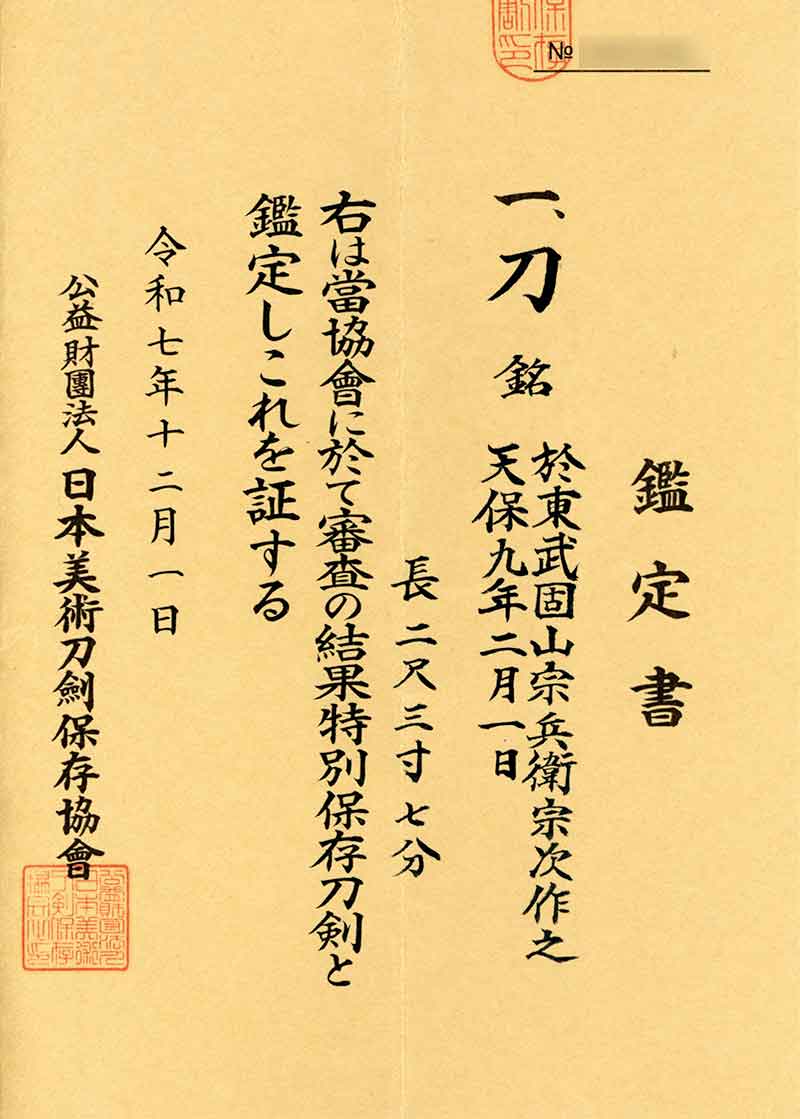
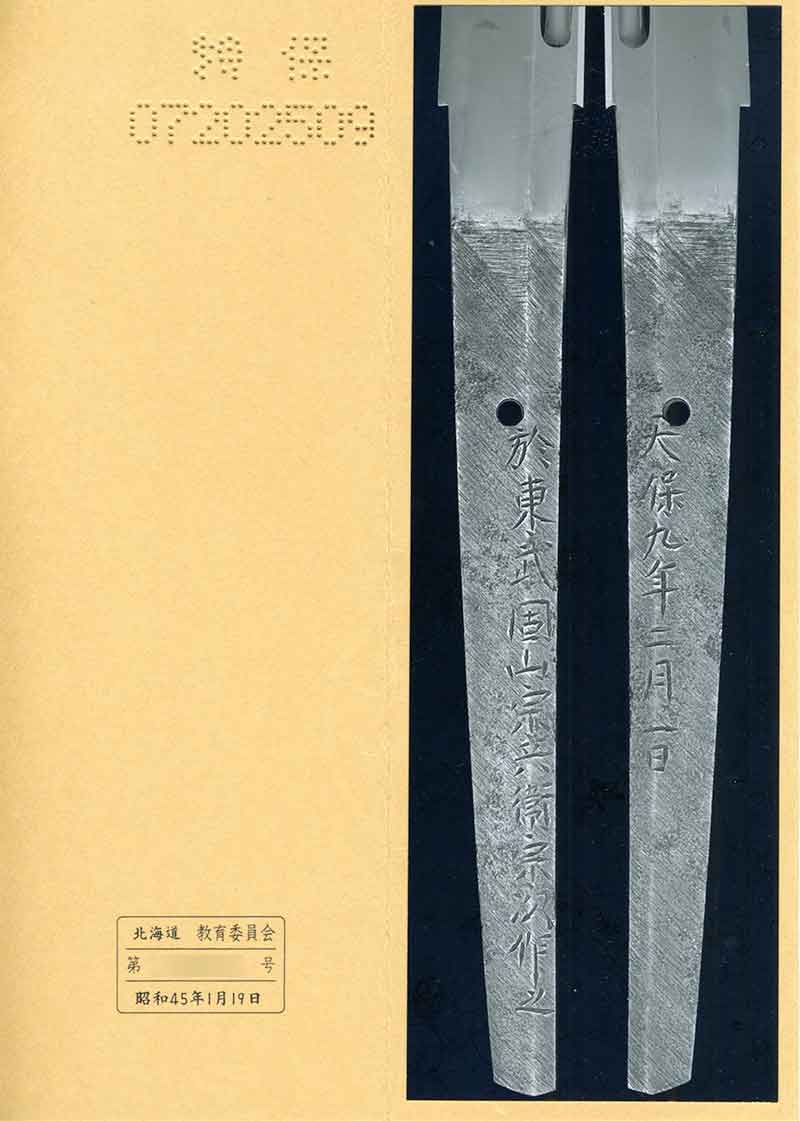
As written by the shop
(Translation unavailable)
Shinshinto · Musashi
19 pieces on the market now
Born in Kyōwa 3 (1803) at Shirakawa in Ōshū, Koyama Munetsugu (固山宗次) carried a smith's name read variously in the setsumei as Munobei or Sōbei, working under the art-names Issensai and Seiryōsai. He came up alongside elder brothers Munehira and Munetoshi, and although his teacher is traditionally given as Katō Tsunahide, the NBTHK readers repeatedly note that the hand of Katō Tsunatoshi shows through his work more plainly. He first served the Matsudaira house of Shirakawa as a retained smith; when that domain was transferred to Kuwana in Ise, he settled in Edo at Azabu Nagasaka and forged as a Kuwana domain smith. In Kōka 2 (1845) he received the court title Bizen no Suke, the signature Bizen no Suke Fujiwara Munetsugu recurring on the dated katana from that point. His production runs from the latter half of Bunsei into the early Meiji years, and the program it serves is the Bakumatsu fukko revival of Bizen-den: a deliberate return, from an Edo workshop, to the chōji tempering of the old Bizen masters. The shared idiom is consistent across the line. Construction tends to a wide mihaba, thick kasane, shallow sori and an extended chū-kissaki or ō-kissaki, giving the heavy-in-hand shinshintō bearing the readers call taihai. The ground is a tightly packed ko-itame, sometimes flowing toward nagare or masame, carrying extremely fine mijin-grade ji-nie and frequent chikei; faint utsuri rises on a number of blades.
The temper is the heart of the recognition: a nioi-dominant chōji-midare or gunome-chōji, with ko-chōji, togariba and angular heads mixed in, long ashi and yō entering, fine sunagashi and kinsuji, and a bright, clear nioiguchi. To read his hand, the setsumei flag particular chōji shapes (the kawazuko tadpole-head and the kobushi fist-shaped chōji clustered near Keiō-dated work), a midare-komi bōshi turning in ko-maru with hakikake, and the bold, thick-chiseled signatures with prominent chisel-pillows. Cutting-test inscriptions are common, several tied to the connoisseur Iga Norishige, who is recorded learning swordmaking from Munetsugu. His pupils carry the same vocabulary: Tairyūsai Sōkan (宗寛, also Munekane), son of Ōno Heizō and later a Koga/Furukawa domain smith, whose blades add a faint midare-utsuri and a smaller-pattern late temper; and the likely student Kongōsai Munehiro, who copied the same shrine original his master did. For kantei, the discriminating points are the orderly yet varied chōji arrayed shoulder-to-shoulder, the nie-laden Tenpō-era pieces whose habuchi has not yet settled, and a deliberate allusion to the second-generation Kunisuke when kobushi-like chōji appear. The named works root the line in documented copying: an utsushi of the National Treasure Koryū Kagemitsu, reconstructed to its original ubu state with kurikara and bonji carved by Sōkan; and a Tenpō 11 (1840) wakizashi copying the hōchō-shaped Masamune of Egara Tenmangū in Kamakura, carved by Tōryūsai Seiju and dedicated by Nomura Toshikatsu, a rare pairing of two Edo masters. Provenance inscriptions name patrons such as Miyake Takuma and the Furukawa domain on the Sōkan side. Across the NBTHK register, the work stands as a disciplined Edo restatement of the Bizen chōji tradition, prized for the brightness of its nioiguchi and for the documentary value of its dated, commissioned and trial-cut tangs. Learn more →
| Smith | Era | Designated |
|---|---|---|
| Munetsugu宗次 | 1830-1870 | 52 |
| Sokan宗寛 | 1850-1868 | 5 |
Bakumatsu: the last war market
Perry’s arrival in 1853 unraveled the Tokugawa peace and created the first mass demand for working swords in two centuries. Kiyomaro, called the Masamune of Yotsuya, died on its eve; Munetsugu and Yukihide carried the boom to the end.
A Hozon-certified blade judged to show notably superior workmanship and a better state of preservation. The bar is higher: re-tempered blades and most unsigned Muromachi/Edo works are excluded.
The NBTHK (Nihon Bijutsu Tōken Hozon Kyōkai, the Society for the Preservation of Japanese Art Swords) is a public-interest incorporated foundation founded in 1948 and supervised by Japan’s Agency for Cultural Affairs (Bunkachō); it is based at the Japanese Sword Museum in Tokyo. Its expert panels physically examine each submitted work (shinsa) and issue a certificate (kanteishō) ranking it by artistic and historical merit. NBTHK papers are the most widely recognized standard of authentication for Japanese swords and fittings.
NBTHK official sitePlease exercise cooling-off within 8 days of the item's arrival. (1) We cannot accept items that have been altered or worked on in any way (e.g. test cutting, polishing or other work, display at viewing meetings, photography, taking oshigata rubbings, use for appreciation, copying of books). (2) Return shipping is at the customer's expense. (3) Costs other than the item price (bank transfer fees, cash-on-delivery fees, installment fees, etc.) cannot be refunded. (4) For cash-on-delivery and similar payments, the refund is made after the payment has reached us. (5) We cannot accept a return when a trade-in item is involved. (6) Items delivered overseas cannot be returned or refunded (because of the time involved and, for swords, the surrender of the registration certificate and other circumstances).
¥2,450,000