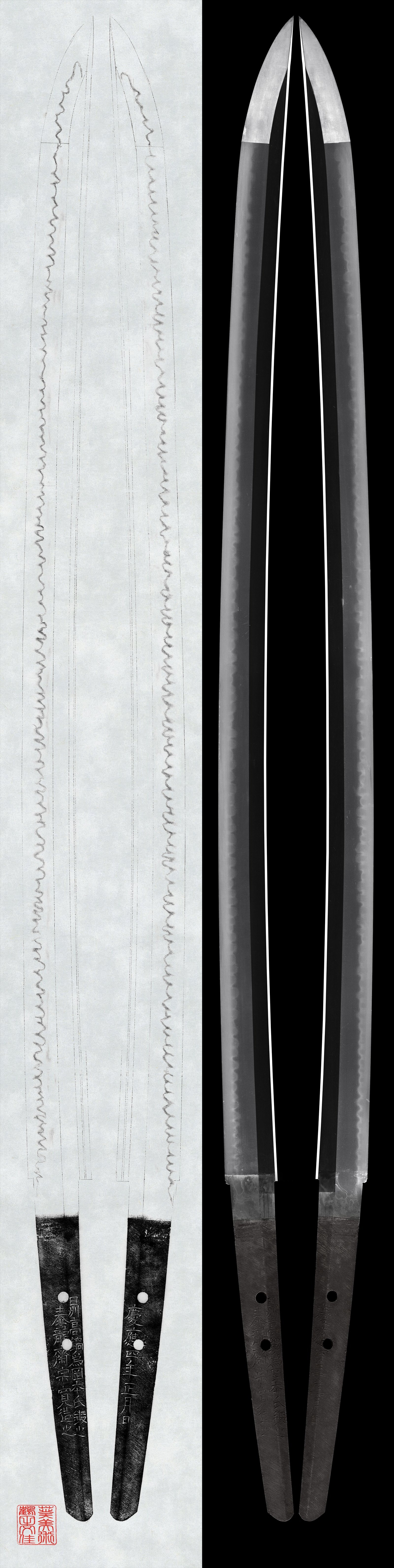
Koyama Munetsugu was born in Kyōwa 3 (1803) at Shirakawa in Ōshū, common name Sōbē, with the art-names Issensai and Seiryōsai, and he became the foremost reviver of the tradition in the closing decades of the period. The published sources record that his teacher is said to have been Katō Tsunahide of Yonezawa, yet they add the careful qualification that, judging from his manner of work, the influence of Tsunahide's younger brother Katō Tsunatoshi seems rather to have been the stronger. He served first the Matsudaira house of Shirakawa, and when that domain was transferred he became a smith for the Kuwana fief in , living in at Azabu Nagasaka; in Kōka 2 (1845) he received the court title no , and he worked from the latter half of the Bunsei era down into the early Meiji years, signing in several forms, as Nishiyama, as Koyama, and as no Fujiwara Munetsugu. His record on the published rolls is one of the largest of any smith, dated tightly across the Tenpō, Kaei, Ansei and Keiō years, and the sources judge that his style remained consistently within the tradition throughout.
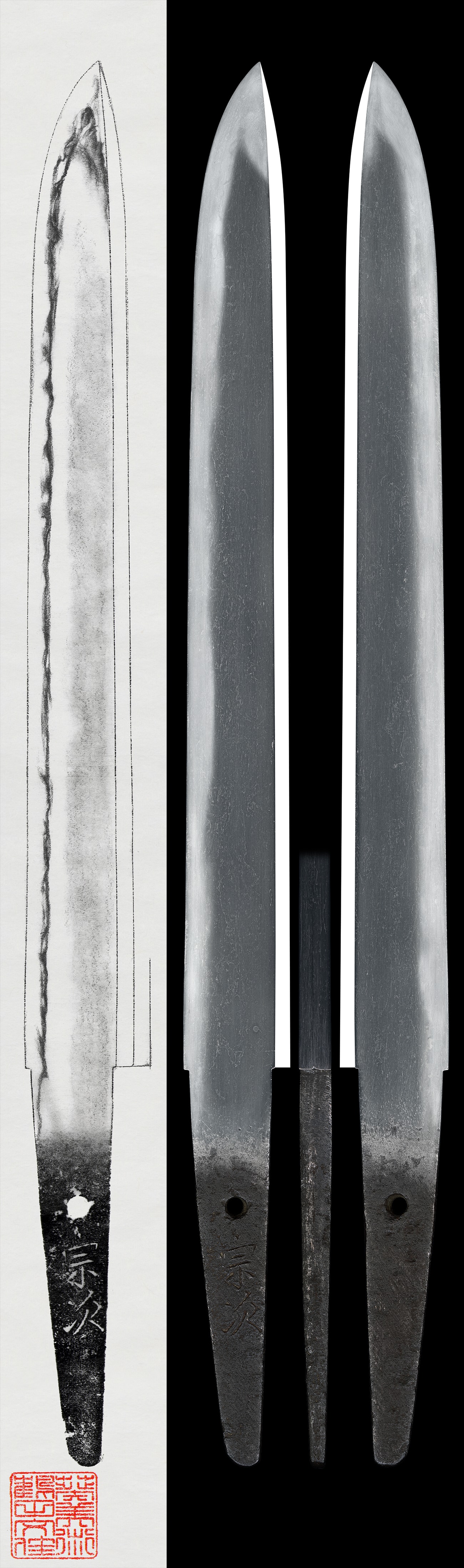
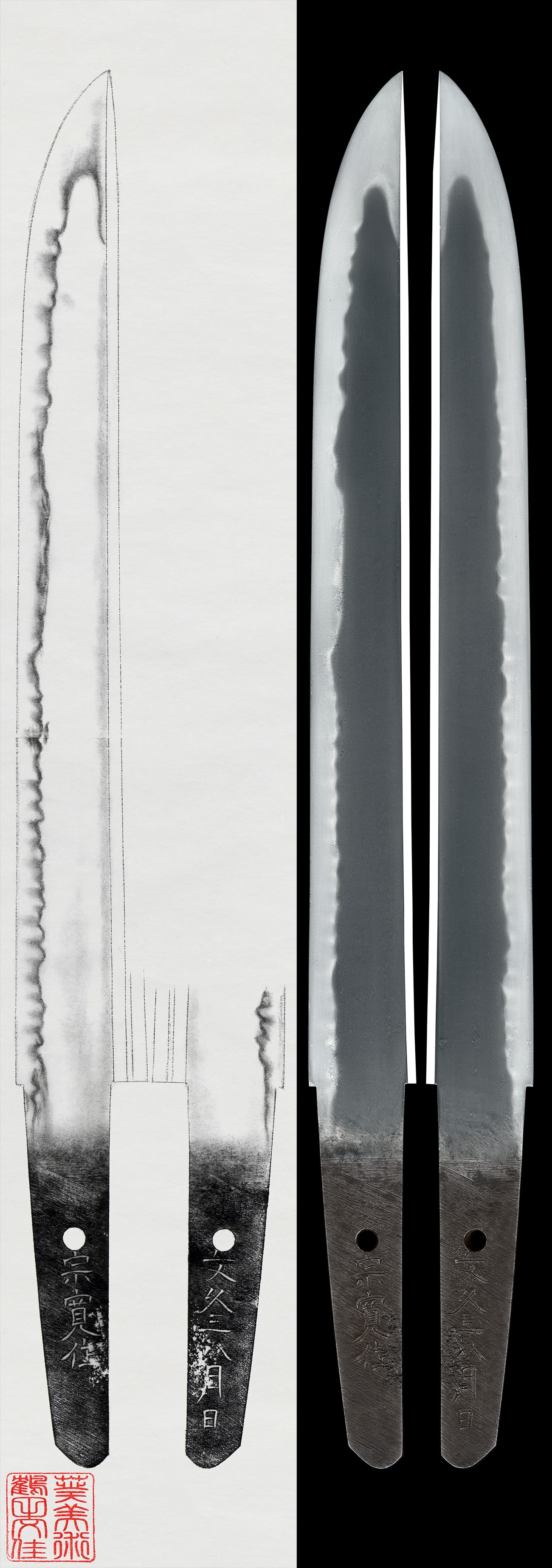
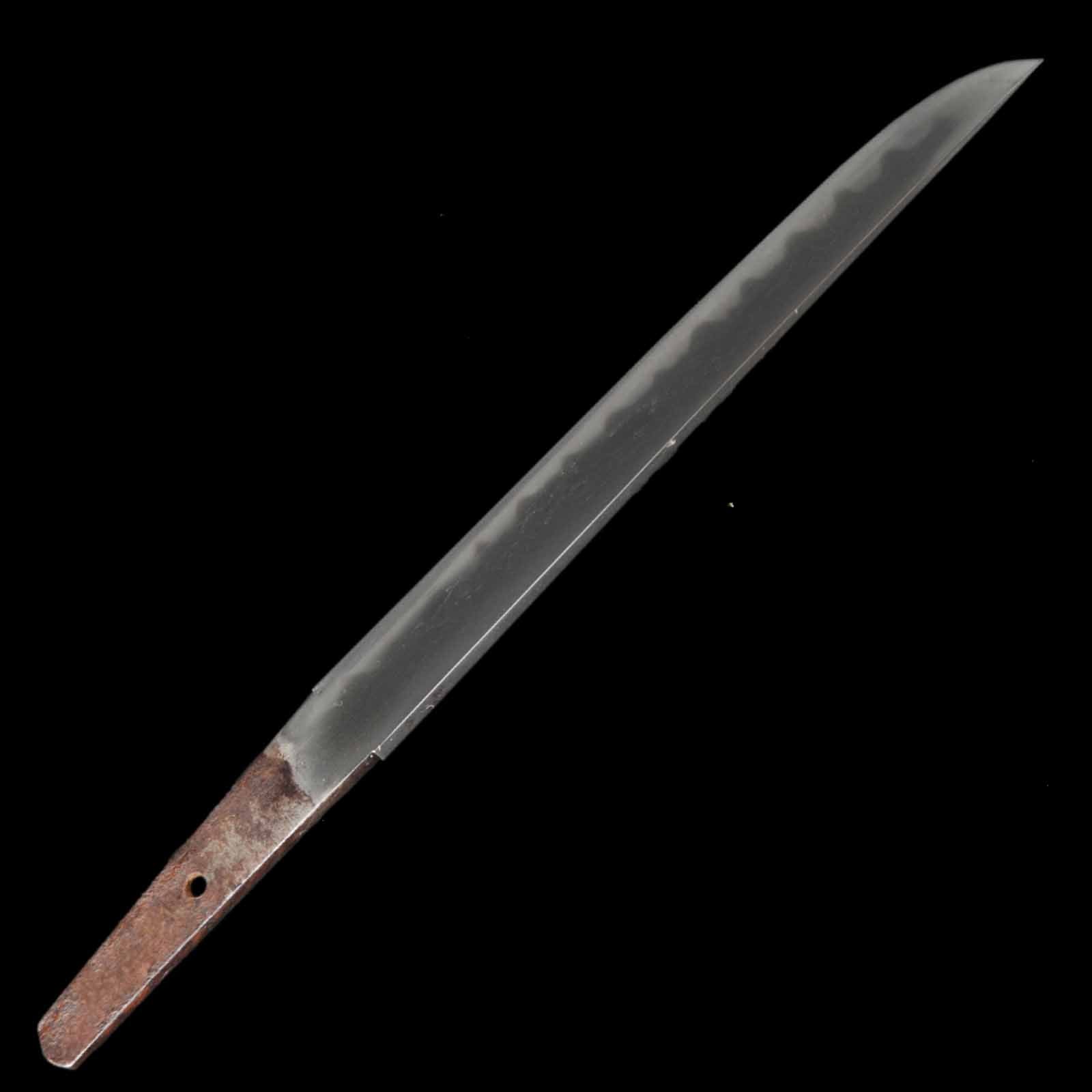
His characteristic hand is a and gunome-chōji in the manner, the feature that distinguishes his work above all others. Over the temper he sets mixed with , pointed elements, and , entering long and well, and the published sources liken the manner to the of Kanemitsu. What is constant, and what separates his revival from the older models he looks back to, is the : it is -dominant and tight, bright and clear, with well adhered, and the brightness within the tempered area is the point the judges return to again and again. On one Tenpō , finished in his showiest vein, the published sources call it 「常にも増して華やかな丁子主調の乱れ刃に仕上げており」, a more flamboyantly -dominant than usual, the full and soft and the interior of the bright.
The is his other constant. His usual is a well-packed , so finely and beautifully forged that it often appears almost plain, with fine adhering and, at times, fine . The published sources summarise the success of his work on exactly these two elements together, calling it 「地鉄のよくつんだ綺麗な鍛えに、匂勝ちの丁子乱れを焼いて成功している」, a tight and beautiful forging of the over which the -dominant is raised. The runs to a turnback, at times becoming pointed with , and where carving is present it is a with accompanying groove, sometimes deepened with , , and a sacred invocation.
Besides his mainline he was a deliberate copyist, and the published sources describe his -mono directly. They call one a typical example of his copy-work: the an imitation of , and especially of Yosazaemon-no-jō Sukesada, the an imitation of the Ōei- masters Morimitsu and Yasumitsu, in which he succeeds in producing an on the shorter blade. A separate vein is the broad, long, blades of the Tenpō years, wide in body with thick , in which the departs from his usual tight grain into an mixed with and , the grain standing, with fine and giving a stronger and more powerful impression that the sources say is not uncommon among his Tenpō works. A quieter and register survives as well, the rarest of his manners. Being an entirely signed and dated smith, the connoisseurship question around Munetsugu is never one of attribution but of quality, and the sources name his teacher with the honesty they bring to the rest, recording that his manner owes more to 「むしろ弟の加藤綱俊の影響力が大きい」.
What marks his place in the bakumatsu is the completeness of his revival and the documentary richness of his blades. Many carry cutting-test inscriptions by the Yamada house, tried at Senju and elsewhere, and his son Yoshitsugu supplied carvings on some of them. One was forged at the command of Lord Date Munenari of the Uwajima domain from the ring-iron taken from the broken mast of a foreign ship, an inscription the published sources call precious as material for the history of the late bakumatsu age. His bright, tight and the near-plain beneath it set his work apart from the deeper, softer of the models he copied, and place him at the head of the - smiths of the new-new sword period.
For the collector Munetsugu is a signed and abundant master rather than a rarity. Fujishiro grades him Jō-jō . He has no National Treasures and no Important Cultural Properties; his standing on the published record runs instead through the rank, where his work is well represented, with the broad named the typical and representative example of his hand, and those of unusually deep and bright singled out as superior pieces in which both and are sound. His blades pass through documented hands rather than museums, the recorded provenance reaching the Marquis of , Matsudaira Chikanai, a senior retainer of the Shōnai domain, and Lord Date Munenari of Uwajima, with one blade long held at the Egara Shrine in . Because so many were made and so many survive, all of them in the tradeable tiers, a signed and dated Munetsugu of good workmanship comes to market more often than almost any other named master of his rank, and remains among the most attainable ways for a collector to hold a fully documented, cutting-tested bakumatsu - blade.