NihontoWatch MonNihontoWatchBETA
MarketEncyclopedia
NihontoWatch Mon

NihontoWatchBETA

Market
Encyclopedia
Overview·Kantei·Designations·Provenance·Blade Forms·Signatures·Lineage·School
OverviewKanteiDesignationsProvenanceBlade FormsSignaturesLineageSchool
  1. Schools
  2. Koyama Munetsugu
  3. Munetsugu

Koyama Munetsugu

宗次

Jūyō
Vol. 43, No. 138 · Katana

Koyama Munetsugu

宗次

51 ranked works

ProvinceMusashiEraTenpo (1830–1844)PeriodMeijiSchoolKoyama MunetsuguTraditionShinshintoTeacherKato TsunahideFujishiroJo-jo sakuToko Taikan700(top 17%)TypeSwordsmithCodeMUN559
51Jūyō Tōken

Overview

Koyama Munetsugu was born in Kyōwa 3 (1803) at Shirakawa in Ōshū, common name Sōbē, with the art-names Issensai and Seiryōsai, and he became the foremost reviver of the tradition in the closing decades of the period. The published sources record that his teacher is said to have been Katō Tsunahide of Yonezawa, yet they add the careful qualification that, judging from his manner of work, the influence of Tsunahide's younger brother Katō Tsunatoshi seems rather to have been the stronger. He served first the Matsudaira house of Shirakawa, and when that domain was transferred he became a smith for the Kuwana fief in , living in at Azabu Nagasaka; in Kōka 2 (1845) he received the court title no , and he worked from the latter half of the Bunsei era down into the early Meiji years, signing in several forms, as Nishiyama, as Koyama, and as no Fujiwara Munetsugu. His record on the published rolls is one of the largest of any smith, dated tightly across the Tenpō, Kaei, Ansei and Keiō years, and the sources judge that his style remained consistently within the tradition throughout.

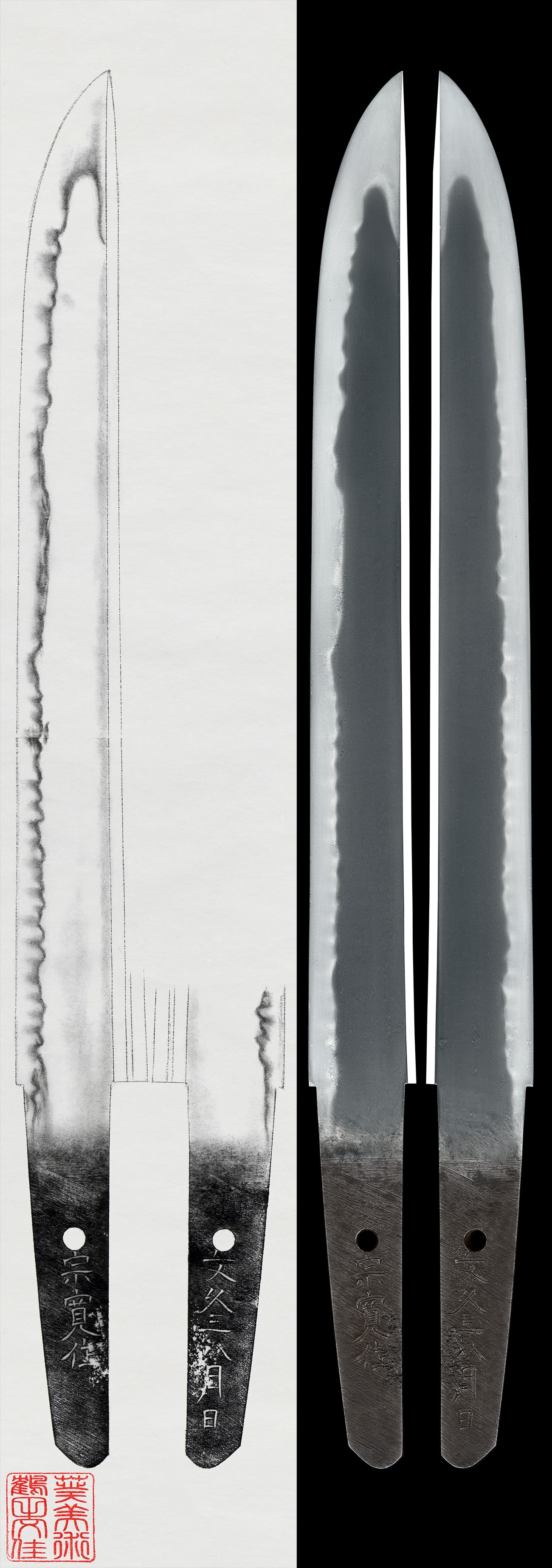
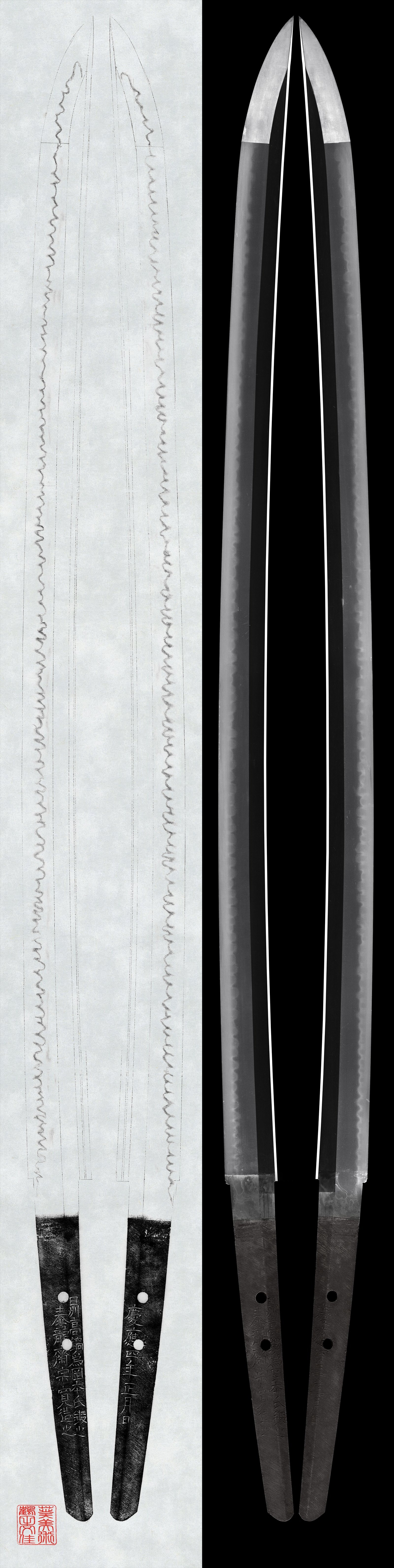
His characteristic hand is a and gunome-chōji in the manner, the feature that distinguishes his work above all others. Over the temper he sets mixed with , pointed elements, and , entering long and well, and the published sources liken the manner to the of Kanemitsu. What is constant, and what separates his revival from the older models he looks back to, is the : it is -dominant and tight, bright and clear, with well adhered, and the brightness within the tempered area is the point the judges return to again and again. On one Tenpō , finished in his showiest vein, the published sources call it 「常にも増して華やかな丁子主調の乱れ刃に仕上げており」, a more flamboyantly -dominant than usual, the full and soft and the interior of the bright.

The is his other constant. His usual is a well-packed , so finely and beautifully forged that it often appears almost plain, with fine adhering and, at times, fine . The published sources summarise the success of his work on exactly these two elements together, calling it 「地鉄のよくつんだ綺麗な鍛えに、匂勝ちの丁子乱れを焼いて成功している」, a tight and beautiful forging of the over which the -dominant is raised. The runs to a turnback, at times becoming pointed with , and where carving is present it is a with accompanying groove, sometimes deepened with , , and a sacred invocation.

Besides his mainline he was a deliberate copyist, and the published sources describe his -mono directly. They call one a typical example of his copy-work: the an imitation of , and especially of Yosazaemon-no-jō Sukesada, the an imitation of the Ōei- masters Morimitsu and Yasumitsu, in which he succeeds in producing an on the shorter blade. A separate vein is the broad, long, blades of the Tenpō years, wide in body with thick , in which the departs from his usual tight grain into an mixed with and , the grain standing, with fine and giving a stronger and more powerful impression that the sources say is not uncommon among his Tenpō works. A quieter and register survives as well, the rarest of his manners. Being an entirely signed and dated smith, the connoisseurship question around Munetsugu is never one of attribution but of quality, and the sources name his teacher with the honesty they bring to the rest, recording that his manner owes more to 「むしろ弟の加藤綱俊の影響力が大きい」.

What marks his place in the bakumatsu is the completeness of his revival and the documentary richness of his blades. Many carry cutting-test inscriptions by the Yamada house, tried at Senju and elsewhere, and his son Yoshitsugu supplied carvings on some of them. One was forged at the command of Lord Date Munenari of the Uwajima domain from the ring-iron taken from the broken mast of a foreign ship, an inscription the published sources call precious as material for the history of the late bakumatsu age. His bright, tight and the near-plain beneath it set his work apart from the deeper, softer of the models he copied, and place him at the head of the - smiths of the new-new sword period.

For the collector Munetsugu is a signed and abundant master rather than a rarity. Fujishiro grades him Jō-jō . He has no National Treasures and no Important Cultural Properties; his standing on the published record runs instead through the rank, where his work is well represented, with the broad named the typical and representative example of his hand, and those of unusually deep and bright singled out as superior pieces in which both and are sound. His blades pass through documented hands rather than museums, the recorded provenance reaching the Marquis of , Matsudaira Chikanai, a senior retainer of the Shōnai domain, and Lord Date Munenari of Uwajima, with one blade long held at the Egara Shrine in . Because so many were made and so many survive, all of them in the tradeable tiers, a signed and dated Munetsugu of good workmanship comes to market more often than almost any other named master of his rank, and remains among the most attainable ways for a collector to hold a fully documented, cutting-tested bakumatsu - blade.
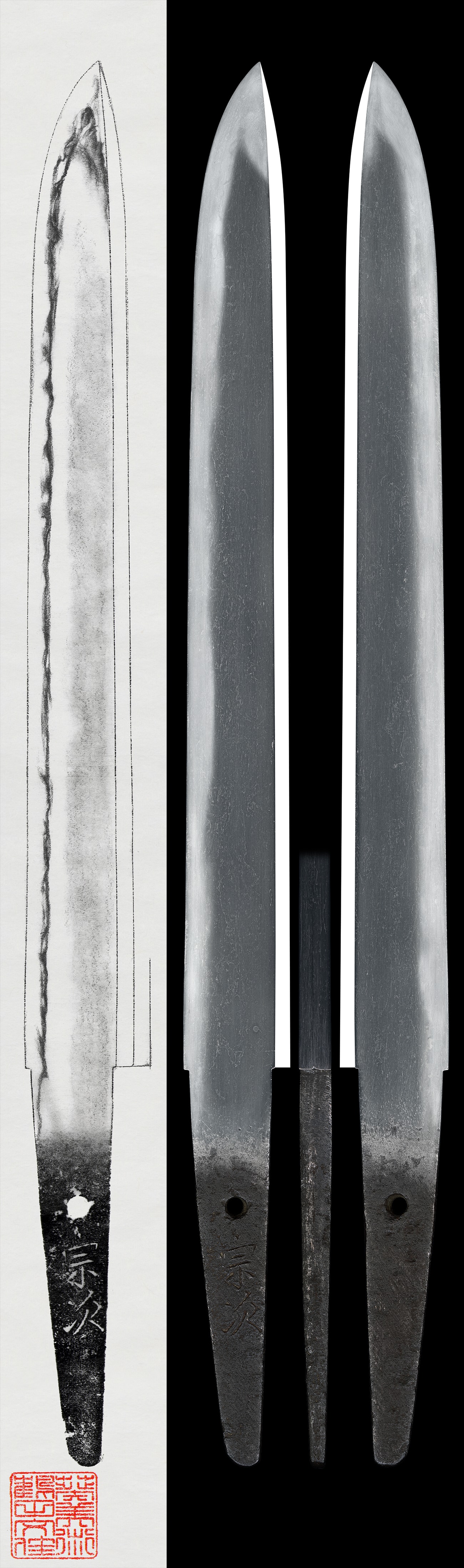
Kantei

one signed bakumatsu Bizen-den hand in three registers: his prime choji and gunome-choji over a tightly packed, near-plain ko-itame, nioi-dominant with a tight bright nioiguchi, modeled on the Kamakura Bizen of Kanemitsu; his utsushi-mono, the Sukesada and Oei-Bizen copies that revive an utsuri and the broad o-kissaki Tenpo blades with standing grain; and a minor suguha / suguha-cho register

Koyama Munetsugu is the leading Bizen-den revivalist of the bakumatsu, born in Kyowa 3 in Shirakawa of Oshu, common name Sobei, with the gou Issensai and Seiryosai; the published sources say he learned from Kato Tsunahide of Yonezawa, yet judge that his manner owes more to Tsunahide's younger brother Kato Tsunatoshi, and that he served first the Matsudaira of Shirakawa and then, when the house was transferred, the Kuwana domain in Ise, living at Azabu Nagasaka in Edo, taking the title Bizen no Suke in Koka 2 and working from late Bunsei into the early Meiji years, leaving a very large body of work signed in several forms (Nishiyama, Koyama, Bizen no Suke Fujiwara Munetsugu). His hand is consistently Bizen-den: over a well-packed, beautiful ko-itame, often so tight as to look almost plain, he tempers a choji and gunome-choji in a nioi-dominant manner with a tight, bright, clear nioiguchi, ashi entering well, ko-nie adhering, with sunagashi and fine kinsuji and a midare-komi ko-maru boshi, a manner the sources liken to the Kamakura Bizen of Kanemitsu. Alongside this mainline he is a deliberate copyist, the daisho after Yosazaemon-no-jo Sukesada and the Oei-Bizen Morimitsu and Yasumitsu in which he succeeds in raising an utsuri, and the broad, long, o-kissaki blades of the Tenpo years in which the grain stands and the steel takes on extra strength. The kantei question around him is not attribution, since he is an entirely signed and dated smith, but his standing as the most accomplished Bizen-den hand of the new-new sword period.

Diagnostic discriminators

unique vs Kamakura Bizen choji (deep, soft nioiguchi)

unique vs his Tenpo blades (standing itame)

Observation by phase

The prime Bizen-den (choji and gunome-choji, his forte)

His recognized forte is the Bizen-den, which the published sources call consistent across his whole career and the most skillful of his manners. The shape is a shinogi-zukuri katana with iori-mune, standard to somewhat wide in body, the sori at times somewhat high and at times shallow, the chu-kissaki tending to elongate, often with sakizori. The ground is a well-packed ko-itame, frequently so tight as to look almost plain, with fine ji-nie adhering and at times fine chikei. Over it he tempers a choji and gunome-choji, the choji mixed with gunome, pointed elements, small choji and small gunome, ashi entering long and well, the nioiguchi nioi-dominant and tight, bright and clear, with ko-nie, light sunagashi and fine kinsuji. The boshi runs midare-komi to a ko-maru turnback, at times becoming pointed with hakikake. The carving, where present, is a bo-hi with soe-hi, sometimes with bonji, gomabashi, kurikara and a sacred invocation. The sources call the brightness and clarity of his tight nioiguchi the special point of his work, and liken the choji-gunome manner to the Kamakura Bizen of Kanemitsu.

Sugata 姿
Jigane 地鉄
Hamon 刃文
Bōshi 帽子

The utsushi-mono and the broad Tenpo blades (copies and powerful o-kissaki work)

The second face of his record is the deliberate copyist. The published sources call his daisho a typical example of his utsushi-mono, the katana an imitation of Sue-Bizen, especially Yosazaemon-no-jo Sukesada, and the wakizashi an imitation of the Oei-Bizen masters Morimitsu and Yasumitsu, in which he succeeds in producing an utsuri, with a flowing ko-itame and a midare-utsuri standing on the shorter blade. The same register includes his broad, long blades of the Tenpo years, wide in body with an elongated chu- or o-kissaki and thick kasane, in which the ground departs from his usual tight grain: an itame mixed with mokume and nagare-hada, the grain standing, with fine ji-nie well adhered and fine chikei, giving a stronger, more powerful impression that the sources say is not uncommon among his Tenpo works. Over it the choji-midare and gunome-choji grow larger and more flamboyant, with kinsuji entering well and sunagashi, the broad o-kissaki proportions grand and forceful and strongly expressing the bakumatsu age. The temper of these copies and powerful blades remains nioi-dominant with a bright nioiguchi, his constant.

Sugata 姿
Jigane 地鉄
Hamon 刃文
Bōshi 帽子

The suguha / suguha-cho register (minor)

less firmly established

A minor register survives in which Munetsugu leaves the flamboyant choji for a quieter line, a suguha or suguha-cho, sometimes a chu-suguha-cho, the ground his usual tight ko-itame with flowing tendencies, ji-nie and at times a faint utsuri, the boshi sugu to a ko-maru. It is the calm counterpart to his choji mainline and the rarest of his manners.

Jigane 地鉄
Hamon 刃文
Bōshi 帽子
Scholarship

The published sources record that Munetsugu's teacher is said to have been Kato Tsunahide but that, judging from his manner of work, the influence of Tsunahide's younger brother Kato Tsunatoshi was rather the stronger, and that he worked consistently in the Bizen tradition throughout a long career from late Bunsei into the early Meiji years.

The published sources describe his copies directly: his daisho is a typical example of his utsushi-mono, the katana imitating Sue-Bizen and especially Yosazaemon-no-jo Sukesada, the wakizashi imitating the Oei-Bizen masters Morimitsu and Yasumitsu, in which he succeeds in producing an utsuri; a separate katana made at the command of Lord Date Munenari of Uwajima from the ring-iron of a foreign ship's broken mast is noted as precious material for bakumatsu history.

Designations

Kokuhō—
Jūyō Bunkazai—
Jūyō Bijutsuhin—
Gyobutsu—
Tokubetsu Jūyō—
Jūyō Tōken51

Elite Standing

0.17 across 51 designated works

Top 13% among smiths

Provenance

6 documented provenances across certified works by Munetsugu

Provenance Standing

1 works held in elite collections across 6 documented provenances

Top 68% among smiths

Raw score: 1.92 / 10

Blade Forms

Distribution across 51 ranked works

Signatures

Signature types across 51 ranked works

Currently Available

Lineage

Munetsugu
Students (5)
  1. 1.Masatsugu正次
  2. 2.Munetsugu宗次9designated
  3. 3.Munetsugu宗次1designated
  4. 4.Munehiro宗弘
  5. 5.Munehiro宗寛1 for sale

Koyama Munetsugu School

Other artisans of the Koyama Munetsugu school

  1. 1.Tairyusai泰龍齋1designated
  2. 2.Sokan宗寛4 for sale5designated