NihontoWatch MonNihontoWatch
Market
Encyclopedia
Kantei
NihontoWatch MonNihontoWatch
Market
Encyclopedia
Kantei

Description

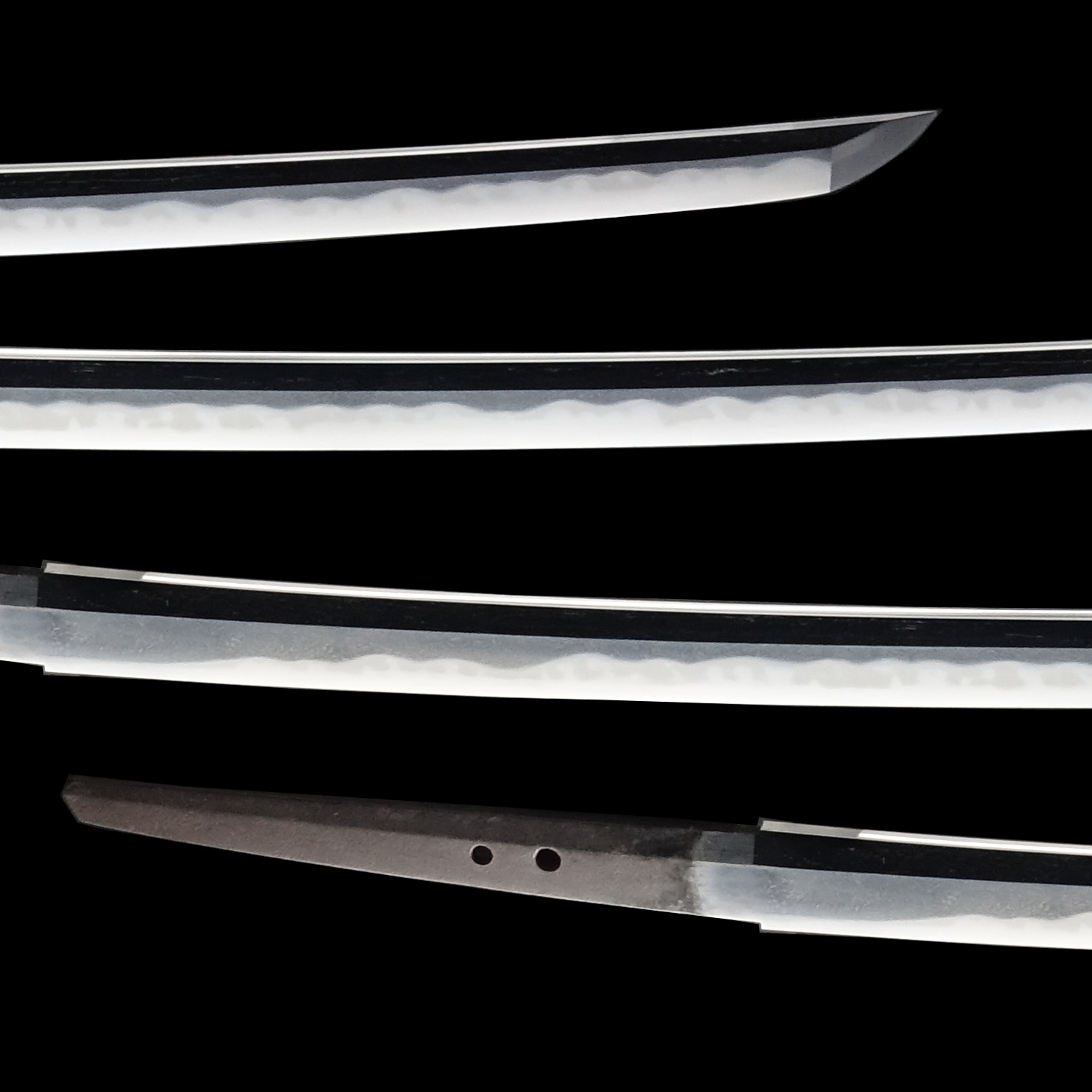
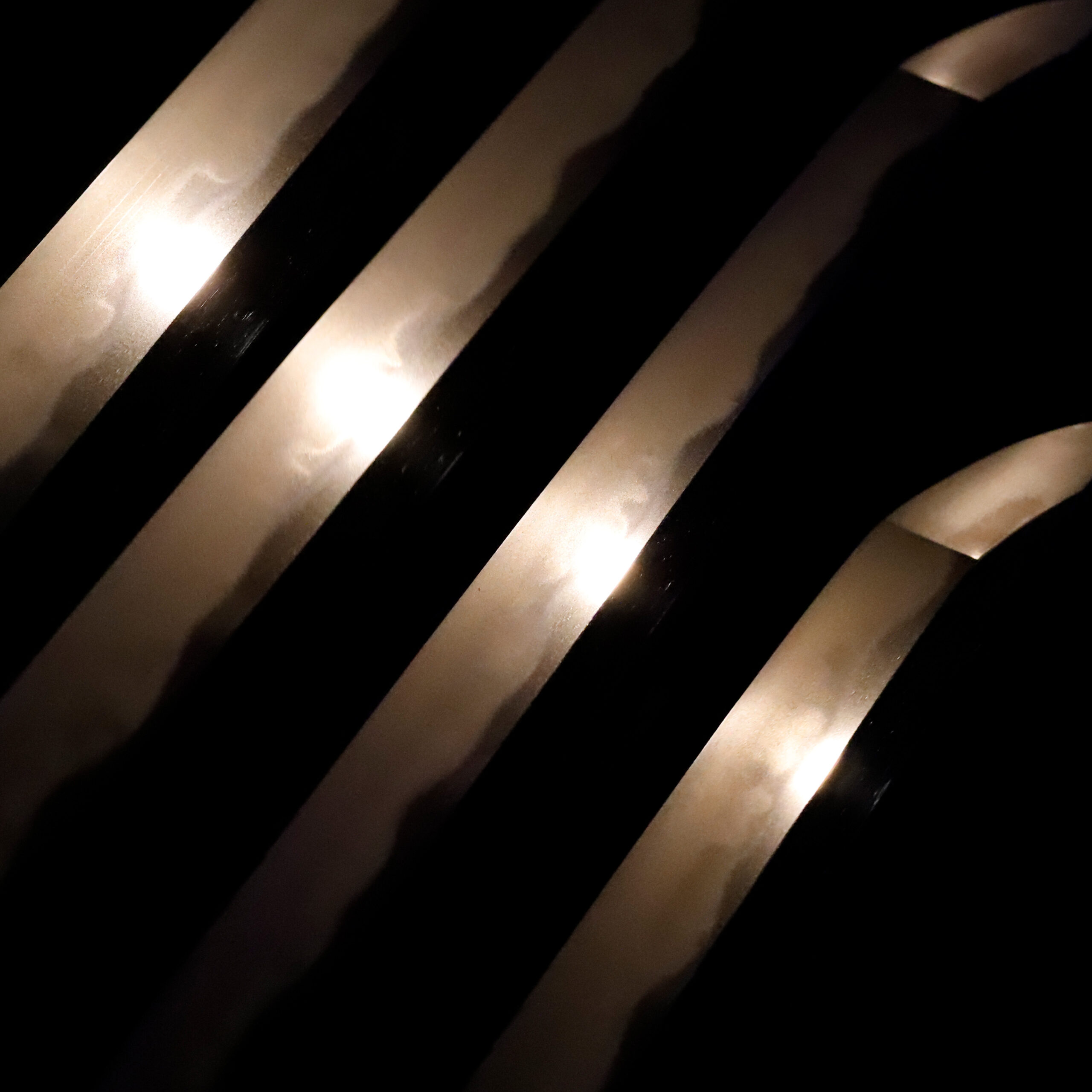
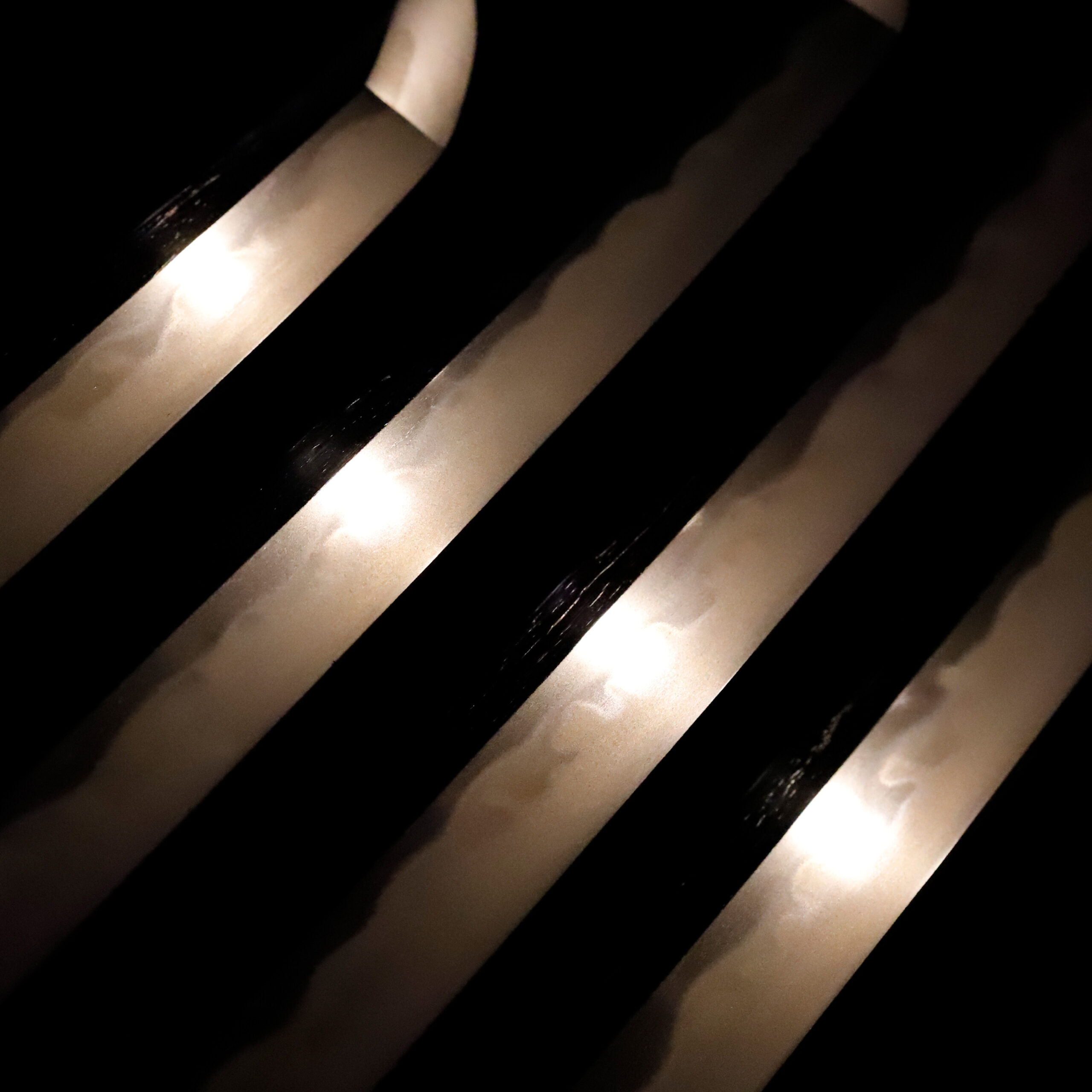
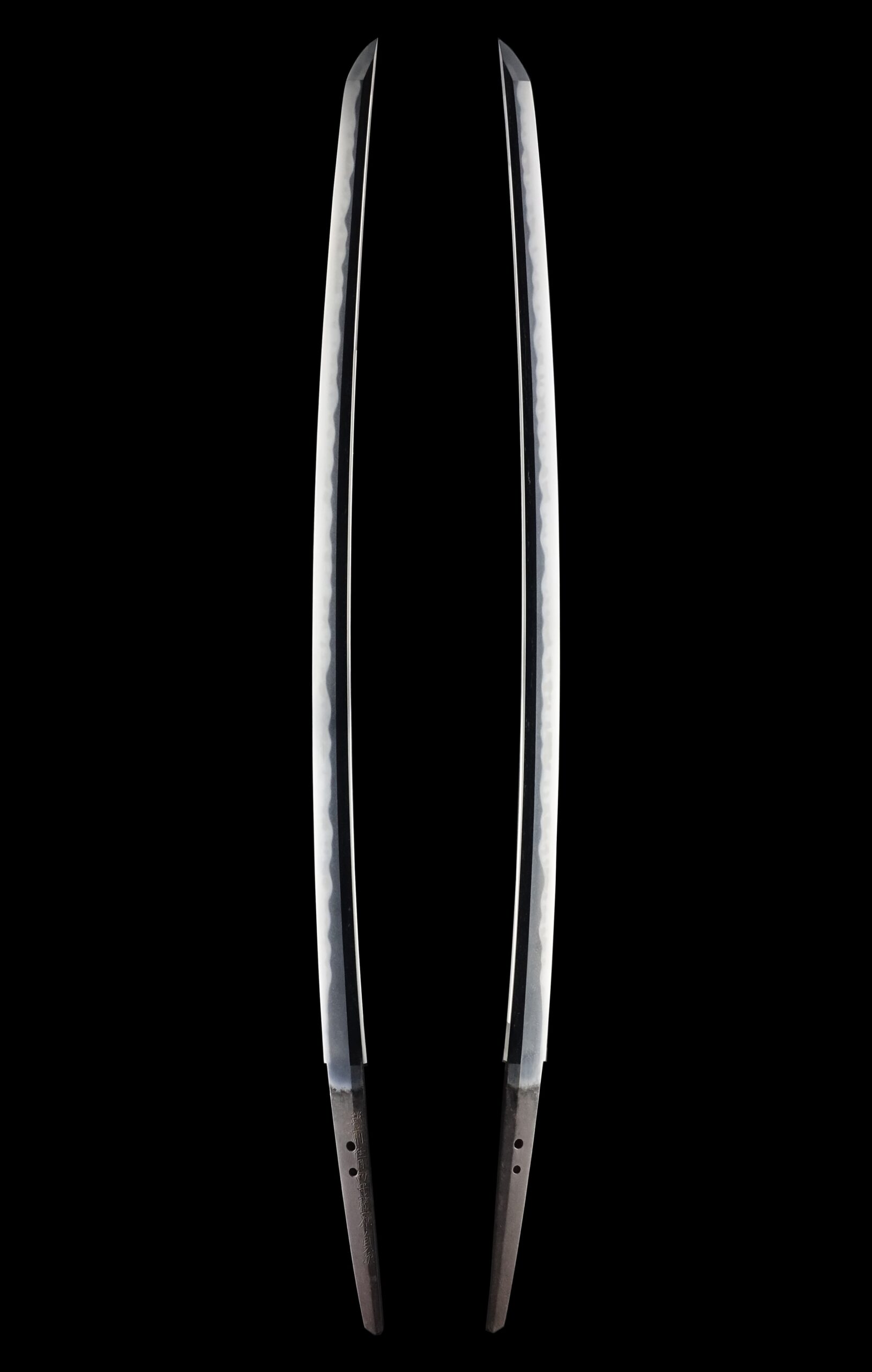
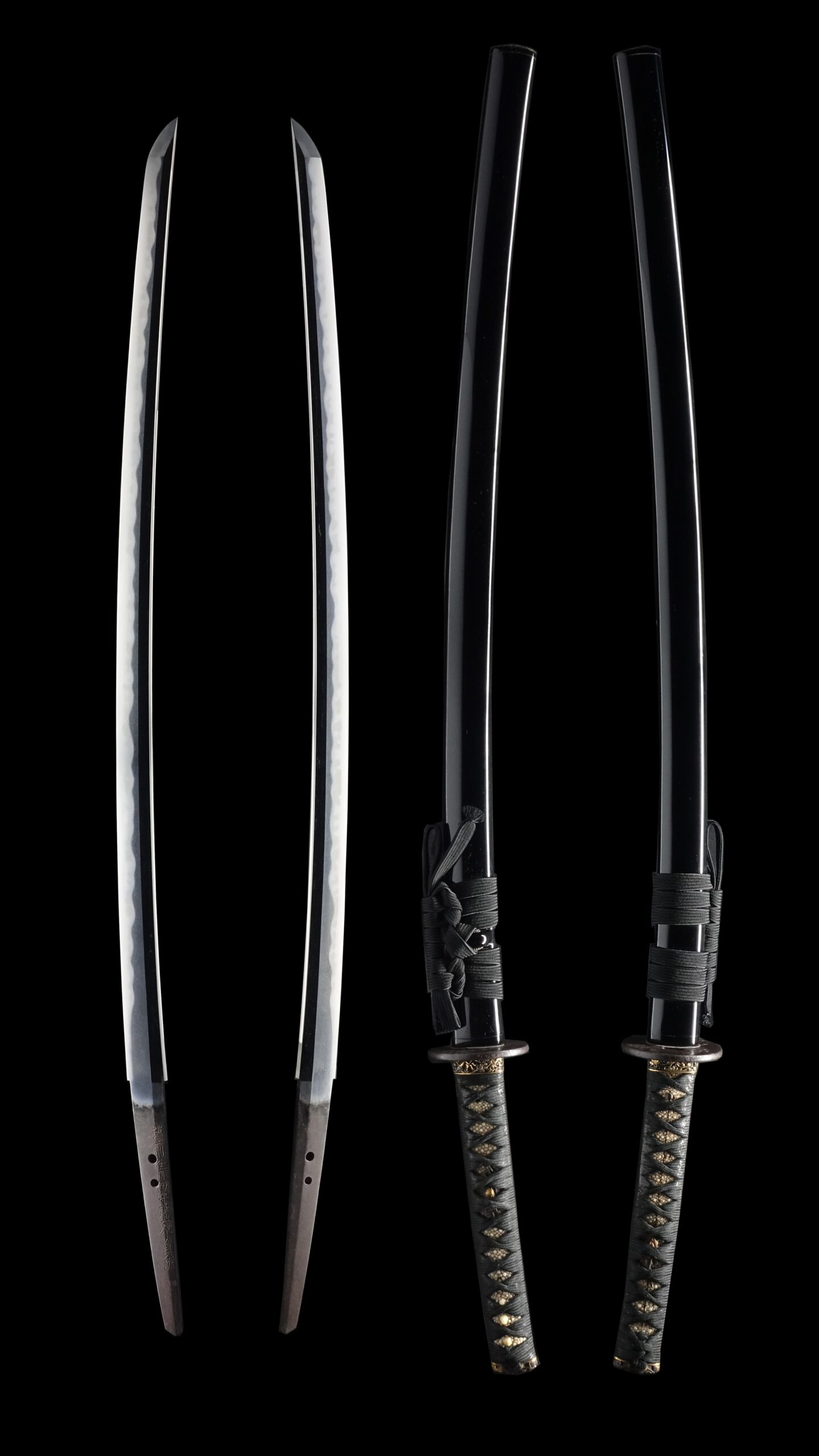
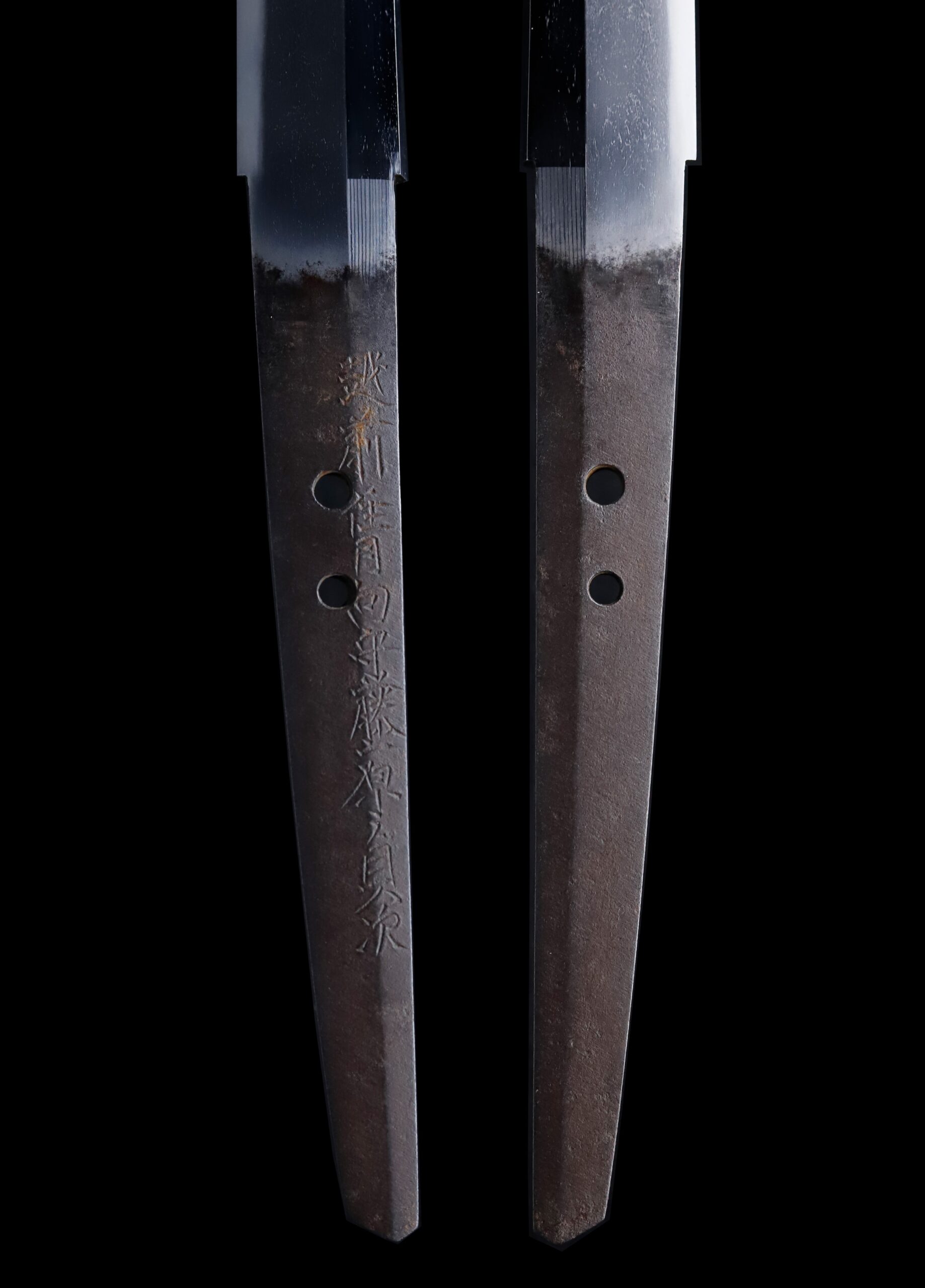
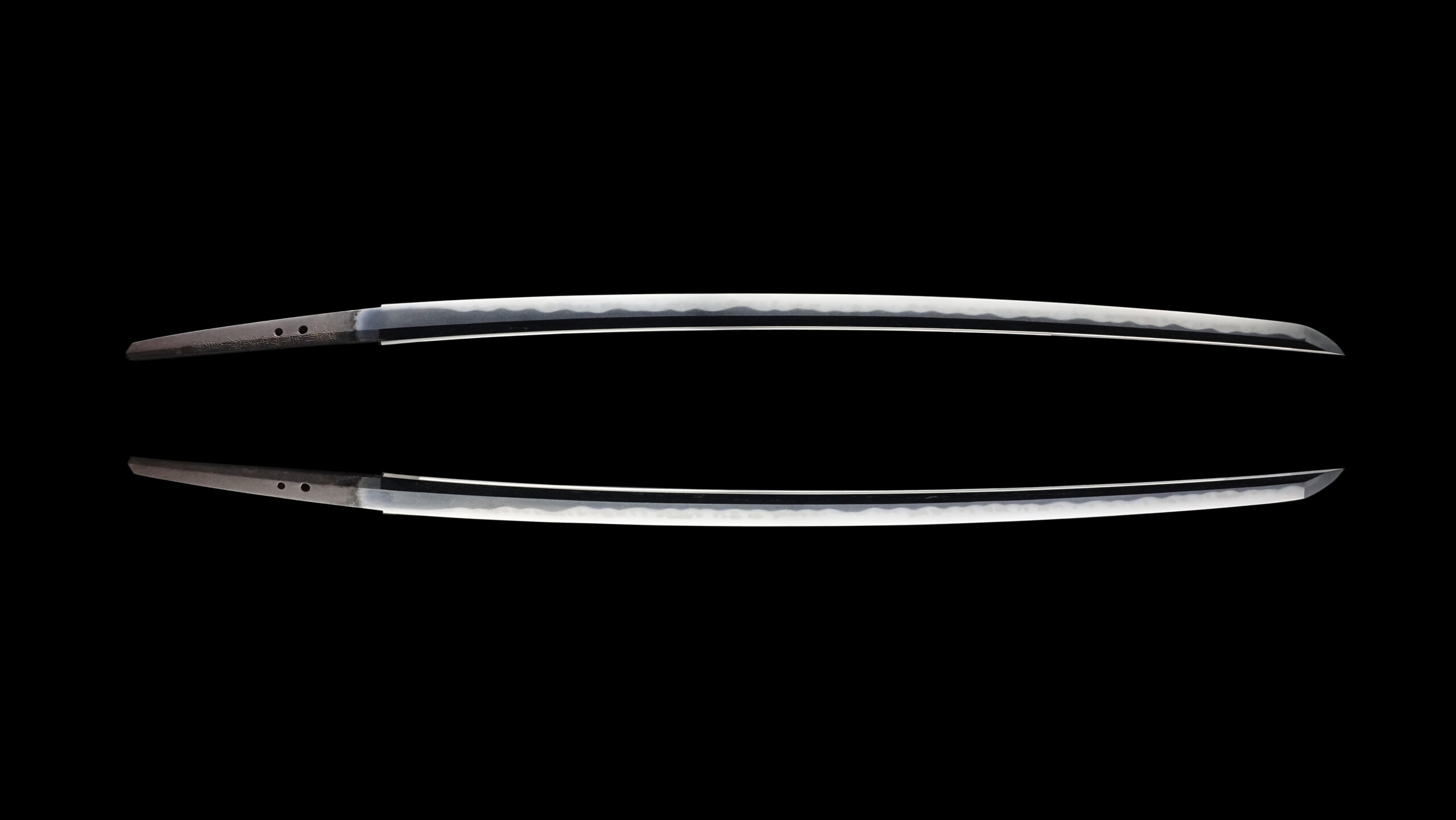
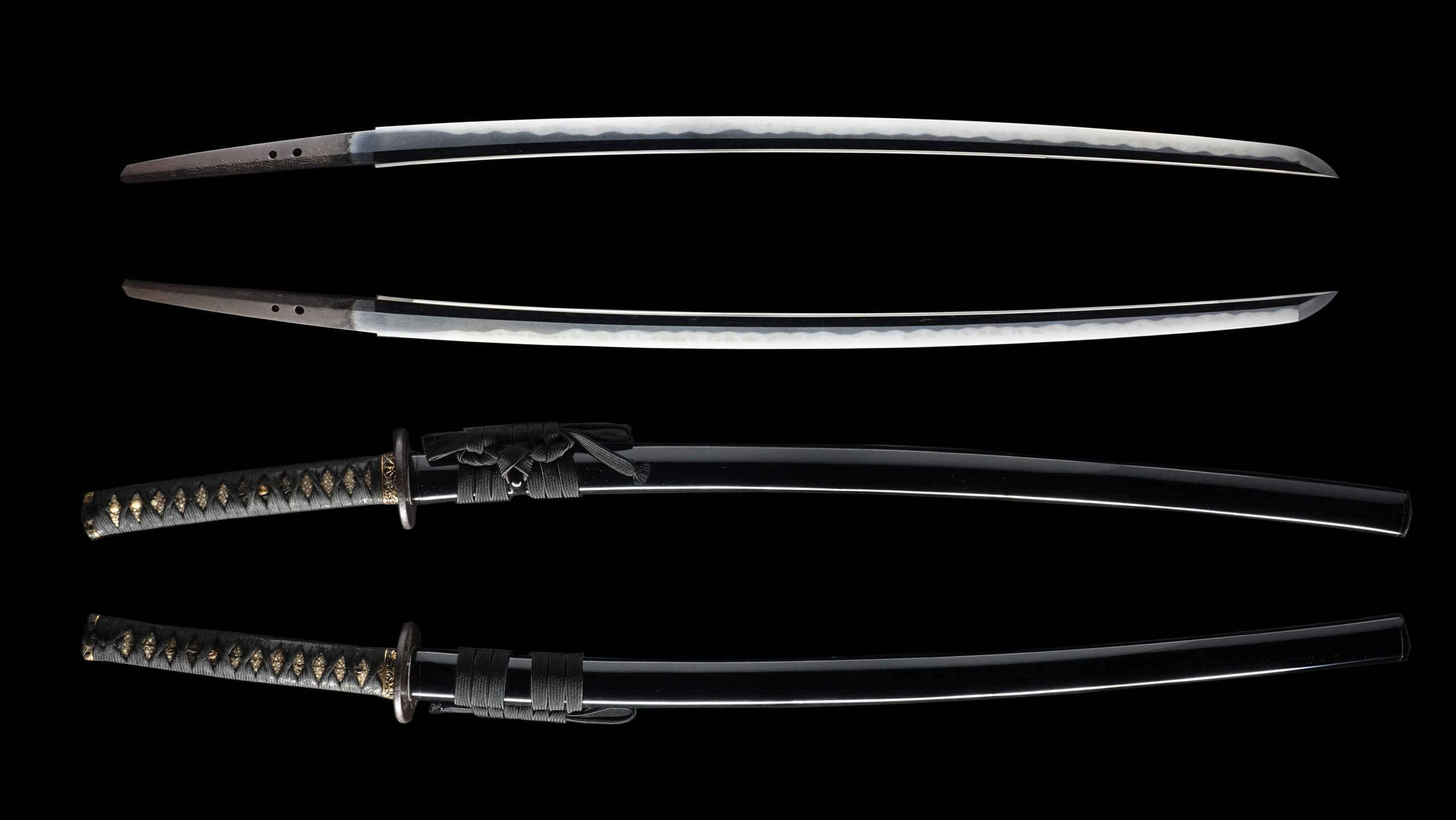
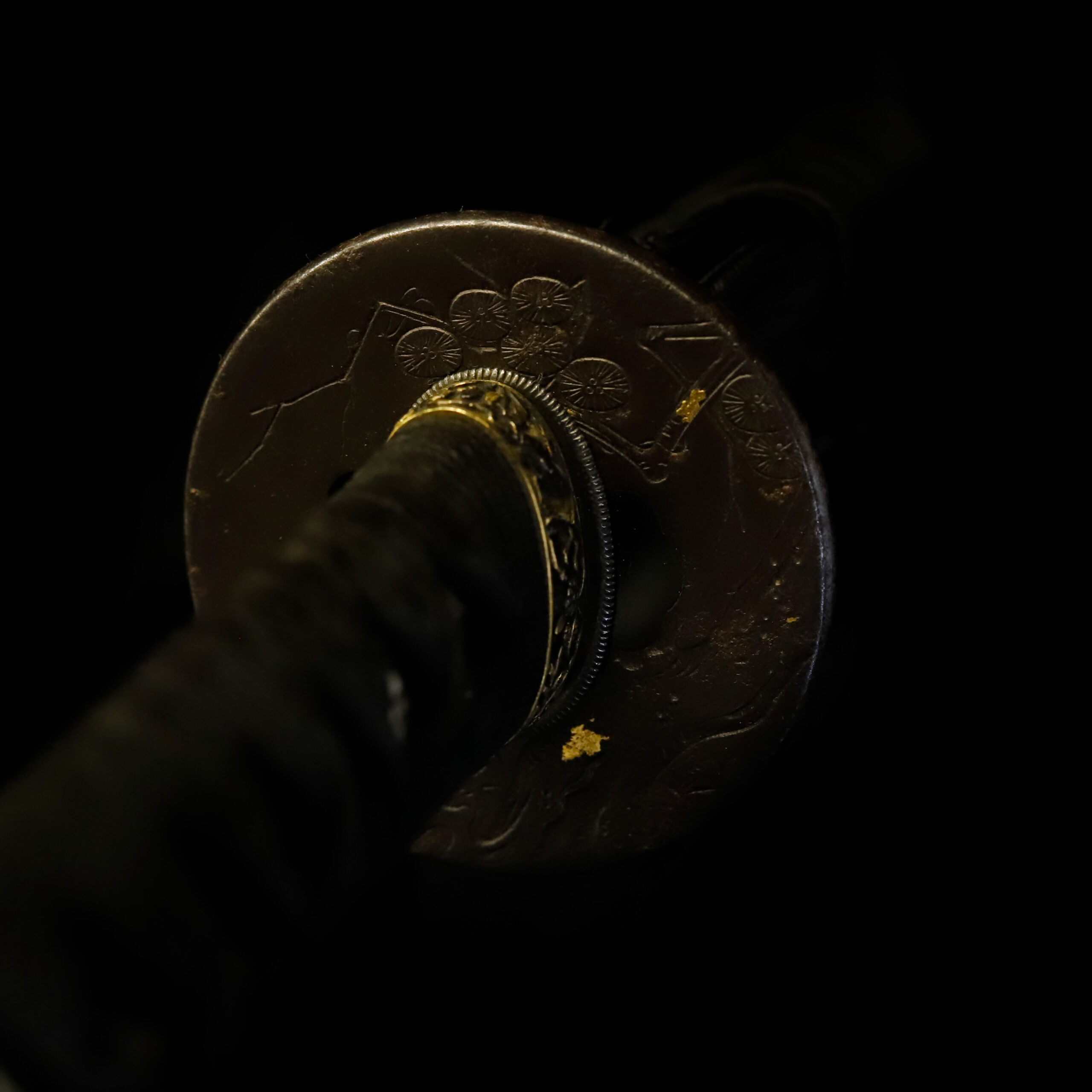
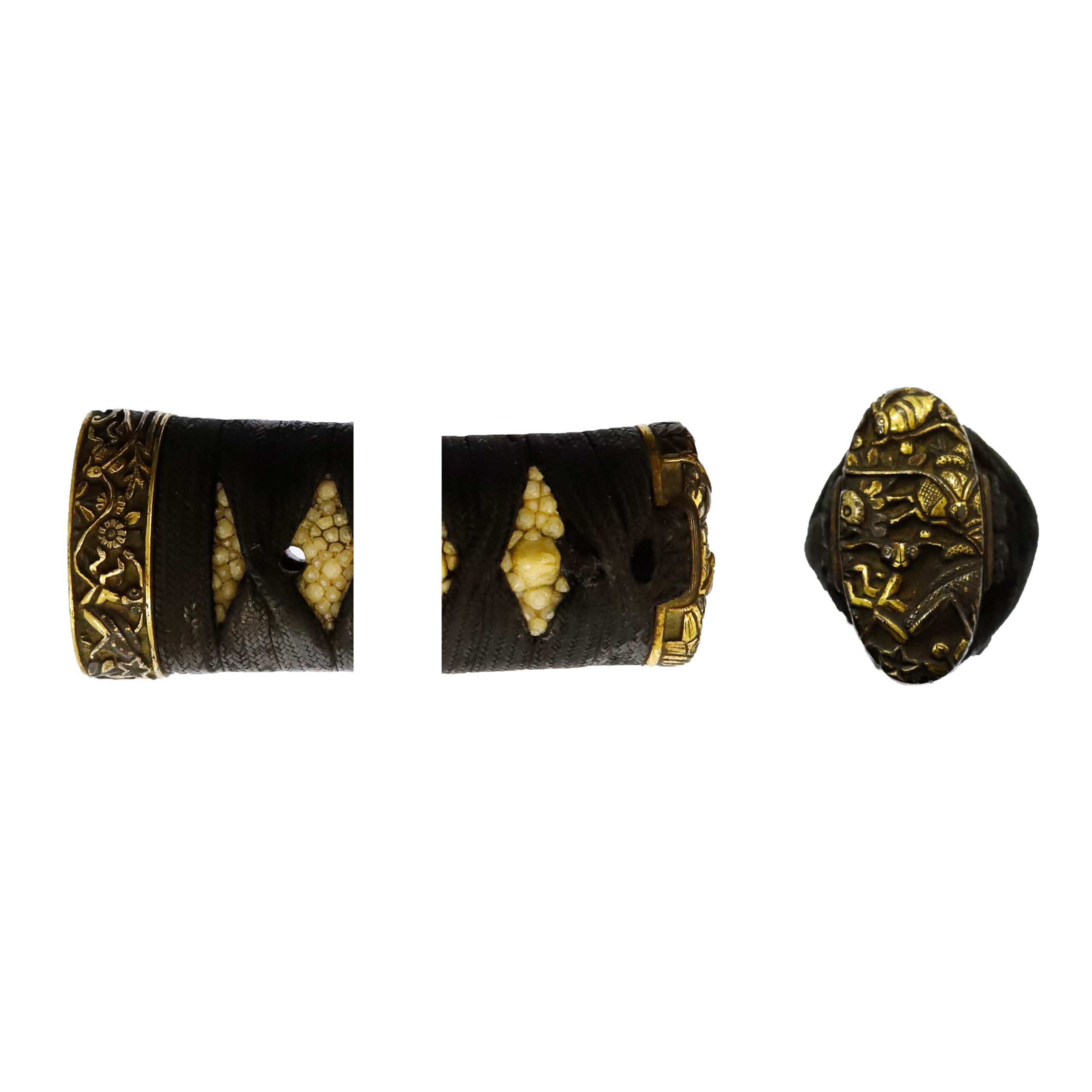
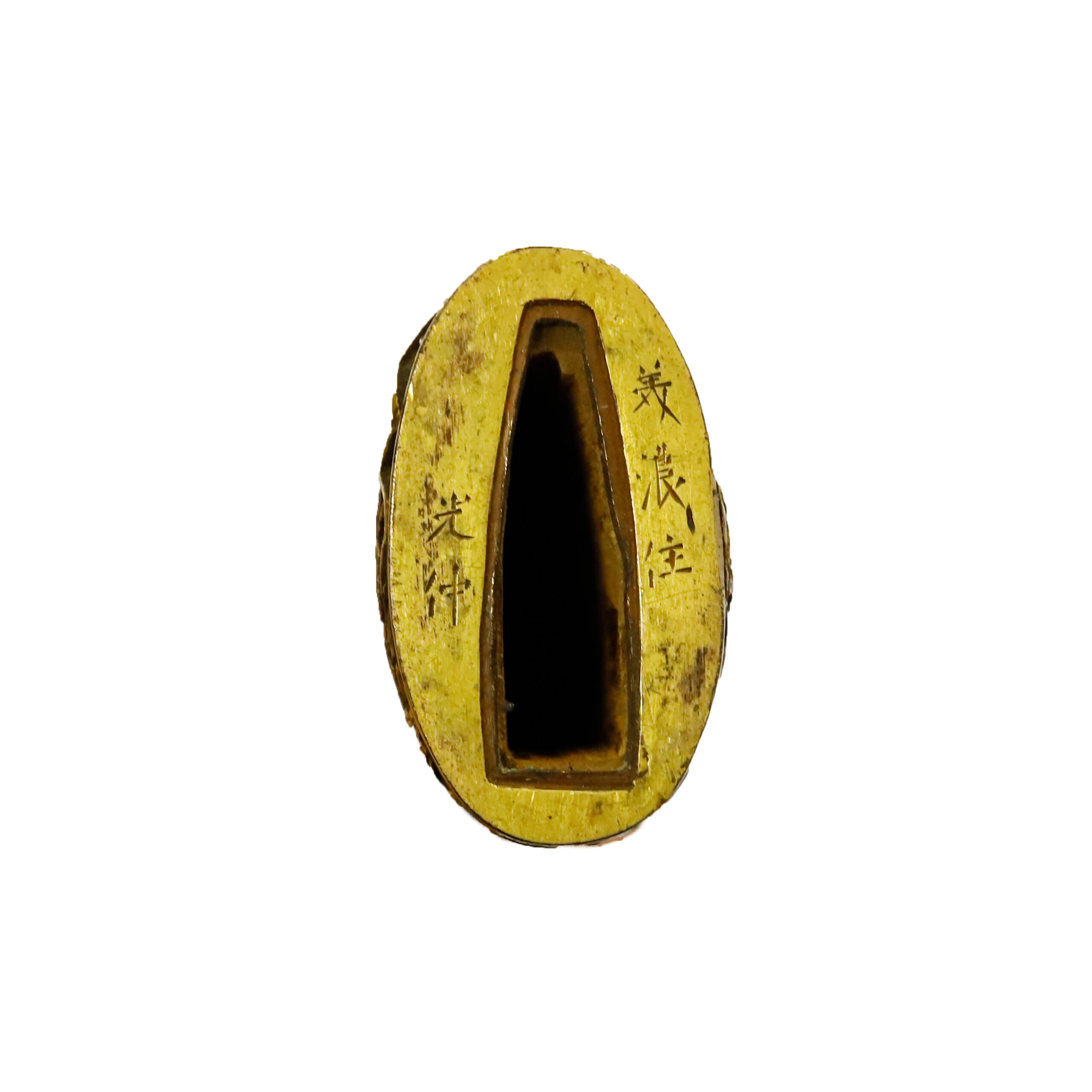
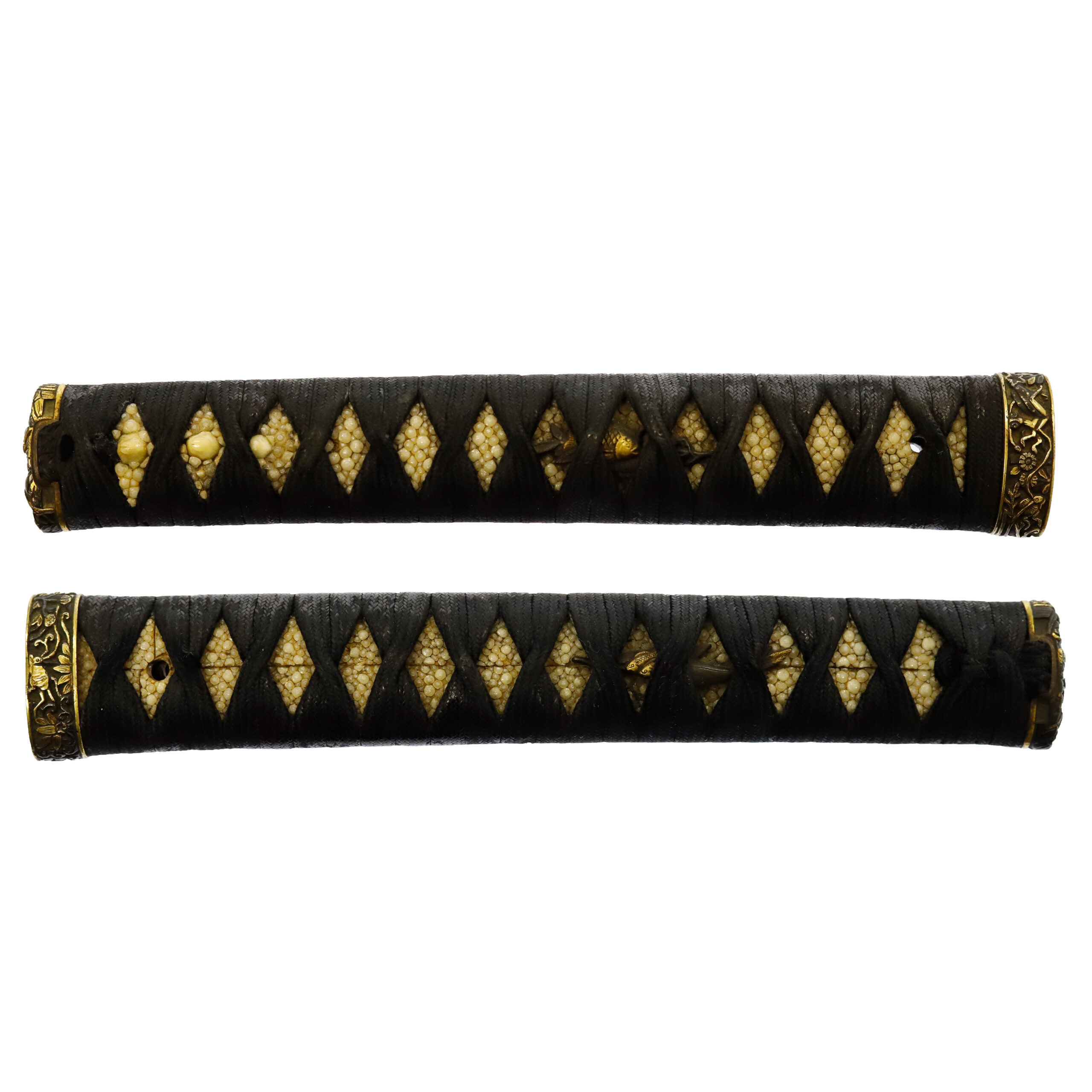
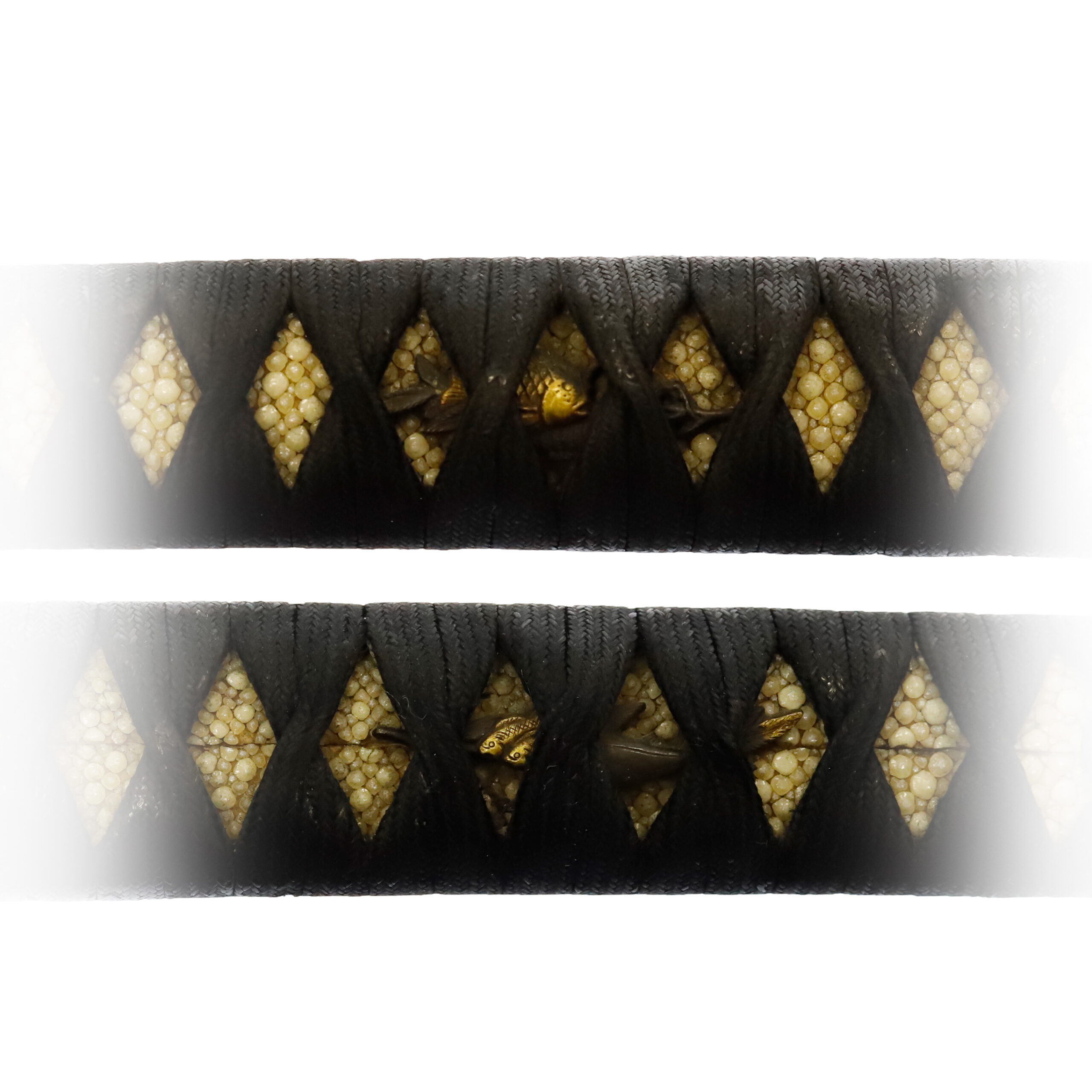
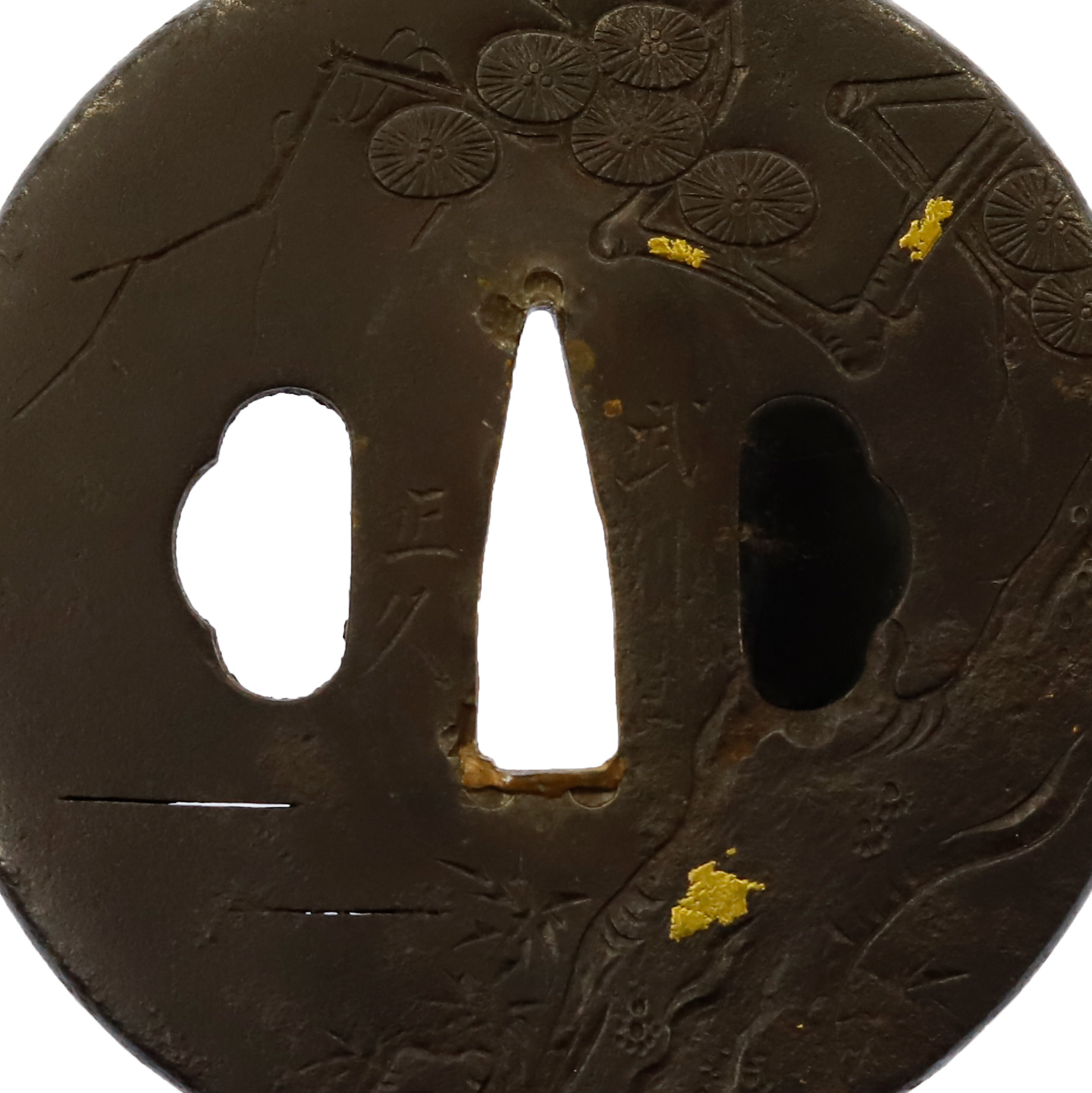
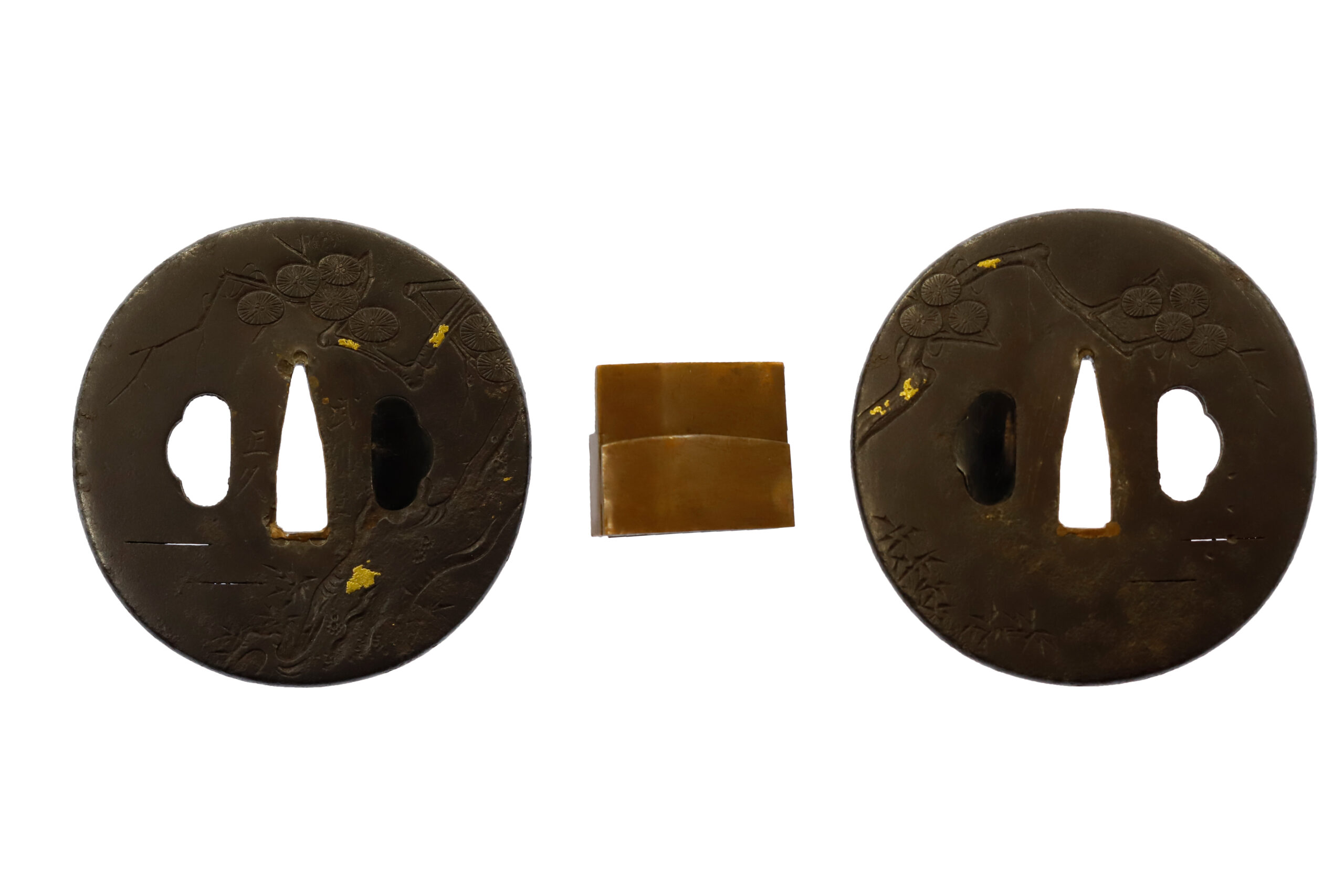
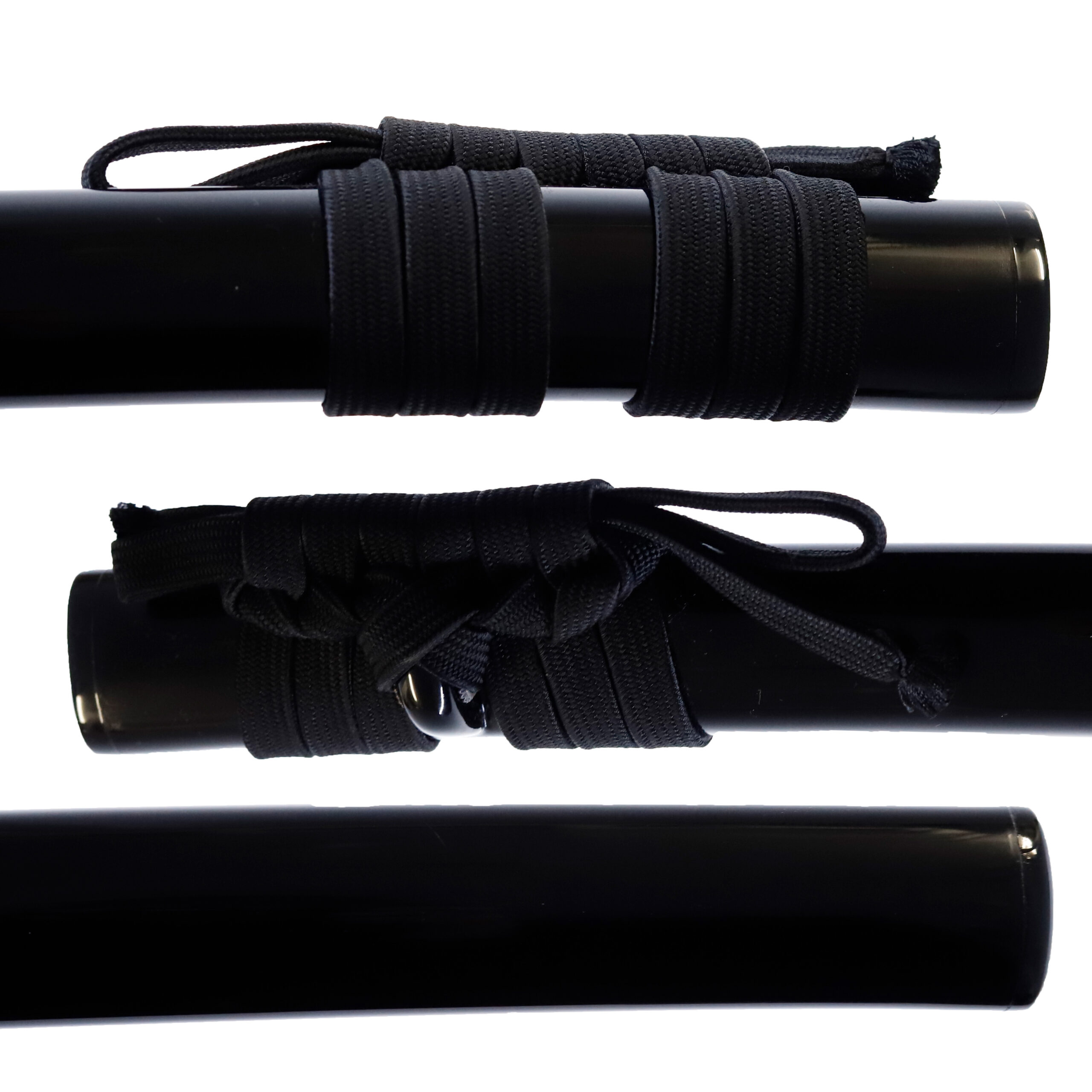
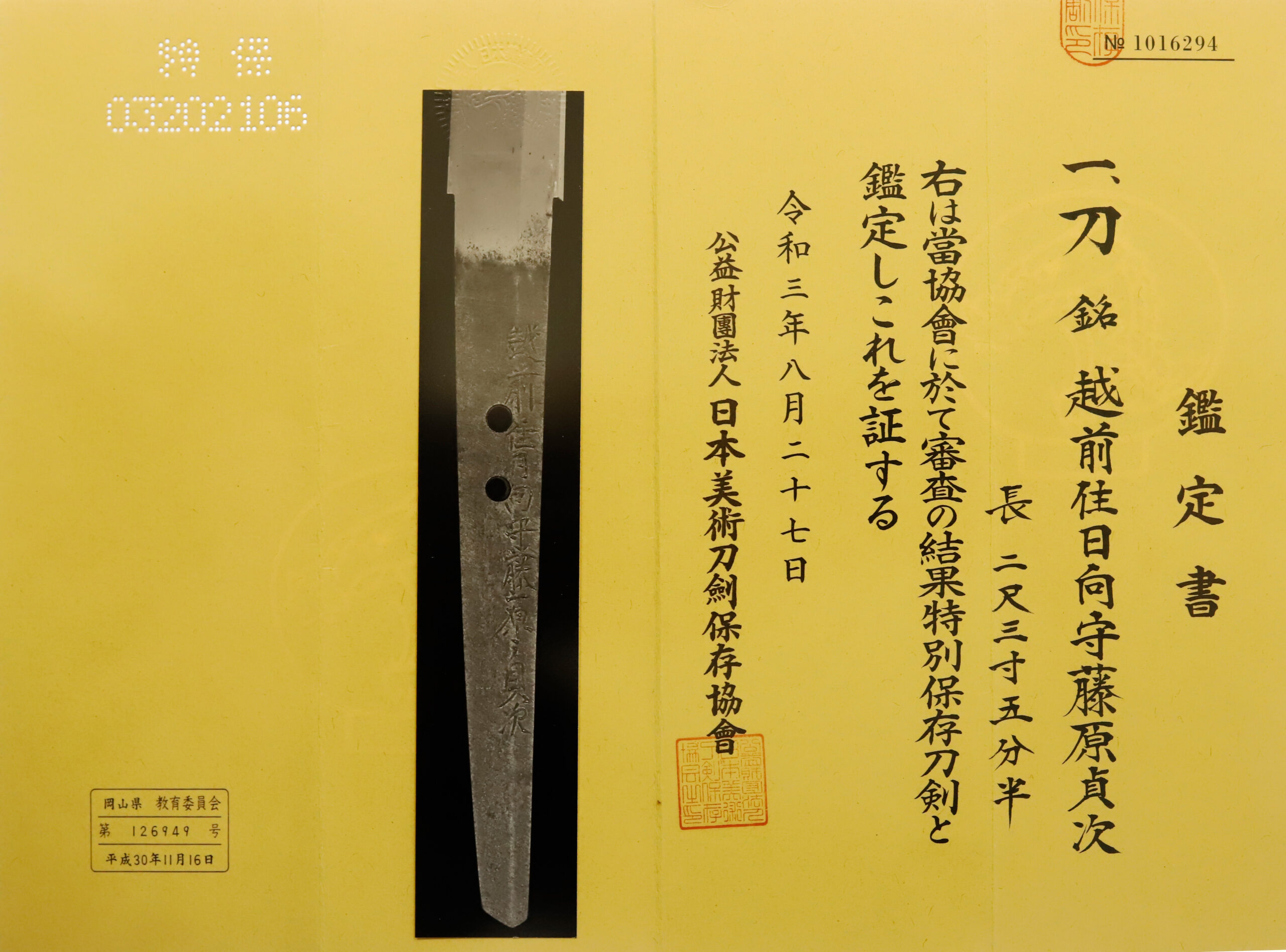
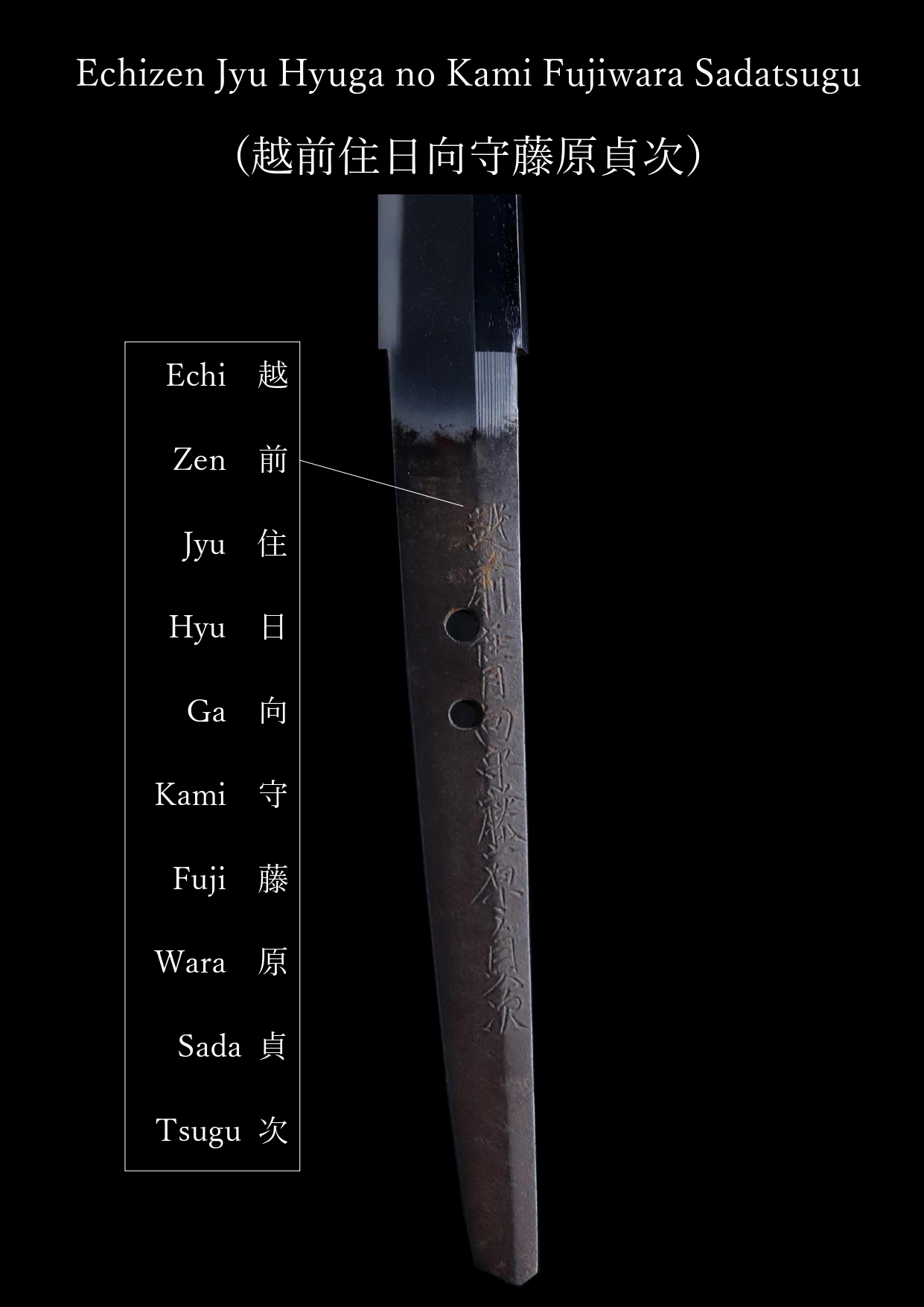
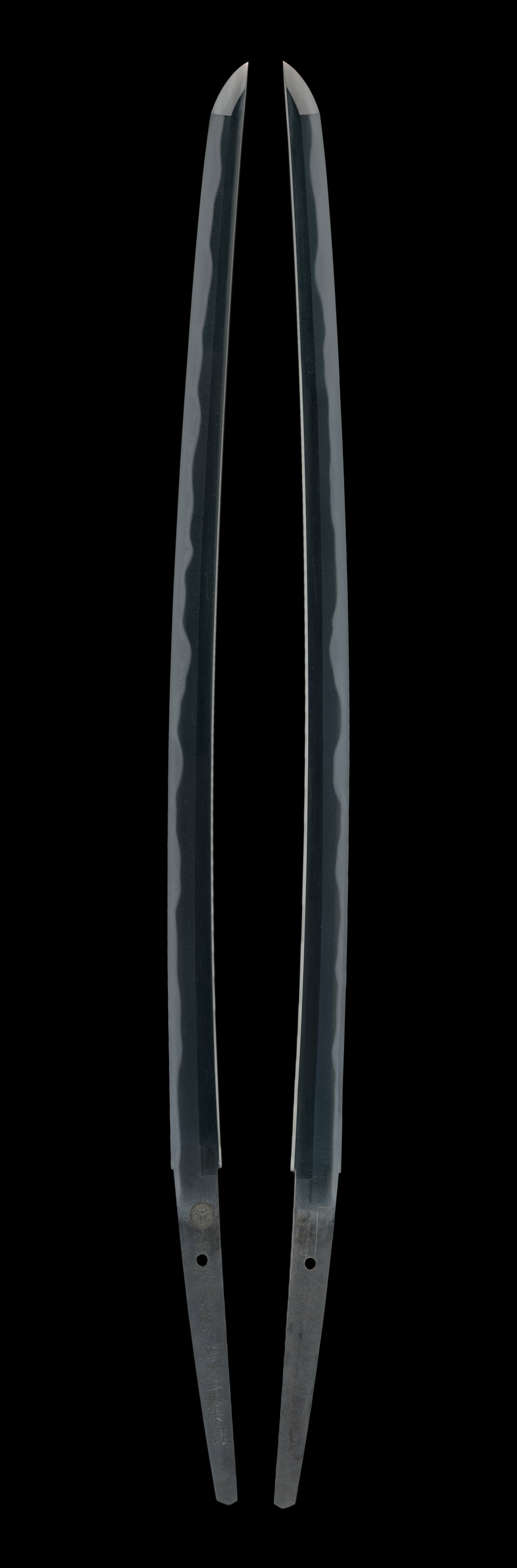
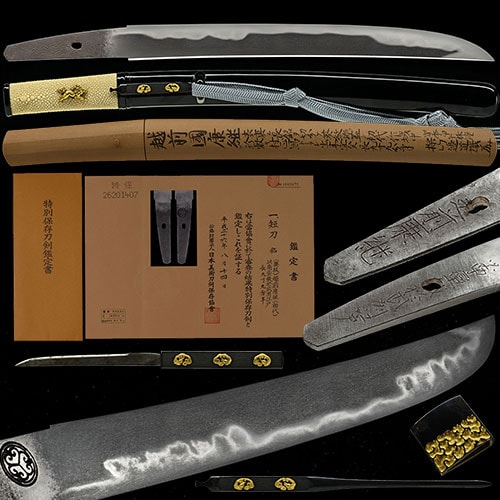
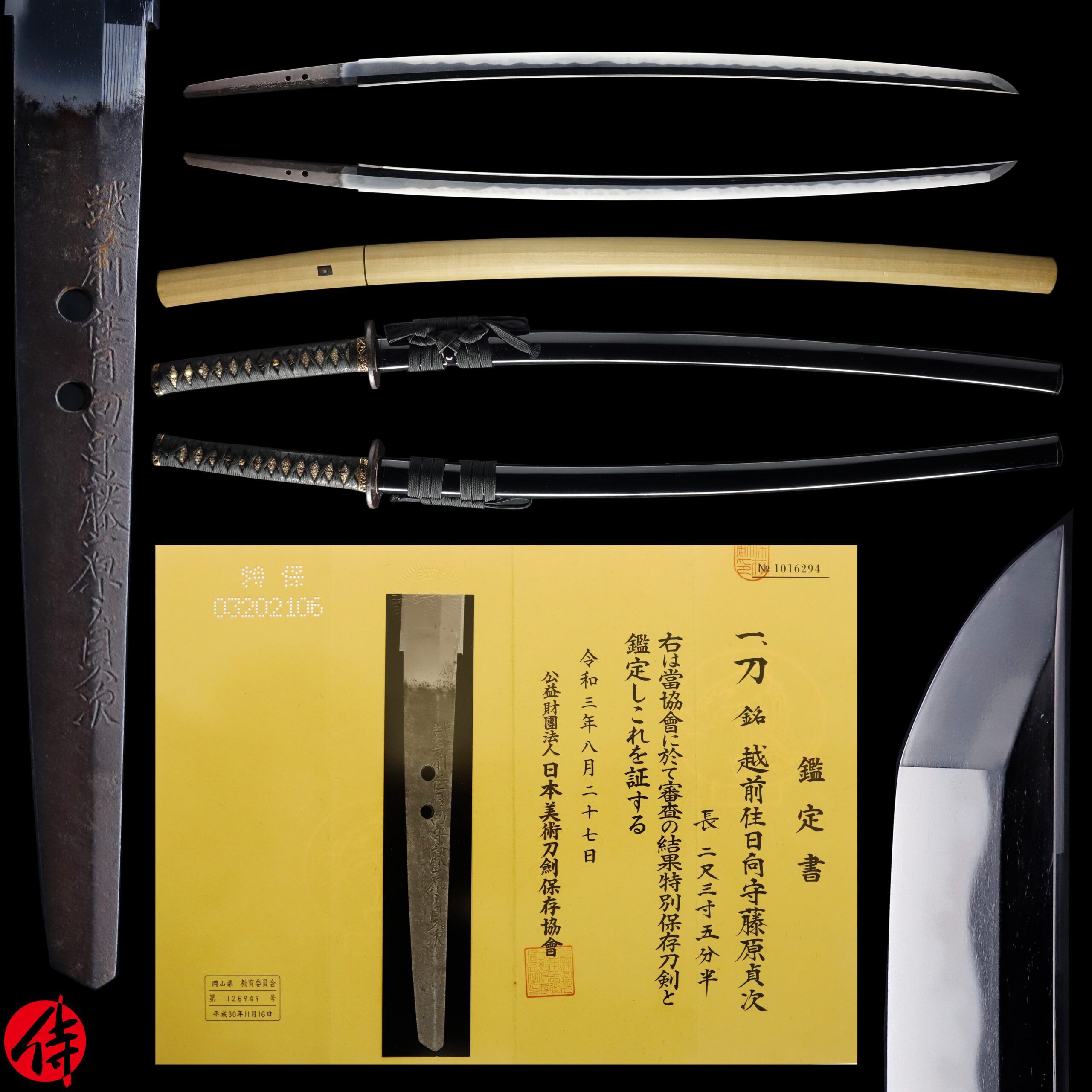
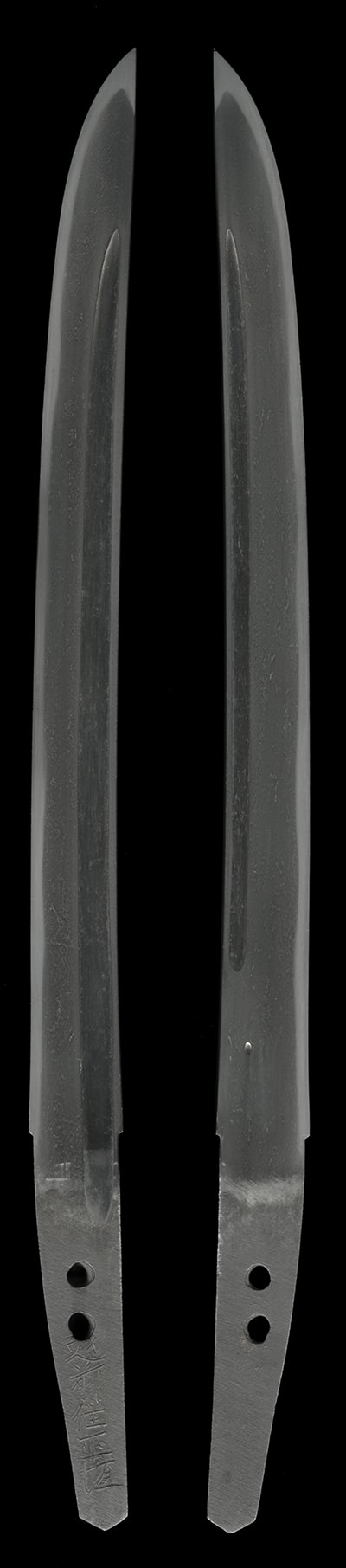
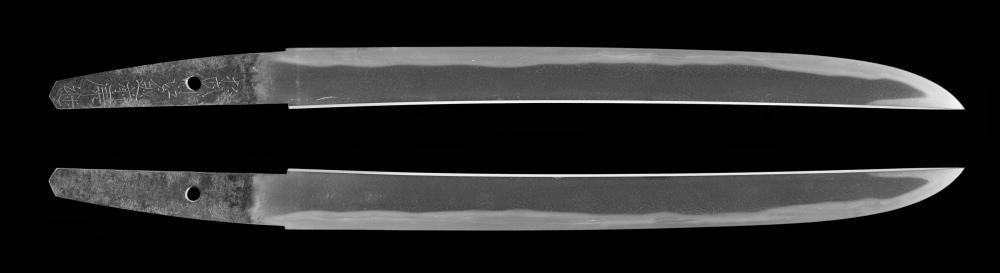
This antique katana is signed by Echizen Jyu Hyuga no Kami Fujiwara Sadatsugu, active during the early Edo period (1624-1645). He was an apprentice of the first-gen Yasutsugu of the Echizen Shimosaka school. The blade comes with an NBTHK Tokubetsu Hozon Certificate and includes a full koshirae mounting with detailed fittings.

NihontoWatch MonNihontoWatch
MarketEncyclopediaKantei
Swords›Shimosaka›Sadatsugu›Antique Japanese Sword Katana Signed by Fujiwara Sadatsugu NBTHK Tokubetsu Hozon Certificate
katanaTokubetsu Hozon
Shimosaka Sadatsugu

Antique Japanese Sword Katana Signed by Fujiwara Sadatsugu NBTHK Tokubetsu Hozon Certificate

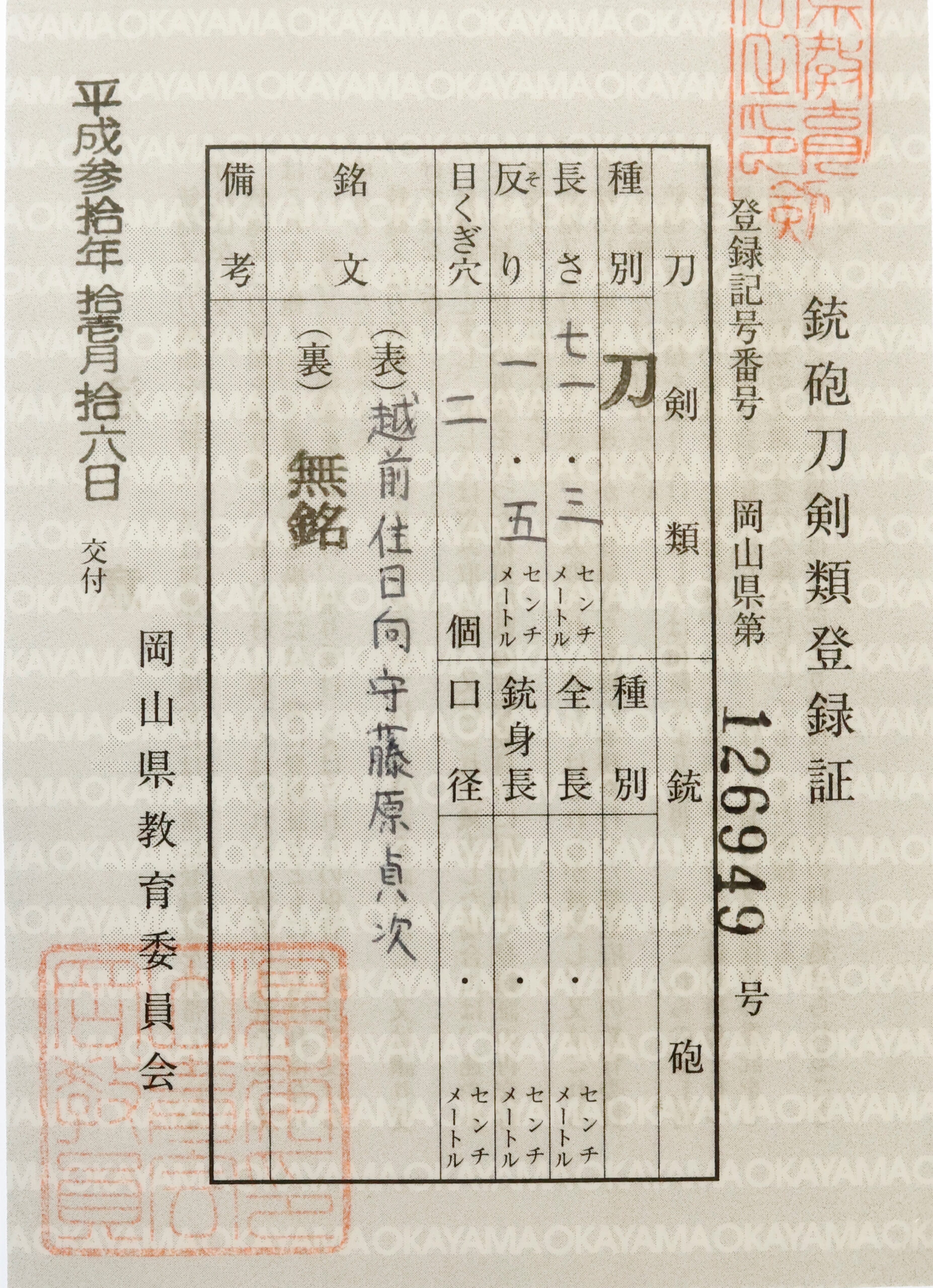
mei · Shimosaka · Kanei (1624-1644) · nagasa 71.3cm · sori 1.5cm

SOLD
Shimosaka Sadatsugu (貞次) · Shimosaka · Kanei (1624-1644)2 works for sale →
Katana
Could you name the smith from the blade alone? Today’s kantei →
Shimosaka Sadatsugu — 1 of 25
Shimosaka Sadatsugu — 2 of 25
Shimosaka Sadatsugu — 3 of 25
Shimosaka Sadatsugu — 4 of 25
Shimosaka Sadatsugu — 5 of 25
Shimosaka Sadatsugu — 6 of 25
Shimosaka Sadatsugu — 7 of 25
Shimosaka Sadatsugu — 8 of 25
Shimosaka Sadatsugu — 9 of 25
Shimosaka Sadatsugu — 10 of 25
Shimosaka Sadatsugu — 11 of 25
Shimosaka Sadatsugu — 12 of 25
Shimosaka Sadatsugu — 13 of 25
Shimosaka Sadatsugu — 14 of 25
Shimosaka Sadatsugu — 15 of 25
Shimosaka Sadatsugu — 16 of 25
Shimosaka Sadatsugu — 17 of 25
Shimosaka Sadatsugu — 18 of 25
Shimosaka Sadatsugu — 19 of 25
Shimosaka Sadatsugu — 20 of 25
Shimosaka Sadatsugu — 21 of 25
Shimosaka Sadatsugu — 22 of 25
Shimosaka Sadatsugu — 23 of 25
Shimosaka Sadatsugu — 24 of 25
Shimosaka Sadatsugu — 25 of 25
1 / 25
1 / 25
Shimosaka Sadatsugu — 1 of 25Shimosaka Sadatsugu — 2 of 25Shimosaka Sadatsugu — 3 of 25Shimosaka Sadatsugu — 4 of 25Shimosaka Sadatsugu — 5 of 25Shimosaka Sadatsugu — 6 of 25Shimosaka Sadatsugu — 7 of 25Shimosaka Sadatsugu — 8 of 25Shimosaka Sadatsugu — 9 of 25Shimosaka Sadatsugu — 10 of 25Shimosaka Sadatsugu — 11 of 25Shimosaka Sadatsugu — 12 of 25Shimosaka Sadatsugu — 13 of 25Shimosaka Sadatsugu — 14 of 25Shimosaka Sadatsugu — 15 of 25Shimosaka Sadatsugu — 16 of 25Shimosaka Sadatsugu — 17 of 25Shimosaka Sadatsugu — 18 of 25Shimosaka Sadatsugu — 19 of 25Shimosaka Sadatsugu — 20 of 25Shimosaka Sadatsugu — 21 of 25Shimosaka Sadatsugu — 22 of 25Shimosaka Sadatsugu — 23 of 25Shimosaka Sadatsugu — 24 of 25Shimosaka Sadatsugu — 25 of 25
Shimosaka Sadatsugu (貞次) · Shimosaka · Kanei (1624-1644)2 works for sale →
Katana
Could you name the smith from the blade alone? Today’s kantei →
Measurements & details
Smith
Shimosaka Sadatsugu
Type
Katana
School
Shimosaka
Period
Around 1624–1644(Kanei)
Province
Echizen
Signature
Signed(100% of this smith's designated works are signed)
Measurements
Nagasa 71.3cmSori 1.5cm
Description

This antique katana is signed by Echizen Jyu Hyuga no Kami Fujiwara Sadatsugu, active during the early Edo period (1624-1645). He was an apprentice of the first-gen Yasutsugu of the Echizen Shimosaka school. The blade comes with an NBTHK Tokubetsu Hozon Certificate and includes a full koshirae mounting with detailed fittings.

About the maker

Sadatsugu

貞次

Echizen Shimosaka school (Echizen, early Shinto, the Yasutsugu milieu) · Echizen · around 1624-1644

Fujishiro Jo saku · Tōken Taikan top 49%

2 pieces on the market now

›

On the tang of a broad katana now in the thirty-seventh Jūyō session, below the mekugi-ana toward the mune, runs a long signature reading Echizen no Kuni Shimosaka Sadatsugu, and on the reverse a tachi-aoi crest is cut above the added inscription Jūdō oyobi tabitabi massai ken kore nari, the cutting-test boast that this sword has severed stacked bodies and is a blade for the latter age. That combination of marks fixes the smith. Sadatsugu is the first-generation Echizen Shimosaka Hyūga no Kami Sadatsugu, an early Shintō maker of the Yasutsugu milieu in Echizen Province. No dated work by him has yet been seen, and the published sources place him at no later than the Keichō era on the evidence of his workmanship and the manner of his signature alone. They read him as one of the most influential close associates of the first-generation Yasutsugu, the head of the Echizen Shimosaka group, calling him 'one of Yasutsugu's most influential near attendants'[[c:1]]: his Shimosaka signature closely echoes Yasutsugu's own, his blades carry the same massai-ken inscription, and like Yasutsugu he was a favored smith of Honda Hida no Kami Narishige, the senior hereditary retainer of the Echizen house whose tachi-aoi crest[[c:2]] appears cut on the tang.

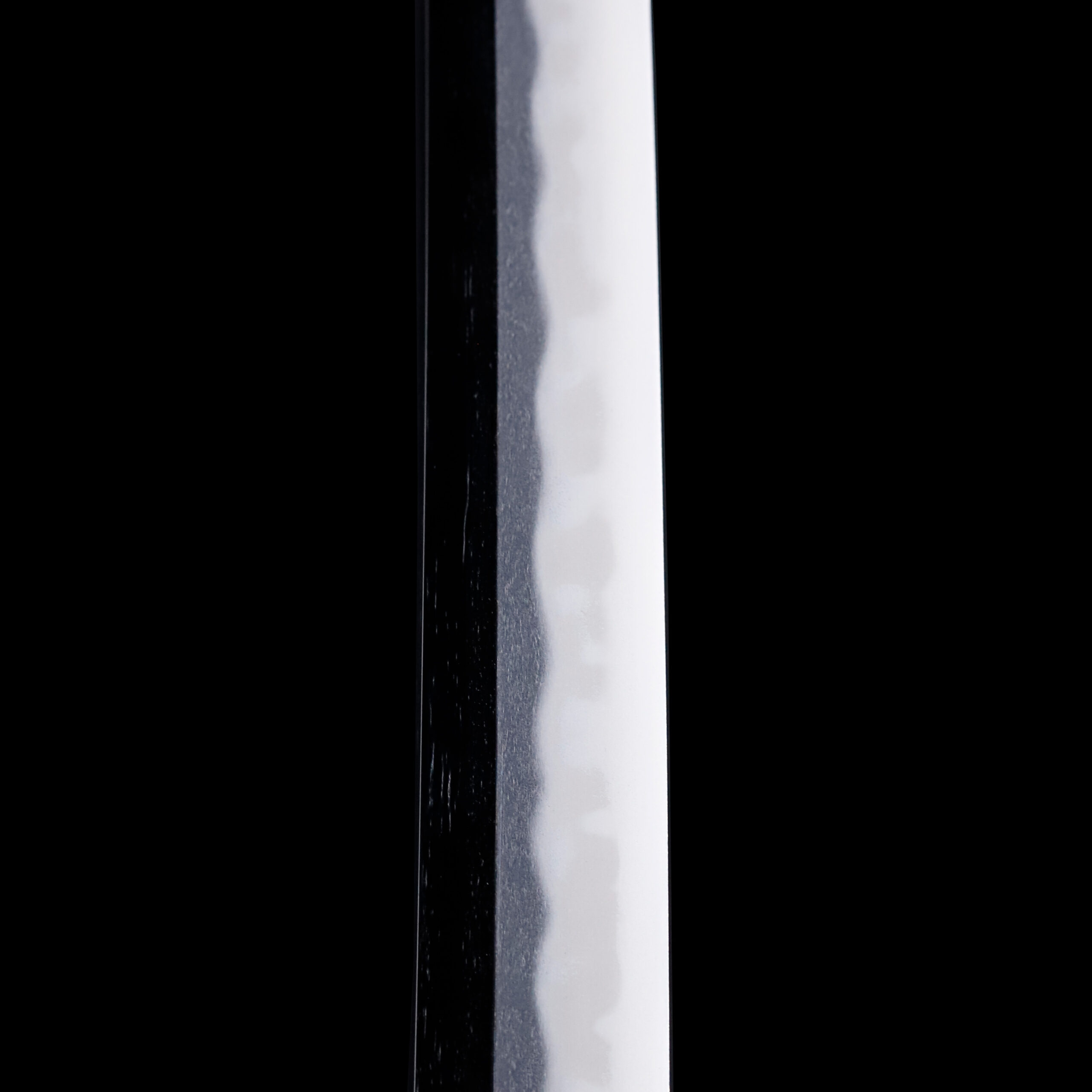
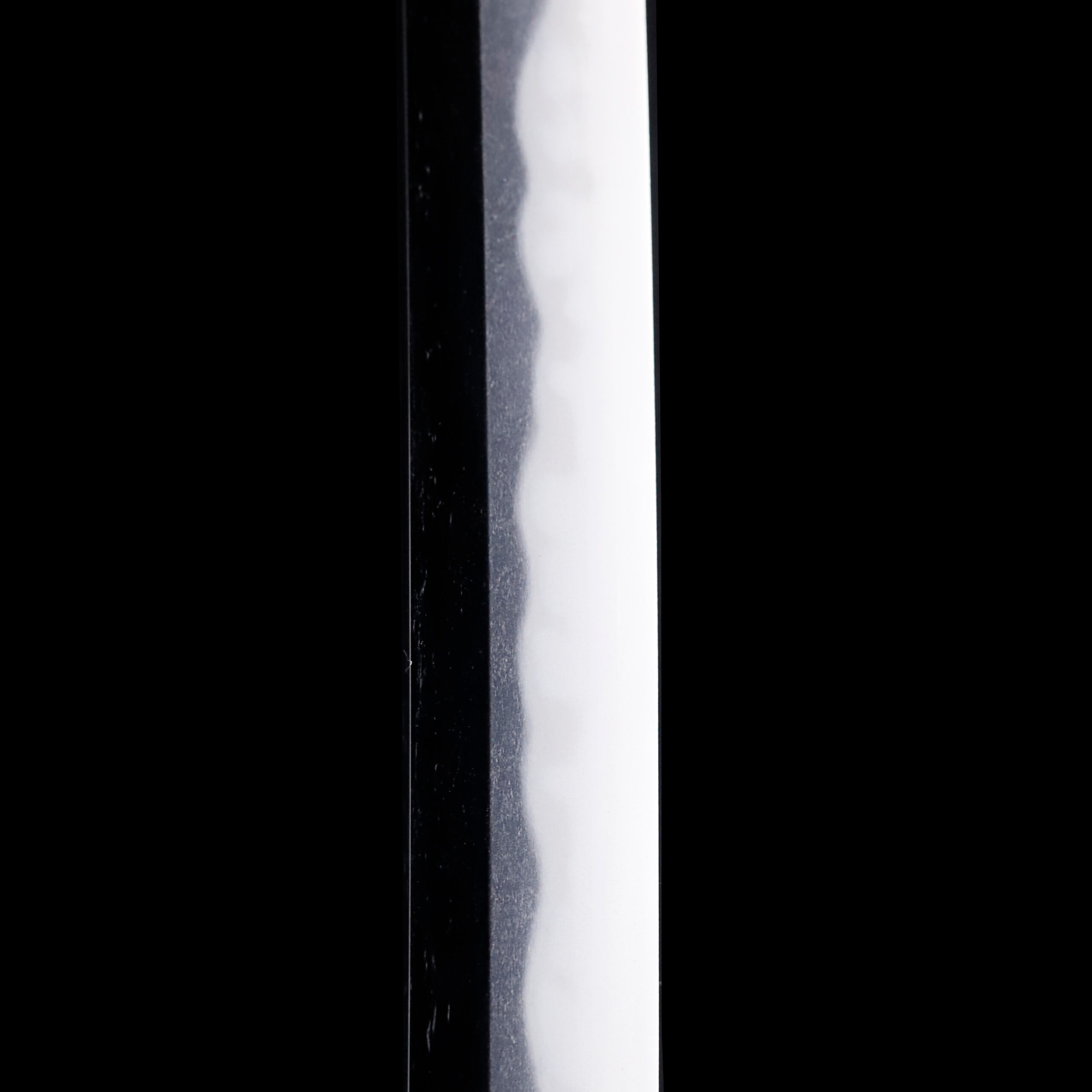
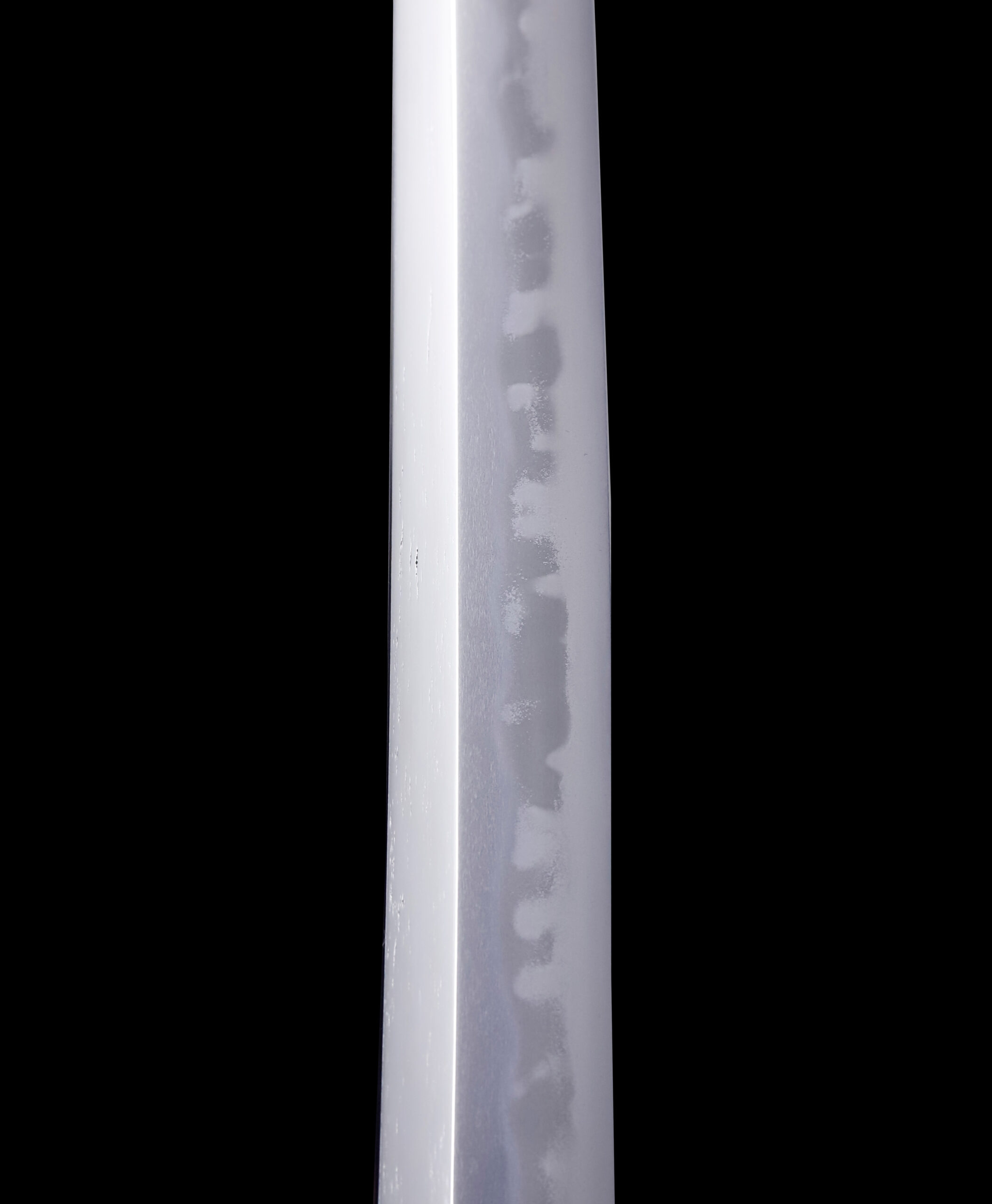
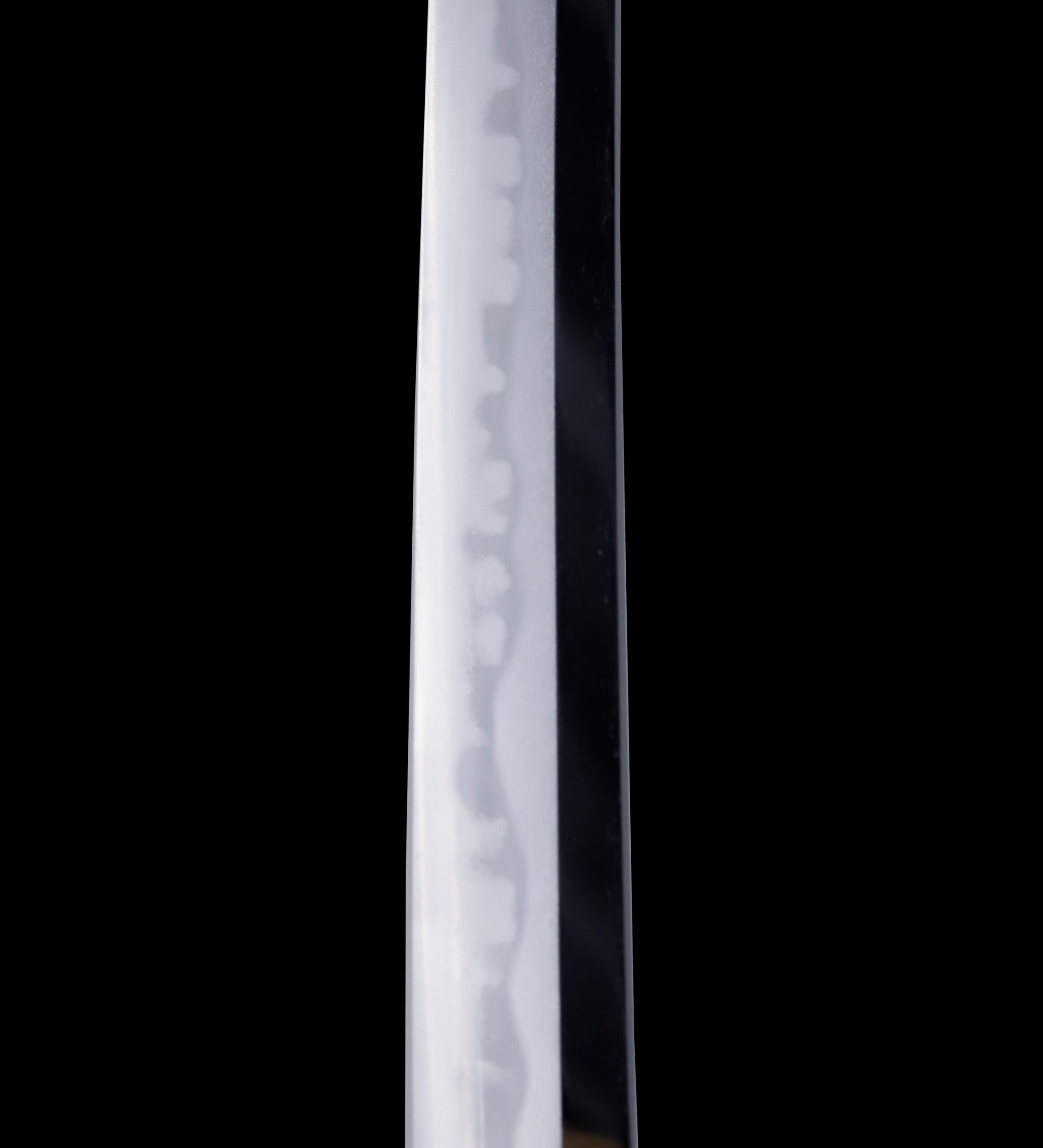
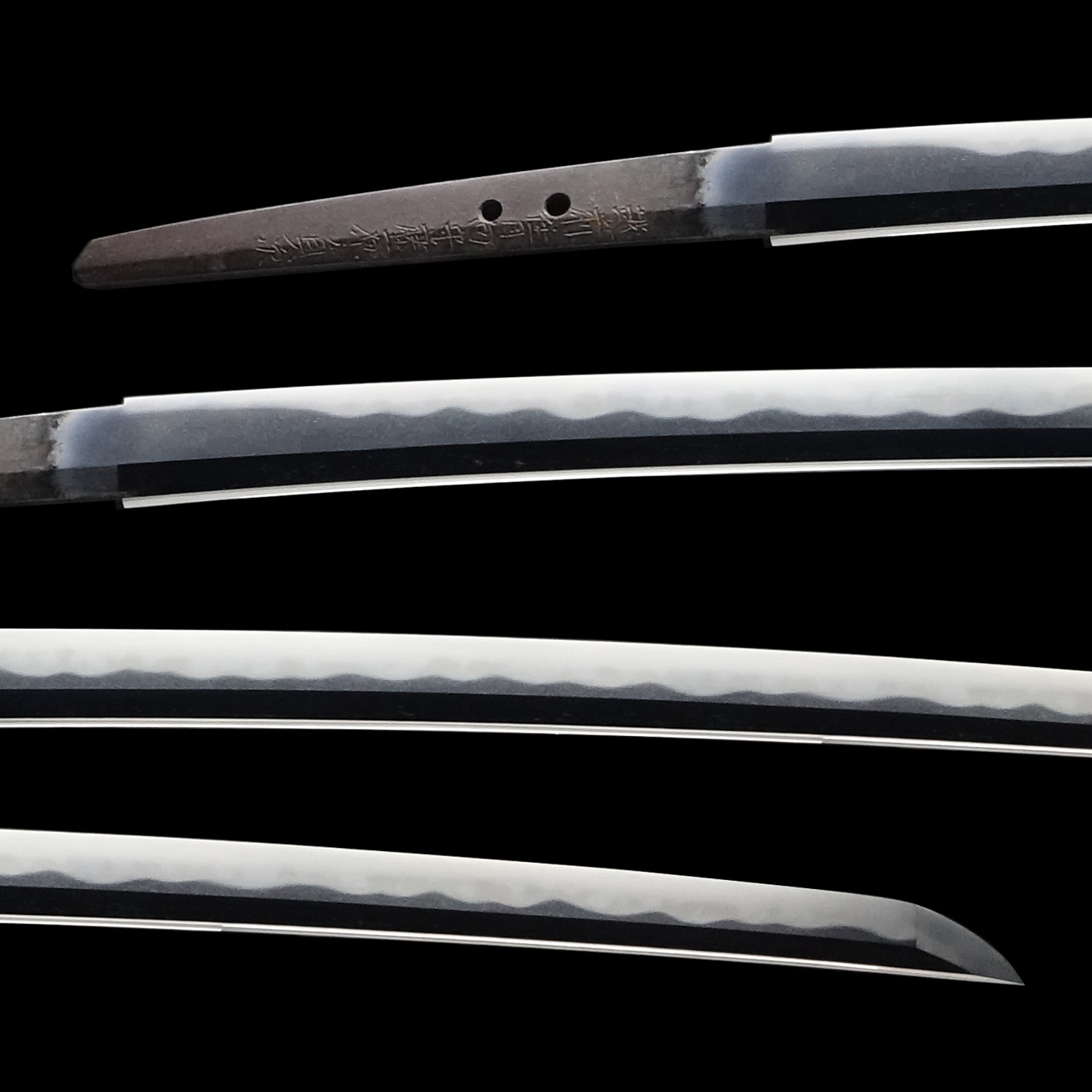
What the published sources return to, blade after blade, is the prominence of his chōji. They state that among the numerous smiths of the Echizen-Seki group his point of especial interest is precisely this, 「丁子が目立っているところにその見どころが窺える」, and on another katana, set directly against his model, that 「丁字が目立つ刃文に貞次の個性がうかがわれる」, that it is in a hamon where the chōji stands out more conspicuously than Yasutsugu's that Sadatsugu's individuality is perceived. His temper is a chōji-midare taken as the principal theme, mixed with gunome, gunome-chōji and pointed togariba, and in places a slightly shima-ba-like detachment. Long ashi enter vigorously, sometimes thick, with yō intermingled, the nioi deep, the nie adhering well and clustering into uneven passages, and through the steps of the midare run fine kinsuji and sunagashi. Tobiyaki appears across the ha, the crescent-moon-shaped variety that the published sources note is also met with in Yasutsugu's work, and around the monouchi muneyaki shows along the back. The nioiguchi tends toward shizumi, subdued and at points roughened, a quiet band beneath a busy temper.

His jigane is an itame mixed with mokume that stands and opens, tending to flow into nagare, the hada conspicuous overall rather than tight. Over it ji-nie adheres and fine chikei enter, and the steel carries a blackish cast that the published sources call kitaguni-mono-like, 「北国物らしい肌合を示し」, the dark provincial jigane of the Hokuriku country. It is this somber, active ji, descended through the many Echizen-Seki smiths from the Seki tradition, against which the chōji and the kinsuji of the ha are thrown into relief. The bōshi answers the temper below it: a midare-komi that turns in with a sharp or rounded point, the kaeri deep and long, brushing into hakikake, and on one blade crossing the yokote in gunome before it returns. Where the omote runs straight to a ko-maru the ura is read as showing a sanpin-like, Mishina-tinged flavor, the inheritance of the Echizen-Seki line surfacing in the point.

Within so small a designated body the published sources still draw a quieter register. On the earliest of his Jūyō katana the upper half of the omote becomes a suguha-toned temper mixed with gunome, with tobiyaki appearing, while the rest opens into chōji-midare with ashi and sunagashi, the temper at its calmest coming close to the restrained Yasutsugu manner before the chōji reasserts itself. The carving is the other constant. His blades carry kinai-bori of ume and take in the Echizen Shimosaka manner, and on the latest piece the published sources describe a composition that takes as its reference the ume-and-bamboo carving of a famed hira-wakizashi attributed to Sadamune and expands it across the whole blade of a stoutly built sword, with the tempering fired into a brilliant, animated midare so as not to be overwhelmed by it, the whole 「一際賑やかな作品に仕上がっている」, finished into an especially lively and bustling work. That no two of his five designated blades carry a date keeps his chronology a matter read from the steel rather than written on the tang.

He is placed by the line itself rather than by an independent reputation. The published sources name his hamon as descended from the Seki tradition and his steel and uneven nie, with the ura bōshi showing a sanpin-like flavor and the darkish kane, as well expressing the characteristics of this group, the Mishina-tinged manner of the Echizen-Seki smiths. Against that shared jigane his own tell is the chōji, the feature they repeatedly contrast with Yasutsugu's quieter temper, and the kinai-bori, the massai-ken inscription and the Narishige crest, the documentary marks that bind him to Yasutsugu's circle. His individuality, as the published commentary frames it, is not a departure from the Echizen Shimosaka idiom but the brightest and most chōji-laden expression of it, a smith who worked at Yasutsugu's side and tempered a more animated midare than his master.

Sadatsugu is rated Jō-saku in the Fujishiro ranking, the mark of a sound master rather than a great name. Five of his blades hold the rank of Jūyō-Tōken, with no National Treasure or Important Cultural Property among them and nothing in the higher Tokubetsu Jūyō tier, so his record is that of a respected provincial Shintō smith of the Yasutsugu group. Provenance beyond the Honda Narishige patronage read from the crest is thin in the designated record, with no daimyō house or museum named among his blades, so the honest account is of a body held quietly in private hands. For a collector his work is among the rarer encounters of the Echizen Shintō makers. Only five katana stand on the official record, every one of them signed, which fixes the name with a certainty that mumei attributions cannot, and a signed Shimosaka Sadatsugu of this quality comes to light only from time to time and with patience, a landmark of the Yasutsugu circle when one does.

Historical importance

Where Sadatsugu stands among comparable artisans: across all of nihontō, and within tradition, era, and period. The tiers (Foremost · Leading · Major · Notable) weigh official designations from the NBTHK and Japan's Agency for Cultural Affairs, together with historical honors of lasting repute such as the Sansaku and Meibutsu-chō.

随一
Foremost
屈指
Leading
有数
Major
著名
Notable

Select a lens to see how it's measured.

Designation record
5 designated works
Jūyō
5
2 works by Sadatsugu on the market→
Sadatsugu — full profileEchizen Shimosaka school (Echizen, early Shinto, the Yasutsugu milieu) school

Study this maker →

About the school

Shimosaka

下坂

Shinto · Echizen

54 pieces on the market now

›

The Shimosaka name began not as a single hand but as a trademark shared by a band of Echizen smiths at the dawn of the shinto era, and the designated record gathers their work under that one signature rather than parsing it into individuals. The published sources read the early inscriptions, the generic Echizen no Kuni Shimosaka and the titled Higo Daijo Fujiwara Shimosaka, as the product of a group, of which the first-generation Yasutsugu served as the representative. Born in Shimosaka village of Sakata district in Omi, Yasutsugu moved to Echizen under the patronage of Yuki Hideyasu, signing in his early years Higo no Daijo Shimosaka before his Keicho 10 to 11 summons to Edo, where he forged before Ieyasu and Hidetada and received the character Yasu and the right to cut the Tokugawa hollyhock crest on his nakago. The titled signature was carried by several Echizen hands at once, and the texts list Yasutsugu, Sadakuni and Kanenori among the smiths whose chisel movement and brush intent are too alike to part on present evidence. From this band the Echizen Yasutsugu line descended, dividing after the second generation into the Edo and Echizen Shimosaka houses, and around it formed the deep relief carving the province made its own. The school is recognized first in its steel. The forging is itame mixed with mokume that stands and opens, often flowing into nagare, carrying thick ji-nie and fine chikei, the kane taking on the blackish cast the sources name outright as Echizen-gane; the same dark, standing jihada recurs from Yasutsugu through his son, through Sadatsugu, Shigetaka and the unnamed Shimosaka hands, and the commentary returns to it as the group's signature. Over it the hamon favors a suguha to chu-suguha or shallow notare into which linked gunome and ko-gunome mix, ko-ashi and yo entering, the nie thick and gathering unevenly into rough patches, kinsuji and sunagashi streaming through, the nioiguchi tending to a sinking shizumi.

The boshi is the steadiest tell, running to a ko-maru swept in hakikake and turning back long, with a Sanpin-flavored reminiscence of the Mishina and Echizen-Seki inheritance. Yet the house is not uniform: Sadakuni works an austere suguha over an unusually refined ji with little of the blackish mokume, Sadatsugu fires the brightest, most choji-laden midare of the circle, and the third generation cleans the forging and brightens the nioiguchi toward his Edo contemporaries. Binding the registers is the carving, the deep Echizen-bori and Kinai-bori of kurikara, Fudo Myoo, bonji and gomabashi set in relief within the hi, which Sadakuni may have first supplied to Yasutsugu's blades. For the collector the school rewards reading by register rather than by a single famous holding. Yasutsugu is its summit, rated Jo-jo saku, retained smith to the shogunal house, whose Sadamune and Toshiro copies (the Namazuo, the lost Oyako, the Shishi) show his own Echizen hand under the model, and whose best katana carry the possession inscriptions of his patron Honda Hida no Kami Narishige and provenance in the Echizen and Kishu Tokugawa houses. The second generation follows so faithfully that his finest blades part from the father chiefly by the form of the character tsugu; the Edo third generation continues the suguha and ko-notare manners with a straight yakidashi and a Hojoji affinity. Around them the specialists define the edges of the idiom: Sadakuni and his quiet suguha with a pair of tanto in the Imperial Collection, Sadatsugu with his Narishige-crested cutting-test blades, and Shigetaka, the most skilled of Yasutsugu's pupils, whose chestnut-tailed kurijiri nakago and Kinai carving (the Honebami and Hossho copies among his masterworks) name him at a glance and whose finest work approaches the master. A signed Shimosaka blade, whether a titled Yasutsugu beneath the aoi-mon, a named piece by one of the band, or a Higo Daijo pre-Yasutsugu register, comes to market only from time to time, valued as the wellspring from which the Echizen Yasutsugu line and its carving tradition arose. Learn more →

16 recorded smiths151 designated works
Leading smiths
SmithEraDesignated
Yasutsugu康繼1596-161573
Yasutsugu康繼1624-164427
Yasutsugu康繼1661-16738
Sadakuni貞國1596-161511
Shigetaka重高1596-16156
Explore the Shimosaka school →

Historical context

The Edo period (1615 to 1868)

›

Under the Tokugawa peace the daishō became a regulated uniform, and demand gathered in the castle towns, above all Edo itself. The craft split two ways: brilliant display work for connoisseurs, and tested blades whose cutting results were sometimes inlaid in gold.

The Edo period (1615 to 1868) →

NBTHK Certificate
Tokubetsu Hozon Tōken特別保存刀剣
Sword Especially Worthy of Preservation
›

A Hozon-certified blade judged to show notably superior workmanship and a better state of preservation. The bar is higher: re-tempered blades and most unsigned Muromachi/Edo works are excluded.

About the NBTHK›

The NBTHK (Nihon Bijutsu Tōken Hozon Kyōkai, the Society for the Preservation of Japanese Art Swords) is a public-interest incorporated foundation founded in 1948 and supervised by Japan’s Agency for Cultural Affairs (Bunkachō); it is based at the Japanese Sword Museum in Tokyo. Its expert panels physically examine each submitted work (shinsa) and issue a certificate (kanteishō) ranking it by artistic and historical merit. NBTHK papers are the most widely recognized standard of authentication for Japanese swords and fittings.

NBTHK official site→
Seller
S
Samurai Museum
🇯🇵Ships from Japan
›
✓Verified dealersamuraimuseum.jp
✓Ships worldwide✓English supportPayPalCredit card
Return policy

Returns/exchanges limited to defects caused by shipping (except willful misconduct or gross negligence by the company); customers must contact within 72 hours of receiving the product.

View all of Samurai Museum’s listings→View this item on the dealer’s site→

More works by Shimosaka Sadatsugu

View all →
Yazawa Shokai
Tokuho
Wakizashi - Tokuho - by Shimosaka Sadatsugu - 1st Gen. SadatsuguWakizashi - Tokuho - by Shimosaka Sadatsugu - 1st Gen. Sadatsugu

Wakizashi

ByShimosaka Sadatsugu
Ask
World Seiyudo
Jūyō
Katana - Jūyō - by Shimosaka Sadatsugu - Echizen-Koku Shimosaka Sadatsugu with Body Cutting Test Inscription - NBTHK Juyo TokenKatana - Jūyō - by Shimosaka Sadatsugu - Echizen-Koku Shimosaka Sadatsugu with Body Cutting Test Inscription - NBTHK Juyo Token

Katana

ByShimosaka Sadatsugu
¥7,500,000

Previously sold by Shimosaka Sadatsugu

View all →
Choshuya
Wakizashi - by Shimosaka Sadatsugu - Echizen ju Hinata Daijo Fujiwara SadatsuguWakizashi - by Shimosaka Sadatsugu - Echizen ju Hinata Daijo Fujiwara Sadatsugu
Sold

Wakizashi

ByShimosaka Sadatsugu
SOLD
Kusanagi
Tokuho
Katana - Tokuho - by Shimosaka Sadatsugu - Tokubetsu Hozon Token: A grand, special-order katana signed "Sadatsugu," student of the first generation Echizen Yasutsugu, with luxurious koshirae.Katana - Tokuho - by Shimosaka Sadatsugu - Tokubetsu Hozon Token: A grand, special-order katana signed "Sadatsugu," student of the first generation Echizen Yasutsugu, with luxurious koshirae.
Sold

Katana

ByShimosaka Sadatsugu
SOLD
Ikeda Art
Katana - by Shimosaka Sadatsugu - Echizen Hyuga no Kami Fujiwara Sadatsugu - Polished, Guaranteed Sharpness, For Appreciation, Iaido, and Test Cutting!!!Katana - by Shimosaka Sadatsugu - Echizen Hyuga no Kami Fujiwara Sadatsugu - Polished, Guaranteed Sharpness, For Appreciation, Iaido, and Test Cutting!!!
Sold

Katana

ByShimosaka Sadatsugu
SOLD
Nihonto Antiques
Tanto - by Shimosaka Sadatsugu - Echizen SadatsuguTanto - by Shimosaka Sadatsugu - Echizen Sadatsugu
Sold

Tantō

ByShimosaka Sadatsugu
SOLD
Nihonto Art
Tokuho
Wakizashi - Tokuho - by Shimosaka Sadatsugu - Rare Gold Inlay Test Cut Wakizashi by SadatsuguWakizashi - Tokuho - by Shimosaka Sadatsugu - Rare Gold Inlay Test Cut Wakizashi by Sadatsugu
Sold

Wakizashi

ByShimosaka Sadatsugu
SOLD
World Seiyudo
Katana - by Shimosaka Sadatsugu - Echizen Shimosaka Sadatsugu - NBTHK Juyo TokenKatana - by Shimosaka Sadatsugu - Echizen Shimosaka Sadatsugu - NBTHK Juyo Token
Sold

Katana

ByShimosaka Sadatsugu
SOLD

More from the Shimosaka school

View all →
Toukentakarado
Jūyō
Katana - Jūyō - by Shimosaka Yasutsugu - (Aoi mon) Echizen Yasutsugu, resident of Bushū EdoKatana - Jūyō - by Shimosaka Yasutsugu - (Aoi mon) Echizen Yasutsugu, resident of Bushū Edo

Katana

ByShimosaka Yasutsugu
¥8,000,000
Eirakudo
Tokuho
Tanto - Tokuho - by Shimosaka Yasutsugu - 1st Generation YasutsuguTanto - Tokuho - by Shimosaka Yasutsugu - 1st Generation Yasutsugu

Tantō

ByShimosaka Yasutsugu
¥5,000,000
Token-Net
Jūyō
Katana - Jūyō - by Shimosaka Yasutsugu - Oite Busyu Edo Echizen Yasutsugu motte Nanban-tetsu (1st Gen.)Katana - Jūyō - by Shimosaka Yasutsugu - Oite Busyu Edo Echizen Yasutsugu motte Nanban-tetsu (1st Gen.)

Katana

ByShimosaka Yasutsugu
¥9,800,000
Giheiya
Hozon
Tanto - Hozon - by Shimosaka School - Hozon Token Koto Echizen ju Masatsune (Shimosaka Signature Re-chiseled to Masatsune) with ShirosayaTanto - Hozon - by Shimosaka School - Hozon Token Koto Echizen ju Masatsune (Shimosaka Signature Re-chiseled to Masatsune) with Shirosaya

Tantō

ByShimosaka School
¥180,000
Shoubudou
Tokuho
Wakizashi - Tokuho - by Shimosaka Yasutsugu - 1st Generation Echizen Yasutsugu (Oie Bushu Edo)Wakizashi - Tokuho - by Shimosaka Yasutsugu - 1st Generation Echizen Yasutsugu (Oie Bushu Edo)

Wakizashi

ByShimosaka Yasutsugu
¥2,500,000
Nihonto Australia
Tokuho
Katana - Tokuho - by Shimosaka Yasutsugu - First Generation Echizen Yasutsugu Katana, Utsushi of Ataki Sadamune, with NBTHK CertificateKatana - Tokuho - by Shimosaka Yasutsugu - First Generation Echizen Yasutsugu Katana, Utsushi of Ataki Sadamune, with NBTHK Certificate

Katana

ByShimosaka Yasutsugu
Ask
Touken Hataya
Tokuho
Wakizashi - Tokuho - by Shimosaka Yasutsugu - Tokubetsu Hozon Wakizashi by Yasutsugu of Echizen with Aoi MonWakizashi - Tokuho - by Shimosaka Yasutsugu - Tokubetsu Hozon Wakizashi by Yasutsugu of Echizen with Aoi Mon

Wakizashi

ByShimosaka Yasutsugu
¥400,000
Aoi Art
Tokuho
Katana - Tokuho - by Shimosaka Yasutsugu - Echizen Yasutsugu (2nd generation)Katana - Tokuho - by Shimosaka Yasutsugu - Echizen Yasutsugu (2nd generation)

Katana

ByShimosaka Yasutsugu
¥1,650,000

Swords

  • Katana
  • Wakizashi
  • Tantō
  • Tachi
  • Naginata
  • Yari
  • Japanese Swords
  • Samurai Swords

Fittings

  • Tsuba
  • Fuchi-Kashira
  • Kozuka
  • Menuki
  • Sword Guards (Tsuba)

Armor

  • Kabuto
  • Samurai Armor
  • All Samurai Armor

By Certification

  • Tokujū
  • Jūyō
  • Tokuho
  • Hozon

Resources

  • Dealer Directory
  • Artist Directory
  • The Daily Kantei
  • Glossary
  • Browse All
Nihontowatch© 2026
TermsPrivacyCookiesAbout
Sold

Description

This antique katana is signed by Echizen Jyu Hyuga no Kami Fujiwara Sadatsugu, active during the early Edo period (1624-1645). He was an apprentice of the first-gen Yasutsugu of the Echizen Shimosaka school. The blade comes with an NBTHK Tokubetsu Hozon Certificate and includes a full koshirae mounting with detailed fittings.

NihontoWatch MonNihontoWatch
MarketEncyclopediaKantei
Swords›Shimosaka›Sadatsugu›Antique Japanese Sword Katana Signed by Fujiwara Sadatsugu NBTHK Tokubetsu Hozon Certificate
katanaTokubetsu Hozon
Shimosaka Sadatsugu

Antique Japanese Sword Katana Signed by Fujiwara Sadatsugu NBTHK Tokubetsu Hozon Certificate

mei · Shimosaka · Kanei (1624-1644) · nagasa 71.3cm · sori 1.5cm

SOLD
Shimosaka Sadatsugu (貞次) · Shimosaka · Kanei (1624-1644)2 works for sale →
Katana
Could you name the smith from the blade alone? Today’s kantei →
Shimosaka Sadatsugu — 1 of 25
Shimosaka Sadatsugu — 2 of 25
Shimosaka Sadatsugu — 3 of 25
Shimosaka Sadatsugu — 4 of 25
Shimosaka Sadatsugu — 5 of 25
Shimosaka Sadatsugu — 6 of 25
Shimosaka Sadatsugu — 7 of 25
Shimosaka Sadatsugu — 8 of 25
Shimosaka Sadatsugu — 9 of 25
Shimosaka Sadatsugu — 10 of 25
Shimosaka Sadatsugu — 11 of 25
Shimosaka Sadatsugu — 12 of 25
Shimosaka Sadatsugu — 13 of 25
Shimosaka Sadatsugu — 14 of 25
Shimosaka Sadatsugu — 15 of 25
Shimosaka Sadatsugu — 16 of 25
Shimosaka Sadatsugu — 17 of 25
Shimosaka Sadatsugu — 18 of 25
Shimosaka Sadatsugu — 19 of 25
Shimosaka Sadatsugu — 20 of 25
Shimosaka Sadatsugu — 21 of 25
Shimosaka Sadatsugu — 22 of 25
Shimosaka Sadatsugu — 23 of 25
Shimosaka Sadatsugu — 24 of 25
Shimosaka Sadatsugu — 25 of 25
1 / 25
1 / 25
Shimosaka Sadatsugu — 1 of 25Shimosaka Sadatsugu — 2 of 25Shimosaka Sadatsugu — 3 of 25Shimosaka Sadatsugu — 4 of 25Shimosaka Sadatsugu — 5 of 25Shimosaka Sadatsugu — 6 of 25Shimosaka Sadatsugu — 7 of 25Shimosaka Sadatsugu — 8 of 25Shimosaka Sadatsugu — 9 of 25Shimosaka Sadatsugu — 10 of 25Shimosaka Sadatsugu — 11 of 25Shimosaka Sadatsugu — 12 of 25Shimosaka Sadatsugu — 13 of 25Shimosaka Sadatsugu — 14 of 25Shimosaka Sadatsugu — 15 of 25Shimosaka Sadatsugu — 16 of 25Shimosaka Sadatsugu — 17 of 25Shimosaka Sadatsugu — 18 of 25Shimosaka Sadatsugu — 19 of 25Shimosaka Sadatsugu — 20 of 25Shimosaka Sadatsugu — 21 of 25Shimosaka Sadatsugu — 22 of 25Shimosaka Sadatsugu — 23 of 25Shimosaka Sadatsugu — 24 of 25Shimosaka Sadatsugu — 25 of 25
Shimosaka Sadatsugu (貞次) · Shimosaka · Kanei (1624-1644)2 works for sale →
Katana
Could you name the smith from the blade alone? Today’s kantei →
Measurements & details
Smith
Shimosaka Sadatsugu
Type
Katana
School
Shimosaka
Period
Around 1624–1644(Kanei)
Province
Echizen
Signature
Signed(100% of this smith's designated works are signed)
Measurements
Nagasa 71.3cmSori 1.5cm
Description

This antique katana is signed by Echizen Jyu Hyuga no Kami Fujiwara Sadatsugu, active during the early Edo period (1624-1645). He was an apprentice of the first-gen Yasutsugu of the Echizen Shimosaka school. The blade comes with an NBTHK Tokubetsu Hozon Certificate and includes a full koshirae mounting with detailed fittings.

About the maker

Sadatsugu

貞次

Echizen Shimosaka school (Echizen, early Shinto, the Yasutsugu milieu) · Echizen · around 1624-1644

Fujishiro Jo saku · Tōken Taikan top 49%

2 pieces on the market now

›

On the tang of a broad katana now in the thirty-seventh Jūyō session, below the mekugi-ana toward the mune, runs a long signature reading Echizen no Kuni Shimosaka Sadatsugu, and on the reverse a tachi-aoi crest is cut above the added inscription Jūdō oyobi tabitabi massai ken kore nari, the cutting-test boast that this sword has severed stacked bodies and is a blade for the latter age. That combination of marks fixes the smith. Sadatsugu is the first-generation Echizen Shimosaka Hyūga no Kami Sadatsugu, an early Shintō maker of the Yasutsugu milieu in Echizen Province. No dated work by him has yet been seen, and the published sources place him at no later than the Keichō era on the evidence of his workmanship and the manner of his signature alone. They read him as one of the most influential close associates of the first-generation Yasutsugu, the head of the Echizen Shimosaka group, calling him 'one of Yasutsugu's most influential near attendants'[[c:1]]: his Shimosaka signature closely echoes Yasutsugu's own, his blades carry the same massai-ken inscription, and like Yasutsugu he was a favored smith of Honda Hida no Kami Narishige, the senior hereditary retainer of the Echizen house whose tachi-aoi crest[[c:2]] appears cut on the tang.

What the published sources return to, blade after blade, is the prominence of his chōji. They state that among the numerous smiths of the Echizen-Seki group his point of especial interest is precisely this, 「丁子が目立っているところにその見どころが窺える」, and on another katana, set directly against his model, that 「丁字が目立つ刃文に貞次の個性がうかがわれる」, that it is in a hamon where the chōji stands out more conspicuously than Yasutsugu's that Sadatsugu's individuality is perceived. His temper is a chōji-midare taken as the principal theme, mixed with gunome, gunome-chōji and pointed togariba, and in places a slightly shima-ba-like detachment. Long ashi enter vigorously, sometimes thick, with yō intermingled, the nioi deep, the nie adhering well and clustering into uneven passages, and through the steps of the midare run fine kinsuji and sunagashi. Tobiyaki appears across the ha, the crescent-moon-shaped variety that the published sources note is also met with in Yasutsugu's work, and around the monouchi muneyaki shows along the back. The nioiguchi tends toward shizumi, subdued and at points roughened, a quiet band beneath a busy temper.

His jigane is an itame mixed with mokume that stands and opens, tending to flow into nagare, the hada conspicuous overall rather than tight. Over it ji-nie adheres and fine chikei enter, and the steel carries a blackish cast that the published sources call kitaguni-mono-like, 「北国物らしい肌合を示し」, the dark provincial jigane of the Hokuriku country. It is this somber, active ji, descended through the many Echizen-Seki smiths from the Seki tradition, against which the chōji and the kinsuji of the ha are thrown into relief. The bōshi answers the temper below it: a midare-komi that turns in with a sharp or rounded point, the kaeri deep and long, brushing into hakikake, and on one blade crossing the yokote in gunome before it returns. Where the omote runs straight to a ko-maru the ura is read as showing a sanpin-like, Mishina-tinged flavor, the inheritance of the Echizen-Seki line surfacing in the point.

Within so small a designated body the published sources still draw a quieter register. On the earliest of his Jūyō katana the upper half of the omote becomes a suguha-toned temper mixed with gunome, with tobiyaki appearing, while the rest opens into chōji-midare with ashi and sunagashi, the temper at its calmest coming close to the restrained Yasutsugu manner before the chōji reasserts itself. The carving is the other constant. His blades carry kinai-bori of ume and take in the Echizen Shimosaka manner, and on the latest piece the published sources describe a composition that takes as its reference the ume-and-bamboo carving of a famed hira-wakizashi attributed to Sadamune and expands it across the whole blade of a stoutly built sword, with the tempering fired into a brilliant, animated midare so as not to be overwhelmed by it, the whole 「一際賑やかな作品に仕上がっている」, finished into an especially lively and bustling work. That no two of his five designated blades carry a date keeps his chronology a matter read from the steel rather than written on the tang.

He is placed by the line itself rather than by an independent reputation. The published sources name his hamon as descended from the Seki tradition and his steel and uneven nie, with the ura bōshi showing a sanpin-like flavor and the darkish kane, as well expressing the characteristics of this group, the Mishina-tinged manner of the Echizen-Seki smiths. Against that shared jigane his own tell is the chōji, the feature they repeatedly contrast with Yasutsugu's quieter temper, and the kinai-bori, the massai-ken inscription and the Narishige crest, the documentary marks that bind him to Yasutsugu's circle. His individuality, as the published commentary frames it, is not a departure from the Echizen Shimosaka idiom but the brightest and most chōji-laden expression of it, a smith who worked at Yasutsugu's side and tempered a more animated midare than his master.

Sadatsugu is rated Jō-saku in the Fujishiro ranking, the mark of a sound master rather than a great name. Five of his blades hold the rank of Jūyō-Tōken, with no National Treasure or Important Cultural Property among them and nothing in the higher Tokubetsu Jūyō tier, so his record is that of a respected provincial Shintō smith of the Yasutsugu group. Provenance beyond the Honda Narishige patronage read from the crest is thin in the designated record, with no daimyō house or museum named among his blades, so the honest account is of a body held quietly in private hands. For a collector his work is among the rarer encounters of the Echizen Shintō makers. Only five katana stand on the official record, every one of them signed, which fixes the name with a certainty that mumei attributions cannot, and a signed Shimosaka Sadatsugu of this quality comes to light only from time to time and with patience, a landmark of the Yasutsugu circle when one does.
Historical importance

Where Sadatsugu stands among comparable artisans: across all of nihontō, and within tradition, era, and period. The tiers (Foremost · Leading · Major · Notable) weigh official designations from the NBTHK and Japan's Agency for Cultural Affairs, together with historical honors of lasting repute such as the Sansaku and Meibutsu-chō.

随一
Foremost
屈指
Leading
有数
Major
著名
Notable

Select a lens to see how it's measured.

Designation record
5 designated works
Jūyō
5
2 works by Sadatsugu on the market→
Sadatsugu — full profileEchizen Shimosaka school (Echizen, early Shinto, the Yasutsugu milieu) school

Study this maker →

About the school

Shimosaka

下坂

Shinto · Echizen

54 pieces on the market now

›

The Shimosaka name began not as a single hand but as a trademark shared by a band of Echizen smiths at the dawn of the shinto era, and the designated record gathers their work under that one signature rather than parsing it into individuals. The published sources read the early inscriptions, the generic Echizen no Kuni Shimosaka and the titled Higo Daijo Fujiwara Shimosaka, as the product of a group, of which the first-generation Yasutsugu served as the representative. Born in Shimosaka village of Sakata district in Omi, Yasutsugu moved to Echizen under the patronage of Yuki Hideyasu, signing in his early years Higo no Daijo Shimosaka before his Keicho 10 to 11 summons to Edo, where he forged before Ieyasu and Hidetada and received the character Yasu and the right to cut the Tokugawa hollyhock crest on his nakago. The titled signature was carried by several Echizen hands at once, and the texts list Yasutsugu, Sadakuni and Kanenori among the smiths whose chisel movement and brush intent are too alike to part on present evidence. From this band the Echizen Yasutsugu line descended, dividing after the second generation into the Edo and Echizen Shimosaka houses, and around it formed the deep relief carving the province made its own. The school is recognized first in its steel. The forging is itame mixed with mokume that stands and opens, often flowing into nagare, carrying thick ji-nie and fine chikei, the kane taking on the blackish cast the sources name outright as Echizen-gane; the same dark, standing jihada recurs from Yasutsugu through his son, through Sadatsugu, Shigetaka and the unnamed Shimosaka hands, and the commentary returns to it as the group's signature. Over it the hamon favors a suguha to chu-suguha or shallow notare into which linked gunome and ko-gunome mix, ko-ashi and yo entering, the nie thick and gathering unevenly into rough patches, kinsuji and sunagashi streaming through, the nioiguchi tending to a sinking shizumi.

The boshi is the steadiest tell, running to a ko-maru swept in hakikake and turning back long, with a Sanpin-flavored reminiscence of the Mishina and Echizen-Seki inheritance. Yet the house is not uniform: Sadakuni works an austere suguha over an unusually refined ji with little of the blackish mokume, Sadatsugu fires the brightest, most choji-laden midare of the circle, and the third generation cleans the forging and brightens the nioiguchi toward his Edo contemporaries. Binding the registers is the carving, the deep Echizen-bori and Kinai-bori of kurikara, Fudo Myoo, bonji and gomabashi set in relief within the hi, which Sadakuni may have first supplied to Yasutsugu's blades. For the collector the school rewards reading by register rather than by a single famous holding. Yasutsugu is its summit, rated Jo-jo saku, retained smith to the shogunal house, whose Sadamune and Toshiro copies (the Namazuo, the lost Oyako, the Shishi) show his own Echizen hand under the model, and whose best katana carry the possession inscriptions of his patron Honda Hida no Kami Narishige and provenance in the Echizen and Kishu Tokugawa houses. The second generation follows so faithfully that his finest blades part from the father chiefly by the form of the character tsugu; the Edo third generation continues the suguha and ko-notare manners with a straight yakidashi and a Hojoji affinity. Around them the specialists define the edges of the idiom: Sadakuni and his quiet suguha with a pair of tanto in the Imperial Collection, Sadatsugu with his Narishige-crested cutting-test blades, and Shigetaka, the most skilled of Yasutsugu's pupils, whose chestnut-tailed kurijiri nakago and Kinai carving (the Honebami and Hossho copies among his masterworks) name him at a glance and whose finest work approaches the master. A signed Shimosaka blade, whether a titled Yasutsugu beneath the aoi-mon, a named piece by one of the band, or a Higo Daijo pre-Yasutsugu register, comes to market only from time to time, valued as the wellspring from which the Echizen Yasutsugu line and its carving tradition arose. Learn more →
16 recorded smiths151 designated works
Leading smiths
SmithEraDesignated
Yasutsugu康繼1596-161573
Yasutsugu康繼1624-164427
Yasutsugu康繼1661-16738
Sadakuni貞國1596-161511
Shigetaka重高1596-16156
Explore the Shimosaka school →

Historical context

The Edo period (1615 to 1868)

›

Under the Tokugawa peace the daishō became a regulated uniform, and demand gathered in the castle towns, above all Edo itself. The craft split two ways: brilliant display work for connoisseurs, and tested blades whose cutting results were sometimes inlaid in gold.

The Edo period (1615 to 1868) →

NBTHK Certificate
Tokubetsu Hozon Tōken特別保存刀剣
Sword Especially Worthy of Preservation
›

A Hozon-certified blade judged to show notably superior workmanship and a better state of preservation. The bar is higher: re-tempered blades and most unsigned Muromachi/Edo works are excluded.

About the NBTHK›

The NBTHK (Nihon Bijutsu Tōken Hozon Kyōkai, the Society for the Preservation of Japanese Art Swords) is a public-interest incorporated foundation founded in 1948 and supervised by Japan’s Agency for Cultural Affairs (Bunkachō); it is based at the Japanese Sword Museum in Tokyo. Its expert panels physically examine each submitted work (shinsa) and issue a certificate (kanteishō) ranking it by artistic and historical merit. NBTHK papers are the most widely recognized standard of authentication for Japanese swords and fittings.

NBTHK official site→
Seller
S
Samurai Museum
🇯🇵Ships from Japan
›
✓Verified dealersamuraimuseum.jp
✓Ships worldwide✓English supportPayPalCredit card
Return policy

Returns/exchanges limited to defects caused by shipping (except willful misconduct or gross negligence by the company); customers must contact within 72 hours of receiving the product.

View all of Samurai Museum’s listings→View this item on the dealer’s site→

More works by Shimosaka Sadatsugu

View all →
Yazawa Shokai
Tokuho
Wakizashi - Tokuho - by Shimosaka Sadatsugu - 1st Gen. SadatsuguWakizashi - Tokuho - by Shimosaka Sadatsugu - 1st Gen. Sadatsugu

Wakizashi

ByShimosaka Sadatsugu
Ask
World Seiyudo
Jūyō
Katana - Jūyō - by Shimosaka Sadatsugu - Echizen-Koku Shimosaka Sadatsugu with Body Cutting Test Inscription - NBTHK Juyo TokenKatana - Jūyō - by Shimosaka Sadatsugu - Echizen-Koku Shimosaka Sadatsugu with Body Cutting Test Inscription - NBTHK Juyo Token

Katana

ByShimosaka Sadatsugu
¥7,500,000

Previously sold by Shimosaka Sadatsugu

View all →
Choshuya
Wakizashi - by Shimosaka Sadatsugu - Echizen ju Hinata Daijo Fujiwara SadatsuguWakizashi - by Shimosaka Sadatsugu - Echizen ju Hinata Daijo Fujiwara Sadatsugu
Sold

Wakizashi

ByShimosaka Sadatsugu
SOLD
Kusanagi
Tokuho
Katana - Tokuho - by Shimosaka Sadatsugu - Tokubetsu Hozon Token: A grand, special-order katana signed "Sadatsugu," student of the first generation Echizen Yasutsugu, with luxurious koshirae.Katana - Tokuho - by Shimosaka Sadatsugu - Tokubetsu Hozon Token: A grand, special-order katana signed "Sadatsugu," student of the first generation Echizen Yasutsugu, with luxurious koshirae.
Sold

Katana

ByShimosaka Sadatsugu
SOLD
Ikeda Art
Katana - by Shimosaka Sadatsugu - Echizen Hyuga no Kami Fujiwara Sadatsugu - Polished, Guaranteed Sharpness, For Appreciation, Iaido, and Test Cutting!!!Katana - by Shimosaka Sadatsugu - Echizen Hyuga no Kami Fujiwara Sadatsugu - Polished, Guaranteed Sharpness, For Appreciation, Iaido, and Test Cutting!!!
Sold

Katana

ByShimosaka Sadatsugu
SOLD
Nihonto Antiques
Tanto - by Shimosaka Sadatsugu - Echizen SadatsuguTanto - by Shimosaka Sadatsugu - Echizen Sadatsugu
Sold

Tantō

ByShimosaka Sadatsugu
SOLD
Nihonto Art
Tokuho
Wakizashi - Tokuho - by Shimosaka Sadatsugu - Rare Gold Inlay Test Cut Wakizashi by SadatsuguWakizashi - Tokuho - by Shimosaka Sadatsugu - Rare Gold Inlay Test Cut Wakizashi by Sadatsugu
Sold

Wakizashi

ByShimosaka Sadatsugu
SOLD
World Seiyudo
Katana - by Shimosaka Sadatsugu - Echizen Shimosaka Sadatsugu - NBTHK Juyo TokenKatana - by Shimosaka Sadatsugu - Echizen Shimosaka Sadatsugu - NBTHK Juyo Token
Sold

Katana

ByShimosaka Sadatsugu
SOLD

More from the Shimosaka school

View all →
Toukentakarado
Jūyō
Katana - Jūyō - by Shimosaka Yasutsugu - (Aoi mon) Echizen Yasutsugu, resident of Bushū EdoKatana - Jūyō - by Shimosaka Yasutsugu - (Aoi mon) Echizen Yasutsugu, resident of Bushū Edo

Katana

ByShimosaka Yasutsugu
¥8,000,000
Eirakudo
Tokuho
Tanto - Tokuho - by Shimosaka Yasutsugu - 1st Generation YasutsuguTanto - Tokuho - by Shimosaka Yasutsugu - 1st Generation Yasutsugu

Tantō

ByShimosaka Yasutsugu
¥5,000,000
Token-Net
Jūyō
Katana - Jūyō - by Shimosaka Yasutsugu - Oite Busyu Edo Echizen Yasutsugu motte Nanban-tetsu (1st Gen.)Katana - Jūyō - by Shimosaka Yasutsugu - Oite Busyu Edo Echizen Yasutsugu motte Nanban-tetsu (1st Gen.)

Katana

ByShimosaka Yasutsugu
¥9,800,000
Giheiya
Hozon
Tanto - Hozon - by Shimosaka School - Hozon Token Koto Echizen ju Masatsune (Shimosaka Signature Re-chiseled to Masatsune) with ShirosayaTanto - Hozon - by Shimosaka School - Hozon Token Koto Echizen ju Masatsune (Shimosaka Signature Re-chiseled to Masatsune) with Shirosaya

Tantō

ByShimosaka School
¥180,000
Shoubudou
Tokuho
Wakizashi - Tokuho - by Shimosaka Yasutsugu - 1st Generation Echizen Yasutsugu (Oie Bushu Edo)Wakizashi - Tokuho - by Shimosaka Yasutsugu - 1st Generation Echizen Yasutsugu (Oie Bushu Edo)

Wakizashi

ByShimosaka Yasutsugu
¥2,500,000
Nihonto Australia
Tokuho
Katana - Tokuho - by Shimosaka Yasutsugu - First Generation Echizen Yasutsugu Katana, Utsushi of Ataki Sadamune, with NBTHK CertificateKatana - Tokuho - by Shimosaka Yasutsugu - First Generation Echizen Yasutsugu Katana, Utsushi of Ataki Sadamune, with NBTHK Certificate

Katana

ByShimosaka Yasutsugu
Ask
Touken Hataya
Tokuho
Wakizashi - Tokuho - by Shimosaka Yasutsugu - Tokubetsu Hozon Wakizashi by Yasutsugu of Echizen with Aoi MonWakizashi - Tokuho - by Shimosaka Yasutsugu - Tokubetsu Hozon Wakizashi by Yasutsugu of Echizen with Aoi Mon

Wakizashi

ByShimosaka Yasutsugu
¥400,000
Aoi Art
Tokuho
Katana - Tokuho - by Shimosaka Yasutsugu - Echizen Yasutsugu (2nd generation)Katana - Tokuho - by Shimosaka Yasutsugu - Echizen Yasutsugu (2nd generation)

Katana

ByShimosaka Yasutsugu
¥1,650,000

Swords

  • Katana
  • Wakizashi
  • Tantō
  • Tachi
  • Naginata
  • Yari
  • Japanese Swords
  • Samurai Swords

Fittings

  • Tsuba
  • Fuchi-Kashira
  • Kozuka
  • Menuki
  • Sword Guards (Tsuba)

Armor

  • Kabuto
  • Samurai Armor
  • All Samurai Armor

By Certification

  • Tokujū
  • Jūyō
  • Tokuho
  • Hozon

Resources

  • Dealer Directory
  • Artist Directory
  • The Daily Kantei
  • Glossary
  • Browse All
Nihontowatch© 2026
TermsPrivacyCookiesAbout
Sold
NihontoWatch MonNihontoWatch
Market
Encyclopedia
Kantei
NihontoWatch MonNihontoWatch
Market
Encyclopedia
Kantei