The divided-courts war impoverished the court society that had sustained Kyōto’s most refined work. With the last Rai masters the classic line effectively closed, while Hasebe and Nobukuni carried the new Sōshū manner into the capital.
 NihontoWatchNihontoWatch
Shodai (first generation) Nobukuni stands apart as one of the supreme swordsmiths of the Nambokuchô period, a figure who bridged the refined *itame* traditions of the *Rai* school with the dynamic energy of Sôshû. Descended from the *Ryôkai* lineage – by some accounts son, grandson, or great-grandson of that celebrated smith – Nobukuni worked from Kyôto and is counted among the “Three Students of Sadamune,” himself the adopted son of the great Masamune. Rated *jôjô-saku* by Fujishiro, his works have been designated *Juyô Bunkazai* (Important Cultural Property), placing him just one level below *kokuhô* (National Treasure) status. This *tanto* is a masterwork that unifies everything the Nambokuchô period stands for: a wide, commanding *hira-zukuri* shape in the classic *Enbun-Jôji* style with *iori-mune*, deep *mihaba*, *sunnobi* proportions, and thin *kasane*. The *kitae* is a fine *itame* mixed with *mokume* that tends toward a standing-out *nagare* along the *ha* – the direct stylistic fingerprint connecting Nobukuni to the *Ryôkai* lineage – and features abundant fine *ji-nie*, *chikei*, and a striking *nie-utsuri*. The *hamon* is a *ko-nie*-laden, gently undulating *notare-chô* with a wide, bright, and clear *nioiguchi* mixed with *gunome*, *ko-ashi*, many *kinsuji* and *sunagashi*, and *hotsure* in places – the unmistakable Sôshû influence channelled through his sensei Sadamune. The *horimono* (engraving) is equally distinguished: on the *ômote*, a *katana-hi* with *soe-bi* that runs as *kaki-nagashi* into the tang; on the *ura*, a *katana-hi* with a *shôbu-hi*-like element – Nobukuni was celebrated as a master engraver, and this blade demonstrates why. The *aikuchi koshirae* dates to the late Edo period and is lacquered black with a stone-like *kuro-ishime-ji-nuri* finish. The *menuki* are exquisite pure silver mice (*nezumi*) from the *Kyô-Ôtsuki* school, circa 1780-1867 – *nezumi* is the first of the twelve zodiac animals, just as Shodai Nobukuni was the first generation of his school. The *kozuka*, attributed to the famed Gotô school in Kyôto, depicts hatching chicks symbolising new life and new beginnings. The *torokusho* (registration card), numbered just 814, dates to 1951 – the very first year swords were formally registered in Japan – suggesting this blade was once held by a prominent former Daimyo family.
Offered by Unique Japan
This piece has sold
Get an email when a new Nobukuni piece hits the market.
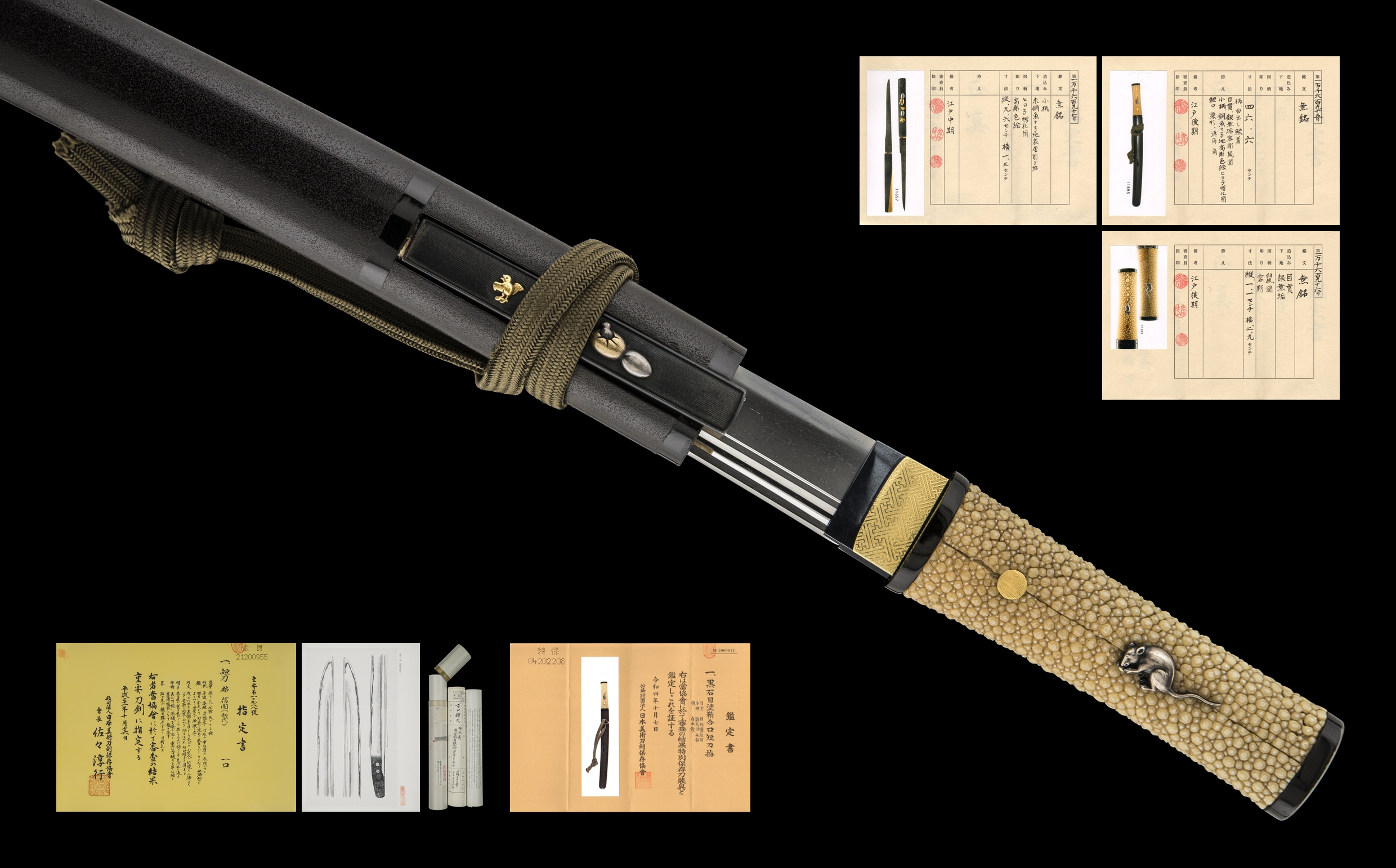
As written by the shop
Yamashiro (Kyoto), Nobukuni school · Yamashiro · around 1356-1368
Fujishiro Jo-jo saku · Tōken Taikan top 8%
A tanto dated Enbun 3 (1358), a wakizashi of Koan 1 (1361), and further dated pieces reaching Joji 5 and Oan 5 (1372) frame the working life of Nobukuni of Yamashiro, the Kyoto master whom the NBTHK counts as the first generation of his name. The old registers placed a founding Nobukuni back in the Kenmu era, but the published sources set that legend aside: no work dated to Kenmu or its vicinity survives, no extant blade can be appraised so early, and the style of the oldest dated works connects directly with that of Sadamune, so that "the prevailing view today regards the Enbun and Joji smith as the first generation"[[c:1]]. Two lines meet in him. By blood he belongs to the Ryokai school, recorded in the transmitted genealogies as the son or grandson of Ryo Hisanobu, himself Ryokai's son, and therefore of Rai descent; by training he is the pupil of Soshu Sadamune, counted among the Sadamune Santetsu (貞宗三哲), the three brilliant pupils. The published sources rank him a representative smith of the Nanbokucho period.
His style, the NBTHK writes in a standing formula, "is in broad outline of two kinds: the one suguha, the other a midare whose main tone is a Sadamune-style notare"[[c:2]]. What binds the two manners is the steel itself. Whether the hamon is straight or irregular, the kitae flows conspicuously toward the ha and takes on masame, and the published record reads this trait, with the suguha of the Enbun 3 and Koan 1 dated works, as what makes the Ryokai pedigree credible. On a Tokubetsu Juyo wakizashi of the tenth session the judges write that "above all, the hada that inclines to masame and flows near the edge suggests his connection to the Ryokai line." The jigane is itame mixed with mokume, ji-nie thick, chikei entering incessantly; on many pieces a nie-utsuri rises toward the mune, and niju-ba appears along the habuchi.
The principal manner of the surviving work is the Sadamune style. Over the flowing itame the temper runs in a ko-notare mixed with gunome and ko-gunome, ashi and yo enter, and the nie lies thick and bright. Kinsuji and sunagashi work constantly through the ha, hotsure fray the habuchi, and yubashiri spill above the temper; on the more flamboyant pieces the yubashiri string intermittently along the ha until, as the published sources write of the Kuroda wakizashi, they produce "the appearance of a kind of two-tiered ha"[[c:3]]. The boshi runs notare-komi or midare-komi into ko-maru with hakikake. A signed wakizashi from the Tosa Yamauchi family is praised as workmanship that thoroughly vindicates the Sadamune-pupil tradition, "yet compared with Sadamune the gunome stand out somewhat, and exactly there the look of Nobukuni shows itself." To this manner belongs the carving the published sources call his house art[[c:4]]: bonji, suken, gomabashi, sanko-ken and kurikara, frequently layered one over another, on one katana judged "skillfully layered in the manner of Daishinbo."
The second manner is the suguha of his ancestry[[c:5]]. His earliest dated works carry it, and a signed Tokubetsu Juyo tanto is praised for "a dignified suguha that strictly preserves the tradition of Kyoto work." These blades show a suguha, at times a hoso-suguha, in ko-nie, the nioiguchi tight or deep, the habuchi finely frayed with hotsure, kuichigai-ba and a niju-ba tendency appearing, and slight yubashiri near the monouchi; beneath lies the same flowing, masa-tinged jigane with nie-utsuri. Most of the corpus consists of hira-zukuri, mitsu-mune wakizashi and tanto of the build the published sources name the Enbun-Joji type[[c:6]]: wide in the mihaba, sunnobi, thin in the kasane, shallow in the sori. The long blades are nearly all o-suriage mumei, wide with little taper, the kissaki extended or reaching o-kissaki, at times with a deep wheel-like sori. One shobu-zukuri tanto is recorded as his kawari-deki, "a construction that at first sight could be confused with Yamato work." His signature is a two-character mei cut centrally below the mekugi-ana, the dated pieces adding the nengo on the ura; of his designated works twenty-nine are signed against forty unsigned, one shortened katana preserves the original mei as a gaku-mei, and the gold-inlaid attributions added later by the Hon'ami are appraisals, not signatures.
The name outlived him. At the very end of Nanbokucho stands a change-of-generation Nobukuni with dates of Eitoku, Shitoku and Meitoku, and in early Muromachi the so-called Oei Nobukuni, smiths bearing the titles Saemon-no-jo and Shikibu-no-jo; every generation favored the notare and the suguha, and from late Nanbokucho into Oei a gunome-led midare entered the school's range beside them. The line continued through Muromachi and later moved to Buzen and then Chikuzen, where it flourished into the shinshinto age. Within that long succession the shodai remains the touchstone: the published sources resolve unsigned blades and generation questions by holding a piece against his dated work, and the Juyo Bijutsuhin record preserves Honma Junji's caution over one tanto whose kuni character departs from the forms usual in the first and second generations. His own blades are told from Sadamune's by the Kyoto traces they carry: the nie-utsuri, the niju-ba, and the hada that drifts into masame along the ha.
Fujishiro grades him Jo-jo saku, and seventy designated works stand on the official record: four Important Cultural Properties, seven Tokubetsu Juyo and fifty-three Juyo, with five more on the prewar Juyo Bijutsuhin rolls and one wakizashi recorded in Honma's inventory of the Imperial collection. The provenance attached to his blades runs through the great houses. The Kuroda wakizashi, with the gold-inlaid possession mark of Kuroda Chikuzen no Kami and a cutting attestation, is said to have been the personal sword of Kuroda Nagamasa, presented to the shogunal house, granted to the Hotta, and passed at last to the Akita Satake; a small mumei wakizashi is a Hongan-ji meibutsu "traditionally said to have been especially cherished by Rennyo Shonin"; the signed wakizashi called Arao Nobukuni[[c:7]] descended in the Asano family of Geishu with a Hon'ami Koon origami of Manji 1 (1658); other pieces were transmitted in the Sanada of Matsushiro, the Tosa Yamauchi and the Tamura, and a tachi was bestowed by the shogunal house upon the Owari Tokugawa in Koka 2 (1845). Of recorded whereabouts today, examples rest in the Tokugawa Art Museum and the Kyoto National Museum among other public and long-private collections. The four Important Cultural Properties are patrimony, preserved beyond the market; the sixty blades in the Tokubetsu Juyo and Juyo tiers are for the greater part held closely, and a signed sunnobi wakizashi of the shodai comes to the market only rarely, a notable occasion when it does.
Where Nobukuni stands among comparable artisans: across all of nihontō, and within tradition, era, and period. The tiers (Foremost · Leading · Major · Notable) weigh official designations from the NBTHK and Japan's Agency for Cultural Affairs, together with historical honors of lasting repute such as the Sansaku and Meibutsu-chō.
Select a lens to see how it's measured.
Years he was demonstrably active, proven by signed-and-dated blades
Yamashiro-den · Yamashiro
22 pieces on the market now
Few Kyoto houses bridged two traditions as deliberately as Nobukuni (信国), the Yamashiro-den lineage whose work runs from the Nanbokucho period through Muromachi and on, in a western branch, into the shinto age. The first generation, the smith the NBTHK counts as shodai, is the master of the Enbun, Koan and Joji years; the older registers placed a founding Nobukuni back in the Kenmu era, but the published sources set that legend aside, since no work survives so early and the style of the oldest dated blades connects directly with that of Sadamune. Two inheritances meet in him. By blood he belongs to the Ryokai line, recorded as son or grandson of Ryo Hisanobu and therefore of Rai descent; by training he is said to have studied under Soshu Sadamune, counted among the Sadamune Santetsu, the three brilliant pupils. The name then passed on: a change-of-generation Nobukuni with Eitoku, Shitoku and Meitoku dates stands at the close of Nanbokucho, and in early Muromachi come the so-called Oei Nobukuni, Saemon-no-jo and Shikibu-no-jo, conventionally the third generation. The published commentary keeps these hands apart and notes that several smiths of the same signature appear within the Nanbokucho period alone. Through Muromachi the line moved to Buzen and then Chikuzen, where it served the Kuroda house of Fukuoka as retained smiths and flourished as the Chikuzen Nobukuni group of Yoshisada, Yoshimasa, Yoshitsugu, Yoshikane and Shigekane. A single steel underlies the whole school. The jigane is an itame mixed with mokume that flows toward the ha and stands into masame, with thick ji-nie and chikei entering frequently; on the finer-forged pieces a streak-like nie-utsuri rises, and that masame-tinged surface is read as the visible token of the Ryokai pedigree.
Over it the temper divides into the manners the sources name together: a suguha expressing the Kyoto tradition, refined in ko-nie with fine hotsure and a niju-ba tendency, carried on tanto and ko-wakizashi; and a ko-notare mixed with gunome inheriting the Sadamune style, laid thick in nie, with kinsuji, sunagashi, hotsure and conspicuous yubashiri, on the most flamboyant pieces stringing into a two-tiered ha. From the late Nanbokucho succession into the Oei generation a third range enters, a gunome-led midare whose tell is paired gunome linked across the valleys by a low ko-notare into a yahazu, arrow-notch, profile, with muneyaki, tobiyaki and niju-ba on the liveliest blades. Above all stands the carving the sources call the house art, the horimono of bonji, kurikara, suken, gomabashi, sanko-ken and the invocation of Hachiman Daibosatsu, often layered one over another in kasanebori; few smiths of the age are so consistently identified by what they carved. The Chikuzen branch carried the masame-leaning itame forward and added a choji-midare with midare-utsuri, Yoshikane reaching toward Soshu-den with deep nioi and thick nie, Shigekane ranked highest in skill within his group and noted as a copyist of meibutsu who emulated Fudo Kuniyuki at the Hama Palace. To kantei Nobukuni is to read the Kyoto traces that part him from Sadamune: the nie-utsuri, the niju-ba, and the hada that drifts into masame along the ha. Within the long succession the shodai remains the touchstone, his dated work the standard against which unsigned blades and generation questions are resolved, the reversed left-form kuni marking the Oei Saemon-no-jo, the yahazu the daigawari hand. The best members rank Jo-jo saku under Fujishiro, and the carving reputation is the constant thread, distinguishing these blades from the plainer utilitarian grooving of contemporary Bizen. Provenance runs through the great houses: the Kuroda wakizashi once carried by Kuroda Nagamasa, a Hongan-ji meibutsu held to have been cherished by Rennyo Shonin, the signed Arao Nobukuni descended in the Asano of Geishu, pieces in the Sanada, Tosa Yamauchi and Tamura families, and a tachi bestowed on the Owari Tokugawa. Examples rest today in the Tokugawa Art Museum, the Kyoto National Museum, shrines such as Atsuta and Ise, and long-held private collections, with the Chikuzen smiths' shogunal-command pieces preserving the historical episodes that produced them. Learn more →
| Smith | Era | Designated |
|---|---|---|
| Nobukuni信國 | 1356-1368 | 70 |
| Nobukuni信國 | 1383-1392 | 33 |
| Nobukuni信國 | 1394-1428 | 44 |
| Yoshikane吉包 | 1661-1686 | 6 |
| Masanobu正信 | 1356-1361 | 4 |
Yamashiro in the Nanbokuchō period
The divided-courts war impoverished the court society that had sustained Kyōto’s most refined work. With the last Rai masters the classic line effectively closed, while Hasebe and Nobukuni carried the new Sōshū manner into the capital.
A blade of top-grade workmanship and condition, formally judged to rank with a nationally recognized Important Art Object (Jūyō Bijutsuhin). Awarded only at the NBTHK’s competitive annual examination.
Of Japan’s roughly 2.5 million registered swords, only 12,348 (about 1 in 202) have ever attained Jūyō.
The NBTHK (Nihon Bijutsu Tōken Hozon Kyōkai, the Society for the Preservation of Japanese Art Swords) is a public-interest incorporated foundation founded in 1948 and supervised by Japan’s Agency for Cultural Affairs (Bunkachō); it is based at the Japanese Sword Museum in Tokyo. Its expert panels physically examine each submitted work (shinsa) and issue a certificate (kanteishō) ranking it by artistic and historical merit. NBTHK papers are the most widely recognized standard of authentication for Japanese swords and fittings.
NBTHK official siteAll swords come with a three-day inspection period beginning from the date of delivery. If not satisfied, the sword may be returned within this period for a full refund of the purchase price. Outside of this period, all sales are final. Swords purchased on a layaway payment plan are not eligible for the three-day inspection period.