Edo was the sword’s age of connoisseurship: the Hon’ami appraisers, the shogunal register of famous blades of 1719, and a thriving literature turned the sword into an object of study even as it ceased to be drawn in war.
 NihontoWatchNihontoWatch
A naginata with a kiwame attribution to Hoki no Kami Nobutaka. Likely intended as a wartime armament, it possesses a grand and powerful sugata with a long sunpaku and wide mihaba, particularly featuring a strongly distended monouchi area and a sharp kissaki. The structure is characteristic of a practical weapon, crafted with a thick niku from the koshimoto to the nakago for the purpose of parrying an opponent's sword, while the mune is shaved down above the koshi-hi to reduce weight and ensure the blade does not get stuck when cutting. The shinogi is set high to withstand enemy attacks, while conversely, the ha-saki around the monouchi is crafted to be sharp, further enhancing its cutting capacity. Additionally, there is no loss of hiraniku, and the hamachi remains deep, maintaining a健全 (kenzen) body. The jitetsu kitae shows a well-tightened masame-hada on the shinogi-ji, while the hirachi is an even more tightly-knit ko-itame-hada without slack, the entire surface covered in fine ji-nie, possessing a beauty one would not expect from a weapon. The hamon begins with a sugu-yaki-dashi, followed by continuous gunome with a togari-gokoro, becoming deeply tempered as it thrusts into the ji around the monouchi; the boshi is shallowly midare, featuring a hoju-shaped tobiyaki at the tip before returning and connecting to a long muneyaki. This deep muneyaki was also intended as protection against attacks. The bright yakiba, a composite of nie and nioi, is free of muranie, with faint ashi radiating within the ha and yo dancing around the monouchi. The first generation Nobutaka descended from the Kanenori line of the Mino Sanami school and moved to Nagoya, Owari around the Keicho era, leaving behind works dated from Tensho to around Kanei 7.
NihontoWatchOffered by Choshuya



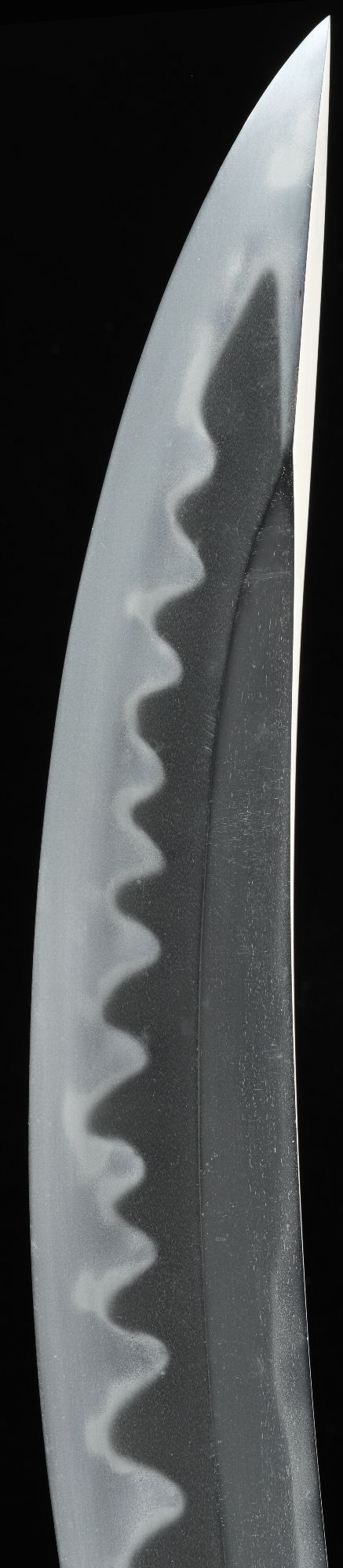
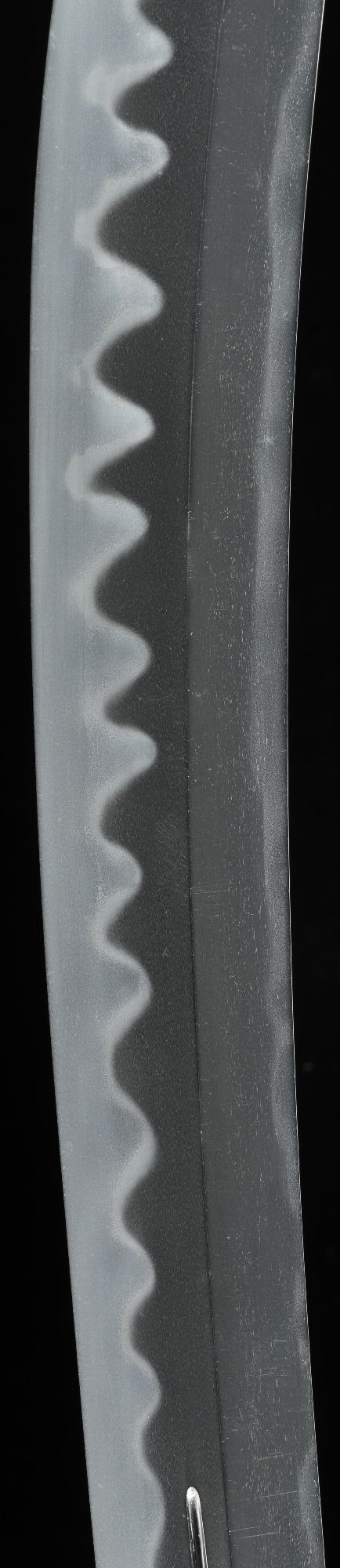

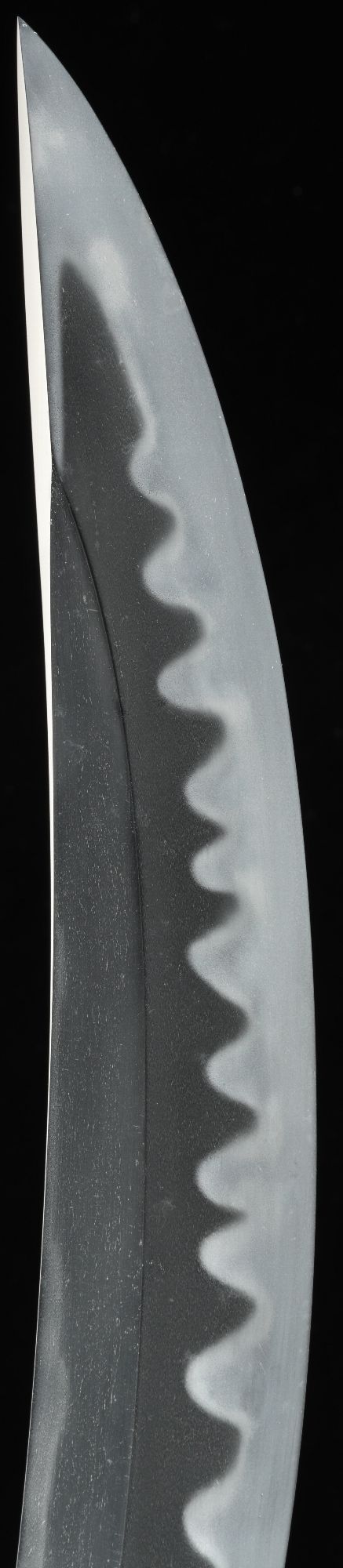
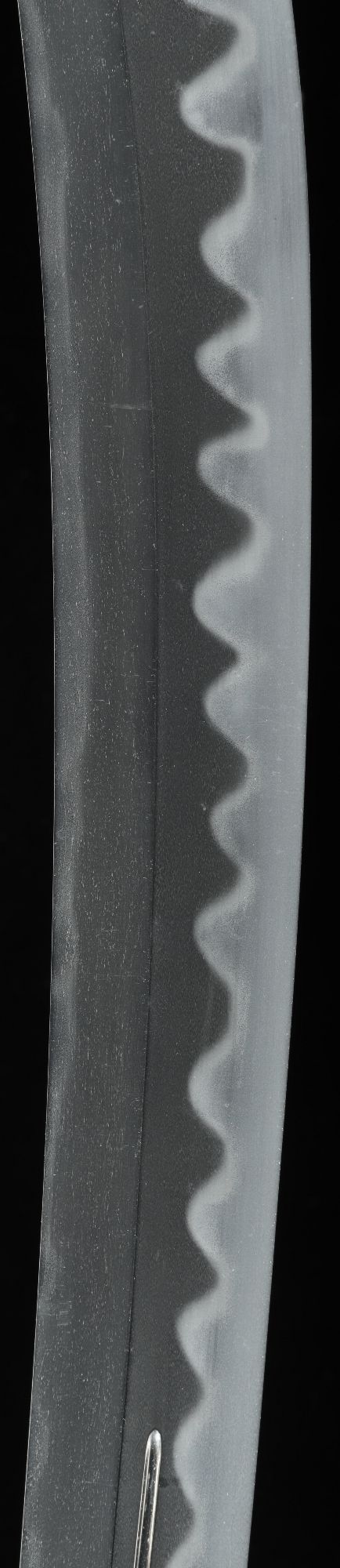

Machine translation from the shop's Japanese · may contain errors ·
Mino-den · Owari · around 1581-1615
Fujishiro Jo-jo saku · Tōken Taikan top 21%
1 piece on the market now
The first-generation Hoki no Kami Fujiwara Nobutaka was born in Eiroku 6 (1563) at Kami-Aruchi in Mino Province. Traditionally said to descend from the San'ami Kanekuni lineage, he received the court title of Hoki no Kami in Tensho 9 (1581) at the age of nineteen. He subsequently moved to Kiyosu in Owari Province and, in Keicho 15 (1610), accompanied Tokugawa Yoshinao to Nagoya, where he became one of the founding figures of the Owari shinto tradition. In Kan'ei 10 (1633) he retired under the Buddhist name Keiyu, dying three years later at seventy-six. His personal name was Kawamura Saemon, and the majority of his extant works are shinogi-zukuri katana and wakizashi, with hira-zukuri tanto and polearms comparatively few.
Nobutaka's forge work reveals the Mino tradition of his origin: itame-hada mixed with nagare-hada, tending toward hada-dachi, with thick ji-nie and chikei. His tempering ranges from tightly controlled notare with clear nioiguchi to bold, spirited compositions in which gunome-midare, tobiyaki, and yubashiri span into the shinogi-ji, developing into hitatsura-like all-over hardening. The nie is deep and sometimes coarsely formed, yielding nie-kuzure at the yakigashira and hotsure along the habuchi, punctuated by frequent kinsuji and sunagashi. His boshi tends to be deeply tempered with long kaeri, at times assuming an ichimai-like boldness.
Among the designated pieces, the Tensho 9 katana is celebrated as an utsushi after the renowned Inabae, executed with natural assurance immediately upon receiving his court title. His imposing o-kissaki katana display the wide-bodied proportions characteristic of the Momoyama period, while even his yari of extraordinary length show no breakdown in execution, demonstrating technical mastery across blade forms.
Where Nobutaka stands among comparable artisans: across all of nihontō, and within tradition, era, and period. The tiers (Foremost · Leading · Major · Notable) weigh official designations from the NBTHK and Japan's Agency for Cultural Affairs, together with historical honors of lasting repute such as the Sansaku and Meibutsu-chō.
Select a lens to see how it's measured.
Years he was demonstrably active, proven by signed-and-dated blades
Mino-den · Mino
6 pieces on the market now
The San'ami line takes its root in Mino Province, where its head smith Kanenori (兼則) worked as one of the so-called Seki Seven Schools. The setsumei place Kanenori from the close of the Nanbokuchō period into the Ōei era of the early Muromachi, alongside Kanemoto and Kanesada among the representative hands of Sue-Seki, and the earliest extant signed tachi of his is appraised as no later than Ōei. A second early smith, Kanekuni (兼国), is recorded as belonging to the San'ami lineage and is judged to predate the Sue-Seki group proper; the remote ancestry given for him runs variously to a disciple of Naoe Kanetomo, to Yamato Kanekuni, or to Kanenori, though the setsumei note that nothing survives to confirm so distant a descent. From this Mino stock came Hōki no Kami Fujiwara Nobutaka (信高), born at Kami-Ōchi in Mino in 1563 and said to descend from San'ami Kanekuni. After receiving the title Hōki no Kami in Tenshō 9 (1581) he moved to Kiyosu in Owari and, serving Tokugawa Yoshinao, later settled at Nagoya, carrying the line into the early Shintō era through a second generation who took the tonsure in Kanbun 2 (1662). Across the corpus the jigane is itame, often closely forged and tending to nagare-hada or flowing grain along the edge, with ji-nie and a frequent standing of the grain (hada-dachi); a faint whitish cast (shirake) marks the older Mino work of Kanenori and Kanekuni. The temper rests on suguha as a base. In the early hands it is a tight, clear (saete) suguha in nioi-deki, sometimes mixed with small gunome, angular elements and pointed ha, carrying ashi, hotsure and scattered tobiyaki.
The Nobutaka works open this out: a broad suguha shifting to shallow notare, ko-notare with a gunome-flavored edge, deep nioi with nie unevenly applied and partly coarse, nie-kuzure at the yakigashira, kuichigai-ba, kinsuji, sunagashi, yubashiri and tobiyaki that climb into the shinogi-ji until the upper half reads as hitatsura. The bōshi runs to sugu with ko-maru, at times midare-komi, pointed, or hakikake, and the early swords keep a slender, high-sori tachi shape while Nobutaka's carry the wide-bodied, ō-kissaki form of the Momoyama transition. The hand is recognized in this pairing of a flowing Mino itame with a suguha core that, in the descendants, breaks toward bold hitatsura. For kantei, the setsumei fix several anchors. In Kanenori's signature the scooped chisel at the fourth stroke of the character kane (兼) is read as a trait of late Nanbokuchō through Ōei work, matched in dated Kaneyoshi mei; the clear suguha of Kanekuni is likened to a Zenjō Kaneyoshi masterpiece. The jizō-flavored bōshi and the nagare-mixed itame in Nobutaka are named as the surviving stamp of the Mino root beneath his Owari manner, and one of his katana is recorded as an Inabae-utsushi. Provenance runs through the corpus: a Kanekuni bears kinzōgan recording it as the sashiryō of Ōkubo Genban-no-jō Tadanari, lord of Odawara in Sagami, worn at the age of ninety-three; Kanenori's tachi descended in the Yamanouchi family. Among the Owari yari makers beginning with Masatsune, Nobutaka's yari of extraordinary length is held in particular regard, and the second-generation Nobutaka is judged no less skilled than his father, with the finest extant Nobutaka works counted to his hand. Learn more →
| Smith | Era | Designated |
|---|---|---|
| Nobutaka信高 | 1581-1615 | 3 |
| Kanenori兼則 | 1370-1372 | 1 |
| Nobutaka信高 | 1624-1644 | 2 |
| Kanekuni兼國 | 1455-1457 | 1 |
| Nobutaka信高 | 1673-1681 | 0 |
The Edo period (1615 to 1868)
Edo was the sword’s age of connoisseurship: the Hon’ami appraisers, the shogunal register of famous blades of 1719, and a thriving literature turned the sword into an object of study even as it ceased to be drawn in war.
Certifies a genuine blade worth preserving: a signature confirmed correct, or, if unsigned, an era, province, and school that the NBTHK can reliably identify.
The NBTHK (Nihon Bijutsu Tōken Hozon Kyōkai, the Society for the Preservation of Japanese Art Swords) is a public-interest incorporated foundation founded in 1948 and supervised by Japan’s Agency for Cultural Affairs (Bunkachō); it is based at the Japanese Sword Museum in Tokyo. Its expert panels physically examine each submitted work (shinsa) and issue a certificate (kanteishō) ranking it by artistic and historical merit. NBTHK papers are the most widely recognized standard of authentication for Japanese swords and fittings.
NBTHK official siteIf, due to our fault, the item differs significantly from its proper condition, the item may be returned. Cooling-off is within one week of the item's arrival.