 NihontoWatchNihontoWatch
江戸時代前期の明暦から延宝を活躍期とする、赤坂二代忠正と極められた作。初、二、三代赤坂の作品には銘がなく、古風で武骨な造り込みが特徴であることから、これらを古赤坂と呼び分けている。赤坂鐔は京透の影響を受けながらも独創的に草体化された意匠であり、後の江戸文化でもある粋に通じることから好まれ、殊に古赤坂の作品は高く評価されている。肉厚く骨太な印象のこの鐔は、京や尾張などにもある古調な雁金などを組み合わせた繋文の意匠ながら、透しの切り口には赤坂の特質が現れている。
NihontoWatchOffered by Choshuya
This piece has sold
Get an email when a new Akasaka Tadamasa piece hits the market.

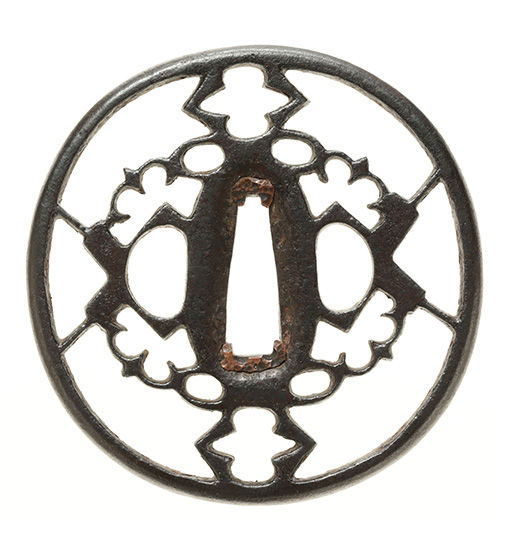
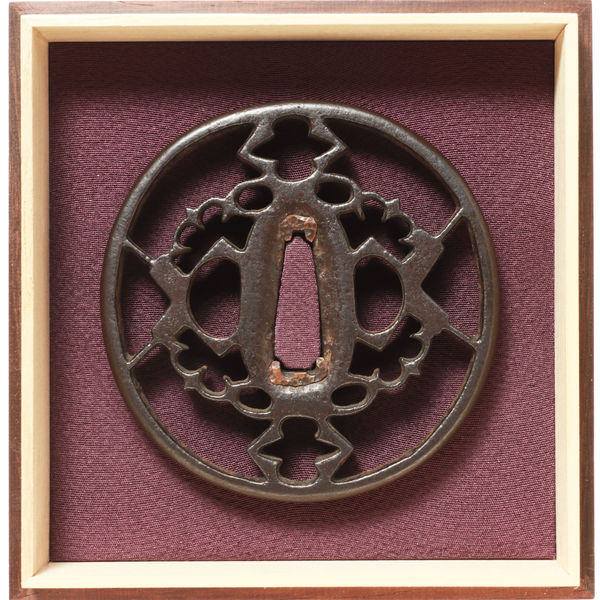
Akasaka Tadamasa
Early Edo (d. 延宝五 1677)
Musashi
Unsigned
Tokuho (NBTHK)
As written by the shop
Iron-tsuba · Musashi · around 1650-1677
1 piece on the market now
The second Tadamasa of the Akasaka school carried his father's name and calling. The published sources state that 「赤坂忠正は, 庄左衛門と称し同名で初二代いる」 (Akasaka Tadamasa was called Shozaemon, and there were a first and a second generation of the same name), and from a genealogy the descendant Tadatoki submitted to the shogunate in the Bunsei era they give the dates: 「初代忠正は明暦三年に歿し, 二代忠正は延宝五年に歿したと記されている」 (the first Tadamasa died in Meireki 3 and the second in Enpo 5). Like all of the old Akasaka upper three generations, he left no signed work.
Two guards are recorded under his name. The first, an iron tsuba pierced with bamboo, clove and catfish on a gently squared hammered plate, is judged a work of the years when father and son worked side by side: 「二代忠正が初代と共に作鐔していた頃の傑作と推考され, 赤坂透鐔全体からみても極めて優れた鐔である」 (thought to be a masterwork from the time the second Tadamasa made guards together with the first, and an exceptionally fine guard even within all Akasaka openwork). The second, pierced with the Musashino field of pampas grass, dew and a crescent moon in yin-yang openwork, the published sources assign directly: 「本作は二代赤坂忠正と鑑せられる鐔で」 (this guard is judged the second Akasaka Tadamasa), praising a refined carving that wastes no relief.
Both guards carry the construction tells the records give to the first and second generations alike, 「上部の尖った切羽台は赤坂初二代の特徴であり, 小柄櫃孔にして笄櫃孔が小さいのも初二代の特徴である」 (the pointed upper seppa-dai is a feature of the first and second Akasaka generations, as is a kogai-hitsu smaller than the kozuka-hitsu). His hand is therefore read with his father's, and the NBTHK names the second generation only where it judges a guard his. Both are designated Juyo Tosogu.
Where Tadamasa stands among comparable artisans: across all of nihontō, and within tradition, era, and period. The tiers (Foremost · Leading · Major · Notable) weigh official designations from the NBTHK and Japan's Agency for Cultural Affairs, together with historical honors of lasting repute such as the Sansaku and Meibutsu-chō.
Select a lens to see how it's measured.
Iron-tsuba · Edo
Phase: Ko-Akasaka古赤坂· 1624–1700
59 pieces on the market now
| Smith | Era | Designated |
|---|---|---|
| Tadamasa忠正 | 1624-1657 | 5 |
| Tadashige忠重 | 1730-1816 | 5 |
| Tadatoki忠時 | 1704-1764 | 0 |
| Juchiku/Toshitake寿竹 | — | 0 |
| Tadanori忠則 | 1730-1780 | 0 |
A Hozon-certified fitting of notably superior craftsmanship and condition, often with signature or workmanship of high reference value.
The NBTHK (Nihon Bijutsu Tōken Hozon Kyōkai, the Society for the Preservation of Japanese Art Swords) is a public-interest incorporated foundation founded in 1948 and supervised by Japan’s Agency for Cultural Affairs (Bunkachō); it is based at the Japanese Sword Museum in Tokyo. Its expert panels physically examine each submitted work (shinsa) and issue a certificate (kanteishō) ranking it by artistic and historical merit. NBTHK papers are the most widely recognized standard of authentication for Japanese swords and fittings.
NBTHK official siteIf, due to our fault, the item differs significantly from its proper condition, the item may be returned. Cooling-off is within one week of the item's arrival.