 NihontoWatchNihontoWatch
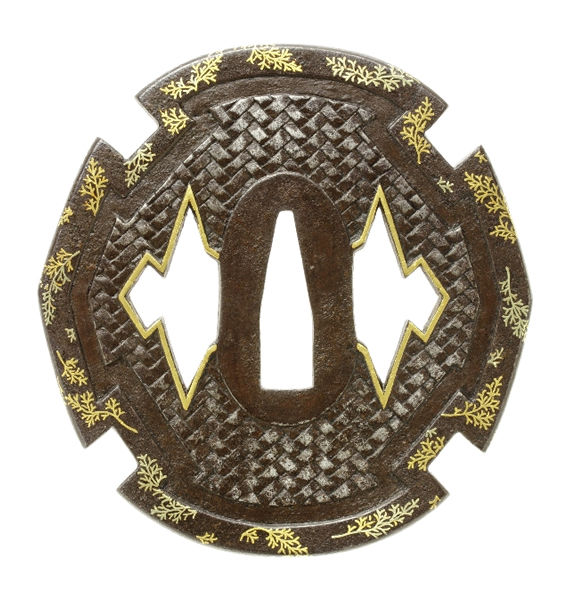
In the Akita Shoami school, starting with Denbei, metalworkers such as Dennai, Denshichi, Shigehisa, Shigehiro, and Shigesada, who excelled not only in technique but also in artistic sensibility, were active. This tsuba uses a matsukawabishi design, combining linear structural lines with the roundness of the tsuba and curved surfaces such as the ajiro pattern on the jimochi, while scattering shinobugusa as a motif along the mimi to enhance its aesthetic beauty. Hozon Tosogu Kanteisho (Akita Shoami)
NihontoWatchOffered by Choshuya

Machine translation of the shop's Japanese ·
Rows still in Japanese are as written by the shop
Machine translation from the shop's Japanese · may contain errors ·
Iron-tsuba · Dewa
11 pieces on the market now
| Smith | Era | Designated |
|---|---|---|
| Denshichi伝七 | 1670 | 1 |
| Shoami Rokuya正阿弥六弥 | — | 1 |
Certifies a genuine fitting worth preserving: a correct signature, or, if unsigned, an identifiable era and school, with recognized artistic and craft value.
The NBTHK (Nihon Bijutsu Tōken Hozon Kyōkai, the Society for the Preservation of Japanese Art Swords) is a public-interest incorporated foundation founded in 1948 and supervised by Japan’s Agency for Cultural Affairs (Bunkachō); it is based at the Japanese Sword Museum in Tokyo. Its expert panels physically examine each submitted work (shinsa) and issue a certificate (kanteishō) ranking it by artistic and historical merit. NBTHK papers are the most widely recognized standard of authentication for Japanese swords and fittings.
NBTHK official siteIf, due to our fault, the item differs significantly from its proper condition, the item may be returned. Cooling-off is within one week of the item's arrival.