 NihontoWatchNihontoWatch
Hiraishi Chikayuki studied under both the Nara school and the Hamano school, incorporating both styles to leave behind charming works. His field of activity was Toyama in Etchu Province, and it is said that after the start of Meiji he engaged in copper work in Takaoka. The key points of this fuchikashira are the accurate and realistic depiction, and the intensity created by a composition rich in dynamic movement. The shibuichi ground is carved in high relief, combining figures as if viewing a scene from Kabuki or a ukiyoe; since the subject is a kijo and Omori Hikoshichi, describing it as having a sense of life might not be appropriate, but it overflows with vitality through the polite treatment of every detail. The highlights are not only the takabori, but the hirazogan applied to key areas is also delicate and beautiful. Hozon Tosogu Kanteisho
NihontoWatchOffered by Choshuya
This piece has sold
Get an email when a new Hamano Chikayuki piece hits the market.

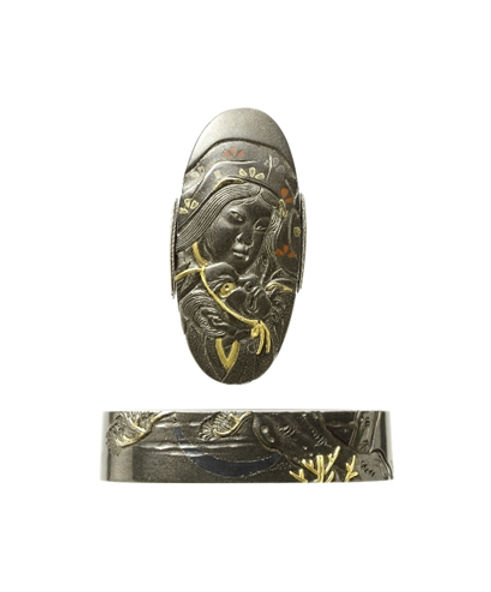
Nara-Ha, Hamano-Ha
Edo
Ecchu
Signed
Hozon (NBTHK)
As written by the shop
Machine translation from the shop's Japanese · may contain errors ·
Machibori · Musashi
1 piece on the market now
Machibori · Edo
32 pieces on the market now
The Hamano school of machibori carving was established in mid-Edo Edo by Hamano Masazui (浜野政隨), commonly known as Tarōbei, an exceptionally gifted pupil of Nara Toshihisa. As the Edo Kinkō Meifu states of him that he "thunders through the world," Masazui won widespread renown as one of the "Four Guardian Kings of Nara" (Nara Shitennō). Training many disciples and employing numerous art names—including Otsuryūken, Aji-zumi, Kankei, Rifūdō, Yūkotei, Shūhōsai, Hankei-shi, and Isshunan—he formed what came to be known as the Hamano school, establishing one of the principal lineages of machibori artistry and founding an independent house. " Works are rendered by means of yōbori (sculptural carving) upon varied grounds—gold-and-silver imo-tsugi-ji, solid gold (kinmuku)—with details frequently treated in the in'yō-kon mode, suggesting the early Gotō masters as models.
The carving is executed with "ample, well-judged volume (nikudori)" and "exceptionally full, weighty presence," while applied metal (okigane) in silver and shakudō with shakudō iroe tightens pictorial fields and imparts additional movement. Later Hamano artists such as Katsurano Akafumi maintained this technical versatility, favoring polychrome inlay applied to high-relief compositions. " The NBTHK repeatedly notes that works "clearly demonstrate the high level of technique," "amply demonstrate advanced technical mastery," and possess "a composed dignity"—attestations to the school's sustained excellence across generations and its enduring place within the broader machibori tradition. Learn more →
| Smith | Era | Designated |
|---|---|---|
| Shozui政随 | — | 17 |
| Sekibun赤文 | 1670 | 8 |
| Noriyuki矩随 | — | 4 |
| Yoshinao義直 | — | 0 |
| Haruchika春親 | — | 0 |
Certifies a genuine fitting worth preserving: a correct signature, or, if unsigned, an identifiable era and school, with recognized artistic and craft value.
The NBTHK (Nihon Bijutsu Tōken Hozon Kyōkai, the Society for the Preservation of Japanese Art Swords) is a public-interest incorporated foundation founded in 1948 and supervised by Japan’s Agency for Cultural Affairs (Bunkachō); it is based at the Japanese Sword Museum in Tokyo. Its expert panels physically examine each submitted work (shinsa) and issue a certificate (kanteishō) ranking it by artistic and historical merit. NBTHK papers are the most widely recognized standard of authentication for Japanese swords and fittings.
NBTHK official siteIf, due to our fault, the item differs significantly from its proper condition, the item may be returned. Cooling-off is within one week of the item's arrival.