The shodai Kunikane was born Hongō Genzō in Bunroku 1 (1592) at Kokubun-Wakabayashi in Sendai, Mutsu, and entered the service of Date Masamune as a retained smith. By his lord's command he went up to Kyoto and studied under Etchū no Kami Masatoshi; in Kan'ei 3 (1626) he received the court title Yamashiro Daijō, and he styled himself a descendant of the later line of Yamato Hōshō Gorō. In the opening decades of the Shintō period, when the Sōshū manner in itame and mokume was the fashion of the day, Kunikane gave his working life to reviving the masame-forging, suguha-tempering Hōshō-den of old Yamato. The published sources record that 「作風は一貫して大和保昌伝に終始し」, his manner kept to the Yamato Hōshō tradition from first to last, and every blade of his on the designation record is signed in his own name.
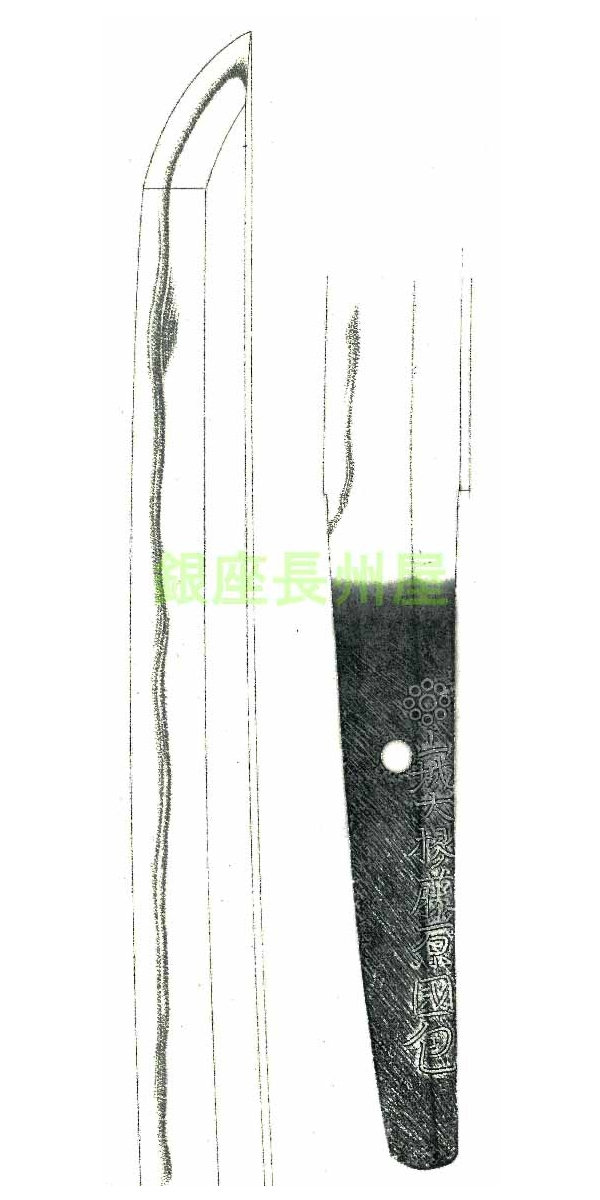
His characteristic hand is constant. The forging is a tightly packed masame-hada, at times running into nagare, carrying fine ji-nie thickly applied and frequent chikei, the steel notably clear. A mizukage often rises from below the machi, and the published sources name it a personal habit of the smith, calling it on one wakizashi a feature that 「初代国包の手くせといえる」. Over that jigane he tempers a suguha or suguha-chō, frequently broad and shallow in notare, the nioiguchi deep and bright. The activity is the Yamato kind: general hotsure along the habuchi, kinsuji and sunagashi set freely into the line, kuichigai-ba, nijūba and uchi-noke mixed in, and ko-ashi entering.
Fine ji-nie and abundant chikei over a clear, well-packed masame recur on nearly every blade, the forging growing more refined as it tightens. The bōshi is the Yamato finish, running straight into a yakizume-like point with vigorous hakikake. On this point the published sources are unusually candid. Measured against the early Hōshō, they say his shortfall lies in 「物打上の変化に乏しいことと, 帽子が平凡な点にある」, a relative want of variation above the monouchi and a commonplace bōshi, while holding that the ji and hamon of his representative dated katana are nonetheless excellent.
One consistent hand divides into two registers by the shape it takes. The standard work is the shinogi-zukuri katana, ubu and long-signed, very often dated, with a high shinogi, shallow sori and an elongated chū-kissaki; his dated katana of Kan'ei 4 and Kan'ei 9 are the reference points for his work. Two prewar Jūyō Bijutsuhin katana carry his go in the signature: one signed Yamashiro Daijō Fujiwara Yokei Kunikane and dated Keian 1 (1648), with a high koshi-zori, funbari, a slightly standing masame and a chū-suguha of ko-nie in a shallow notare with sunagashi, the other signed Yokei Kunikane saku over a clean masame. The rarer register is the hira-zukuri wakizashi, of which the published sources note that very few survive. On these the temper opens out: the upper half takes a broader yakiba, the nie thickens and coarsens in places, tobiyaki resembling yubashiri appear and the nioiguchi tends toward shizumi, while the carvings, a suken and a katana-hi with soe-hi, are cut deep in the manner of old Yamato work. Of the Onikiri wakizashi the published sources say that in it 「初代国包の本領が遺憾なく発揮された」, his true strengths brought out without reserve.
His bright masame and Yamato bōshi set him apart from the Sōshū-fashion smiths of his day, and his disciplined suguha over a clear jigane separates him equally from the kotō Hōshō he revered, whose monouchi and bōshi the texts say he did not quite equal. He retired in Shōhō 2 (1645) and handed the headship to his eldest son Kichiemon, the second-generation Yamashiro no Kami Kunikane, founding a Sendai Kunikane line that carried the masame Hōshō-den to the end of the Edo period; the shodai remains the standard against which the later generations are judged.
His designated record runs through one Important Cultural Property, four prewar Jūyō Bijutsuhin, one Tokubetsu Jūyō and twenty-eight Jūyō blades, with one sword recorded in Honma's inventory of the Imperial collection, thirty-five designated works on record and every one signed. There are no National Treasures. His finest, an ubu, signed and dated katana preserved in its original form and held in the Uwajima Date family, the published sources call 「古保昌に優るとも劣らぬ作域」, equal to or surpassing the old Hōshō, and a masterpiece of imposing presence. Provenance runs through the houses he served and a few long-private hands: the Date and the Uwajima Date families above all, and named collectors such as Kimura Sadazō. A signed shodai Kunikane is not beyond a serious collector's reach in the way a great Kamakura master is, yet his blades are mostly held rather than traded, the hira-zukuri wakizashi rarest of all, and a dated example in good state comes to market only from time to time.
 NihontoWatch