Hizen swords were a domain enterprise: the Nabeshima sent Tadayoshi to study under Umetada Myōju around 1596, then built a licensed school around him. Nine generations carried its famously consistent konuka-hada work into the Meiji era.
 NihontoWatchNihontoWatch
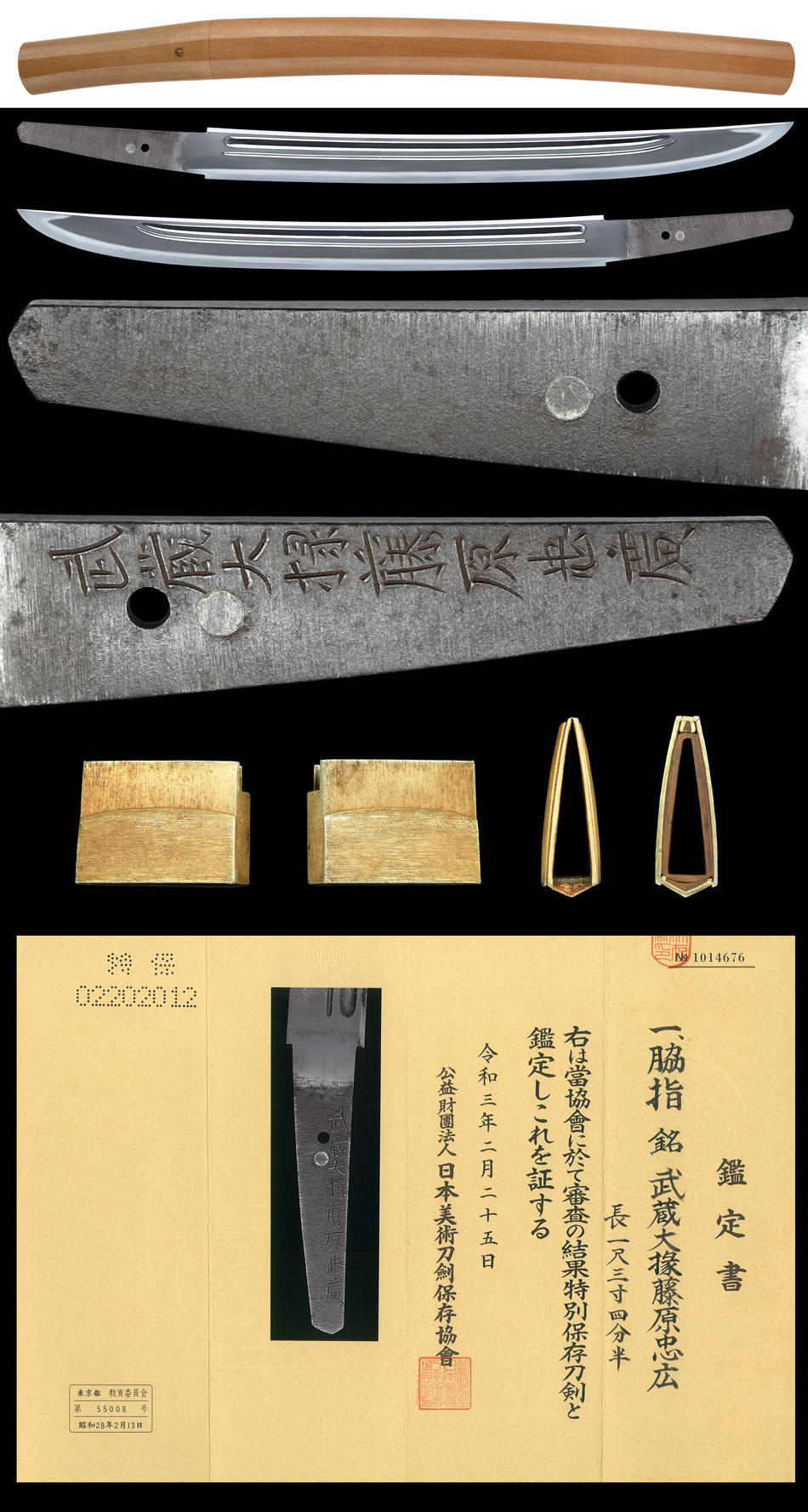
Musashi Daijo Tadahiro is the same person as the first generation Tadayoshi, born in Genki 3 (1572) to Kanei 9 (1632), born in Nagase, Saga District (present-day Takase Village) in Genki 3. His real name was Hashimoto Shinzaemon-no-jo Tadayoshi, and in the history of nihonto, he is the founder of Hizen-to and a master smith of the highest rank. At a young age, he was employed by Nabeshima Naoshige with a stipend of 25 koku, and in Keicho 1 (1596) at the age of 25, by order of the domain, he entered the school of Umetada Myoju in Kyo along with Munenaga of his clan to study. Returning home in Keicho 3, he lived in the Saga castle town and flourished greatly under the patronage of the Hizen Saga Domain. In Genwa 10 (1624), he received the title of Musashi Daijo and changed his name to Tadahiro. He is one of the leading master smiths representing the Keicho Shinto period. His style includes Aoe-utsushi and Shizu-utsushi, which are extremely skillful and do not pale in comparison even when compared to old works. From around Keicho 10, he began to temper konuka-hada with suguha, notare-ba, and gunome choji-ba, eventually establishing the style known as Hizen-to. He passed away on the 15th day of the 8th month of Kanei 9 at the age of 61. His works are of the highest rank in Shinto, with a rank of Shinto Saijo-saku. Furthermore, due to the evaluation of outstanding sharpness, he is also ranked as Saijo O-wazamono. He signs mei such as Hizen no Kuni Junin Tadayoshi saku, Hizen no Kuni Tadayoshi, Hizen Ju Tadayoshi, Hizen no Kuni Junin Musashi Daijo Fujiwara Tadahiro, and Hizen no Kuni Fujiwara Tadahiro. Depending on the period of production, they are divided into the Goji Tadayoshi-mei, Shugan-mei, Junin-mei, and the Tadahiro-mei after the name change. The taihai is, as expected, Hizen-to. One is always impressed by the good style of Tadayoshi's swords. The jigane is ko-itame hada, the kitae is densely packed with jinie, a refined and beautiful kitae without any slackness. It is a strong hada-kitae unique to Keicho Shinto that does not become rice-bran-like hada as seen in works from the second generation onwards. The hamon is clear and bright, a chu-suguha with a tight nioiguchi and konie, with fine sunagashi. The boshi is kaen-fu. It is a beautiful and magnificent sword with an excellent workmanship that does not shame its rank. Gold-clad nijyu habaki, Tokubetsu Hozon Token Kanteisho.
Hizen Tosa no Kami Tadayoshi忠吉
Offered by World Seiyudo

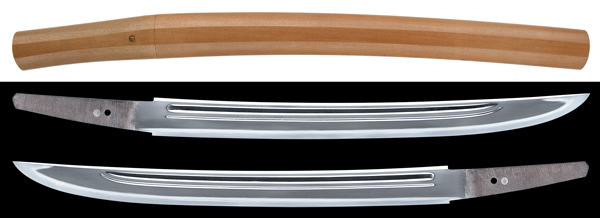
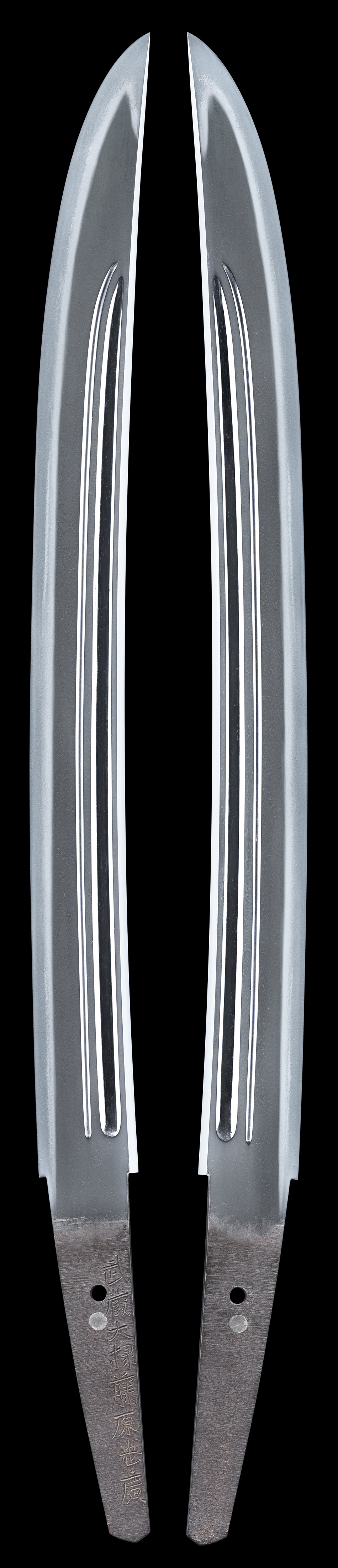
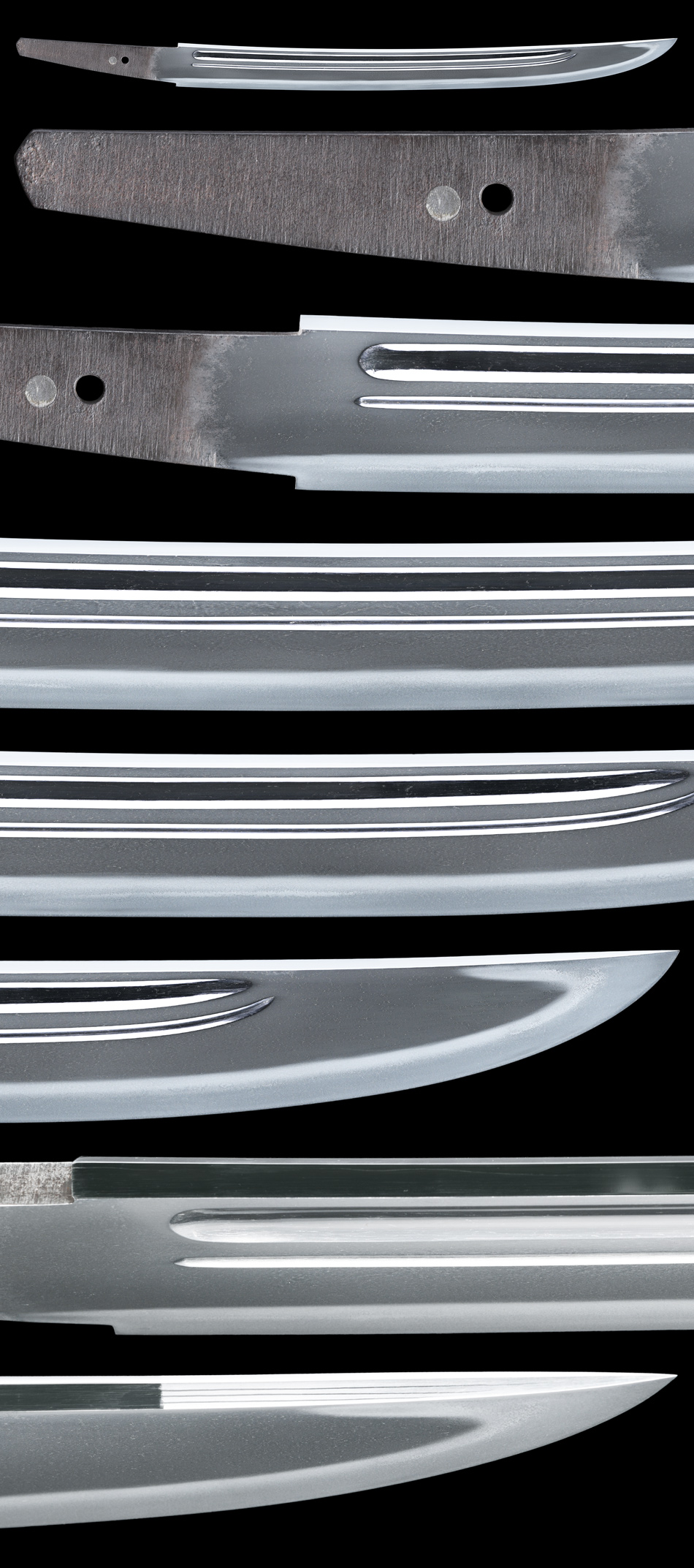
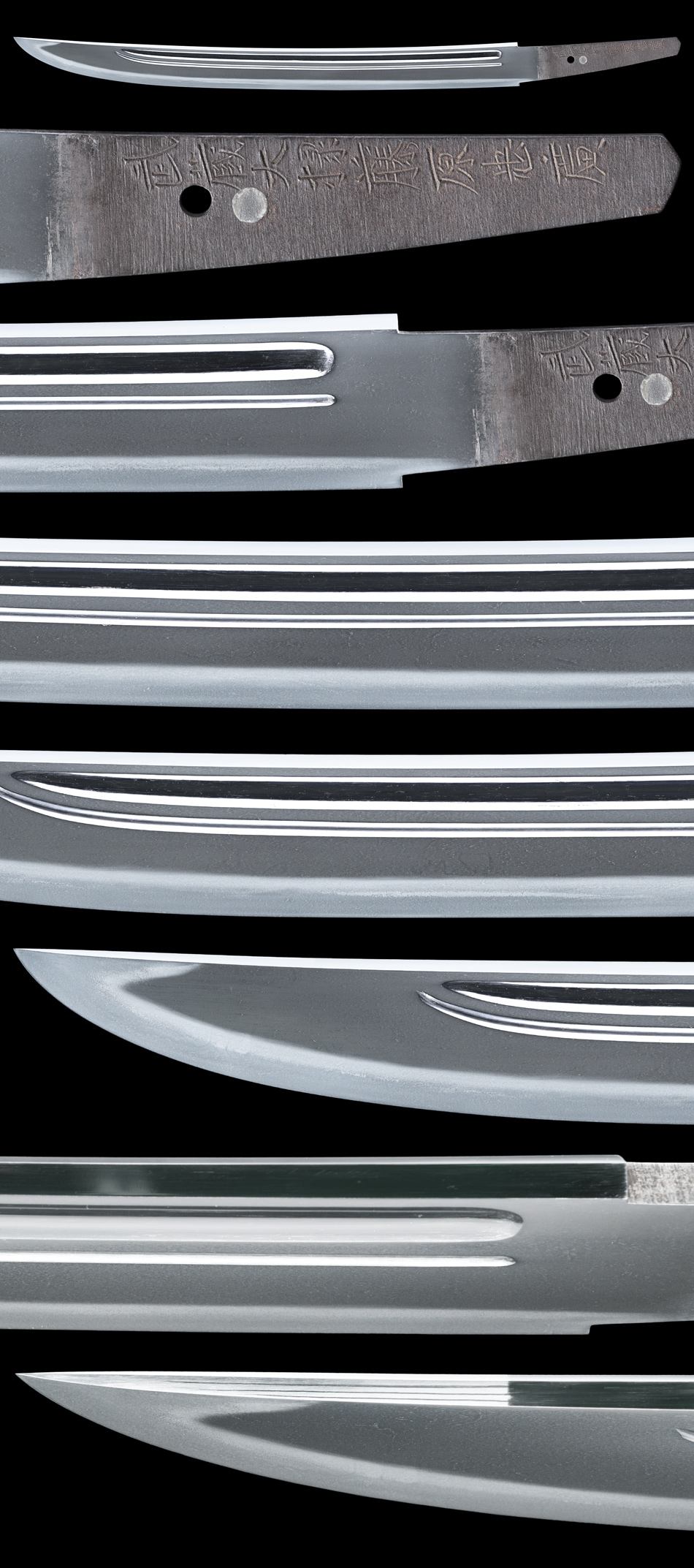
Machine translation from the shop's Japanese · may contain errors ·
Shinto · Hizen · Early Edo
Fujishiro Jo-jo saku · Tōken Taikan top 21%
1 piece on the market now
Tosa no Kami Tadayoshi occupies a position of singular ambiguity within the Hizen tradition. The NBTHK setsumei observe that "there are many competing theories, and it remains uncertain who he actually was," though "there is no doubt that he stood in a very close relationship to the first-generation Tadayoshi." It is transmitted that when the first-generation Tadayoshi changed his name to Tadahiro in Kan'ei 1 (1624), the Tadayoshi signature was transferred to this smith, who subsequently received the court titles Tosa no Jo and then Tosa no Kami. The third-generation Mutsu no Kami Tadayoshi, the legitimate heir of the second-generation Omi no Daijo Tadahiro, predeceased his father, and surviving works by both Tosa no Kami and Mutsu no Kami are comparatively rare.
Across extant designations, the hallmarks of the Hizen school are consistently evident. The kitae ranges from tightly forged ko-itame-hada with well-adhering ji-nie to dense ko-itame of fine quality. The hamon encompasses both spirited midare-ba -- including choji mixed with gunome and ko-gunome, with deep nioi and well-adhering ko-nie and sunagashi -- and the vigorous choji-midare with intermingled tobiyaki characteristic of the school's more animated works. Blades attributed before the receipt of the Tosa title display particularly fine workmanship, with the jigane described as "well-forged and tightly refined."
The setsumei emphasize both the rarity and the scholarly value of these works. The Kan'ei 1 dated blade is described as "extremely valuable material for the study of Hizen swords," as it sits at the precise moment of the name transfer from first-generation to successor. Among the broader Hizen tradition, naginata by any generation are noted as "few in number," lending additional significance to the third-generation's contribution in that form. Across all attributions, the consistent refinement of both ji and ha affirms the intimate continuity linking these smiths to the founding standards of the Hizen school.
Where Tosa no Kami Tadayoshi stands among comparable artisans: across all of nihontō, and within tradition, era, and period. The tiers (Foremost · Leading · Major · Notable) weigh official designations from the NBTHK and Japan's Agency for Cultural Affairs, together with historical honors of lasting repute such as the Sansaku and Meibutsu-chō.
Select a lens to see how it's measured.
Years he was demonstrably active, proven by signed-and-dated blades
Shinto · Hizen
109 pieces on the market now
The Hizen school began with a single domain commission. In Keicho 1 (1596) the Nabeshima of Hizen ordered Hashimoto Shinzaemon, the smith who would sign Tadayoshi, up to Kyoto with the carver Munenaga; there he entered the gate of Umetada Myoju and studied forging while Munenaga learned the chisel. The two returned to the province in Keicho 3 (1598), and Tadayoshi settled in the castle town below Saga, where under the domain's patronage the line grew into the dominant sword-making house of Kyushu. His own work runs from Keicho 5 (1600) to his death in Kan'ei 9 (1632); in Genna 10 (1624) he received the court title Musashi Daijo, changed his name to Tadahiro, and shifted his clan name from Minamoto to Fujiwara, so that the late Musashi Daijo blades are the founder under a second name. From him the house became a true generational institution: his son the second-generation Omi Daijo Tadahiro carried it forward as its most prolific hand, the third-generation Mutsu no Kami Tadayoshi returned its highest finish, and a Tosa no Kami branch took the founder's signature when he set it aside. Around this main line grew a circle of disciples and collateral hands, the waki-Hizen or Soba-Hizen smiths, several of them, like Yoshiie and Hironori, working as daisaku substitute makers whose own signed pieces are therefore scarce. The school's signature is its steel. Over a ko-itame forged so tightly it shows no slackness, fine ji-nie gathers in minute particles until the surface takes on the rice-bran konuka-hada (also written komenuka-hada) that no other school produces, fine chikei entering throughout and the ji notably clear and bright.
The orthodox temper laid upon it is a chu-suguha or hiro-suguha, sometimes tinged with a shallow notare and ko-gunome, the nioiguchi deep with finely clustered ko-nie and tightened to a bright clarity, the boshi running straight to a quiet ko-maru. The founder aimed this suguha toward the Rai school yet departed from it, his nioiguchi tighter and his forging carrying more vigor; the third generation refined it to what the published sources call the strongest and most precise hand of the first three generations. Against that calm register the house also worked a showier one, the Hizen choji-midare mixing gunome, long ashi, kinsuji and sunagashi, a manner the published sources already find more often in the founder's late Musashi Daijo work than in his Tadayoshi years, and one the second generation made his own. The branches pushed further from the suguha standard: Tadakuni of the Ogi domain ran sunagashi more conspicuously than any other Hizen hand and reached toward old Ichimonji in his o-choji; Masahiro and Yukihiro favored a flamboyant long-ashi choji over the calm main line; and the Iyo no Jo Munetsugu line worked apart in the Soshu-den, building a midareba on notare with a pointed togariba and a jihada that tends to stand and tone slightly blackish. A collector seeks Hizen-to first for that steel, and reads it the same way the appraiser does: a bright suguha lying over a clear, tight konuka-hada identifies the school before the signature is consulted, and the quiet ko-maru boshi on the ura-signed tang confirms the main-line practice. Generation and branch are then told within that frame, the third generation's powerful sugata recalling not his father but his grandfather, the waki-Hizen hands set apart by their irregular temper, their sujikai file marks and a sashi-ura signature, the Munetsugu line by its Soshu togari. The main line, made in real numbers across so long a span, reaches the market more readily than any Kamakura master, so a papered example is within reach of a patient collector, while the founder's own work and the finest konuka-suguha of the third generation come to open hands only from time to time. Provenance runs back through the house the school served, blades recorded to Nabeshima Katsushige and Nabeshima Naomoto and passing onward to the Owari Tokugawa, the Satake and the Imperial families; documentary inscriptions sharpen the picture further, a Myoju soemei attesting the founder's discipleship, Umetada carving adding flowers to brocade on his late blades, and the gold-inlaid cutting tests of Yamano Kanjuro and Yamano Ka'emon, rare on Hizen work, naming the edge as well as the hand. Learn more →
| Smith | Era | Designated |
|---|---|---|
| Tadayoshi忠吉 | 1596-1632 | 155 |
| Tadayoshi忠吉 | 1660-1686 | 61 |
| Tadahiro忠廣 | 1633-1693 | 133 |
| Masahiro正廣 | 1624-1655 | 30 |
| Tadakuni忠國 | 1648-1652 | 32 |
Hizen: a domain enterprise
Hizen swords were a domain enterprise: the Nabeshima sent Tadayoshi to study under Umetada Myōju around 1596, then built a licensed school around him. Nine generations carried its famously consistent konuka-hada work into the Meiji era.
A Hozon-certified blade judged to show notably superior workmanship and a better state of preservation. The bar is higher: re-tempered blades and most unsigned Muromachi/Edo works are excluded.
The NBTHK (Nihon Bijutsu Tōken Hozon Kyōkai, the Society for the Preservation of Japanese Art Swords) is a public-interest incorporated foundation founded in 1948 and supervised by Japan’s Agency for Cultural Affairs (Bunkachō); it is based at the Japanese Sword Museum in Tokyo. Its expert panels physically examine each submitted work (shinsa) and issue a certificate (kanteishō) ranking it by artistic and historical merit. NBTHK papers are the most widely recognized standard of authentication for Japanese swords and fittings.
NBTHK official siteNo cooling-off period or returns; refund only if the purchased sword is proven fake, capped at purchase price (excludes commission sales, accessories, auction items).