Perry’s arrival in 1853 unraveled the Tokugawa peace and created the first mass demand for working swords in two centuries. Kiyomaro, called the Masamune of Yotsuya, died on its eve; Munetsugu and Yukihide carried the boom to the end.
 NihontoWatchNihontoWatch
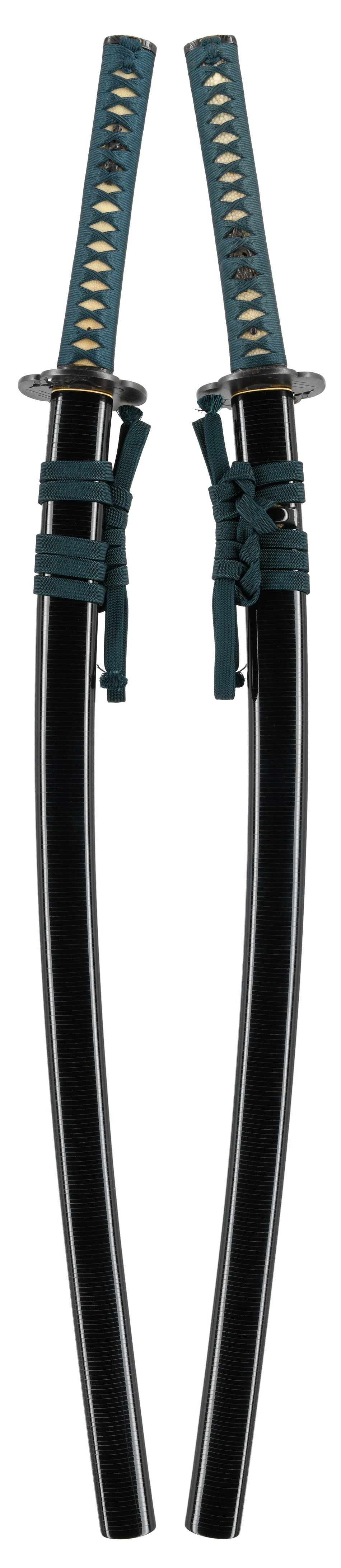
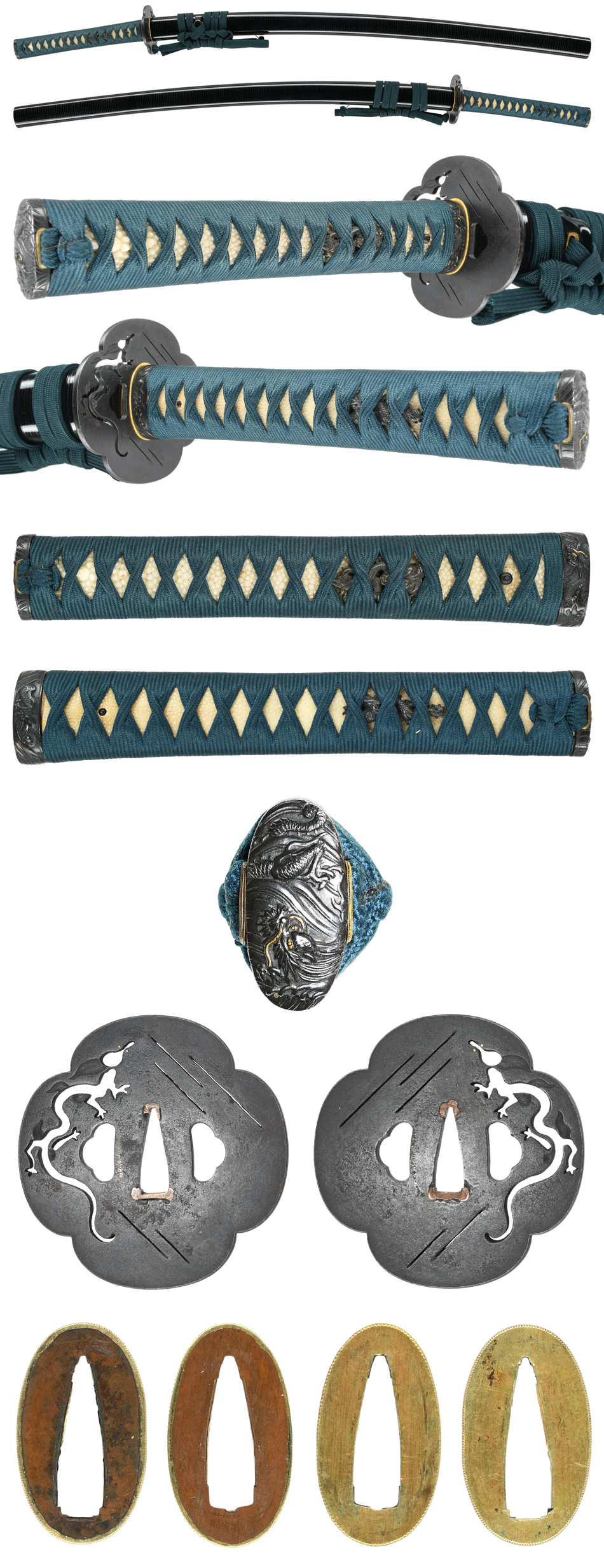
Stock number:KA-010323Paper(Certificate): [N.B.T.H.K]Tokubetsu Hozon TokenCountry・Period:Musashi(Tokyo)・Late Edo period 1851Blade length(Cutting edge): 69.8cmCurve(SORI): 2.2cmWidth at the hamachi(Moto-Haba): 3.06cmThickness at the Moto-Kasane: 0.72cmWide at the Kissaki(Saki-Haba):2.40cmThickness at the Saki-Kasane: 0.55cmHabaki: One parts, silver foil HabakiLength of Koshirae : About 98cmSword tang(Nakago): Unaltered,Sujikaiyasuri with Keshoyasuri file patternRivet Holes(Mekugiana): 1Shape(Taihai): Shinogizukuri,Iorimune,Chu-kissakiJigane(Hada): Ko-itameTemper patterns(Hamon): Gunome-choji-midareTemper patterns in the point(Bohshi): Midarekomi then komaru round tipRegistration Card: Ibaraki【Additional Information】備前介藤原宗次(固山宗次)は、享和三年(1803年)奥州白河(現 福島県)に生まれました。俗名を宗兵衛(惣兵衛)といい、兄に宗平・宗俊がいます。銘には精良斎、一専斎とも号します。同工は初め白河松平家の抱え工でしたが、天保頃に出府して加藤綱英の門人となり、桑名藩工として江戸麻布永坂四谷左門町にて鍛刀しました。師である加藤綱英の他、同門の加藤綱俊にも影響を受けていたとされます。弘化二年(1846年)に備前介を受領し、明治初年頃までの作品が確認されています。茎鑢目は安政七年より切に改めています。作風のほとんどが得意の備前伝で、新々刀上々作に位列する大変著名な刀工です。本刀体配は、刃長が二尺三寸強。身幅重ね尋常に、鎬筋が凛とし、反りよく利き、フクラ豊かに、やや延び心の中切っ先となる優美な刀姿です。地鉄は良く練られた小板目肌で、欠点なく総体キメの細かい精良な鍛えを呈します。刃文は匂出来の互の目丁子が高低を付けながら派手やかなに乱れます。小沸良く付き、匂口極めて明るく、眩いほどに輝きを放ちます。刃中には足が盛んに働きます。帽子は乱れの勢いを抑えて先小丸へ返ります。茎には丁寧な化粧鑢がかかり、刀工銘と年紀を刻します。拵は金具が波濤龍図、鞘は黒呂笛巻となり、手が込んだ優品が附いております。本作は澄んだ潤いのある地鉄に、同工が得意とする互の目丁子刃文が華やかに咲き誇る、誠に美麗な固山宗次の傑出の一口です。白鞘、銀一重鎺、黒呂笛巻塗鞘打刀拵、特別保存刀剣鑑定書。新々刀大鑑所載。
NihontoWatchOffered by World Seiyudo
This piece has sold
Get an email when a new Koyama Munetsugu piece hits the market.

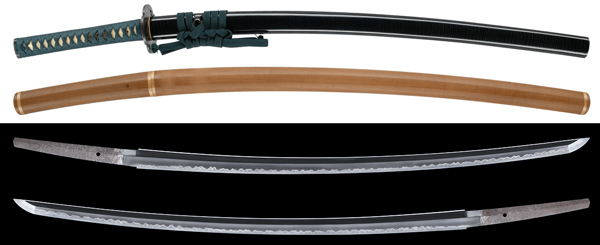

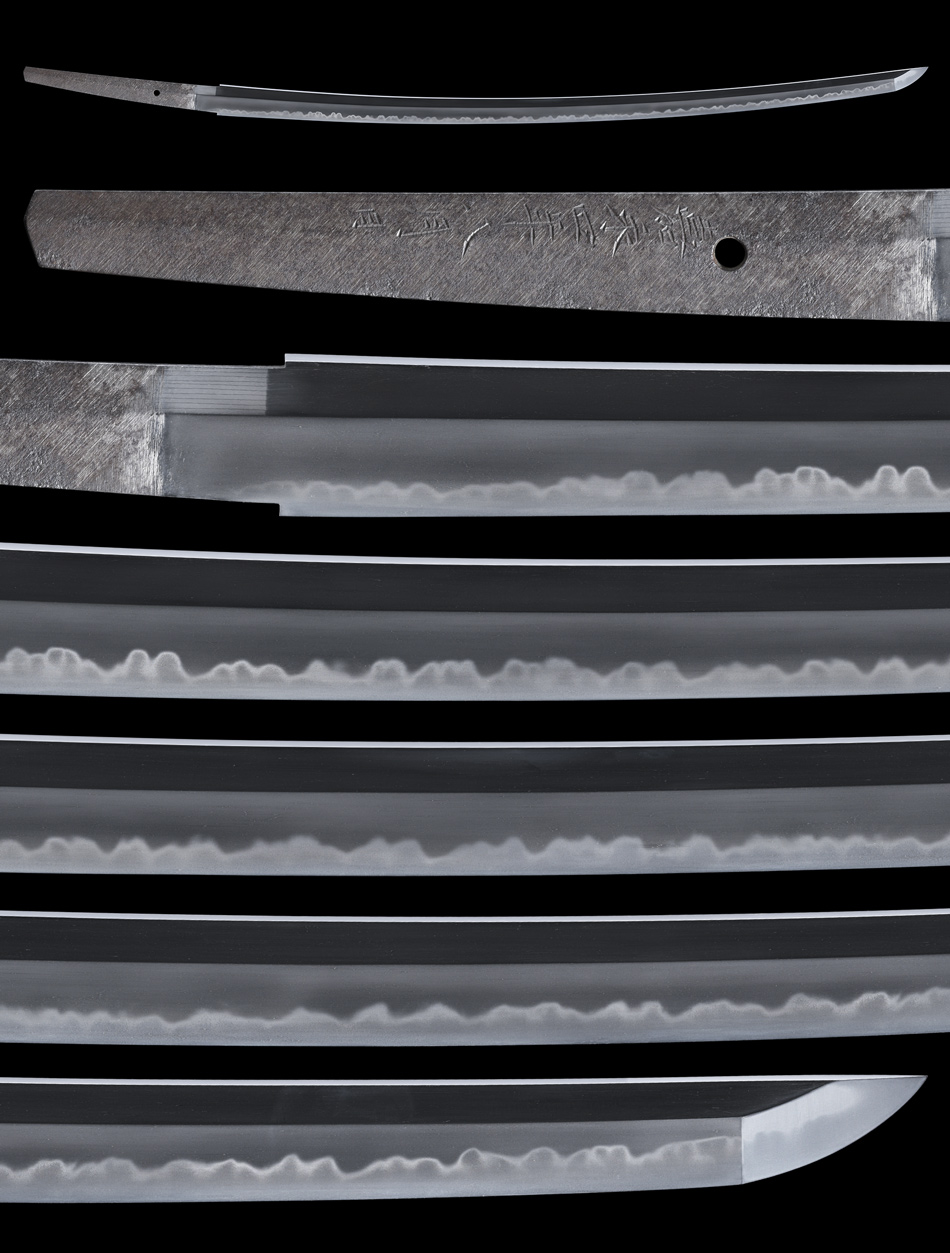
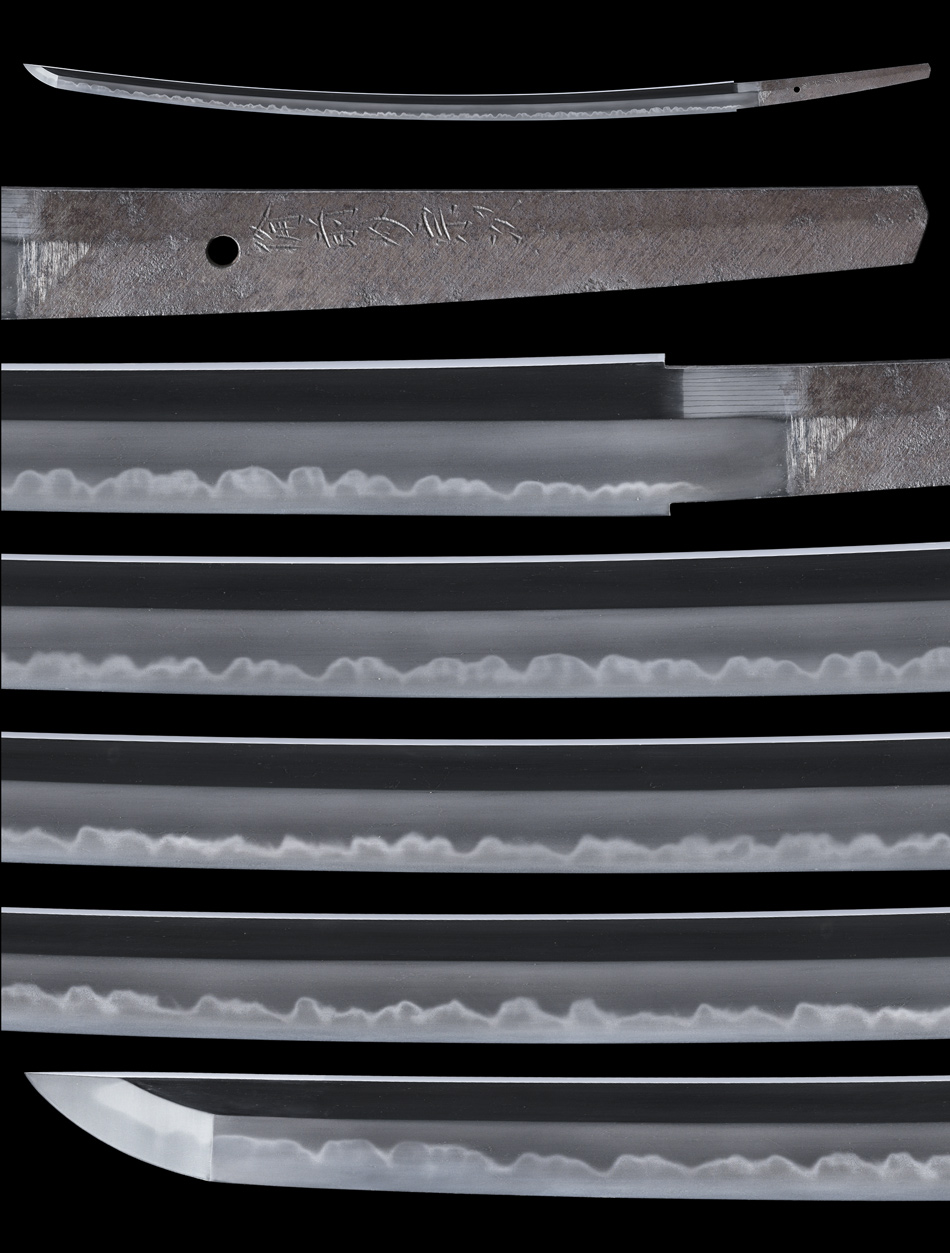
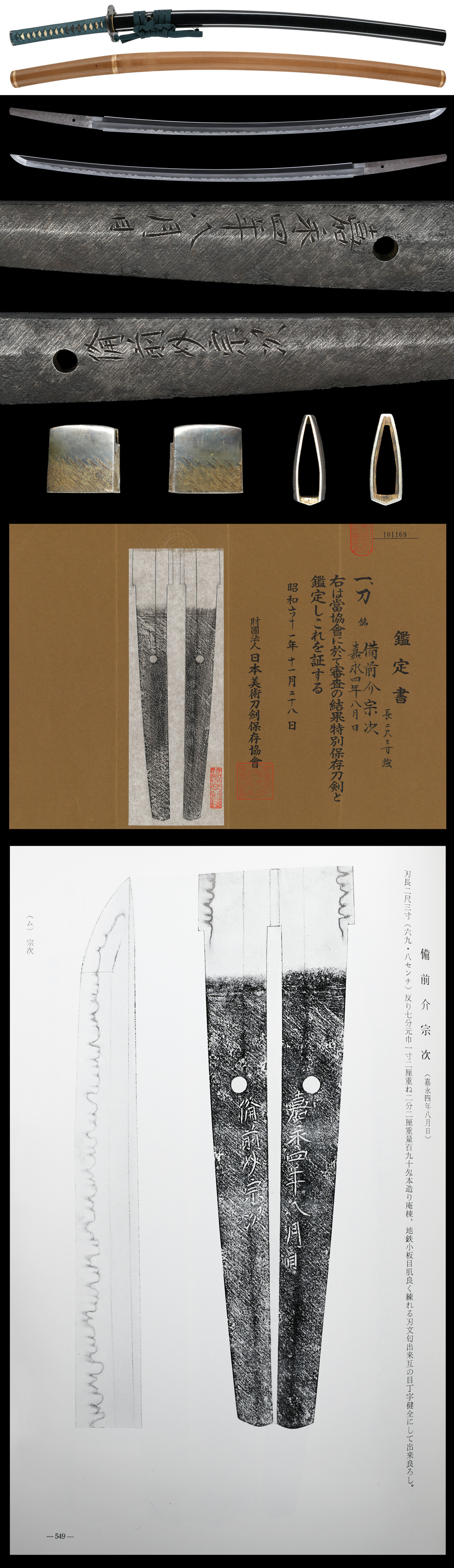
Koyama Munetsugu (shinshinto Bizen-den, Shirakawa / Edo) · Musashi · around 1830-1870
Fujishiro Jo-jo saku · Tōken Taikan top 17%
5 pieces on the market now
Koyama Munetsugu was born in Kyowa 3 (1803) at Shirakawa in Oshu, common name Sobe, with the art names Issensai and Seiryosai. The published sources record that his teacher is said to have been Kato Tsunahide of Yonezawa, but add that, judging from his manner of work, "the influence of the younger brother Kato Tsunatoshi was rather the greater"[[c:1]]. He served first the Matsudaira house of Shirakawa, and when that domain was transferred he became a smith for the Kuwana fief in Ise, living in Edo at Azabu Nagasaka. In Koka 2 (1845) he received the title Bizen no Suke. He worked from the latter half of the Bunsei era into the early Meiji years, signing as Nishiyama, as Koyama, and as Bizen no Suke Fujiwara Munetsugu, and the sources note that his surviving works are extremely numerous. They sum up his career in one phrase: "his style was consistently Bizen-den"[[c:2]].
His characteristic hand is a choji and gunome-choji in the Bizen manner. He sets choji mixed with gunome, pointed elements, ko-choji and ko-gunome, with ashi entering long and well, and one entry likens a gunome-choji of his to the manner of Bizen Kanemitsu. The temper is nioi-dominant with ko-nie adhering, and what the published sources return to most often is the nioiguchi: bright and clear on the majority of his blades, and on a number of them described as tight as well. On one Tenpo katana finished in his showiest vein, the sources write that he has "finished it in a midareba more flamboyantly choji-dominant than usual"[[c:3]], noting kinsuji in the upper half and a bright nioiguchi.
The jigane is his other constant. His usual jigane is a well-packed ko-itame, so finely forged that it often looks almost plain, with fine ji-nie and at times fine chikei. The published sources summarise his success on exactly these two elements together, saying that "over a well-packed, beautiful forging he tempers a nioi-dominant choji-midare, and succeeds"[[c:4]]. The boshi runs in midare-komi to a ko-maru turnback, at times pointed with hakikake. Carving, where present, is a bo-hi or a paired groove, sometimes with bonji, goma-bashi, kurikara or a sacred invocation, and his son Yoshitsugu supplied the carving on some blades.
Besides his mainline he was a deliberate copyist. Of one daisho the published sources say that "this daisho is typical of Munetsugu's copy-work"[[c:5]]: the katana takes Sue-Bizen, especially Yosozaemon no Jo Sukesada, as its model, and the wakizashi copies the Oei-Bizen masters Morimitsu and Yasumitsu, succeeding in producing utsuri. A wakizashi of Tenpo 11 copies the large hocho-shaped blade attributed to Masamune that is a treasure of the Egara shrine in Kamakura, and was dedicated at the Shiba Shinmei shrine in Edo. A separate vein is the broad, long blades of the Tenpo years, wide in body with a thick kasane, in which the jigane departs from his usual tight grain into an itame mixed with mokume and flowing grain, standing and with ji-nie and chikei. The sources say this is often seen in his Tenpo work. A quieter suguha register survives as well but is rare.
His place in the bakumatsu rests on the completeness of his Bizen revival and on the documentary richness of his blades. The sources note that he "seems to have been well known as a master of Bizen-den"[[c:6]], and he forged a daisho at the command of the lord of Koga. Many of his blades carry cutting-test inscriptions by the Yamada house, tried at Senju and elsewhere. One katana was forged at the command of Lord Date Munenari of Uwajima from the ring-iron of a foreign ship, an inscription the sources call "precious also for the history of the bakumatsu"[[c:7]]. His bright choji-midare over a near-plain ko-itame sets his work apart from the deeper, softer nioiguchi of the Kamakura blades he studied.
For the collector Munetsugu is a signed and abundant master rather than a rarity. Fujishiro grades him Jo-jo saku. He has no National Treasures and no Important Cultural Properties; his standing on the designation record runs through the Juyo rank, where fifty-two of his works are held, all signed, the broad choji-midare katana named his typical and representative work. His recorded provenance reaches the lord of Koga and a Koga retainer, Matsudaira Chikanai of the Shonai domain, and Lord Date Munenari of Uwajima. Because so many were made and so many survive, a signed and dated Munetsugu of good workmanship comes to market from time to time, and remains one of the more attainable ways for a collector to hold a documented, cutting-tested bakumatsu Bizen-den blade.
Where Munetsugu stands among comparable artisans: across all of nihontō, and within tradition, era, and period. The tiers (Foremost · Leading · Major · Notable) weigh official designations from the NBTHK and Japan's Agency for Cultural Affairs, together with historical honors of lasting repute such as the Sansaku and Meibutsu-chō.
Select a lens to see how it's measured.
Years he was demonstrably active, proven by signed-and-dated blades
Shinshinto · Musashi
18 pieces on the market now
Born in Kyōwa 3 (1803) at Shirakawa in Ōshū, Koyama Munetsugu (固山宗次) carried a smith's name read variously in the setsumei as Munobei or Sōbei, working under the art-names Issensai and Seiryōsai. He came up alongside elder brothers Munehira and Munetoshi, and although his teacher is traditionally given as Katō Tsunahide, the NBTHK readers repeatedly note that the hand of Katō Tsunatoshi shows through his work more plainly. He first served the Matsudaira house of Shirakawa as a retained smith; when that domain was transferred to Kuwana in Ise, he settled in Edo at Azabu Nagasaka and forged as a Kuwana domain smith. In Kōka 2 (1845) he received the court title Bizen no Suke, the signature Bizen no Suke Fujiwara Munetsugu recurring on the dated katana from that point. His production runs from the latter half of Bunsei into the early Meiji years, and the program it serves is the Bakumatsu fukko revival of Bizen-den: a deliberate return, from an Edo workshop, to the chōji tempering of the old Bizen masters. The shared idiom is consistent across the line. Construction tends to a wide mihaba, thick kasane, shallow sori and an extended chū-kissaki or ō-kissaki, giving the heavy-in-hand shinshintō bearing the readers call taihai. The ground is a tightly packed ko-itame, sometimes flowing toward nagare or masame, carrying extremely fine mijin-grade ji-nie and frequent chikei; faint utsuri rises on a number of blades.
The temper is the heart of the recognition: a nioi-dominant chōji-midare or gunome-chōji, with ko-chōji, togariba and angular heads mixed in, long ashi and yō entering, fine sunagashi and kinsuji, and a bright, clear nioiguchi. To read his hand, the setsumei flag particular chōji shapes (the kawazuko tadpole-head and the kobushi fist-shaped chōji clustered near Keiō-dated work), a midare-komi bōshi turning in ko-maru with hakikake, and the bold, thick-chiseled signatures with prominent chisel-pillows. Cutting-test inscriptions are common, several tied to the connoisseur Iga Norishige, who is recorded learning swordmaking from Munetsugu. His pupils carry the same vocabulary: Tairyūsai Sōkan (宗寛, also Munekane), son of Ōno Heizō and later a Koga/Furukawa domain smith, whose blades add a faint midare-utsuri and a smaller-pattern late temper; and the likely student Kongōsai Munehiro, who copied the same shrine original his master did. For kantei, the discriminating points are the orderly yet varied chōji arrayed shoulder-to-shoulder, the nie-laden Tenpō-era pieces whose habuchi has not yet settled, and a deliberate allusion to the second-generation Kunisuke when kobushi-like chōji appear. The named works root the line in documented copying: an utsushi of the National Treasure Koryū Kagemitsu, reconstructed to its original ubu state with kurikara and bonji carved by Sōkan; and a Tenpō 11 (1840) wakizashi copying the hōchō-shaped Masamune of Egara Tenmangū in Kamakura, carved by Tōryūsai Seiju and dedicated by Nomura Toshikatsu, a rare pairing of two Edo masters. Provenance inscriptions name patrons such as Miyake Takuma and the Furukawa domain on the Sōkan side. Across the NBTHK register, the work stands as a disciplined Edo restatement of the Bizen chōji tradition, prized for the brightness of its nioiguchi and for the documentary value of its dated, commissioned and trial-cut tangs. Learn more →
| Smith | Era | Designated |
|---|---|---|
| Munetsugu宗次 | 1830-1870 | 52 |
| Sokan宗寛 | 1850-1868 | 5 |
Bakumatsu: the last war market
Perry’s arrival in 1853 unraveled the Tokugawa peace and created the first mass demand for working swords in two centuries. Kiyomaro, called the Masamune of Yotsuya, died on its eve; Munetsugu and Yukihide carried the boom to the end.
A Hozon-certified blade judged to show notably superior workmanship and a better state of preservation. The bar is higher: re-tempered blades and most unsigned Muromachi/Edo works are excluded.
The NBTHK (Nihon Bijutsu Tōken Hozon Kyōkai, the Society for the Preservation of Japanese Art Swords) is a public-interest incorporated foundation founded in 1948 and supervised by Japan’s Agency for Cultural Affairs (Bunkachō); it is based at the Japanese Sword Museum in Tokyo. Its expert panels physically examine each submitted work (shinsa) and issue a certificate (kanteishō) ranking it by artistic and historical merit. NBTHK papers are the most widely recognized standard of authentication for Japanese swords and fittings.
NBTHK official siteNo cooling-off period or returns; refund only if the purchased sword is proven fake, capped at purchase price (excludes commission sales, accessories, auction items).