 NihontoWatchNihontoWatch
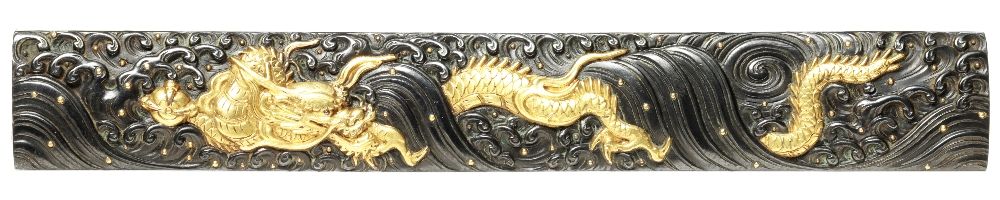
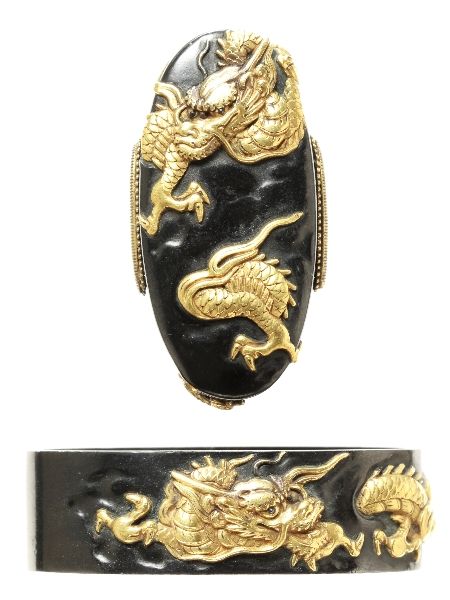
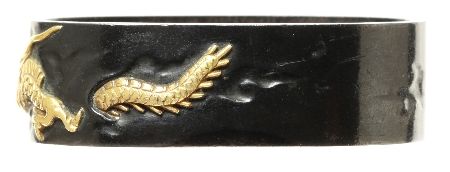
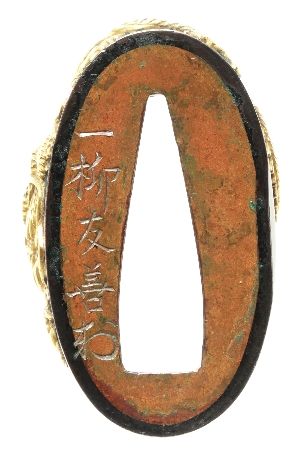
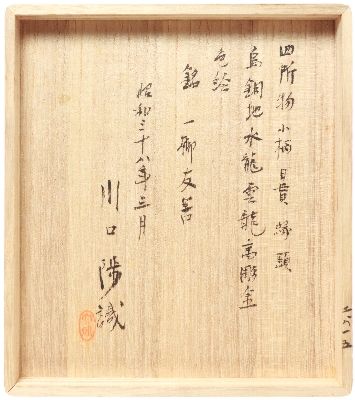
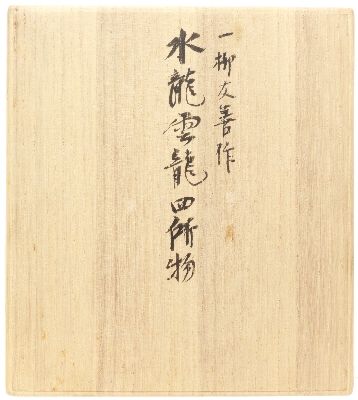
Fuchigashira: Sig. Ichiryu TOMOYOSHI (Kao) Fuchigashira: Sig. Ichiryu Tomoyoshi(Kao) Calligraphy on the Kiri box, written by Kawaguchi Wataru 覇気に富んだ龍神図装剣小道具で遍く知られる一柳友善の揃金具。光沢の強い漆黒の赤銅地を高肉に彫り表したこの揃い物は、龍神が天上へと昇らんとしている場面を表現したもの。 取りし、髭、眼窩の窪んだ目、胴体を包む鱗や鰭の線を鋭く彫り出している。小柄は珠を掴み波を掻き分けて進む龍で、正確な描写の高彫に鮮やかな金色絵。縁頭は雲間を天上目がけて昇る龍神。量感のある高彫に細部まで細やかな鏨を切り込み、濃密な金の色絵を施している。いずれも目玉に光沢があり、精気に包まれている。
NihontoWatchOffered by Choshuya
This piece has sold
Get an email when a new Mito Tomoyoshi piece hits the market.





Mito Tomoyoshi
Edo
Hitachi
Signed
Tokuho (NBTHK)
Machibori · Hitachi · around 1716-c.1920
6 pieces on the market now
Where Tomoyoshi stands among comparable artisans: across all of nihontō, and within tradition, era, and period. The tiers (Foremost · Leading · Major · Notable) weigh official designations from the NBTHK and Japan's Agency for Cultural Affairs, together with historical honors of lasting repute such as the Sansaku and Meibutsu-chō.
Select a lens to see how it's measured.
Machibori · Hitachi
73 pieces on the market now
The Mito school of sword-fitting makers emerged as an officially sponsored tradition in the domains of the Tokugawa family's Mito branch, achieving particular prominence in the late Edo period. The school's lineage traces through Shinozaki Katsushige and his successors, who served as goyō horimonoshi (official engravers) to the domain. Unlike the privately patronized workshops of Edo and Kyoto, Mito metalworkers operated within a system of domain service, producing both presentation fittings for formal occasions and richly decorated works for commission. This institutional foundation fostered both technical rigor and stylistic continuity, as masters such as Hagiya Katsuhei and his pupils transmitted the school's methods through direct apprenticeship. The Mito aesthetic is characterized by meticulous shakudō nanako-ji grounds upon which high-relief carving (takabori) is combined with precise gold and silver iroe to yield compositions of exceptional textural depth. The school showed particular mastery in figural subjects—immortals, deities, and mythological beasts—rendered with close attention to anatomical realism and dynamic poses.
The nanako punch-work is notably disciplined, each grain laid in orderly arrangement, while the relief carving rises to striking heights, with elements such as lion manes and peony petals executed in fully three-dimensional chiselwork. Color inlays are applied with exacting accuracy, and thematic coordination across entire fitting sets demonstrates a sophisticated understanding of decorative unity. The Mito school's influence extended well into the Meiji period through the achievements of second-generation masters. Hagiya Katsuhei's circle produced such celebrated artists as Namekawa Sadakatsu and Unno Shōmin, who carried the school's technical standards and stylistic vocabulary into new contexts. The tradition's emphasis on figural carving, inherited from the Tamagawa lineage, and its adherence to orthodox forms for formal presentation fittings established the Mito school as one of the principal regional traditions of late-period Japanese sword-fitting production. Learn more →
| Smith | Era | Designated |
|---|---|---|
| Katsuhira勝平 | 1804-1886 | 13 |
| Shomin勝珉 | 1844-1915 | 12 |
| Teikan貞幹 | — | 5 |
| Mototane元胤 | — | 0 |
| Unno Bishu海野美秋 | — | 0 |
A Hozon-certified blade judged to show notably superior workmanship and a better state of preservation. The bar is higher: re-tempered blades and most unsigned Muromachi/Edo works are excluded.
The NBTHK (Nihon Bijutsu Tōken Hozon Kyōkai, the Society for the Preservation of Japanese Art Swords) is a public-interest incorporated foundation founded in 1948 and supervised by Japan’s Agency for Cultural Affairs (Bunkachō); it is based at the Japanese Sword Museum in Tokyo. Its expert panels physically examine each submitted work (shinsa) and issue a certificate (kanteishō) ranking it by artistic and historical merit. NBTHK papers are the most widely recognized standard of authentication for Japanese swords and fittings.
NBTHK official siteIf, due to our fault, the item differs significantly from its proper condition, the item may be returned. Cooling-off is within one week of the item's arrival.