Swordsmith Shigemasa, whose given name was Hiroshi, was born in Meiji 38 in Shizuoka City. In Taisho 10, he became a disciple of the master of toshin chokoku, Kasama Shigetsugu, and after inheriting those techniques, he became independent in Showa 7. During and after the war, he worked in the Bizen-den and Soshu-den styles, seeking harmony between ancient traditions and the modern era through pure yakiba such as flamboyant choji midare and gunome midare, combined with his specialty of toshin chokoku, which fascinated many sword lovers.
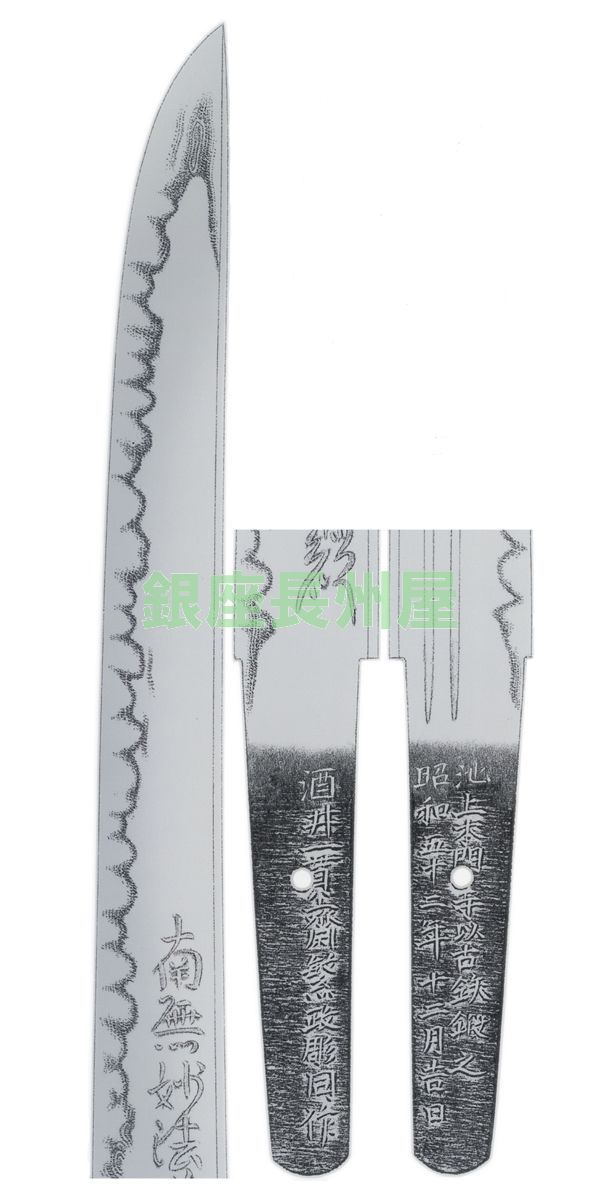
This tanto is a superior work by the master of carving, Shigemasa, featuring the Odaimoku in sosho style on the omote, and on the ura, Sanskrit characters representing Fudo Myoo and Dainichi Nyorai along with gomahashi, one of the ritual implements, expressed with two simple engraved lines. The dimensions are slightly elongated with a slight sori, and it is well-balanced from the nakago-jiri to the kissaki. The finely packed itame-kitae jigane hides delicate chikei within the depths, possessing a sense of dynamism and a bright texture that reflects light clearly. The hamon is a neat Bizen-den gunome midare with the yakigashira rising and falling gently; the boshi, which is a small midare-komi, has a tama fired at the tip on the ura and returns, with the mune around the monouchi fired very shallowly. The yakiba, with a nioiguchi that is slightly urumi, has a flowing scenery of delicate hotsure at the habuchi in the lower half, with yubashiri appearing around the monouchi where nie grains shine vividly, and slightly sakagakatta ko-ashi pierce sharply into the clear ha-chu with nioi.
Since the early modern period, there are many examples of swordsmiths refining steel from nails and other materials used in historic old shrines and temples to create sword materials for the reproduction of ancient masterpieces. This work uses old nails and other materials from Ikegami Honmonji (Note), and it can be said to be a precious work made by refining Kamakura period steel. ,br>
Note... Ikegami Honmonji is the Daihonzan of the Nichiren sect located in Ota Ward, Tokyo. Incidentally, the Sanmon (former National Treasure), which was destroyed in an air raid, was rebuilt as the Niomon in Showa 52.
Machine translation from the shop's Japanese · may contain errors ·
Swordsmith Shigemasa, whose given name was Hiroshi, was born in Meiji 38 in Shizuoka City. In Taisho 10, he became a disciple of the master of toshin chokoku, Kasama Shigetsugu, and after inheriting those techniques, he became independent in Showa 7. During and after the war, he worked in the Bizen-den and Soshu-den styles, seeking harmony between ancient traditions and the modern era through pure yakiba such as flamboyant choji midare and gunome midare, combined with his specialty of toshin chokoku, which fascinated many sword lovers.
This tanto is a superior work by the master of carving, Shigemasa, featuring the Odaimoku in sosho style on the omote, and on the ura, Sanskrit characters representing Fudo Myoo and Dainichi Nyorai along with gomahashi, one of the ritual implements, expressed with two simple engraved lines. The dimensions are slightly elongated with a slight sori, and it is well-balanced from the nakago-jiri to the kissaki. The finely packed itame-kitae jigane hides delicate chikei within the depths, possessing a sense of dynamism and a bright texture that reflects light clearly. The hamon is a neat Bizen-den gunome midare with the yakigashira rising and falling gently; the boshi, which is a small midare-komi, has a tama fired at the tip on the ura and returns, with the mune around the monouchi fired very shallowly. The yakiba, with a nioiguchi that is slightly urumi, has a flowing scenery of delicate hotsure at the habuchi in the lower half, with yubashiri appearing around the monouchi where nie grains shine vividly, and slightly sakagakatta ko-ashi pierce sharply into the clear ha-chu with nioi.
Since the early modern period, there are many examples of swordsmiths refining steel from nails and other materials used in historic old shrines and temples to create sword materials for the reproduction of ancient masterpieces. This work uses old nails and other materials from Ikegami Honmonji (Note), and it can be said to be a precious work made by refining Kamakura period steel. ,br>
Note... Ikegami Honmonji is the Daihonzan of the Nichiren sect located in Ota Ward, Tokyo. Incidentally, the Sanmon (former National Treasure), which was destroyed in an air raid, was rebuilt as the Niomon in Showa 52.
The twentieth century nearly killed the craft twice: wartime distortion, then the occupation ban. The NBTHK’s founding in 1948 and licensed forging from 1953 rebuilt the sword as an art, crowned by Living National Treasures and the mukansa rank.
Certifies a genuine blade worth preserving: a signature confirmed correct, or, if unsigned, an era, province, and school that the NBTHK can reliably identify.
About the NBTHK›
The NBTHK (Nihon Bijutsu Tōken Hozon Kyōkai, the Society for the Preservation of Japanese Art Swords) is a public-interest incorporated foundation founded in 1948 and supervised by Japan’s Agency for Cultural Affairs (Bunkachō); it is based at the Japanese Sword Museum in Tokyo. Its expert panels physically examine each submitted work (shinsa) and issue a certificate (kanteishō) ranking it by artistic and historical merit. NBTHK papers are the most widely recognized standard of authentication for Japanese swords and fittings.
If, due to our fault, the item differs significantly from its proper condition, the item may be returned. Cooling-off is within one week of the item's arrival.






 NihontoWatch