The twentieth century nearly killed the craft twice: wartime distortion, then the occupation ban. The NBTHK’s founding in 1948 and licensed forging from 1953 rebuilt the sword as an art, crowned by Living National Treasures and the mukansa rank.
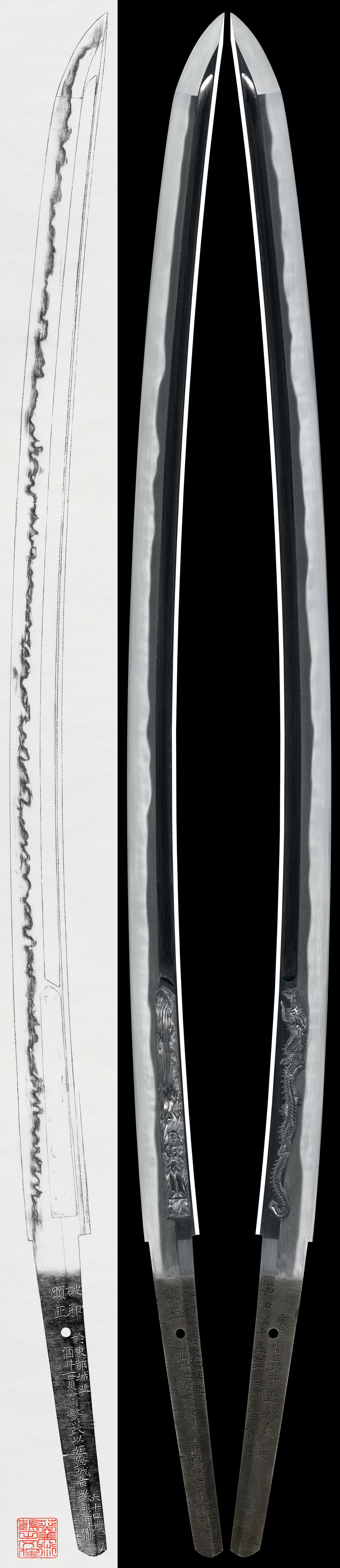
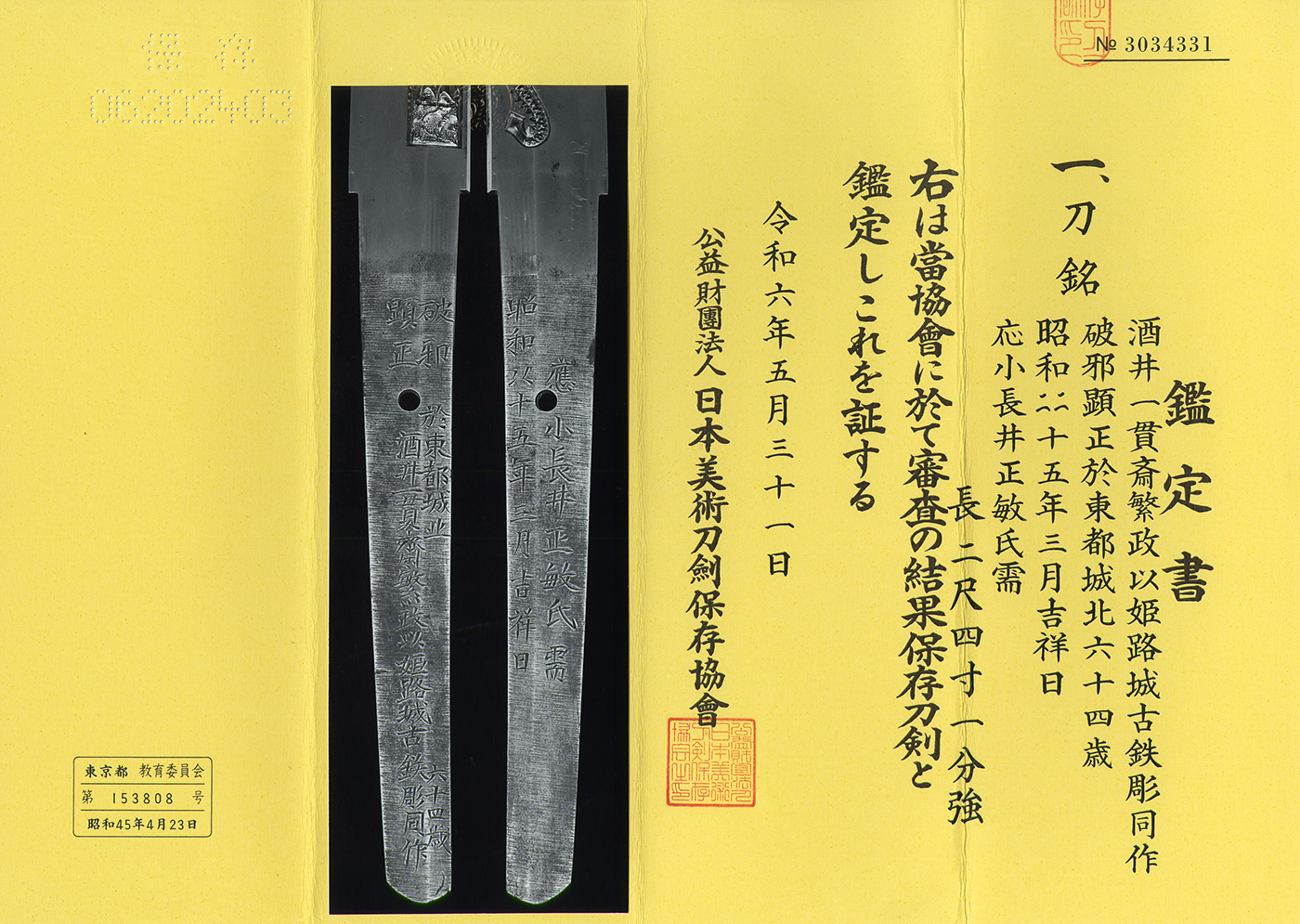
Katana in Shirasaya (NBTHK Hozon Token) (We divide 4 sections for each sword as Saijyo Saku, Jyojyo Saku, Jyo Saku and Regular Saku). This blade is ranked as Jyo Saku among the works of Sakai Ikkansai Shigemasa. Shape: A blade with a wide mihaba and standard kasane. Bo-hi are carved on both sides of the blade. The front features a magnificent horimono of Fudo Myo-o surrounded by flames, while the reverse side is carved with a dragon. Jigane: Beautifully refined and well-forged ko-itame hada, displaying exceptionally fine steel. Hamon: Ko-nie-deki gunome-midare with a relatively deep nioiguchi and well-defined ashi. Features: Sakai Ikkansai Shigemasa was a swordsmith born in Shizuoka Prefecture in 1905 (Meiji 38). His real name was Sakai Hiroshi. In 1921 (Taisho 10), he became an apprentice to Kasama Shigetsugu. He received the character "Shige" from his master as part of his swordsmith name. In 1932 (Showa 7), he became independent and began forging swords at the Nihonto Tanrenjo (Japanese Sword Forging Workshop) of Yasukuni Shrine. However, his swordmaking activities were interrupted by the end of World War II. In 1981 (Showa 56), he was officially recognized as a Mukansa swordsmith by the Society for the Preservation of Japanese Art Swords (NBTHK). He passed away at the age of 91. Shigemasa executed the carvings on this blade at the age of 64. The blade retains its original ubu-ba (unsharpened portion near the base), indicating that it remains in healthy and well-preserved condition. Aoi Art’s Comment: Many works by Shigemasa are illustrated in the Shinshinto Taikan (Comprehensive Reference of Shinshinto Swords), and we recommend examining these examples for comparison. This particular sword is especially noteworthy because it was forged using old iron recovered from Himeji Castle during restoration and modification work. The steel displays a beautifully refined and well-forged jigane. The inscription reads: "Sakai Ikkansai Shigemasa, made and carved using old iron from Himeji Castle, in the northern part of Tokyo, at the age of 64." The fact that the swordsmith recorded his age in the inscription suggests that he devoted considerable effort and personal attention to the creation of this blade. The phrase Haja Kensho (破邪顕正) means "to destroy evil and reveal righteousness." Haja refers to overcoming evil or false teachings, while Kensho means revealing and upholding what is true and righteous. The magnificent horimono on both sides of the blade, combined with the brilliant and flamboyant hamon, creates an exceptionally beautiful appearance. Furthermore, the use of historic iron, including old nails and other iron materials recovered from Himeji Castle, makes this sword particularly rare and valuable. It is also unusual for a swordsmith to engrave his age on a blade, making this an especially interesting and significant example of Shigemasa's craftsmanship. Overall, this is an outstanding work displaying excellent workmanship, remarkable carvings, and a fascinating historical connection to Himeji Castle. NBTHK Hozon Token.
Offered by Aoi Art
4 on the market


As written by the shop
around 1926-1989
4 pieces on the market now
Shōwa to the present: destruction and revival
The twentieth century nearly killed the craft twice: wartime distortion, then the occupation ban. The NBTHK’s founding in 1948 and licensed forging from 1953 rebuilt the sword as an art, crowned by Living National Treasures and the mukansa rank.
Certifies a genuine blade worth preserving: a signature confirmed correct, or, if unsigned, an era, province, and school that the NBTHK can reliably identify.
The NBTHK (Nihon Bijutsu Tōken Hozon Kyōkai, the Society for the Preservation of Japanese Art Swords) is a public-interest incorporated foundation founded in 1948 and supervised by Japan’s Agency for Cultural Affairs (Bunkachō); it is based at the Japanese Sword Museum in Tokyo. Its expert panels physically examine each submitted work (shinsa) and issue a certificate (kanteishō) ranking it by artistic and historical merit. NBTHK papers are the most widely recognized standard of authentication for Japanese swords and fittings.
NBTHK official siteIf you wish to return an item, please notify us within 3 days of receipt. After this period we cannot accept cancellations. Please ship the return to us within 5 business days. Cancellation is conditional on the item being kept in the same condition as at the time of sale, so please handle it with care.
Auction status: live on sword-auction.com.